



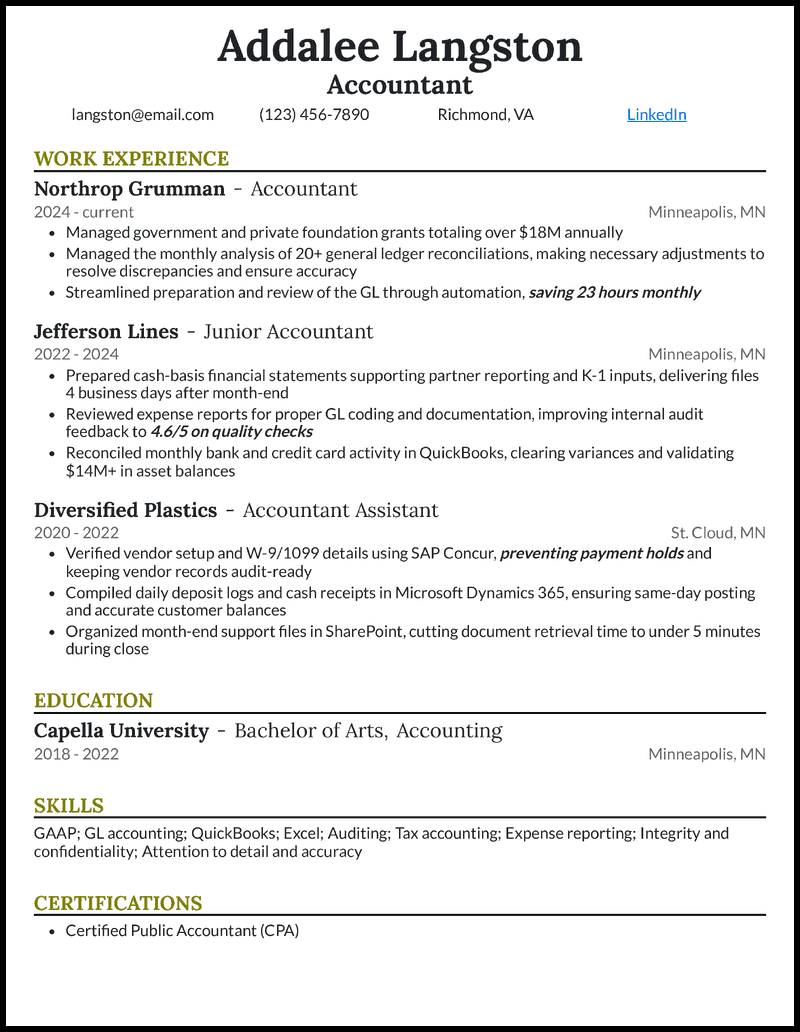
An accountant’s resume should be clean, results-focused, and easy to scan, showcasing your accuracy, compliance, and measurable financial impact.
Because accounting jobs come in many forms (such as tax, audit, corporate, FP&A, AR/AP, payroll, etc.), you must write a resume that balances role-specific keywords with compelling storytelling driven by results (and don’t forget to write an equally great cover letter).
To compile this resource, we reviewed hundreds of accounting job descriptions from top companies hiring in 2026, distilling what works and what doesn’t into 30 accountant resume examples so you can:
- ✅Find and integrate the exact skills and keywords employers want
- ✅Translate your achievements into metric-loaded bullets that emphasize your professional value
- ✅Follow the right structure and sections that describe your accounting path and level

Why this resume works
- This accountant resume conveys qualifications accurately, ensuring everything is easy to read. It follows a simple resume formattingso that recruiters can see your value at first glance. Most importantly, it avoids any images or graphics that may hurt ATS-friendliness.

Why this resume works
- Relevant experience: This accounting assistant resume highlights the candidate’s cashier role at Kroger, showcasing accuracy, cash handling, and fast transactions.
- Added credibility: Includes hobbies that demonstrate the candidate is precise, consistent, and methodical.
View more accounting assistant resumes >
Why this resume works
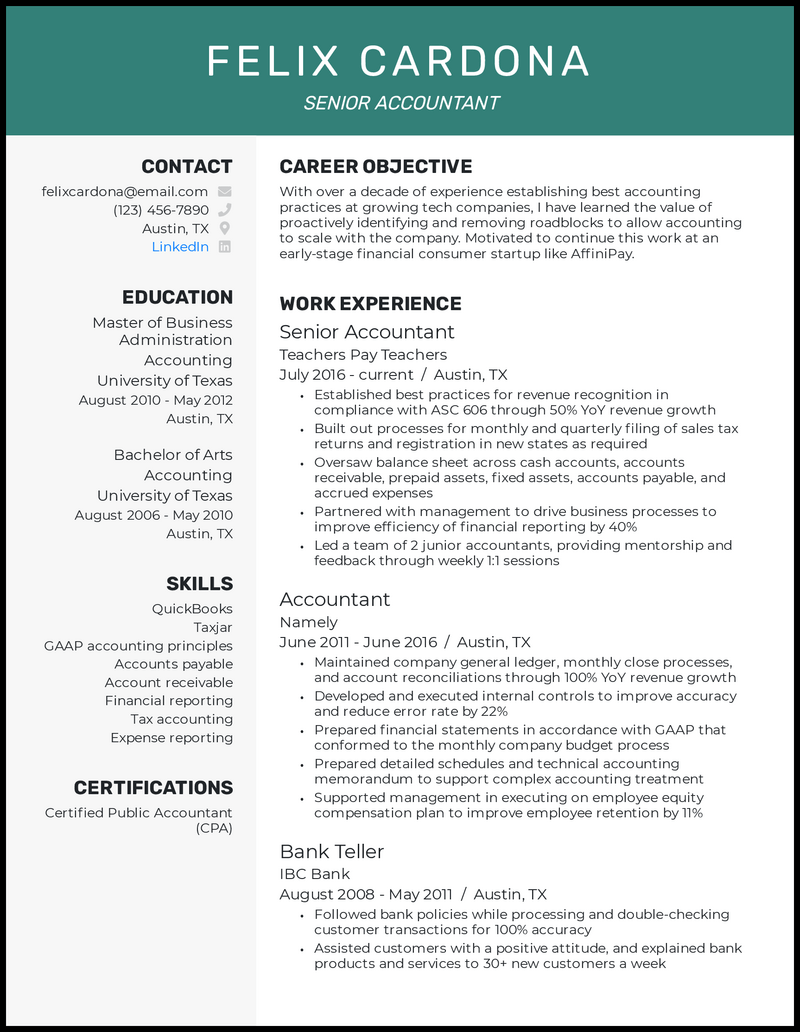
- This senior accountant’s resume narrates a career history that begins at a junior level and culminates in a senior accountant role, a signal of taking on more responsibilities and earning trust.
- It highlights measurable impact in reconciliations, process improvements, and high audit scores that made a business impact.
- It adds credibility with a CPA, signaling technical depth, ethics, and readiness for higher accountability.
View more senior accountant resumes >

Why this resume works
- This staff accountant resume establishes role fitness by highlighting competency in niche tools such as Advanced Excel, QuickBooks, and Xero, presenting the candidate as job-ready from day one.
- It proves relevant accounting experience through progressive roles as an accounting assistant and junior accountant.
- It’s backed by a Bachelor of Arts in Accounting, reinforcing strong fundamentals and credibility.
View more staff accountant resumes >

Why this resume works
- This accounting intern resume grabs the recruiters’ attention from the moment they begin reviewing it, thanks to a highly specific career objective that clearly targets the internship and the value the candidate will add.
- It’s anchored by a Bachelor of Arts in Accounting, showing strong fundamentals and academic readiness.
- It proves practical capability through projects that sharpen and test core skills using Excel, Tableau, and audit-style analysis.
View more accounting intern resumes >

Why this resume works
- This accounting clerk resume prioritizes hands-on experience from an accounting assistant role, proof that the candidate has what it takes to excel.
- It then draws professional authority from an Associate in Science (Accounting) to demonstrate an academic background that aligns with the role.
- Finally, it matches employer needs with in-demand tools such as BambooHR, Concur, and TaxAct, showing the candidate can ramp up quickly.
View more accounting clerk resumes >

Why this resume works
- This tax accountant resume sets the right tone by not only putting relevant payroll and bookkeeping experience at the top (in reverse-chronological order), but also backing it up with clear, measurable achievements.
- It’s anchored by a B.S. in Accounting, showing the technical foundation employers expect for tax work.
- It adds niche, job-ready tools such as TurboTax, Zoho Invoice, and Wave Accounting to deliver immediate productivity gains.
View more tax accountant resumes >

Why this resume works
- Relevant progression: This general ledger accountant resume starts with a career as a staff accountant, rising through the ranks and highlighting proven results.
- Accounting education: A formal grasp of accounting principles and practices proves the candidate’s strengths in reconciliations, accruals, and reporting.
- Job-fit tools: Hands-on with QuickBooks, Microsoft Excel, and SAP ERP align with the systems GL teams expect.

Why this resume works
- In-demand payroll finance stack: Proven competencies in Oracle NetSuite, Deputy, and ADP SmartCompliance, paired with measurable achievements, add value to this payroll accountant resume.
- CPA credential: Signals trusted technical judgment for payroll accounting, controls, and audit-ready reporting.

Why this resume works
- CPA credential: Establishes strong technical judgment for capitalization policy, depreciation, and audit-ready reporting on a fixed asset accountant’s resume.
- Proven accounting track record: Progressive roles show hands-on ownership of asset lifecycle controls, reconciliations, and close execution.

Why this resume works
- Traceable progression: This accounting specialist resume starts with a bookkeeping internship that was a big success, transitions to an accounting clerk role, and then to an accounting specialist role. Recruiters can see increased ownership and close readiness in this candidate.
- CPA credential: Demonstrates professionalism, industry credibility, and the willingness to be regulatory-compliant.

Why this resume works
- Proven impact: This senior tax accountant’s resume demonstrates quantified tax outcomes, team leadership and mentorship, and data-backed decision-making.
- Tech-forward execution: There is evidence of systems-savvy in tools such as Tableau and Sovos Tax Compliance to scale compliance and collaboration.
- Senior-ready scope: From positions held now and in the past, hiring managers can clearly see ownership of complex, multi-entity work and end-to-end review-level accountability.

Why this resume works
- Proven fit: This junior accountant’s resume uses a professional summary (not a career objective) to leverage the accounting internship experience.
- Transferable strength: Practical school projects translate into real-world skills such as reconciliations, analysis, and documentation, showing immediate on-the-job potential.

Why this resume works
- Tools-driven impact: This cost accountant resume connects with recruiters by demonstrating expertise in SAP ERP, CostWorks, and ProActivity, as evidenced by achievements in closing accuracy and variance control.
- Credential credibility: The Certified Management Accountant (CMA) is a testament to the cost-accounting rigor and a controls’ mindset that the candidate brings to the job.

Why this resume works
- Template fit: This fund accountant resume uses a professional, easy-to-scan layout, ensuring recruiters can spot NAV work at a glance.
- Keyword alignment: The integration of key phrases such as Advent Geneva, Bloomberg AIM, RiskWatch, and valuation judgment improves the resume-job description match.

Why this resume works
- Aligned experience: This public accounting resume shows staff accountant achievements and tool fluency that translate directly to client deliverables and deadline-driven execution.
- CPA credibility: The CPA signals industry-benchmark technical authority, ethics, and readiness for higher-trust public accounting work.
View more public accounting resumes >

Why this resume works
- Market alignment: This real estate accountant resume presents solid evidence of expertise in core skills, such as TurboTax, Sage Intacct, and effective tenant communication, which are critical for accurate, defensible reporting.
- Niche credibility: The Real Estate Financial Analyst (REFA) certification reinforces specialized real estate finance knowledge and industry fit.

Why this resume works
- Clear progression: This accounting analyst resume starts with the most relevant analyst experience first, highlighting measurable impact from junior accounting and bookkeeping roles.
- Measurable impact: The bullets not only quantify results but also address tasks vital to the employer’s needs (which are more likely stated in the job posting), such as accurate, timely reconciliations, increased invoice throughput, and streamlined processes to enable quick decision-making.

Why this resume works
- Relevant experience: This project accountant’s resume weaves in past roles (staff accountant and junior accountant) to demonstrate the candidate’s ownership of project costing, billing controls, expenses, and contract tracking.
- Tool alignment: It demonstrates hands-on proficiency with QuickBooks, Toggl, Expensify, and more, crucial skills necessary to run projects end to end.
- CPA credibility: The CPA strengthens trust in financial controls, accuracy, and audit-ready reporting.

Why this resume works
- Entertainment-aligned track: Budget Coordinator (Warner Bros.) and Bookkeeper (A24) build directly into production accounting scope, proving industry-fit for a production accountant resume.
- Tools of the trade: Proficiency with Sage Intacct, Final Draft, and Avalara, and flawless use of these tools to generate reports, budgets, and tax/compliance workflows, are traits recruiters truly value for this role.

Why this resume works
- Language that sells the fit: This revenue accountant resume speaks in true revenue-accounting terms by integrating ASC 606 contract digestion, performance obligations, variable consideration, SSP allocation, and billing-to-GL tie-outs. It also uses punchy verbs and outcomes, mirroring the job description closely.

Why this resume works
- Investigation-led track: This forensic accountant’s resume powerfully demonstrates success in financial fraud prevention, investigation, and accountability in each case.
- Authority badge: The Certified Fraud Examiner (CFE) credential is adequate proof of fraud methodology and courtroom/audit-ready rigor.
View more forensic accountant resumes >

Why this resume works
- Career-build narrative: Starting as a bookkeeper and then transitioning to a staff accountant is a career path that showcases increasing scope and ownership, with clear leadership through mentoring and guiding close-quality standards. Recruiters expect no less of a senior staff accountant’s resume.
- Future-ready edge: A “tech-forward” mindset with proven expertise in TeamMate+ Audit, SmartVault, and Zapier for process automation, streamlining workflows, spotting and preventing risks, says the candidate is moving with trends.

Why this resume works
- This management accountant resume landed the job ahead of the competition by demonstrating strong account control in key areas, including cost tracking, budget management, and fast close/forecast turnarounds, leveraging tools such as QuickBooks, Xero, and NetSuite, which were more likely mentioned in the accountant job description.
View more management accountant resumes >
Why this resume works
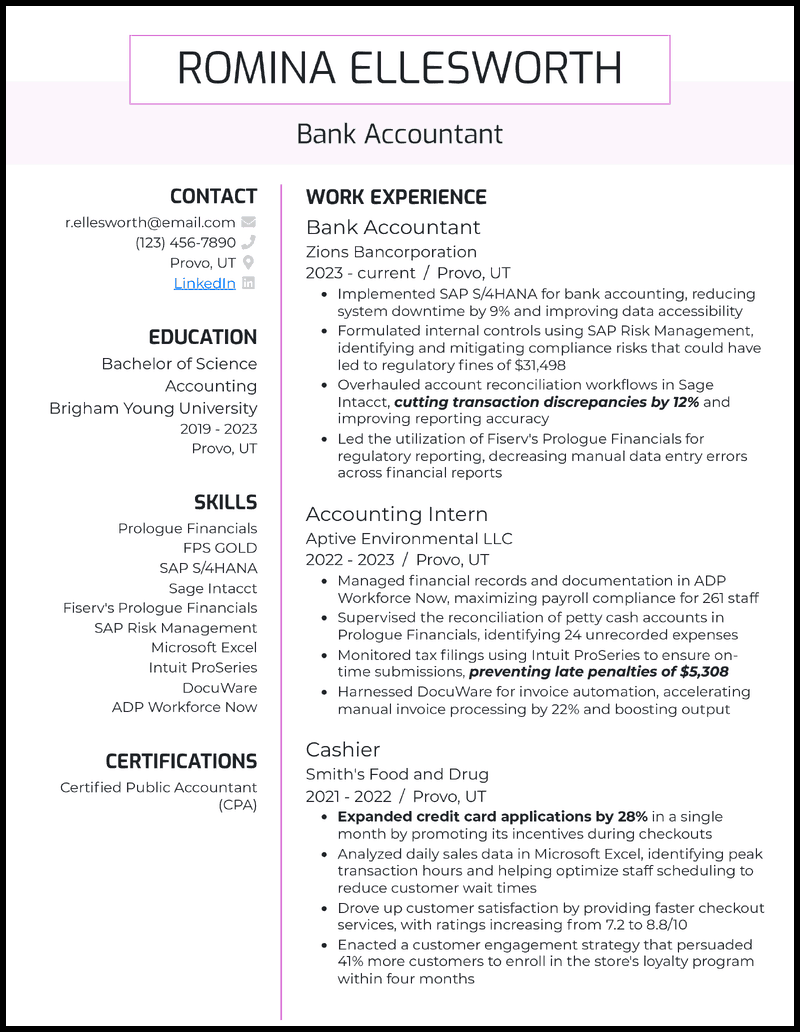
- Work-ready foundation: This bank accountant resume highlights the impact made during the accounting internship: proper documentation, audit-ready reporting, and team support; all traits of a terrific closer.
- Credibility signal: The CPA credential isn’t just a signal of authority and trust; it also proves the candidate’s professional curiosity and ability to keep up with regulations and trends.

Why this resume works
- Summary-to-scope fit: A professional summary at the top third of this financial analyst accountant resume quickly teases the potential of this candidate through an internship, tools competency, and the goal for this position.
- Proof beyond the internship: Projects that nurtured practical skills in reconciliations, variance logic, and reporting ensure the candidate’s potential reads as job-ready, not theoretical.
View more financial accountant analyst resumes >

Why this resume works
- Credential-first positioning: This Certified Public Accountant (CPA) resume sets a solid professional background with Certified Public Accountant (CPA) and Certified Management Accountant (IMA) credentials, packing credential that draws in recruiters to keep reading.
- Proof in execution: The established authority is backed by results-based work, further supported by expertise in Intuit QuickBooks, Oracle NetSuite, and Xero, ensuring this candidate is interview and job ready.
View more CPA resumes >
Why this resume works
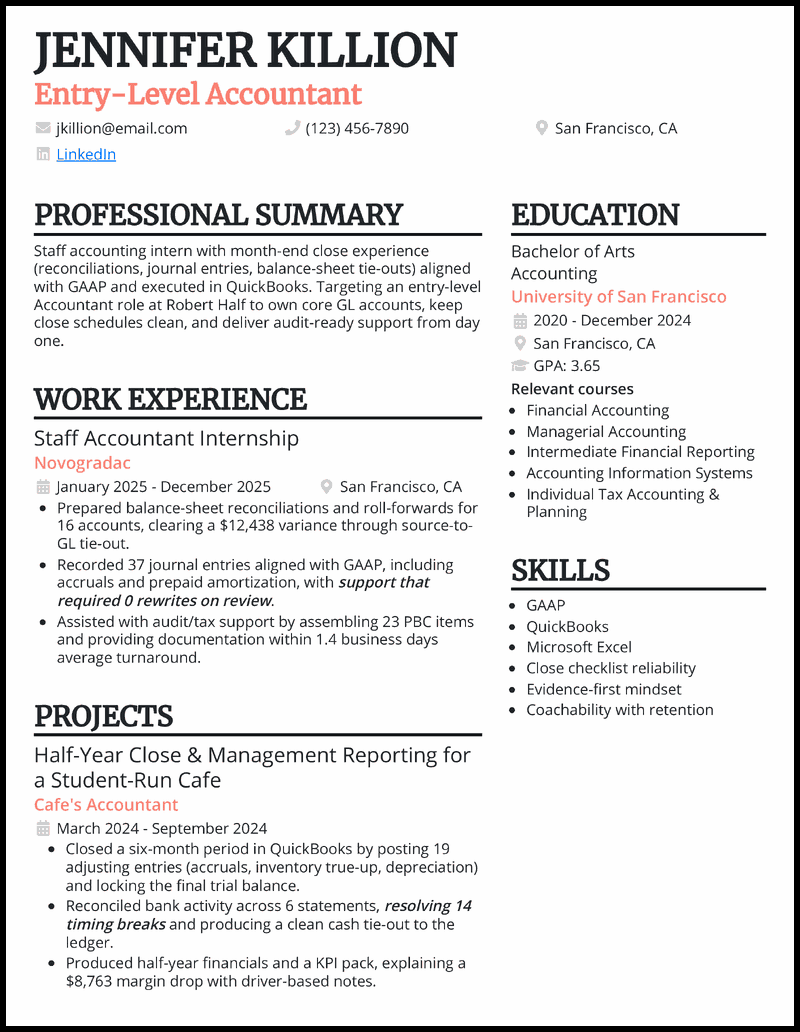
- Goal-set summary: This entry-level accountant resume uses a professional summary to align with the job requirements through a track record of close support experience, keywords (GAAP, QuickBooks, Microsoft Excel), and a specific goal for the role.
- Proof from real work: Internship + the cafe close project translates into transferable skills (recons, JEs, GAAP-based reporting, clean documentation) that show you can execute, not just learn.
View more entry-level accountant resumes >

Why this resume works
- This junior cost accountant resume shows an internship that delivered real cost-impact wins (cleaner inventory close, variance fixes, actionable PPV insights) and directly earned conversion into a permanent junior cost accountant role.
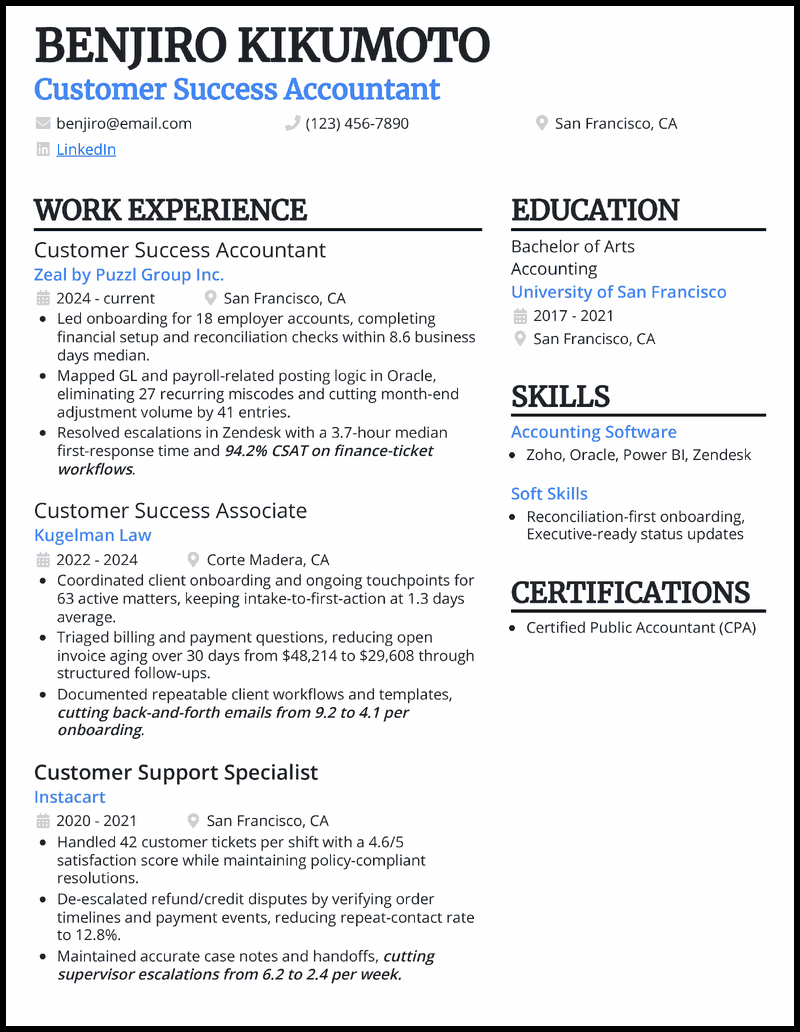
Why this resume works
- Support-to-finance progression: This customer success accountant resume is anchored in customer support from day one and shows a clear climb into customer-facing accounting ownership.
- Tools that match the work: There’s adequate proof that you can run both sides of the role using Zoho and Oracle for accounting workflows, plus Zendesk and Power BI for ticket execution and customer reporting.
How to Write an Accountant Resume

As an accountant, you know that precision matters. You’re expected to be an analytical expert who can produce reliable research and solve complex legal and financial problems. So, think of your resume not only as a place to highlight your experience but also as a place to demonstrate your attention to detail and high standard of work.
Boosting your resume’s potential requires special attention to these four areas:
- Start with a professional profile, either a career objective (if a beginner or pivoting) or a summary (if you have 10+ years of accounting experience)
- Lead with your impactful accounting experience
- Add relevant education and certifications
- Highlight your most outstanding skills and competencies in accounting
- Bonus point: Even small details like your LinkedIn headline matter to recruiters

Highlighting keys skills on your accountant resume
When recruiters post an accountant job description, it’s not unheard of for them to receive upwards of 100 resumes. With the sheer number of applicants, companies can’t carefully review every accountant’s application. The applicant tracking system (ATS) software helps weed out applicants before a recruiter reviews them, which saves time and gets rid of candidates without the right experience.
ATS work by using algorithms that match keywords from the company to keywords in your resume. So even if you’re highly qualified for a job, your resume may be thrown out if it doesn’t include the right keywords. To avoid this, you need to know how to include job-appropriate skills on your resume (keywords).
What are the right skills? The right skills will vary depending on the accountant role. Read this excerpt from a sample accountant job description and see if you can pick up on the essential skills:
Greenhill is seeking a certified accountant who can tackle every level of the accounting process, from balancing ledgers to researching the law and analyzing data to ensure efficient and effective operations. This position is ideal for candidates who are jacks of all trades! Must possess strong public speaking and collaboration skills while demonstrating initiative and the capacity to conduct independent work.
Based on this small sample, we can create a list of essential skills customized for the job. You do not want to take exact words from the job description or lie about your skill level. Instead, use the accountant job description as a jumping-off point to think about the most relevant skills you possess:
- Accounting applications: Quickbooks, ERP, Concur, Taxjar
- GAAP
- Tax accounting
- Expense reporting
- State law compliance
- Accounts payable/receivable
- Collaboration and communication
- Data analysis and research presentations
On other accountant job postings, you can expect to see different skills emphasized, such as:


Choose the best resume format
It’s not just about what you write on your accountant resume; it’s about how you write it. Your resume format is important for ensuring that your resume is visually appealing, easy to read, and easy for the ATS to recognize.
For these reasons, we always suggest the reverse-chronological format to keep your most recent job experience listed at the top of your resume, but there are some other aspects of resume formatting you need to know.
Here are some other essential elements of resume formatting that you should pay attention to:
- Resume length: Always ensure your resume is a full, single-sided page. It’s acceptable to use two pages if you have 10+ of experience as an accountant.
- Bullet points: Break up large text sections about your work experience with classic round bullet points.
- Avoiding icons/images: The ATS does not seem to appreciate icons/images; neither will recruiters.
- Listing the title of the position you’re seeking: Specialize your resume for each job you apply for to show respect and genuine interest in the job. (This is especially useful for a company that may be hiring for multiple positions.)
- Objective/Summary: Only use one when necessary (hang tight—we’re about to cover this in-depth).
Remember these formatting tips, and you’ll be confident that your resume is ATS-friendly and easy to read for recruiters.

Understand the elusive resume objective and summary
All right, back to the objective and summary. A resume objective is one of the most misunderstood sections of your resume. Most people think objectives are outdated and pointless, but that’s only the case if you don’t tailor them and keep them short.
But what exactly is a resume objective? And what’s the difference between that and a resume summary? Let’s dive in!
A resume objective and summary statement are both short, two to three-sentence paragraphs at the top of a resume to express your interest in a position or a brief career synopsis. Both require customization and should be avoided if you don’t plan on writing a new one for every job application.

However, these two types of paragraphs differ in how they communicate interest in the job. An objective describes the value you’ll add to a company and why you want the job. Objectives are best suited to accountants who are just starting their careers or going through a career change (like from a staff accountant to an accounts payable specialist).
A resume summary highlights your past work experience, leveraging it to prove your qualifications and skills. Because the summary relies on many past job experiences, it’s only recommended for senior accountants with 10+ years of industry experience.
Let’s work through a few examples together, so you can better understand all the moving parts:
Poor resume objective: Years of experience in the industry, looking for a full-time job in the accounting field with benefits.
- There are multiple issues at play here. First, it’s uninformative. The applicant doesn’t list anything that provides concrete evidence of their skills. Secondly, it’s not specific. They don’t mention a particular job title, applicable skills, or the company to which they’re applying. Lastly, this candidate is only focused on what the job will do for them. You need to mention why you’ll be an asset to the company, not what the job will provide for you personally.
Better resume objective: Detailed junior accountant with 4 years of experience working for Big Four accounting firms. Seeking an opportunity as a staff accountant at a smaller-scale operation like Fender Co., where my specializations in optimizing pricing through software adoption and systems streamlining would positively impact sales.
- This resume objective makes the case that the applicant is valuable to the company by highlighting relevant skills and years of experience. Furthermore, it’s customized to the specific job the candidate is seeking, which is a major green flag for employers.
Poor summary statement: Experience as an accountant for 3 businesses. My role, which was providing organized, detailed work for all 3 companies, positively impacted the companies.
- This statement is vague and confusing, not to mention it’s poorly worded. Would you trust this person with your company’s financial accounts?
Better summary statement: Data-driven certified accountant with specialized work in small and mid-size businesses for 10+ years. Dedicated to providing services that adhere to GAAP standards while optimizing operations and financial performance. Expertise in Xero, QuickBooks, Zoho, and SAP. Experience supervising and collaborating across cross-functional teams and departments while increasing ROI by 5%+ YTD.
- This summary statement provides specific metrics, specialized skills, and a job title. It’s a great example of a strong statement that would impress a hiring team.

How to build an accurate contact information header
From your name to your LinkedIn profile, you should include all basic details that the employer will need to reach out to you. As a rule of thumb, make sure you have the following information:
- Full Name
- Phone Number (Current)
- Address
- LinkedIn (optional)
While a LinkedIn profile isn’t necessary, a fleshed-out contact header will give you more credibility, especially if you’re a CPA.

How to quantify your positive impact as an accountant
If you want to prove to a company that you’re an excellent accountant, you’ll want to focus on numbers. Quantifying your impact on your accountant resume provides concrete proof that you’re an asset to the company.
Fortunately, as an accountant, there are many ways to quantify your impact, such as:
- Internal company operations: Have you worked with company executives to propose financial incentives to improve employee retention? Have you instituted software adoption that reduced error rates?
- Leadership: Do you manage, mentor, or collaborate with a team? Do you work across several departments?
- Work with vendors: Do you assess vendor invoicing or review vendor statements? Do you manage accounts payable for vendors?
- Clients: How many clients do you advise if you work with individual clients? How long have you retained these clients?
- Revenue: How much revenue does the company you work for generate? How many assets do you oversee? How much have you saved in potential penalty costs?
- Reductions in error rates: Have you reduced errors during employment at your past jobs? Do you use specific types of software to minimize mistakes?
Based on the above, check out these examples that demonstrate how metrics can fuel your bullet points:
- Proactively identified and communicated potential problem areas related to a client’s reporting issue, saving the client $2K+ in penalty fees
- Supported management in executing an employee equity compensation plan to improve employee retention by 11%
- Led a team of 2 junior accountants, providing mentorship and feedback through weekly 1:1 sessions
- Reconciled vendor statements in QuickBooks, investigating and correcting any discrepancies within 48 hours

What are good action verbs for accountants?
We know working with numbers is your strong suit, so allow us to tell you which action words best suit this role:
- Analyzed
- Reconciled
- Forecast
- Audited
- Reported
- Calculated
- Reviewed
These are just a few examples of the many different verbs you can use. While checking your resume, ensure they appear at the start of each bullet point.

How to include accounting-related education?
Education reinforces your credibility and shows employers that you’re a trained professional. Here, you should include your degree, institution, location, and graduation year. Here’s an example of how you can format it:
Bachelor of Arts in Accounting
University of Texas
Aug 2006 – May 2010
Austin, TX
While not necessary, pairing your education qualifications with certificates boosts your authenticity, which brings us to our next point.

How do you list accounting certifications (CPA, CMA) on a resume?
Make a separate section using an AI resume builder to list all your accounting certifications and licenses. You can even have specific sections for both, but it’s best to have them under one heading to avoid wasting space.
From the top, list your most recent licenses or certs and continue downwards. It’s best to have your licenses first and then any certificate programs later on. Some good examples to include here are:
- Certified Public Accountant License (CPA)
- Certified Management Accountant (CMA)
- Certified Internal Auditor (CIA)

How to optimize your accountant resume for each job
Unfortunately, you can’t just have one copy of your resume that you submit for every accountant job application. Every application deserves a tailored resume.
With the job description in view, these are the areas you’ll need to pay special attention to:
- Objective/summary statement: Remember how we encouraged you to include specific company names? One of an applicant’s worst mistakes is failing to change the company name on multiple job applications. Make sure you read over your statement (if included) before submitting your resume, changing the job title, skills, and company name.
- Skills: To customize your skills section, read the job description. Often, hiring managers will overtly say what skills are important for the specific accounting job (but be careful not to plagiarize).
- Job description bullet points: Are you applying to a job that needs you to interface with clients? Or maybe you’ll be working behind the scenes with data? Think about how you can shift how you discuss your work experience to highlight what’s important for each particular job.
We know it’s frustrating to focus on customization when you want to submit multiple applications in a short amount of time. Consider creating a document with a master list of job description bullet points and skills, sorted into groups based on the skills you need to highlight (e.g., one section that demonstrates your accuracy, another for client interactions, another for public speaking, etc.). Then, you can pick and pull things from this document to create fully customized resumes in no time.
For now, we think you’ll find something to help you get started on your accountant resume, no matter the exact role:
Tax vs. corporate accounting resume
Tailoring your resume to a tax or corporate accounting role isn’t difficult, as it mainly depends on which quantified metrics you emphasize. Here’s how you can customize a resume for both cases:
- Tax-based role: Emphasize compliance, regulations, and client relations.
- Corporate accounting: Keep focus on forecasting, reporting, and strategic analysis
Accountant resume
- Do you have experience in general ledger (GL) accounting?
- Try to demonstrate your knowledge of accounting basics, including balance sheets, accounts payable/receivable, and accounting software.
- Remember, you don’t need to include all of these accounting skills in each position, but they must be covered at least once somewhere on your accountant resume.
Senior accountant resume
- As a senior accountant, focus on customizing your resume to demonstrate skills beyond just the basics.
- Underscore things like extensive improvements in efficiency rates, accuracy, and year-to-year financial growth.
- Have you collaborated with upper management to set company-wide standards or implement internal policies or financial work incentives?
- Highlight your ability to step into leadership and mentorship roles.
Accounts payable resume
- Hone in on what matters by discussing payment processing and review, tracking business expenses (such as vendor invoices), and ensuring GL and GAAP compliance.
- Have you worked on complicated accounts, perhaps with payment discrepancies that required your action on the part of the company’s interest?
- Highlight your attention to detail and how it has saved revenue for companies you’ve worked for in the past.
Entry-level accountant resume
- Hiring managers do understand that everyone starts somewhere, so you don’t need to have tons of accounting experience right out of the gate (although that is preferred).
- You can leverage almost any job position to highlight particularly relevant skills in accounting. For example, a restaurant server can still balance payments, check receipts against bills, etc.
- Read the job description carefully, noting what skills are most important to the hiring team and emphasizing your capacity to work in accounting based on their requirements.
Staff accountant resume
- As a staff accountant, you’ll generally have more responsibility and focus on more specific work than general accountants.
- Your staff accountant resume should focus on general ledger maintenance/oversight, tax revenue billing, accounts payable/receivable, reports, and general record-keeping.
- Don’t forget to showcase your potential for job advancement down the road by highlighting any aspects in which you provided management/supervisory work.

Final takeaway for improving your accountant resume
The hardest part of writing your accountant resume is getting started, so congratulate yourself on starting your resume journey! You’re one step closer to creating your best-ever accounting resume. We’ve laid out all the essential tips, including optimizing your skills section, formatting, metrics, and resume customization, so you can write an amazing resume in no time.
We also have a host of tools to make resume writing easier. See how your resume stacks up against our AI-powered tips. Or, if it’s time to write your resume for the first time, you can use our resume builder with built-in formatting standards and corresponding recommendations to keep the process stress-free, easy, and quick—leaving you time also to craft a killer accountant cover letter for your dream role.
No matter what stage you’re at, we’re here to help, and we wish you the best of success!
Accountant Resume FAQs

First, get your basics right by focusing on relevant personal information, skills, work experience, and education/certification. Next, quantify all your achievements and tailor them to the job description as much as possible.
Review your current resume’s work experiences, skills, and education. Take out anything irrelevant to the role you’re targeting. Next, naturally include keywords directly mentioned in the job description to increase your chances of getting hired.
The best format for an accounting resume is listing work experiences in reverse chronological order. This format places your most recent achievements at the top, giving employers a quick glimpse of your strengths instantly.
If you don’t have accounting experience, focus on your education, internships, and accounting-related projects. Add a clear career objective and highlight your impact on any projects, volunteering, or internships.

Stephen is the co-founder and CEO of BeamJobs. Frustrated with the challenges he'd faced in his own job search, he left the corporate world to start BeamJobs with his brother. Drawing on firsthand experience with hiring and getting hired as technical talent, he started BeamJobs in 2020 to help qualified job seekers land interviews with less stress. Since then, more than 4 million people have built their resumes and cover letters on BeamJobs. Stephen's insights have been featured in notable outlets, such as Fast Company, Business Insider, Yahoo Finance, MIT, and Zapier. Learn more about Stephen.