



The best senior accountant resume demonstrates impact, precision, and progression. Recruiters and applicant tracking systems (ATS) are scanning for specific signals, including financial leadership, audit-readiness, ERP fluency, and results that demonstrate your strategic value in a structured, scannable format.
Every section should act as a standalone answer to a recruiter’s unspoken query: Can this person lead and deliver at a senior level? Therefore, use tested and proven resume templates to frame your content, but tailor every detail to the role. When you write your resume, focus on audit-readiness, process improvement, and results that recruiters want to cite. Anything less risks invisibility.
This guide includes:
- ↪ 13 real senior accountant resume examples that worked in 2026
- ↪ What recruiters and ATS look for at this level of experience
- ↪ How to structure your resume for clarity and impact

Why this resume works
- Your degrees add another layer of credibility to your profile and help employers understand the level of theoretical knowledge you possess in accounting. Also add any jobs you’ve worked while pursuing your degree to showcase you’ve been dedicated from the get-go.




How to Write a Senior Accountant Resume

To finally make it to the top-level leadership, you need a senior accountant resume that presents your impact-filled work history in the exact format that hiring systems and AI models can parse. The key is clarity, structure, and alignment with the actual job description.
You want to match the exact job skills employers list, core leadership and management competencies that demonstrate your abilities, achievements that leave no doubt about your fitness for the job; all presented in a format that lets each section stand on its own, and ensures your resume survives automated screening.
Before you can confidently apply, run your document through a resume checker to spot areas of improvement and also generate a cover letter to complete the application package.
This section will break down:
- What hiring systems and recruiters actually look for
- How to structure experience, skills, and credentials to match intent
- How to align phrasing with common accounting job description language
- Why a scan-ready format improves your interview chances

What’s the best resume format for a senior accountant?
Go with the reverse-chronological order because it:
- Matches recruiter skimming and ATS parsing
- Showcases impact first
- Foregrounds promotions
- Gives scope growth (e.g., staff → mid-level→ senior)
- Prioritizes recent tools (SAP/NetSuite/Oracle, ASC 606)
For the sections you include, place work experience above education, followed by certifications. Set aside a skills section that concisely lists 6–10 items.

Which job skills should a senior accountant list (and how many)?
You need 6-10 skills that you’re competent in, and no more than 12, even for a senior role. Ensure that you add 2–3 skills from the job description to demonstrate your fit. It’s also recommended to validate coverage with a keyword scanner to catch keyword gaps.
Just as you help others wade through financial information, your resume will serve as a guide to recruiters. Since accountants are a-plenty, your skills and work experience will set you apart.
Add a few mentioned in the sales job description of the role you’re applying for, as you need to show that your skillset is relevant to what they need.
Here are some of the best job skills recruiters are looking for in senior accountants.
Skills that matter for a senior accountant resume
- Accounts Receivable/ Payable
- Financial Analysis
- Certified Public Accountant
- Compliance
- Financial Reporting
- Financial Statements
- US GAAP
- General Ledger
- Invoicing

How to demonstrate impact from your senior accountant work experience
Senior accountants are responsible for many things, but recruiters will want to know more about your impact throughout your work history. How did you affect or support the organization you worked with?
The best way to showcase your efforts is by including quantifiable metrics, and you know better than anyone how numbers matter in effective visualization. With measurable results, you’ll be able to convince a recruiter that you’ll be a great addition to the company.
Here are a few samples:
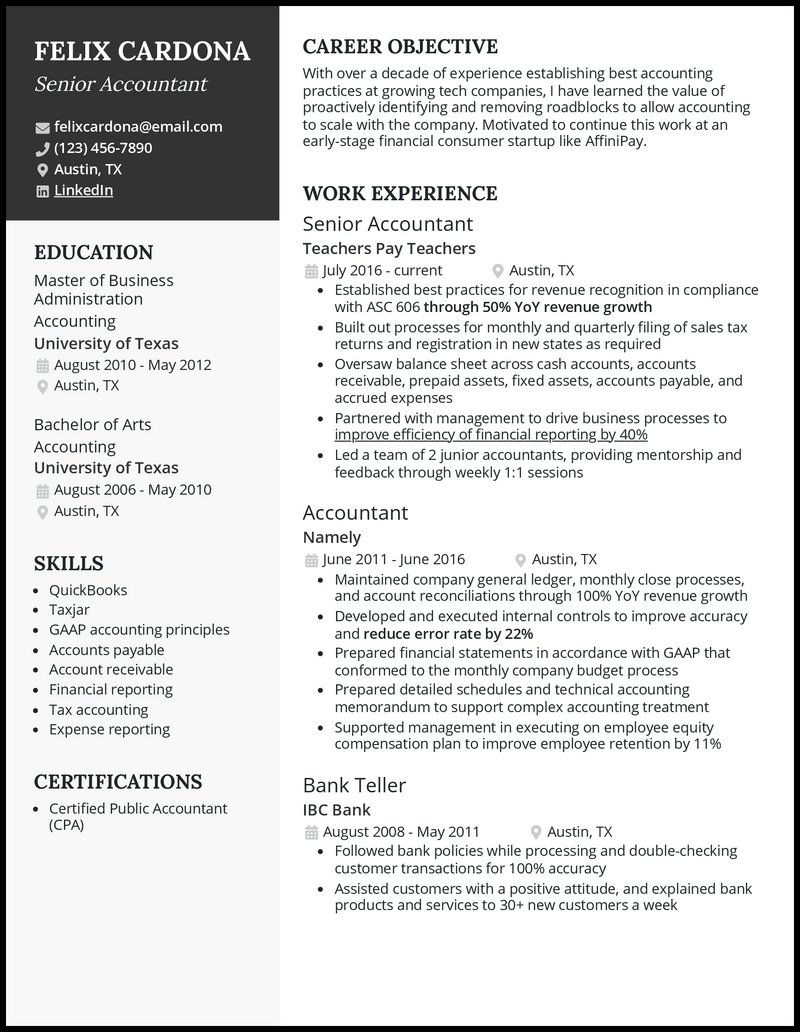
- Established best practices for revenue recognition in compliance with ASC 606 through 37% YoY revenue growth
- Partnered with management to drive business processes to improve efficiency of financial reporting by 40%
- Led a team of 2 junior accountants, providing mentorship and feedback through weekly 1:1 sessions
- Developed and executed internal controls to improve accuracy and reduce error rate by 22%
- Supported management in executing on employee equity compensation plan to improve employee retention by 11%

How do I tailor my resume to the job description?
To ensure your resume mirrors the job listing:
- Pull the role’s must-haves that the employer lists in the job ad (phrases like multi-entity consolidations, ASC 842, NetSuite)
- Reorder your top skills to ensure that role-critical items are at the top
- Rewrite 3–4 bullets to tie your impact to their stack/processes

How do I write impact-driven bullets? (Formula + examples)
Follow this formula:
Verb + What + How/Tool + Result + Metric = Impact-driven, job-aligned point
Examples of impact-driven bullet points for a senior accountant resume
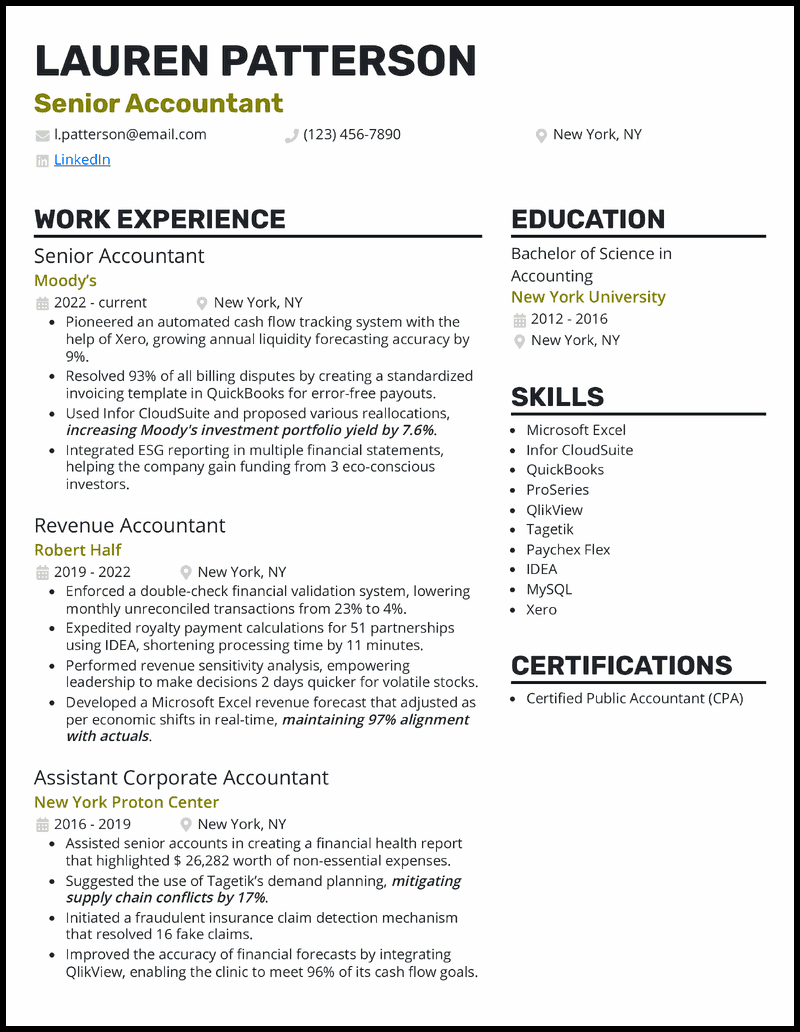
- Reduced month-end close from 8→4 days by standardizing reconciliations in BlackLine
- Saved $1.2M annually by using SAP S/4HANA to analyze costs and renegotiate vendor contracts
- Cut manual journal errors by 22% through SOX control redesign and reviewer checklists
- Automated revenue schedules in NetSuite, improving forecast accuracy +11%

What metrics work beyond revenue or cost savings?
Beyond dollar amounts for revenue generated and costs saved, include these metrics in your work experience bullet points:
- Close-time reduction
- On-time filings %
- Audit findings
- Error rates
- Days sales outstanding (DSO)
- Recon aging
- Automation coverage
- Team throughput
- Cycle time
- Material weaknesses remediated
- Variance accuracy

How to list certifications on your senior accountant resume
Senior accountants are in charge of a lot, from adhering to tax laws to following GAAP. Having the right certifications and presenting them appropriately on your resume will reassure hiring managers you have the knowledge they’re seeking in a leader to oversee income statements and expense reports.
The certifications section is typically listed beneath your accounting education and skills sections. When listing accounting or financial certifications, you should include:
- The title of the certification, such as CFA or CGMA
- The organization you received it from, such as Kaplan Financial
- The date you acquired it
- The certification’s expiration date (when applicable)

What certifications should you list on a senior accountant resume?
Create a separate ‘Certifications’ section and place it right under ‘Skills’ or ‘Education’. List only certifications that are current, relevant, and specific to the role you are applying for. Keep the list to a maximum of 3 to avoid noise.
There’s no shortage of certifications available in the financial field, and when you’ve made it to a senior accounting role, you may have acquired many throughout your career. Generally, it’s best to limit it to three certifications that are the most relevant to the role you want to get into. To give you some ideas, here are some of the best certifications for senior accountants to list:
- Certified Public Accountant (CPA): When you want to showcase quality and accuracy in your work, having passed the intensive state-certified exams to become a CPA is a great way to do so. It’s a top-notch certification that will reinforce skills you’ve listed in auditing, tax preparation, and financial planning while showing leadership potential.
- Certified Management Accountant (CMA): The CMA is a great choice for senior accounting applicants who want to get into a leadership role at their next job. This certification showcases your in-depth knowledge of staff supervision, financial forecasting, and managing general ledgers.
- Certified Financial Analyst (CFA): Are you a strategic leader? Then, a CFA may be an ideal choice for your senior accounting resume. It’ll show you have expert abilities in valuations, corporate finance, and economic analysis.
Some other top-tier certifications you can include are:

Should I use a career summary—and what should it say?
Write a 2–3 line career summary, but only if it adds net value. Quickly establish your value through skills, top achievements, vision, and why the company should hire you. Avoid fluff and instead anchor with outcomes.
Example of a career summary for a senior accountant resume
Example
“Senior Accountant (CPA) with 10+ experience across SaaS and manufacturing; c
ut close 52%, implemented ASC 606/842, and led NetSuite ARM rollout. Known for SOX rigor and team coaching.”

How do I show leadership and team management?
Let your resume quantify the scope of team sizes, cadence, and outputs for which you were directly responsible. Describe your role and contributions to hiring, onboarding, cross-training, and providing backup coverage. Tie leadership to measurable performance.
Example:
- Led a team of 6 junior accountants using Oracle NetSuite, cutting month-end close time by 28% and reducing reporting errors that previously cost $450K annually
- Oversaw hiring and onboarding of 4 staff accountants in QuickBooks Enterprise, boosting team productivity by 22%
Should I include major projects (If yes, how)?
Yes, achievements in projects signal accountability, responsibility, and readiness to take the mantle. State project + your role + tool + outcome = “Led the SOX Compliance Audit Project with Workiva, cutting audit adjustments by 42% and saving $150K”

What belongs in education for a senior accountant?
Keep it lean: Name of degree, school, major/minor, years studied, city, and state. Since you graduated several years ago, factors such as coursework and GPA are no longer relevant, as they would be for an early career.

Where do soft skills go (and which ones matter)?
Avoid a long list of soft skills: keep it to 2-3. Add context to them in bullet points for a complete professional profile.
Examples of soft skills that matter to senior accountants
- Coaching
- Communication
- Problem-solving
- Leadership
- Stakeholder management

How do I ensure the resume passes the ATS?
More companies are incorporating ATS in their hiring processes, and here’s how to ensure that your resume is tailored for those systems:
- Use standard section labels: (Experience, Skills, Education, Certifications)
- Save as PDF, DOCx, unless the job description states otherwise
- Avoid tables/text boxes
- Include exact keywords from the job description

Do I need a cover letter—and what should it include?
Yes, especially for senior roles. Use the cover letter to add context on your close-time win, a compliance success, and tool-based achievements that match the employer’s stack. Close with your vision for the role and company.
Top 5 tips for your senior accountant resume
- Emphasize your qualifications
- Accounting is a profession that emphasizes certification, and employers will want to know they’re putting their valuable financial information in qualified hands. Your skills section should focus on the technical skills and certifications you might have.
- Make your career summary count
- If you’re using valuable resume real estate to include a career summary, tailor it to each company you apply for. Speak about your highest achievements, like removing bottlenecks to financial performance that allow the company to scale.
- Don’t exaggerate or lie
- You might not have a specific required skill or qualification, such as Sage100 or Quickbooks. As long as you’re honest, sometimes a company will be willing to take the skills you do have as an alternative or equivalent to what they’re looking for—or they may be willing to train you.
- Keep your resume short and sweet unless you have more than 10 years of experience
- Recruiters are inundated with hundreds of resumes. Increase your chances of success by keeping your resume to one page. It’s probably not necessary to include your accounting internship or entry-level accounting job at this stage in your career.
- Quantifying metrics isn’t always about the money
- It’s tempting to default to financial facts and figures when trying to illustrate your impact in past roles, but money doesn’t make the world go round in this case. Switch it up by trying alternatives, such as the hours you saved or the percentage efficiency you helped achieve.

Key takeaways
- Emphasize your qualifications
- Make your career summary count
- Don’t exaggerate or lie
- Keep your resume short and sweet unless you have more than 10 years of experience
- Quantifying metrics isn’t always about the money
Senior Accountant Resume FAQs

To write a good accounting resume, you must explain what makes you different from the average accountant and your best qualities. Start from your skills section—list modern accounting software, finance, and time management abilities. For your work experience, highlight key phrases that show your impact in past workspaces.
Since you’re in a high-ranking role, it’s best to include quantified bullet points that show your career’s best work experiences and achievements. Include any specialization training/certifications you’ve obtained while leveling up your accounting game. Show how you’ve exceeded expectations, ensure compliance, led teams, and trained and mentored juniors.
Use a reverse-chronological resume format to show your upward progression in your accounting career. As a senior accountant, it’s essential that your most recent, most applicable work experience is at the top of your resume since you don’t want recruiters to have to scan the entire page just to find it.
Only include skills that employers actually search for. Cluster them into two main categories:
Technical skills
GAAP / IFRS / SOX compliance
Financial reporting & budgeting
ERP systems: Oracle, SAP, NetSuite
Excel (VLOOKUP, PivotTables), Power BI, Tableau
Soft skills
Team leadership & cross-department collaboration
Financial storytelling & presentation to execs
Accuracy under deadlines
Mentorship of junior accountants
A strong senior accountant resume in 2026 clearly answers: “Why hire you over another CPA?”
It must be tool-forward, impact-backed, industry-current, and be built with these blocks that recruiters scan for:
Modern tools
Regulatory fluency and compliance
Measurable outcomes
Recent, industry-aligning credentials
Proof of leadership
Keep your senior accountant resume on one page if you have under 10 years of experience; a maximum of two pages if your experience spans multiple companies, industries, or roles.
Follow this checklist:
Can each bullet be tied to a dollar amount, percentage, or time savings? If not, cut it
Does every section answer a potential hiring manager’s query?
Are your ERP platforms and compliance frameworks visible in <5 seconds?

Stephen is the co-founder and CEO of BeamJobs. Frustrated with the challenges he'd faced in his own job search, he left the corporate world to start BeamJobs with his brother. Drawing on firsthand experience with hiring and getting hired as technical talent, he started BeamJobs in 2020 to help qualified job seekers land interviews with less stress. Since then, more than 4 million people have built their resumes and cover letters on BeamJobs. Stephen's insights have been featured in notable outlets, such as Fast Company, Business Insider, Yahoo Finance, MIT, and Zapier. Learn more about Stephen.