



Struggling to create a resume for a college student that gets the attention of recruiters? It’s not just you! As a current college student or a recent undergraduate, you may feel overwhelmed with tracking job applications. Ironically, you have more to offer than you might think.
Whether you’re applying for a part-time job, internship, or your first job after graduating, the right college student resume can open doors.
In this guide, we share:
- ↪ 17 expert-verified college student resume examples
- ↪ Step-by-step cover letter writing and resume tips
- ↪ Insider’s advice on what to include, and how to avoid common pitfalls
- ↪ Plus, editable resume samples and answers to all FAQs so you can confidently send your resume.
Why this resume works
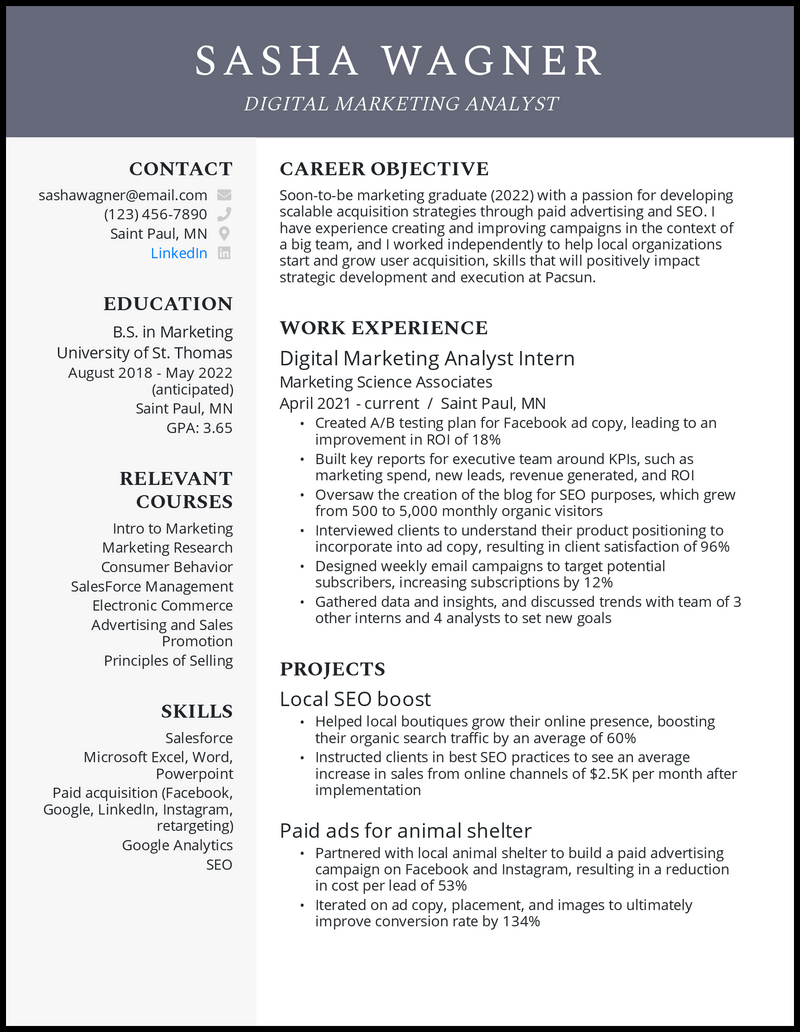
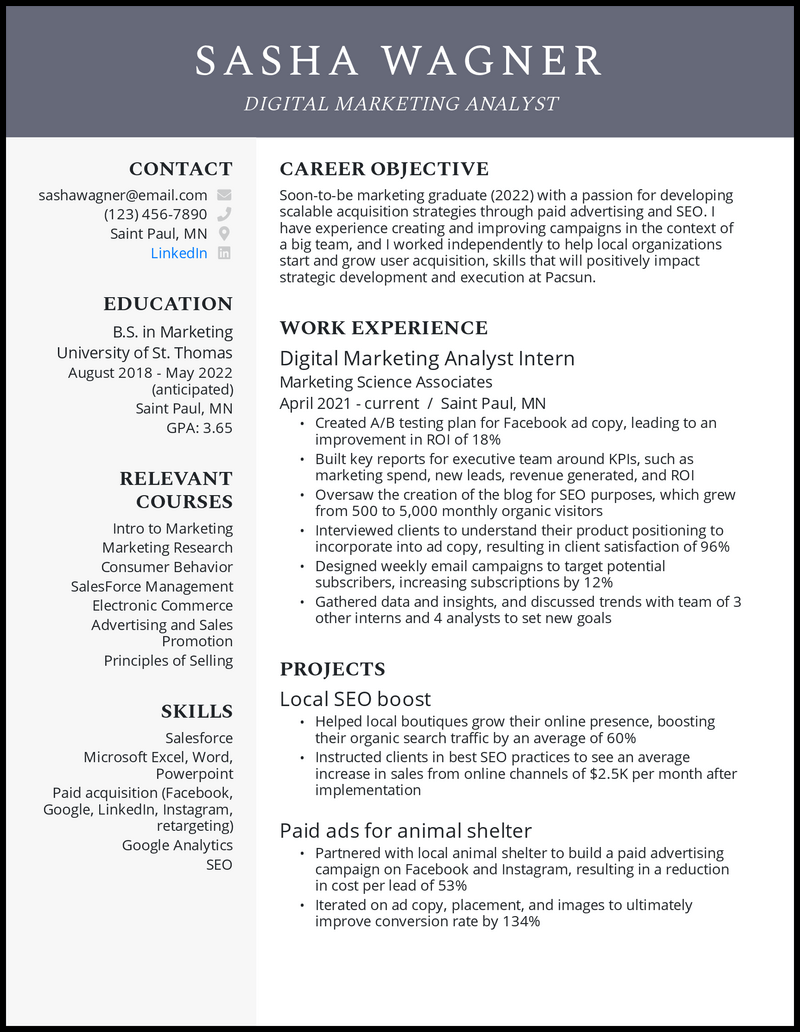
- At the top of your college student resume, have an objective overview of your professional aspirations, experiences, and skills. Use that space to highlight your passion for developing scalable acquisition strategies through paid advertising and SEO, and collaborative projects.

Why this resume works
- Suppose your college application resume is for a Bachelor of Arts in education. Express your passion for teaching and eagerness to advance your knowledge of education theories and practices.
- Even better, emphasize your long-term ambition to shape future generations through innovative education methods. To stay ready for applications, start creating this resume in freshman year so you can track achievements over time.

Why this resume works
- Use past projects to advantage here even if they’re only a year long. Clearly state how you used skills such as Canva and Microsoft Teams to make specific impacts during this time. Another great addition to your college freshman resume is any work experience under your belt.
View more college freshman resumes >

Why this resume works
- For college students, your undergraduate student resume must underline your adaptability in every new role you take. Like this example, you want to show your willingness and openness to taking new positions to leverage your skills and gain experience, while also highlighting academic achievements when relevant.

Why this resume works
- Your accounting internship can be the perfect opportunity to show what you can offer to the real-world job market. In that case, your university student resume can capitalize on your analytical skills, which helped identify cost-saving opportunities and cut overall expenses by six percent.

Why this resume works
- For a college admission resume tailored for an engineering program, let the admission committee envision you mastering valuable skills in the real world. Your stints as a restaurant server, project presenter, and volunteer paint a picture of a well-rounded character who can take on varied challenges of an engineering program.
- You can also include extracurricular activities and honors such as student organizations, athletic involvement, or scholarships, since admissions readers often value sustained involvement and commitment over formal titles alone.
Why this resume works
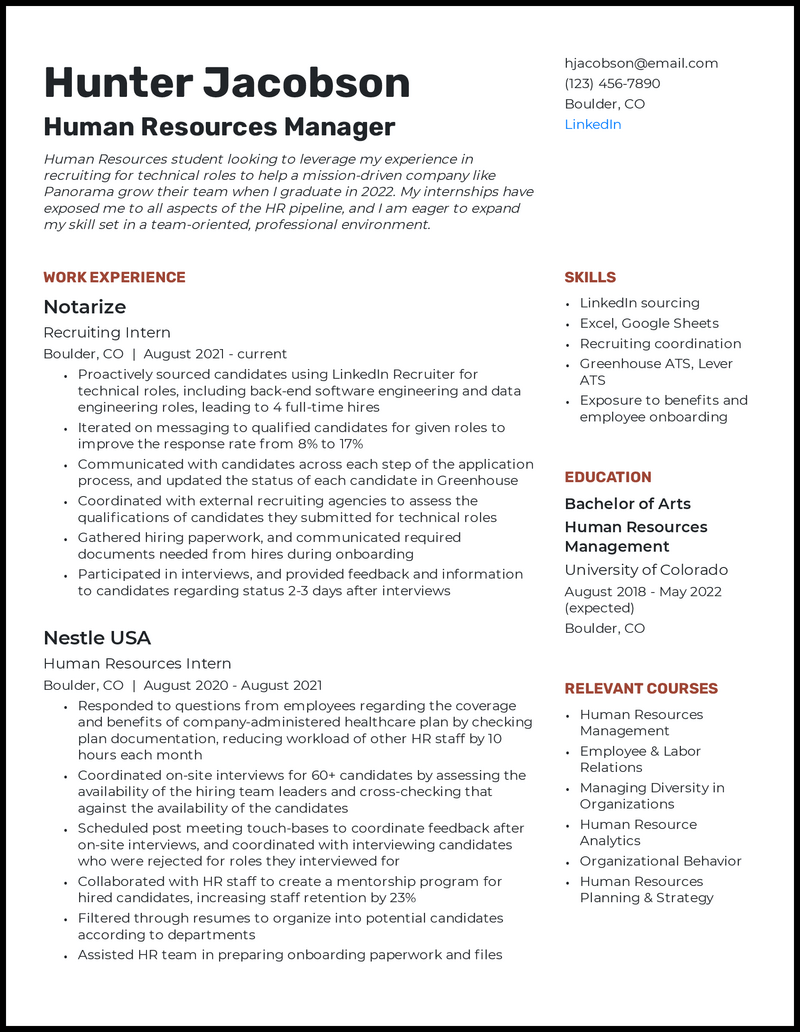
- Recognized as the most popular resume format, reverse chronological order can highlight your experience in recency on your current college student resume—perhaps a recruiting internship (your latest role), not forgetting an earlier stint as an HR intern.
View more current college student resumes >

Why this resume works
- Use a career objective statement, typically a brief 1-3 sentence pitch, to highlight your inspiration for the role (internship, in this case), while briefly connecting it to your career goals, but with a twist. It’s better custom-fitted to match the hiring company’s needs.

Why this resume works
- Your personal hobbies might not always be relevant to a professional position you’re applying to, and that’s all right. However, if you spend your own time on activities that align with your academic or professional goals, or show meaningful campus involvement tied to those interests, you should include them in your freshman college student resume.
View more freshman college student resumes >

Why this resume works
- Creating a resume with limited experience can feel like biting more than you can chew. The secret to acing it is exploring as many resume templates as possible and choosing one that allows you to highlight your strengths best (read relevant qualifications) even for a college student no experience resume.
View more college student no experience resumes >
Why this resume works
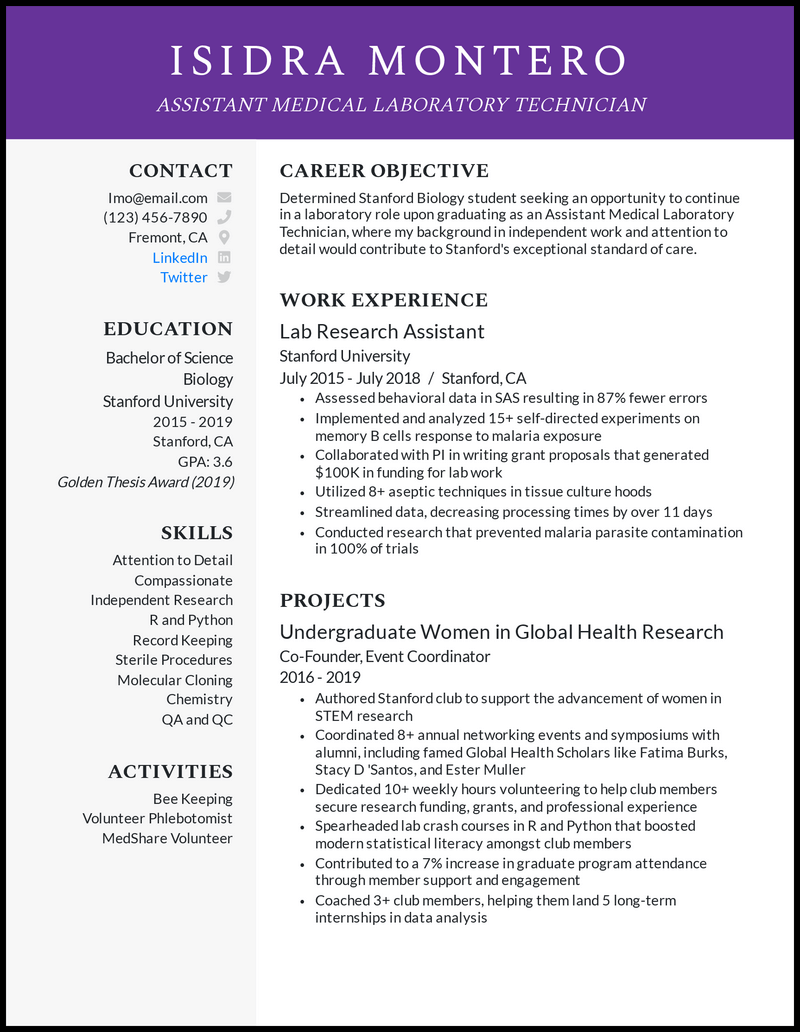
- Just because you’re in a science field doesn’t mean you spend all your days in the lab. Keep recruiters in the loop by adding a hobbies/interests section to your resume; it can paint you through your college student assistant medical laboratory technician resume as a cultural fit, make your sales pitch stand out, and, even better, serve as an ice breaker during the interview.

Why this resume works
- An aesthetically pleasing college student case assistant resume will undoubtedly make a splash and help you score some brownie points with hiring managers. You can make it easy by using our ready-to-build resume templates and handy Google Docs interactive resumes for inspiration.
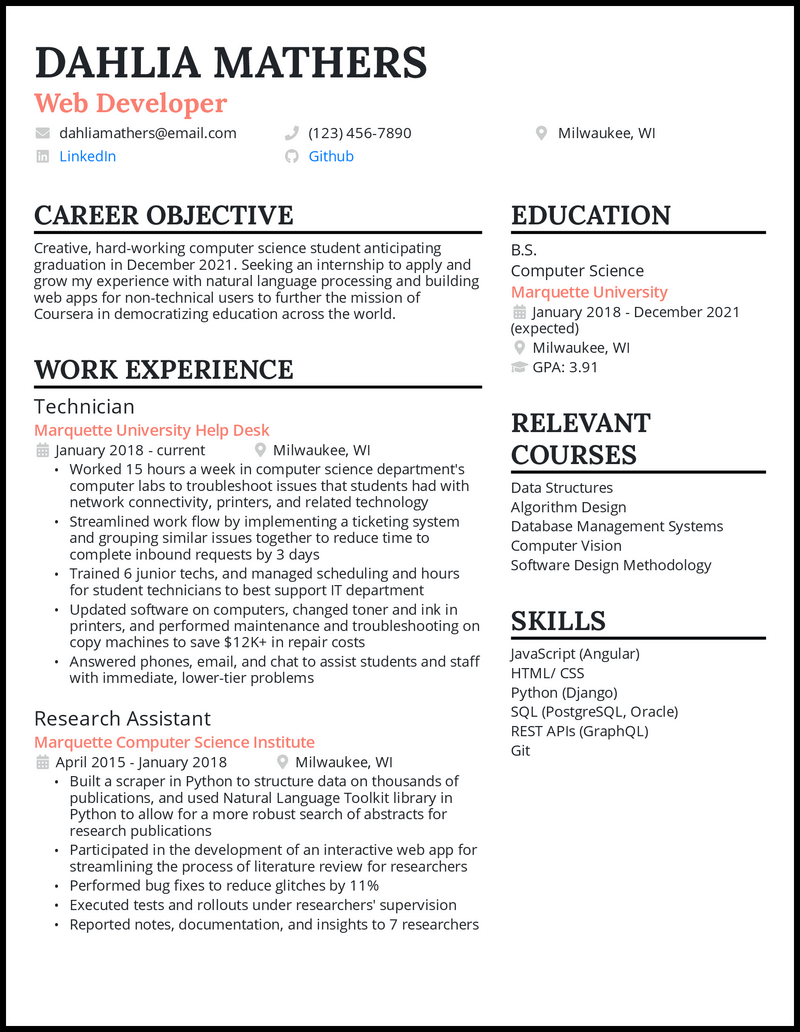
Why this resume works
- Contrary to popular opinion, you can effortlessly bag an internship at your dream company. Take our advice and review as many college student internship resume examples as possible; and read the job description a couple of times and jot down the abilities the potential employer is hunting for.
View more college student internship resumes >
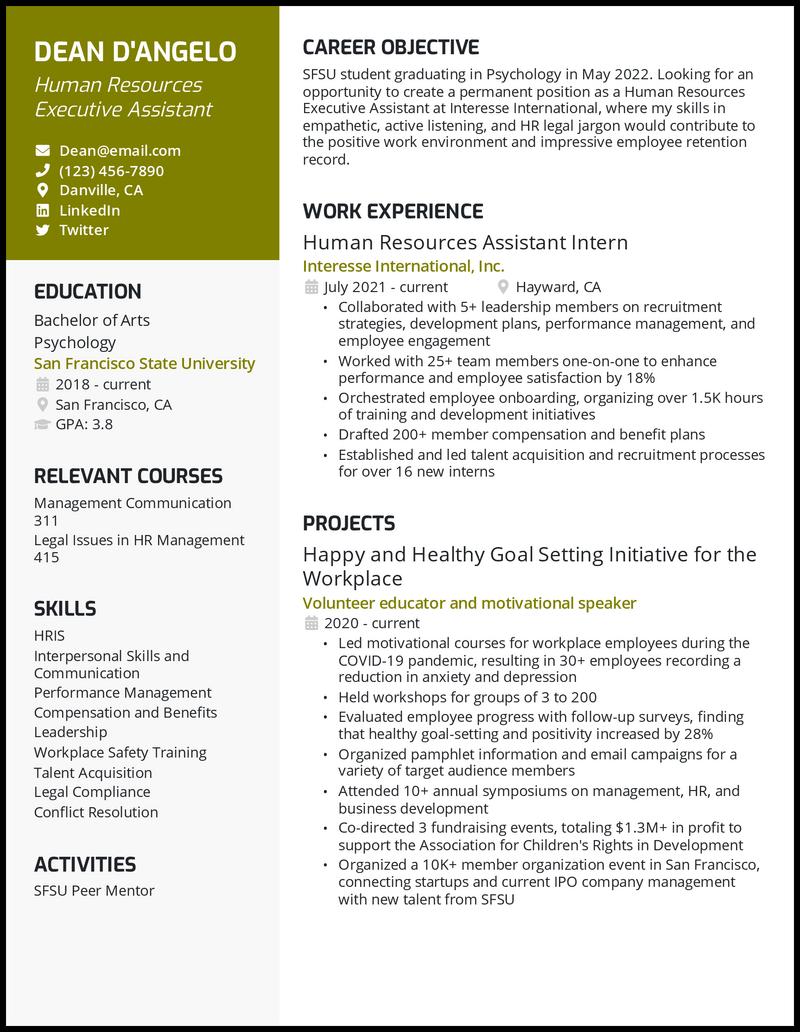
Why this resume works
- Strategically positionskills on your resume (think active listening, empathy, and HR jargon) to show potential employers your availability for a full-time role. This section is better off nestled at the third top of your college student HR executive assistant resume’s sidebar.
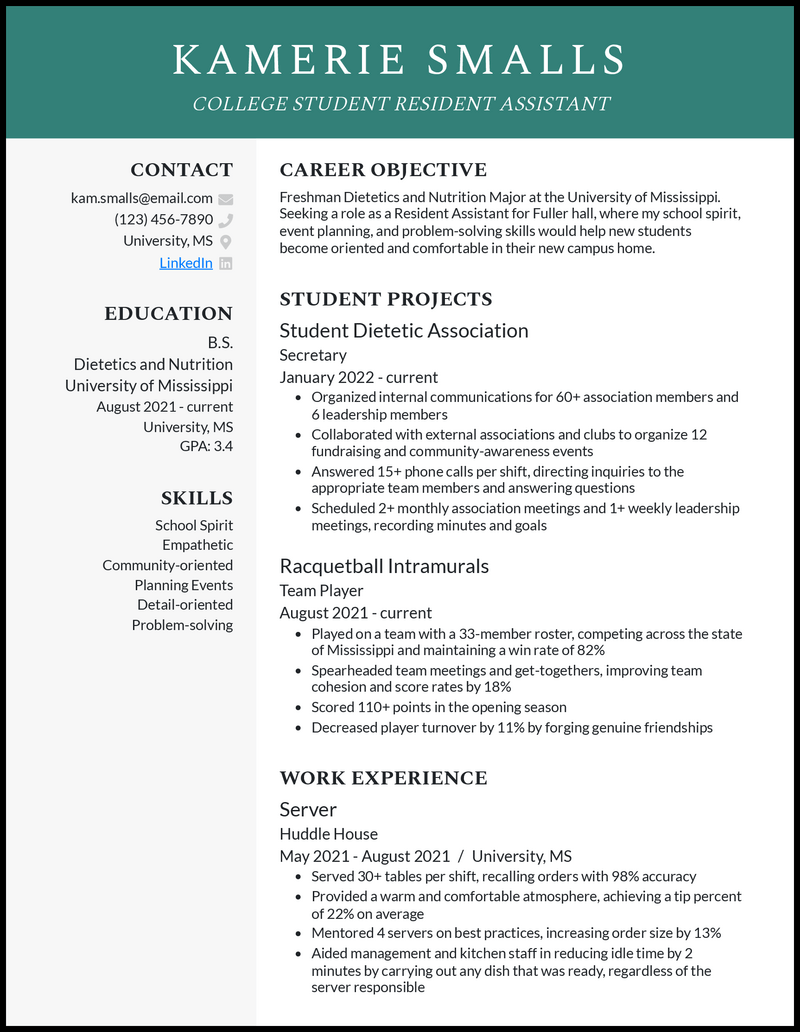
Why this resume works
- Let your college student resident assistant resume take advantage of your stints as a secretary in a student association, a racquetball player, or a server to showcase handy transferable soft skills.
- Note how class projects, volunteer work, and leadership roles also show initiative (cue communication, problem-solving, communication, and empathy.

Why this resume works
- Your college student warehouse worker resume’s work experience and projects sections should boost your credibility and appeal with quantified achievements, since quantifying them makes bullet points more effective and credible.
- “Conducted 35+ field and laboratory testings of concrete…” and “Wrote 30+ ECN reports,” and “…built 7 proof-of-concepts” are a few good examples.

Why this resume works
- Since you’re just starting out at a university, nobody expects you to have paid experience on your first year college student resume. Still, you can really skyrocket your chances of coming across as a well-rounded individual by including your work with personal or academic projects.
View more first year college student resumes >
Related resume guides
How to Write a College Student Resume

Writing a resume for a college student, especially with limited or no work experience, is intimidating. However, by picking the right resume template and highlighting relevant skills from projects, internships, community service, coursework, and extracurriculars, you can be noticed by recruiters.
The winning strategy here is to emphasize your education and skills rather than your work experience, which you don’t have anyway.
Here’s what this section covers:
- How and why a compeling resume objective matters for college students
- How to format your resume right
- Must-have components for a successful college student resumes
- How to demonstrate impact from projects, volunteer work, and extracurriculars
- How to impress recruiters with education and other academic accolades
- how to convert your transferable skills to what the needs

How to write a strong resume objective for a college student
When you’re applying for a job or internship as a college student, you likely won’t have extensive work experience. So, we’d recommend including a resume objective instead of a resume summary.
The goal of your resume objective is to set the stage for your resume. It should highlight your skills applicable to the job at hand, connect those skills to the career field you want to enter, and be specific to the job you’re applying to.
Most resume objectives are boring and generic. By taking the time to craft a customized and effective resume objective, you give yourself an edge over other applicants and increase your chances of getting an interview.
Before we dive into the rules for creating a strong resume objective, let’s look at some examples.
Sample college student resume objectives
- “Recent college graduate with a degree in marketing looking for a full-time role where I can utilize my experience in social media and paid advertising to help an up-and-coming brand like Club Z! Inc. spread awareness and acquire more users.”
- “Diligent college student at the University of Pittsburgh who is equally committed to academics and service, with a 3.8 GPA and student leadership at the local food shelter, looking for an opportunity at Unidos as a part-time employee to utilize these talents to improve customer satisfaction.”
- “Recent graduate with a Masters of Business Administration (MBA) seeking an opportunity within an established management organization to utilize my organizational and quantitative abilities. Epic seems to have a culture of empowering employees to have ownership over their problems, and that culture fits my work style perfectly.”
You can see that all of these resume objectives specifically mention the company that the student is applying to. Tailoring is the golden rule of resume objectives, and graduate students often highlight more experience than underclassmen in these statements.
What are the rules to make your objective the best it can be?
- Again, take the time to customize your resume objective for each company to which you’re applying.
- Don’t be afraid to inject your personality. Making an impression will help you stand out among the hundreds of other applicants.
- Keep it to two to three sentences.
- Mention any relevant skills or certifications you have for the role to which you’re applying.

Which resume format should a college student choose?
One of the hardest parts of using a resume maker as a college student is the blank page. The “getting started” part is overwhelming. You’re unsure what your resume should look like, let alone what should be in it!
When it comes to formatting your resume, the best advice is to keep it simple. You need to convincingly make the case that you deserve an interview for the role to which you’re applying.
In short, your resume should likely contain the following sections:
- Header: This is your name and job title. Include your full name, phone number, email, and LinkedIn profile, and have your job title match the job title to which you’re applying.
- Resume objective: We talked about this above, a quick summary of your skills and what you’re seeking.
- Education: As a college student, this should include your university name, degree, expected graduation date, and relevant classes.
- Skills: List six to ten technical skills relevant to your career.
- Work experience: If you have any relevant internships or part-time jobs, mention them here.
- Projects: Did you do any side projects that demonstrate your competency? Include them!
A master resume can help you streamline customization across application documents. Not all of these sections need to be included in your resume. Your resume should focus on your strengths.
If you don’t have much relevant work experience, you can omit that section in favor of discussing your projects or classwork.
However, no matter what format you choose, there are a few writing guidelines you should adhere to throughout your resume.
Formatting guidelines for your resume
- Keep your resume to one page. Your piece should only extend to a second page when you have 10+ years of experience.
- Avoid any spelling or grammar errors by double-checking your text and having a friend review your resume. Don’t let typos be the reason why you don’t get an interview.
- Break up your work experience into small, consumable bullet points. Nothing is harder to read than a big wall of text.
- Use reverse-chronological order to keep your most recent experience/projects at the top.
- Don’t include fancy images or graphics. It’s highly likely a computer will read your resume before a human ever does, and images are hard for computers to scan.
- Don’t list more than ten skills on your resume. (We’ll expand on this below.)

What skills should a college student include on a resume?
When building your skills section, it can be tempting to list any and every skill you know. You’ll have to resist this temptation.
Before a human reviews your resume, an automated system called an Applicant Tracking System (ATS) will score your resume based on whether or not it includes the “right” keywords. These filters are largely screening for specific skills, so get an AI resume review before you apply to jobs.
Doesn’t this mean that you should include as many skills as possible to beat the ATS? Unfortunately, you need to make your resume appealing to both the ATS and a human, and nothing is a bigger red flag to a hiring manager than a candidate with a laundry list of skills.
You’re much better off focusing on six to ten skills you’re an expert in than including more that you kind of know. Generally, if you wouldn’t be comfortable being interviewed on a given skill, don’t include it on your resume.
Technical skills and hard skills
Examples
- Google Slides
- SQL
- Adobe Photoshop
- Bloomberg Terminal
- HubSpot
- Report writing
Soft skills
Examples
- Relationship building
- Time management
- Attention to detail
- Critical thinking
- Collaboration
- Excellent communication
- Leadership

How to quantify relevant work, projects, and extracurriculars
In any resume, no matter the career stage, your work experience and projects should take up at least 70 percent of the overall space. These will decide whether you get an interview or not.
Once you have a few years of experience, then the size of your projects section will decrease as the size of your work experience section expands.
If you have an internship relevant to the job you’re applying for, this should be listed in your “work experience” section. As a college student, your experience working in internships, part-time jobs, or volunteer work can also go here, even if it doesn’t seem directly relevant to the position, and each entry should describe your responsibilities with action verbs.
It’s not easy to balance work and school, so having a part-time job demonstrates responsibility and drive.
When talking about your work experience, there are a few key tips you should follow:
- Mention the skills you demonstrated on the job.
- Quantify the impact of your work whenever possible.
- Talk specifically about your role; avoid being too general.
- Use action verbs like “owned” or “led” in every experience description.
Numbers truly speak louder than words, especially on your resume. By providing numerical context around your work, you show your ability to contribute meaningfully to your workplace.
Compare these two descriptions of an internship. Which do you think would be more compelling to a hiring manager?
WRONG – general work experience descriptions
Marketing Science Associates
April 2020 – Current, New York NY
Digital Marketing Intern
- Created testing plan for Facebook ad copy
- Built key reports for the executive team around KPIs
- Oversaw the creation of the blog for SEO purposes
- Worked closely with clients to understand their product positioning to incorporate into ad copy
RIGHT – specific, quantified descriptions
Marketing Science Associates
April 2020 – Current, New York NY
Digital Marketing Intern
- Created A/B testing plan for Facebook ad copy, improving ROI by 15%
- Built key reports for the executive team around KPIs such as marketing spend, new leads, revenue generated, and ROI
- Oversaw the creation of the blog for SEO purposes which grew from 1,000 to 5,000 monthly organic visitors
- Worked closely with clients to understand their product positioning to incorporate into ad copy, leading to client satisfaction of 99%

How to demonstrate impact from projects if you have no work experience
If you don’t have much (or any) relevant work experience for your resume, don’t fret. You can still create a highly effective resume by showcasing your projects.
As a college student, you’ve likely done a lot of class projects that are relevant to the job or internship you’re looking to get. This is the perfect place to talk about those projects. When traditional experience is limited, relevant coursework and research can also help support a strong projects section.
You can even mention projects you completed outside of class. Talk about your goals, the methods/skills you used, and the project’s outcome.
The key is to include anything that will convince the hiring manager you have the drive, skills, and ability to translate your academic knowledge to the real world and contribute to the roles for which you’re applying.
Here are some potential projects you can work on for different majors:
Project ideas for college students
- Are you a business student? Detail a case study that you analyzed, researched, and presented in front of teachers.
- If you’re a marketing student, you can write a short blog post about how you’d improve the paid marketing strategy for a company you admire, especially if it also draws on creative writing.
- As a graphic designer, this is a great opportunity to talk about some of the projects in your portfolio.
- If you’re looking for a data analyst role, talk about how you analyzed stock data to determine areas of opportunity.
- As a human resources major, you’ve likely created processes for companies as part of a class, so talk about that.
- Software engineering students complete meaningful coding assignments all the time. Discuss one of those or talk about your side project.
- If you’re looking to break into product management, discuss a hackathon you were part of or create a case study for a feature your favorite product is missing.
Basically, the projects you include on your resume can be just about anything. They simply have to demonstrate you know what is required of the kind of role you’re applying to, and that you can meet those requirements.

How to include your education
As a college student, it should go without saying that you need to include an education section on your resume.
Here’s what you need to include in your education section no matter what:
- The school you’re currently attending (or recently graduated from). You do not need to include your high school; if you still have a high school resume, those details should generally be removed by your second year in college.
- If you have an impressive GPA, relevant coursework, awards, honors, or academic achievements, this is the place to include them.
- Your graduation date (or expected graduation date). You can give just the month and year.
- The kind of degree you’re working toward (bachelor of arts, bachelor of science, master’s, etc.).
- Your field of study.
When to include coursework and GPA: What’s the threshold?
Once you include all that, there’s more flexibility. If you have a strong GPA, include your GPA if it is 3.5 or higher.
If you don’t have much experience yet, then you can add relevant coursework or awards to your education section, provided they’re relevant to the job for which you’re applying.
For example, if you’re applying for a role as a data scientist, then it makes sense to include any math, economics, or programming classes you completed.
Here’s an example of an effective education section for a college student looking for a marketing role:
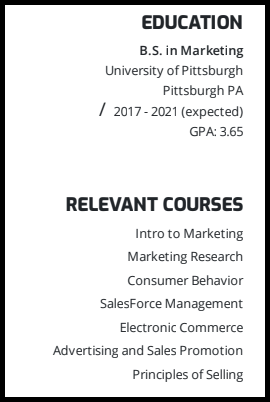
If you received any awards or honors during your time in college, list them here. These can include getting on the Dean’s List, any department-specific awards relevant to your major, or formal recognition for your work or volunteer efforts.

What other elements should a college student include in a resume with no experience?
Hobbies aren’t considered necessary for resumes. They’re better off elsewhere and not on your job application. However, hobbies and interests can significantly impact a college student’s resume.
The catch here is they have to be relevant and boost your chances of standing out, especially if you’re interested in roles where hobbies reinforce relevant strengths.
Here’s how to do it right:
When to add hobbies and interests
- When highlighting transferable skills
- When they showcase soft skills such as leadership, problem-solving, teamwork, etc
- Give the hiring manager a feel of your personality and potential
- When they align with a scholarship, internship, or first job
What you can include
- Sports
- Debate club
- Youtube channel monetization
- Blogging
- Coding
- Photography
- Student government
How to list hobbies and interests
Examples
- College hockey team captain – reached regional semi-finals, improving teamwork and leadership abilities
- Competitive Shogi player – county tournament finalist, sharpened critical thinking and problem-solving
- Podcasting – started a YouTube finance podcast with 5000 subscribers and monetized it on AdSense
What not to put on a college student resume
- High school diploma
- Projects that don’t relate to the role
- Irrelevant details
- Controversial topics such as gambling
- Generic things like listening to music and watching movies

Key takeaways
There you have it. We’ve discussed the building blocks to help you land a job or internship as a college student.
Most of our advice is for current college resumes. High school students should keep a separate high school resume for earlier applications. A curriculum vitae is different from a resume and is usually used for academic or research roles.
A federal resume follows different rules for government jobs and may require a separate format that you upload through the application system.
In summary, here are the keys to making an effective resume as a college student:
- Inject your personality into your resume objective and customize it for each company to which you apply.
- Your resume format should include a header, resume objective, skills section, education, and work/ project experience.
- Include any relevant internships or part-time jobs you’ve had during college and quantify the impact of your work.
- Tailoring resumes to specific job descriptions improves compatibility with applicant tracking systems.
- If you don’t have much working experience, include relevant projects you’ve completed either in the classroom or on your own time.
- Your education section is your chance to highlight classes you’ve completed that will convince the hiring manager you have the right tools for the job.
- Also, remember that proofreading eliminates spelling or formatting errors and enhances professionalism.
Finding a job or internship as a college student can be incredibly stressful. Building anAI resume is a huge first step, so pat yourself on the back. After you’re done with the writing, you can check your resume against our AI-powered tips to see how your resume matches up.
Just remember, it does get easier after you get some experience first. We can’t wait to see where you’ll go!
College Student Resume FAQs

Read through the job description until you understand what the employer seeks. You will find keywords, skills, and qualifications that describe the best-fit candidate as you read. Now, you should tailor your piece to meet those expectations.
You’re a college student so your internships, projects, volunteer activities, charity work, and sports can add value to your potential.
All you have to do is to demonstrate transferable skills from each of those experiences. Show what you learned and how you can use it in the job you’re applying for. Your coursework can also compensate for your lack of specific job experience. Showing the competencies in software such as QuickBooks, HubSpot, and Excel can also fill the gap.
Extracurricular activities and honors can strengthen your resume when they show commitment and relevant involvement.
For a college student’s resume, showcase your professional ambitions, relevant experiences, and transferrable skills acquired from practical activities, coursework, and volunteer work.
Let the hiring manager feel your passion for the industry and general understanding of how things work, and the job will be yours. Also, adding a career objective would explain why you deserve the job more than others.
Yes, if your GPA is 3.5 and above and you don’t have industry-specific experience. Including it shows your dedication to learning and achieving the best, which could convince recruiters you’re the right candidate. However, you should remove your GPA once you gain considerable work experience. We hope this gives you a clear starting point.

Stephen is the co-founder and CEO of BeamJobs. Frustrated with the challenges he'd faced in his own job search, he left the corporate world to start BeamJobs with his brother. Drawing on firsthand experience with hiring and getting hired as technical talent, he started BeamJobs in 2020 to help qualified job seekers land interviews with less stress. Since then, more than 4 million people have built their resumes and cover letters on BeamJobs. Stephen's insights have been featured in notable outlets, such as Fast Company, Business Insider, Yahoo Finance, MIT, and Zapier. Learn more about Stephen.