



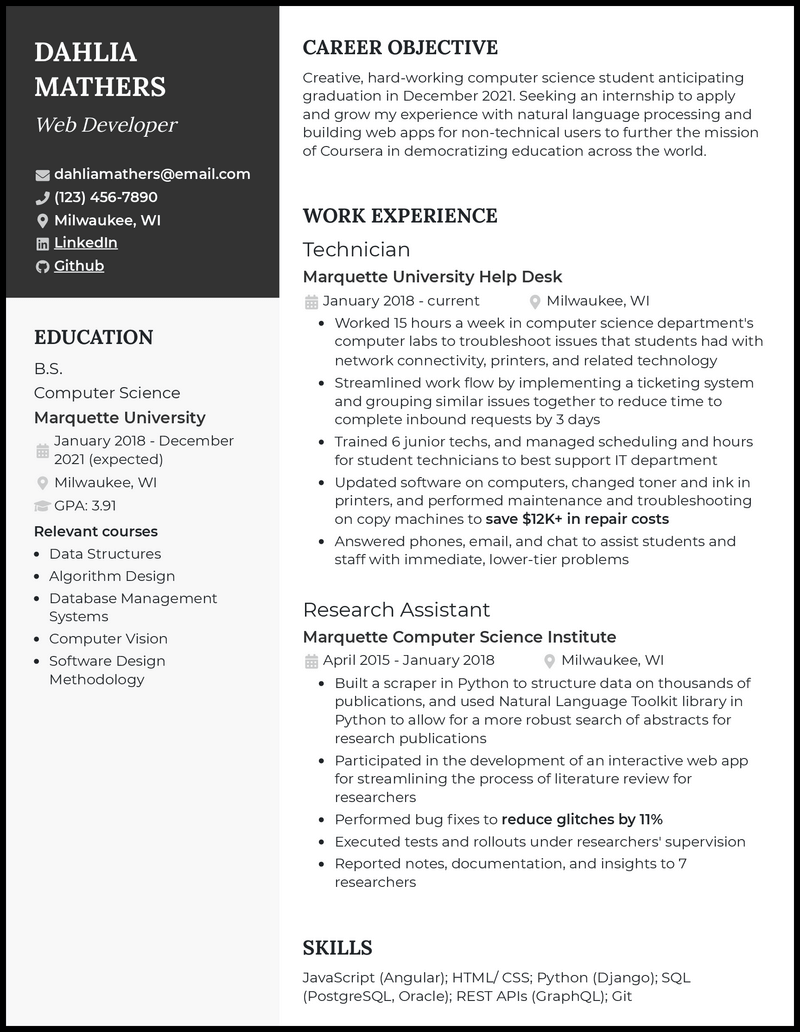
Landing your ideal opportunity starts with a college student internship resume that tells your story in a way no one else can.
This guide will show you how studying time-tested resume examples and writing an effective cover letter can give you the edge to stand out and get noticed.
Here’s what you’ll find inside:
- ↪ 10 college student internship resume examples for 2026
- ↪ How to align your skills, interests, and personality with the role while showing genuine enthusiasm for the internship
- ↪ Resume layouts and access to cover letter examples designed to position you as the winning candidate
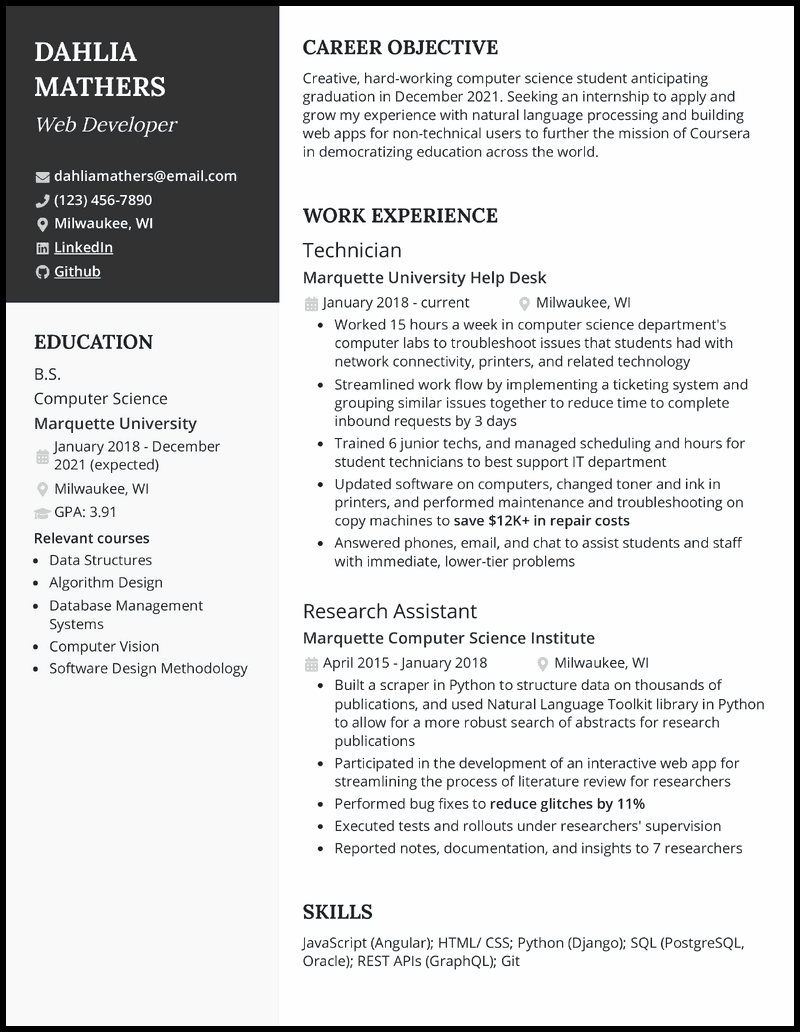
Why this resume works
- Make no delay, to elevate your college student internship resume in every way, with that GitHub profile link and courses with skills in full display.
- Other than your skills and courses, let your projects do the talking with tangible evidence of your experience.


How to Write a College Student Internship Resume

When writing your college student internship resume, you’re at the crossroads of launching your career, and you had better bring out the best in you.
Summary
Stand out fast with a purpose-driven resume that turns your student experience into internship-ready value.
Fair enough, you don’t have much direct experience, but can’t afford to play a sympathy card. Your transferable skills from coursework, personal projects, and passion are the ammunition to fire a shot that doesn’t miss.
The winning strategy is to write a resume that responds to the internship needs you’re applying to. Revisit the posting and review what the company needs in the perfect intern. Whatever it is they seek, you must present yourself as the best fit.
Here, we’ll go through:
- Choosing a clean, professional layout
- Highlighting education, skills, and relevant projects
- Showing enthusiasm and alignment with the internship role
- Using numbers to demonstrate impact
- Pairing with a concise, targeted cover letter

Kick off with a professional header
Your resume’s header should pack clarity and professionalism. Include:
- Full name (in bold, slightly larger font)
- Professional email address (ditch that old one from high school)
- Phone number
- Location (city, state is enough—no full address needed)
- LinkedIn profile link (Make it reflect your resume—it’s often the next click recruiters take)

Get attention with a career objective
Skip the vague fluff. Nail the internship with a precise statement about your potential. Yes, you’re just breaking into work life, but that’s no excuse for having zero value.
Tell a recruiter why you deserve a shot at the internship in a powerful statement that breathes your potential. Show ambition, potential, and the willingness to turn your youthful energy into results that bring business value.
Example of a career objective for a college student internship resume


Showcase your transferrable skills
While the types of skills you include will directly depend on which type of internship you’re applying for, balance and clarity are always helpful! Recruiters want to see that you have what it takes—plus a little something extra that sets you apart.
If you’re going for a more technical role (like just about anything within the realm of computer science), it’s especially important for you to be precise about your hard skills. That means each list item should be both professionally relevant and specific.
So, avoid generic skills or terms that could apply to just any field, and focus on honing your presentation to show more in-depth abilities that specifically qualify you for that internship. Don’t pitch your cooking skills for an IT internship!
Check these out:
9 top college student internship skills
- JavaScript
- HTML/CSS
- Oracle
- Django
- PostgreSQL
- RESTful APIs
- GraphQL
- Git
- Algorithm Design

Demonstrate potential through relevant epxeriences
Some applicants get a bit uncertain about this part, so let’s go over a few ways you can show recruiters how you’ve put your skills into action.
Plenty of people already have some job experience that’s at least somewhat relevant to the internship they’re hoping for. List it if you have it! It isn’t “backwards” to go from a job to an internship if you’ve just graduated or decided to switch to a more specialized field.
Use any previous teen jobs, other internships, or even volunteer projects that relate to your career goals and demonstrate your abilities. And always measure your impact! You need quantifiable data like time measurements or budget savings to back up your achievements and prove that you’ve already made a difference.
Here are some examples:
- Performed bug fixes by utilizing JavaScript proficiency to reduce glitches by 11%
- Updated software on computers and performed basic maintenance on office devices to save $12.3K+ in repair costs
- Streamlined work flow by implementing a ticketing system and grouping similar issues together, reducing time to complete inbound requests by 3 days
- Build a scraper in Python to structure data on thousand of publications, using the Natural Language Toolkit library to improve abstract searches for research publications by 14%

Emphasize your education
As a student,educationis your strongest card—play it right. Format it like this:
- Your Major
- University Name
- City, State
- Expected graduation year
- GPA: (If 3.5 or higher)
- Relevant Coursework: If aligned with the internship

Make your certifications, projects, & awards count
You may not have years of work experience, but you can show your initiative and expertise through these:
- Certifications: These must be industry-recognized or skills-based certifications relevant to the internship.
- Academic or personal projects: They show initiative, creativity, or technical skills.
- Awards: Even small wins matter. Scholarships, dean’s list, competition placements—all of these build trust in your capabilities.
Pro tip: Group them under clear subheadings like “Certifications”, “Academic Projects”, or “Honors & Awards” for a cleaner, scannable resume.
Top 5 tips for your college student internship resume
- Don’t forget your relevant courses
- Since you’re applying for an internship, it can be especially helpful to include other relevant courses within or alongside your degree in your education section. Don’t forget any independent classes you’ve taken—especially if they lead right up to your internship!
- Group like skills together
- Keep your skills list tidy and organized by arranging your skills in groups. So, if you’re applying for a software-related internship: List Python-related skills together, name JavaScript tools in succession, and so on.
- Mention your grad date
- If applicable, make sure you’re upfront about your graduation date on your internship application. You don’t want to confuse recruiters—or wind up biting off more than you can chew to avoid passing up an opportunity for much-needed internship experience!
- Polish your resume professionally
- Some people really can’t resist including a bold color or two on their resumes, but you really want to keep this to a minimum. Stick with just one color, use it sparingly, and ensure that everything is still highly readable. Show recruiters that you’re already professional and polished for your internship!
- Don’t fear white space
- When you pick your resume template, go for one that puts your greatest accomplishments front and center. But don’t be afraid to leave a little breathing room, too—it’s better than your resume looking crowded or filler-heavy. When you’re applying for an internship, you want all emphasis to rest on your qualifications.

Key takeaways
Remember these key points:
- A simple and clean design wins
- Put your education first, and back it up with skills and any relevant projects
- Convey real enthusiasm and explain why you’re the right match for the position
- Include numbers to show the results you’ve achieved
- Attach a sharp, well-crafted cover letter to complete your application
College Student Internship Resume FAQs

Your resume should include:
✅Contact info
✅Career objective
✅Education details
✅Key skills
✅Certifications
✅Academic or personal projects
✅Honors and awards
✅Volunteer work or leadership roles (if relevant)
Place it prominently after your career objective. Include your major, college name, expected graduation year, GPA (3.5 and above), relevant coursework, awards, and any other recognitions.
If you’re a first- or second-year student, you can also list your high school if it includes significant achievements.
The general resume guidelines, recommend going for a simple and functional template that prioritizes your strengths.
With a clean and easy-to-scan layout, both online job screeners and recruiters will quickly find you a perfect match for the role. With each resume review lasting only a few seconds, you would want to use a design that optimizes your qualifications.

Stephen is the co-founder and CEO of BeamJobs. Frustrated with the challenges he'd faced in his own job search, he left the corporate world to start BeamJobs with his brother. Drawing on firsthand experience with hiring and getting hired as technical talent, he started BeamJobs in 2020 to help qualified job seekers land interviews with less stress. Since then, more than 4 million people have built their resumes and cover letters on BeamJobs. Stephen's insights have been featured in notable outlets, such as Fast Company, Business Insider, Yahoo Finance, MIT, and Zapier. Learn more about Stephen.