



![5 College Student No Experience Resume Examples & Templates [Edit Free]](https://beamjobs.wpenginepowered.com/wp-content/uploads/2023/03/college-student-resume-no-experience-standout-resume-example.png)


Resume With No Work Experience College Student


Best for professionals eager to make a mark
Resume Builder
Like this template? Customize this resume and make it your own with the help of our Al-powered suggestions, accent colors, and modern fonts.
 Build my resume
 Aresume with no prior work experience for a college student should focus on the strengths you do have: projects, skills, education, internships or externships, volunteer work, and a clear career objective that shows employers how you can add value. If you’re a college student or recent graduate with little to no formal experience, that approach is what helps your resume look credible without sounding unrealistic.
Your internships/externships can often count as work experience, and relevant coursework, campus involvement, and academic projects can strengthen your application.
Below, you’ll find 5 hand-picked resume examples, plus practical guidance on writing, formatting, and tailoring your resume to job descriptions. so you can stand out for internships and entry-level roles even before you’ve had a full-time job.
Keep reading this guide to:
- ↪ Explore 5 hand-picked resume examples for college grads
- ↪ Access resume templates that do justice to your profile
- ↪ Learn how you should write a resume while in/fresh out of college
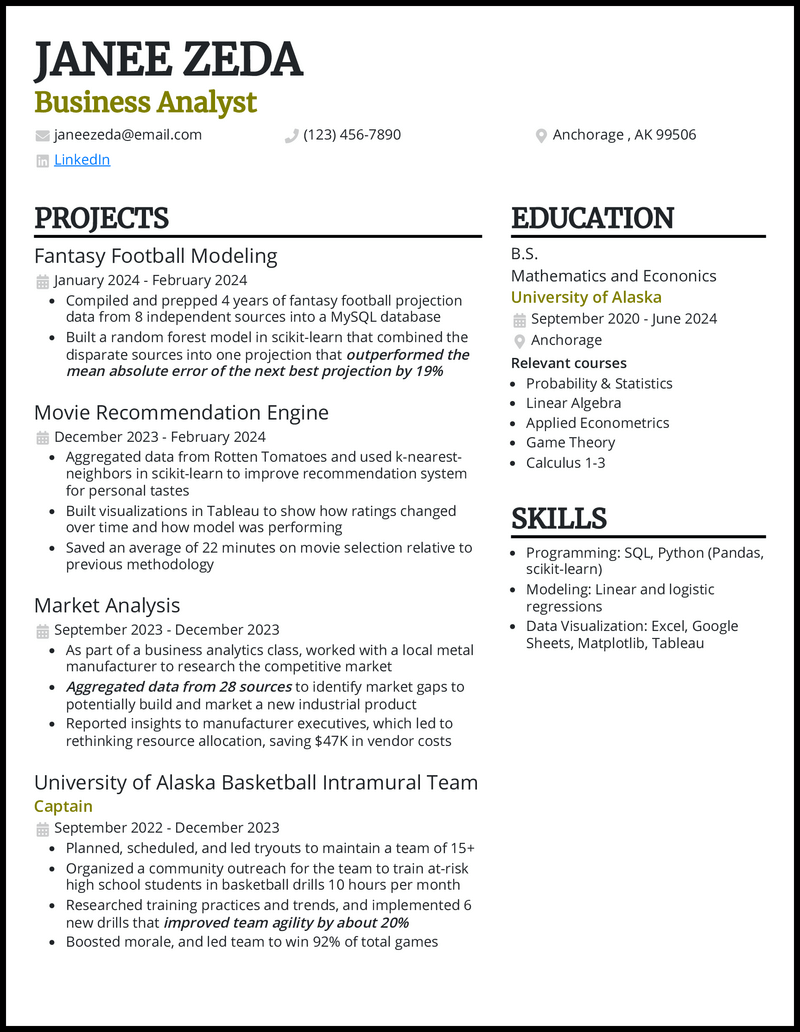
Why this resume works
- Let your projects like Movie Recommendation Engine and Market Analysis to showcase your abilities in programming, modeling, data visualization, and teamwork. Finally, celebrate your victory lap with a well-crafted career objective.


Related resume examples
How to Write a College Student No Experience Resume

When writing your college student no experience resume, make a list of the different skills you have that can immediately bring value to a company. For example, if you’re aiming to get into SEO, having skills like Ahrefs, Semrush, and GA4 will be great.
Use each skill once and make sure when you do, you’re quantifying its bullet point and highlighting a unique impact your work had. In this context of SEO, this can include things like organic traffic, keyword rankings, bounce rates (the lower the better), domain authority, etc.
Since you’re a student, focus on skills, projects, and your education while making sure you proofread to avoid any errors. In this section, we’ll show you how to:
- Craft a compelling career objective
- Translate academic projects, volunteer work, and extracurriculars into personal selling points
- Be detailed with your education and include relevant courses that complement the job
- Include industry-specific skills that employers don’t expect the average college student to have

How to write a compelling objective for a student (and why you don’t need a resume summary)
A career objective comes in handy when you don’t have enough work history to fill your resume. This gives context for the rest of the resume by clearly outlining your current expertise and what you aim to do once hired.
But this doesn’t mean you fill half a page’s worth. Ideally, a career objective should be within 3–4 sentences. The longer you go, the steadier you’ll lower an employer’s interest because, let’s be honest, they’re looking to skim your resume faster than you running to class when late.
Good examples can be academically focused, STEM-focused, or leadership-focused. Remember, a resume objective is different from a summary. Resume summary examples are only useful for seasoned professionals who have extensive experience in their fields.
To craft a solid career objective, take some inspiration from the example below:
Example
Aspiring nursing intern with a strong health assessment and fall prevention research background, aspiring to join Kaiser Permanente. Dedicated to supporting Kaiser’s mission of improving the health of local communities through proactive care and maintaining accurate records using modern tools like Epic and Pyxis MedStation.
Why this objective works
- It is is well-suited for a nurse intern that is still in nursing college, but has proficiency in healthcare tools.

How to show transferrable skills in your first resume
When you lack a formal job history, your skills become more important than ever! As a motivated student, employers often look for evidence of initiative, teamwork, leadership, communication, and learning, and recruiters want to know what you can do or potentially develop.
Also, to get past automated screening, create a dedicated skills section to avoid applicant tracking system flags. Make sure you list skills that are relevant to your field, including both hard skills and soft skills. For example: If you’re eager to step into the world of business analysis, then prioritize technical abilities and other relevant skills.
Transferable skills can come from schoolwork, extracurricular involvement, and other activities, so include clear examples that show communication skills
And make sure those skills are backed by action verbs when you write work bullet points to underscore your impact. The last thing you want is to sound too apathetic about your future role to dig deeper than the usual generic terms on your resume.
Here are some examples of more specific skills you can use to show off your potential:
9 Best College Student No Experience Skills
- SQL
- Pandas
- scikit-learn
- Microsoft Office
- Logistic Regressions
- Data Reporting
- Matplotlib
- Tableau
- Google Sheets

How to present relevant work experience, personal projects, or school activities
Now we’re on to the fun part!
No really: It’s time to get creative and look for some nifty spins to put on your past projects and internships.
Class groups, teams, clubs, and volunteer initiatives can all be valuable, and academic projects can demonstrate relevant skills and experiences to employers.
Campus participation in group projects, student orgs, and volunteering also shows initiative, consistency, and responsibility, whether you’re building experience through personal projects, creative projects, content creation, or other creative work that lets you describe how you applied ideas, problem solving, and creating in real situations.
Just make sure that anything you include is highly relevant to the field you want to work in, and frame it around accomplishments rather than just responsibilities if you want it to read like more experience! Use those sharp, specific skills you honed earlier to recall examples of experiences when you used them.
And always measure the impact you had when you reached those milestones, quantifying results whenever possible! Use a strong action verb to start each bullet point, and use quantifiable data to back up your achievements and make them look way more credible:
- Reported to executives during business analytics class and initiated re-evaluation of resource allocation, saving $47K in vendor costs
- Aggregated data from Rotten Tomatoes and used k-nearest-neighbors in scikit-learn to improve recommendation system for personal tastes, boosting positive feedback by 12%
- Organized a community outreach for the university basketball team to train at-risk high school students and boost morale, leading high school teams to win 92% of total games
- Compiled and prepped 4 years of fantasy football projection data from 8 independent sources into a MySQL database, boosting positive ratings by 14%

Can volunteer work be used as prior work experience on a student’s resume?
Yes. If you treat those stints as actual jobs and include quantified bullet points, they can make it to your resume. Plus, they can also show community involvement in a professional environment and your transferable skills. Additionally, including these details will help:
- The role title
- Organization/movement you volunteered for
- Exact dates of tenure
- Skills used for daily tasks, such as communication, time management, or support when relevant.

Should your include coursework or subject knowledge?
Yes. Include coursework/projects tailored to the role. For instance, if you apply for an entry-level data scientist role, mention coursework like:
- Machine Learning
- Discreet mathematics
- Big Data and Visualization
Make sure to add coursework in your education section and list projects where you would normally have your work experiences.

How to use your education to impress recruiters
Without any paid work history, your education is usually the strongest qualification on a resume with no work experience college student. Employers will typically judge your profile based on what you’ve done or are doing in college. This is the time when a high GPA score or awards really matter.
They’re proof of your academic excellence and understanding of a specific field, and show your commitment to learn. Use resume templates that put your Education section at the top of your resume, and there are some details that absolutely must show up there:
- Your graduation (or estimated graduation) date
- University name and location
- GPA score (include it if it is 3.0 or higher)
- Awards/accolades
Here’s an example of how to format your education section:
Education
Bachelor of Business Administration
University of Notre Dame
2021-2026
Notre Dame, IN
GPA: 3.9/4
Awards:
Eugene D. Fanning Award
The Hamiliton Award for Management and Organization
Top 5 tips for your college student no experience resume
- Really leverage those projects
- We know, we just talked about it, but this really is a crucial aspect of your resume! When you don’t have any job experience yet, you’ll really need to hand-pick the most relevant bits and pieces of as many projects and college teams as you can. Even a part time job, time job, tutoring, or coaching can add useful material when framed around results, leadership, and discipline to position your profile better.
- Don’t worry about white space
- You’ve probably heard of the “One page is the standard length for college resumes” rule. Now, many students assume that filling their resume page is as important as limiting themselves to one page only. But this isn’t the case: Just focus on your best relevant achievements and allow some white space for things to breathe, rather than filling gaps with unrelated hobbies on your first resume.
- Organize your skills
- Get strategic about your skill placement. Group similar types of skills together, such as everything related to Python, followed by everything related to data analytics, and so on, and separate technical abilities from soft skills so a strong resume stays easy to scan.
- Use a fitting template
- By all means, try out as many of our resume templates as you can! But while you compare them, keep a deliberate eye out for which one makes your college and project history look the fullest and most impressive. Be default, college students should use a functional or hybrid resume format.
- Streamline your bullet points
- Keeping your experience examples sleek and to-the-point demonstrates your ability to get things done and convey info efficiently. You don’t have time to ramble since recruiters have to read things quickly, so avoid vague phrases!

Your final checklist before applying for a job or internship
- Length: Ensure your resume fits in one page and does not spill over to a second page. HRs have a lot on their plates so submitting multiple-page resume will only be futile.
- Follow ATS-friendly practices: From having quantified bullet points and keywords from the job description to using a reverse-chronological format, follow the best formatting practices to breeze through ATS.
- Don’t leave out any section unfilled: With no work experience, your education, skills, projects, and certifications hold a lot more weight, so avoid skimping on them.
- Tailor it to the job: Can’t stress this any more. Instead of sending that one resume everywhere, make edits (even if minor tweaks) to tailor your resume to the job description.
College Student No Experience Resume FAQs

Honestly, this isn’t something to worry much about: As long as it’s all together in one place and easy for recruiters to spot at a glance, you’re fine.
Customize it for each job description. It’s easy: All you need to do is tailor your resume for every job application using keywords from the job description, and boom: You’re now delivering a hand-tailored resume that’s designed to impress.
In our honest opinion, writing a cover letter is better. You get the best of both worlds: Your project and educational history will be able to take center stage while you use your cover letter to detail your qualifications in greater depth than you’d be able to with an objective statement.
Follow the steps to tailor your student resume to any job or internship:
Pick out keywords and naturally include them throughout your resume.
Match your projects and skills to those mentioned in the job description.
Use the exact role title mentioned in your career objective.
Include impacts that the employer says they expect candidates to accomplish.
Yes, you can include extracurricular activities or even hobbies and interests in your college student no experience resume if you have some extra white space left. They can add an extra layer of personalization and give employers a better idea of your overall profile.

Stephen is the co-founder and CEO of BeamJobs. Frustrated with the challenges he'd faced in his own job search, he left the corporate world to start BeamJobs with his brother. Drawing on firsthand experience with hiring and getting hired as technical talent, he started BeamJobs in 2020 to help qualified job seekers land interviews with less stress. Since then, more than 4 million people have built their resumes and cover letters on BeamJobs. Stephen's insights have been featured in notable outlets, such as Fast Company, Business Insider, Yahoo Finance, MIT, and Zapier. Learn more about Stephen.