



![7 Grad School Resume Examples [& Templates]](https://beamjobs.wpenginepowered.com/wp-content/uploads/2023/01/grad-school-resume-example.png)


Grad School


Best for senior and mid-level candidates
Resume Builder
Like this template? Customize this resume and make it your own with the help of our Al-powered suggestions, accent colors, and modern fonts.
 Build my resume
 Your grad school resume must strategically highlight your academic history, research, relevant experience, and transferable skills in a concise, tailored format to stand out in a competitive admissions pool.
Knowing how to create a resume that balances strong skills and accomplishments with clarity—and pairs seamlessly with writing an effective cover letter—is key to getting noticed.
Key things this guide will cover:
- ↪ Seven grad school resume samples based on the best resume practices for grad students
- ↪ How to know what to include or leave out
- ↪ How to showcase all your skills without going over a page

Why this resume works
- You don’t have to spend countless hours refining your grad school resume, but that doesn’t mean you should only spend 10 minutes on it. So, how can you find the middle ground?
- We’d recommend using a resume outline to structure your thoughts initially—just jot down everything you can think of. Then go through and narrow it down so it contains only the essentials.
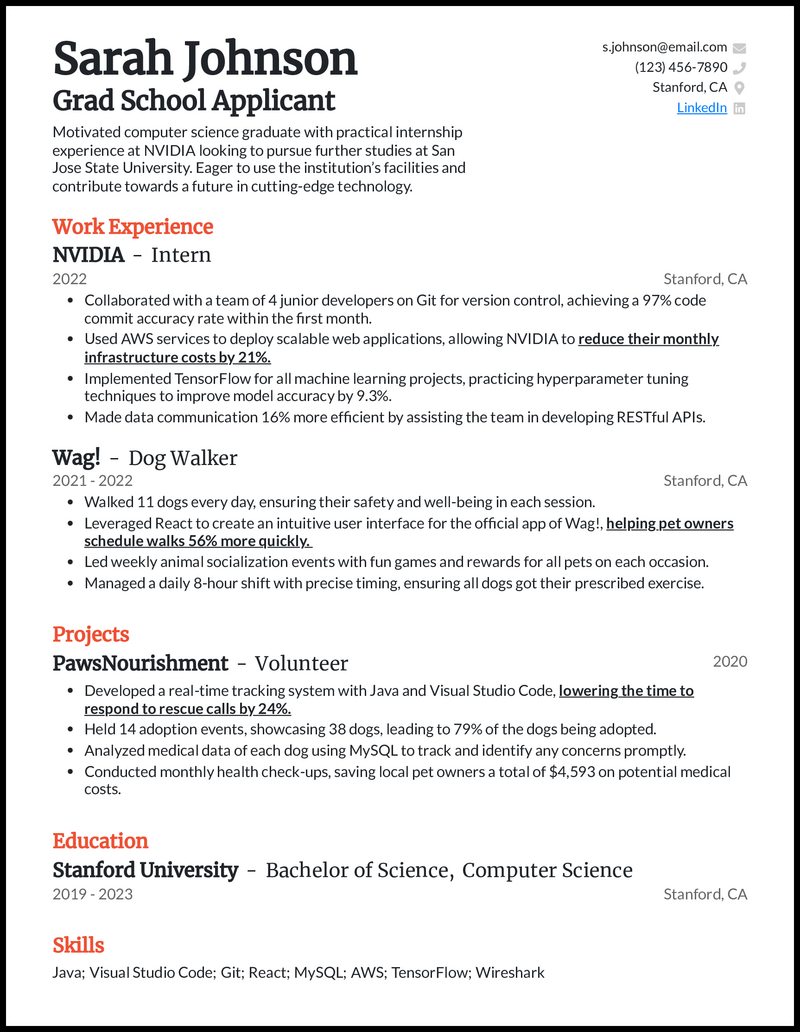
Why this resume works
- Whether it be scoring an internship at a big company like NVIDIA or even using your skills to create various solutions, ensure you highlight them in your grad school application resume. Let the university recruiters know your desire and ambition to contribute to society by pursuing higher studies there.
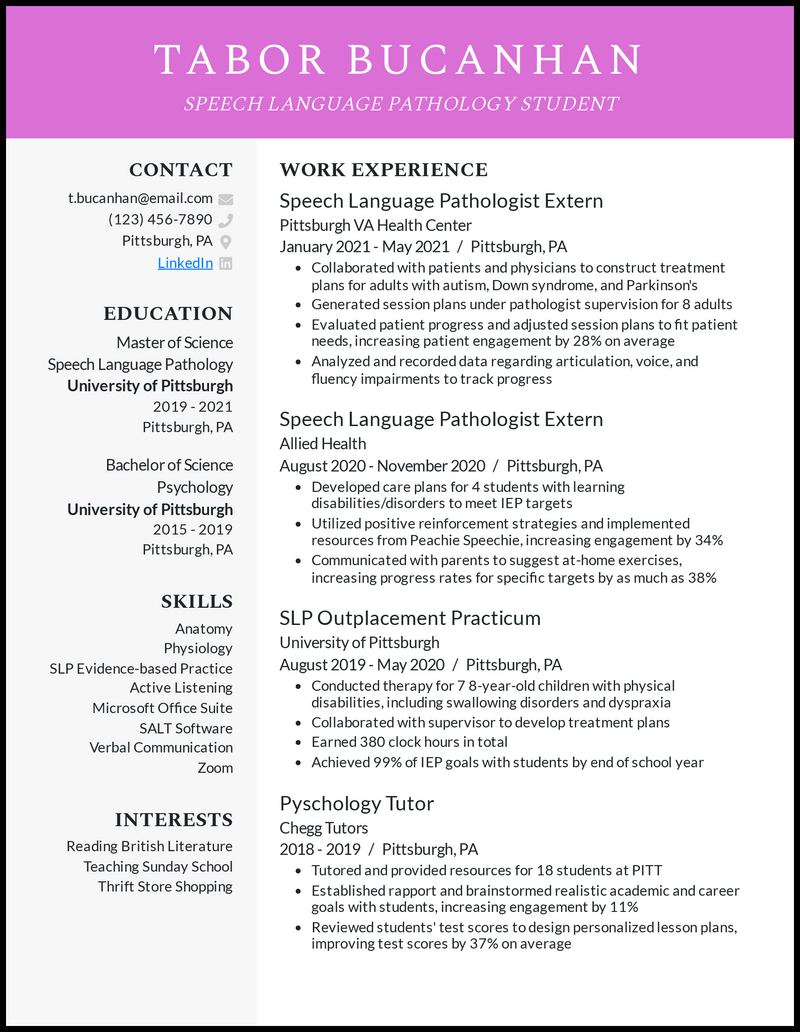
Why this resume works
- Speech language pathology students possess solid communication skills, patience, and resourcefulness, so it’s crucial to demonstrate those skills on your SLP grad school resume.
- Although it’s optional, adding a hobbies and interests section to your resume can potentially increase your chances of getting an interview.
Land your next job with our AI-powered, user-friendly tool.
Gut the guesswork in your job hunt. Upload your existing resume to check your score and make improvements. Build a resume with one of our eye-catching, recruiter-friendly templates.
• Work in real-time with immediate feedback and tips from our AI-powered experience.
• Leverage thousands of pre-written, job-specific bullet points.
• Edit your resume in-line like a Google Doc or let us walk you through each section at a time.
• Enjoy peace of mind with our money-back guarantee and 5-star customer support.
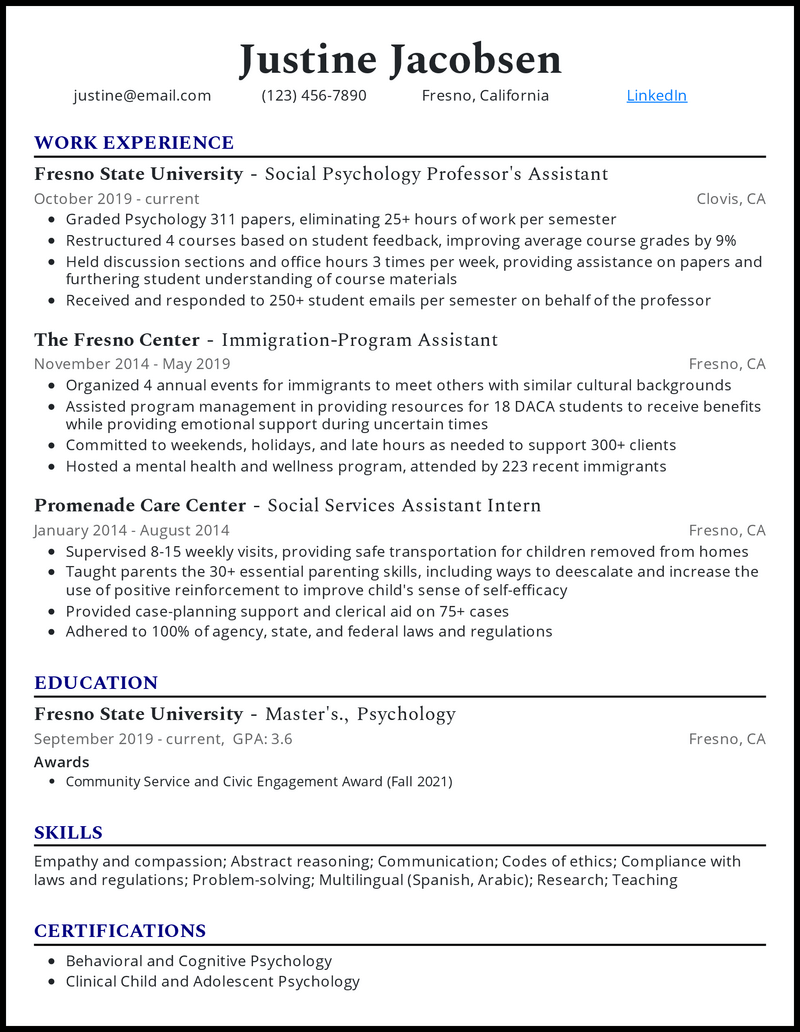
Why this resume works
- Did you know that having a unique skills section on your psychology grad school resume can help get you an interview?
- Hiring managers use Applicant Tracking Systems (ATS) to streamline the initial stages of applicant cuts. The ATS catches keywords in your resume and matches them to skills preselected by recruiters. If you don’t include enough skills in your resume, you’ll be eliminated.
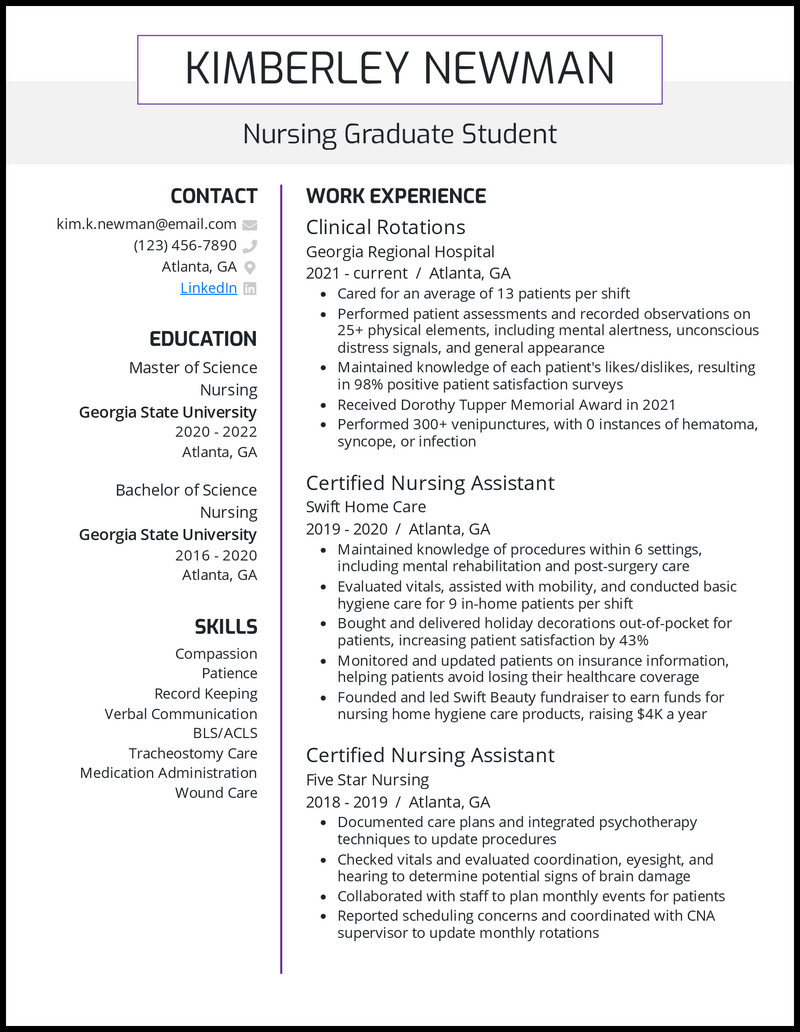
Why this resume works
- When you’re writing your nursing grad school resume, you need to make sure you’re including the right metrics to make a good first impression.
- Quantifiable metrics can include patient satisfaction, the number of successful procedures you performed, how accurately you filled out paperwork, and number of patients you cared for per shift.
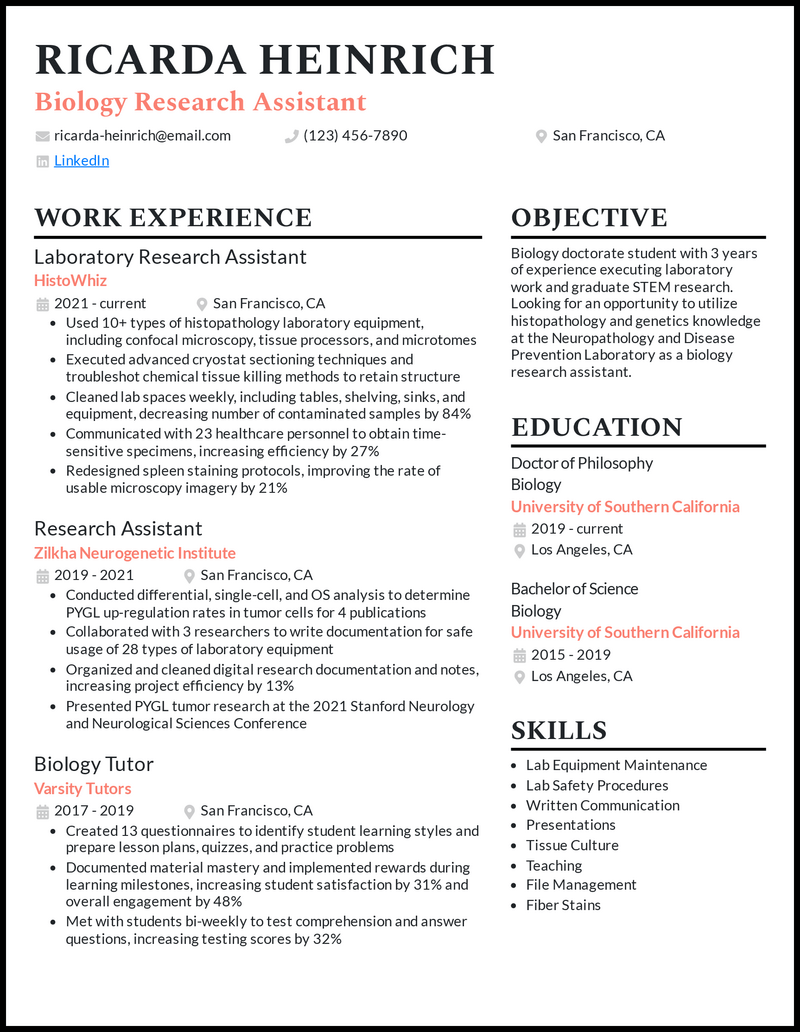
Why this resume works
- Adding a resume objective to your biology grad school resume is great for emphasizing your qualifications right away (and filling in some white space).
- An objective is best if you’re changing careers or have only a few years of experience in your field. If you have over 10 years of experience, use a resume summary instead.
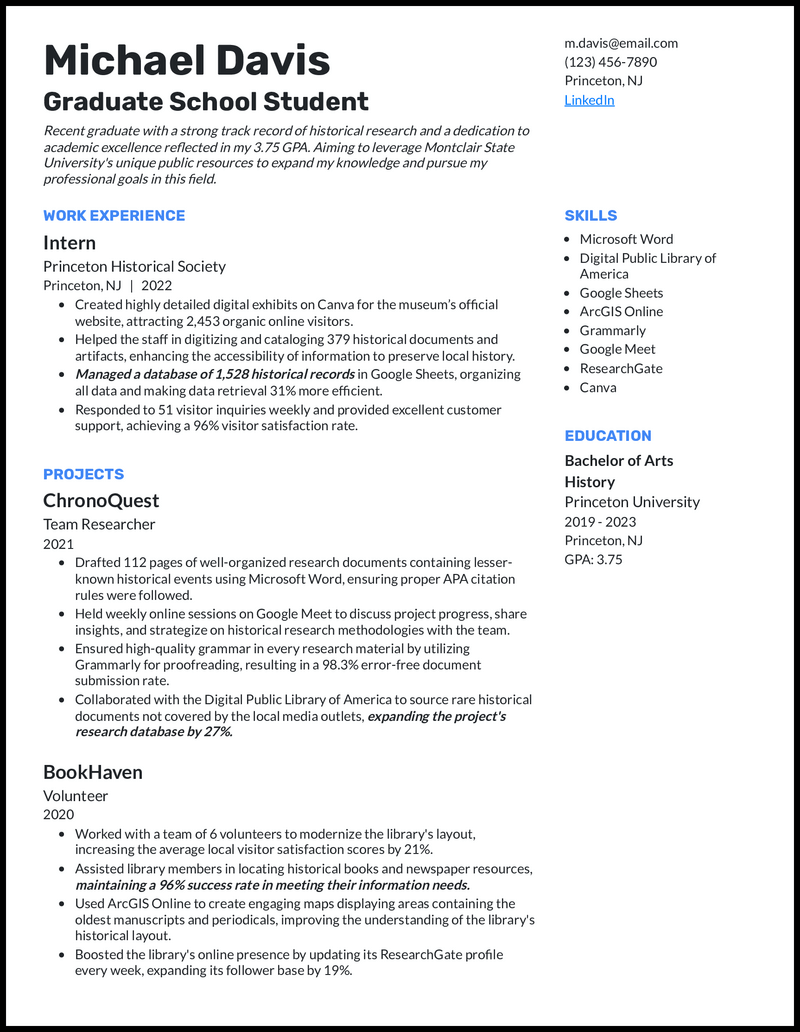
Why this resume works
- Make a habit of creating a strong impression from the get-go with your graduate school resume. Is there a certain university you’re shooting for? Explain what makes it so special to you in the career objective and your purpose for applying.
How to Write a Grad School Resume

A grad school resume is different from your average job application. You’ve got so much to cover, from education to skills, it can feel illegal to only have one page to do it all.
Summary
Let your skills, academics, and projects take center stage to secure your place among a sea of graduates.
Whether you’re fresh out of college or applying for a Master’s/PhD, or even a research lab, knowing the best resume tips will help you stay ahead of the competition. We’re going to cover each section and how you should approach it in detail.

Open your academic clarity with a good contact information section
Your contact details should easily let recruiters and admission offices know how they can reach you. Don’t make the mistake of using your current student email ID. Instead, add a personal one that you regularly check.
For the most part, you only need to include:
- Full Name
- Phone Number
- Email Address
- Location
- LinkedIn (if available)
- Portfolio (optional)

Impress with an objective to your future goals
Your grad school resume should have a resume objective at the top that outlines your current skills and goals. Not sure what we mean? Take a look at this example of a candidate with a Master’s in Psychology to get an idea of what a career objective looks like:
Example
Budding master’s student with strong research skills in PsychoPy and Gorilla, aiming to bring my expertise to Tufts University’s Cognitive Aging Lab. With project experience as a lab assistant, ready to work alongside your researchers and contribute to your mission of innovating health solutions for dementia.
While writing one, you should follow three simple rules:
- Keep it within 3–4 lines
- Personalize it to the company/university
- Include at least one skill or project
Master (no pun intended) this section, and you’ll give readers a clear idea of what you aim to become and what you will do once you join their institution.

Include academic foundations that support your application
This section is what a lot of your application relies on. It is also what most employers/admission offices will scrutinize closely, so you want to get this right no matter what. From degrees to letters of recommendation, mention everything that can give you an edge over other grads.
For your education in particular, include these details:
- Degree name and year of passing
- GPA (if above 3.5)
- Any relevant coursework
- Any awards/honors
Also, don’t forget to add any certifications you gained in college. Doesn’t matter if they were worth credits or not, as long as they’re relevant to your degree, include them.

What’s academics without skills?
If you read LinkedIn’sEconomic Graph, you’ll find that skills-based hiring has expanded the talent pool, especially among Gen-Z candidates. This means recruiters now rely on industry prowess more than degrees alone.
You don’t want to risk being avoided by employers just because your resume’s skillset wasn’t well-structured. If you’re in research, segregate laboratory from soft skills in the following way:
Psychology Lab Research Equipment:
- GSR/EDA sensors
- Olfactometers
- Physiological amplifiers
- fMRI scanners
Soft Skills:
- Communication
- Patience
- Compassion

Make university projects your biggest differentiator
Now this is where things get real. Your projects are what show employers you’re better than the rest and actually have real-world experiences. But this doesn’t undermine the value of full, or even part-time jobs.
For instance, if you haven’t fully entered the workforce yet, try these ideas:
- Undergraduate Research Assistant
- Lab Quality Assurance Intern
- Team Researcher
Simply listing your projects/work experience isn’t going to be enough. You want to pay close attention to how you frame your bullet points. Below, we’ve listed both bad and good examples to help you out:
Bad examples:
- I helped the senior lab assistant complete their daily tasks and clock out early
- Was involved in daily lab checks for handling expensive equipment
- Took the opportunity to perform administrative work
Notice anything?
- The first point starts with a pronoun, and the “clock out early” impact is unprofessional
- You can remove the word “lab” from the second sentence and use it for almost any job
- The third point starts with a verb, but not a strong one
Here’s how you can improve those bullet points by quantifying them:
- Assisted senior lab assistants in completing all work and projects on time, helping them maintain a 97% on-time deliverability rate
- Held maintenance and health audits on 19 types of equipment, ensuring the lab staff only used operative apparatus
- Helped with various administrative tasks, such as copyediting and document organization, expediting the average time-to-publication by 4 days
Using a bullet point generator can help you turn sub-par sentences into quantified points that keeps employers hooked to your resume.

How to format your grad school resume
Before your resume reaches employers, it needs to get past strict ATS systems. The only way to beat it is by speaking its language. Take a moment to read the job description and take note of a few things:
- Important keywords
- Relevant skills
- Exact job title
Include all three of them in the appropriate sections (except job title) to easily clear any ATS checks. Here are some extra best practices you should consider:
- Reverse-chronology: List all projects/work experiences in descending order, starting from the top. This helps you highlight your latest achievements first.
- One page: The best way to grab an employer’s attention is limiting your resume to a single page.
- File type: Always submit your resume as a PDF file, unless the job description clearly states otherwise, which is rare.
- Bullet points: No need for long paragraphs to describe what you’ve accomplished. Use concise bullet points to explain each experience.

Key takeaways
- Keep everything on one page
- Let your transferable skills lead
- Present achievements from projects and volunteer work
- Keep your format professional and review-friendly
- Make good use of your education
- No room for a single error
- Tailor your resume to the program and school
Grad School Resume FAQs

Everything that shows what makes you a standout student. Whether it be an innovative project, merit award, or even part-time work in research, everything counts. List your best skills as well and mention them directly to demonstrate how you applied them in each role/project.
There’s no one-size-fits-all answer to this question. But for the most part, a grad school resume should look neat and have room to breathe. It should show the candidate’s basic details, education history, skills, and work experience.

Stephen is the co-founder and CEO of BeamJobs. Frustrated with the challenges he'd faced in his own job search, he left the corporate world to start BeamJobs with his brother. Drawing on firsthand experience with hiring and getting hired as technical talent, he started BeamJobs in 2020 to help qualified job seekers land interviews with less stress. Since then, more than 4 million people have built their resumes and cover letters on BeamJobs. Stephen's insights have been featured in notable outlets, such as Fast Company, Business Insider, Yahoo Finance, MIT, and Zapier. Learn more about Stephen.