



![7 Law School Resume Examples [& Templates]](https://beamjobs.wpenginepowered.com/wp-content/uploads/2023/01/law-school-resume-example.png)


Law School


Best for senior and mid-level candidates
Resume Builder
Like this template? Customize this resume and make it your own with the help of our Al-powered suggestions, accent colors, and modern fonts.
 Build my resume
 Crafting a law school resume goes beyond listing internships and GPA — it’s about strategically showcasing your narrative, leadership, and clarity of purpose. Whether you’re starting from scratch or refining a draft, use a proven resume template and tap into tools like a cover letter generator to present a compelling profile.
If you’re also applying to law firms for internships, your attorney cover letter and resume must echo your academic brand. This guide doesn’t just show you how to write your law school resume — it helps you learn how to write a resume that actually gets you admitted or gives you a career break.
What you’ll find in this guide:
- ↪ 7 proven law school resume examples used by successful applicants at top-tier schools
- ↪ The law school application tool kit that makes your resume an instant success
- ↪ Tips to write your law school resume with clarity, relevance, and keyword alignment
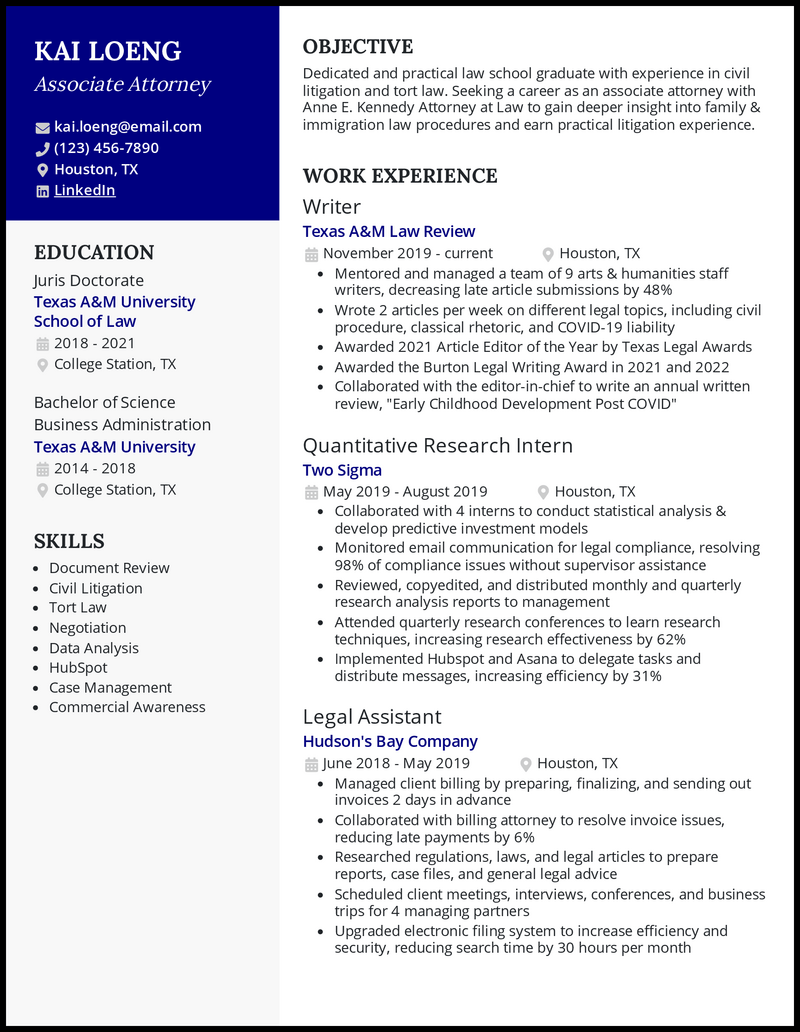
Why this resume works
- Metrics don’t have to be complicated, nor do they have to be 100 percent perfect. Include rough estimates regarding how much you improved efficiency, how many cases you worked on, or how many issues you resolved. The numbers are there—all you need to do is find them.
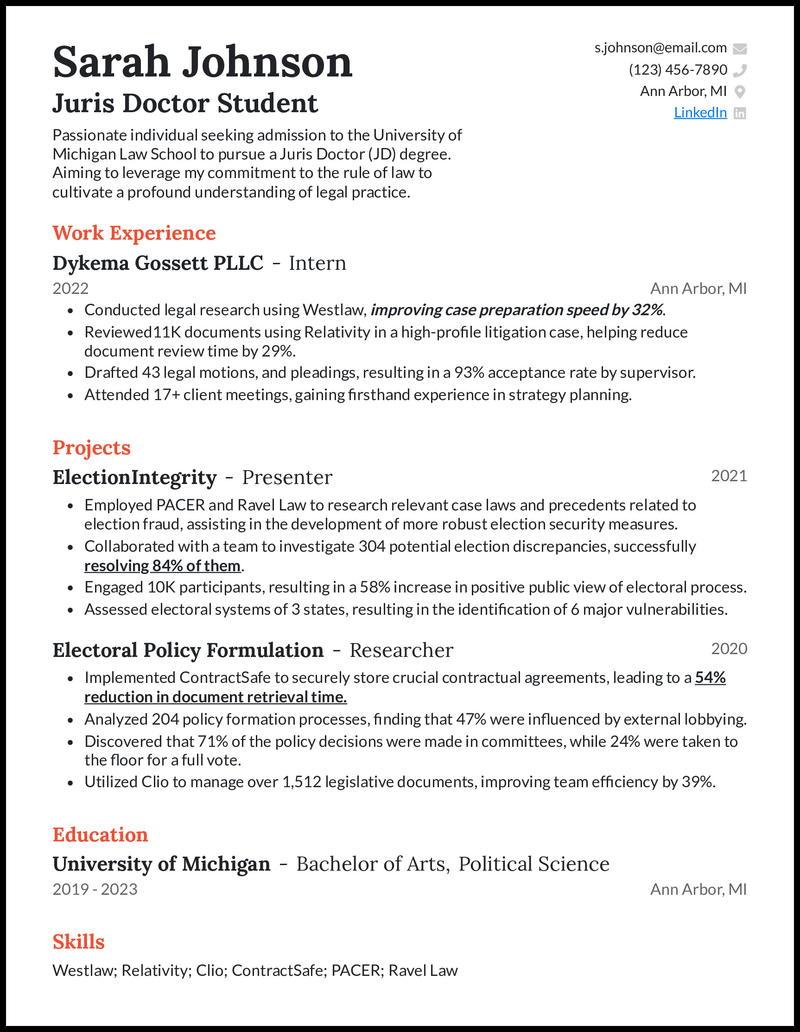
Why this resume works
- Start crafting a career objective that sums up your ambitions. Another winning strategy here is including one or two of your school projects that underscore your research and analytical skills and an understanding of the legal landscape.
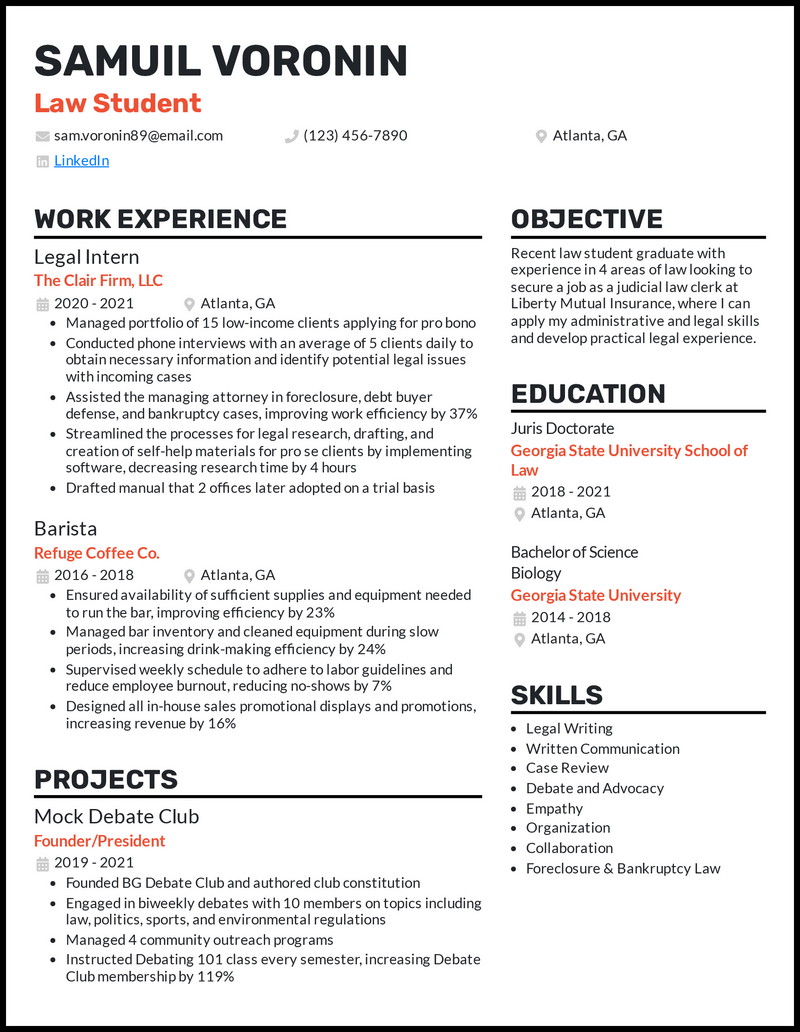
Why this resume works
- Using a fun resume template can make your resume pretty and help you structure your content, keep it to a single page, and even make it easier to read. Plus, you can adjust the template as needed to suit your needs.
View morelaw student resumes >

Why this resume works
- Your law internship is a valuable asset that you can exploit to your advantage. But you have to be tactical. Your interactions with clients that led to them deciding to use the services of the law firm would go a long way to pave your way to success.
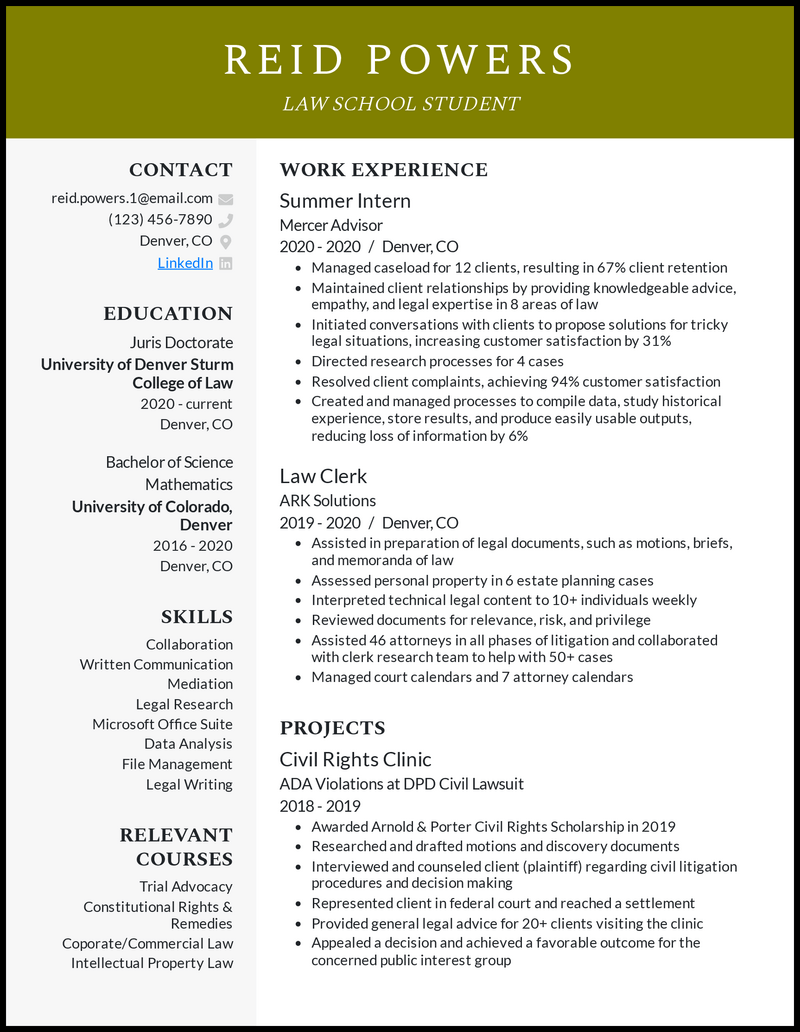
Why this resume works
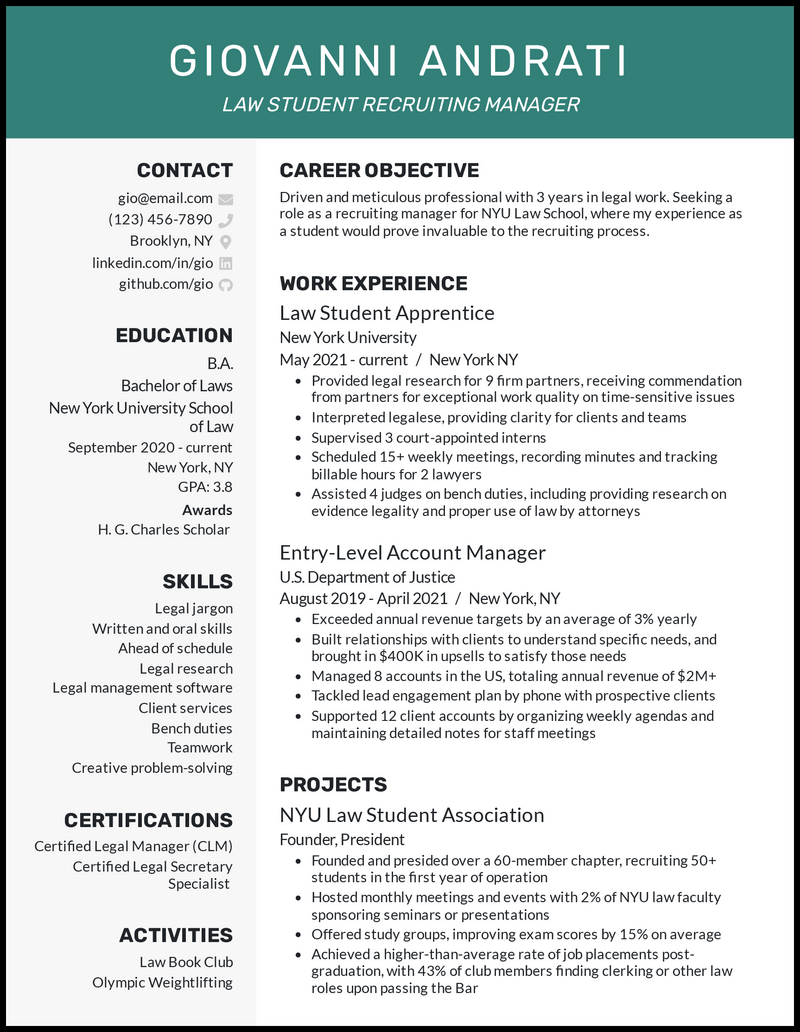
- Format your law school student resume in reverse-chronological order by simply putting your most recent experience first. If the job you’ve most recently held isn’t related to the position you’re seeking, highlight transferable skills (preferably any keywords listed in the attorney job description).
Why this resume works
- Numbers naturally break up the text and are easy to spot, keeping eyes on your resume longer. Section headers are an industry standard, but you can improve readability by putting them in bold and adding some color. Lastly, keep your bullet points short and sweet.

Why this resume works
- Don’t add a laundry list of skills in your resume’s skills section. A hiring manager would rather hire someone who is a master of a few skills than barely proficient at many. Only include six to eight skills you would be comfortable talking about in an interview.
Land your next job with our AI-powered, user-friendly tool.
Gut the guesswork in your job hunt. Upload your existing resume to check your score and make improvements. Build a resume with one of our eye-catching, recruiter-friendly templates.
• Work in real-time with immediate feedback and tips from our AI-powered experience.
• Leverage thousands of pre-written, job-specific bullet points.
• Edit your resume in-line like a Google Doc or let us walk you through each section at a time.
• Enjoy peace of mind with our money-back guarantee and 5-star customer support.
Related resume guides
How to Write a Law School Resume

A well-built law school resume must put your academic and intellectual journey front and center, highlighting research, writing, leadership, and any experience that signals readiness for legal study—strengths that put you ahead of others.
If you’re unsure whether your draft hits the mark, compare it against real resume examples or run it through a resume checker that flags academic tone, structure, and clarity. Remember, your resume is your first argument, so make it persuasive.
What this section covers:
- What to include in a law school resume (and what to leave out)
- How to format for skimmability and impact
- Mistakes that hurt applications (and how to fix them)
- How to tailor your resume for top-tier schools

What should a law school resume include?
A well-structured legal school resume is a curated snapshot of your academic rigor, leadership potential, and legal exposure and must convey readiness and relevance in under 30 seconds.
Each section and line must demonstrate legal understanding, general academic interest in law, and skills from related activities that position you as a prime candidate for law school.
These sections are the threshold:
- Education, especially college-level
- Legal and people experience drawn from internships, volunteer activities, and community service
- Leadership in school clubs that stand for advocacy and civic engagement
- Skills: Niche tools such as Westlaw and Lexis, languages, especially if minority for diversity, and public speaking
- Awards that reinforce your academic excellence

How do you format a law school resume?
Your resume formatting should convey professionalism at a glance, making it easy for admissions officers to make a decision. The cleaner your resume looks, the more they trust you.
Follow the following clean, hierarchical structure
- Reverse chronological order: Most recent comes first
- Font that’s professional and readable e.g., Times New Roman, Calibri, Arial) in 11–12 pt
- Margins of 1 inch
- Semantics headers with a larger font than the body text, for example: Education, Experience, Leadership, Skills, Activities
- Consistent line and white spacing throughout the doc
- Keep everything left-aligned and only center your name

Should you include high school on a law school resume?
In most cases, no. Law school resumes should reflect your academic and professional maturity. Listing a high school can signal the opposite unless it directly supports your candidacy.
Prioritize readiness for law school with relevant, recent experience
The resume should project who you are now, not who you were at 16 or 17 years old. Admissions committees prefer college-level achievements as better predictors of legal potential.
When to include high school
Include only if:
- You’re a first or second year undergrad
- You achieved national-level honors in high school, such as a Presidential Scholar or an Intel STS finalist
- It ties to your early legal interests, for example, a high school moot court champion who later pursued pre-law

Do law school resumes require a GPA and LSAT score?
No—your law school resume should not list your GPA or LSAT score. These numbers are submitted through official application portals and are already available to the admissions committee.
Your resume’s role is to contextualize your academic journey, so instead highlight:
- Dean’s List
- Latin honors such as cum laude, magna cum laude, and summa cum laude
- Academic scholarships

How should you list internships on a law school resume?
List internships under “Experience” with title, organization, dates, and bulleted achievements. Focus on impact from activities such as conducting legal research, drafting documents, or engaging with clients. When you generate bullet points, use action verbs and pair them with metrics and the skills you applied.
Internships prove your legal exposure and real-world initiative. A well-represented accomplishment from an internship can instantly differentiate you from applicants with similar GPAs or LSAT scores.
Example of how to list internships on your law school resume
Legal Intern
Bronx Defenders
Summer 2024
New York, NY
- Conducted 20+ housing court intakes using LegalServer to capture case data for tenant defense
- Drafted immigration impact memos on misdemeanors using Westlaw for attorney advisories
- Prepped hearing materials (exhibits, witness outlines) in Word/Acrobat for 4 evidentiary cases

Should a law school resume include a summary or objective?
No. Why? A resume summary or objective section is a waste of space and time. It’s clear from the onset that you’re applying to law school. Far better, opt for a leadership role, a contribution to a research project, or a standout academic achievement that proves your potential for both the school and the legal profession.
For example, A generic objective like “Aspiring legal professional seeking admission to Harvard Law School” sounds excellent on paper but has zero value.
However, a section under the heading “Research & Writing” that says you “Published an eviction memo that informed county law reform and cited by local housing board” is an attention-grabbing signal that announces your readiness to earn the scholarship and make a real-world difference.

What’s the difference between a law school resume and a job resume?
A Law school resume prioritizes academics, intellectual rigor, and extracurricular activities, while a job resume emphasizes role-specific skills and relevant experience.
It all comes down to proving who you are. On one hand, a job-seeking resume shows you can do the work, and on the other, a law school admission resume shows you can think the work.
To get it right, switch from results-oriented, corporate-style language to a tone that highlights intellectual curiosity, academic performance, leadership, and service.
Law school resume vs Job resume bullet point
- Law school resume: “Led outreach project; analyzed client retention trends in Excel to present strategy insights.”
- A job resume: “Boosted Q2 sales by 22% via client targeting campaign using Salesforce.”

How should you describe extracurricular activities on a law school resume?
Use bullet points under a section titled “Leadership & Activities” or “Extracurriculars.” Don’t just list the titles; clearly define what you did, how you did it, and the impact it had. If well executed, admission boards will see your leadership and initiative—two things that prove you deserve the slot in a highly competitive admission process.
For example
Don’t vaguely say, “Vice President, Debate Club.”
But rather state:
“Led 10-member debate team to organize 4 public forums attended by 400+ students and faculty.”

Do you include work experience not related to law?
Yes, as long as the non-legal work shows responsibility, leadership, or transferable skills, it belongs here. Non-legal experience can showcase discipline, leadership, time management, and people skills—valuable traits for achieving success in law school.
For example, let’s examine this bullet point from a retail associate: “Managed closing operations and trained 3 new associates, ensuring consistent customer service under high-volume conditions.”
Yes, it doesn’t have any legal context, but you can see responsibility, teamwork, and pressure-tested performance—all valuable in legal education and practice.

What skills matter in a law school resume
Even if you’re just a student/fresher, it won’t hurt to mention some hardcore legal skills, as long as you don’t overdo it. The point is, don’t downplay your talent. If you’re good with case management software, don’t be shy about adding it.
Typically, a blend of software and academic skills will be enough, but read the job description or admission notice to check if there’s any preference for candidates with specific skills. Below, we’ve listed skills that you can consider adding:
- Case Review
- Legal Research
- LexisNexis
- Google Workspace
- Client Handling
- Legal Drafting
- Clio

How do you customize a law school resume for each school?
Create one strong resume—then fine-tune it for each school’s fit. Most law schools accept a common resume format, but you must make subtle edits to your draft, emphasizing what each program values most. For some, it will be a matter of public interest and academic rigor, while others will lean more heavily on leadership and advocacy.
For example, a bullet like this one is a perfect fit for NYU: “Coordinated eviction defense intake for 20+ low-income tenants in housing court.”
However, Berkeley Law would prefer a bullet like this one: “Drafted legal memos on immigration law used to prepare for moot-style evidentiary hearings.”

What resume mistakes should law school applicants avoid?
Don’t make any of these mistakes; it can be costly:
- Typos or grammar errors
- Generic templates
- Overuse of legal jargon
- High school activities without context or relevance
- Outdated or irrelevant jobs
- Cluttered or inconsistent formatting

Key takeaways
- Fit everything on one page. Going beyond can lead to employers disinterest in your profile instantly.
- Line all work experiences in a reverse-chronological order and leverage quantified bullet points to highlight your work’s impact in each role.
- Add relevant education and skills to demonstrate your expertise in handling clients and using legal software.
Law School Resume FAQs

A law school application resume should summarize your experiences that make you a strong candidate. Whether it’s school work or volunteer activities, pick the ones that present your qualifications and convince admission boards you deserve a spot at their institution. Be as brief as possible and only say things that add value to your eligibility.
It’s a vital part of your application because it’s the only document built for skimming. While personal statements tell a story, transcripts reveal grades; your resume showcases your leadership, work ethic, and intellectual rigor—within seconds.
Write for clarity, not cleverness. A strong law school resume highlights your top traits and makes your growth progress trackable. Don’t sound like a lawyer, but prove you have the discipline, intellect, and initiative to become a great one.
With a resume skills generator, you can list 6-12 of your best competencies. When you write your job descriptions, use skills to showcase what you can do with them. If used effectively, the skills can be your direct ticket to landing an interview fast. Review the job posting for keywords and legal jargon to ensure that you’re sticking to what the job is asking.
Your law school resume should fit on one page. Admissions officers spend an average of 15 to 30 seconds per application document. Therefore, brevity isn’t optional; it’s strategic.
Prioritize clarity, impact, and legal relevance over sheer length—just enough to show you’re ready for law school now..
Follow these dos:
Cut redundant job descriptions
Remove unrelated jobs or extracurriculars
Use bullet points that lead with action + outcome

Stephen is the co-founder and CEO of BeamJobs. Frustrated with the challenges he'd faced in his own job search, he left the corporate world to start BeamJobs with his brother. Drawing on firsthand experience with hiring and getting hired as technical talent, he started BeamJobs in 2020 to help qualified job seekers land interviews with less stress. Since then, more than 4 million people have built their resumes and cover letters on BeamJobs. Stephen's insights have been featured in notable outlets, such as Fast Company, Business Insider, Yahoo Finance, MIT, and Zapier. Learn more about Stephen.