



As an attorney in 2026, being a legal expert is but one of your many hats. Uou’re also expected to be a strategic thinker, researcher, and advocate. Yet when it’s time to write a resume, fitting years of achievements and case wins that earned client trust into one concise page can feel impossible.
This guide solves that problem with nine real attorney resume examples that helped lawyers secure roles at top law firms, in-house counsel positions, and government agencies. Each section includes custom tips and formatting advice so you can confidently build your own winning legal resume.
Whether you’re entering the legal sector, updating your resume for the first time in years, or tailoring it to a specific legal specialty, every example shows what actually works — from structure to metrics, skills, to optional sections.
In this guide, you’ll learn how to:
- ↪ Format your attorney resume for maximum clarity, readability, and ATS compatibility
- ↪ Use data-driven bullet points to show measurable impact in your legal work/projects
- ↪ Tailor your resume, attorney cover letter, and supporting documents to match your desired firm or role
Our examples and templates in the next section are designed to help you stand out above the competition and land the attorney position you’ve been working toward — faster, smarter, and confidently.

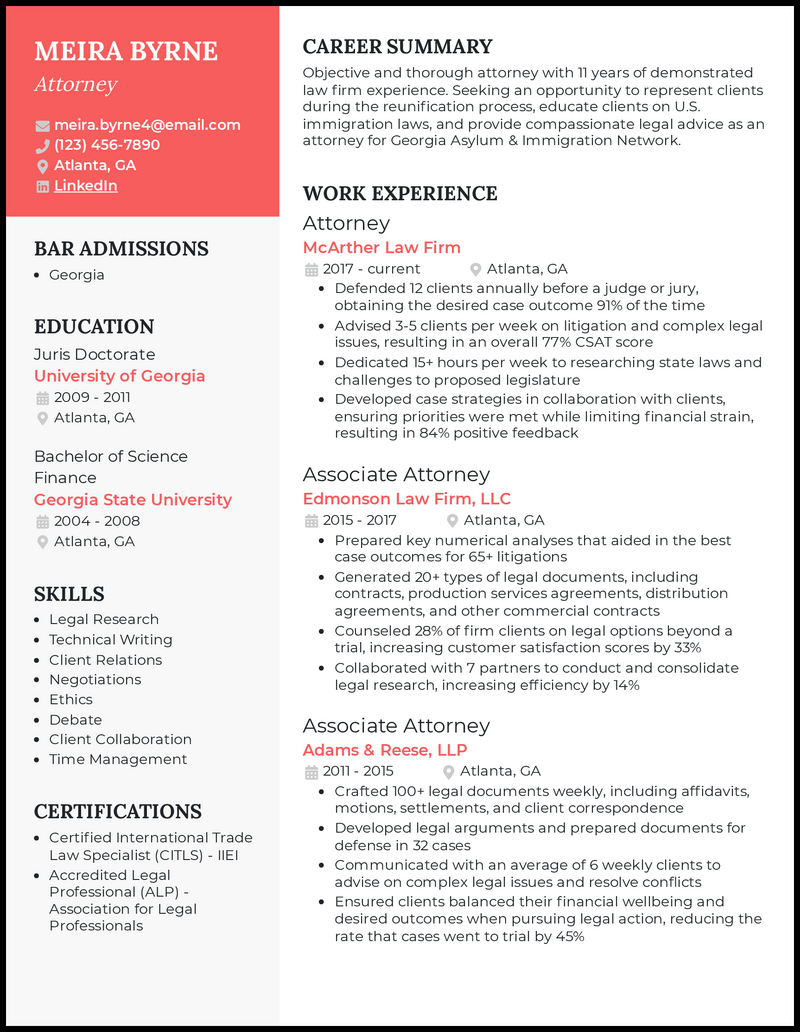
Why this resume works
- Of course, your attorney resume needs stellar content, but don’t underestimate the power of creativity when it comes to getting a job. Use a resume template with two font types, separate each section with big headers, and include a splash of color.
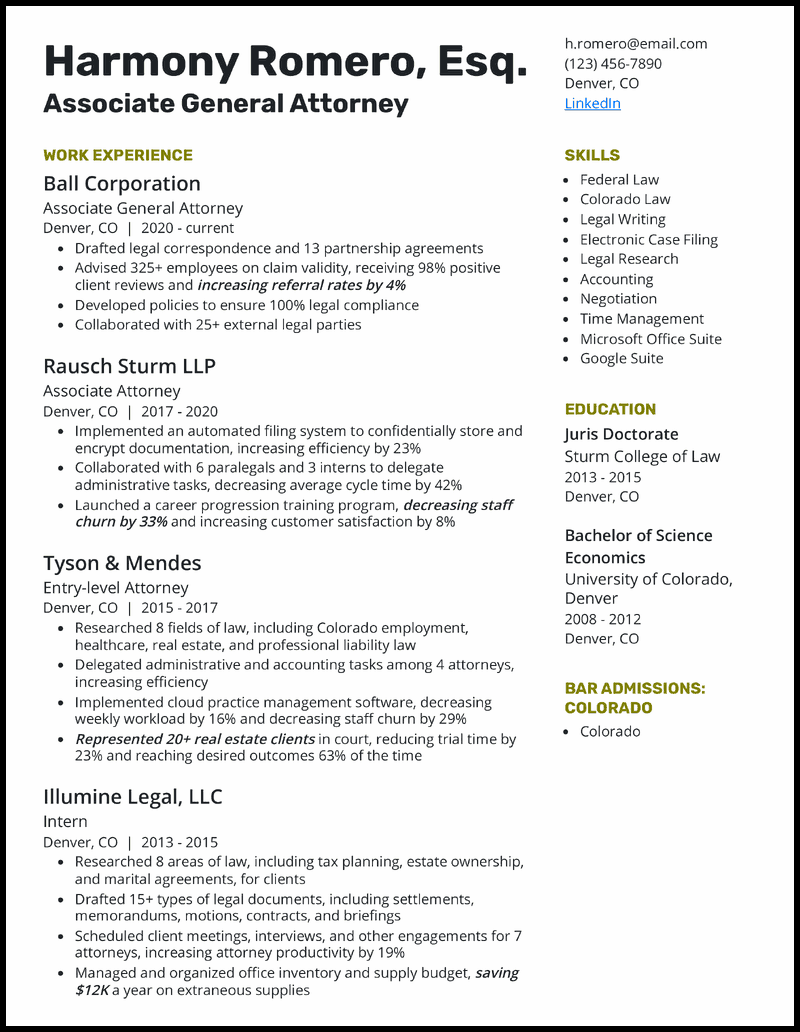
Why this resume works
- As you get more litigation experience, you’ll have more to include on your associate attorney resume. However, we’d recommend having a maximum of four work experience entries (three being the average).
- When done, check your resume to make sure it’s error-free; a second reviewer can also catch mistakes spell-check may miss before you submit it.
See more associate attorney resumes >
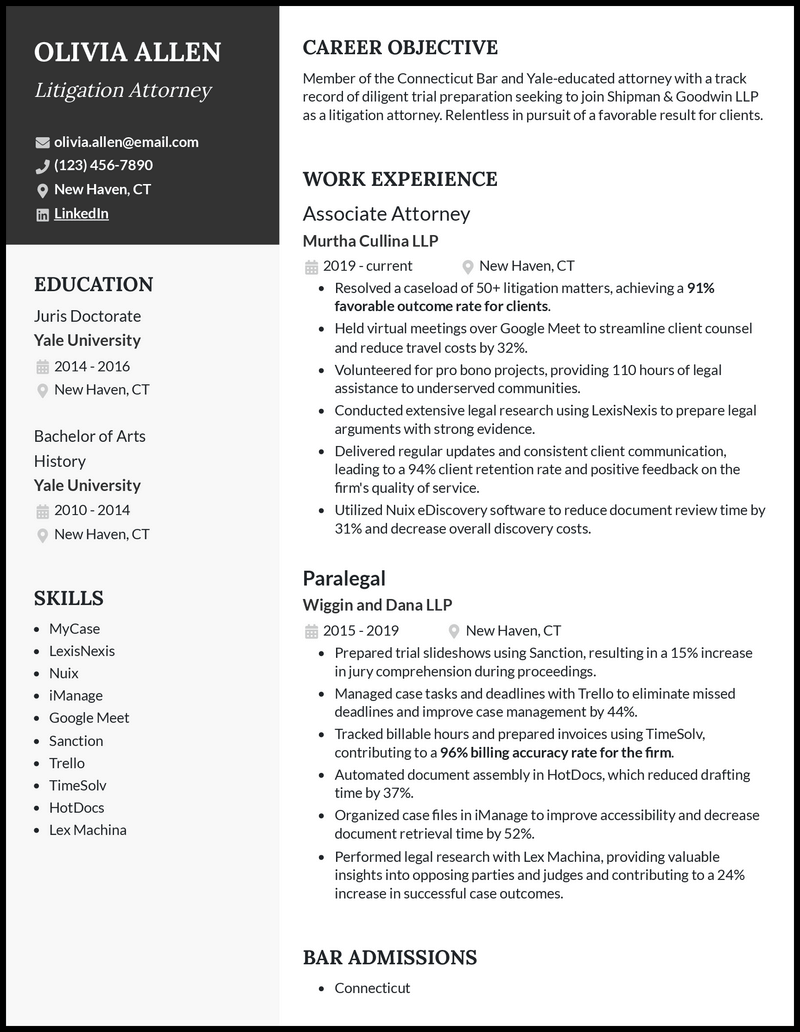
Why this resume works
- Many top attorneys start out as paralegals. A professional background in legal support equips you to dive right in to the firm once you’ve earned your J.D. Therefore, don’t downplay your paralegal experience on your litigation attorney resume. It adds a degree of proficiency to your practice.
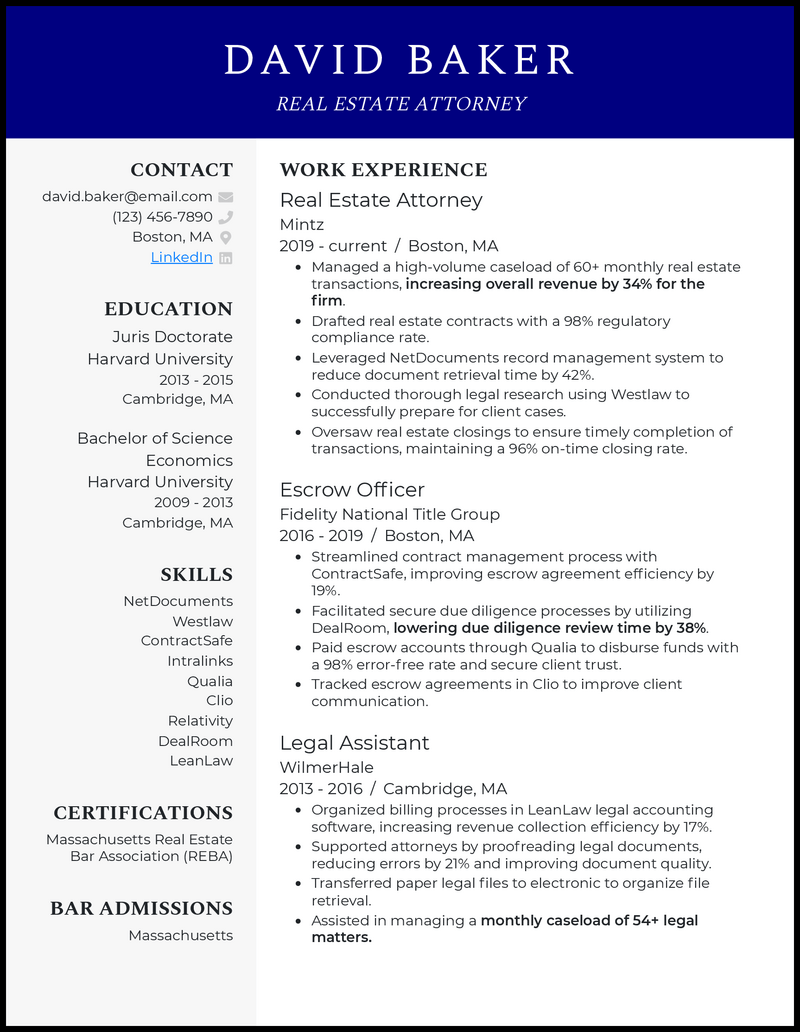
Why this resume works
- As an attorney, you know that you can only practice in the state you were admitted to the Bar. But if you’re a certified member of a specialized Bar Association—like real estate—in that same state, you can take your real estate attorney resume up a notch.
See more real estate attorney resumes >

Why this resume works
- Don’t worry if your entry-level attorney resume lacks work experience; you have more flexibility with your resume. For example, ncluding a resume objective can be an effective way to demonstrate your particular interest in the role you’re seeking.
See more entry-level attorney resumes >
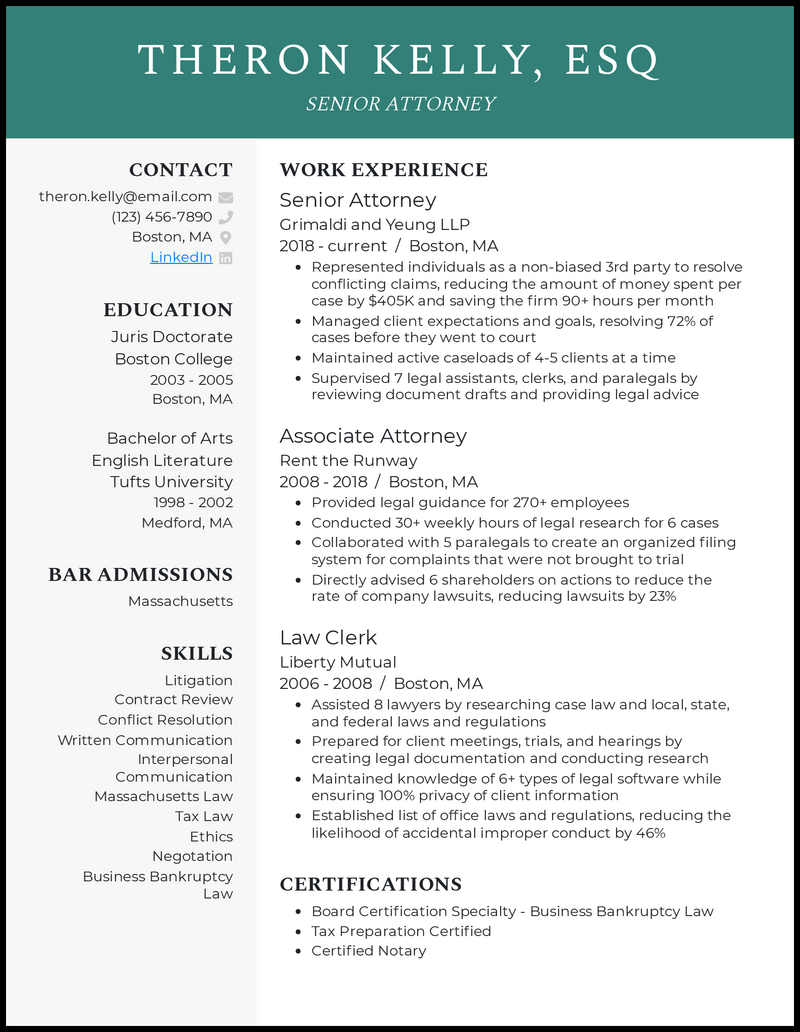
Why this resume works
- As a senior attorney, you have years of experience that you want to show your future employer. Thus, you may wonder whether you should submit a CV or a resume. Whatever you choose, double-check the job description to ensure you’re providing the correct information.
- Also, note that attorneys with extensive experience may need more space, but your resume should usually stay within one to two pages based on relevant experience and role seniority.
See more senior attorney resumes >

Why this resume works
- Whether your experience is in trademark law or not, always compare your trademark attorney resume against the attorney job description. Use similar keywords and responsibilities to reassure your future employer that you’re fit for the job.
See more trademark attorney resumes >
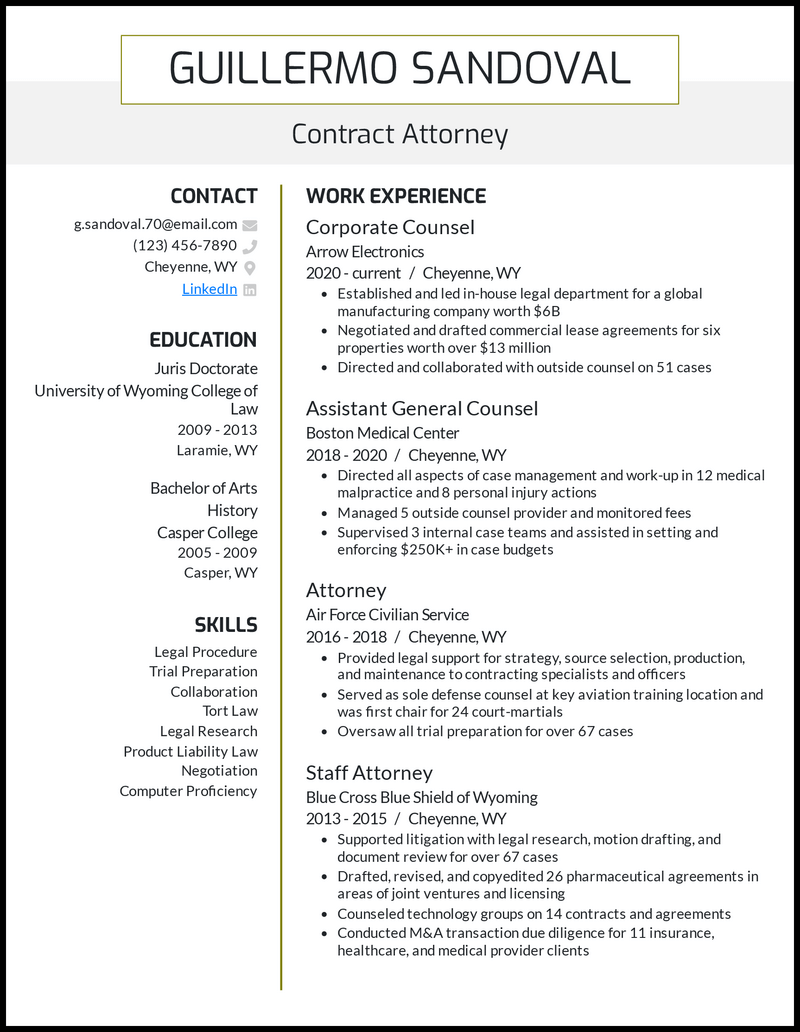
Why this resume works
- The best way to make your contract attorney resume shine is by matching your experience and skills with the attorney job description. Tailor your resume skills section and work experience by including keywords mentioned in the job ad.
See more contract attorney resumes >

Why this resume works
- Quantifiable results always grab an employer’s attention, and since civil litigation almost always involves dollars, you need to show hiring managers the money. How many cases did you handle? How many clients did you meet? How many contracts or drafts did you review? Odds are, most of your responsibilities involve numbers.
See more civil litigation attorney resumes >
How to Write an Attorney Resume

Summary
You’ll learn how to write a powerful, results-driven attorney resume highlighting legal expertise, measurable impact, and job-specific skills to land top legal roles.
Creating a job-winning attorney resume demands charisma, brevity, and a deep understanding of legal employers’ needs. We’ll show you the essential components of a standout attorney resume—from highlighting your legal expertise and courtroom success to showcasing your analytical skills and impactful achievements.
In this section we’ll cover:
- How to present your qualfication in the best format
- Why and how to craft a compelling professional summary
- How to present your experience with impact through metrics
- Hard and soft skills that matter to every role
- How to position your resume to match the job posting

How to choose the right resume format for attorneys
Your resume format makes it easy or difficult for recruiters, potential employers, and applicant tracking systems (ATS) to read and understand your document. The right layout must make it easy to find the most crucial information: Expertise, results, education, and professional growth presented for both human and AI readership.
As an attorney, you have three formats to choose from: reverse-chronological, functional, or hybrid/combined. The one you choose depends on your experience level, speciality, and career goals.
Let’s now delve more into how to make the best choice.
Reverse-chronological vs. functional format
The reverse-chronological resume is the most trusted and widely used format by attorneys and universally accepted by law firms. Present your legal work history in reverse chronological order, starting with your most recent role, and list each position with the employer, title, and dates of employment before the accomplishment bullets to show a clear progression in both scope and expertise.
The reverse-chronological format is best if you:
- Have consistent experience in the same legal domain (e.g., litigation, corporate, or IP law)
- Want to showcase career growth through promotions, leadership roles, or employer changes over time
- Need to align with the traditions of the legal practice
A functional format, by contrast, focuses on skills rather than experience and periods. As an attorney, use it only when changing practice focus or returning to the legal field after a gap. However, be advised that law firm recruiters and ATS software tend to favor it less because it obscures employment timelines.
When to use a hybrid resume format
The hybrid (or combined) resume mixes both the worlds of chronological and functional elements. It can start with either the skills or work experience summary, then present each role and achievements in chronological order.
This format is ideal for:
- Mid-level attorneys transitioning into new specialties, for instance, from litigation to compliance
- In-house counsel candidates who want to emphasize strategic impact above roles
- Attorneys with a blend of experiences, say in consulting, contract, or part-time legal work, and would need flexibility in presentation
Formatting tips for entry-level vs. senior attorneys
Among many other factors, formatting options differ depending on your level of legal career. Here’s how to ensure you use the right format.
For entry-level attorneys:
- Don’t go beyond one page
- Prioritize your law school achievements and early-career track record from clerkships, internships, and bar admissions
- Present your section in headers, such as “Education,” “Legal Experience,” or “Skills”)
For senior attorneys:
- One page is great, but use two pages if you have 10 or more years of experience
- Prioritize your standout achievements in leadership and management
- Use metrics when possible

How to craft a compelling attorney resume summary
Your professional profile is a 10-second elevator pitch that can open doors for you. It’s what recruiters read first to identify a quality hire, so make it count. Whether you’re a legal beginner or a seasoned pro, this statement should highlight who you are and showcase your value, career journey, and aspirations.
Your attorney resume summary is, most of the time, the first and probably the only thing a hiring manager reads before deciding to toss or proceed reading the rest of your document. It’s also the key section that applicant tracking systems (ATS) begin their scanning on to establish relevance. Therefore, you need a two or three-line overview that proves you have the legal expertise, experience, and measurable accomplishments that say you’re fit for the job.
In short, this section should clearly answer:
- What type of attorney are you?
- What’s your law specialty?
- What impact have you made in prior roles or cases, and are they relevant?
Tip: Be factual, concise, and lean more on results rather than duties.
What to include in a legal resume summary
For an attorney resume summary to hook recruiters and impress ATS, define your professional identity, expertise, and impact.
Must-include elements:
- Job title/niche: e.g., “Corporate Attorney,” or “Employment Law Specialist.”
- Years of experience: Be specific 5 years or give an estimation, 10+ years
- Core skills: Must be inclined to your niche, e.g., “M&A transactions,” “contract negotiation,” or “regulatory compliance”
- Notable achievements or metrics: Quantify your success where and when it makes sense
- Domain/client focus: Reference the industry you practice, such as “healthcare,” “financial services,” or “intellectual property”
Pro Tip: Always provide context on how and when you used these relevant skills, as well as the results of your actions.
Attorney resume summary examples (Entry-Level, Junior, Mid, Senior)
Your career summary should reflect your level, goals, domain, and industry you want to join or have experience in.
Entry-level attorney resume objective:
“Recent J.D. graduate with substantial research and litigation skills developed through internships and moot court competitions. Passionate about corporate law and eager to join Latham & Watkins LLP as a junior associate to contribute to high-profile M&A cases. Proficient in legal writing, contract analysis, and case law research.”
Junior attorney resume summary example:
“Licensed attorney with 3 years of experience in commercial litigation and arbitration. Skilled in drafting motions, managing discovery, and supporting trial preparation. Proven ability to manage 20+ active cases simultaneously while maintaining client satisfaction at Morton Green Advocates.”
Mid-level attorney resume summary example:
“Corporate attorney with 6 years of experience advising 4 Fortune 500 clients on M&A transactions and compliance. Known for negotiating 50-million-dollar contracts and leading cross-functional deal teams to ensure risk mitigation and regulatory alignment.”
Senior attorney resume summary:
Business law attorney with 12+ years of experience advising Fortune 500 clients on regulatory compliance and commercial litigation. Achieved a 92%-win rate in arbitration cases over the past 6 years. Expert in risk assessment, cross-functional team leadership, and legal strategy. Seeking to lead the litigation practice at a forward-thinking law firm.

How to highlight your legal experience with impact
Your resume shouldn’t read like a job description—it should show your impact. Generate bullet points to demonstrate what you accomplished, not just your roles. Emphasize metrics, results, and the legal skills that made you successful. Recruiters want to know if you’ll make their lives easier and cases stronger.
Your legal experience section is the clearest signal of your professional credibility: It showcases where you’ve worked, what you achieved, and presents it with numbers that speak to your success. One great trick here is to use action verbs and quantifiable results in a legal context to let recruiters know you’re the best candidate, as well as provide what ATS will be screening for.
As you follow this script, revisit the job posting and address the firm’s needs by offering solutions that leverage your skills, specialization, and results.
Use action verbs and legal jargon strategically
Strong verbs establish an immediate impact and help hiring managers visualize your capabilities. However, you must ensure a balanced use of legal jargon so that both humans and AI screener can understand.
Examples of high-impact action verbs for attorney resumes:
- Advocated
- Drafted
- Negotiated
- Litigated
- Argued
- Resolved
- Advised
- Structured
- Mediated
- Represented
Pro Tip: Don’t merely say, “Responsible for case”, Say, “Represented 4 clients…”
Quantify legal achievements (with metrics)
Metrics are transformative in that they convert your experience from mere description of duties to persuasive achievements that compel employers to pay attention to your resume. If possible and logical, use numbers, percentages, or frequencies to give the measurable outcome of your activities.
How to quantify legal experience:
- Case wins vs losses, acquittals vs. convictions
- Financial results for negotiated settlements
- Client impact, for example, “Reduced corporate litigation exposure by 33%.”
- Volume of work: Cases handled within a specific timeline
- Efficiency gains: Cutting case turnaround times by, say, an average of 13 days/case
Tailor experience to legal domain (Real Estate, Litigation, etc.)
Each legal field values different skills, so tailoring your resume shows you know what you want. Name the practice area, case type, or industry to show clients you understand their needs.
How to tailor your experience for each niche effectively:
- Litigation: Competencies in case preparation, motion practice, depositions, and achievements that say you’re a winner
- Real Estate Law: Provide hard proof that you can be relied on to draft contracts, close hard-fought deals, zoning approvals, and property due diligence
- Corporate Law: Let big law firms or clients know that you have their backs in M&A, compliance, and contract negotiations
- Family or Criminal Law: Wins in client advocacy, mediation success rates, and case resolution speed are central to what clients, as well as potential employers, will seek in your resume
Work experience bullet points for an attorney resume
✅ Led a team of 3 attorneys in managing 45+ civil litigation cases, resulting in a 78% client success rate and reducing case resolution time by 6 days.
✅ Drafted and negotiated 123 commercial contracts with zero legal disputes, contributing to a 27% increase in client satisfaction year-over-year.

How to showcase relevant legal skills
Your attorney skills define the kind of expertise you would bring to the workplace when hired. Hiring managers and ATS will be screening for both hard and soft competencies to see if you meet the threshold dictated in the job posting. The best approach is to organize your skills in a manner that is visible and easy to retrieve.
Key legal skills for all attorneys
Your skills section should be a laser-focused list of what makes you the must-hire attorney. Think of it as your greatest hits—the tools, strategies, and legal knowledge that set you apart. Keep it tailored to the open role, relevant, and scannable.
Key legal skills:
- Legal Research & Writing
- Contract Drafting
- Trial Preparation
- Regulatory Compliance
- Litigation Strategy
- Corporate Law
- Negotiation
- Westlaw & LexisNexis
- Client Counseling
- Case Management
Top hard skills for attorneys (By specialization)
Hard skills are direct competencies that demonstrate your ability to handle legal procedures, tools, and documentation in accordance with professional standards and best practices. These attributes vary from one niche to another, but also span different practice areas.
Litigation attorneys
- Legal research and writing
- Motion drafting and pleading
- Deposition preparation and trial advocacy
- Client counseling
- Case strategy
- Electronic documentation: PACER, CM/ECF
Corporate Attorneys
- Entity formation and restructuring
- Mergers and acquisitions (M&A)
- Contract negotiation and review
- Regulatory compliance
- Risk management
- Due diligence
Real estate attorneys
- Title review
- Closing coordination
- Contract analysis
- Lease drafting
- Property acquisitions and financing
- Escrow and settlement management
Intellectual property (IP) attorneys
- Trademark and patent application filing
- IP portfolio management & litigation support
- Licensing and infringement analysis
- Trade secret protection
Employment & labor attorneys
- Drafting employee handbooks
- Labor relations and dispute resolution
- EEOC and compliance representation
- Mediation and arbitration
In-demand soft skills for attorneys in 2026
While it’s your legal prowess that distinguishes your practice from other candidates, some positions expect you to be a leader, adaptable, and emotionally intelligent. Other interpersonal skills that matter for attorneys include:
- Strategic problem-solving
- Written and verbal advocacy
- Client relationship management
- Team collaboration and mentorship
- Active listening
- Time management and multi-case prioritization
Pro Tip: Always provide context on how and when you used these skills, as well as the results of your actions.
Where to place skills on your attorney resume
Place and use your skills in the following areas:
- Dedicate a “Skills” section, often below your professional summary, after education, or experience
- Embed within experience bullets to add context

How to include your education, certification, and bar admission
Education matters—especially in corridors of justice. List your law school first, including honors, relevant coursework, and your GPA if it’s 3.5 and above.
Example of education
Juris Doctor (J.D.),
University of Michigan Law School
Ann Arbor, MI
2020-2024
GPA: 3.8
Activities: Law Review, Moot Court
Certifications boost credibility. If you’ve taken legal-specific training or earned industry certifications, add them here.
Certification example
Certified in Legal Project Management – Legal Project Management Institute, 2024
Bar admission is non-negotiable. Mention your active license and jurisdiction. Include multiple states if applicable.
Example
Admitted to the Bar – State of New York, 2024
Admitted to the Bar – District of Columbia, 2026
How to tailor your resume to the open role
Keep professional contact details prominent at the top so recruiters can identify and reach you immediately. The best attorney resumes respond to what the job demands.
Carefully read the job posting, paying close attention to the key legal skills and experiences they seek from your target employer. Add those key terms to your resume to get past ATS filters.
Next, choose a clean, modern, ATS-friendly template that will not be rejected by HR systems. Keep the formatting consistent, use standard headers, and save your document as a PDF for device portability unless specified otherwise. Leave some white space and keep paragraphs concise to enhance readability.

Key takeaways
- Use a clear format (reverse-chronological most of the time)
- Start with a compelling summary
- Show impact through metrics
- Match your language to your practice area and mirror keywords from job descriptions
- Blend hard and soft skills
- Keep it one page and two pages if you’re experienced in a specific domain for 10+ years
Related resume guides
Attorney Resume FAQs

A good attorney’s resume is clear, concise, targeted, and results-driven. It highlights your legal mastery, shows the impact of your past roles with metrics, and aligns perfectly with the job you’re applying for. Clear formatting, active voice, and relevant keywords help you stand out.
Use the reverse-chronological format and add key sections in this order: the professional profile, experience, skills, education, then certifications, and bar admissions.
Use bullet points, a definitive job title, and clear section headers. Keep it to one page if you have less than 10 years of experience; two pages is the max for senior attorneys. Always proofread because your attention to detail reflects your legal credibility.
Yes. As an attorney, employers expect you’ll have passed the bar, and depending on the specific type of legal work you’re interested in, you may need more specialized certifications, such as the Certified International Trade Law Specialist or Board Certification in Criminal Law.
While hiring personnel will likely request photocopies of your licenses and certifications, you should still list these on your attorney resume since it’s a quick assurance that you’re qualified for the specific role.
List your highest education first. Start with law school and work your way down to your undergraduate degree (exclude high school). In the education section of your resume, you should list the name of the school along with the location, law degree, and when you completed the degree.
If you’re recently out of school, consider adding short bullet points that point to academic accomplishments, especially as it relates to legal work.
Keep it to one page. This is your opportunity to quickly advertise your best law qualifications and accomplishments. Going into detail is best reserved for writing a great cover letter.

Stephen is the co-founder and CEO of BeamJobs. Frustrated with the challenges he'd faced in his own job search, he left the corporate world to start BeamJobs with his brother. Drawing on firsthand experience with hiring and getting hired as technical talent, he started BeamJobs in 2020 to help qualified job seekers land interviews with less stress. Since then, more than 4 million people have built their resumes and cover letters on BeamJobs. Stephen's insights have been featured in notable outlets, such as Fast Company, Business Insider, Yahoo Finance, MIT, and Zapier. Learn more about Stephen.