



![7 Security Officer Resume Examples [& Templates]](https://beamjobs.wpenginepowered.com/wp-content/uploads/2023/02/security-officer-resume-example.png)
Creating the perfect security officer resume means showing employers that you can protect people, property, and information with skill and reliability.
This guide explains what exactly you should include on your resume and how to make a cover letter that completes a strong application.
Here’s what you’ll learn:
- ↪ 7 security officer resume samples to guide your structure and wording
- ↪ A step-by-step guide to land your next job in 2026
- ↪ How to stand out from the competition by showcasing measurable results and key strengths
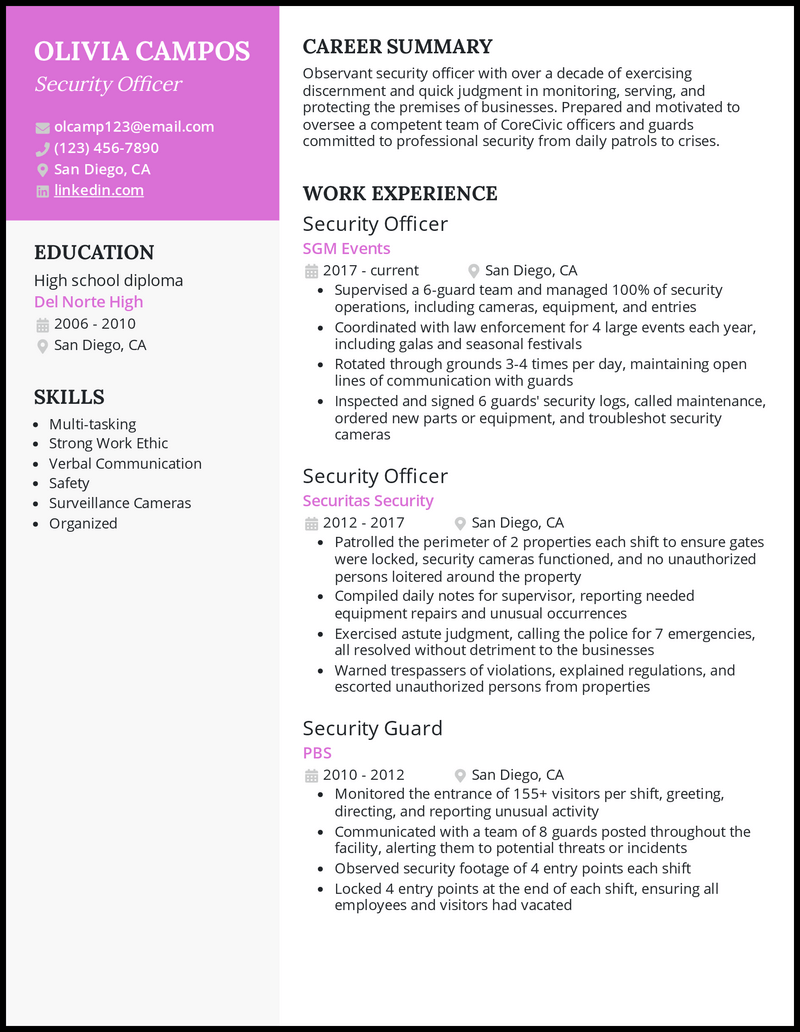
Why this resume works
- If you’re seeking career advancement, you’ll want to ensure your security officer resume delineates that upward progression. It’s best to place your work experience in reverse-chronological order as it will display your most recent job first, which will likely be most similar to the position for which you’re applying.
- In your resume summary statement, emphasize that you’re ready for advancement.

Why this resume works
- What was your role in supporting juniors to improve their efficiency and performance? Like John, did you train new officers and see their security protocol proficiency improve?
- That’s a plus for your transportation security officer resume because it shows recruiters your ability to transfer skills to ensure better team performance.

Why this resume works
- Data security is at the core of your responsibilities in this role. As such, to impress potential employers, your chief information security officer resume must show a perfect record in preventing and thwarting breaches.
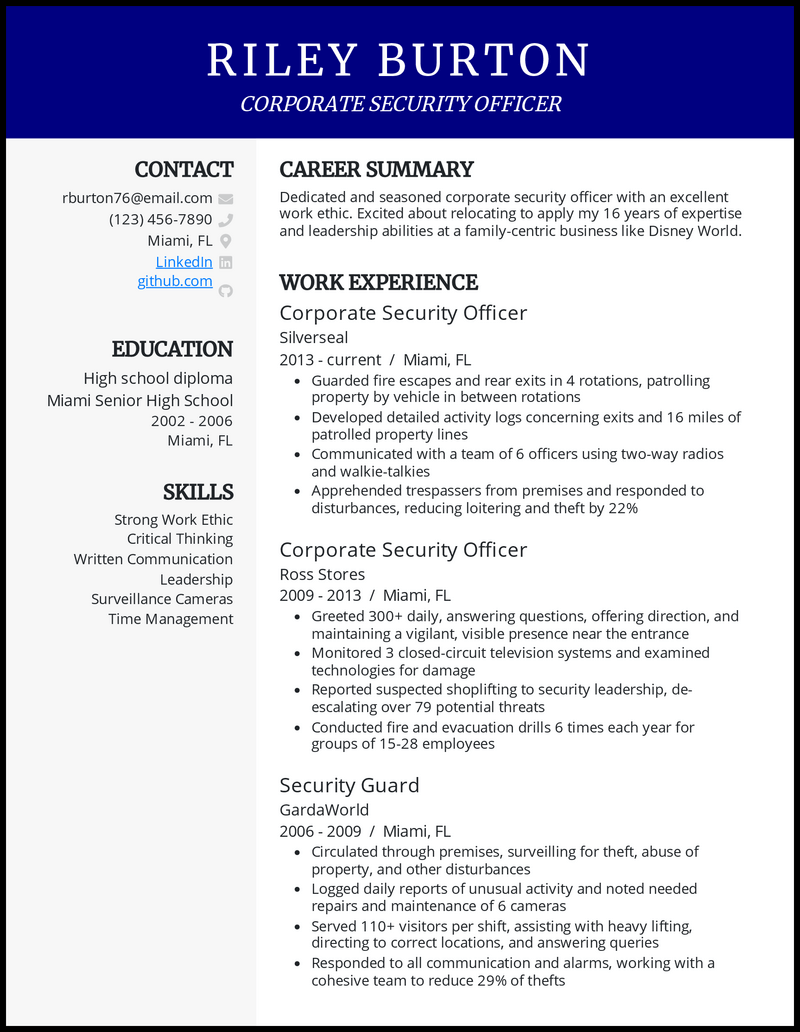
Why this resume works
- Your corporate security officer resume can demonstrate career progression by highlighting increased responsibilities with metrics regarding theft reduction, effective management of threats, or the size of teams you worked with or managed.

Why this resume works
- Let your protective security officer resume summary pack a punch. If you’ve got a hefty work history in the field, abilities, skills, certificates, or licenses that not everyone else has, use the summary statement to highlight what you can bring to the table.
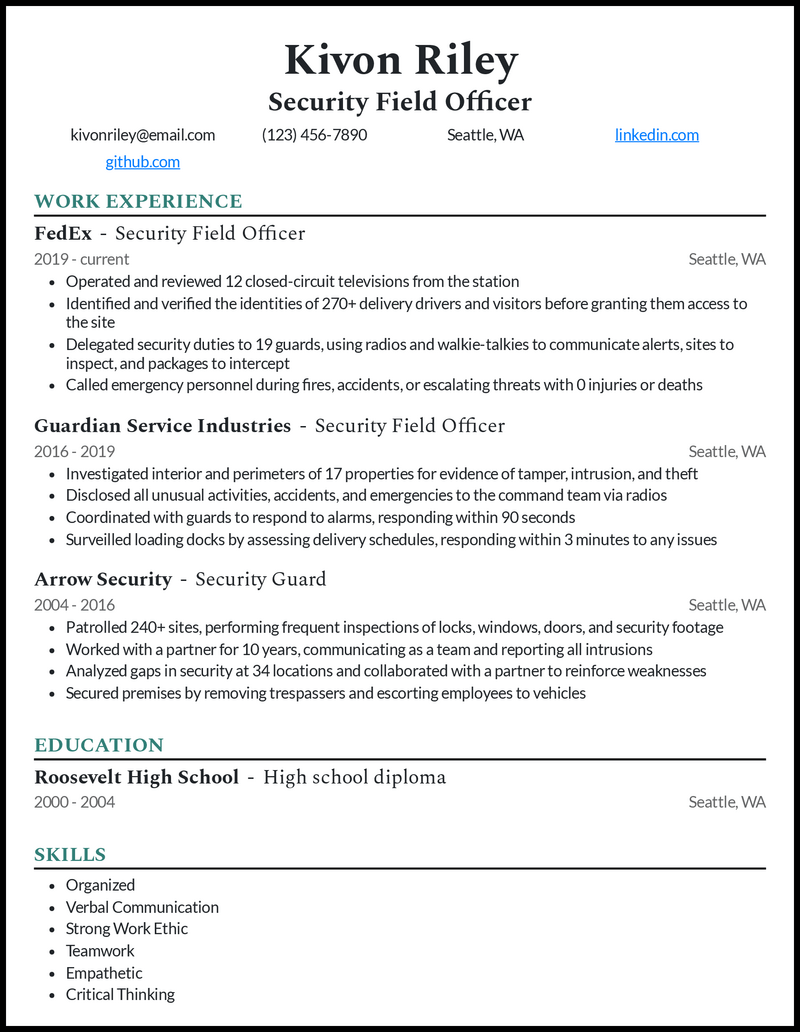
Why this resume works
- One skill that’s super important for a security officer is working well with other people. Your security field officer resume will work best if you show collaboration and partnership for each role listed at least once.
- If you choose a resume format that places your skills toward the bottom, that’s okay, provided your work experience bullet points demonstrate those skills.

Why this resume works
- When you’re just building a work history, you may feel unsure about how to fill a page on your entry-level security officer resume. Do some research on the specific security officer job you’re seeking by looking over the job description. A great area to start is the “resume skills” section.
- Another way to fill your page as an entry-level candidate is to include a resume objective.
Related resume guides
Land your next job with our AI-powered, user-friendly tool.
Gut the guesswork in your job hunt. Upload your existing resume to check your score and make improvements. Build a resume with one of our eye-catching, recruiter-friendly templates.
• Work in real-time with immediate feedback and tips from our AI-powered experience.
• Leverage thousands of pre-written, job-specific bullet points.
• Edit your resume in-line like a Google Doc or let us walk you through each section at a time.
• Enjoy peace of mind with our money-back guarantee and 5-star customer support.
How to Write a Security Officer Resume

The best security officer resumes tell a story of responsibility, action, and reliability. They show employers that you won’t miss details, lose your cool, or drop the ball in a crisis. That starts with strategic resume writing.
Summary
Safeguard your career path by crafting a security officer resume that’s precise, professional, and packed with proof of your vigilance, reliability, and readiness.
Whether guarding a corporate campus or managing night patrols, your resume should reflect the discipline and alertness you bring to the job. An excellent security officer resume isn’t just about listing job titles—it’s about communicating that you’re trustworthy, observant, and action-ready.
What to include?
- Your certifications and licenses (like CPR, first aid, or state-issued guard cards)
- Shift experience (day/night), foot vs. vehicle patrols, monitoring systems
- Incident response stories that showcase calm, control, and clarity
- Soft skills like conflict resolution, communication, and integrity
How to write it?
- Use clear, no-fluff language that mirrors your professional presence
- Focus on results—did you prevent theft, reduce risk, improve procedures?
- Always tailor it to the job post—employers want relevant and recent experience

Core components of a security officer resume
These are the must-haves in your resume:
- Contact: Keep it simple and professional
- Summary or objective
- Work experience: Focus on results
- Skills: Divide into hard and soft skills
- Education: A high school diploma or equivalent usually suffices
- Extra sections: Certifications, languages, awards, or commendations

Tips for writing a security officer resume
Follow these hacks and be on your way to the next job:
- Tailor it: Always customize your resume for each job posting. Keywords like “patrol,” “access control,” or “loss prevention” go a long way.
- Keep it concise: Focus on what proves you’re dependable and effective—not on every job you’ve ever had.
- Use active verbs: Start bullets with “Monitored,” “Secured,” “Responded,” or “Deescalated.” They show initiative and impact.

Write a security officer summary
One of the selling points of your resume is brevity. If you can tell recruiters why they should hire you in a maximum of three lines, you’ve saved time and made a perfect first impression.
In a brief statement of 2-3 lines, say who you are, your achievements, skills, specialization, and anything else a potential employer should care about. It’s also important to use some keywords from the job posting.
Whether it is an objective or a resume summary, convince the hiring manager you have what it takes to excel in the job.
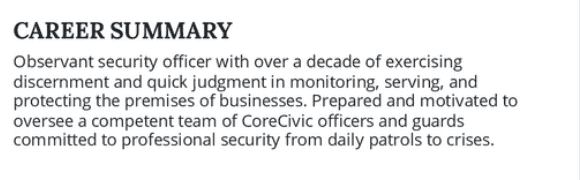
Example of a career summary for a security officer resume

Outline your relevant work experience
From your work history, identify roles similar to a security officer’s job. It may be an internship or a junior role, but as long as it aligns with the new role, you can use it.
List two or three roles with your job title, the company name, location, dates worked, and four bullet points for each entry.
Start with the most recent role and take recruiters on a journey of career progression, more responsibilities, and your growing professional value.

Use Metrics to highlight value and impact
What did you do from the roles you’ve served before? What achievements are you proud of?
Security is about being hands-on with your skills and tools, and making people feel safe. Use a combination of action words, numbers, and abilities to paint a clear picture of your achievements in a potential employer’s mind.
Did you reduce security breaches? How many threats did you neutralize, or when did you lead a team to get the job done? From all these activities, say the specifics in a clear, measurable, and impactful manner.
Example
✅Reduced unauthorized access incidents by 44% in six months by implementing CCTV monitoring and conducting hourly patrols
✅Trained a team of 8 junior officers on incident reporting software and emergency protocols, cutting response times by 3 minutes during drills and real events
✅Prevented property loss valued at over $75K by detecting and resolving security breaches using access control systems

Demonstrate your competencies
Keeping people and facilities safe takes more than brawn. You should make good calls for every security incident, clearly communicate with colleagues and the people you’re protecting, and stay calm when things are heated.
Your competencies are the only way to demonstrate that you can do that. You should be able to use the latest surveillance technologies, report incidents accurately, respond to emergencies in a timely and professional manner, properly understand legal procedures, defuse situations, and clearly communicate.
Here, your technical and soft skills come to the fore. You need a blend of both to carry out your duties to satisfaction.
Examples:
- Strong work ethics
- Surveillance cameras
- Motorola APX 8000XE
- Cisco ASA
- Firemon
- Time management
- Morpho Detection Itemiser DX

Leverage action verbs
When you describe your past jobs, you should be convincing. As much as using metrics does the heavy lifting for you, action words add the punch that will make recruiters call you.
At the beginning of every bullet point, deploy a unique and compelling action verb that presents you as a competent worker. You can use these words to match the persona that recruiters want.
Be careful not to throw buzzwords that add no value to your candidacy.
Instead of saying, “Helped”, “Assisted” or “Supported”, say you “Managed”, “Investigated” or “Patrolled”. These words are not only action-oriented but also suitable for the security field.

Package everything in a professional format
Every role, company, and industry is different, and recruiters seek candidates who match their needs. When you write your security officer resume, ensure it is directly tailored to the job, the company, and industry you want to work in.
Ensure to:
- Use a formal, easy-to-scan format
- Be consistent with spacing, margins, and fonts
- Avoid graphics and images
- Keep it all on one page

Key Takeaways
For security officer resume that win the job:
- Show professionalism
- Lead with impact
- Tailor, tailor, tailor
- Be confident with your skills
Security Officer Resume FAQs

Your resume should communicate that you protect people, property, or assets—list tasks like patrols, access control, surveillance monitoring, emergency response, and incident reporting.
Core skills include surveillance, crisis response, conflict de-escalation, report writing, and communication. Soft skills like integrity, reliability, and alertness should also be considered.
Ideally, one page. If you have over 10 years of highly relevant or specialized experience, you may extend to two—but no more.

Stephen is the co-founder and CEO of BeamJobs. Frustrated with the challenges he'd faced in his own job search, he left the corporate world to start BeamJobs with his brother. Drawing on firsthand experience with hiring and getting hired as technical talent, he started BeamJobs in 2020 to help qualified job seekers land interviews with less stress. Since then, more than 4 million people have built their resumes and cover letters on BeamJobs. Stephen's insights have been featured in notable outlets, such as Fast Company, Business Insider, Yahoo Finance, MIT, and Zapier. Learn more about Stephen.