



Building a police officer resume takes more than listing past responsibilities — it’s about showing integrity, specialized training, and proven results in keeping communities safe.
Whether you’re an entry-level officer, new cadet, experienced patrol officer, federal agent, NYPD officer, campus security, auxiliary officer, or transitioning from the military or retirement, we’ve got tailored resume examples and tips for every scenario.
From making an amazing resume to writing an effective cover letter or a professional resignation letter, this guide walks you through presenting your career with clarity and confidence.
What you’ll find inside:
- ↪13 police officer resume samples to inspire your application
- ↪ Step-by-step breakdown of how to let your skills and achievements set the tone of success
- ↪ Guidance on what to include or leave out to transition smoothly into your next role

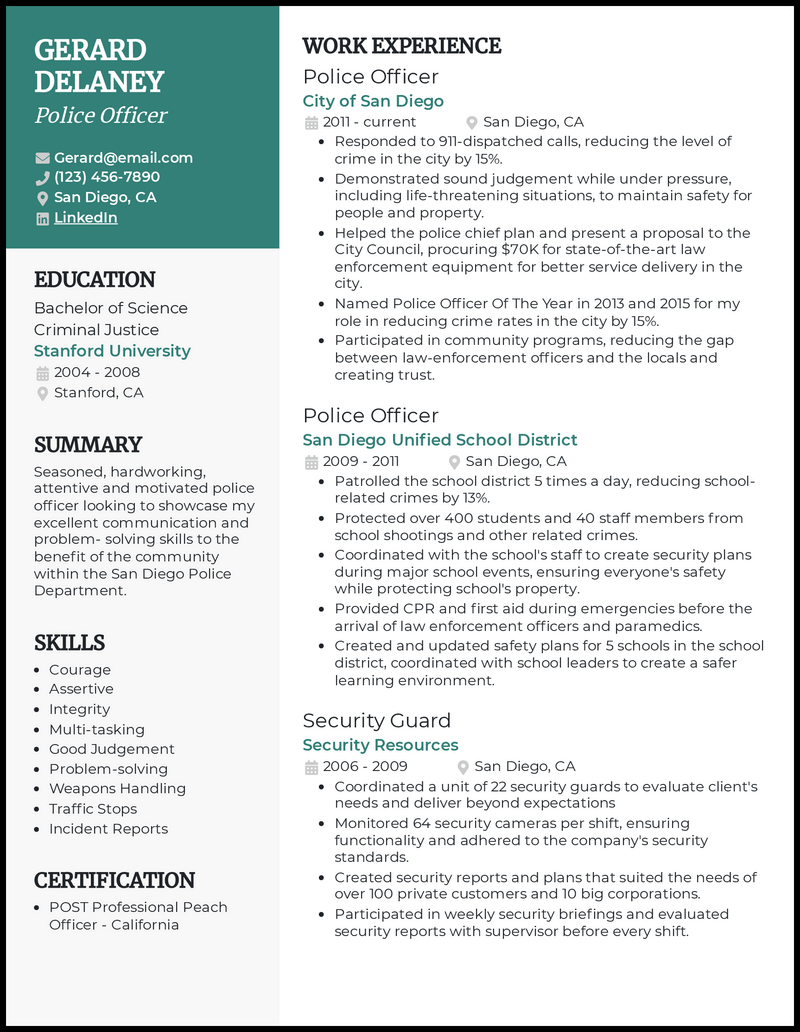
Why this resume works
- While many people may recommend adding a summary or objective, you should only include a resume summary if you’ve been in the field for at least 10 years. If you’re just starting out, you can use a resume objective instead.

Why this resume works
- The first order of business is to have proper sections for your personal details, education, and skills. Next, don’t forget to add certifications such as Virginia Law Enforcement Certification to display your expertise.

Why this resume works
- Using impactful action words can do wonders for your police sergeant resume. Take a look at how words such as tracked, developed, and supervised convey the candidate’s strength more confidently.
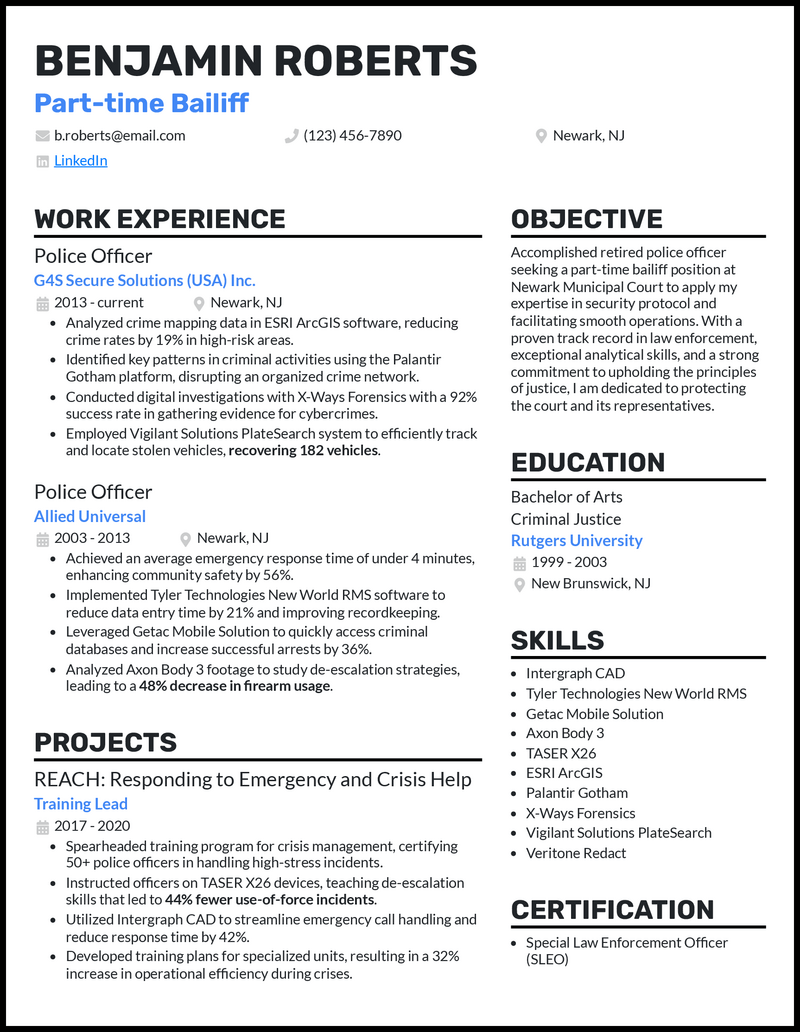
Why this resume works
- It may be challenging to summarize your storied law enforcement career on your retired police officer resume, but including a career objective can help align your background with your desired role.

Why this resume works
- You should show how you’ve taken on greater responsibilities if you have multiple sections of work experience in your public safety officer resume. Applying this resume tip will help the employer get a sense of what you’ve accomplished in your career.
View more public safety officer resumes >

Why this resume works
- A military police officer resume that shows you can keep the upper hand while in the field can give you a leg up in the competition. And what better way to write it than by showcasing your leadership prowess?

Why this resume works
- Despite being wet behind the ears, make sure to create a good first impression. You don’t want the potential employer thinking they’ve got to teach you everything. So? Ensure that your police officer trainee resume is nothing short of dazzling.
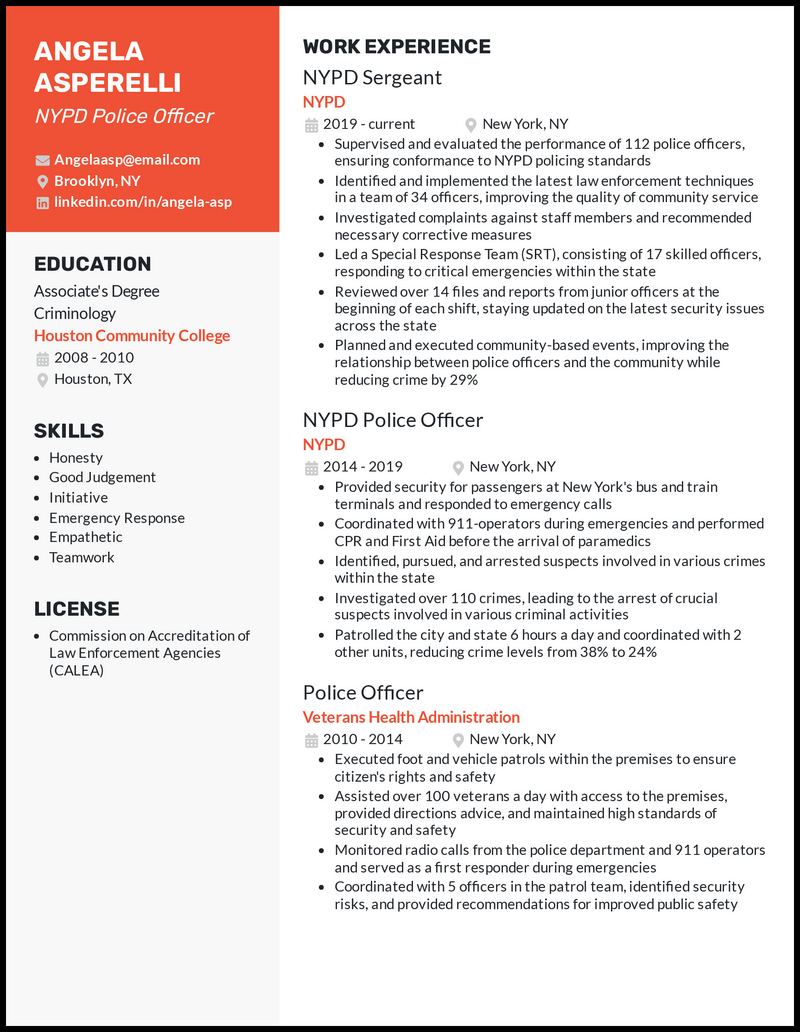
Why this resume works
- Your NYPD police officer resume needs to have modern, formatting should state your most current experience first. For instance, did you achieve the status of sergeant or captain? Include it on your resume, highlighting your most recent and relevant experience first in reverse-chronological order.
View more NYPD police officer resumes >
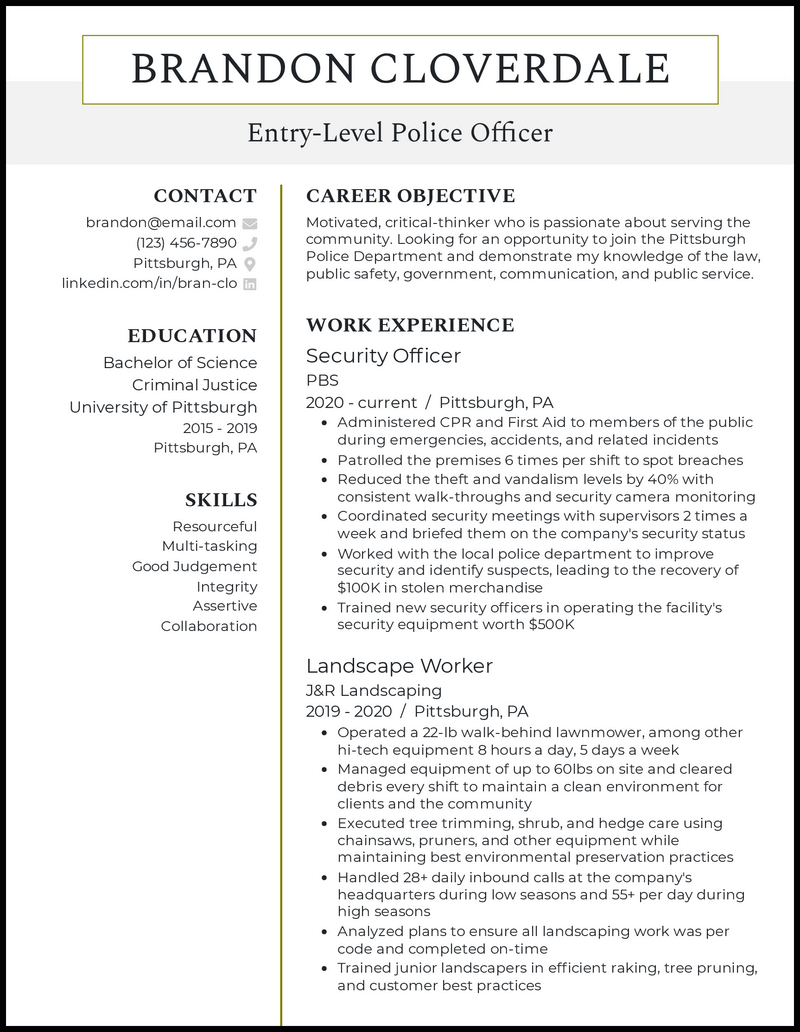
Why this resume works
- Simply include any work experience you have. Then in your work experience bullets, focus on highlighting transferable skills related to the police officer job description.
View more entry-level police officer resumes >

Why this resume works
- Make your federal police officer resume sparkle with a neat and elegant resume format. Start by putting your work experience in reverse-chronological order, then lay out the rest of your information according to importance.
VIew more federal police officer resumes >
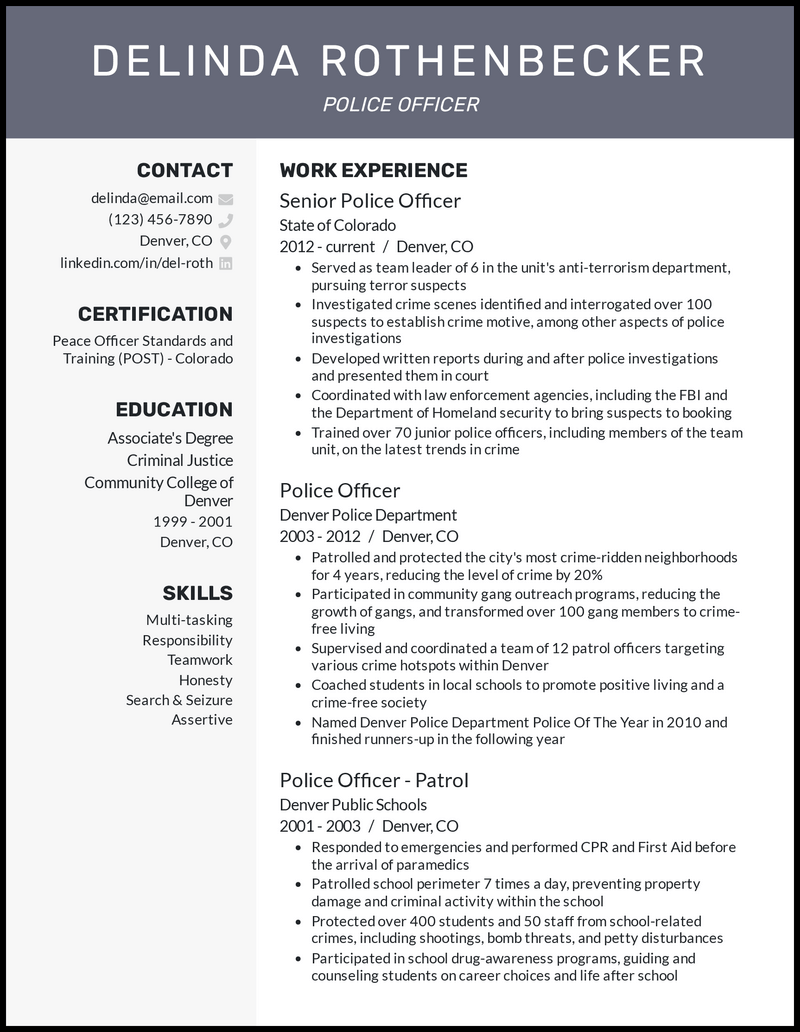
Why this resume works
- Demonstrate your capabilities in the field using numbers to quantify achievements and explain your impact throughout your experienced police officer resume. “Supervised and coordinated a team of 12 patrol officers” and “reducing road accidents in school zones by 50%” are potential examples of tangible, eye-catching results.

Why this resume works
- An essential attribute in any candidate seeking a police support role is a passion for public safety. Presenting a long history of commitment to law and order will strengthen your auxiliary police officer resume.

Why this resume works
- The entire point of writing a resume is to show how you’re qualified for the job. Make the job description your roadmap for skills and experience to include. Customizing your resume is the number one way to get noticed!
Related resume guides
How to Write a Police Officer Resume

Writing the best police officer resume is about showing the dedication, skills, and real-world results that prove you’re ready to serve and protect in your next role.
To achieve this, showcase your training, discipline, and achievements for a law enforcement resume that commands attention and highlights your readiness to serve your community.
In this section, you’ll learn exactly what makes a resume stand out and check it for completeness— so you can move forward with confidence by knowing:
- How to frame your experience and training for maximum impact
- Essential sections every police officer’s resume needs
- Simple mistakes to avoid that could cost you interviews

What should a police officer resume include?
When you’re putting together your police officer resume, think like the hiring officer reading it and make a befitting impression as a law enforcement candidate. Your resume should be straightforward, easy to read quickly, and tailored to the job you’re after. Here’s what to include:
- Professional Summary – Give a clear picture of your background, what kind of officer you are, and what you bring to the table
- Certifications & Training – Include any police academy training, firearm certifications, or courses in things like crisis intervention or community policing
- Work Experience – List your past roles starting with the most recent. Be specific about what you did, and whenever possible, show the results of your work
- Education – Add details about your degrees, diplomas, training, or coursework related to criminal justice or public safety
- Skills – List practical skills (like writing reports, operating radios, or handling traffic stops) along with people-focused strengths (such as resolving disputes or staying calm under pressure)
- Honors & Awards – If you’ve earned any commendations, medals, or other recognition, this is where you show them
Pro tip: Pair your accomplishments, skills, and metrics with active verbs.

How to write a compelling professional summary
Your career summary is often the first and, most likely, the only section that recruiters will review before deciding whether to read the rest of your application. Therefore, make it count by using law enforcement’s language, adding skills that matter, relevant work experience, certifications, specialization, and achievements that say you’re the best candidate for the job.
Here’s a summary of what to touch on:
- How many years you’ve worked in law enforcement or similar roles
- The key areas you’re trained or experienced in (like investigations, patrol, or crisis management)
- The settings you’ve worked in—urban neighborhoods, rural areas, traffic units, etc
- Any leadership roles or standout accomplishments, such as organizing a community event or leading a successful case
Example of a professional summary :
Example
“Seasoned NYPD Sergeant with 10+ years of experience leading precinct operations, conducting felony investigations, and managing officer teams of 20+. Certified in Crisis Intervention and fluent in Spanish. Proven record of reducing neighborhood crime by 28% through strategic community engagement.”

Start with a bold resume header
Your resume header is the part where you list your contact details. It should look clean and professional—no clutter, and definitely no gimmicks.
Make sure you include:
- Your full name
- Your phone number
- A professional email address (ideally some version of your name)
- Your city and state
- A link to your LinkedIn profile, if it’s relevant and up to date
Optional (but helpful in some cases):
- Any active security clearance
- Your badge number, if appropriate
- Languages you speak fluently—especially useful if applying in a diverse community
Pro tip: Avoid putting in photos or fancy graphics. Keep it simple and focused.
How to choose the right format for law enforcement careers
The best format for police officer resumes is undoubtedly the reverse chronological order. It starts with the most recent and top role, which is expected for law enforcement jobs that emphasize rank progression, for example, Cadet recruit → Junior patrol officer → Sergeant → Lieutenant.
However, if you’re transitioning from a different industry compatible with law enforcement or have explainable career gaps, then use the combined or functional resume formats. For instance, when coming out of retirement or joining a local police force after service in the military.
Not formatting your police officer resume can be just as criminal as letting a jaywalker run amok. Before it lands on a recruiter’s desk, your resume has to pass a strict ATS system that scans your resume for nearly everything.
Below, we’ve listed the best formatting tips to ensure your resume doesn’t get handcuffed by the ATS system:
- Reverse-chronological format: When it’s time to narrate your heroics, start from the latest ones at the top and continue below with earlier achievements.
- Length: No matter how many burglars or arsonists you locked up, explain it all within one age. Going beyond a one-page resume will only make employers more disinterested.
- Leverage bullet points: Use bullet lists to describe your previous stints and quantify your work’s impact in the neighborhood.
- Use headings for key sections: Never leave your education, skills, or work experience section blank. This can cause ATS systems to instantly reject your application.

Highlight your law enforcement work experience with results
Your work experience section is the most powerful pitch that reinforces your suitability for a law enforcement officer position. Therefore, you must prove that you can protect and serve by presenting your past achievements. One effective strategy is to focus on the impact on the communities served, team leadership, and mentorship from your previous roles.
Generating work experience bullets backed with metrics shows recruiters and AI screeners that your contributions added real value. Therefore, use numbers, time frames, and a variety of other results to pitch your performance story.

How to write experience bullets that command attention
The perfect bullet = Action verb + Task + Quantifiable Result
Every bullet should clearly present what you did, how you did it, and the impact you made because of it.
Weak bullet
“Patrolled city streets and responded to calls.”
Strong bullet
“Patrolled a 17-square-mile district, responding to 100+ service calls weekly and reducing property crime rate by 18% year-over-year through proactive policing.”
Why the second bullet point works:
It combines numbers, context, and measurable outcomes, which helps hiring managers and online applicant screeners to understand your real-world impact.
How to tailor each experience by role
Each law enforcement work experience is different, and so is each role you’re applying for. Your bullets must accurately reflect what the job description requests: the rank, work environment, and scope of responsibilities.
Let’s break this down further:
- Patrol Officer — Focus on interaction with communities, incident response, and crime prevention.
Bullet point example:
“Responded to 500+ public safety incidents monthly, achieving a 98% citizen satisfaction score for professionalism and response time as per visitors’ service review forms.”
- Detective / Investigator — Highlight your analytical skills, use of investigative tools/software, case outcomes, and cross-functional team collaborations.
Bullet point example:
“Led an investigation team of 4 through a multi-county fraud ring; securing 9 convictions and recovering $2.4M in stolen assets.”
- Sergeant / Supervisor — Showcase leadership, ability to mentor, and outcomes from operations.
Bullet point example:
“Implemented data-driven shift planning for a 10-officer patrol unit that cut overtime costs by 22% while improving coverage.”

Examples of experience bullets by career level
These impact-driven bullet examples should guide you to make an application that lands you more interviews:
Entry-level police officer work experience bullets
- Completed 400-hour police academy with top 5% academic performance
- Trained in de-escalation, firearms safety, and traffic enforcement, achieving instructor commendation for field decision-making
Federal officer work experience bullets
- Investigated cross-jurisdictional crimes under an FBI task force, compiling evidence that led to 16 federal indictments
- Coordinated intelligence-sharing between state and federal units that completely paralyzed operations for an interstate narcotics trafficking network
Campus police officer work experience bullets
- Pioneered an after-dark campus escort program, achieving a zero safety breach incident for a full academic year
- Compiled Title IX reports with trauma-informed care and confidentiality compliance
Retired/senior officer work experience bullets
- Mentored 57 junior officers in 11+ senior service years through structured training, improving retention rates
- Recognized with LAPD’s Lifetime Service Award for 25 years of community-first leadership in underserved neighborhoods

Include relevant hard & soft skills for police resumes
When hiring teams and ATS review your resume, one of the most essential components they scan is the skills section. They want to know that you’re adequately trained and possess the personal traits necessary to get the job done.
You must blend both your technical and soft skills, presenting a complete profile that makes you the best candidate for the role. It would be a good idea to read the job posting once more and be on the lookout for phrases such as:
- Proficiency in WatchGuard Evidence
- Experience with Electric Citation Systems
- Trained in Emergency Response Coordination
Key hard skills for law enforcement professionals
Your technical abilities show readiness, the proper training, and certifications that align with what the role and agency expect.
Here are some examples:
- Threat assessment
- Report writing
- Digital record systems management (CAD/RMS)
- First aid and emergency response
- Evidence collection and scene preservation
- Firearms proficiency (Rifle, handgun, or shotgun)
Soft skills that define effective police officers
Since your work revolves around public safety, you must have the right set of people skills, such as:
- Excellent communication and active listening skills
- De-escalation tactics
- Ethical judgment
- Situational awareness
- Leadership
- Collaboration
- Cultural awareness
- Ability to make decisions under pressure
How to tailor your skills to the role
Each policing job requires a unique set of skills. Therefore, you must tailor your resume to the tasks, environments, and expectations of the job, as detailed in the table below:
| Role/Job Type | Skills to emphasize |
|---|---|
| Entry-Level | Police procedures, teamwork, trainability |
| Campus Police | Cultural awareness, patrol, de-escalation |
| NYPD Officer | Traffic enforcement, CompStat familiarity, tough decision calls |
| Military/senior officer | Leadership & mentorship, tactical prowess |

Showcase key certifications & law enforcement training
Certifications and training in law enforcement demonstrate that you don’t just meet the requirements, but that you’re credible and ready to perform the job professionally. Recruiters can tell that you’re trustworthy, fit, and reliable for public safety, and AI resume screeners will find your application compliant with the expectations of the employers.
Why certifications matter
These credentials are evidence of your skills and professionalism. They also serve as keywords that help your resume sail through ATS and land on a recruiter’s desk. For instance, if you’re FTO or SWAT certified, your application will be easily visible to jobs that expect you to have such a background.
Core certifications for police officers
- Field Training Officer (FTO): Showcase your skills to lead, mentor, and evaluate situations in the field
- SWAT / Tactical Response Certification: Proves you can operate in risky situations to protect communities
- Crisis Negotiation Training: Very valuable for de-escalating tense security situations, which require excellent communication skills
- Crime Scene Investigation (CSI) or Forensics: For detectives to help solve crimes
- Community Policing / Cultural Competency Courses: Ensure that you fit in the culture of the communities you serve
- Secret Security Clearance (indicate expiry): For those with military training
Relevant law enforcement training
- Policy academy training: include the department and your year of training (LAPD police Academy, 2022)
- State Peace Officer Standards and Training
- Firm arms and defence tactics
- Trauma care, EMT, and EPR

How do you put military experience on a police resume?
You can translate the discipline, tactical prowess, training, and certification from your military experience into what the police work is seeking. Your accountability, mission readiness, and integrity are among the key transferable traits that you should strongly highlight.
Start by translating your military language into terms relatable to civilian safety. Use phrases such as teamwork, leadership, de-escalation, patrol, incident response, and others to align yourself with what a prospective police department is looking for.
Also, your training, awards, and security clearance make a strong case for your suitability for the role. For instance, if you were awarded the Army Commendation Medal for bravery in combat or you’re certified in first aid and non-lethal tactics, spotlight them to emphasize your unique qualifications.

How do you write an entry-level police officer resume?
You may be new to law enforcement, but you’re not out of ways to prove that you have what it takes to be a great police officer and target your resume to the role you’re seeking.
Here’s how to build a strong resume:
Lean on your transferable strengths:
- Leadership roles from school, ROTC, or volunteering
- Any experience in security, even if it was unpaid
- Relevant classes or training in public safety, law, or criminal justice
- Military service, athletics, or physical activities that underscore discipline, commitment, and endurance
Structure matters
Ditch the traditional experience-first layout and instead go with a skills-based (functional). Divide your resume skills and experiences as follows:
- Public safety
- Collaborating with others
- Working under pressure
- Community service
Under each section, describe real experiences or training that show you’ve already started building the mindset and tools of a law enforcement officer.

Key takeaways
- Start off in the right direction with strong formatting. From your key sections to a well-spaced template, design your resume to be irresistible.
- Quantify all your work experiences and line them up in reverse chronological order to push your best achievements in front.
- A relevant educational background and training certificates will strengthen your profile, so include those if you can.
Police Officer Resume FAQs

What employers don’t want to see is a list of job duties. They already know what a police officer does; instead, use your job description bullet points to speak to accomplishments in your law enforcement career. What situations did you encounter, how did you respond to those situations, and what was the result or impact? Whenever possible, quantify those statements.
Be detailed and specific in your resume, but save the story-telling aspect for your police officer cover letter.
This depends on the job description. If you’re applying to work as a public safety officer, you might consider skills like firearm safety and security equipment maintenance. If you’re planning to serve at a college campus, crowd control is an excellent skill to have. And working for a traditional police department, search and seizure will be important. The point is to understand what the job requires and to tailor your police resume accordingly.
Since law enforcement leaves room for an upward trajectory, it makes the most sense to format your resume in reverse-chronological order. What’s “above the fold” of your resume is what hiring teams will focus their attention on most, which means if you’re currently a sergeant, you shouldn’t start by listing your first job right out of the police academy.
If you served in the military, that experience can give your police officer resume a strong edge. Recruiters often look for the discipline, leadership, and operational training that military service brings.
Here’s how to do it right:
List military roles under your work experience, just like any civilian job
Use everyday language where possible
Include the skills you developed—weapons handling, strategic thinking, dealing with high-pressure situations, or managing personnel
In your career summary, mention how your service prepared you for law enforcement—things like command presence, respect for procedure, and the ability to stay calm under stress.
Pro tip: Be sure to translate any acronyms or military terms into civilian equivalents so hiring managers without military experience can understand your value.

Stephen is the co-founder and CEO of BeamJobs. Frustrated with the challenges he'd faced in his own job search, he left the corporate world to start BeamJobs with his brother. Drawing on firsthand experience with hiring and getting hired as technical talent, he started BeamJobs in 2020 to help qualified job seekers land interviews with less stress. Since then, more than 4 million people have built their resumes and cover letters on BeamJobs. Stephen's insights have been featured in notable outlets, such as Fast Company, Business Insider, Yahoo Finance, MIT, and Zapier. Learn more about Stephen.