



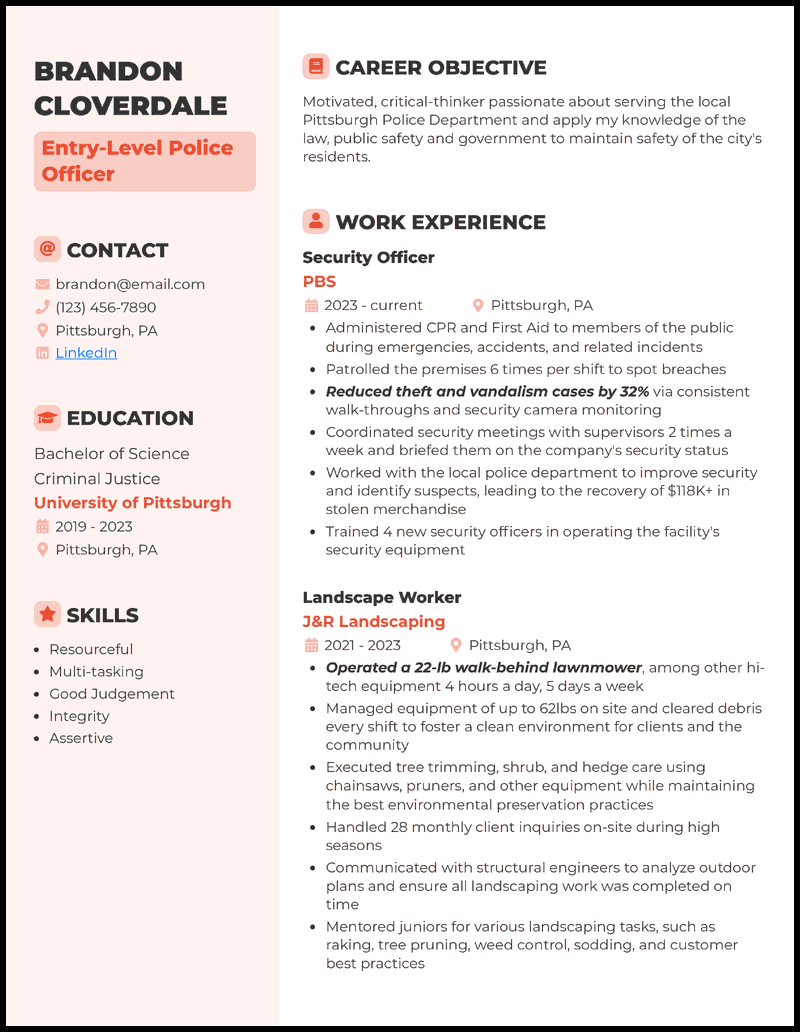
Your first step to landing your first job in law enforcement is preparing a resume that communicates your strengths, integrity, and readiness to serve.
In this guide, we’ll share proven strategies, real examples, and the competitive edge of using a cover letter maker to ensure you stand out from other entry-level applicants.
Here, you’ll find:
- ↪ 5 entry-level police officer resume templates built for 2026 applications
- ↪ Expert tips recruiters look for when reviewing first-time candidates
- ↪ Ways to frame your training, skills, and character to win the job

Why this resume works
- Drop a relevant degree like “Bachelor of Science in Criminal Justice” in your entry-level police officer resume to prove your point. Employers will more likely contact a candidate who has at least theoretical knowledge than someone with no background education.


Related resume examples
How to Write an Entry-Level Police Officer Resume

The foundation to landing your first role in law enforcement starts with a precise, professional application and a strong entry-level police officer resume.
Summary
Your entry-level police officer resume should highlight your training, skills, and character so law enforcement recruiters can see you’re ready to protect and serve from day one.
Here, we’ll share the recruiters’ manual to help you confidently present your skills, training, impactful outcomes, and character just like in the ready-to-hire resume examples.
Key things we’ll discuss:
- Expert advice on formatting, keywords, and ATS optimization
- Pairing your skills with impactful outcomes from relevant experiences and projects
- How to highlight training, education, and personal strengths effectively
- Beating common mistakes to prove you’re the right candidate

Core components for your entry-level police officer resume
Make your application strong by starting with the right foundation. Cultivate a good balance between structure and substance by including the following:
- Clear header
- Polished objective
- Quantifiable results from relatable work experience (paid or volunteer)
- Education and training
- Specialized skills

Hook recruiters with a passionate resume objective
Start on a winning note with an objective that reflects a candidate who is passionate and committed. In 2-3 lines, declare your interest in the position, say who you are, your strengths, and your long-term career plans.
If you’re struggling for writing ideas, a resume headline generator can ensure your opening is sharp and professional.

Don’t just list skills, show what you can do with them
As an entry-level officer, you won’t have prior experience in the police force. Given the extensive training you’ve received, this won’t be a problem, but it also means that showcasing your career skills is more important than ever.
Every word counts, so use them wisely. This section is not the place to use generic terms like “hard worker,” even though you are.
Instead, highlight the things that your employer can easily verify and will appreciate, such as having a driver’s license, physical stamina and agility, and certifications like POST or CPR.
Here are the key skills for an entry-level police officer:
9 most popular entry-level police officer skills
- Driver’s License
- First Aid
- CPR
- Physical Fitness
- De-escalation
- Cultural Competency
- Foreign Languages
- Knowledge of Law
- Crisis Management

Pitch your value with accomplishments from relevant work
From writing crime scene reports to conducting patrols, you’ll face many challenges as an entry-level police officer. So, it’s crucial to focus on work experience that highlights your ability to adapt, act fast, and make difficult decisions on the fly.
Even an unrelated job can be relevant if you underscore the right tasks, such as leading a team, helping others, and responding to emergencies.
The best way to show hiring managers that you’re a valuable addition to the team is to focus on measurable impact. How did your work transform your previous workplace? Use numbers to make each bullet point count; don’t be afraid to get specific.
Get inspired with these bullet points from our resume samples:
- Monitored 10 security cameras throughout 12-hour shifts, achieving 89% accuracy in spotting attempts at theft
- Designed and implemented a new patrol route around the premises that increased security, lowering vandalism by 28% over 3 months
- Responded to over 30 emergency calls, administering CPR and using de-escalation techniques to settle conflicts
- Developed a drug awareness program at a local community center, teaching more than 50 youths about the dangers of substance abuse

Include relevant training
Law enforcement is a stickler for the right skills acquired from approved training programs. Give recruiters what they want by mentioning your passion of ability assessment tests, academy coursework, field exercises, firearm safety training, and any community work or internships that connect to public safety.
Such inclusions prove that, although you may be a newcomer, you already have the right combination of traits to excel as a police officer.

Use certifications to earn credibility
You’re a beginner with limited work experience, and anything that defines your value is worth adding to your resume. Certifications such as First Aid/CPR, firearms licensing, or defensive driving can give you a real edge over other applicants without them.
Create a section for the certificates and include details like the issuing organization, the date it was issued, and its expiration date.
To ensure that everything is as it should be, run your document through a resume parser to confirm that applicant tracking systems (ATS) will properly recognize these details.

Tailor your application to the specific job
If you use the same resume for all jobs you apply to, you’re starting at a disadvantage. Go back to the job description and take note of what it wants. This includes reviewing the skills, responsibilities, and law enforcement terminologies and ensuring you use them to mirror the tone set from the beginning.
Tailoring shows a proper understanding of the role and increases your odds of passing through application filters and reaching a recruiter.
Top 5 tips for your entry-level police officer resume
- Adjust your resume frequently
- Each police department looks for something different in a new entry-level police officer. If the role emphasizes patrolling and pursuing suspects, stress your physical ability to show you can keep up. If there’s a focus on investigation and reporting, mention Microsoft Office and your natural organization skills.
- Show off your physical fitness
- As an entry-level police officer, you’ll do plenty of running and chasing. If you’ve completed a marathon or regularly play baseball, make it known in a hobbies and interests section.
- Certifications and training are key
- If this is your first job in the police force, you’ll start by learning the ropes at an academy—but it’s good to show your employer what you already can do. This includes certifications such as First Aid, defensive driving, CPR, POST, or CIT.
- Mention foreign languages
- Adaptability is key when you’re a police officer, and not every citizen in your community will speak English. If you can speak Spanish, Mandarin, Russian, or any other foreign language, find a resume template that lets you add this section.
- Every experience can be relevant
- Portray previous experience as relevant to police work. Talk about roles in security, customer service, the military, or even volunteering to emphasize transferable skills.

Key takeaways
- Your relevant training should come before any experience
- Use number to quantify any meaningful accomplishments
- Show your passion for law enforcement
- Internships and projects can give you an edge
- Certifications in public safety come highly recommended
Entry-Level Police Officer Resume FAQs

You definitely should. Most entry-level police officer jobs require a high school diploma or GED, but some departments require an associate’s or bachelor’s degree in criminal justice or a related field.
As this is an entry-level role, your lack of experience may not be a dealbreaker—especially if you spin things in your favor. Talk about school projects you led or sports teams you’re a part of to emphasize your leadership and ability to be a part of a group.
It’s okay to list some soft skills on your resume, but avoid being generic. Mention conflict resolution strategies, such as mediation and active listening, as well as community awareness and critical thinking.
As an entry-level police officer, your primary roles revolve around enforcing laws, patrolling assigned areas, responding to emergencies, and engaging with the community to maintain public safety. You’ll also write reports, gather evidence, and support senior officers in investigations.

Stephen is the co-founder and CEO of BeamJobs. Frustrated with the challenges he'd faced in his own job search, he left the corporate world to start BeamJobs with his brother. Drawing on firsthand experience with hiring and getting hired as technical talent, he started BeamJobs in 2020 to help qualified job seekers land interviews with less stress. Since then, more than 4 million people have built their resumes and cover letters on BeamJobs. Stephen's insights have been featured in notable outlets, such as Fast Company, Business Insider, Yahoo Finance, MIT, and Zapier. Learn more about Stephen.