



A great entry-level resume should be a signal of how fast you learn. Employers and AI screeners don’t look for empty years of experience; they look for evidence of problem-solving, clarity, and growth.
That means every bullet, project, and metric on your resume should answer one simple question: “What did I make better?”
Since you’re early in your career, treat your college projects, part-time jobs, and volunteer roles as data points of initiative. When described with action verbs and measurable outcomes, they outperform “professional experience” in both human and machine evaluations.
In this guide, you will:
- ↪ Find 15 entry-level resume examples ready to edit
- ↪ Understand why it matters to pair your resume with an AI cover letter and track your jobs
- ↪ Learn how to overcome your lack of experience and present an application that gets you hired

Why this resume works
- Who says you can’t score a job right after graduation? Check out Jessica’s business analyst entry level resume and see how she leverages project experience to her advantage.

Why this resume works
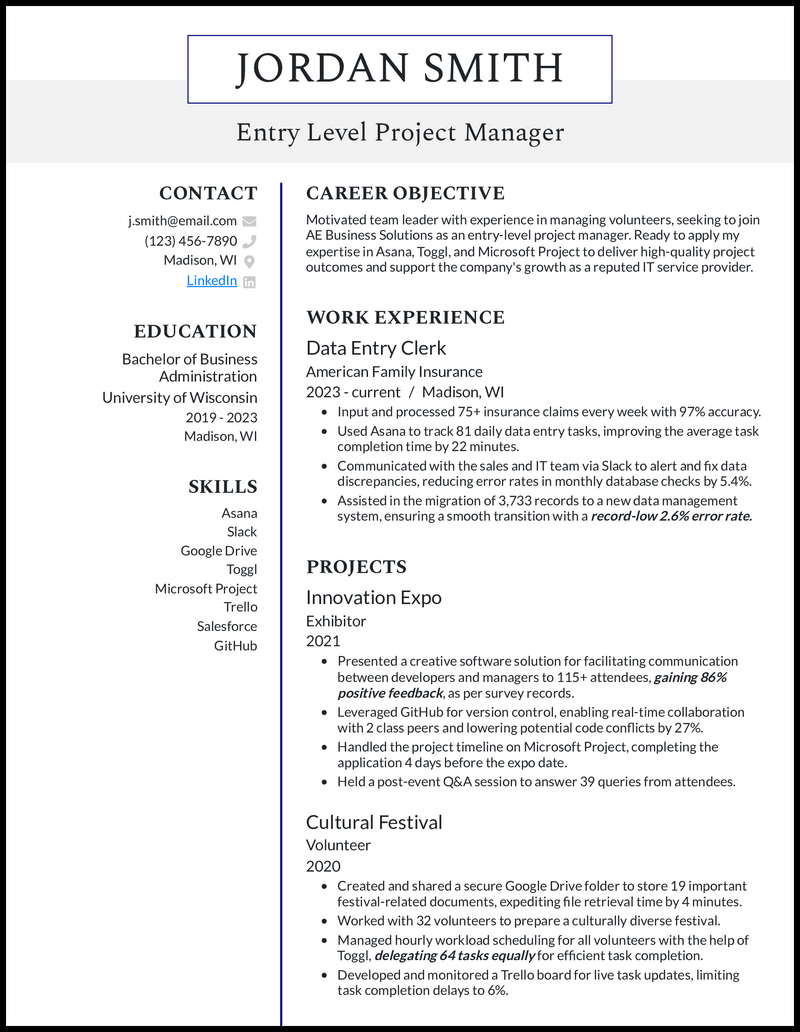
- If you’re creating your project manager entry level resume and can’t find any reasonable past experience, then use the career objective to impress employers. Pick out key impacts from your projects.

Why this resume works
- When writing an entry-level data analyst resume, projects can drastically improve your chances of getting an interview. Any way to quantify your results will improve the quality of your resume. Need more room? These story-telling details are a perfect storm for an effective entry-level cover letter.
Why this resume works
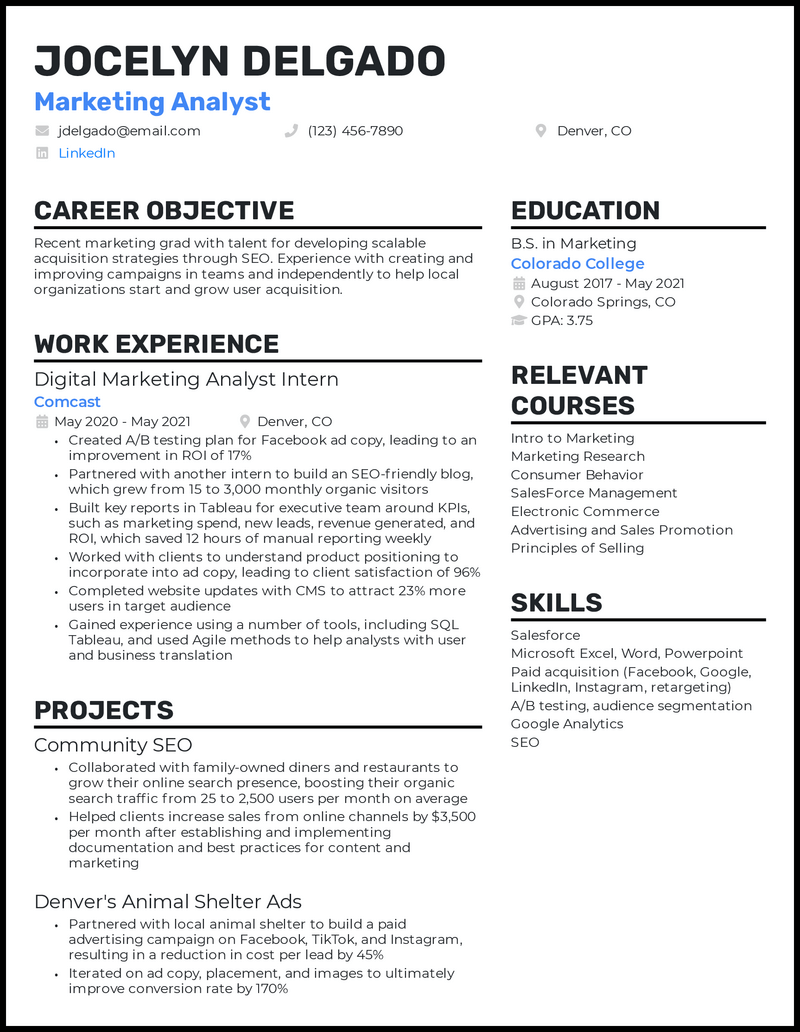
- In the resume skills section of your entry-level marketing analyst resume be sure to state all of the channels (both paid and organic) that you’re comfortable with.
- Since you’re looking for an entry-level role, this list doesn’t need to be exhaustive. It’s okay if that’s one to two channels when you start your career.

Why this resume works
- It’s better to show you’re a master of a few skills than a jack of all trades on your entry-level software developer resume. Listing one to two programming languages you know really well is much wiser than mentioning four to five languages you have novice familiarity with.
Want more entry-level tech resumes? Explore ourcomputer science student resumes>
Why this resume works
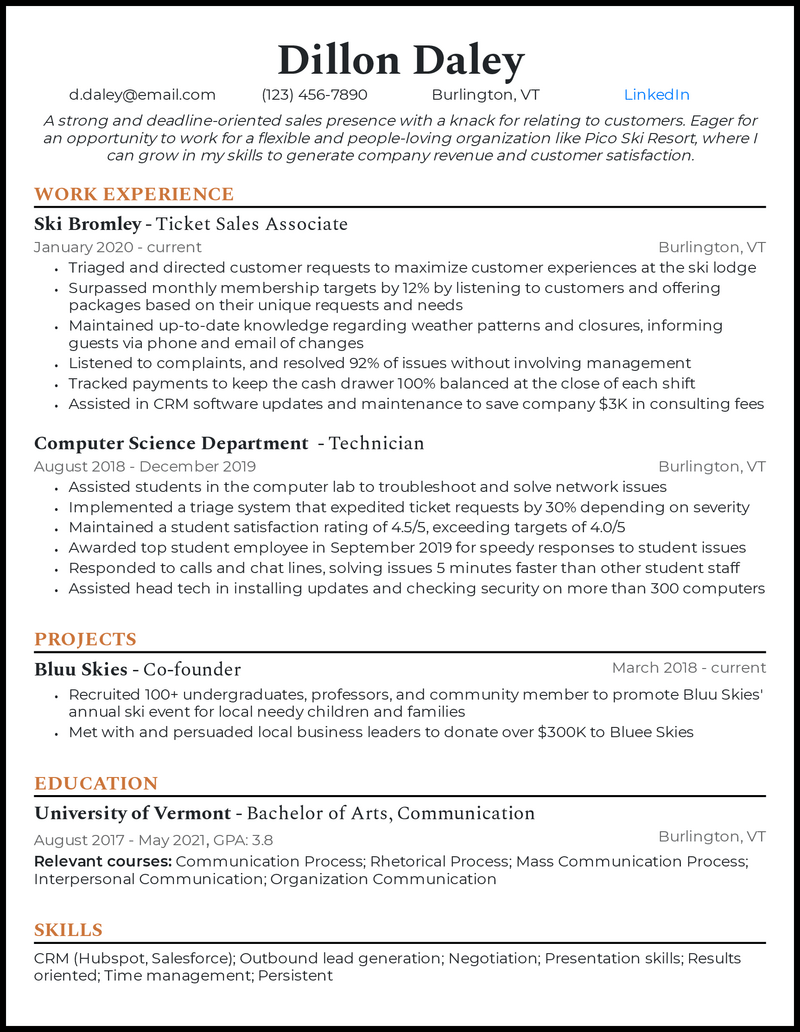
- If you’ve had a part-time job before looking for an entry-level role, you should almost certainly include it on your entry-level sales resume even if you think it’s unrelated to the role you’re seeking.
- Having a job, regardless of what it is, demonstrates responsibility. One of the most in-demand skills for entry-level candidates.
Why this resume works
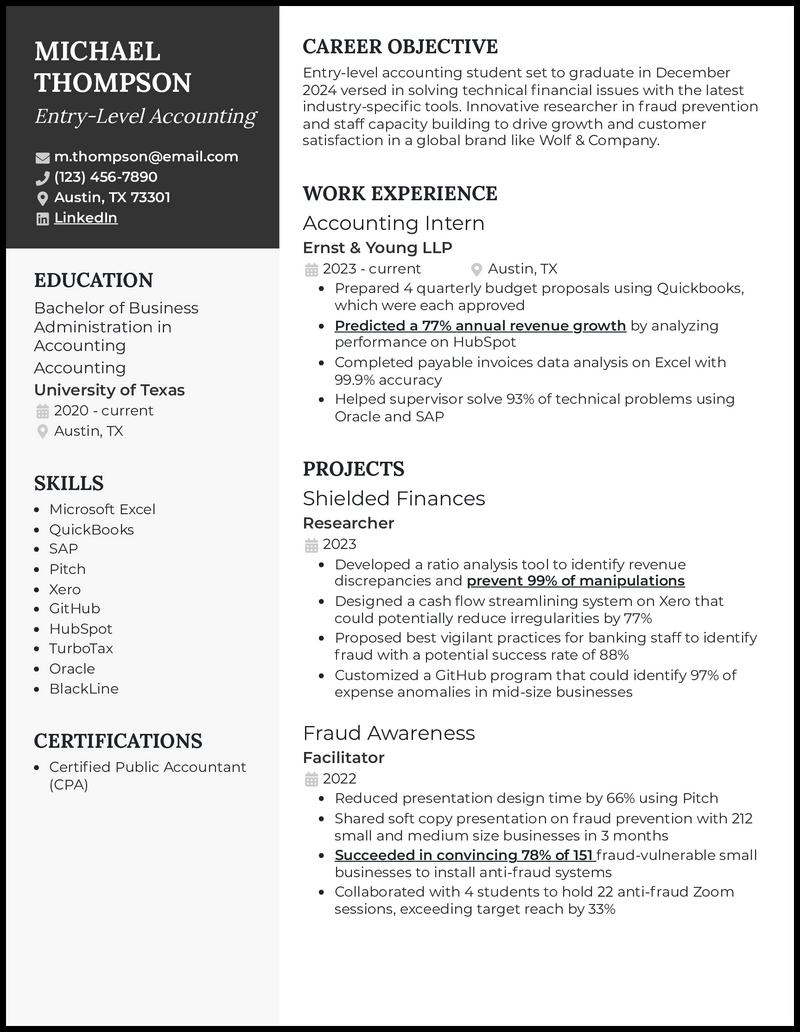
- What you lack in practical skills in your entry-level accounting resume can be compensated with your strong analytical and research competencies. Your projects and voluntary work can make a strong impression on your abilities.
See more entry-level accounting resumes>
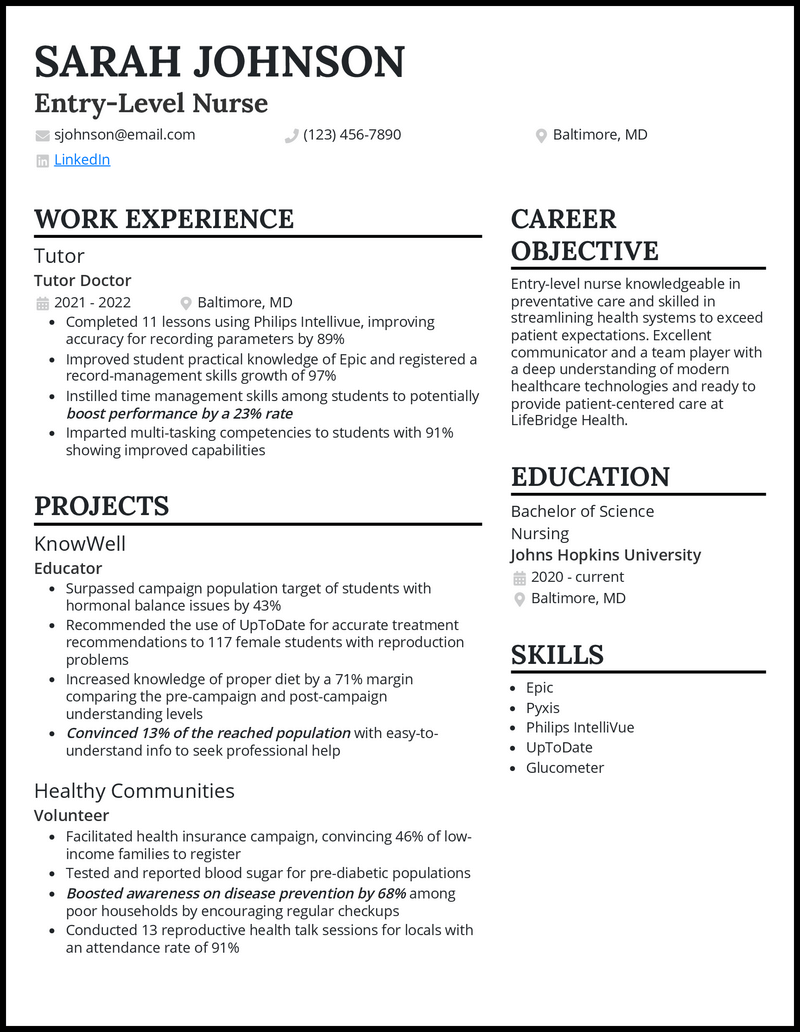
Why this resume works
- Vividly show your achievements in your entry-level nurse resume as an educator and highlight your voluntary roles to benefit disadvantaged groups. A tutor role can exemplify your leadership and change-maker potential.
See more entry-level nurse resumes>
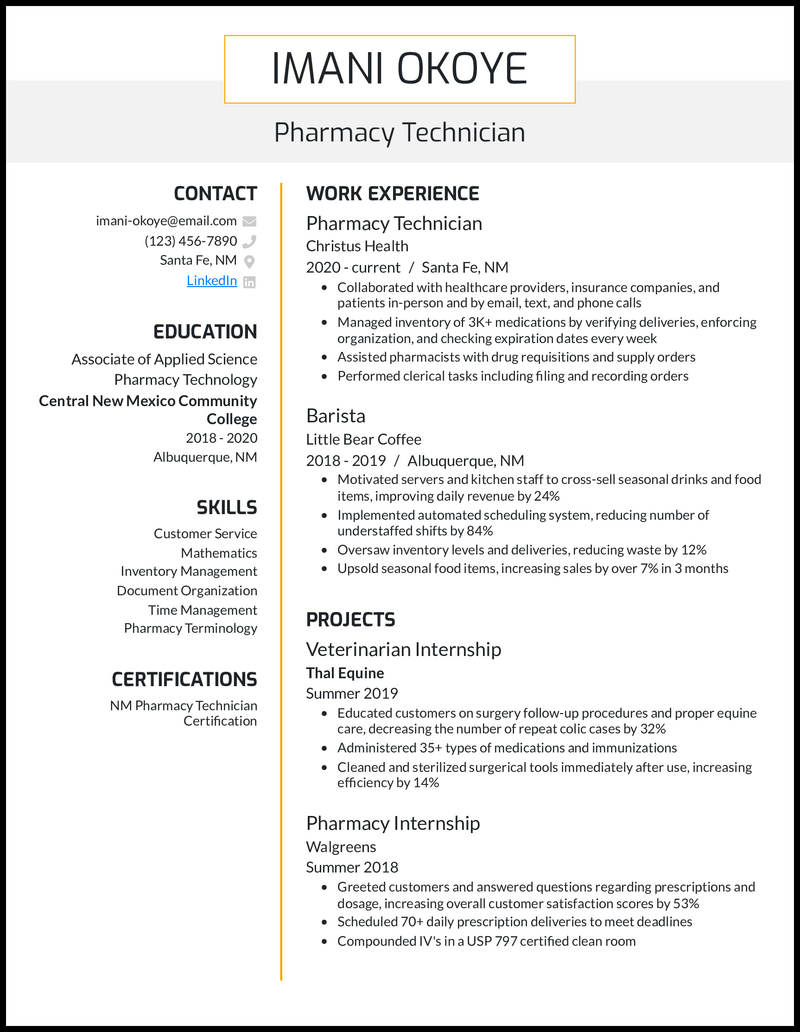
Why this resume works
- Starting off with the right resume template and formatting your resume properly can save you oodles of time and set you in the right direction as you begin writing your entry-level healthcare resume.
- Also, work in the form of internships, volunteering, projects, and surprisingly, even relevant interests and hobbies can be included on your resume.
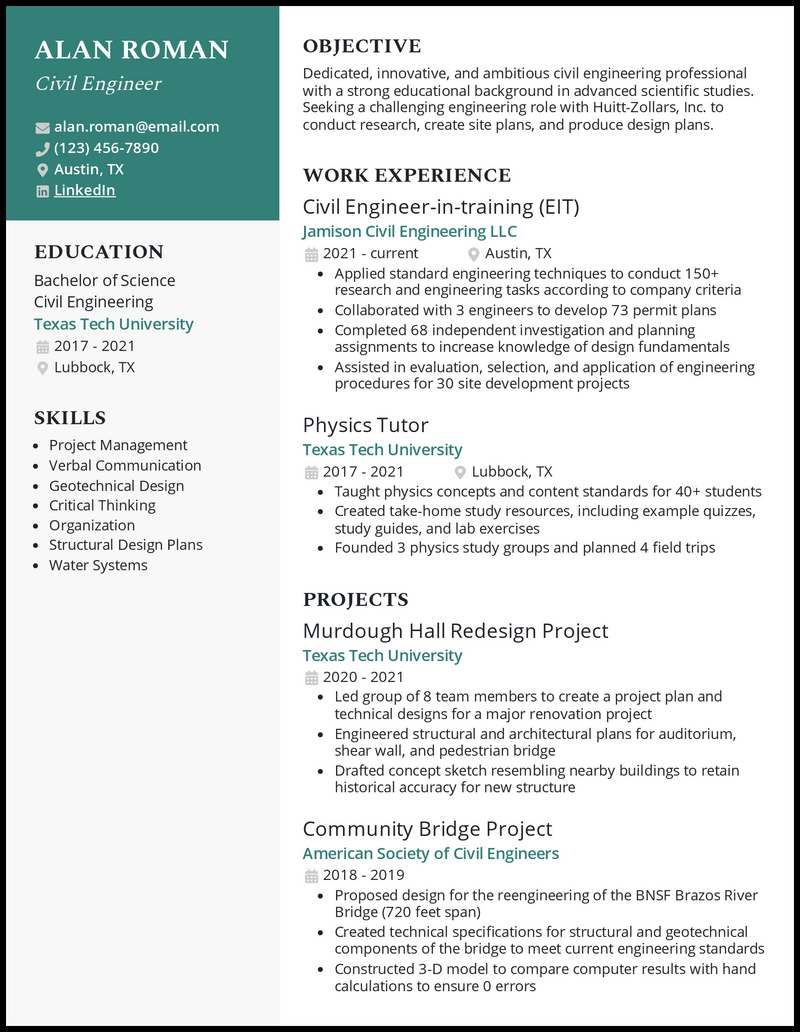
Why this resume works
- To boost your chances of getting an interview, tailor your entry-level engineer resume. Tailor it to match the job description’s keywords, including them in a few of your work experience bullet points and your resume objective.

Why this resume works
- When you only have a pinch of experience to show off in your entry-level finance resume, brag about your industry-relevant certifications.
- That “CERTIFICATIONS” sidebar section showing you’re a Certified Public Accountant (CPA), Certified Internal Auditor (CIA), or Certified Fraud Examiner (CFE)? It could be a lifesaver.

Why this resume works
- See how James gives his entry level HR resume a clever twist by pointing to his successful “Navigating Workplace Harmony” project presentation and research for the “HR Trends in Modern Workplace” project.

Why this resume works
- What better way to spruce up your entry level phlebotomist resume than leading with your career objective? It’s a no-nonsense way to tell the hiring manager who you are and, more importantly, what you want to become.

Why this resume works
- We harbor no doubt that a career objective section will look good on your entry-level QA tester resume. Did you know that (if done right) it can also help you score an interview?
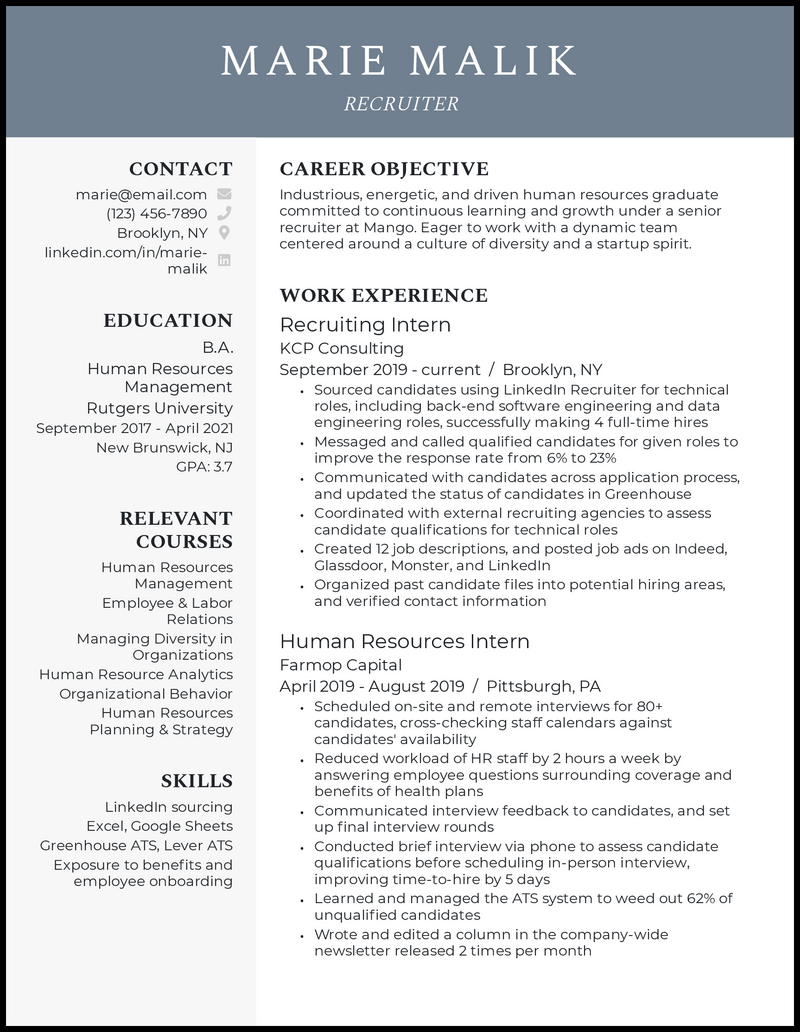
Why this resume works
- Lead with your strengths on your entry-level recruiter resume. More often than not, this will be your education. Hiring managers understand that when you start your career, you won’t have a ton of relevant experience with which to write your resume.
- That’s why it’s important that you show your qualifications through relevant classes you took in school.
Related resume guides
How to Write an Entry-Level Resume

Let’s face it. Writing an entry-level resume isn’t only intimidating. It can be crushing if you keep getting rejected. But you can stop that cycle by getting the resume basics right, such as transferable skills, relevant project experiences, and clearly defining your qualifications.
Whether you’re pivoting industries or applying for your first full-time role, this is your chance to show employers that you may be new to the field, but you’re not new to ambition, problem-solving, or impact.
How? Let’s show you how to write a resume that puts your newbie tag in the back seat by displaying your untapped potential.
Here’s what you’ll find in this section:
- How to package your entry-level resume to be irresistible
- Overcoming your lack of experience by demonstrating value
- Making the most out of school, internships, or volunteer work
- How to sum up your qualifications compellingly
- The secrets top make recruiters sold on your potential

Must-have components for an entry-level resume
If you want your entry-level resume to be an instant hit once it lands on the desk of an HR manager, then include these must-have components:
- Contact details section
- Professional profile
- Relevant work experience: Internships and projects
- Transferable skills: Technical and soft competencies
- Bonus sections: Awards, honors

Tips for writing a job-winning entry-level resume
- Customize your resume: Reflect the keywords on the job description, and demonstrate the skills and experiences that show you’re the best candidate for the role
- Format like a pro: Use a professional resume format that is easy to scan, with headings, bullet points, and enough white spaces
- Leverage transferrable skills: Bring in competencies you acquired from projects, classwork, and internships
- Be brief: You’re just starting. Put all the essential information on one page

What do employers seek on an entry-level resume?
There isn’t much work experience you can put together as an entry-level employee to impress recruiters. Once you know that, you can focus on things that add value to your application.
Some of the things that hiring managers want to see on your resume are:
- Your potential: No experience, but you are a promising star for the future
- Right personality: Your fitness for the company culture and industry’s standards will be evaluated
- Transferable skills: Lessons from school leadership and working in teams with colleagues
- Minimum qualifications: You must at least meet the threshold for qualifications one way or another

Craft a perfect resume header
Your header is the first thing hiring managers see. Don’t waste it. Keep it clean, simple, and professional. Ditch the outdated objective statement and focus on contact essentials: full name, phone number, professional email, city and state, job title, and your LinkedIn profile or portfolio (especially if you’re in tech, design, or media).
Use a larger font for your name and put it in bold. A resume headline generator can help you make the section easy to scan. Avoid nicknames, funny email addresses, or unnecessary extras like your full address.

Entry‑level resume format: Which one to choose for your first job?
The best format for an entry-level resume will be determined by comparing your real-world experience with transferable skills and education. Recruiters and applicant-tracking systems (ATS) are often drawn in by the structure of your resume before they read its content. Therefore, choosing the right layout directly decides if your resume is parsed, scored, and read.
For entry-level positions, emphasize clarity over creativity. Ensure the format you choose is easy to scan, presents relevant information first, breaks down your content into semantic headings, and allows for the inclusion of measurable accomplishments.
Reverse‑chronological vs functional vs hybrid for entry-level
- Reverse-chronological order lists experience from newest to oldest. Use this order if you have quantifiable results from internships, part-time work, or relevant coursework.
- A functional format emphasizes skills over experience; thus, it is ideal if you don’t have relatable work experience but have skills that recruiters should be aware of.
- The hybrid (combination) format balances between relevant experience and skills.
In conclusion, hiring managers and ATS systems tend to lean more towards reverse chronological formats, as they present your most recent experience first and are easy to follow and parse. If you have limited experience, keep the relevant experience section lean and foreground education, skills, and projects instead of past job history.

What’s the right template for an entry-level resume?
There’s no silver bullet when it comes to resume templates. You can use any template and make a resume from LinkedIn or from scratch. An entry level resume template can be a good starting point because it’s simple and easy to customize.
If you want to edit one quickly, open it in Google Docs and tailor each section to the job. If you prefer to copy and paste into your own layout, start from a text version.
Just be sure to follow a few rules:
- Make sure your resume is readable. Make the job of the person reviewing your resume as easy as possible.
- Keep your resume to one page. Your resume should only stretch to two pages when you have five or more years of experience.
- The resume sections you need: work experience, skills, education, and contact info. The rest are optional.
- If you use a hybrid format, balance your skills section with relevant experience that highlights internships, projects, or volunteer work.
- Please, please, avoid spelling and grammar errors. Triple-check your resume; then, have a friend read it.
All of these rules are in service of one goal: make it as easy as possible for the person reviewing your resume to come away convinced that you deserve an interview for the role you’re applying to.
Stretching your resume to two pages or inserting big blocks of text goes directly against this goal.
Insert plenty of white space, avoid really small font, and use big headings.

Should you use a resume summary or a resume objective?
Have you ever opened a book or article because the title was compelling just to read the introduction to be disappointed?
Think of the resume summary or resume objective as the introduction paragraph to your resume.
Before we dive into how to make an effective summary or objective, let’s get some definitions out of the way:
- Resume summary: Used for experienced professionals to recap some of their career highlights.
- Resume objective: A short statement of a candidate’s key skills or qualifications as well as why they’re a good fit for a specific job.
As you can imagine, a resume objective is more suitable for an entry-level candidate.
Keep in mind that, unlike an introduction for a book, a resume objective is not required for your resume.
In fact, 95 percent of entry-level resumes should omit a resume objective!
Why? Because most resume objectives don’t increase a candidate’s chances of getting an interview.
To ensure you write a resume objective in the top five percent of applicants, follow these rules:
- Customize it for each job you apply to.
- Don’t be afraid to be personal about why you’re interested in the role or career you’re applying to.
- Keep it to two to three sentences. Any more and it will be ignored by the hiring manager.
- State your top one to two qualifications for the role you’re applying for.
We know, this seems like a lot to fit in two to three sentences. To help give you some inspiration, here are a few examples of effective entry-level resume objectives.
Entry-level resume objective examples
- “Prospective data analyst who strives to pose and answer questions with quantitative-driven insights. Through the development of personal projects I’ve learned the importance of having an iterative, hypothesis-oriented approach to analysis and I’m excited to leverage that approach at Acme Corp as a data analyst.”
- “Recent computer science graduate with a passion for developing scalable web applications and working across the full stack. I’ve built two web apps from the ground up using React, Node, and PostgreSQL.”
- “Retail sales associate with experience working directly with customers to ensure their satisfaction. Looking for an opportunity to work for a KPI-focused organization where I can grow like Acme Corp.”
- “Recent marketing graduate with a passion for developing scale-able acquisition strategies through paid acquisition and SEO. I have experience creating and improving campaigns in the context of a big team and I worked independently to help local organizations start and grow their user acquisition.”
- Pro Tip: It’s also advisable to use a LinkedIn headline generator to ensure your profile headline aligns with your resume objective.

How do you make any experience relevant?
Here’s the bane of every entry level job seeker: Including experience when you’ve not even entered the workforce.
The answer, frankly, is anything that you can make seem relevant to the role you’re applying for. We believe that any work experience has skills that are transferable to other jobs.
Hiring managers understand that early in your career you may not have a ton of relevant industry experience to draw on.
That’s okay! Having a job, whether that’s a part-time summer job or an entirely unrelated full-time position demonstrates responsibility. Employers value evidence of initiative communication and the ability to learn quickly in entry-level resumes.
So don’t be hesitant to include any employment you’ve had in the past.
If anything, own it! Still, there is another way to demonstrate to prospective employers that you’re qualified to do the entry-level job you’re applying to: projects.
These can be projects you did as part of a class or projects you undertook to satiate your own curiosity. Projects demonstrate a few things to employers:
- You have a real interest in the industry you’re seeking employment in.
- You take initiative (a very desirable trait for entry-level candidates).
- A level of expertise in your field.
Projects can truly be anything. To give you a better sense of that, here are some project ideas for different entry-level positions:
Project ideas for entry-level resumes
- Entry-level digital marketer
- Did you build a social media following for a club or organization you were part of or implement a successful SEO initiative?
- Entry-level recruiter
- As part of a class, did you build out a comprehensive case study or hiring process for a real or fictional company? Talk about it.
- Entry-level software developer
- Did you build a web app to help your friends decide on which movie to watch next? What kind of programs have you developed in class?
- Entry-level business analyst
- Can you do a deep dive on a company you’re interested in and build a presentation around a new market they can expand into or a new product offering they can develop?
- Entry-level product manager
- Can you try to join a hackathon and shape the vision of a product to build? Can you choose your favorite consumer web app and detail any changes you’d make?
- Entry-level data analyst
- Pose a question you’ve always wanted to answer; then collect and analyze data to answer that question and put it in a blog post.
Which skills matter for entry-level resumes?
When it comes to the skills to include on your entry-level resume, it’s better to include a few skills you know very well than a laundry list of skills you kind of know.
Put yourself in the shoes of the hiring manager. Isn’t it a little suspicious for an entry-level candidate to be an expert in 10+ skills?
You should include your relevant skills in a dedicated “skills” section on your resume and also include the context in which you used those skills in a work experience or project.
How do you know what skills to list for a given job?
- Write down 10-15 of your top professional skills in a document or spreadsheet.
- If you’re looking for a technical role, be sure to include programming languages or relevant technologies.
- Read the job description of the job you’re applying to.
- Is there any overlap between what’s in the job description and your list?
- If so, list those skills!
- If not, are there skills mentioned in the job description you have that weren’t on your list?
It’s important to customize the skills that you include on your resume for each job you’re applying to because before a human reads your resume, an automated system called an Applicant Tracking System (ATS) will read it.
The ATS is checking whether or not your resume contains certain keywords mentioned in the job description. So it’s worth the time to customize your skills section for each entry-level role you’re applying to.
What are common skills for entry-level roles?
- Critical thinking
- Attention to details
- CRM tools: SalesForce, HubSpot
- Data visualizations: Tableau
- AI & Automation
- Project management tools: Notion, Trello

How and why to make your entry-level resume pop with active verbs
Every word on your resume should be calculated to advance your job chances. Cliches like “Responsible for” or “In charge of” aren’t what recruiters want to hear. Instead, replace them with power words such as “Led”, “Spearheaded”, “Managed”, and “Collaborated”. The game plan is to show action, and you are at the center of making things happen.
You may not have years of experience, but you have done things and how you say them makes a huge difference. Therefore, use power verbs to reframe part-time work, volunteer roles, internships, and even academic group projects as real, relevant experiences.

How to include relevant education and certifications
When you’re just out of college or fresh from an internship, your education plays a big role in aligning you to the expectations of the industry you’re looking to work in.
Focus Area | What to Include & How to Format |
|---|---|
Section Placement | When you’re just out of college or fresh from an internship, your education plays a big role in aligning you to the expectations of the industry you’re looking to work in. Place this section near the top, usually right after your professional summary. |
Educational Background | Use it to strengthen your educational background with your major and minor, school name, location, graduation year, GPA only if 3.5 or above, relevant coursework if you’re a new graduate, and even awards or extracurricular activities when experience is limited. |
Achievement Style | Use active verbs to spotlight relevant achievements, not just responsibilities. |
Professional Certifications | Certifications can add instant credibility, especially in IT, project management, healthcare, or marketing. Think: CompTIA A+, Google Data Analytics, or HubSpot Inbound Marketing. |

Bonus sections: awards and honors
Awards don’t just make you look good, they prove you deliver results. Include them if you’ve earned scholarships, academic awards, competition wins, leadership recognitions, or even “Employee of the Month” at your part-time job.
Place this section below education so the recruiting team does not miss it, and make a connection with your academic background.

How to match your resume to the job posting
You can’t afford to send out the same resume to every job. Tailoring your resume for each application is the most effective way to beat the Applicant Tracking System (ATS) and grab a hiring manager’s attention.
Your resume must be semantically aligned: Offer proof that you can solve the employer’s problem. When you review the job posting, you’ll clearly understand the priorities of the would-be employers presented as keywords, skills, and deliverables.
Get some of these signals that describe you and use them in your resume to prove you’re the right candidate for the job. Incorporate those terms in your skills and use them in bullets to show you can use them to exceed expectations for the role.
Our AI job description matcher will help you see how well your resume is fit for the role. It will also help you avoid the cost of hiring a certified professional resume writer, which can cost a fortune for students.
When scanned for relevance, your draft will be visible and match the expectations of ATS and recruiters. That’s the first nod of approval, and you have better chances of getting more interview invites.
Here’s how:
- Use skills, responsibilities, company values, and other key terms in your resume
- Add only relevant experience; leave out any other fluff
- Use numbers to show your impact
- Stick to a page and format it for easy skimming

Key takeaways
Here’s what you’ve learned and should practice when writing your entry-level resume:
- Format for both ATS and recruiters
- Tailor your resume to the role, employer, and industry
- Use numbers to show what you can do
- Bring in transferrable skills from projects, internships, and voluntary work
- Be concise: Go for quality over quantity
Entry-Level Resume FAQs

Highlight education, relevant experience (paid or unpaid), projects, and skills that align with the job. You want recruiters to see your potential when they read your resume, and that’s by putting together your skills, impactful achievements, and qualifications in a package that they can’t resist.
Absolutely! Broaden your definition of “experience.” This can include internships, class projects, volunteer work, part-time jobs, or club leadership roles. It’s not about the title. It’s about transferable skills and achievements.
Example: A barista job can demonstrate teamwork, customer service, and time management, which are key soft skills needed in almost every industry.
Focus on a blend of hard and soft skills that match the job posting. For hard skills, think data analysis, coding languages, Excel, Canva, social media tools, etc. For soft skills, consider communication, adaptability, problem-solving, and collaboration.
Use a skills section and tailor it to the job. Tools like a skills generator can help you identify what employers in your field care about.

Stephen is the co-founder and CEO of BeamJobs. Frustrated with the challenges he'd faced in his own job search, he left the corporate world to start BeamJobs with his brother. Drawing on firsthand experience with hiring and getting hired as technical talent, he started BeamJobs in 2020 to help qualified job seekers land interviews with less stress. Since then, more than 4 million people have built their resumes and cover letters on BeamJobs. Stephen's insights have been featured in notable outlets, such as Fast Company, Business Insider, Yahoo Finance, MIT, and Zapier. Learn more about Stephen.