



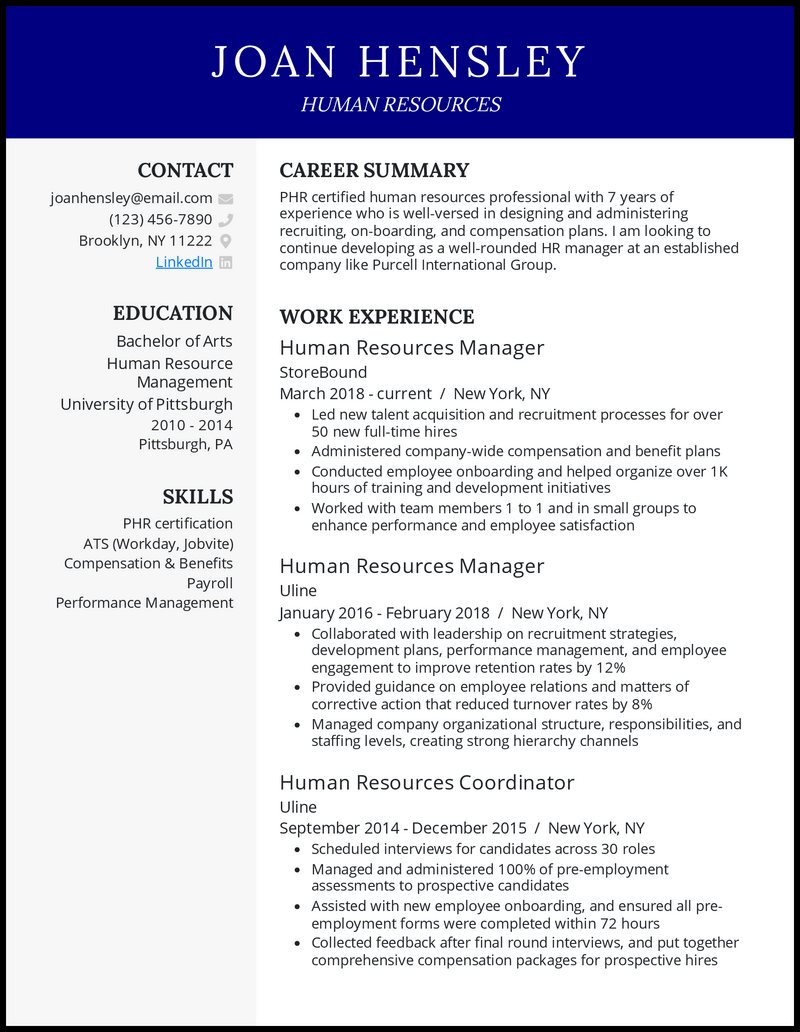
A strong human resources CV isn’t just about bombarding with quantified metrics, but demonstrating a genuine interest in the field through ongoing education and qualifications. Having such credentials is beneficial when you’re writing a CV or even a covering letter.
Now, this doesn’t negate the importance of having metric-based work experiences (employers love those!). Rather, it’s about using your CV arsenal to the maximum, and that’s exactly what we’ll cover in the guide. Stick around to get:
- ↪ 30 CV examples created for HR professionals at every career stage
- ↪ The best insider tips to build a strong HR CV
- Clarification on commonly asked questions about HR recruitment
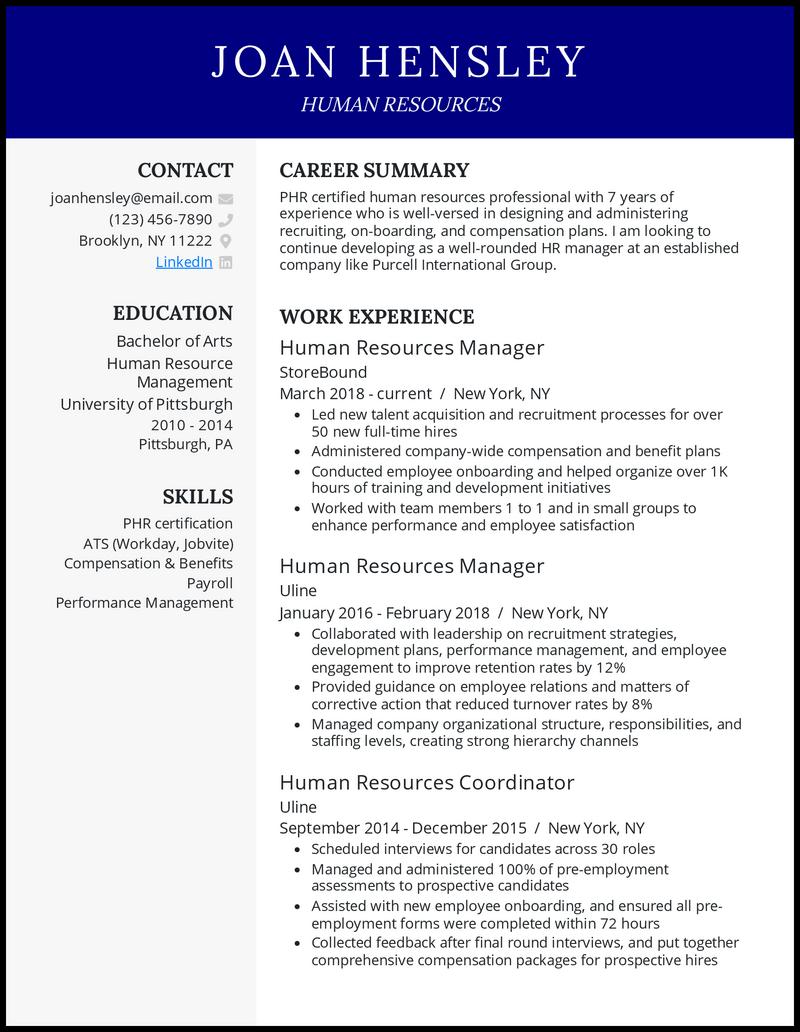
Why this CV works
- If you have more than 10 years of experience, you can add a CV summary to list your HR experience and biggest achievements. Space is limited on your human resources CV, but don’t worry—you’ll have more room to discuss the context of your experience in your human resources cover letter.

Why this CV works
- You know that a great CV skills section is essential for getting an HR job, but it’s tough to know what to include. You can help the reader out by formatting your CV with your most recent experience first. That way hiring managers see your best roles straight away, which will encourage them to keep reading.
View more human resources (HR) manager CVs >
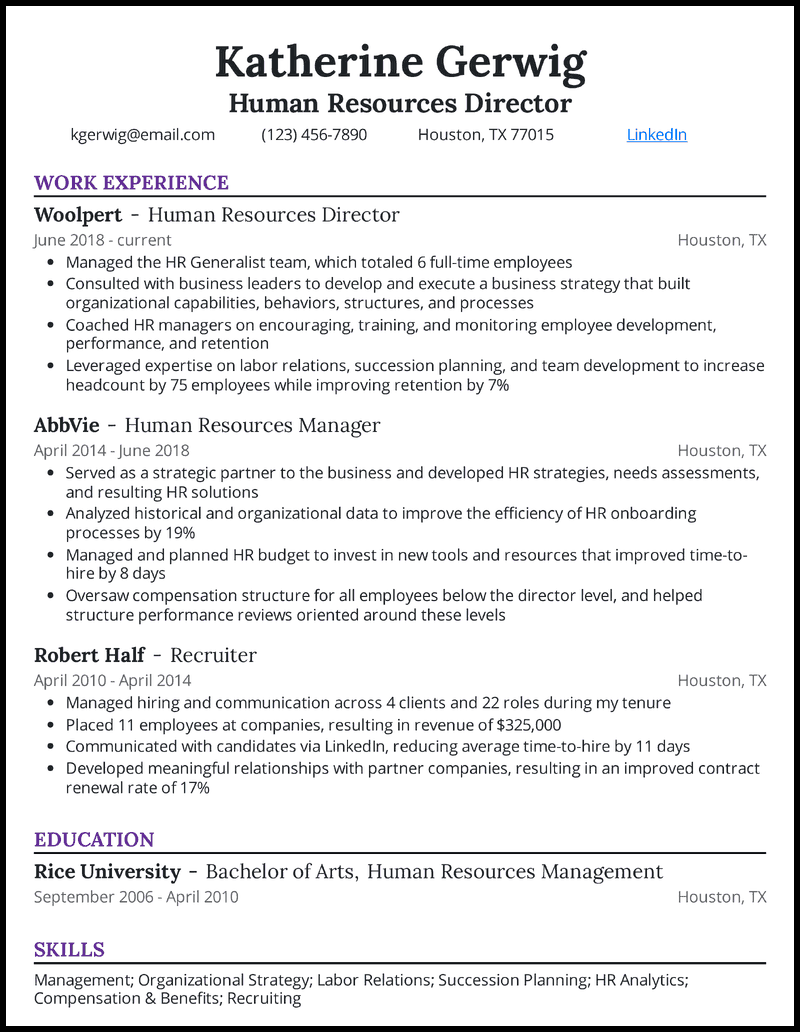
Why this CV works
- Your CV for a human resources director doesn’t have to be dull. Comprehensive, yes, but boring? Absolutely not! Using a CV template can help you easily change stylistic elements to suit your taste, like colours, font types, and layouts. Be creative and go for it!
View more human resources (HR) director CVs >
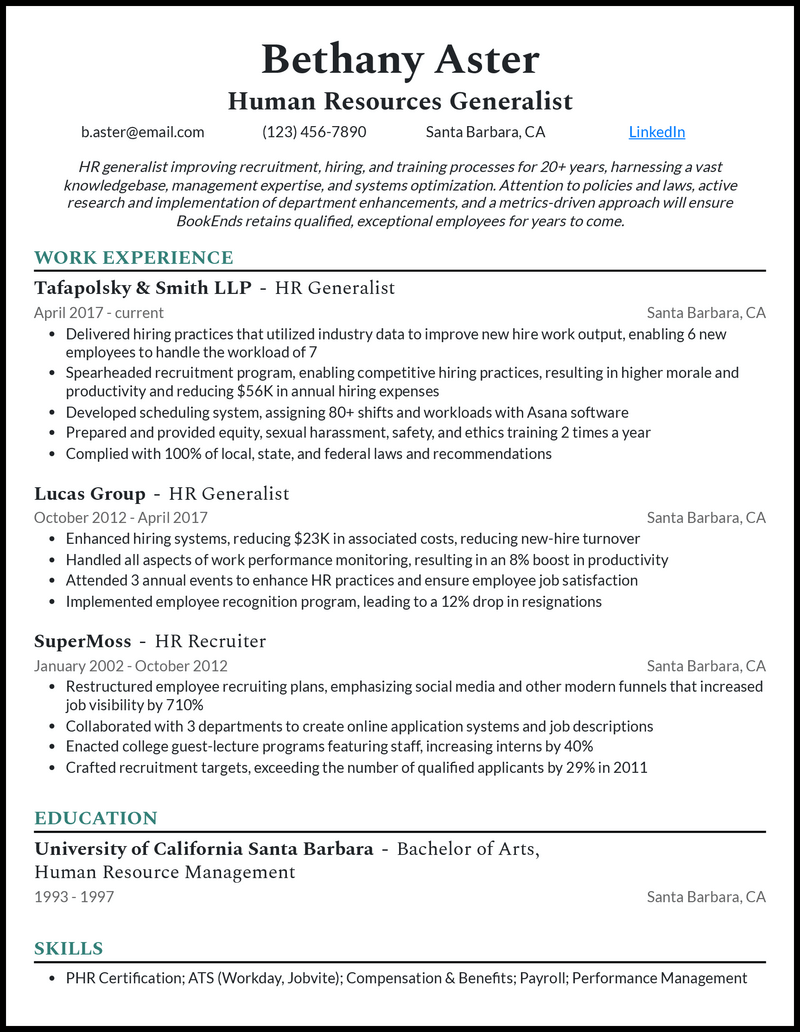
Why this CV works
- Your human resources generalist CV may include a lot of content, but it doesn’t have to be overwhelming. Use small amounts of colour (and different font types) to break up an otherwise monotonous page of black text and draw attention to section headers.
See more human resources generalist CVs >
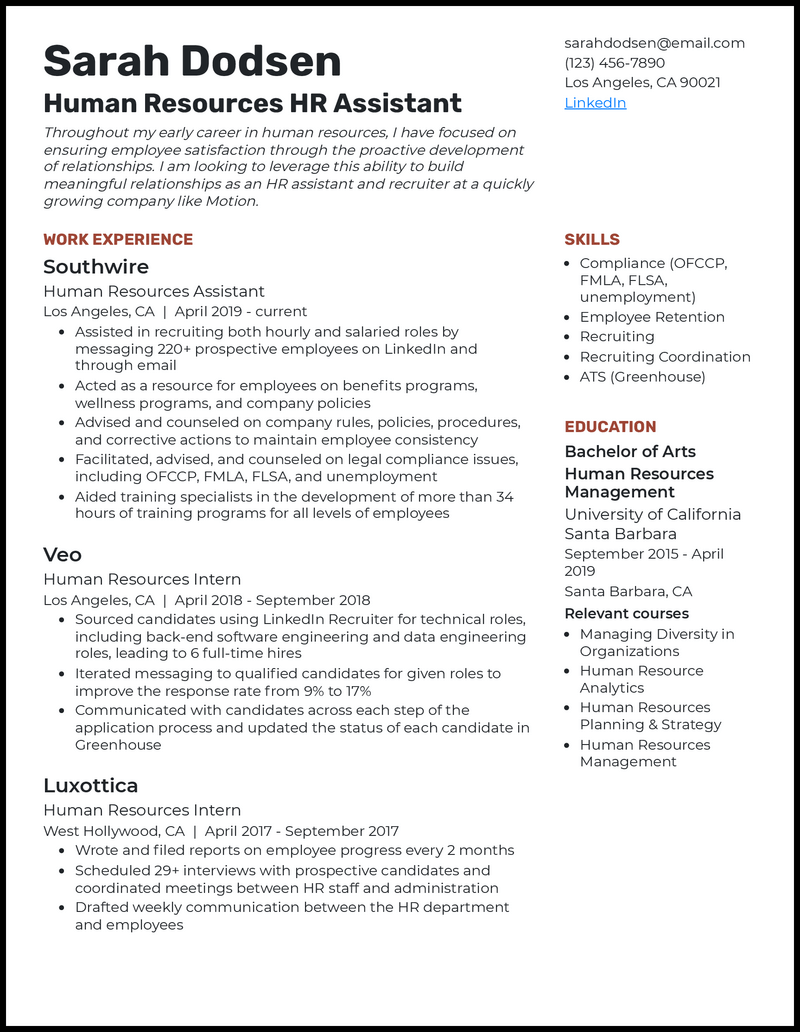
Why this CV works
- When writing about your work experience, try to quantify the impact or scale of your work. For example, did you help plan an event that brought in an additional £3,000 in revenue? Or perhaps you collaborated with your HR team to develop new onboarding processes that reduced the cost-per-hire by 21%.
View more human resources (HR) assistant CVs >
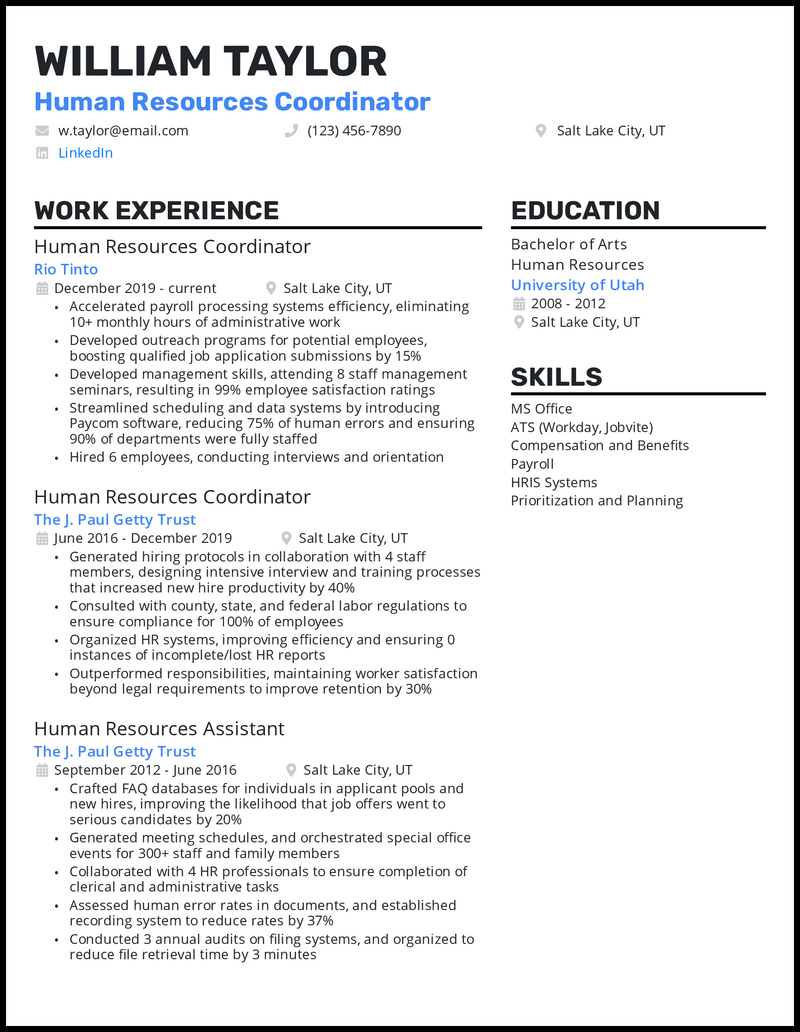
Why this CV works
- Hiring managers typically only review each CV for six seconds—want to see if your HR coordinator CV passes the test? One way to make your CV easier to read is by using a CV outline. An outline will ensure you hit all the points employers want to see without going overboard.
View more HR coordinator CVs >
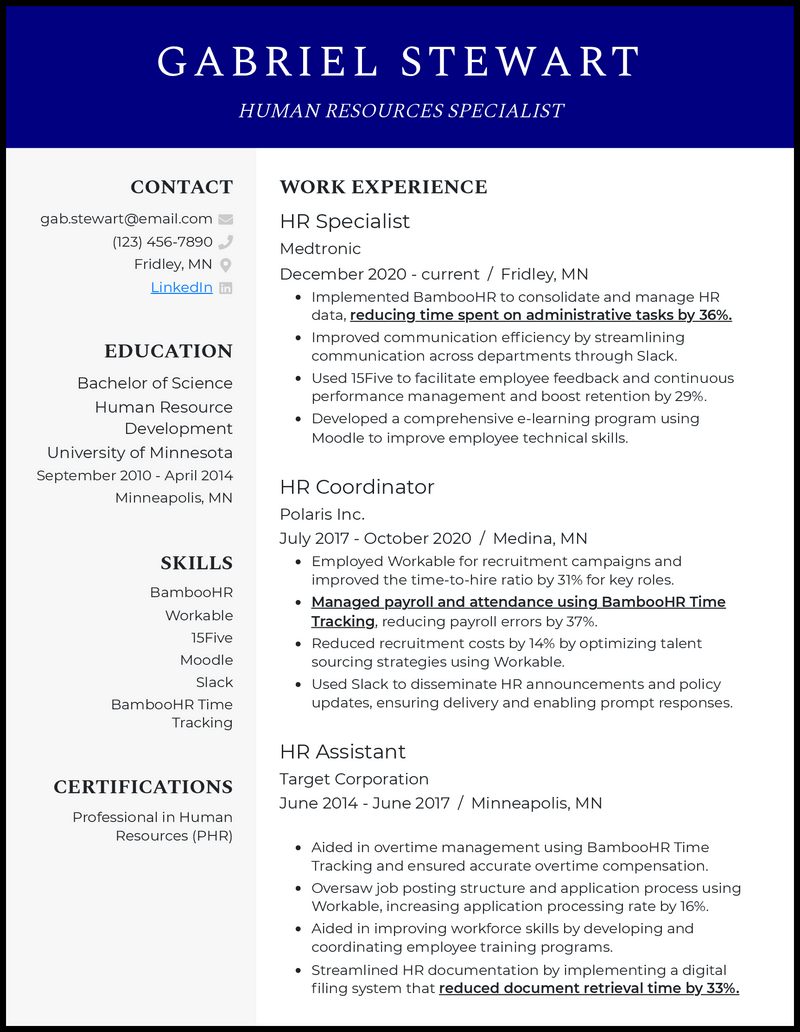
Why this CV works
- Have you obtained a professional certification that attests to your abilities as an HR specialist? If yes, use our human resources specialist CV to add a dedicated section where you can include your qualifications and improve your chances of being hired.
View more human resources specialist CVs >

Why this CV works
- You don’t necessarily need skills like SurveyMonkey or BambooHR to make your HRIS analyst CV stand out. As long as you list tools like Tableau, Oracle HCM Cloud, or even TSheets, you’ll be able to convince a potential employer that you understand the intricacies of visualising employee data that help an organisation reduce its staff turnover rates.
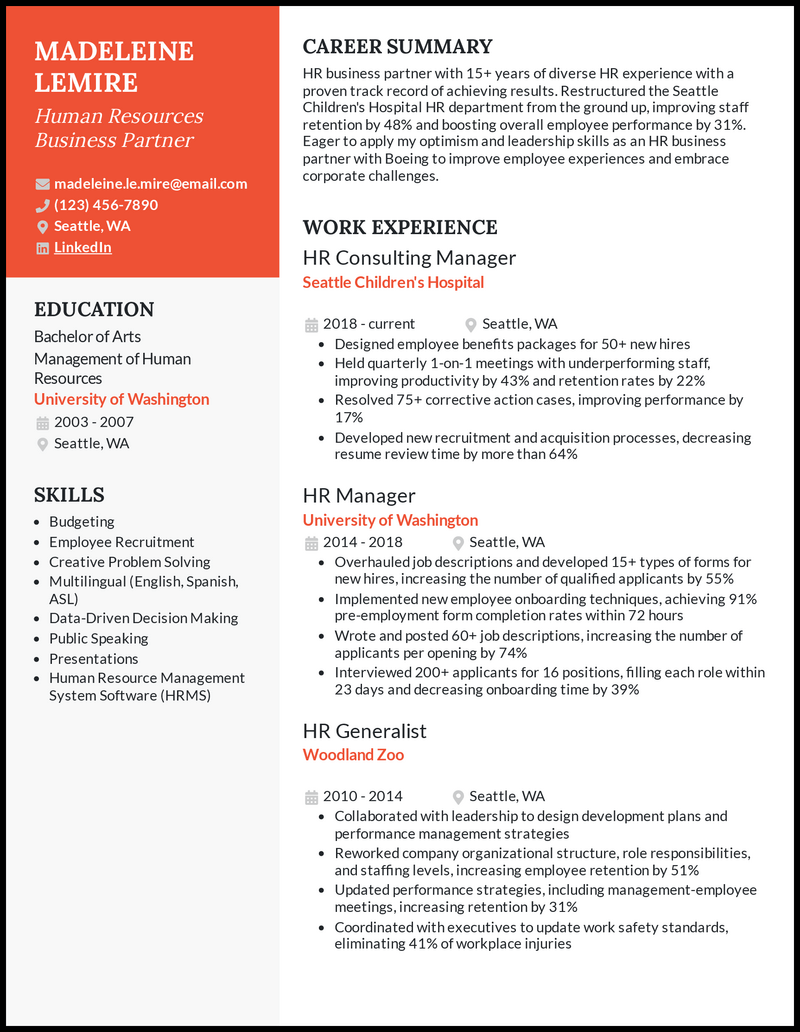
Why this CV works
- With decades of experience in your field, you have the unique opportunity to select your most relevant work experiences for your human resources business partner CV. We recommend listing your experience in reverse chronological order to enhance the chances of making a strong first impression immediately.
View more human resources business partner CVs >

Why this CV works
- Make your HR analyst CV more eye-catching by choosing the “Standout” template and selecting a yellow tone that is easy on the eyes. Support this visual appeal with a degree such as a Bachelor’s in Organisational Behaviour and Human Resources that you’ve completed and demonstrate that you’re a professional in managing employee behaviour and data.
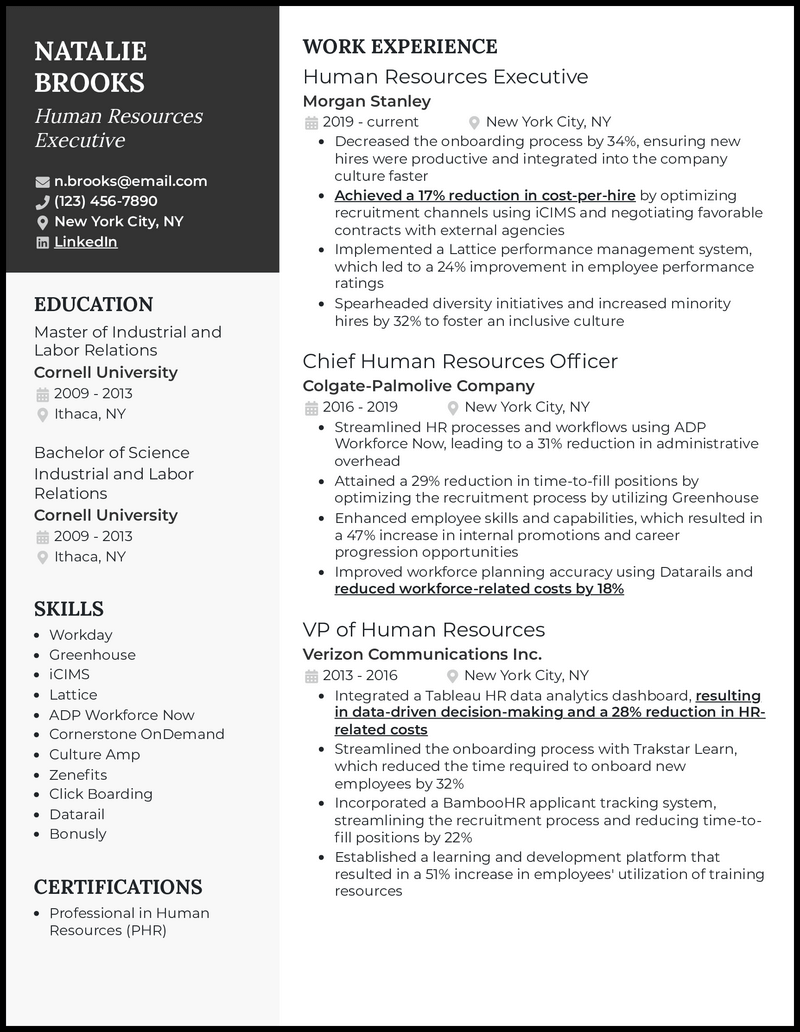
Why this CV works
- You should have a comprehensive view of the best practices both within and outside the company. For instance, integrating Tableau’s HR data analytics dashboard to support decision-making would give recruiters a reason to pick your human resources executive CV ahead of others.
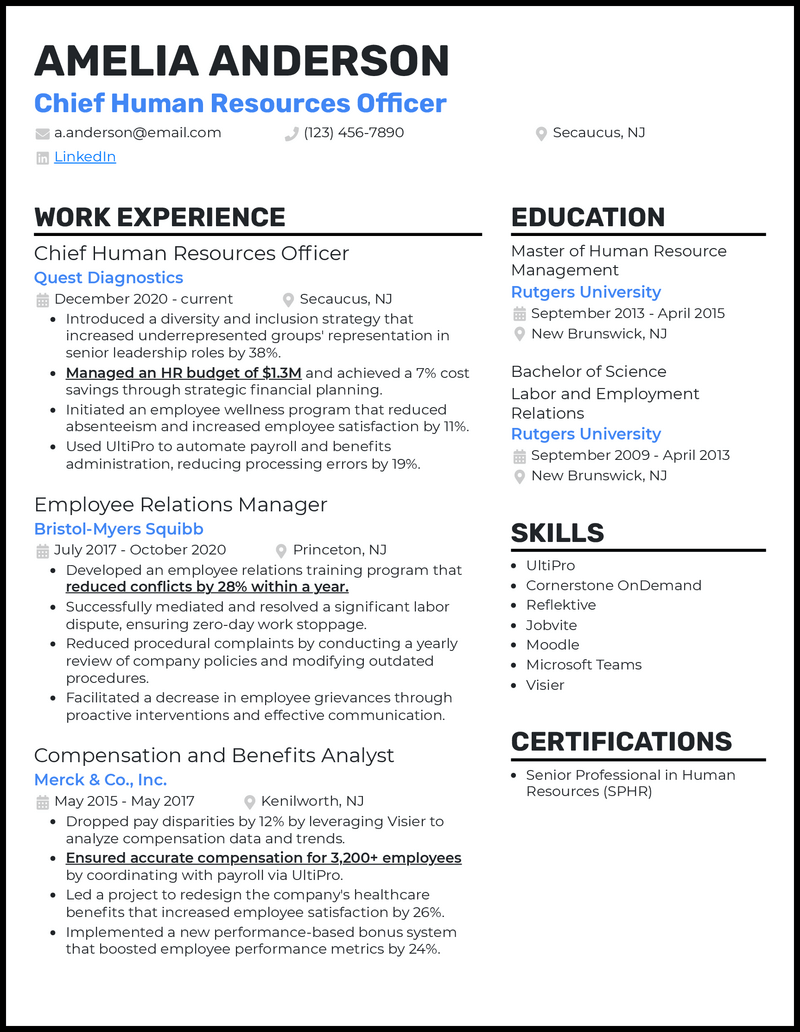
Why this CV works
- Don’t underestimate the role that the format of your chief human resources officer CV can play in improving your chances of getting hired. Using a clean template, like our Elegant, Official, Standout, or Professional templates, will allow a recruiter to focus on what’s important and help you put your best foot forward.
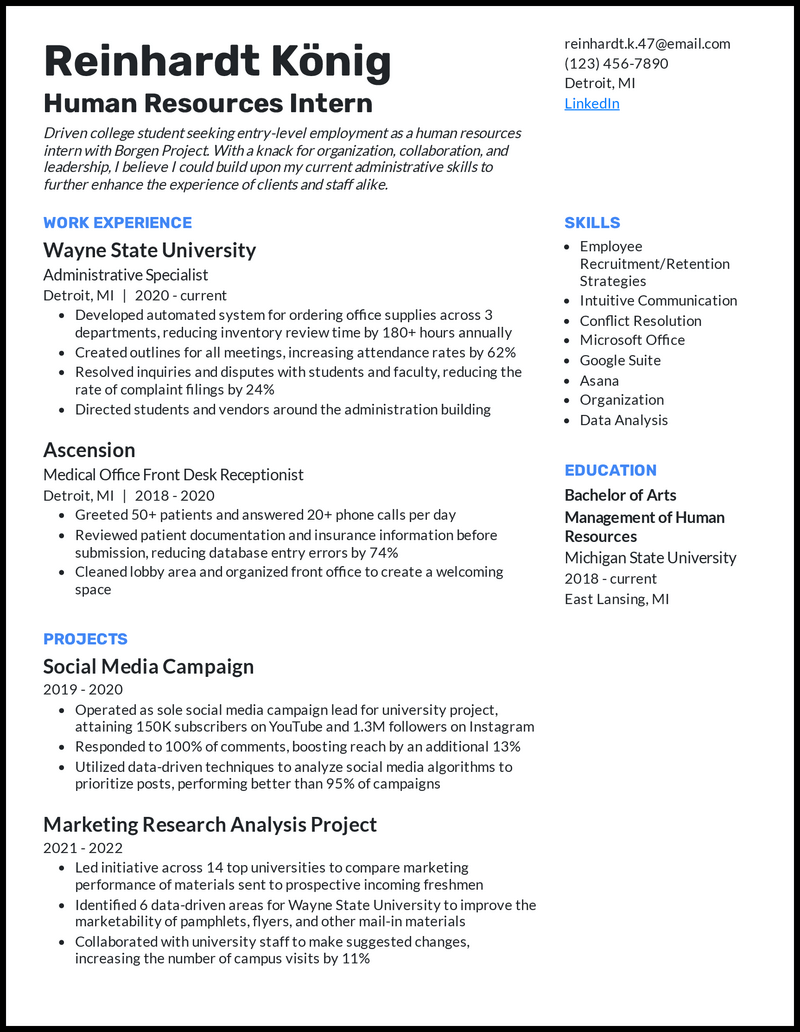
Why this CV works
- If you’re lacking in experience, take the time to craft a compelling objective for your human resources intern CV. In just two to four sentences, let potential employers know which company you wish to work for, the job title you’re aiming for, and the specific skills you possess that will benefit the company.
View more human resources (HR) intern CVs >

Why this CV works
- Share your story by highlighting your previous work experiences! Enhance your senior HR manager CV by showcasing the progression in your career. Include details of your early career and how you’ve progressed from merely reviewing policies to ultimately improving employee satisfaction as a manager.

Why this CV works
- Now, suppose you’ve got a couple of degrees. Structuring the education section in your vice president of human resources CV is the way to go. For example, let your Master’s in Business Administration take the lead, followed by your Bachelor’s in the same field.

Why this CV works
- We hate to break it to you, but you’ll need to do more than just showcase relevant technical expertise in your human resources consultant CV to convince the recruiter of your value to the team. What more must you do then? Highlight your soft skills, too.
View more human resources consultant CVs >

Why this CV works
- Enhance your HR compliance CV and include how you’ve maintained order from the outset. Emphasise bullet points such as “reducing instances of compliance violations by 17%” in your previous roles. These metrics will effectively demonstrate your commitment and capability to ensure all workplace operations comply with national and regional regulations.

Why this CV works
- What about the impact you’ve made on the career progression of colleagues, especially those junior to you? A great example you can use in your human resources administrator CV is highlighting your contribution to achieving a 42% increase in promotion rates for employees under your supervision.

Why this CV works
- If you truly want your human resources student CV to pave the way to incredible career success, it’s best to enhance it with a tailored career objective section to impress recruiters. Written in the first person (I), your career objective should spotlight your overall career goal while emphasising what you plan to contribute if the recruiter offers you an opportunity.

Why this CV works
- Take some inspiration from this human resources training CV. Include impactful phrases like “increased internal promotion rates by 19%” and “enhancing satisfaction scores of interns by 8%.” These are proof that your training doesn’t just instruct—it transforms. Remember, in HR, numbers speak louder than PowerPoint presentations.
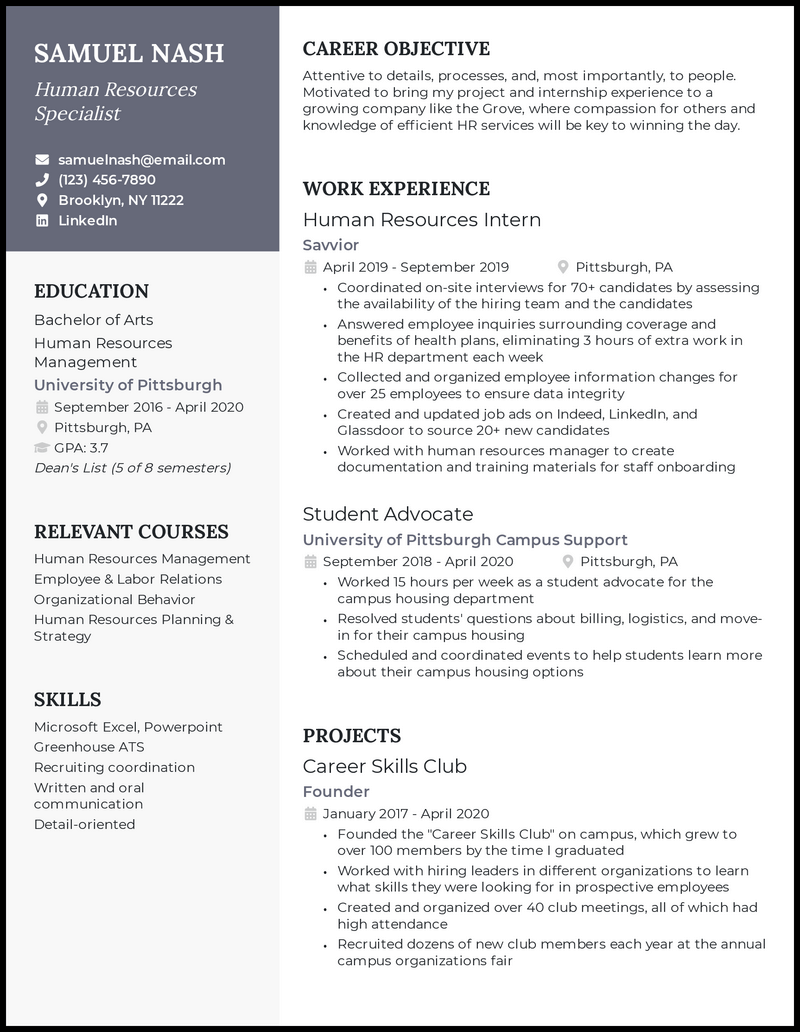
Why this CV works
- Have you started a club, completed a work placement, or had a part-time job? These can all be valuable on your entry-level human resources CV. You can also highlight your academic abilities by listing your degree classification or any awards you won during university. You can even list relevant modules to really show off your skills!
View more entry-level human (HR) resources CVs >

Why this CV works
- Include a variety of HR tools in your experienced human resources CV. From streamlining payroll tasks in Gusto to handling employee benefits in BambooHR, demonstrate that you’ve got the tech skills to keep things running smoothly using your bullet points.
Why this CV works
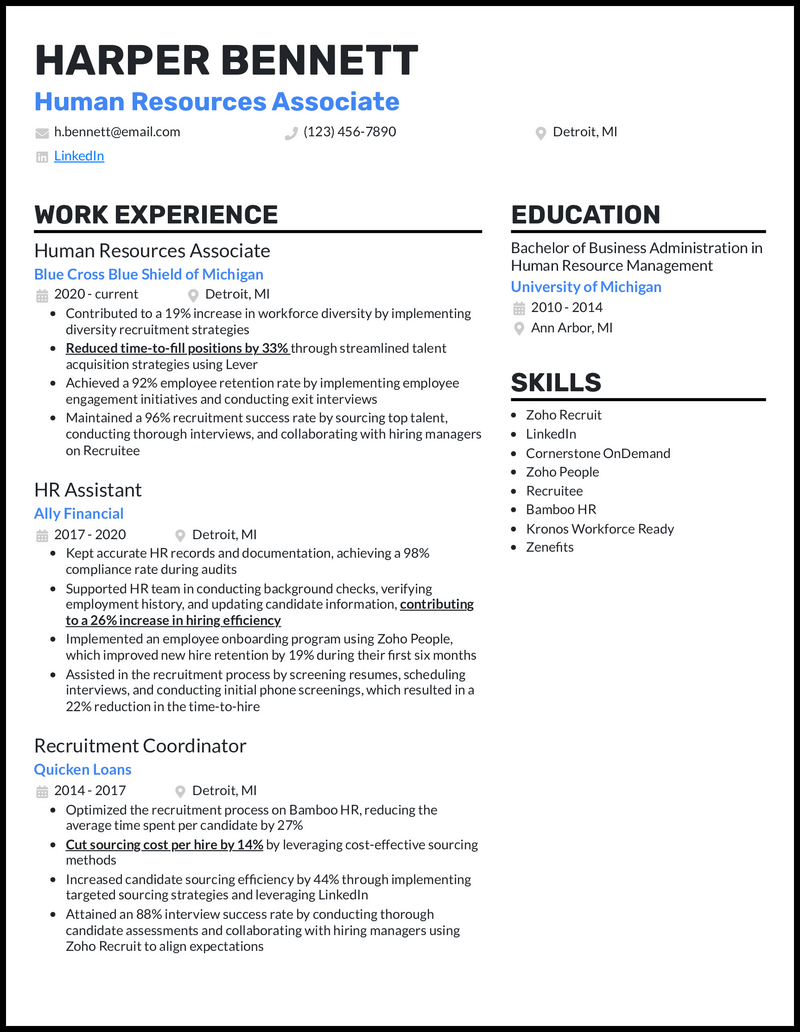
- Your ability to collaborate with others throughout talent acquisition and recruitment portrays you as an effective team player. However, your human resources associate CV must also demonstrate your contribution in identifying, interviewing, and onboarding new starters.
Why this CV works
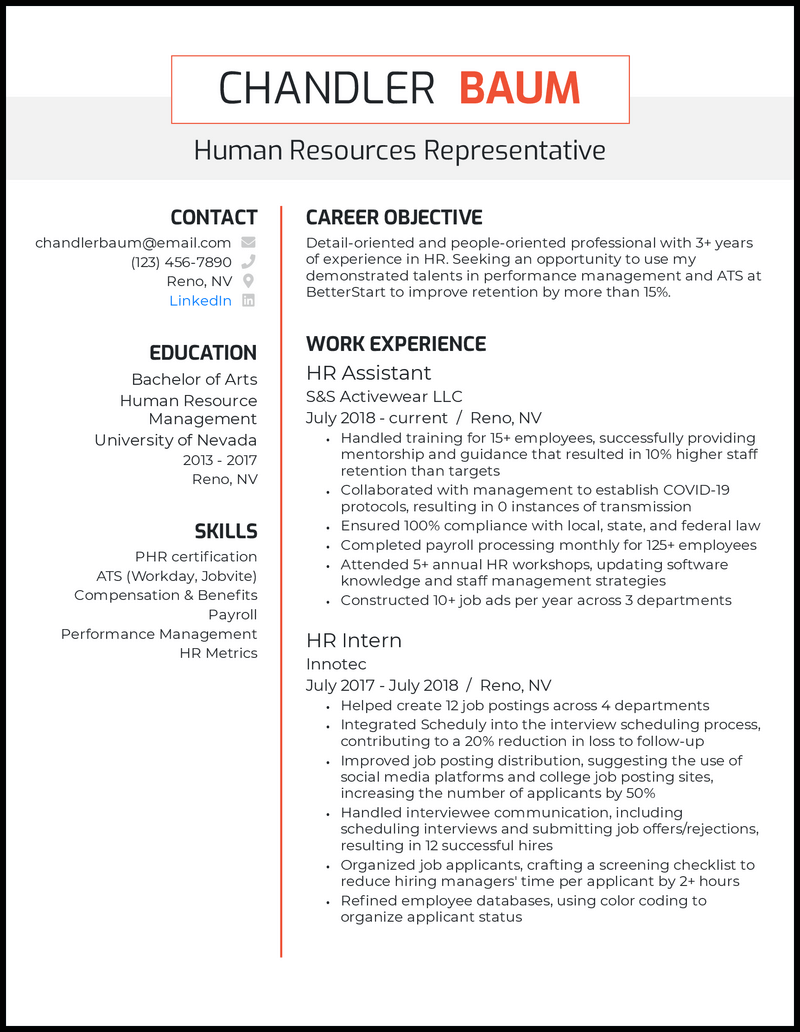
- When you’re writing your human resources representative CV, include three to four work experience listings in total so you can expand on each. Any more than four, and it starts to get rather overwhelming.
Why this CV works
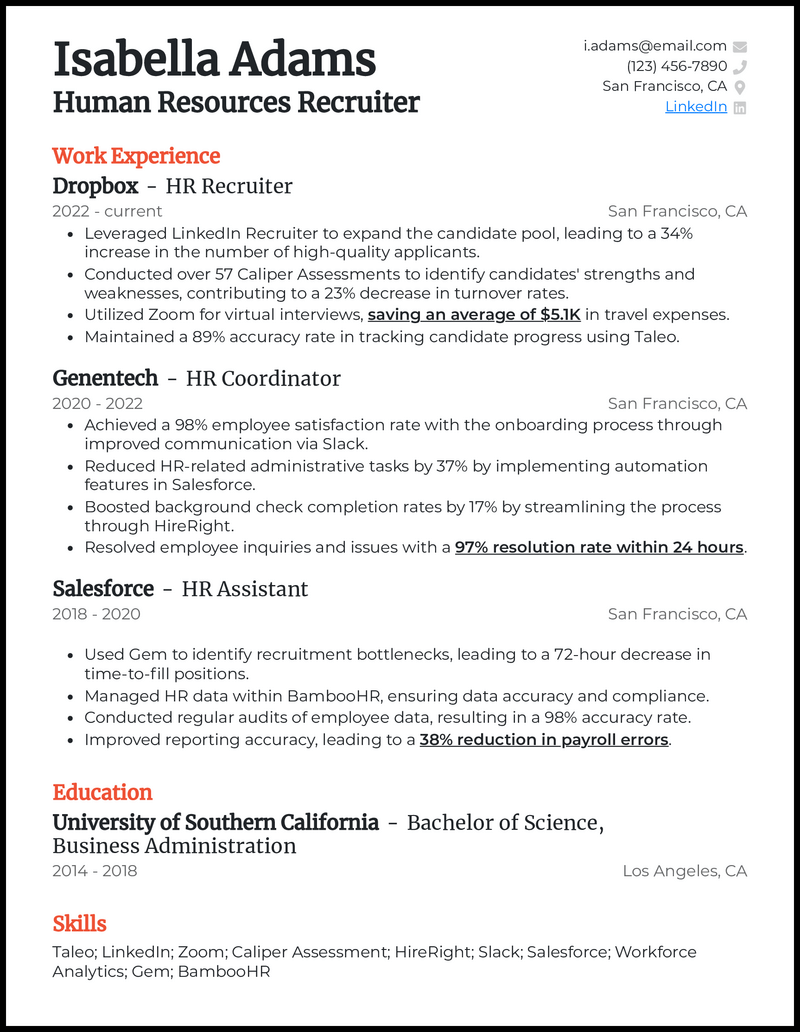
- There are several ways to demonstrate that you’re the perfect fit for the job in your human resources recruiter CV. For example, you must highlight your exceptional competencies in skills and tools that track, assess, and facilitate the smooth onboarding of new hires.
Why this CV works
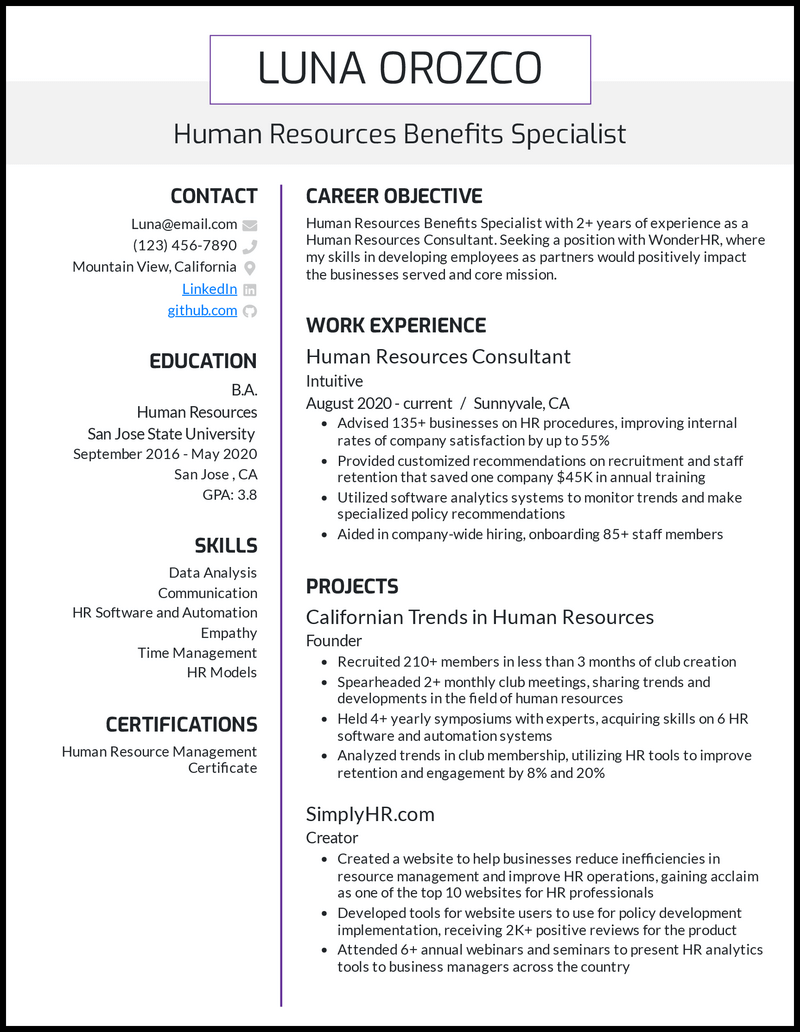
- We’ve discussed metrics before, but they’re one of the most important elements for your human resources benefits specialist CV. Numbers will encourage hiring managers to pause and carefully read your text. Plus, they take up less space than words and can demonstrate your capabilities more quickly.
Why this CV works
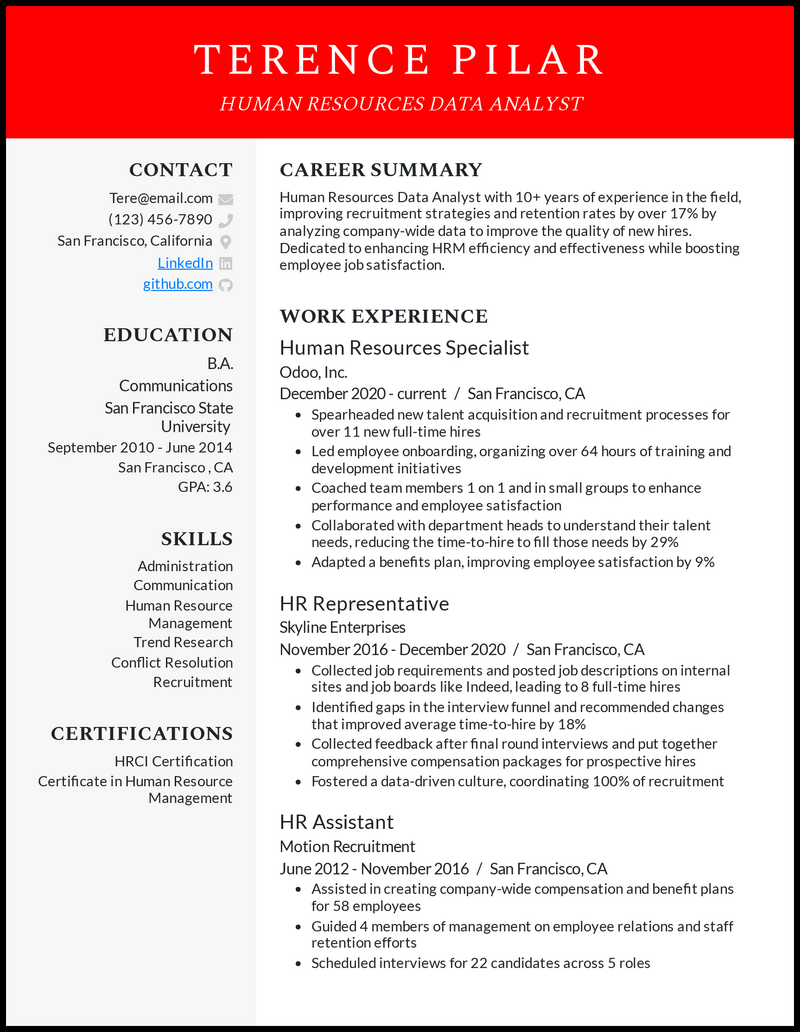
- Making your human resources data analyst CV visually appealing isn’t that hard; simply think of font, layout, and style. A CV template is the easiest way to fix formatting, so consider using one if you’re struggling with this step.
Why this CV works
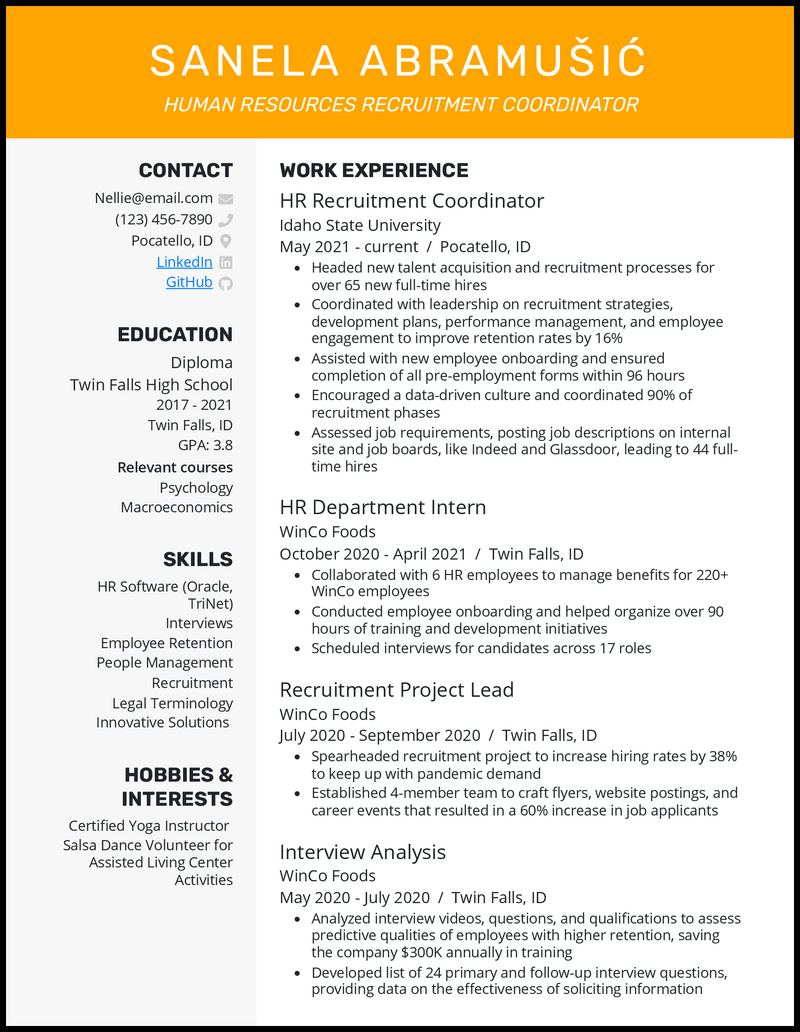
- Did you know your human resources recruitment coordinator CV can be both engaging and professional? Scroll through some recruiter-approved CV samples to get a feel for what might work for your unique style.
Why this CV works
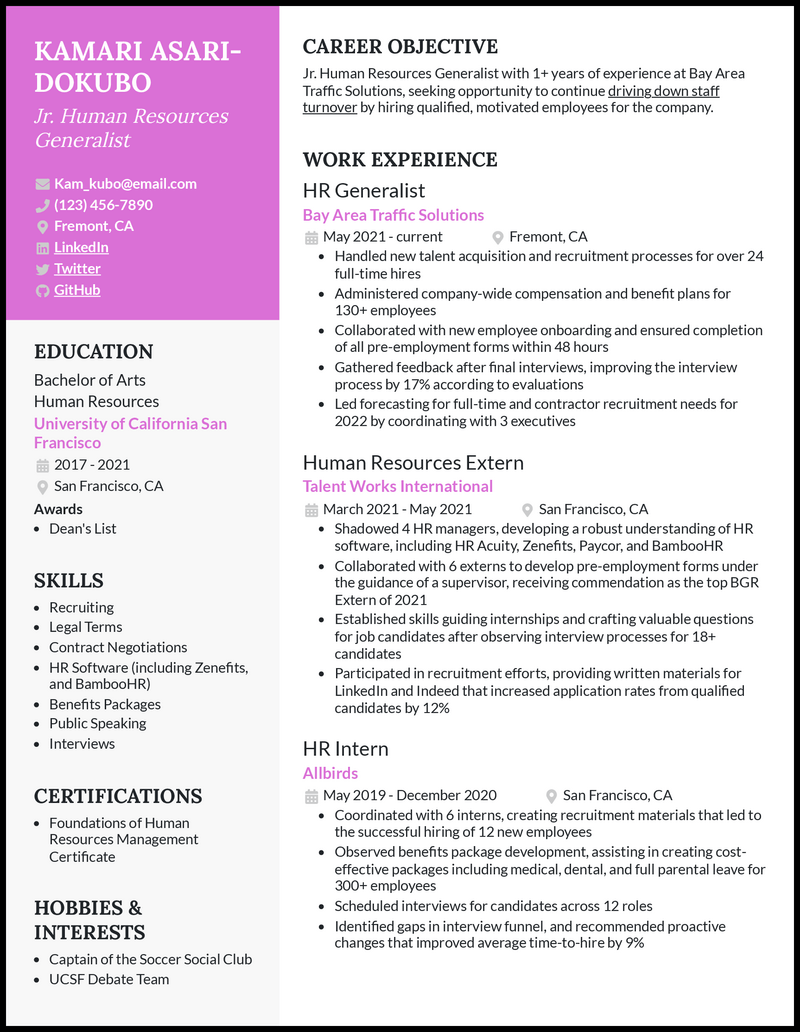
- Hold on for a moment and use our CV checker to ensure your junior human resources generalist CV is formatted correctly and that you’re using all the gold-standard grammar and punctuation rules.

Why this CV works
- A senior human resources analyst CV that shines with instances where you introduced new processes, designed more effective systems, developed better problem-solving strategies, or launched products demonstrates that you’re innovative.
How to Write a Human Resources (HR) CV

You could be an employer’s dream candidate, but you won’t be hired if your CV isn’t readable or logical. So before your professional resignation letter reaches your current employer’s desk, go through our guide on the top CV formats, what to include in your contact header, and how to make your HR CV readable for employers and ATS.
You may have the best tricks up your sleeve for retaining employees, but unless you clearly utilise continuous education, it won’t land you a job. Every other HR CV today can be described as “good,” and you need to be better than just good to stand out.
So, the first step is having at least one certificate that covers modern HR practices and strategies. This is a strong indicator that you’re up-to-date with the industry. Similarly, your CV skills and work experience also play a crucial role.
This section will cover:
- When HR professionals need to use a career summary/objective
- The latest in-demand HR skills that are irresistible.
- Certifications that prove you’re ahead of HR trends.

What are top HR CV formats?
The top three CV formats for 2026 are reverse-chronological, functional, and combination/hybrid. Each format showcases your suitability for the job in different ways.
- Reverse-chronological: This format highlights your career progression by placing your most recent job at the top. It’s easy to skim through, but it can reveal gaps in employment or career changes.
- Functional: Skills are the key focus with this format, which highlights job-related and transferable skills alike. However, it can confuse ATS and recruiters since it’s not common.
- Combination/hybrid: It’s the best of both worlds with a detailed skills section and an employment history section, but it can be difficult to format and isn’t ATS-friendly.
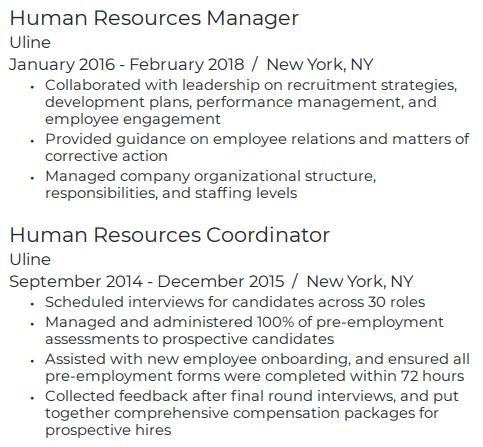
We believe the reverse-chronological format, as shown below, is the best choice for a human resources CV because it’s easy for ATS and recruiters to read quickly and provides a consistent, steady account of your career.

Include the right details in your contact header
Your contact header is where you list (surprise, surprise) your contact information. In this section, you’ll want to include the following:
- Name
- Job title you’re looking for
- Email address
- Phone number
- City/County (optional)
- Professional connections (optional but recommended)
Since your contact header is the first thing recruiters will read, you need to design it carefully. Place your contact header at the top of your CV, either centred or left-aligned, to make it easy to spot. If you’re struggling to fit everything, remove the optional elements or go down a font size. Just make sure it’s no smaller than your CV body text.
You should also adjust the colour, font style, and layout. Giving your name a different font and a colour block outline can showcase your personality and desired role. No matter what you do with your contact header, just ensure it’s easy to read and looks professionally appealing.
Our CV examples can offer inspiration if you’re struggling to format your contact header.
Make your HR CV readable for software and people
HR professionals understand that the recruitment process is complex, so an ATS can be invaluable when used effectively. Scanning your CV is an excellent way to consider the ATS and avoid being rejected.
Our tips on formatting elements can help you format your CV to impress ATS and employers.
- Margins: Avoid margins smaller than half an inch or larger than one inch to give your CV a professional and clean appearance.
- Fonts: Sans-serif fonts are the best for ATS readability, but unusual fonts aren’t a good choice. Choose safe standards like Arial, Verdana, and Helvetica.
- Font sizes: Overly large or small fonts can be overwhelming and difficult to read. Use 10 or 12-point font sizes to ensure reading is easy.
- Header names: ATS systems aren’t programmed to recognise creative header names, so stick to industry standards like “work experience” and “skills.”
- Skills: Include skill keywords listed in the job description to ensure your CV passes ATS inspection.
- Logical order: ATS and recruiters read CVs quickly, so organise your CV according to industry recommendations. Namely, put your contact header at the very top and place your work experience in the middle.
- One page: Recruiters have limited time to read through numerous qualifications, so keep your CV to a single page.
- File type: Some ATS won’t recognise .dot, .txt, .jpg, or other file types that aren’t .docx. Submit your CV as a Word document and PDF to cover all your bases.

How to write a winning HR CV
Writing an effective CV is a daunting process, but HR professionals can complete it quickly by focusing on one section at a time.
In the following sections, we’ll introduce:
- Using an objective/summary effectively
- Listing your HR experience
- Selecting the appropriate skills
- Writing the education section and adding optional elements
- Tailoring your HR CV
- Editing your CV for maximum impact

Decide whether you should use an objective/summary
Many people will argue that a CV objective or summary is a waste of space that’s “me-centric.” Yet, a worthwhile objective or summary can showcase your qualifications and provide a snapshot of how you can impact a business.
Effective objectives and summaries convey to the recruiter why you should be employed in three sentences or fewer. They should emphasise your skills while demonstrating how you’ll utilise your unique experience in the position for which you’re applying.
Objectives are typically used when you’re changing careers or just starting out, and they focus on your strengths and transferable skills. Summaries are used for those who have been in their career field for some time, and they serve as a snapshot of your long-standing career.
You may not need a summary or an objective, but if you do choose one, always tailor it to each job you apply for.
For example, generic objectives offer nothing more than buzzwords like this:
- Talented human resources professional seeking new opportunities. Skilled in recruitment, management, and communication.
This doesn’t tell the recruiter anything about the candidate’s unique experience (or anything about the candidate at all). A good objective is specific and personable, like this example:
- Compassionate and detail-oriented HR professional with 3 years of experience. I aim to utilise my interpersonal communication skills and conflict resolution abilities to enhance employee satisfaction at CORE. My objective is always to nurture relationships from the beginning of the induction process, resulting in a 15% reduction in ETR.
Similar to the example above, notice how this savvy candidate tailors the career objective to the target company.
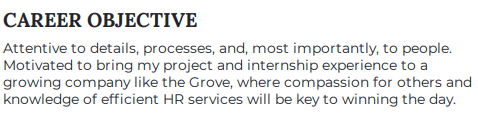
Summaries are excellent tools if you’re further along in your career. If you’re SHRM-SCP certified or have been in management for years, you should use a summary for your CV. Summaries can be difficult, though, because you have to condense years of experience, often resulting in something that looks like this:
- Experienced HR professional who is organised and passionate about people. I am qualified and ready to bring my 10+ years of communication, training, and administration skills to your company.
It’s not bad in itself, but it’s vague and not tailored to the company. The one below gives examples of the applicant’s skills and what they’ll offer their employer:
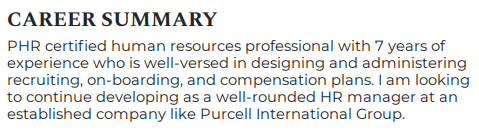
- Onboarding and employee training are my specialities as a CIPD-certified manager with over 10 years of HR experience. I’m passionate about talent acquisition, coaching, interviewing, and compensation/benefits. I wish to use my skills to increase employee satisfaction and training effectiveness while reducing time-to-hire and time-to-productivity at CORE.
As with the visual below, the summary above outlines goals, specialities, and what the candidate can offer their future employer. When writing your objective or summary, ensure it is detailed and concise to highlight your best qualities.

How to list your HR work experience
HR professionals juggle many roles, so it can be tempting to include as many past jobs as possible to demonstrate your adaptability and skills. This results in a CV that’s overloaded without a clear focus.
Instead, list two to four of your most relevant work experiences. Doing so provides a clear narrative of your career and gives you room to elaborate on the responsibilities and skills you acquired from each role.
If you lack formal work experience, list internships, voluntary/leadership work, and projects related to your desired HR position.

How to write effective bullet points
Bullet points are the mainstay of your experience section, so your writing should be as specialised as possible in this area. Use active verbs and targeted language without resorting to personal pronouns to create the most impact. Consistency is key, so match your verb tenses and either use punctuation or avoid it altogether.
Distinct and concise bullet points are essential for an HR CV. Use the following examples to help you craft impressive bullet points on your CV:
- Ensured compliance with national, regional, and company employment laws
- Created individualised employee performance appraisals in collaboration with management quarterly
- Informed employees about company policies, procedures, and remuneration during staff training
- Established a standard set of induction processes, including interviewing, office setup, and software training
These bullet points showcase your specialised skills and highlight your achievements most effectively and efficiently.

Harness the power of numbers
Metrics are often overlooked in HR CVs, but they’re a significant asset. They provide clear evidence that you’ve performed your role effectively. Therefore, you should aim to include metrics in 50 per cent of your job description bullet points.
When discussing your job responsibilities, try to include some of the following HR metrics:
- Reduced time-to-hire
- Improved staff retention
- Improved staff satisfaction
- Improved staff performance
Below are some sample job description bullet points using the above metric types.
- Implemented enhanced recruitment processes, including quarterly updates to job descriptions, sourcing strategies, and training/development opportunities for existing staff, reducing the time to hire by 7 days.
- Provided personalised guidance through weekly one-to-one meetings with new staff members, resulting in a 13% increase in employee retention compared to previous years.
- Distributed satisfaction surveys during meetings and incorporated feedback into procedures over 6 months, resulting in satisfaction rates 50% higher than the previous year.
- Encouraged employees in weekly meetings with special mentions and consistently directed employees to HR records in case of concerns regarding payroll, benefits, or training, resulting in a 15% increase in employee performance compared to the previous quarter.

How should entry-level HR CVs differ from senior-level ones?
Candidates at entry level should highlight their education, work placements, and transferable skills. If applicable, include specialised modules such as Organisational Psychology or Employment Relations if relevant.
On the other hand, mid-to-senior HR professionals should concentrate on leadership, strategy, and measurable achievements. Your work experience should be extensive and demonstrate your ability to enhance workplaces.

Select your HR skills carefully
The skills section on an HR CV presents your attributes and qualifications in an easy-to-read manner. Regardless of your experience, this section demonstrates why you’re the best candidate for the role because you possess the traits and knowledge the employer is seeking.
This is why ATS prioritises skill keywords to filter out candidates, so getting this section right is crucial. To ensure you stay on the recruiter’s list, choose skills that appear in the job description or those related to similar HR positions.
Below are some good examples of hard and soft skills HR recruiters seek:
- Recruitment
- Microsoft Office Suite
- Legal Compliance
- Conflict Resolution
- Performance Management
- Pay and Benefits
- ATS
- HRIS or HRMS
- PHR Certification
- Planning and Strategy
These CV skills demonstrate experience in multiple areas, such as recruitment and payroll, while also listing some hard skills like ATS knowledge.

How to include education, and decide on optional sections
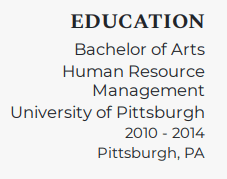
As shown in the diagram below, you’ll need to include education, as most HR positions require a BA in Human Resources Management or related degrees. Depending on your level of education, years in the workforce, and any specialisations and certifications, you may need to include different sections on your CV.
For example, if you have multiple qualifications, it may not be wise to cram them all into your objective/summary. Instead, list them in your skills section.
You may wonder if you should add a hobbies and interests section to your CV, but most HR CVs shouldn’t include these. Interests and hobbies can be useful in tipping the balance in your favour, but most often, they don’t significantly increase your chances.
However, if the job description or advert mentions company culture or the importance of interests, you should include a section on interests and hobbies. For example, if you apply for a position at an entertainment company, including your love of Harry Potter and Star Wars might be beneficial.

What qualifications should HR professionals include?
As mentioned earlier, certifications validate your expertise and commitment to continuous HR development. It’s best to list one enduring and several recent certifications.
For example:
- Practical AI and Prompting for HR Professionals (AI Business School) – 2026
- Generative AI 101 for HR Professionals (IBM) – 2024
- Senior Certified Professional (SHRM-CP) – 2022
This list of achievements clearly shows SHRM-CP, which is a well-known qualification in the HR industry, while also emphasising the candidate’s initiative to become proficient with GenAI for human resources tasks.

Adjust your HR CV accordingly
Every job is different, so each CV you submit should also be unique. Human resources roles will have things in common, so you don’t need to completely overhaul your CV. Still, pay attention to the differences with each position. Tailor your objective/summary, your skills, and your work experience bullet points to match the job description or advert for every job to which you’ve applied.

Edit your HR CV for optimal impact
Although it’s tempting, don’t submit your CV straight away! Even though it’s technically complete, there could be mistakes you’ve missed.
Walk away for a day or two and let others read it. Once you’ve refreshed your mind, come back and check your CV one last time for any errors. Then make the necessary changes until your HR CV is spotless.
What mistakes should HR professionals avoid on their CVs?
Regardless of your experience, it’s very easy to make a mistake on your HR CV. This list covers a few things you should keep in mind before you hit “send.”
- Never omit compliance experience (GDPR, FMLA, or HSE policies)
- Use results-driven language instead of generic phrases, like “Managed HR tasks”
- Avoid writing paragraphs; recruiters (and ATS) prefer concise bullet points

Key takeaway
- Tailor your CV to the level of responsibility and industry context
- Include certifications like CIPD Level 5 to gain credibility
- Maintain a balance of soft skills and HR-based technical proficiency

Ace the interview and get the job
The final step is to celebrate and prepare for your interview! You can use our CV checker to upload your CV and check it against our AI-powered tips or use our free CV maker, which allows you to create CVs from scratch. Just remember, whenever you apply for a job, you’ll want to tailor your CV again. Good luck—we’re cheering you on!
Human Resources (HR) CV FAQs

A good human resources (HR) CV showcases your ability to manage people, procedures, and compliance issues. Whether you are an entry-level or senior HR professional, your CV must demonstrate impeccable interpersonal skills, knowledge of HR practices, and measurable achievements.
Keep it concise when completing your “About Me” section. Emphasise your HR strengths, years of experience, and your top achievements. Customise this to the role—if the company is seeking a recruitment expert, describe how you excel at hiring talent like no one else.
A good HR CV summary should be around 3–4 lines and concisely explain the highlights of your career. Focus on your past achievements and impacts in previous roles and the value you can bring to the company you’re applying to.
To stand out from other generic HR CVs, tailor yours closely to the job description. Naturally, include keywords and skills from the posting and highlight achievements that match what the company is looking for in an ideal candidate.

Stephen is the co-founder and CEO of BeamJobs. Frustrated with the challenges he'd faced in his own job search, he left the corporate world to start BeamJobs with his brother. Drawing on firsthand experience with hiring and getting hired as technical talent, he started BeamJobs in 2020 to help qualified job seekers land interviews with less stress. Since then, more than 4 million people have built their resumes and cover letters on BeamJobs. Stephen's insights have been featured in notable outlets, such as Fast Company, Business Insider, Yahoo Finance, MIT, and Zapier. Learn more about Stephen.