



From standing behind the till, juggling customers, stock, and sales targets, your retail CV needs all the daily little wins to impress employers. Demonstrating these retail skills and achievements can be difficult when creating your CV or covering letter.
That’s precisely why we’ve created this guide. Stay with us and you’ll discover:
- ↪ 13 great retail CV examples
- ↪ The best CV formatting tips to land a job
- ↪ Some commonly asked questions about retail CVs
Why this CV works
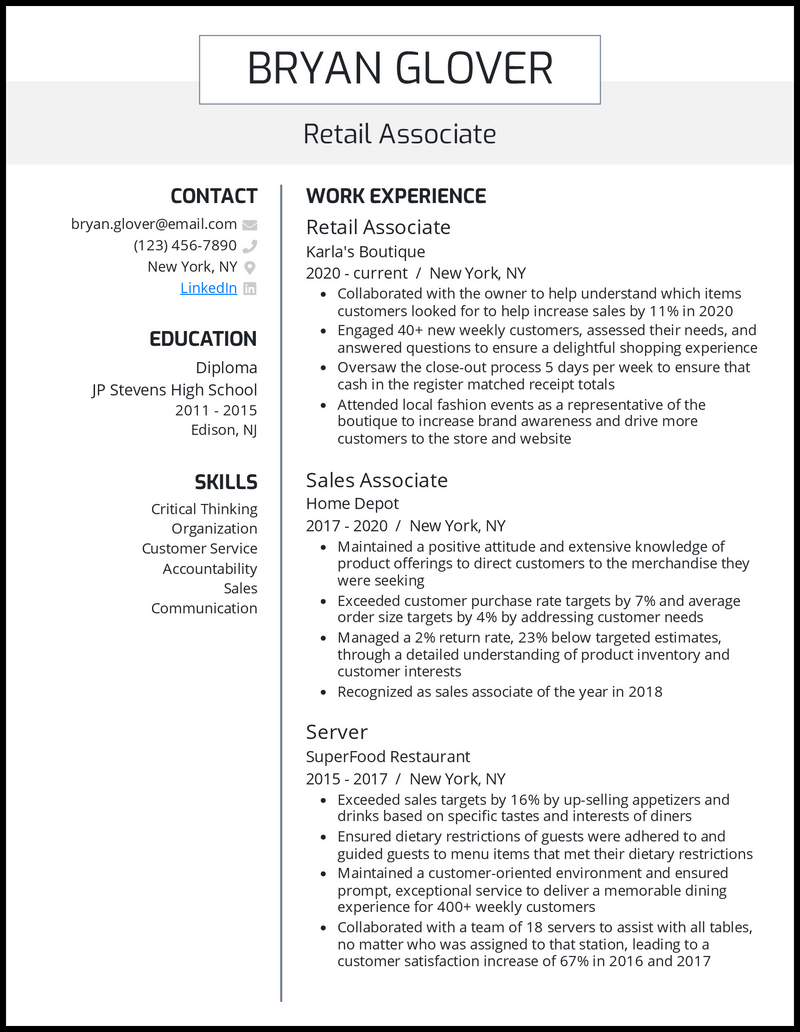
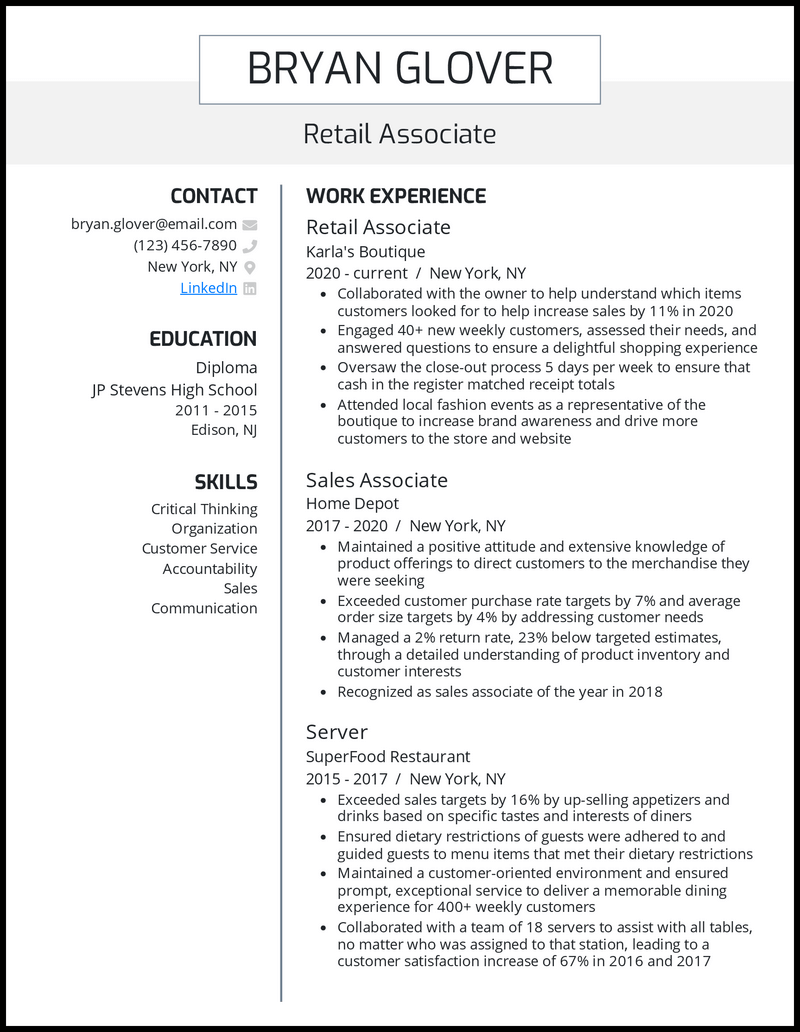
- Retail workers need to combine both sales and customer service. On the customer service side, your CV should demonstrate that you’ve adopted a customer-first approach in your roles.
Why this CV works
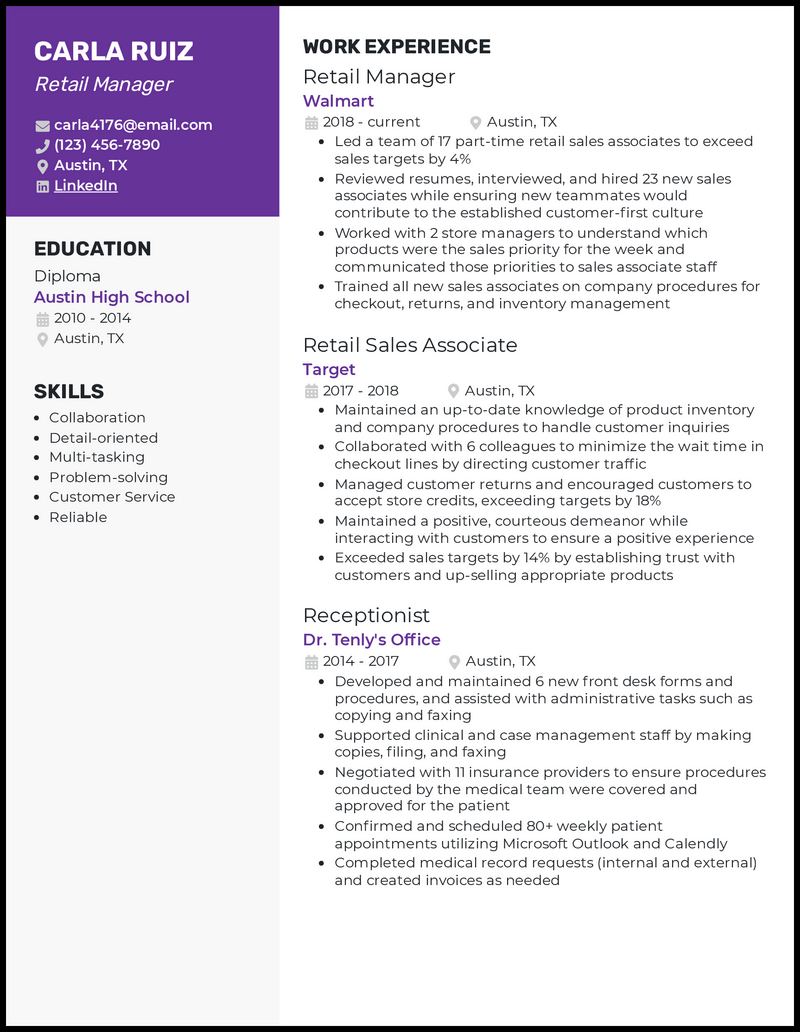
- Your retail manager CV should clearly state the number of employees you’ve managed in any previous management roles. You should also be clear about any hiring or training you’ve led. Including these metrics shows the hiring manager that you understand what is most important for a retail manager.
View more retail manager CVs >
Why this CV works
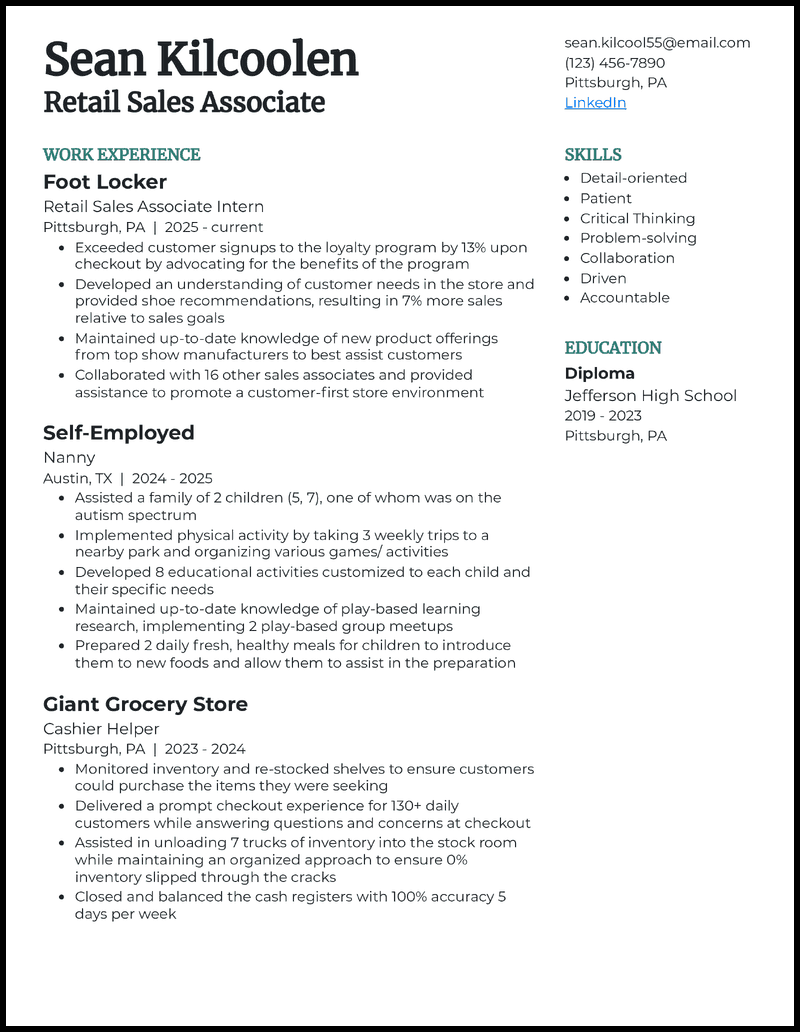
- Most retail sales assistants, especially for large retail chains, are given sales targets each month that they need to achieve. If you have experience in retail sales, then you should mention how you performed against these sales targets on your retail sales assistant CV.
View more retail assistant CVs >
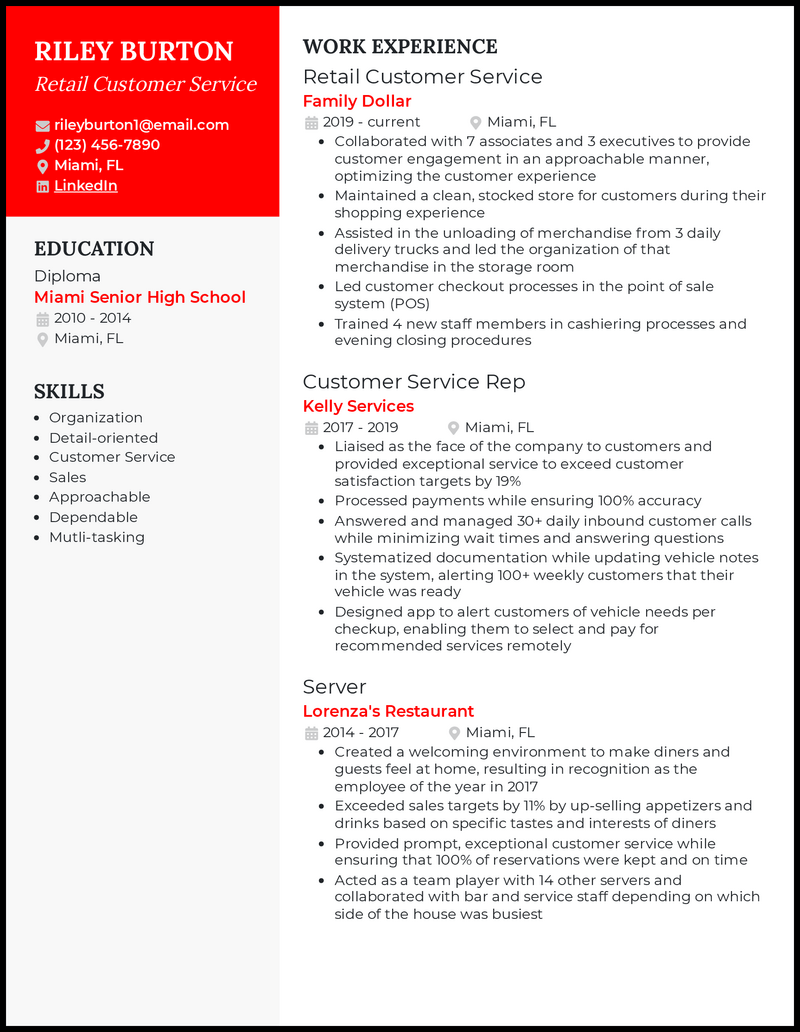
Why this CV works
- This is a customer service role, and your interpersonal skills should be prioritised. Responding to enquiries, resolving issues, the number of customers attended to, and the business value of such interactions are metrics you must pay attention to.

Why this CV works
- Emphasise how you’ve maintained a high customer satisfaction rating even in a non-sales role to demonstrate credibility in keeping end-users happy— an important aspect of any sales position.
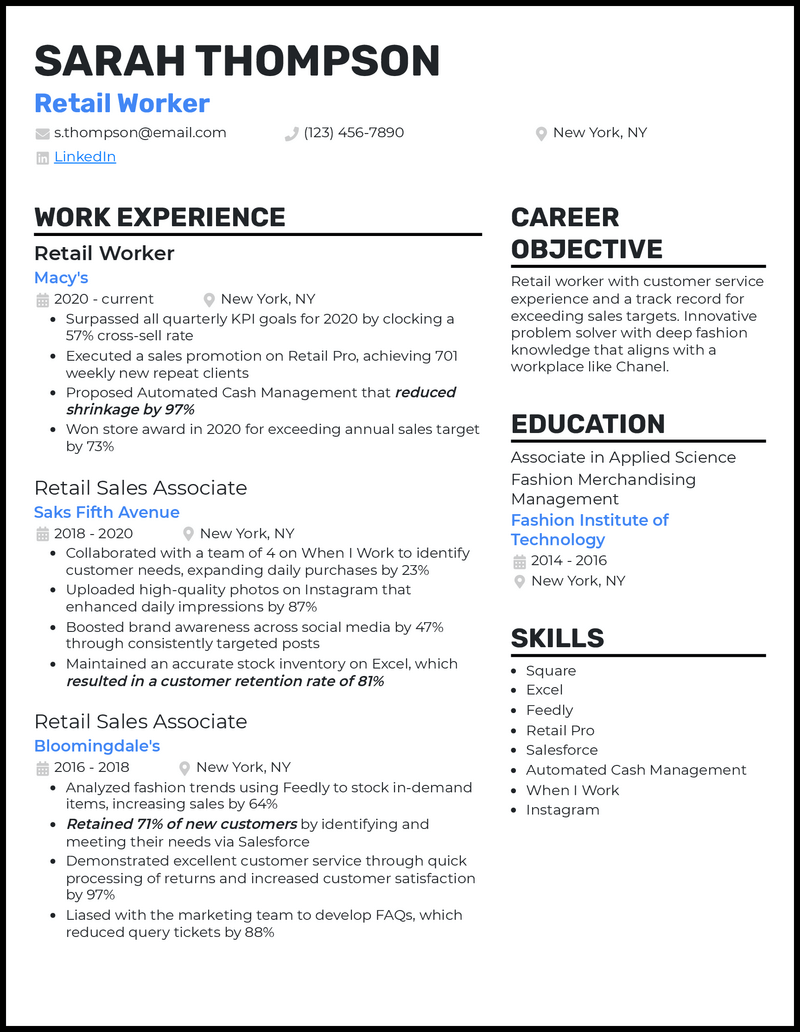
Why this CV works
- Clearly demonstrate your customer service and communication skills, as well as your ability to solve problems instantly in your retail worker CV.
View more retail worker CVs >

Why this CV works
- Highlight your proficiency in sales management, growth, and ability to enhance customer retention and satisfaction.
View more luxury retail CVs >

Why this CV works
- Demonstrate your adaptability in various situations and enhance a brand’s reputation in multiple ways. You can explore the how and why of these details in your retail cover letter.

Why this CV works
- Enhance your retail buyer CV by using the right template with plenty of space to detail various work duties such as scheduling purchases, identifying cost savings in supply chains, and reordering products promptly.

Why this CV works
- Show initiative in your CV by including a good mix of previous retail-related work experiences along with skills such as Square POS, Retail Pro, and When I Work.

Why this CV works
- A retail keyholder CV that effectively highlights numerical achievements can demonstrate your potential value to the hiring company and set you apart from your competitors. Example: “Coordinated eCommerce integrations via Shopify, adding 78 SKUs online and driving a £9,664 increase in monthly sales”.
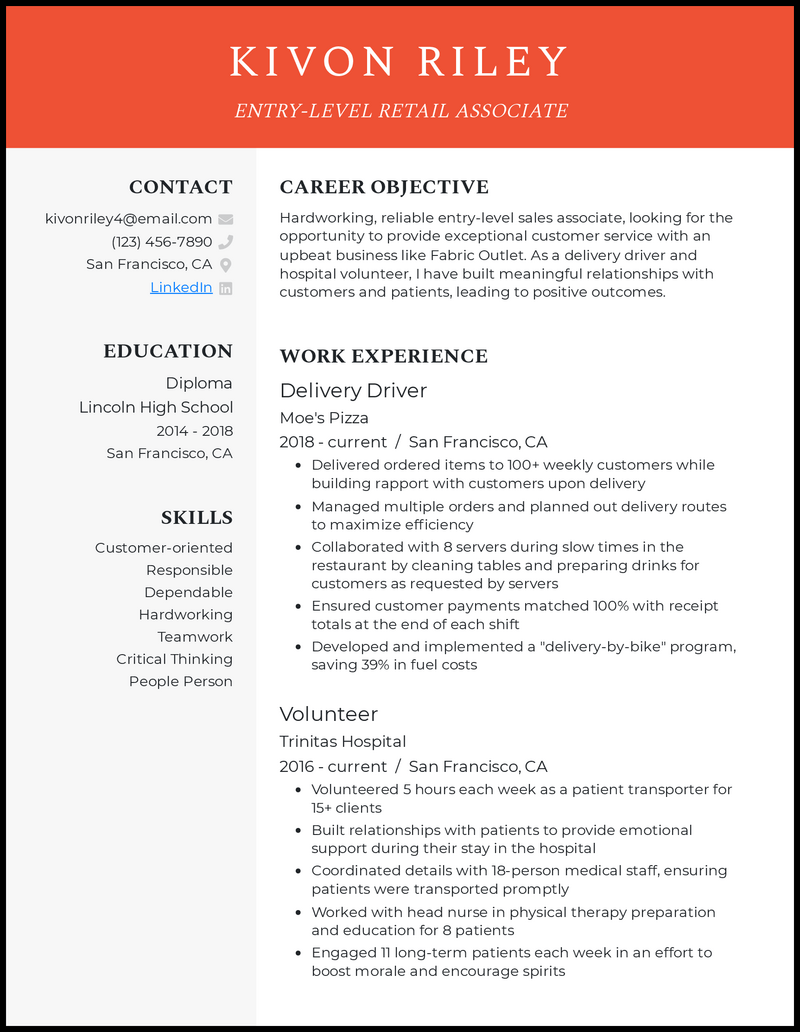
Why this CV works
- Including volunteer experience on your entry-level retail CV is worthwhile. It demonstrates that you are hard-working and genuinely interested in helping others. These are both qualities that retail hiring managers look for.
View more entry-level retail CVs >

Why this CV works
- Before you click on the “Submit” button, please take a moment to proofread your high-end luxury retail CV. Skipping this step is a cardinal sin that might result in the hiring manager moving on without a second glance.
How to Format Your Retail CV

Creating the perfect retail CV is the precise skill you need to secure a job as a sales representative, customer service representative, sales assistant, or cashier. While the content of your CV is of the utmost importance, it’s also essential that you properly format your CV to ensure that it’s readable, logical, and complete. To that end, there are three formatting components you should be aware of, which include
- Reverse-Chronological Format, Functional Format, and Combination/Hybrid Format
- Contact Information and Header
- ATS and Readability

Retail CV format types
The reverse-chronological format, functional format, and combination/hybrid format are the most popular formats for retail CVs in 2026.
Retail CV format choices:
- Reverse-chronological format: Start with the most recent employment history and work backwards. Dates, educational institutions, and previous employers should be displayed.
- Functional format: This type of CV highlights the strengths and skills you believe are important to an employer. On the other hand, names, places, and dates aren’t nearly as clear. If you have a patchy work history, this format downplays this history.
- Combination/hybrid format: This is designed to combine the reverse-chronological and functional formats to incorporate the strengths of both. Make sure to mention skills you’ve acquired in the past that will help you with the specific job for which you’re applying.
While each retail CV format has its own set of advantages and disadvantages that you should be aware of, the reverse-chronological option is ultimately the best choice for retail. Many employers outright dislike the functional format for retail positions. The reverse-chronological format is ideal for retail CVs because it allows you to show prospective employers your most recent work history automatically, enabling them to determine if you have the experience necessary for the role.
Suppose you’ve worked as a cashier and shop assistant for eight years before becoming a supervisor or store manager for another five to ten years. You may be ready for another promotion to regional manager or even a corporate position. If you’ve had any experience in the retail industry, the reverse-chronological format effectively shows a pattern of lateral or upward mobility. The main benefits of using the reverse-chronological format for retail include:
- This format is easily the most popular option among recruiters and employers within the retail sector.
- The CV automatically positions you as seeking the next upward step in your career.
- Employment dates are linked, which emphasises continuity and places more weight on your most recent experience.

Including a contact header on your retail CV
When you’re getting started with your CV, it’s essential that you position your contact information and the CV header in the correct locations. Your name should always be included at the very top of the CV and can be set in the centre or left side of the page. Consider placing your prospective job title on the line below your name, ensuring that these two pieces of information are seen first by potential employers.
Before you start typing your header, it’s important that you select the right font, colour, alignment, and font size that potential employers expect from a retail CV. Classic fonts like Times New Roman and Arial are preferable in most cases. A CV should be formatted with simplicity in mind rather than style and flair.
Regarding the font size, the standard text should be between 11-12 points. Conversely, headings should have font sizes ranging from 14-16 points, and your name can be the largest. Most of your text should be black, but a touch of colour in your headings or name is appropriate, adding some nice contrast to make the information on your CV stand out. Like most professional documents, CVs should be left-aligned, making them easier to read. However, your contact information and name can be centre-aligned if you prefer. The types of information that should be included in your retail CV header are:
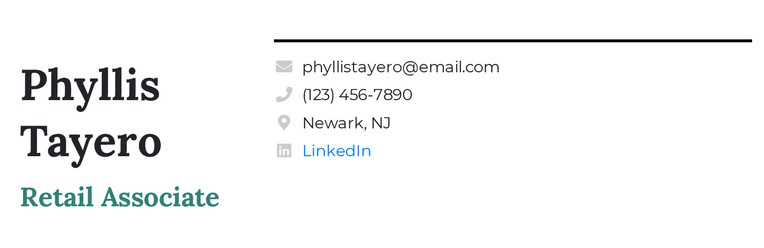
- Full name
- Job title
- Email address
- Phone number
- Town and County
- An optional LinkedIn or other professional URL
This example is clear, logical, and includes a small bit of colour, attracting the eye:

Is your retail CV ATS-friendly?
If you want to ensure your CV is properly formatted and readable, parse your CV to make sure it will pass through the ATS, which stands for applicant tracking system. This is a type of human resources software that allows employers to organise large numbers of CVs efficiently.
To create an ATS-friendly CV, you’ll want to pay attention to:
- Margins: Margins should never be less than half an inch. The ideal margin is one inch on all sides.
- Fonts: Any font you use should be easy to read. If your CV font isn’t clear, the ATS and hiring manager may find it too difficult to read.
- Font sizes: The font must be large enough to read, making anything between 10 and 14 points acceptable.
- Header names: Use capitalisation, and don’t get overly creative in deciding how to label your headers, as you don’t want to trip up or confuse ATS software.
- Skills: Optimise your CV with keywords, your soft skills, and hard skills. Only include relevant information about your skills. Any filler should be eliminated if you want to provide prospective employers with a concise and effective CV.
- Logical order: Sticking to the reverse-chronological format will allow you to create an ATS-friendly CV. Start with your name and contact information before detailing your work experience, education, and skills.
- One page: The ideal length for any retail CV is one page.
We know there’s a lot to remember, but our CV maker will ensure you’re formatting for success without having to keep it all in mind.
How to Write a Retail CV

The right retail CV will include three work experiences, a strong education section, and a varied skillset, but this doesn’t mean you should spend hours creating it. Simply drafting a decent first copy and using a CV checker can help you speed things up.
As you write your retail CV, you’ll want to consider the following:
- Objective or summary
- Work experience
- Top retail skills
- Education and qualifications
- Projects, interests, or hobbies
- Tailoring your CV to the job
- Editing and proof-reading

Should you write a retail CV objective or summary?
You could include a CV objective or summary when creating your retail CV. An objective statement is a concise and position-focused statement describing how you can add value to the employer, and the company needs that you can fulfil. The objective could include a short statement of your skills and qualifications for the position in question. Professional CV summaries tend to be a bit lengthier than objective statements and are meant to provide more in-depth details about your job experience, skills, education, and specialisations over the course of a lengthy (10+ years) career.
Objective or summary for your retail CV?
- Consider writing a personal statement when:
- You want hiring managers to know you’re a good fit for a specific role
- You’re a junior employee with very little experience
- You are changing careers
- You’ve just moved to a new city or town
- You might want to choose to write a summary when:
- You have years of experience and want to bring this experience together
- You want to focus on key transferable skills
- You believe that an objective statement isn’t enough to demonstrate your value to the employer
- You want to emphasise your selling points clearly
Even though objective statements and summaries can help you convey your point to hiring managers, not everyone should use one. If you don’t have years of experience or your career path is straightforward and clear, a lengthy summary is unnecessary.
When it comes to objective statements, they aren’t always suitable for retail CVs. Your employer might think that the objective statement you write is essentially all you have to offer as an employee. If the statement is too brief or not descriptive enough, it could damage your chances. To gain a better understanding of what a well-written objective or summary looks like, let’s examine a couple of poor examples:
- Objective: “To work as a sales assistant in a shop.”
- Summary: Experienced sales assistant who is kind and helpful. Capable of solving problems as they occur.
The objective statement is far too vague and isn’t focused on the position for which you’re applying. It doesn’t inform your employer of anything other than the fact that you’re seeking a job. Regarding the summary, it mentions that you have experience and a few soft skills but doesn’t effectively promote this information. Employers won’t be convinced by what you’re stating in the summary. Here’s an improved objective statement and summary:
- Objective: “Keen to inspire and lead teams to achieve a 10% or greater increase in sales through mentorship and accountability. Seeking to enhance my team management and problem-solving skills as a store manager with potential for career progression at ABC Company.”
- Summary: Dedicated cashier with over 5 years of retail experience. Keen to apply attention to detail and organisational skills at XYZ, Inc. Awarded Employee of the Month for three consecutive months for efficiency and reliability during changes in ownership. Maintained a record of 530 days without taking sick leave.
These examples succeed because they discuss specific details rather than general ideas, telling employers something about you and your work.

How to present your retail work experience
Try to include two to four examples of work experience for your CV. However, it’s unnecessary to include every job you’ve had since your first. If you have plenty of experience, include those roles most relevant to the position for which you’re applying. While writing down your work experience may seem straightforward, it’s easy to make mistakes in this section.

Writing your retail job descriptions
The most important thing to avoid when writing an effective work experience section is creating a wall of text. If a prospective employer decides to skim through your CV, it’s important that they read the most relevant aspects of your past work experience. As such, this experience should be displayed via concise bullet points. Always use active verbs and language in these bullet points. Examples of active verbs for a retail CV include:
- Strategise
- Analyse
- Increase
- Enhance
- Resolve
- Generate
Ensure you use the past tense when writing about your experience. These verbs should prove useful when trying to condense your work experience. Avoid using personal pronouns like “me” and “I,” which detract from the professionalism of your CV.
Three bullet point examples that should be far, far away from your retail CV:
- Processed transactions for customers
- Responsible for managing customer interactions calmly
- Responsible for resolving customer issues
These are examples of passive work responsibilities, too vague to satisfy potential employers. Always provide detailed information about your achievements and past responsibilities using action verbs and precise figures.
Three examples, on the other hand, that would serve your retail CV well:
- Awarded Retail Associate of the Year in 2019 for motivating the team to increase sales with monthly competitions
- Surpassed annual sales targets by 30% by upselling subscriptions and products based on customer interest
- Stocked, organised, and replenished inventory, completing tasks 15% faster than other sales assistants
These are richly detailed bullet points that provide precise figures and action verbs about previous work experience.

Use metrics to quantify your impact in retail
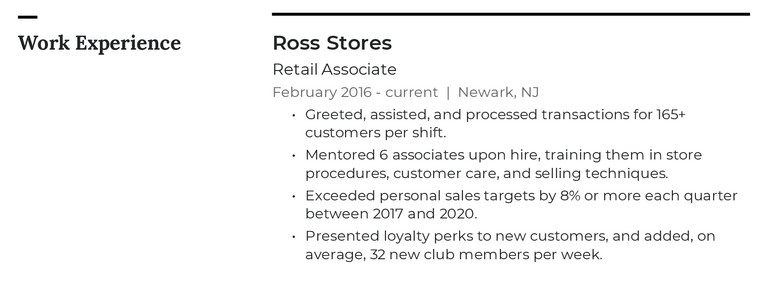
You must be able to quantify the impact you’ve had on the companies you’ve worked for in the past. To achieve this aim, it’s recommended that you use metrics to demonstrate exactly what a company would lose if they didn’t have you as an employee.
Did you surpass set sales targets or reduce return rates? By quantifying your work experience, it becomes easier for potential employers to assess the kind of return they would get from hiring you. Try to include a couple of metrics for every job you list on your CV. More is always better! Some examples of ways to incorporate metrics into your bullet points include:
- Daily number of customers you assisted
- Number of retail team members you supervised
- Sales targets that were met or exceeded
- Loyalty programme goals that were met or exceeded
These retail descriptions include all of the above:
How do you specifically demonstrate customer service experience on a retail CV?
To demonstrate how you enhanced the average customer’s experience in retail shops, use strong action words at the beginning of each bullet point. However, ensure they clearly convey the impact of your efforts.
A few examples of compelling verbs you can use include: Improved, Increased, Maintained, and Enhanced.
If you’re unsure about using these words, try using a bullet point generator or take inspiration from the examples below:
- Maintained an average 97% customer satisfaction score for Macy’s largest store, according to annual surveys.
- Resolved 92% of all service complaints within 19 hours, maintaining Macy’s reputation as a customer-focused brand.
- Reduced the shop’s product return rate by 11% by offering appealing replacement deals and encouraging customers to exchange rather than request a refund.

How do you handle seasonal or part-time roles on a retail CV?
If you’ve worked in several part-time roles, grouping them together under the same job title is the clever approach. Here, you can include a bullet point for each role and highlight unique contributions.
Here’s how to present such experiences:
Seasonal Freelance Retail Manager
Freelance (Multiple Shops)
2016 – 2018
- Managed all Black Friday sales operations, dealing with over 150 customers daily.
- Led a team of 7 sales assistants, ensuring the shop met all its sales targets by the end of each month.

What are the top retail skills?
If you have extensive previous work experience, you likely possess dozens of skills that could prove useful in the role for which you’re applying. However, you should include skills relevant to the specific requirements listed in the job advert. Before you start listing your skills, you should understand the difference between hard skills and soft skills.
Hard skills refer directly to the abilities and knowledge that employees require to perform their responsibilities effectively. These skills are entirely job-related. Soft skills are more difficult to measure. For retail jobs, examples of hard skills include:
- Handling money and basic maths
- Product knowledge
- Inventories
- Upselling
Some examples of soft skills that are ideal for the retail sector include:
- Communication
- Good listener
- Patient
- Quick to learn and adaptable
Look for keywords in a job advert that indicate the types of skills the company is looking for. You should usually list around five to eight skills on a retail CV.

What education and qualifications do you need on your retail CV?
Most retail positions automatically require a high school diploma, which should be listed with the name of the school you attended, the years you attended, and the school’s location. Some retail jobs will require a little more education. While you may be able to obtain a position as a store manager with a high school diploma, an associate’s degree in marketing and sales management may help push your resume to the top of the list.
Most regional retail managers require a bachelor’s degree in business. If you attended a university or institution, include your degree classification if it’s a 2:1 or above and any specialisation. You might also want to list certifications and licences to set your CV apart from others.
Typically, retail shops only require their employees to have completed secondary school, so as long as you have a certificate, you can add it to your education section. However, having a degree in retail will, of course, improve your chances of being hired.
When it comes to qualifications, having the latest ones is the best approach:
- Certified Retail Sales Associate – Retail Council of Canada
- Certified Retail Management Expert – British Institute for Business Management and Communication
- CIM Professional Certified Marketer – Chartered Institute of Marketing

Projects, interests, or hobbies: Does your retail CV need these?
In most situations, it’s unnecessary to mention your interests and hobbies and the projects you’ve worked on in the past. However, there are some scenarios where adding this information is appropriate depending on your level of experience and the employer to whom you’re sending a CV.
Suppose you’re currently a secondary school or university student or are applying for an entry-level position. In that case, your lack of experience gives you the perfect opportunity to add projects, hobbies, and interests to your CV.
For interests and hobbies, you might include:
- Playing team sports
- Studying foreign languages
Additionally, your retail CV could benefit from including projects such as:
- Creating a personal website with WordPress
- Reorganising your school’s entire library of over 1,600 books

Tailor your retail CV for every job application
Creating an effective CV involves more than simply listing your skills and work experience. It’s also crucial to tailor your CV to each job for which you apply. Many candidates make the mistake of sending the same CV to every job. However, most hiring managers will notice this.
To properly tailor your CV, add company or organisation-specific information to the objective/summary sections, the skills section, and bullet points. If the job advert you’re responding to mentioned they’re looking for a strong leader who can manage numerous team members, you should focus on your leadership skills throughout your retail CV.

Check for mistakes before submitting your retail CV to jobs
This is the simplest yet most overlooked aspect of formatting and writing a retail CV. Hiring managers and recruiters dislike grammar and punctuation mistakes. Writing the word manager as “manger” is one of the more common mistakes on retail CVs. Carefully read through your CV to look for any issues with grammar, language, consistency, and formatting. Take advantage of our free CV checker to streamline this process.

Key points
Now that you’ve come this far, we hope you’re feeling confident about:
- The correct CV format to use
- How to write a CV objective or summary
- How to list work experience
- What retail skills to include on your CV
- What education and qualification information should be provided
- How to tailor your CV to each specific job
Congratulations on writing your CV and preparing yourself for the next step. All that’s left is for you to go and get the job!
Retail CV FAQs

To write a CV for a retail job, highlight key skills such as customer service, upselling, product knowledge, and communication. Include your top three work experiences, ensuring most bullet points mention a skill or achievement. Consider including any certifications or retail management university coursework to further enhance your profile.
The best format for retail (and most) CVs is reverse chronological. This layout allows you to highlight your most recent experiences and achievements at the top, providing employers with a quick overview of your strengths. It also ensures that you include the most important information first so that recruiters see it when they review your application.
Focus on your past work experiences, emphasizing your impacts rather than duties. Use action words to begin each bullet point and keep hiring managers engaged.
For instance: “Grew monthly sales by 11% using strategic upselling techniques” sounds better than “Was responsible for selling extra products to products.”
Yes. Having a retail CV gives employers a quick overview of your skills and work experience. Most jobs expect one (some may even require a covering letter), so ensure you craft a well-designed CV and attach it to your application before applying.
The best way to describe your retail experience is by starting each bullet point with a strong action verb. As you write about your experience, include a unique impact each time (such as improving customer satisfaction, increasing sales, meeting revenue targets, etc.) and quantify them to show recruiters what you’ve achieved in the past.

Stephen is the co-founder and CEO of BeamJobs. Frustrated with the challenges he'd faced in his own job search, he left the corporate world to start BeamJobs with his brother. Drawing on firsthand experience with hiring and getting hired as technical talent, he started BeamJobs in 2020 to help qualified job seekers land interviews with less stress. Since then, more than 4 million people have built their resumes and cover letters on BeamJobs. Stephen's insights have been featured in notable outlets, such as Fast Company, Business Insider, Yahoo Finance, MIT, and Zapier. Learn more about Stephen.