



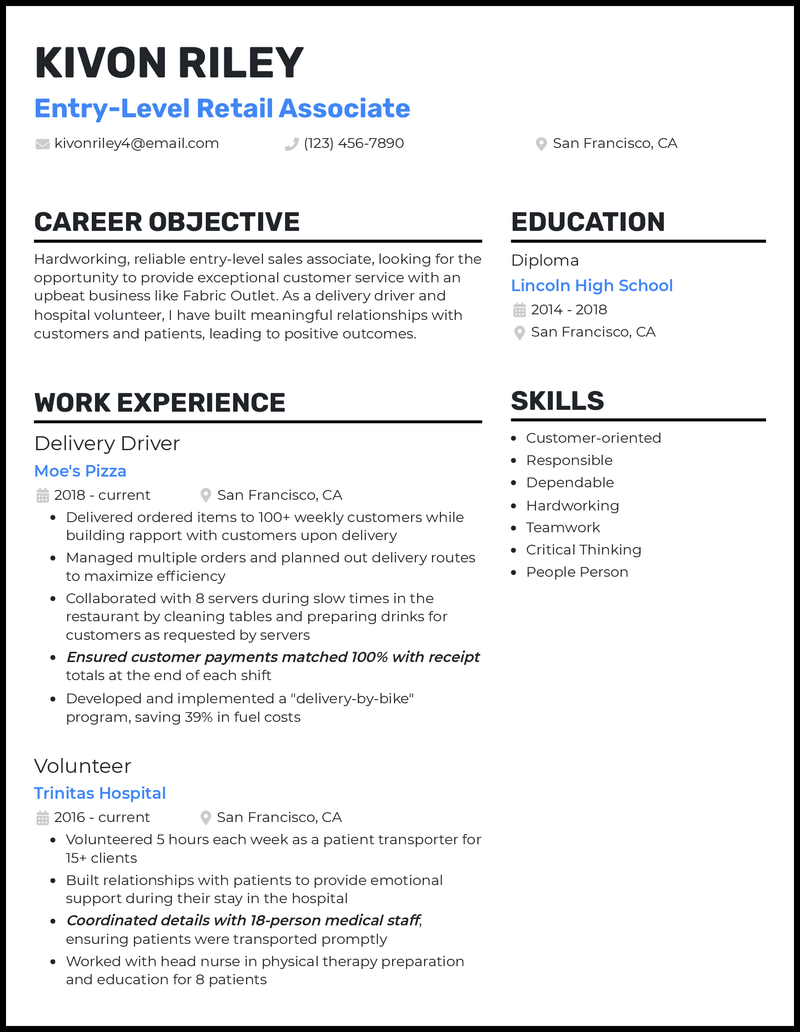
Crafting your first retail resume shouldn’t be overwhelming — with the right tools, like a free resume maker, strategic use of top skills in your resume, and an edge from an AI cover letter generator, you can build a compelling application that gets you hired.
This guide will show you exactly how to stand out from the crowd, with real resume examples and actionable tips for succeeding in today’s retail job market.
This guide will cover:
- ↪ 5 entry-level retail resume examples that actually work
- ↪ How to stand out in the hiring process using the best practices and phrasing
- ↪ The most relevant skills hiring managers look for in retail resumes
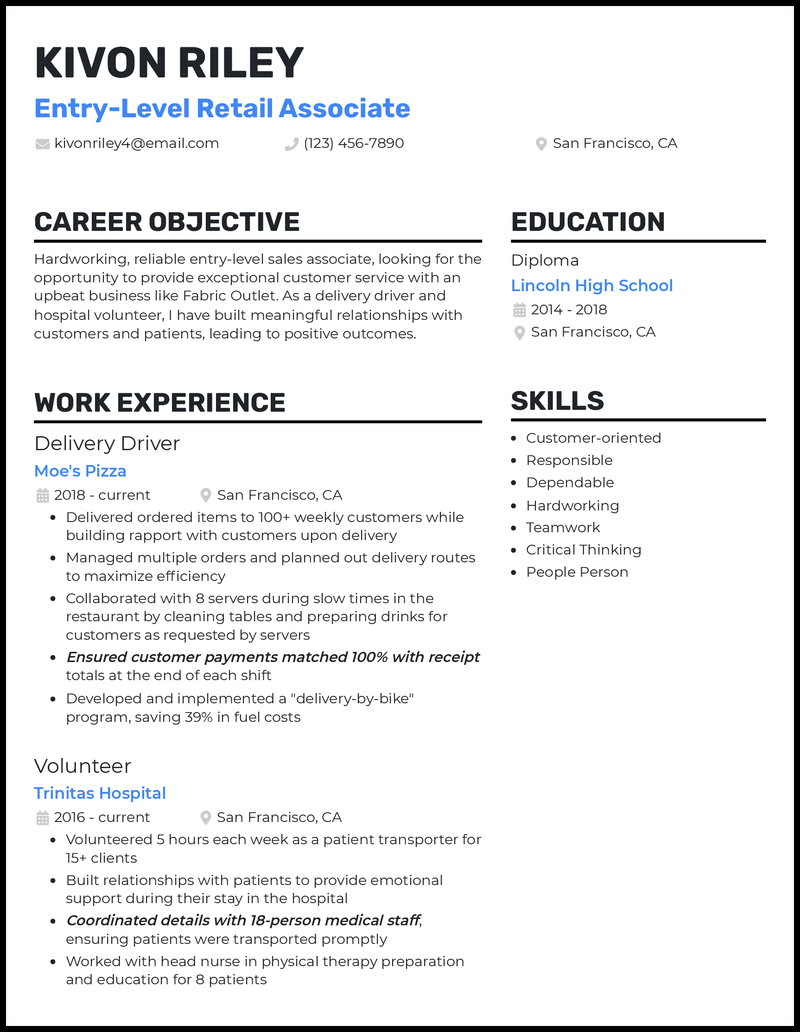
Why this resume works
- You don’t want to hand in that entry-level retail resume with a font like Comic Sans and Chalkduster. Here’s why it’s a bad move:
- Recruiters won’t take you seriously—it’ll rather make your resume look like a kid’s homework. Instead, choose professional fonts like this resume such as Montserrat or Open Sans to create a polished piece.


Related resume examples
How to Write an Entry-Level Retail Resume

The perfect entry-level retail resume must highlight customer-facing skills, flexibility, and passion, which make you stand out in a fast-paced environment.
Summary
Creating an entry-level retail resume that can land the job means showcasing your potential—not just your work history. A winning strategy here is to highlight your strengths, structure your resume to stand out, and leverage smart tools to build a polished application that gets interviews.
Before your draft is ready to submit, run it through a trusted resume checker and explore proven resume templates that hiring managers already love.
What you’ll learn in this guide:
- The top soft and hard skills retail managers want
- How to format your resume with no prior retail experience
- How to effectively position relevant work experiences, such as part-time jobs, school activities, or volunteer work
- Common mistakes entry-level candidates make (and how to avoid them)

Present everything in a clear structure
The first thing you must do for your entry-level retail resume is to get the layout right. Recruiters and screening bots skim for a clean structure, so keep things crisp and scannable.
Use and mark each heading clearly, such as “Career Objective,” “Education,” and “Work Experience.”
Pro tip: Stick to a simple, clean formatting—no graphics, columns, or hard-to-scan layouts.
If you’re using a LinkedIn resume builder, it will automatically structure everything, but double-check for spacing and alignment before sending it out.
Things you must include:
- Job title
- Contact info at the top (email, phone, LinkedIn)
- Optional links, like portfolio or professional social media
- Key sections in standard order: skills, work experience, education, and certifications
For an extra layer of confidence in your document, run your draft through a resume scanner to ensure it’s readable by ATS (Applicant Tracking Systems) and easy for recruiters to review.

Craft a strong career objective
Do you want to break into retail but have no direct experience? Start with a career objective, clearly stating what you want, who you are, and why you’re the perfect fit for the job. Playing this card is especially important for entry-level roles, where passion, soft skills, and willingness to learn matter most.
Example
❌Looking for a job in retail, even though I don’t have a direct example, I’m hard-working.
✅Motivated high school graduate with strong communication skills and a passion for customer service, seeking an entry-level retail associate position at Target to build hands-on experience in fast-paced environments.”
To be sure that you phrase this statement to the liking of hiring managers, use a resume summary generator.
As you do this, it’s crucial for your objective to mirror what the employer is looking for as stated in the job description.
You can also save some time by using a resume job description match tool—this way, you won’t leave anything that may hurt your chances.

Showcase your value through transferable skills
Many entry-level retail candidates don’t have much work experience, so you’re probably wondering what skills you can list in this section.
If you don’t have much experience, think about skills you’ve gained from education, school clubs/sports, volunteer work, or any other responsibilities you’ve held that apply to the position. For instance, if you’re applying for a cashiering position, your basic math abilities would be essential to list.
Here are some of the most popular skills retail hiring managers look for on entry-level resumes.
9 most popular entry-level retail skills
- Customer Service
- Verbal Explanations
- Basic Computer Skills
- Teamwork/Collaboration
- Basic Math
- Cash Handling
- Sales Principles
- Consumer Products
- Data Tracking

Demonstrate your results-driven mindset by showcasing impact from relevant experience
Many entry-level retail candidates also feel overwhelmed with this section if they don’t have much prior work experience. However, just like the skills section, there are still a lot of different examples you can list here.
For instance, if you volunteered at an animal shelter and managed feeding schedules, that would be a great experience to list, showing your abilities to be timely and organized.
Additionally, educational experiences like maintaining a high GPA or participating in competitions through school clubs could be great to fill out your resume.
Here are a few samples:
- Used clear and precise verbal explanations and rebuttals to get 2nd place in a 20-person debate team competition.
- Studied diligently about equation variables and the quadratic formula to achieve a 98% overall grade in algebra classes.
- Counted and made change for cash payments with 99% accuracy while volunteering at an event ticket booth.
- Maintained high levels of communication while working with teammates to effectively run plays throughout the basketball season to achieve 1st place in the division.
Include relevant education and certifications
Retail may not be very strict about your academic background, but sharing details about it can make a big difference in your application’s success. Recruiters want to use it to assess your discipline, attitude, time management, and readiness to learn.
Share the name of your diploma (high school diploma), institution, years of study, and location (city and state).
If you’ve completed certifications like CPR, food handling, and POS systems, list them below education. These credentials can set you apart in retail environments requiring safety or equipment handling.

Strategically beat the bots and impress recruiters
Most retail employers, just like in other industries, use ATS to screen resumes. This means if your resume doesn’t match the job description’s keywords, it might not even get read by a human. That’s the reason why ATS optimization becomes critical.
Here’s what you must do:
- Run your copy through a resume scanner to identify missing keywords or formatting misses
- Use phrases from the job description. For example, use “customer interaction” instead of “customer service” if that’s what the job ad says
- Replace vague terms with retail-focused active verbs such as assisted, restocked, resolved, processed, and recommended
Key terms that resonate with entry-level retail jobs:
- Customer service
- POS systems
- Inventory management
- Team collaboration
- Upselling techniques

Tailor to the entry-level role
Your resume must address the job you’re applying for, not retail in general. As you’ll notice, entry-level retail positions in clothing stores, grocery chains, or electronics shops each emphasize different strengths.
For example:
- Clothing retail focuses more on styling, organization, and customer engagement
- Tech retail will emphasize product knowledge and troubleshooting
- Grocery retail will lean more on efficiency, stocking, and multitasking

Proofread to get rid of any errors
It takes one typo for a hiring manager to move on. An error-free resume says you pay attention to detail—something retail roles depend on daily.
When you proofread:
- Use a grammar checker, but trust your ability to spot mistakes
- Read aloud to hear anything that sounds wrong
- Ask someone close to review it—they can catch something obvious you missed
- Ensure you get brand names, dates, and locations right
Remember that with clean formatting and zero errors, you come out as someone professional, and that’s the first impression you want to make.
Top 5 tips for your entry-level retail resume
- Proofread for spelling and accuracy
- Retail hiring managers will want to ensure you can perform tasks accurately, like counting change and tracking inventories. Start things off right by submitting an accurate resume without grammatical errors.
- Keep your resume organized
- Think of your resume like you’re putting together a school presentation showcasing your top skills. Your teacher would probably ask you to use clear headers, bullet points when possible, and an easily readable font. You should do the same for your resume.
- Aim for concise and easily understandable examples
- Hiring managers don’t expect you to include every detail about how you accomplished your achievements on your resume. Simply saying you kept inventory of products with 98% accuracy would show many key skills that inform them about your abilities to perform in a retail environment.
- Consider including a resume objective
- Entry-level candidates without much experience will benefit from a resume objective. For instance, you could say you’re a dedicated student with a 3.85 GPA, eager to apply your abilities in a retail position.
- Measure your impact
- An excellent way to make examples stand out is by using numbers. For instance, that could be achieving a 98% score on your team project or keeping your cash drawer organized with no shortages or overages for eight months.

Key takeaways
- Use a clean, readable structure to ensure ATS and recruiters can read your copy easily
- Give a profile of your potential, goals, and strengths
- Include relevant education and certification if available
- Tailor content to the entry-level role and brand
- Proofread to catch any errors
Entry-Level Retail Resume FAQs

Try to fill up an entire page with relevant details related to your abilities to perform well in a retail position. If you don’t have work experience, using educational examples, volunteer work, hobbies & interests, and an objective can help fill in more details.
Most entry-level retail jobs don’t require a cover letter. However, many still state that you can submit one, which can be a good idea if you want to stand out. Leverage a free cover letter builder to include information about why you’re passionate about the organization’s mission or how you’ll apply your teamwork skills to the job’s needs.
Reverse chronological order is the best fit, which lists your most recent experiences first. Your most recent experiences will be the most relevant to your current customer service and computer skills to show how you’ll perform in retail.

Stephen is the co-founder and CEO of BeamJobs. Frustrated with the challenges he'd faced in his own job search, he left the corporate world to start BeamJobs with his brother. Drawing on firsthand experience with hiring and getting hired as technical talent, he started BeamJobs in 2020 to help qualified job seekers land interviews with less stress. Since then, more than 4 million people have built their resumes and cover letters on BeamJobs. Stephen's insights have been featured in notable outlets, such as Fast Company, Business Insider, Yahoo Finance, MIT, and Zapier. Learn more about Stephen.