



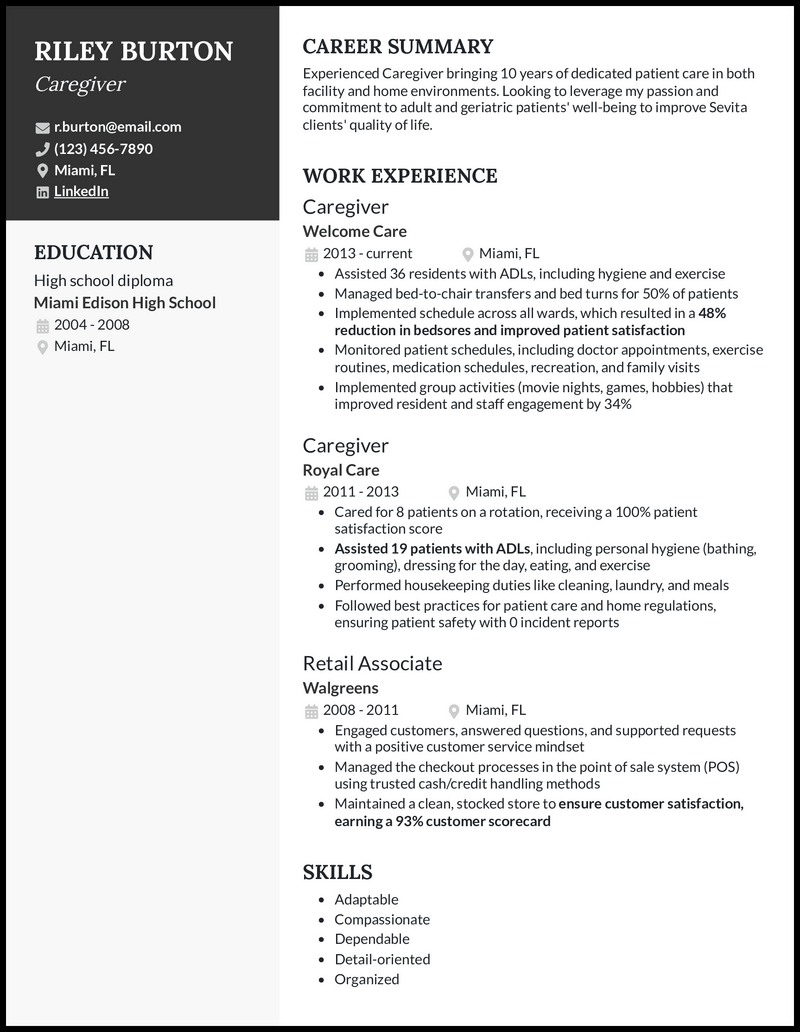
To write a strong caregiver resume, highlight your compassion-driven experience with tailored sections that demonstrate your passion for the role. You also have to back up your qualifications with certifications, past caregiving roles, and specific examples of how you’ve improved someone’s quality of life.
Whether you’re an in-home caregiver, private family aide, or live-in support specialist, this guide provides real resume examples and templates tailored to your role and experience level.
What you’ll find in this guide:
- ↪ 11 caregiver resumes that got jobs in 2026 to guide your draft
- ↪ How to write a resume that highlights trust, empathy, and reliability
- ↪ What to include to meet both agency and private family expectations
Why this resume works
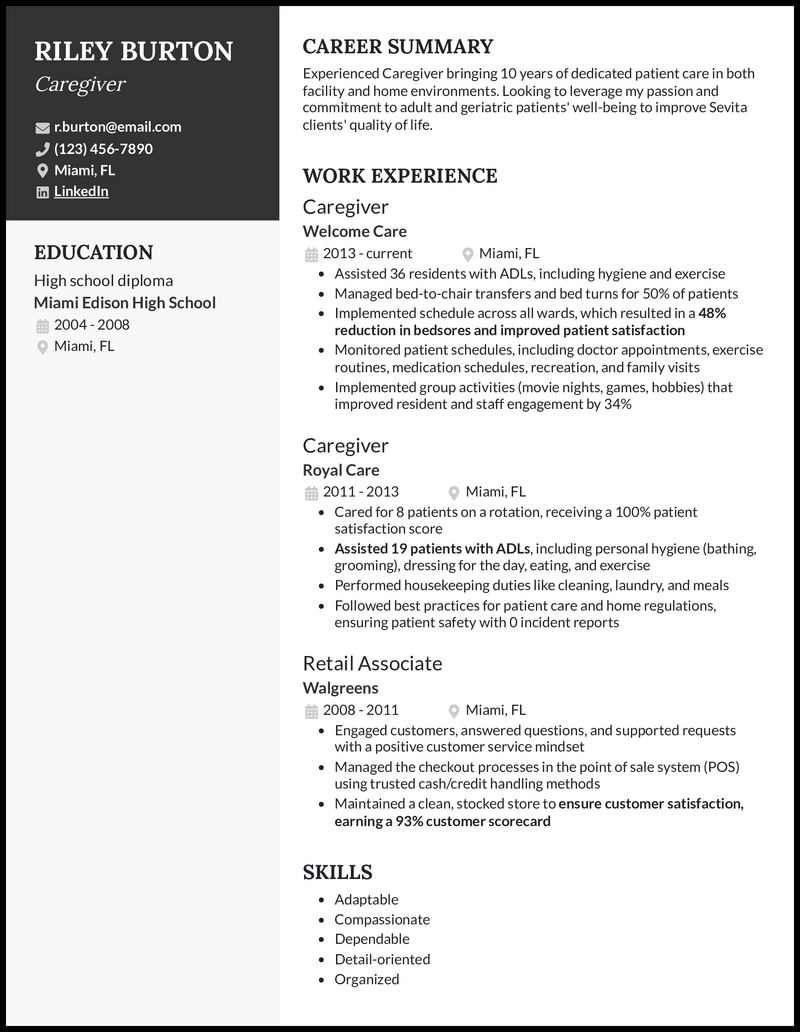
- Your caregiver resume should highlight your abilities to build trust with patients, follow company policies without supervision, and other caregiving responsibilities like housekeeping, providing transportation for patients and interacting with the patient’s family.
Why this resume works
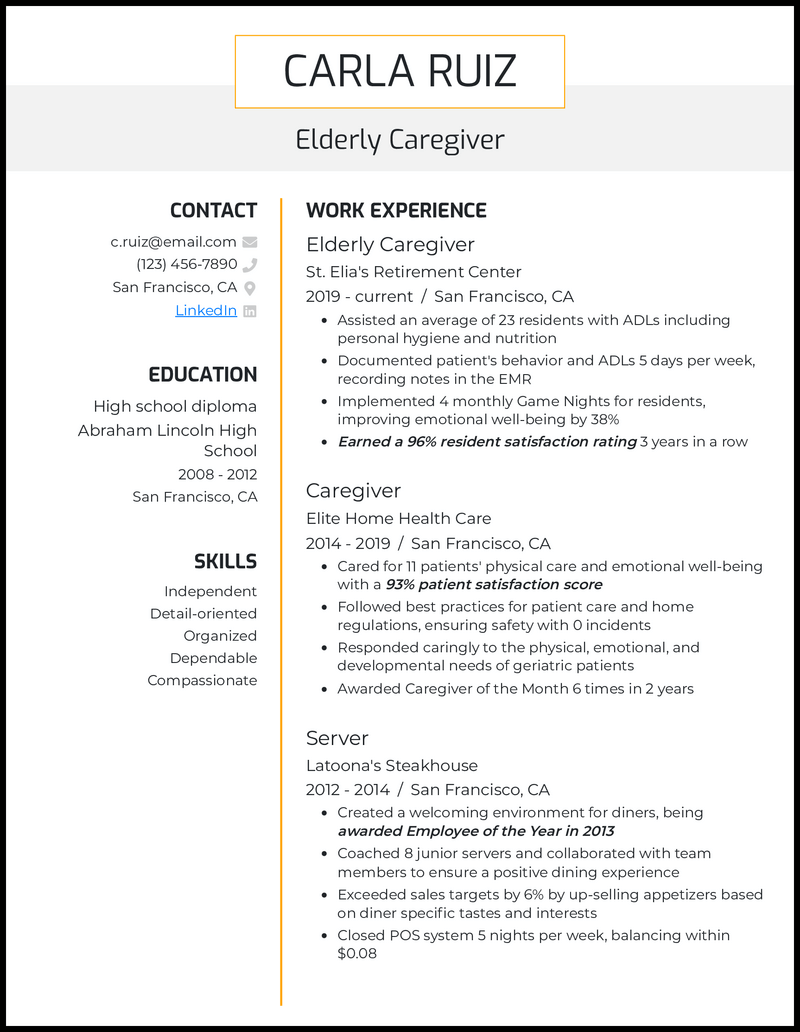
- Metrics catch the eye, helping ensure the employer makes it to the end of your elderly caregiver resume. Power-packed metrics can include the number of patients cared for at a time, satisfaction scores, safety incident records, and more.
See more elderly caregiver resumes >
Why this resume works
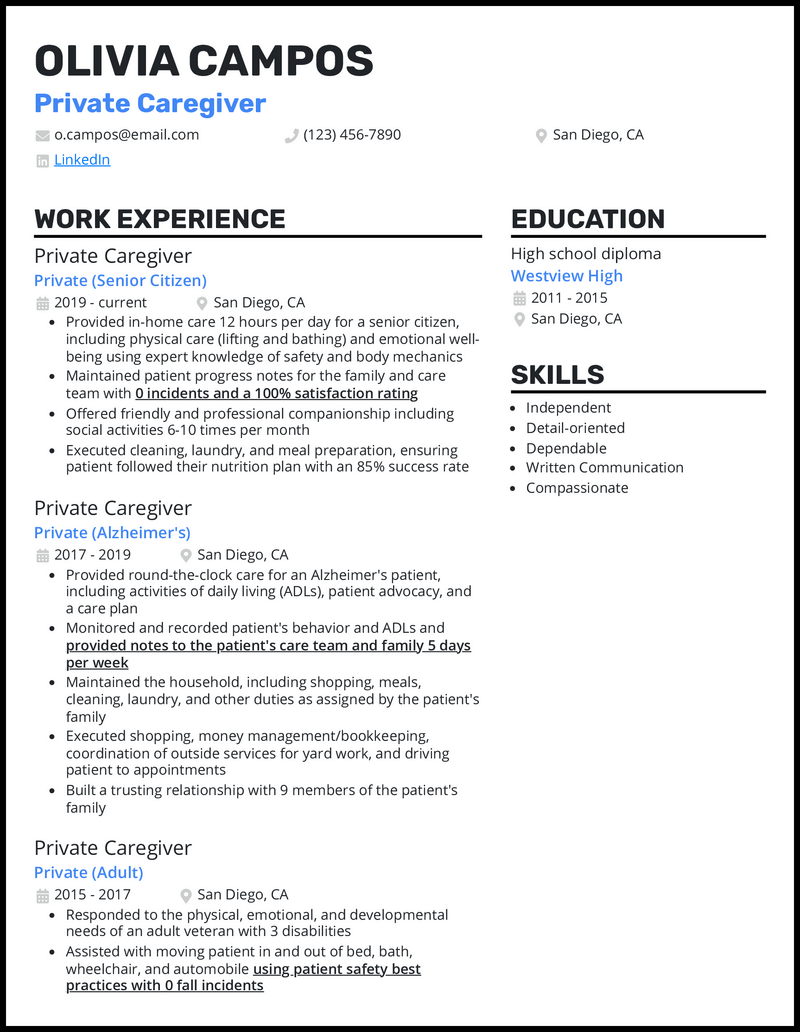
- A private caregiver resume showcases your ability to build trust with patients and their families, relying on your expertise and knowledge regarding best practices for in-home patient care. So, take advantage of detailing these kinds of stories in your caregiver cover letter.
See more private caregiver resumes >

Why this resume works
- The recruiter has only a few seconds to scan your special needs caregiver resume. For them to read every word in your masterpiece, it’s crucial to keep your layout simple and clear. Try a one-column layout.
Why this resume works
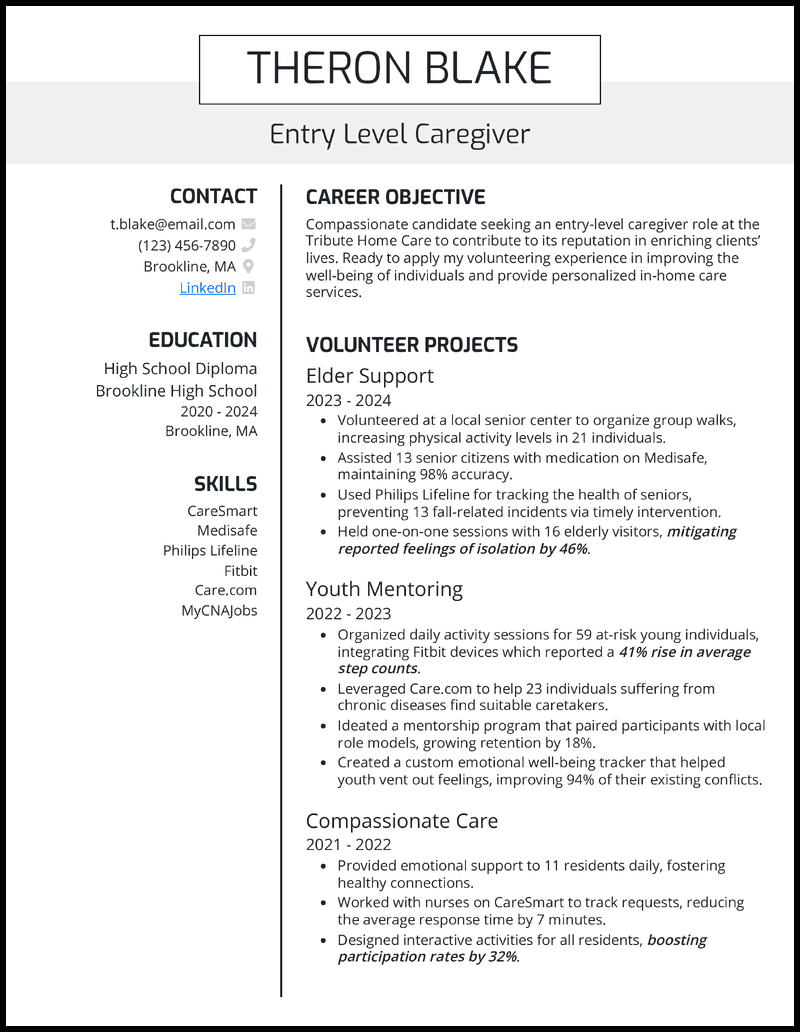
- f you’re eyeing an entry-level position, let your volunteering stints do the talking. Include impactful volunteering experiences, like assisting the elderly, mentoring youth, and supporting nursing home staff.
Why this resume works
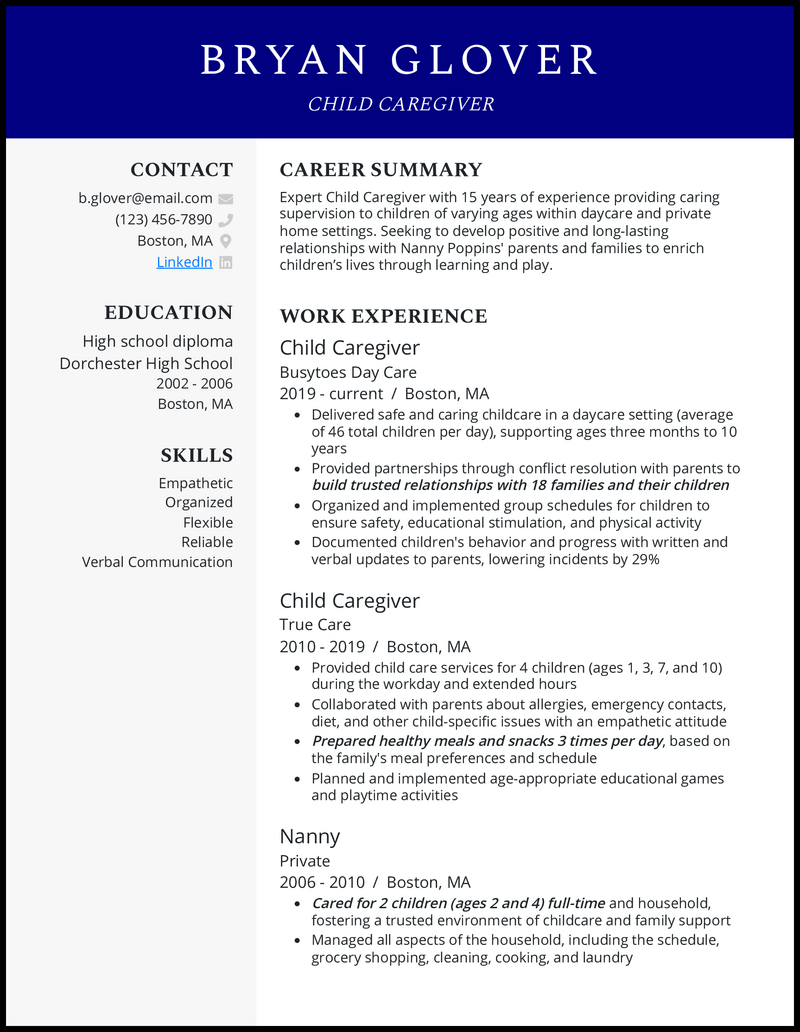
- Your child caregiver resume needs to include the number of children, the ages of the children you have cared for, how often you cared for them (for example, full-time, part-time, weekends only), and a resume-related passion, interest, or hobby.
See more child caregiver resumes >

Why this resume works
- Perhaps recall the time you slashed missed doses by 92% in only six months as a family caregiver. Leading with such feats in your family caregiver resume’s work history section is a great opener and is sure to capture the attention of your potential employer.
Why this resume works
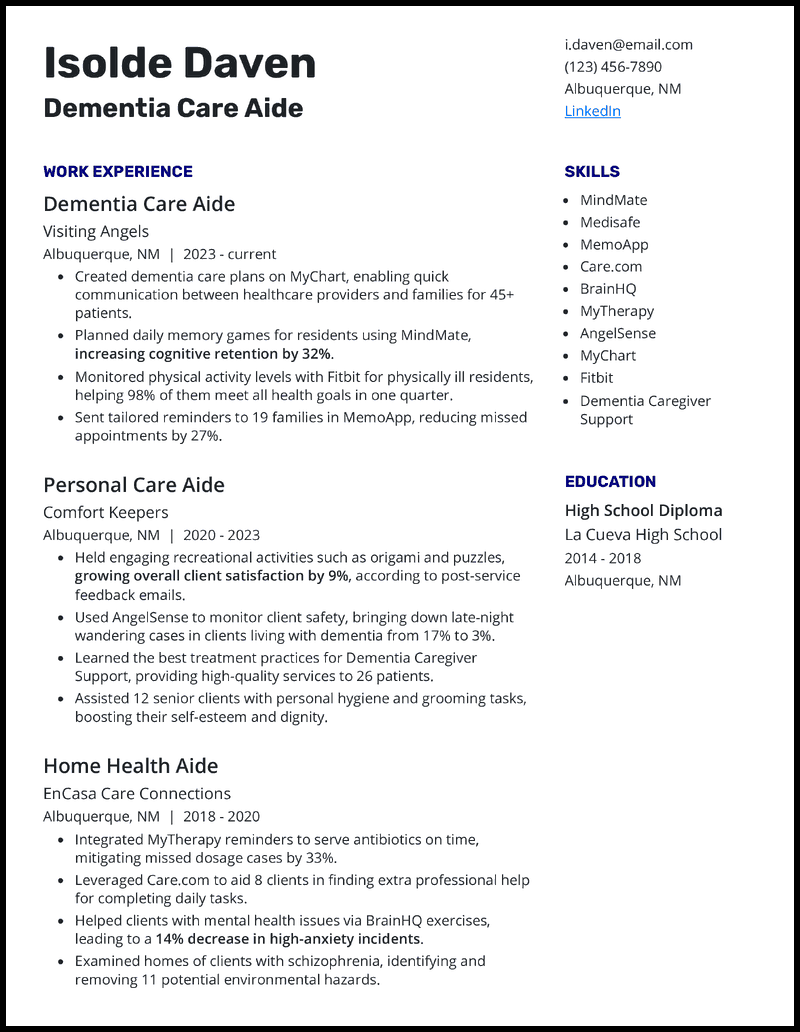
- Use quantified metrics to your advantage—it’s the best way to highlight your dementia caregiving expertise. They prove you’re not just looking after patients but helping them improve their cognitive skills, one step at a time.
Why this resume works
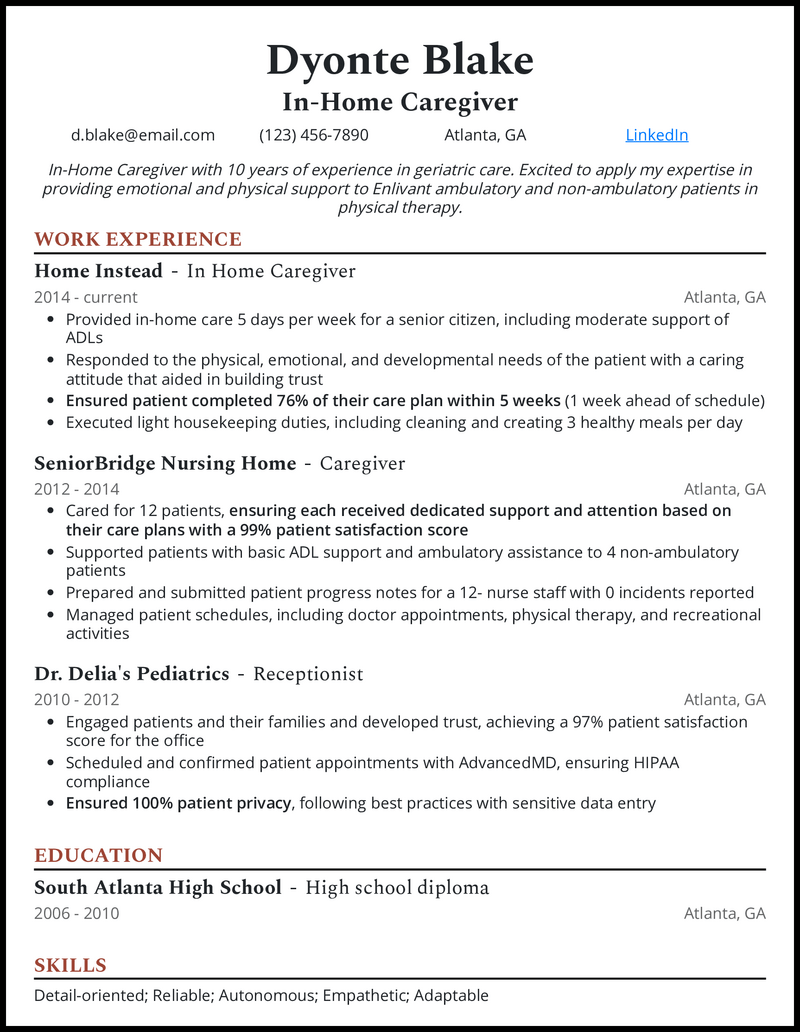
- A home caregiver resume should focus on in-home care (where your services are provided through a company). Highlight your expertise in cultivating trust with patients, and performing caregiving tasks such as housekeeping, transportation, and collaborating with the patient’s family.
See more home caregiver resumes >
Why this resume works
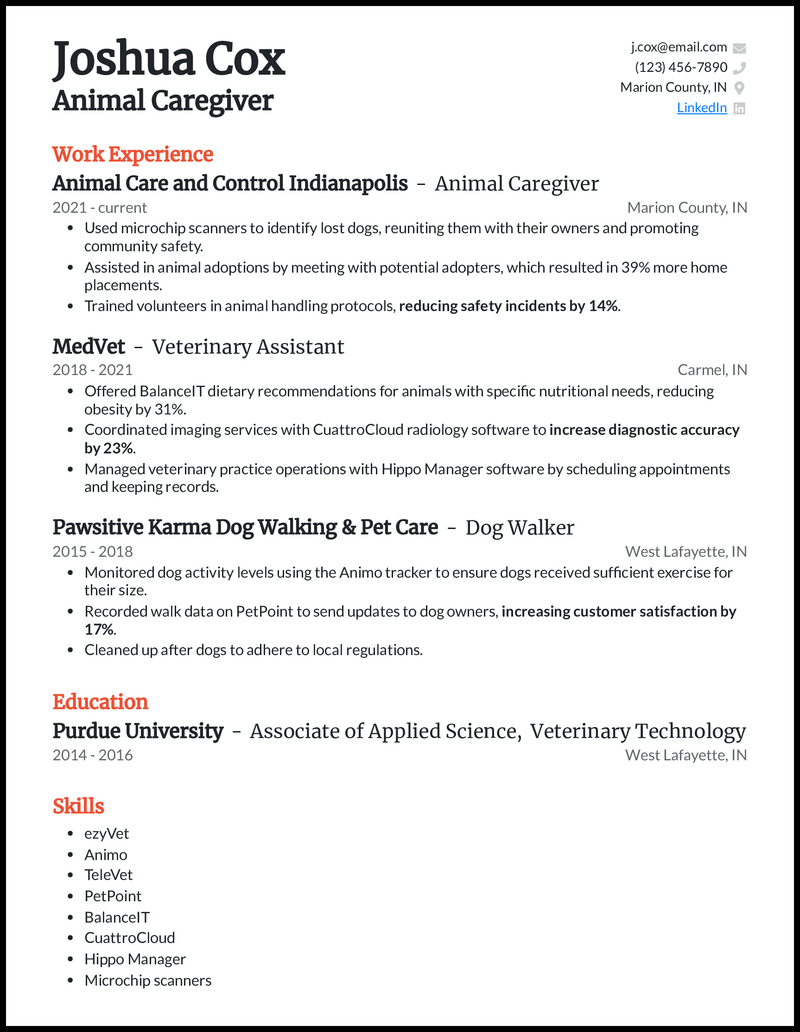
- The first trait owners look for on an animal caregiver resume is a love for pets. Showing a wide array of experiences working with animals will breed enough trust to land you an interview.

Why this resume works
- If you want to work in memory care, noting relevant training on your Alzheimer’s caregiver resume is critical. An education in a specialized field like gerontology is well worth noting.
Related resume guides
How to Write a Caregiver Resume

For a standout caregiver resume, focus on the real-life impact you’ve made, delivered clearly and warmly—your experience should tell a story of trust and support. Most importantly, pitch your value by blending passion, hands-on expertise, and unwavering support for those in need.
Moreover, include key details like certifications, hands-on care experience, and specific ways you’ve improved daily life for those you’ve helped.
Here’s what we’ll cover:
- Making your resume clean and easy to scan
- What to include to show both skill and compassion
- How to highlight certifications like CPR, First Aid, or CNA
- Making a strong first impression with a professional profile
- Tips for tailoring your resume to the type of caregiving role you want

Review the job posting thoroughly
As a caregiver, you play a critical role in being there and giving the much-needed helping hand to patients. When applying for a job, it’s best to thoroughly examine the job posting to understand what is expected of you and the skills you must possess. You can also get inspiration from this set of resume examples to know how to format your resume and position yourself as the leading candidate to get the job.

Who is a caregiver and how reflect that in your resume?
You work in the healthcare sector, and your primary duty is to help patients with mobility and offer emotional support. Your responsibilities revolve around ensuring those under your care are clean, can move, eat, and lead the best quality of life under the circumstances.
As a caregiver, your role is as diverse as it gets, which might make it harder to fill your resume template with relevant work experience and skills. Fortunately, the job description should give you a good idea of the scope of the duties you’ll be expected to perform.
Here are some of the job responsibilities that are often required in a caregiver role. Will you add any of these to your resume?
- Administer medications according to prescribed schedules and maintain accurate records
- Assist with toileting in patients with incontinence issues
- Perform housekeeping tasks based on client needs, including cleaning and meal preparation
- Provide transportation, mobility aid, and transfers
- Assist with ADLs, including bathing, grooming, dressing, personal hygiene, and feeding
- Provide companionship, conversation, and emotional support

How to choose the right resume format
The correct resume format will draw recruiters to review your resume because they can clearly see and read everything, easily find anything they’re looking for, and quickly spot strengths that make you an ideal candidate.
If you’re an experienced caregiver, the reverse chronological format emphasizes your impactful work history. On the other hand, a functional format is the way to go if you took a break from your career to pursue a personal or educational goal and want to draw attention to your abilities.
Whichever format you pick, ensure it highlights your strengths, breezes through applicant tracking systems (ATS), and gives recruiters an easy time to review your application.
What is the best caregiver resume format?
Go with a format that puts your strengths first in layout that’s easy to scan for both humans and screening bots. On top of that, the best resume design should:
- Use clean professional fonts (Arial, Times New Roman, or Calibri) at 10-12pt
- Keep it on one page, and close to the second page if you have 10+ years of experience
- Save in PDF or Word Doc, or the format preferred by the employer
- Break your sections into sections with clear headings
- Present your work experience in short, impactful bullet points
- Avoid graphics, tables, and creative themes

How to start off right with resume header and contact information
Don’t make recruiters work to find your email address or phone number. Give them a clean and professional header with the following:
- LinkedIn profile if relevant
- First and last name
- Job title
- Professional email address (no nicknames)
- Personal phone number
- City and state

How to summarize your qualifications to standout
With a short and precise professional profile, you can grab the attention of recruiters and have them read your resume to the last word.
Write a resume summary or a career objective emphasizing your qualifications and strengths in 2-3 short lines packed with your skills, passion, measurable results, experience, and career direction.
When to use a summary vs. an objective for a caregiver resume
A professional summary is suitable for individuals with impressive caregiving experience or experts who have developed skills in roles related to healthcare, hospitality, or family care. Here, you should highlight your accomplishments, specialties, and the kind of environments you work best in.
Summary = Experience-driven snapshot
A career objective, on the other hand, is for beginners, career changers, or those with a career gap. To prove to potential employers that you’re a serious candidate, you must clearly state your goals, passion, and project outcomes that reinforce your interest in this sector.
What is a caregiver resume objective? = Motivation-driven introduction
Summary statement example
CPR and first aid certified caregiver with 4 years of senior care in private homes and assisted living environments. Excellent in personal hygiene assistance, mobility support, and medication reminders. Known for maintaining clients’ dignity and comfort while fostering trust and emotional well-being.
Career objective example
Aspiring caregiver with proven abilities to communicate effectively, patience, and a passion for helping others. Eager to provide high-quality personal care and companionship at Visiting Angels while continuing to develop expertise in elderly and disability support.

How to quantify your impact: Metrics and examples
Numbers don’t lie — they prove your value. Through measurable results in your caregiver resume, prospective employers can visualize the real difference you made and can make in people’s lives if hired.
The winning formula is not just stating what you did, but demonstrating its impact through quantifiable results. Enhance the depth of your contributions by diversifying your outcomes through the use of numbers, percentages, and timeframes.
Examples of quantifiable impact statements:
- Implemented personal care program for 4 elderly clients with strict compliance with personalized care plans and HIPAA documentation standards
- Reduced quarterly emergency hospital visits by 12% through consistent medication reminders and digital care log tracking using CareSmart
How to present your specialization
If you have a specialty in, say, dementia caregiving, post-surgical care, or mobility assistance, highlight relevant coursework, certifications, or outcomes from such work experience. Specialized skills demonstrate higher reliability and empathy, qualities that make you a perfect fit for the open job.
How to integrate active verbs and keywords
In addition to metrics, your work experience bullets can be more effective when you incorporate active words and keywords from the job posting. Using niche-specific words, such as “supported,” “coordinated,” and “implemented,” aligns with what recruiters expect and boosts the chances of your resume being ATS-friendly.

How to create a caregiver resume with no experience
Even without direct caregiving work experience, you can land the job because, as much as employers prioritize your history, they also value potential, willingness to learn, passion, and reliability. Therefore, confidently write your resume by focusing on transferable skills from projects and voluntary work, and how such opportunities exposed you to real-world care for those in need.
Where to get transferable skills
You have probably done one or more of the following:
- Assisted at community centers
- Supported individuals with disabilities
- Solved someone else’s problems
- Completed First Aid course
Lean on these experiences to demonstrate that you are empathetic, attentive to details, and punctual—these are core attributes that caregivers should possess.
Use a functional resume format
As opposed to someone with prior caregiving experience, do the following to make your caregiver resume with no experience stand out:
- Replace “Work Experience” with “Relevant Experience” and demote it to come after “Education” and “Skills”
- Emphasize coursework, training, and certifications over experience
- Present lessons, challenges, and outcomes from projects
- Quantify results from relevant experience
How to list and integrate hard & soft skills
In this profession, having a caring heart is a crucial component; however, for a caregiver resume to secure the job, skills and their proper use tell a compelling story. Employers and ATS are more interested in what you can do, how you do it, and the outcomes. Give them exactly that by blending your hard and soft skills both in a dedicated section and using them in describing your achievements.
Here’s how to get it right:
Set aside a “Skills” section
Dedicate some prime estate of your resume to a “Skills” section. It could be on the side below your education, or right after your contact information, depending on your level of experience. Under it, create a list of competencies that you are good at and can use to make a difference.
Examples of hard skills for caregivers:
- Gait belt
- Vital sign monitoring
- CPR and First Aid certification
- Hoyer lift
- Dementia care
- Medication reminders
- Nutrition tracking
- Safety procedures
- HIPAA documentation
Examples of caregiving soft skills:
- Empathy and patience
- Collaboration
- Time management
- Client and family communication
- Reliability and integrity
- Emotional intelligence
- Active listening and compassion
- Adaptability
How to integrate your skills into work experience
Don’t let your skills “idle” in your resume. Use them to reinforce your bullet points and, together with metrics and active verbs, paint a picture of someone ready for the job.
Example
Monitored vital signs daily using HomeCare HomeBase software to maintain consistent and accurate health records
How to match skills to each job posting
Every caregiving job, agency, and client is looking for a different set of skills. Some are in for hospice care, dementia support, or mobility assistance. Whatever each job requires is clearly spelled out in the advertisement. Review it and identify some of the recurring terms, then adapt them to become part of your expertise. It’s an effective way to demonstrate to hiring managers that you possess the strengths they’re looking for and have your resume parsed and passed through the ATS quickly.

How to add relevant education and certifications
Caregiving jobs don’t demand a degree, but listing relevant education and certifications can be what sets you apart in a competitive hiring process. Having relevant training proves you have the foundational knowledge of how to get things done and you can scale up your skills when necessary.
Where to place education and certifications
Typically, for caregivers, your education and certifications are listed at the bottom third of your resume. However, if the job description specifically lists a specific credential or training as part of the qualifications, place this section right after your “Skills” section.
Start with your highest education level
Mention your most recent or highest education level or certification. Even if your academic background isn’t directly related to caregiving, it says that you have the professional discipline to follow instructions and meet legal requirements.
Include:
- Diploma/degree title
- School’s name
- When you joined and left
- Location (City, State)
- Coursework (if recent and relevant)
Example
Associate Degree in Health Sciences
Austin Community College
2022-2024
Austin, TX
Coursework: Nutrition
Add caregiver-specific certifications
Certifications are the trust signals that tell recruiters and ATS you’re trained, qualified, and compliant with all laws and regulations for caregiving.
Common caregiving certifications to include:
- Certified Nursing Assistant (CNA)
- Home Health Aide (HHA)
- CPR and First Aid Certification
- Alzheimer’s and Dementia Care Training
- Hospice and Palliative Care Training
How to list certifications
- Certified Nursing Assistant (CNA) – CNA Training Institute, 2023
- CPR & First Aid Certified – American Red Cross, Expires 2026

Bonus sections: awards, professional bodies, volunteer work, and languages
If you have attributes that other candidates may not have, include them to stand out:
- Ever been “Employee of the Month”?
- A National Association Alzheimer’s Hospice (NAHC) member?
- Did you take care of seniors at a local hospice center as a volunteer?
- Speak Spanish or French and want to work in a diverse community?
These additions showcase the depth of your abilities, and the hiring manager will pay more attention to your application.

Key takeaways
Before you can start sending applications confidently, confirm you’ve done the following with your resume:
- Uses a simple, clear, and professional format
- It’s one page
- Tailored to the job
- Uses active verbs
- Quantifies achievements
- Emphasizes specialty if you have one
- Use keywords and skills from the job advert
Caregiver Resume FAQs

First, you must express your enthusiasm for putting patients’ best interests first. Next, showcase your professional work ethics, emphasizing doing the right things, prioritizing safety, and working under no or minimal supervision. Additionally, you must include impactful results from your past work and demonstrate that you have the core skills expected from the best candidate.
Pick three of the most recent and relevant experiences from your work history for a caregiver role. For each experience, create 3-4 bullet points tied to action verbs, skills, and measurable outcomes. The goal here is to demonstrate the value you bring if hired.
Be at the forefront of ensuring that patients’ well-being is guaranteed at all times by providing support during their daily activities. The fact that you’re certified means you understand and can excel in delivering the best quality care to improve the lives of those under your care.
A page. All you need to show are pertinent caregiving skills, relevant work experience, and impactful accomplishments from current and past jobs. You must also align yourself with the job responsibilities and the expectations of employers and patients. All that can be articulated in a one-page resume unless you’re an experienced professional with a rich work history and achievements.
Land your next job with our AI-powered, user-friendly tool.
Gut the guesswork in your job hunt. Upload your existing resume to check your score and make improvements. Build a resume with one of our eye-catching, recruiter-friendly templates.
• Work in real-time with immediate feedback and tips from our AI-powered experience.
• Leverage thousands of pre-written, job-specific bullet points.
• Edit your resume in-line like a Google Doc or let us walk you through each section at a time.
• Enjoy peace of mind with our money-back guarantee and 5-star customer support.

Stephen is the co-founder and CEO of BeamJobs. Frustrated with the challenges he'd faced in his own job search, he left the corporate world to start BeamJobs with his brother. Drawing on firsthand experience with hiring and getting hired as technical talent, he started BeamJobs in 2020 to help qualified job seekers land interviews with less stress. Since then, more than 4 million people have built their resumes and cover letters on BeamJobs. Stephen's insights have been featured in notable outlets, such as Fast Company, Business Insider, Yahoo Finance, MIT, and Zapier. Learn more about Stephen.