



The best way to demonstrate to recruiters that you’re prepared to assist senior doctors and nurses with their daily tasks is by having a comprehensive, quantified work experience section. The reason is that the demand for medical assistants is at an all-time high.
As per the U.S. Bureau of Labor Statistics, the employment for medical assistants is predicted to rise by 12% between 2024 and 2034 (higher than the average for other occupations). This means your resume is not just a formality, but a chance to stand out in an in-demand field.
To help you write a medical resume that blends structure, precision, and compassion, we take you through:
- ↪ 11 expert medical assistant resume examples
- ↪ Crafting a medical skillset that wows employers
- ↪ Degrees, certificates, and academic accolades worth mentioning
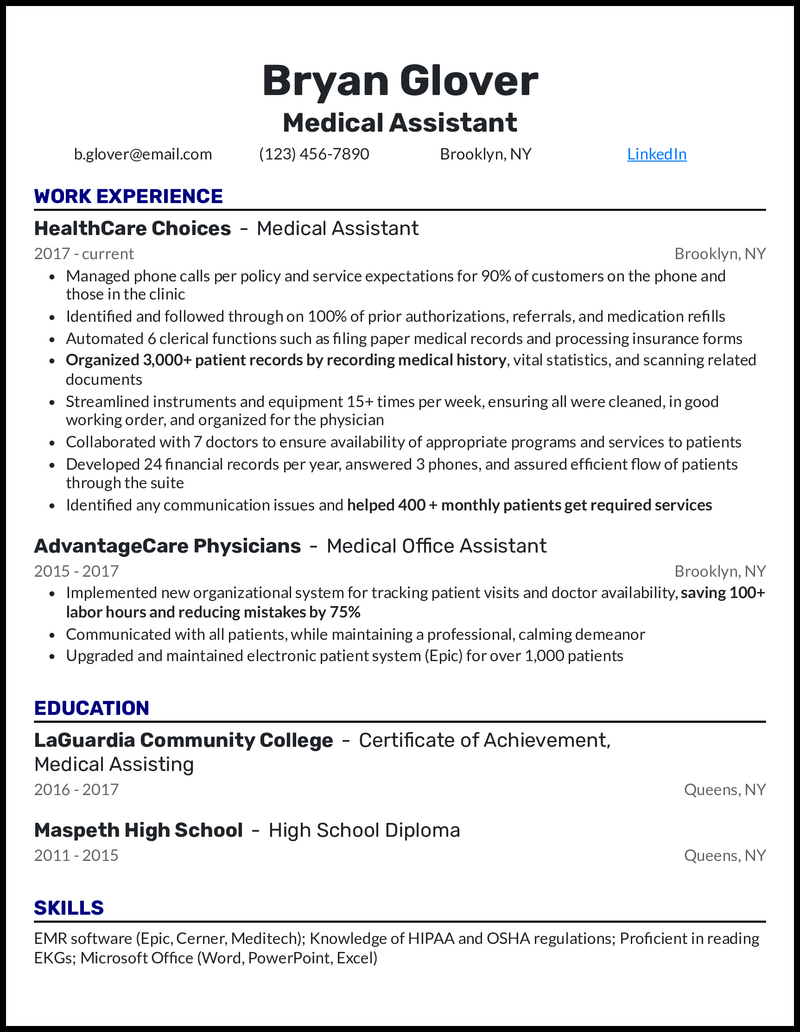
Why this resume works
- Most medical assistant jobs require you to be certified. Generally speaking, these certifications need to be renewed every five years, so make sure you include the year you were last certified.

Why this resume works
- When discussing your work experience, it helps to start each bullet point with a strong action verb. Format your resume so that it’s easier to scan (the average recruiter spends less than 24 seconds reviewing a resume), and make it clear that you’ve had an impact in previous roles.
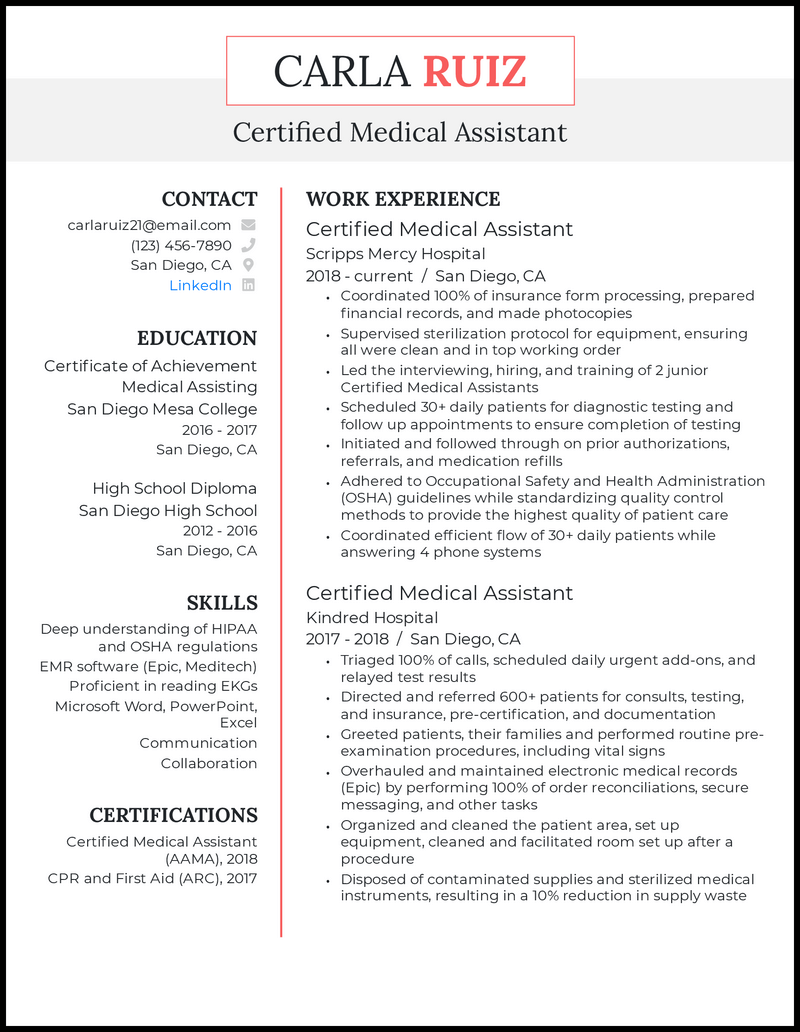
Why this resume works
- As you gain more experience as a medical assistant, you should show more leadership and impact. You can beef up your resume by touching upon organizational systems (such as inventory and patient scheduling) that improve clinic efficiency, save time, reduce the chances of making mistakes, and support smoother clinical workflows.
View more certified medical assistant resumes >
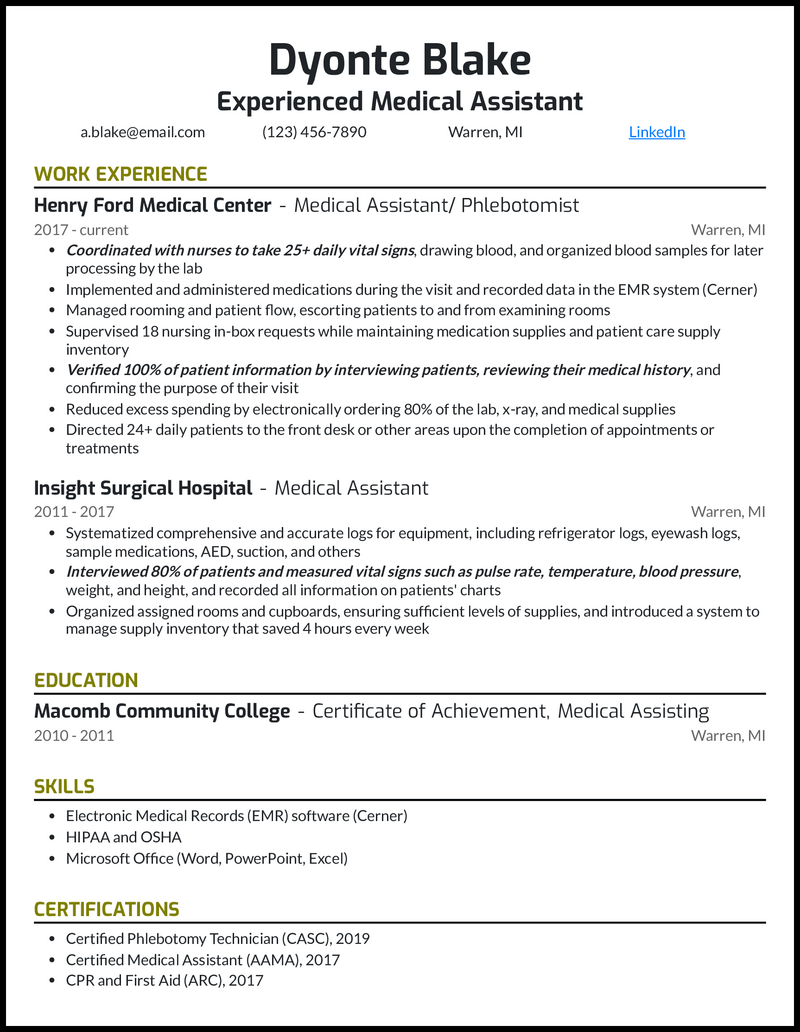
Why this resume works
- Your resume skills section should not be exhaustive but include the essential skills named in the job description, balancing clinical skills with administrative skills; for medical assistants, a strong resume includes both sections, with familiarity with OSHA and HIPAA standards plus anything else that might set you apart.
View more experienced medical assistant resumes >
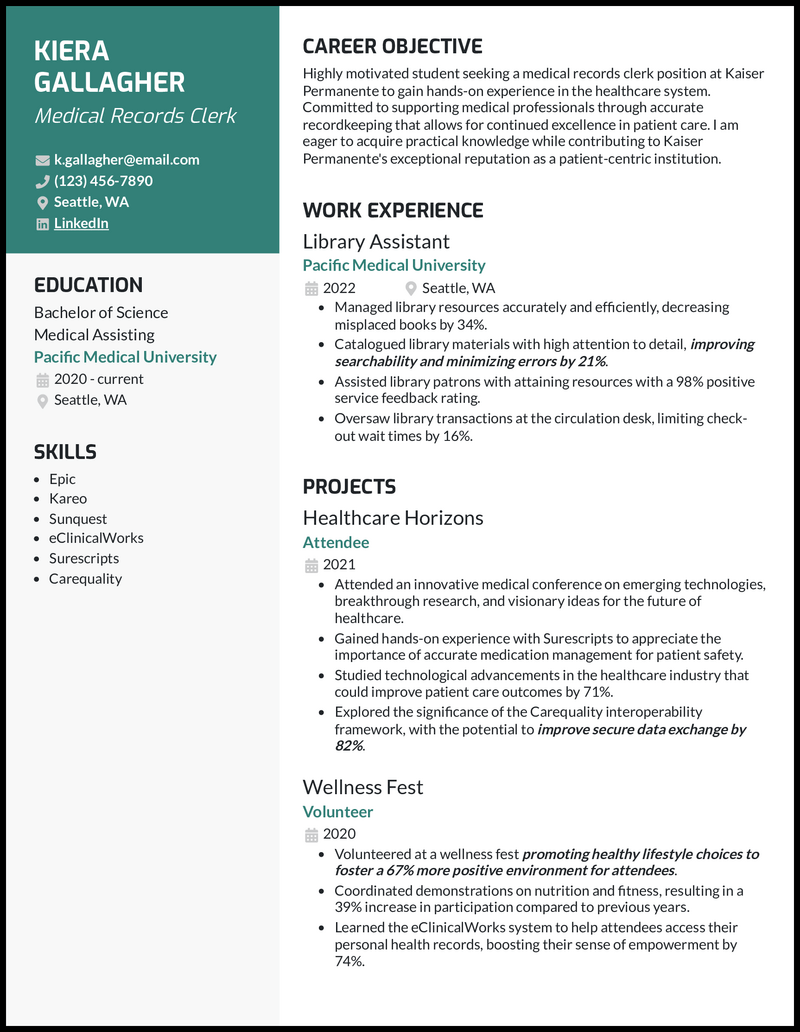
Why this resume works
- Projects that leveraged your competency with medical software, such as a public health fair, can help on your medical assistant student resume.
- However, for entry-level candidates a medical assistant externship or other clinical training should also be treated as valid experience when relevant because it shows hands-on clinical training and readiness for patient care.

Why this resume works
- Update your phone number and email. Plus, a professional email address like [email protected]. So, perhaps save wacky stuff that might raise eyebrows or snag a laugh (think “cat_lover@…com” or love_skeptic@…com”) for the group chats with friends, not your clinical medical assistant resume.

Why this resume works
- Can you recount presenting a relevant project at college? Or maybe you attended a seminar like “TechNurse Evolution” in Mia’s piece? Be sure to bring these moments to life in your resume and then you can fill in the details in your medical assistant cover letter.

Why this resume works
- Examine the job ad carefully and match the language in the specific job description, not just generic keywords, since using the same terminology can improve ATS ranking.
- In addition, optimize your layout for applicant tracking systems, which scan for items such as medical assistant certification keywords. This means avoiding any graphics or images, since creative resume templates may not parse correctly.
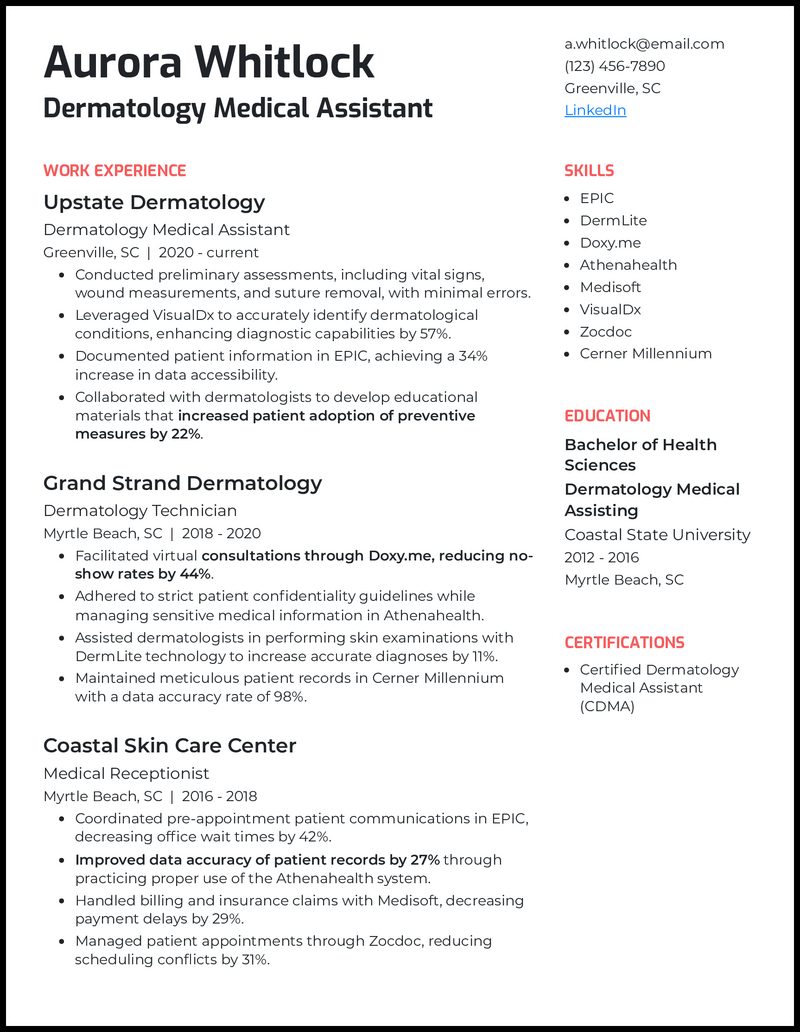
Why this resume works
- Supporting dermatologists as a medical assistant requires specialized knowledge of technology used exclusively for skin procedures.
- Include examples of your work with tools such as DermLite to emphasize your field-specific skill set, since that kind of experience reflects the specialized skills employers look for in dermatology settings.

Why this resume works
- Show how you’ve been part of a team collaboration if that’s what the job expects. Do they dictate proficiency in the SurgiCare Inventory? Detail how you used the platform to streamline medical supplies’ storage, tracking, and usage.
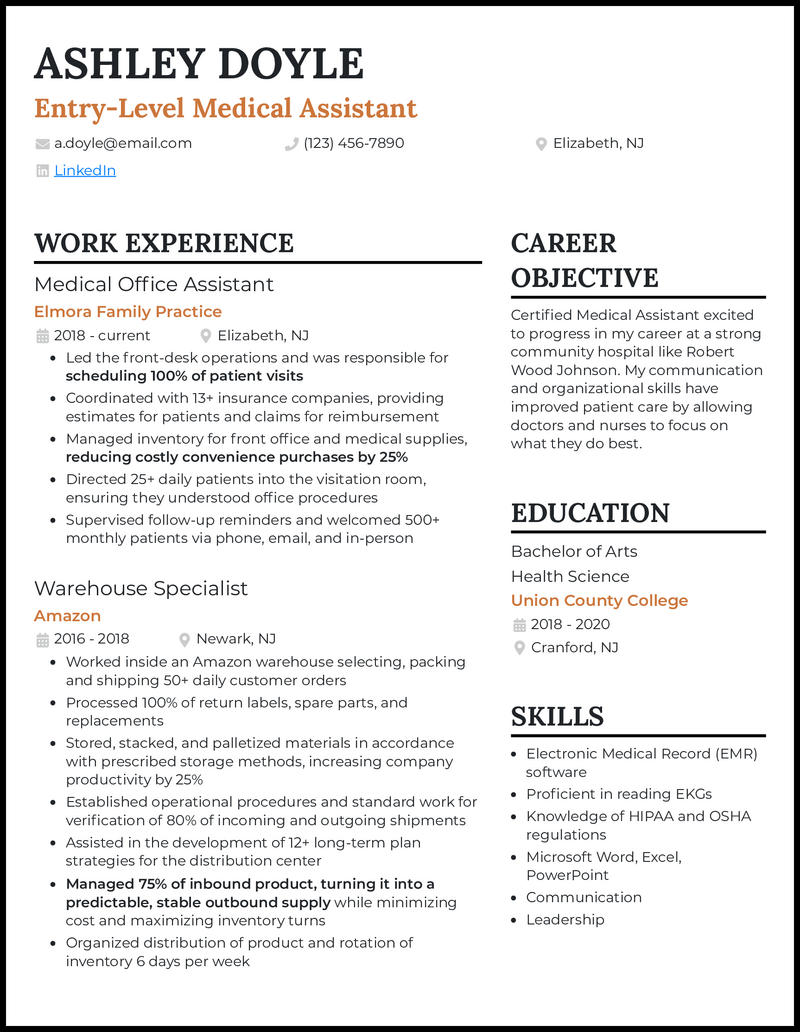
Why this resume works
- When outlining your resume, it’s perfectly okay to include previous work experience outside of medicine. This can help show that you’re disciplined and organized.
View more entry-level medical assistant resumes >
Related resume guides
How to Format a Medical Assistant Resume

Aside from the actual content of your resume, the formatting you use determines whether a hiring manager will seriously consider your medical assistant resume. When formatted correctly, your resume will be easy to read, have a logical flow, and be complete.
If your resume lacks these formatting qualities, there’s a likelihood that hiring managers won’t take your resume seriously; if it makes their job more difficult, they may toss your application.
To properly format your resume, pay special attention to the following:
- Resume format options
- Contact info and header
- ATS and readability

What resume format options do you have?
You have a few resume formats to choose from, with these being the most popular in 2026:
- Reverse-chronological: This type of format is uniquely positioned to highlight your most recent job experience first, highlighting career growth and giving a competitive advantage when numerous applicants compete with you for the same position.
- Functional: This resume format highlights skills over work experience. You might choose this format if you have large gaps in your work experience, but be cautious because many recruiters may find this format confusing or less forthcoming than other popular formatting options.
- Combination/hybrid: The combination/hybrid format blends both reverse-chronological and functional formatting by skills and work experience with equal weight. It’s a popular choice for industry experts with many years of experience.
Each type of format can work, but the best medical assistant resume format is reverse chronological because it lists work experience from most recent to oldest.
Since recruiters in the medical industry are routinely inundated with 100+ resumes per job posting, they prefer resume formats that lend themselves to quick skimming. A reverse-chronological resume does that while highlighting your most recent job title.

How to build the contact info and header
When a hospital recruiter determines that they want to reach out for an interview, make sure they know how to reach you. Using a large font, position your name on the left side or top center of your resume, and use a smaller font to include the medical assistant job title you seek. Have your contact info available, too.
Your resume header should consist of:
- Name
- Job title you’re seeking
- Phone number
- City/State (optional)
- Professional links (such as LinkedIn or other professional sites) (optional)
Your header is also a good place to add a (professional) pop of color. Take a look at these resume examples and the visual sample below to get inspiration for a wide variety of header styles!


How to ensure ATS-friendliness and readability
We don’t want to sound dramatic, but we can’t overemphasize how important it is that your medical assistant resume is ATS-friendly for every job you apply to in 2026.
What is ATS? Simply put, Applicant Tracking System software (ATS) became an integral part of the recruitment process after the explosion of the internet led to sharp increases in online job applicants.
ATS will scan your resume, searching for keywords by recognizing your resume formatting. For this reason, it’s critical that your medical assistant resume matches ATS standards, lest your application gets thrown out without ever being reviewed.
How to beat the ATS with these tips:
- Margins: Margins on all sides of your resume should be between 0.5-1.0 inch.
- Fonts: Stick with basics like Arial, Calibri, Cambria, or Times New Roman.
- Font sizes: Your name should be the largest font size (around 24-point), with your title slightly smaller (around 20-point). The rest of your resume (including your contact information) should remain at the standard font size of 12-point.
- Header names: Headers throughout your text should stand out in some way. Consider using bold text or contrasting colors.
- Skills: Read the job posting and use the same wording for skills and certifications, especially for technical skills that match the role.
- Logical order: As mentioned, we recommend using reverse-chronological order on your medical assistant resume, with your most recent job experience at the top of the page. Applicant tracking systems prefer it, and it’s easier to read.
- One page: If your resume is over a page, it’ll look strange, and recruiters will wonder if you lack enough experience. Clean templates also parse better than heavily designed ones.
Feeling overwhelmed? Check out our resume builder to ensure your formatting is done correctly.
How to Write a Medical Assistant Resume

Here’s a hard hiring fact: Recruiters spend only 5-7 seconds scanning a resume.
So, you want to start with a clear header, followed by a concise work experience section that quickly highlights your patient care skills and medical knowledge. However, it’s just as important to read the job description first and include skills and keywords directly mentioned in it.
Using our resume builder, you can avoid all the frustration of writing and re-writing improperly formatted sections. Save yourself the time that could be spent on the job search. Let’s address the essentials:
- What’s the objective/summary all about?
- Work experience
- Top skills for your medical assistant resume
- Education, certs, projects, interests, and hobbies
- Resume customization for every medical assistant job application
- Edit for a flawless medical assistant resume
What’s the objective/summary all about?
Though similar in many ways, a resume objective and summary statement are slightly different paragraphs to consider including in your medical assistant resume. Both are highly specified, short (two to three sentence) paragraphs, but an objective will emphasize why you’re seeking the job, whereas a summary highlights the skills you’ve honed throughout your career.
Consider including a resume objective if you’re going through a substantial career change, such as a dental assistant to a surgical assistant. An objective can also be a helpful place to emphasize why you’re seeking a particular role (and use up white space) if you have minimal experience.
On the other hand, resume summaries focus on skills and specializations developed throughout your career. Consider adding a resume summary if you’re a seasoned medical assistant with 10+ years of experience.
If you decide to include a resume summary or objective, you’ll need to commit to customizing it for every job to which you apply. Let’s review some great examples of highly-specialized resume summaries and objectives.

Example 1—A poorly written objective:
Want to improve my career prospects with a job that will get me experience in the medical field.
What we don’t like: This objective contains no specific details. It should include the job title you’re seeking, one to three specific skills that will help you contribute to the work environment, and the business name to which you’re applying. This objective consumes precious space on your resume without providing any useful information.
Example 2—A strong resume objective:
OSHA and HIPAA-compliant medical assistant with 6+ years of medical assistant experience serving 100+ daily patients while delivering exceptional patient care in fast-paced ER environments. Seeking an opportunity at Trinity United Healthcare to continue serving patients and medical staff in the Pediatric Orthopedics department, where my efficient workflow and compassionate care management can help ensure more patients are served per hour.
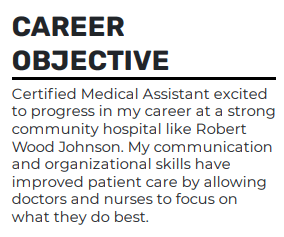
What we like: Specific skills, years of experience, job title, hospital name, and work contributions were mentioned. A resume objective like the one above and the visual sample below deserve the space they take up on your resume.
Example 3—A poorly worded summary:
I have years of experience working well as a medical assistant.
What we don’t like: Like the first objective example, this summary provides little substance. It’s vague and short.
Example 4—A strong resume summary:
Detail-oriented medical assistant with 20+ years of experience in clinics and hospitals across Idaho, with clinical expertise and a depth of knowledge of HIPAA, ERM software, medical terminology, and Microsoft Office. I enjoy working in fast-paced environments that enable me to improve patient comfort, physician efficiency, and operating systems, and this kind of summary can also note personal attributes that support patient communication and care.
What we like: This summary gets right to the point, discussing some of the most valuable skills a great medical assistant will possess while highlighting years of work experience and how they would add value to the business.

How to use your work experience to align with the role
Your work experience section should include two to four positions you’ve had throughout your career, but use it to show both your clinical and administrative duties, not just job history.
That means, if you’ve been a medical assistant for many years, you don’t need to include information about the job you had in high school. Instead, focus on the most recent 10-year period, and narrow that list to the most relevant.
Note: if you’ve just entered the workforce, there’s nothing wrong with highlighting less relevant job experience or even class projects and volunteer experience, but we’ll touch on that later.
To prove that you have experience facilitating smooth patient flow, use warm action verbs that create a sense of comfort while still clarifying your job duties. Words such as Supported, Helped, Assisted, Communicated, and Reassured are a few good examples.
Next, tie them with actual, data-backed results to win over employers. For instance, phrases like “improved average patient satisfaction scores by 19%,” “reduced patient anxiety by 44%,” or “documented 120 procedures performed per month with 98% charting accuracy” are great to show your compassionate side and quantify patient care impact.

How to write your job description bullet points
Chunking your job description text with bullet points is a great way to organize job tasks clearly, enhance readability, and summarize an overwhelming resume. This is especially true when those bullets emphasize the most relevant and specific responsibilities rather than generic duties.
While writing bullet points, focus on:
- Action verbs: Start each bullet point with strong, unique verbs such as “Outperformed” or “Overhauled” to make clinical and administrative duties clearer and more compelling.
- Active voice: Avoid passive voice. A passive phrase, like “the IV was inserted by the R.N.,” is less interesting than active language, like “the R.N. inserted the IV.”
- Avoid personal pronouns: The employer knows your resume is written about you!
- Either using punctuation or not: When you start writing your bullet points, you can leave periods at the end of your sentences or skip them. Whatever you choose, be consistent.
- Verb tense: Though you can keep your current experience in the past tense, ensure all your past work experience is written in the past tense.
Here are a few medical assistant bullet points that incorporate this advice:
- Overhauled clinic software operations, integrating Meditech EMR and electronic health records workflows to boost office operation efficiency.
- Initiated HIPAA-compliant insurance verification and intake documentation processes to maintain strict patient confidentiality.
- Outperformed efficiency targets, reaching more clients to confirm appointments and follow up on visits than any other M.A.
We like these bullet points because they use active voice and action words while avoiding personal pronouns such as “I” or “my,” and they have consistent punctuation written in the past tense.

How to quantify your clinical medical assistant impact
The only thing our above bullet point examples are missing is quantifiable metrics (numbers). Numbers are an essential element in your medical assistant resume, and you should aim for at least 50 percent of your bullet points, including them.
Here are some questions to ask yourself to find these metrics:
- How much work did you get done?
- Examples: seeing 20+ patients each day, managing four healthcare professionals, or maintaining records for 50+ patients
- How good was the quality of your work?
- Examples: increased patient satisfaction rates by 20%, reduced prescription errors by 10%, or maintained 99% accuracy in data entry and lab sample collection
- How much money did you save?
- Examples: lowered medical supply costs by 15%, reduced missed appointments by 10%, or streamlined insurance verification to cut claim denials by 12%
- Increased operations efficiency
- Examples: reduced patient wait times by 15%, accelerated lab result turnaround by two days, or optimized patient scheduling to shorten average appointment times by 25%
- How much did you grow?
- Examples: cut onboarding time from two weeks to six days, increased monthly patient volume by 10%, or helped expand to another clinic location
- What teams did you work with?
- Examples: working with surgical teams, coordinating with a staff of 10 therapists and specialists, or serving as a liaison between patients and providers
- Did you receive any awards or recognition?
- Examples: awarded Employee of the Month, rated 4.9/5 stars in patient surveys, or recognized for maintaining compliance during an audit
These are the most common numbers employers see, but they’re not all that you can use. Any time you can add a hard number, percentage, or timeframe, it will make your bullet points stronger.
Take a look at these metrics-based sample bullet points:
- Managed an average of 35 patient appointments per day, improving clinic scheduling efficiency by 18%.
- Processed 120 weekly claims and insurance forms through patient intake and medical billing workflows with a 97% accuracy rate.
- Supported 4 physicians and 6 nurses during daily rounds while maintaining on-time room turnover for 25+ patients.
- Updated clinical documentation in the EHR for 50+ patient visits per week with 99% accuracy.
Why are metrics important for job seekers?
Numbers positively impact your resume in two ways. First, the visual interest helps break up text and draw in hiring managers’ eyes. This is critical, as it will encourage them to read your resume more thoroughly. Second, numbers are impressive because they demonstrate your proven job performance. In the context of your medical assistant resume, numbers say a thousand words.
Here are a few places you can leverage metrics from your medical assistant work experience:
- Patient volume
- Consider highlighting your organizational skills by noting the number of patient records you’ve organized. You may also wish to discuss the number of patients you call per shift, the size of the hospital you work for (volume of patients, number of physicians, etc.), or the percentage of patients who gave you positive reviews.
- Increased operations efficiency
- Highlight how you’ve improved workflow as a medical assistant. Perhaps that means you’ve provided hundreds of appointment confirmations, reducing gaps in physician schedules? Or maybe you reorganized E.M.R. software, resulting in increased capacity for patients?
- Administration
- Including metrics about your administrative duties isn’t too hard. Think about the percentage of total office insurance forms you processed, the number of appointments you’ve scheduled per shift, referrals you’ve written, or the types of electronic medical records software you’re trained to use.
Here are a few examples of job description bullet points that would work well for any medical assistant resume.
- Automated 6 clerical functions, including processing insurance forms and filing medical records
- Scheduled 30+ daily patients for diagnostic testing and follow-up appointments to ensure completion of testing
- Overhauled and maintained EMR by performing 100% of order reconciliations, secure messaging, and other tasks

How should you show patient care experience?
To prove that you have experience with taking care of patients the right way, use warm action verbs that create a sense of comfort. Words such as Supported, Helped, Assisted, Communicated, and Reassured are a few good examples.
Next, tie them with actual, data-backed results to win over employers. For instance, phrases like “improved patient satisfaction scores by 19%,” “reduced patient anxiety by 44%,” or measurable contributions to patient education are great to show your compassionate side.
You can also note when you documented vital signs and other patient care data to demonstrate clinical accuracy.

How should experienced medical assistants structure their resumes?
If you’ve been in the field for more than a decade, having a career summary is going to help. You may even be able to get away with a two-page resume, but it’s always best to stick to a single page.
When it comes to the design structure, you can use BeamJobs’ templates.
Remember to choose a clean medical assistant resume template with simple formatting so both hiring managers and ATS can review it easily, since creative resume templates may not be parsed correctly, such as:
- BEAM
- Official
- Elegant
- Standout
All of these designs give you enough space to include your expertise while leaving room to breathe, so HRs don’t look at a cluttered mess.

Should you include externships or training programs?
Yes! If you’re just starting out in this field from college, include a medical assistant externship on an entry-level resume as valid experience, especially on a medical assistant externship resume. Here it can show readiness for clinical procedures through hands-on training along with extracurricular activities.
As a rule of thumb, entry-level resumes should highlight externship hours and certifications. These experiences are a testimony to your ability to use medical knowledge in real-world settings, even if you weren’t on a payroll.

Should medical assistants mention HIPAA or OSHA?
One of the most important parts of any medical or healthcare-related resume is having HIPAA and/or OSHA mentioned. Some ATS systems may rule you out simply if you don’t have those keywords on your application. The easiest way to naturally reference them is via:
- Certificates
- Training programs
- Relevant courses
- Work experiences

Top skills for your medical assistant resume
One of the most under-utilized sections on most resumes is the skills section. Many medical assistants don’t realize that this section is essential for catching the eye of ATS. Since ATS works by matching keywords in your resume to pre-selected words (skills) chosen by hiring managers, you want to ensure you’re listing the right skills.
Ideally, your medical assistant resume should include both technical skills and soft skills. Technical skills such as “CRM software proficiency” can be trained. They’re highly specific to the job title you’re seeking, and they demonstrate your ability to utilize the skill, especially when backed by certifications or specialized training that set you apart.
On the other hand, soft skills are skills you can include on any resume. These skills, such as “organization” or “attention to detail,” are universally important. However, it’s difficult to measure these skills; they’re often overused and may be disregarded by hiring managers.
Focus mostly on hard skills while incorporating a few particularly relevant soft skills. Include 6 to 10 resume-relevant skills for your medical assistant resume, such as:
- Chronic Disease Management and HIPAA compliance: Being aware of regulations, laws, and best practices to keep patient information safe while reducing the risk of contracting or spreading disease. Hiring managers won’t overlook these hard skills.
- Reading electrocardiograms (EKG): This is a great hard skill that not all medical assistants have. Stand out by emphasizing your vitals-taking skills.
- EMR software: Do you have an understanding of Epic or Meditech software? Specify which EMR systems you know.
- Clinical skills: Clinical skills include injections, phlebotomy, and infection control practices.
- Administrative tasks: If you want to impress, use hard skills like typing speed and creating treatment plans.
- Bilingual: Do you know Spanish, A.S.L., or Arabic? Share this hard skill, as it’s always in high demand in healthcare, and it’s especially valuable for patient communication in clinical settings.
- Compassionate care: This is a soft skill, but it’s important that the focus of all of your work as a medical assistant is on the health and well-being of your patients, with empathy and strong communication at the core.

How and when to add education, certs, projects, interests, and hobbies
Becoming a medical assistant has a few different educational routes. Some employers are satisfied with on-the-job training experience, while others seek applicants with one-year certificates or an associate’s degree, such as an Associate of Applied Science in medical assisting.
Federal law doesn’t require formal training for medical assistants, but most states and employers do.
When listing your education, avoid including too many details unless you’re a recent graduate with limited work experience. As you gain work experience, you can reduce details about your education, including only your most advanced education level.
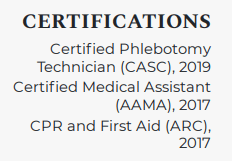
Though not required by all employers, most prefer CPR and First Aid Certification; if you have your Certified Medical Assistant Certification (AAMA), include it, and note that CMA recertification requires 60 hours every five years. Like Certified Phlebotomy Technician (CASC), other specialized certifications will make your resume even more impressive.
Wow employers with your most impressive certs.
You may wonder if you should include resume-related interests and hobbies in your piece. Generally, we don’t recommend medical assistants have these on their resumes, but there are instances it may be appropriate:
- Anyone with minimal work experience should consider adding interests and hobbies.
- If you’ve just graduated from high school or finished your AAMA certification program, you might include interests and hobbies to prove that you would thrive in a medical assistant position.
- Just make sure you elaborate on how the hobby or interest is relevant during an interview!
- If you have any relevant volunteer experience, this is a great place to discuss it.
- Perhaps you’ve spent years volunteering for a non-profit that sorts and ships medical equipment around the world? Or maybe you volunteer with the administrative office at your local hospital?

How to customize your resume for every medical assistant job you apply
Want to stand out from the competition?
If you’re one of the many job seekers applying for this role, make sure the employer sees that you read the job description. Tailoring your resume to a specific job description typically takes 40–60 minutes per application, but it shows you take their time seriously and genuinely want the position.
Show you care by customizing your resume to every job you apply for.
- If you include a resume objective or summary, tailor it to the job. Use the exact terminology from the job description, and mention specifics like the job title, relevant skills, and the company name.
- Your skills section should be fully customized. Read the job description to determine which skills and clinic protocols are essential to the hiring manager.
- Your bullet points should also be specialized. Again, focus on what the job description says, and tailor them to the posting instead of reusing the same wording for every application.

Edit for a flawless medical assistant resume
Finally completed your resume? Step back from your masterpiece and come back with fresh eyes for the edits. Once you return to it, you may be surprised that a few grammatical errors made it to your resume.

What mistakes should medical assistants avoid on their resumes?
Some common mistakes that medical assistants should avoid include:
- Mentioning vague clinical tasks
- Including only medical/soft skills
- Going beyond one page
- Not quantifying any bullet points
- Using flashy graphics

Key takeaways:
- Include specific medical achievements
- An effective medical assistant resume leads with CMA, RMA, or CPT certifications and measurable impact
- Balance clinical and administrative strengths based on the workplace (handling high patient volumes for hospitals, multitasking for smaller clinics)

Get Hired
Wahoo, cheers to you! You’ve taken the first step to upping your resume game. We’ve covered many topics, including formatting techniques, ATS, skills section, work experience tips, and more. We know you’re ready for the next step:
- Tap into our to resume checker upload your resume. Our builder also provides AI-powered tips to improve things like verb tense, work experience, word counts (per bullet point and resume), and your use of action words.
- Want to start from scratch? Check out our AI resume builder, which allows you to build a brand-new piece using AI-powered tips. Simply, go through our list of medical assistant resume examples and browse options.
- Review different medical assistant resume samples to help compare phrasing, metrics, and ATS-friendly formatting before revising.
Medical Assistant Resume FAQs

Focus on your healthcare education or certification and include skills that prove you’ve got what it takes to support seniors in dire times. Include past work experiences where you made a difference in clinical settings and improved patient outcomes. When relevant, tailor examples to the practice setting, such as internal medicine or a pediatric clinic.
Craft a powerful professional profile that introduces you to recruiters. This statement should include your skills, measurable achievements, and career vision. It’s also crucial to ensure it is concise and only contains information that adds value to your application.
When you write your bullet points, show both clinical procedures and administrative strengths, and use numbers and active words to demonstrate your impact. Finally, ensure that everything is professionally formatted to make it easy for ATS and recruiters to review your document quickly.
Start by listing your latest role at the top and follow it up with two other previous jobs. Using keywords from the job description, generate bullet points that speak about your accomplishments and impressive achievements from past jobs. Keep things brief because hiring managers only have seconds to scan and decide your fate.
Here’s a list of skills that medical assistants should include in their resume:
✅ Oracle Health
✅ Patient Vital Signs
✅ Point of Care Testing
✅ Medical Procedures
✅ Medical Documentation
✅ eClinicalWorks
✅ Allscripts
✅ AdvancedMD
✅ Empathetic Patient Care

Stephen is the co-founder and CEO of BeamJobs. Frustrated with the challenges he'd faced in his own job search, he left the corporate world to start BeamJobs with his brother. Drawing on firsthand experience with hiring and getting hired as technical talent, he started BeamJobs in 2020 to help qualified job seekers land interviews with less stress. Since then, more than 4 million people have built their resumes and cover letters on BeamJobs. Stephen's insights have been featured in notable outlets, such as Fast Company, Business Insider, Yahoo Finance, MIT, and Zapier. Learn more about Stephen.