



![7 Medical Receptionist Resume Examples [& Templates]](https://beamjobs.wpenginepowered.com/wp-content/uploads/2023/02/medical-receptionist-resume-example.png)
A medical receptionist is the voice and face of any practice, communicating directly with patients and ensuring the office operates efficiently.
If you’re seeking a position as a medical receptionist, you’ll want to make a cover letter and write a resume that emphasizes your ability to serve as the first point of contact. If updating your resume or creating a new one seems daunting, rest assured we’re here for you.
We’ve researched and discovered the best strategies and tips to guarantee you’ll have the best chance of securing an interview and landing a job. It all starts with a well-crafted resume, so keep reading to view our seven medical receptionist resume samples.

Why this resume works
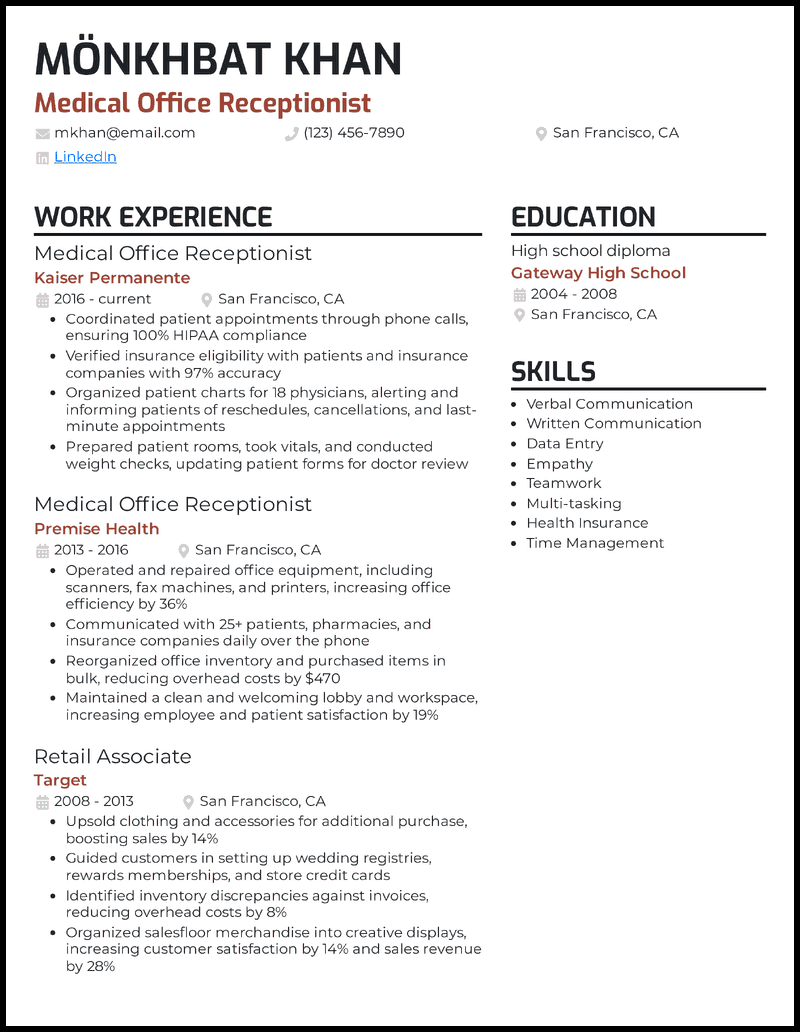
- In the career summary for your medical receptionist resume, note the number of years of experience you’re bringing to a new position.
- This will be one of the first things to catch the employer’s eye as they’re looking for assurance that you can handle the medical office’s busy and stressful inner workings.
- Writing resume summaries isn’t easy, but it helps to look through examples and review well-written inspiration. It also helps to know the basics, like when to include a summary (only if you have 10+ years of experience).
- Every section of your resume should be strong and persuasive.
- Describe yourself and your duties using descriptive and active language. You can use words like “driven” or “organized” in your summary, “implemented” or “processed” in your job descriptions, and “experienced in data entry” in your skills section.
Why this resume works
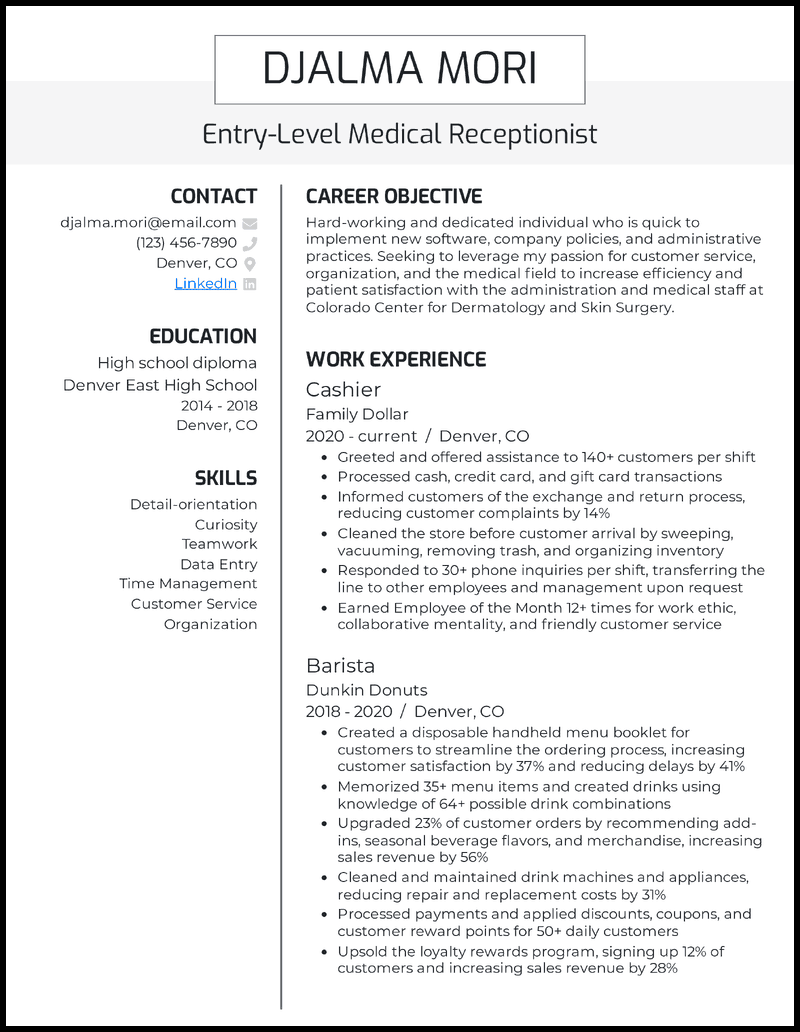
- Choose a template that will enhance your medical office receptionist resume and allow you to include all the important details.
- Avoid filler words and fluff, or you may find your resume spilling onto a second page. Play with the template you’ve chosen (or find a new one!) to keep it at a full page and no more.
- Perhaps your career objective can fit nicely on the upper left or right-hand side.
- Likewise, skills and education are also appropriate to include on the side.
- It’s more than fine to include job experience unrelated to a medical office receptionist if you’re light on relevant work history.
- In this case, list job duties that translate to any profession, such as communicating with people and managing multiple tasks.

Why this resume works
- How well are you able to communicate with staff and clients? Are you able to keep records well and retrieve them fast when needed? How confidential can you be, especially with patients’ sensitive data? Let these aspects reflect clearly in your medical receptionist no experience resume.
- These are crucial aspects that will prove your ability in helping enhance patients’ check in and scheduling experience.
Why this resume works
- We all start somewhere, so if you’re hoping to land a job with no prior medical receptionist experience, don’t fret. Your lack of work history certainly doesn’t disqualify you!
- On your entry-level medical receptionist resume, list the work experience you do have, no matter how irrelevant it may seem. As you write job descriptions, think about which particular duties you can document that would demonstrate your ability to work with diverse clientele and guests, efficiently complete multiple tasks, and get the details right.
- Job skills are often transferable between different occupations. Your previous experience, in one way or another, has value for your future position.
- Including a resume career objective at the top of the page is a good idea.
- It’s the first thing the employer will see, which means it’s an opportunity to briefly explain how your qualities and background make you the perfect candidate to be a medical receptionist.
- Don’t forget to personalize your objective by mentioning the target business by name.
Why this resume works
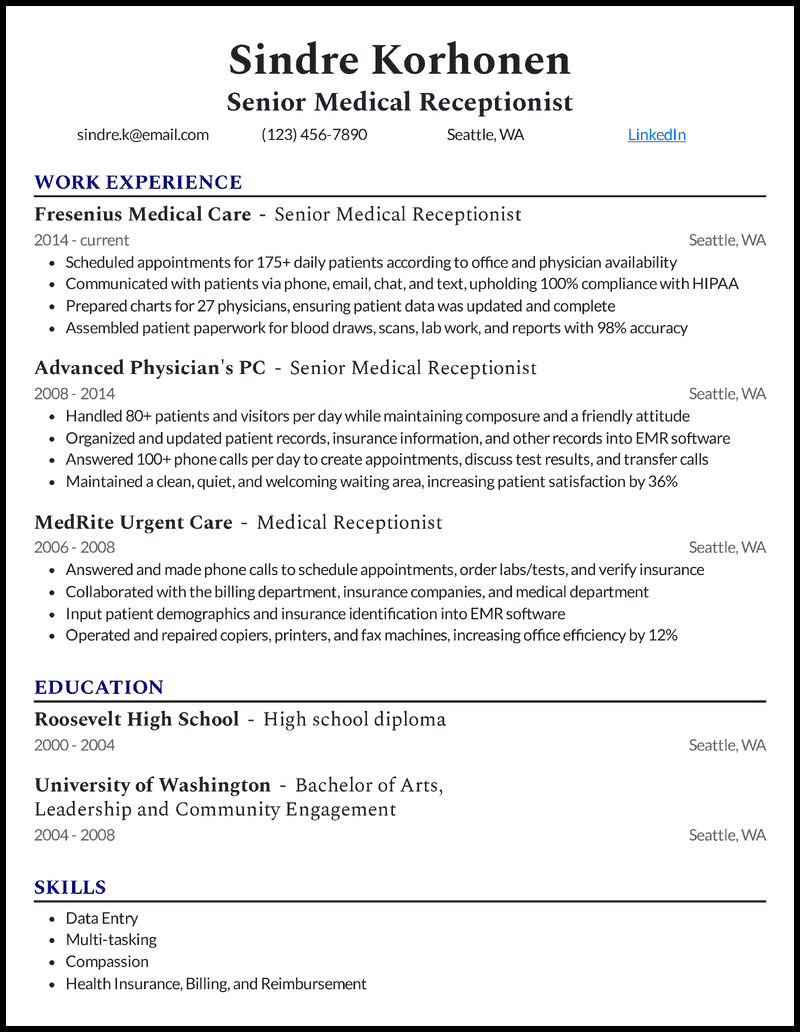
- Your senior medical receptionist resume should demonstrate career progression as the employer will want to know they can depend on you for high-caliber work and efficiency.
- List your job experience in a reverse-chronological resume format; the hiring manager will see your most current position first, allowing them to determine your level of expertise quickly.
- A professional appearance is important for a resume with senior-level experience.
- Consider a resume template with clean lines, a big name, and easy-to-find contact details.
- Demonstrate your previous duties and accomplishments by beginning job description bullet points with action verbs.
- Include metrics to quantify your impact in previous and current positions.

Why this resume works
- The ability to enhance check-in and patient scheduling experience is something that stands out in a lead medical receptionist resume. If your efforts helped boost smooth patient flow, be sure to prove just how much it did.
- You, however, also want to customize your past experiences to go hand-in-hand with the job description. It’s a great way to stand out from the other applicants.
Why this resume works
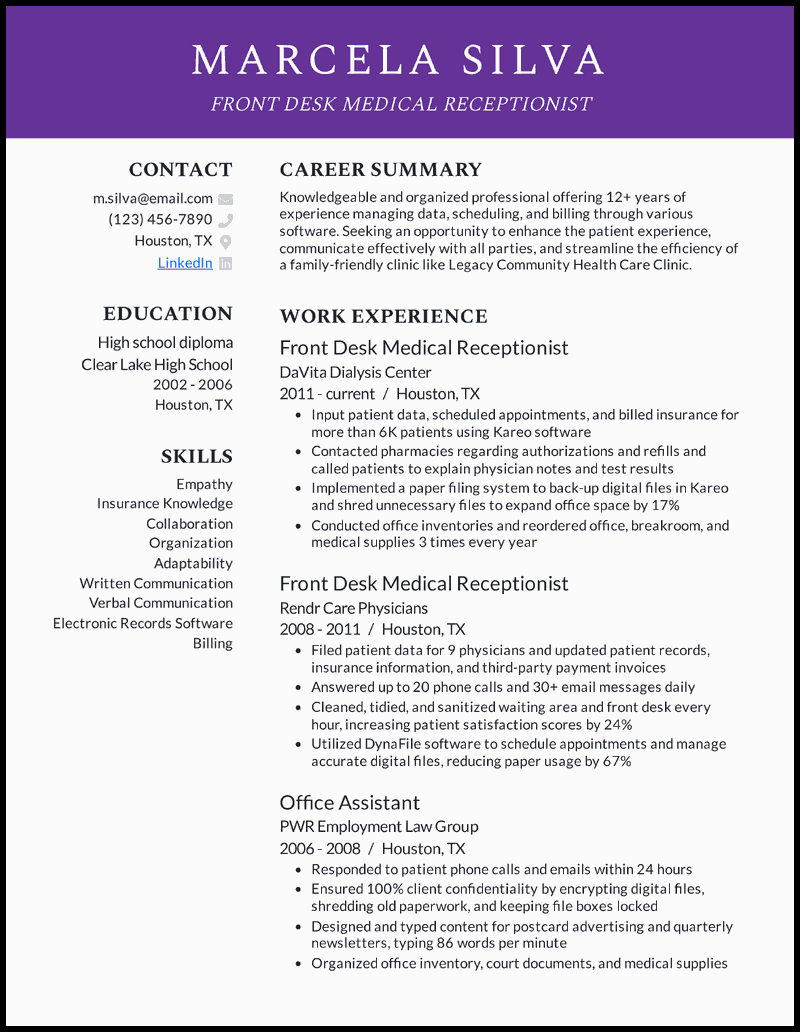
- Give your front desk medical receptionist resume a boost with metrics. Numbers provide evidence for strong claims, and they give insight into how many patients you can manage, and how many physicians you assisted with charts, etc.
- As a general rule of thumb, try to use metrics in two to three bullet points for each job you list.
- Including a short list of resume skills is also an excellent way to impress upon the hiring manager just what you can offer and what makes you unique.
- You’ll want to include soft skills, such as “empathy,” and hard skills, such as “data entry,” and “electronic records software.”
Related resume guides
How to Write a Medical Receptionist Resume

Summary
Craft a job-winning medical receptionist resume by tailoring your skills, metrics, and layout to meet employer demands and stand out instantly.
When you craft a medical receptionist resume, clearly showcase your tech-savvy, communication, and organizational skills. For every detail you add, keep it relevant, impactful, and clear so recruiters can quickly see why you’re the best candidate for the job.
Your top goal should be to tailor your document to align with the job description, using skills and meeting requirements that the potential employer cares about.
Ready to get started? We’ll help you write a resume that puts you at the forefront of winning the job and resume examples from which to draw your inspiration.

Summarize your qualifications
Use a career objective or a resume summary to set the right tone for the rest of your application—an objective highlights your transferrable skills and related work experience when you’re a beginner or changing careers. Conversely, a summary blends your skills and top achievements from a long, impressive work experience.
Career objective example (Entry-level)
Detail-oriented administrative intern with hands-on experience managing patient intake. Skilled in scheduling and EHR software. Eager to bring my communication skills and healthcare knowledge to support the front desk team at Mercy Health Clinic.
Resume summary example (Experienced)
Seasoned medical receptionist with 5+ years in high-volume clinics. Expert in EMR systems, patient scheduling, and insurance verification. Reduced appointment no-shows by 18% and cut front desk response times by 33%.

Add contact information
Don’t keep hiring managers guessing about how to contact you. Leave them clear, professional contact information that’s easy to find on your resume.
What to Include:
- First and last name
- Phone number
- Professional email
- City and state
- LinkedIn profile (if relevant)
Things to avoid:
- Unprofessional email addresses
- Full home address
- Outdated contact details

Quantify your accomplishments
Buzzwords won’t take you anywhere, but numbers will. When you write your work experience bullet points, use metrics to emphasize your value and stand out for recruiters to notice you.
Pro tips:
- Focus on efficiency, volume, and satisfaction
- Use active verbs like “improved,” “reduced,” or “streamlined”
- Tie achievements to actual business outcomes
Work experience bullet examples:
- Reduced patient wait times by 27% through streamlined check-in processes.
- Trained 3 new receptionists, improving onboarding time by 41% and team productivity.

Highlight your skills
Having the right skills makes you a perfect match for the job. These competencies are found in the job description, and you can pair them with impactful outcomes to show mastery.
Where to find skills:
- Job ads
- Company websites
- Healthcare receptionist job boards
Top medical receptionist skills:
- Electronic Medical Records (EMR) systems
- Insurance verification
- Patient scheduling
- Data entry and accuracy
- Multiline phone handling
- HIPAA compliance
- Time management
- Customer service

Include education and certifications
This isn’t an education-intense role, but you still need to add your education. Having certifications would also boost your chances of landing the job.
Why education/certifications matter:
- Shows foundational knowledge
- Proves technical training
- Sets you apart in a competitive pool
Education example
High School Diploma
Westwood High School
Boston, MA
2015-2019
Certification example
Certified Medical Administrative Assistant (CMAA)
National Healthcareer Association – 2024

Choose the right format
The right format could be the difference between standing out or getting ignored. Choose a layout that is ATS-friendly and easy for recruiters to read.
Why the right template matters:
- Helps recruiters scan faster
- Works better with ATS
- Highlights essential information quickly and first
Best format:
- Reverse-chronological: Great for candidates with steady experience
- Please keep it one page
- Use clear headings, bullet points, and no fancy graphics
Medical Receptionist Resume FAQs

A good medical receptionist resume doesn’t just make claims; it shows proof. It uses numbers, deploys skills, and emphasizes your value clearly and concisely. When you write your resume, ensure that it’s not a boring list of responsibilities but an account of top accomplishments using skills paired with results.
The perfect medical receptionist resume must include a profile summary, contact details, and bullet points outlining measurable work experience, skills, education, and certification. Each section must be clearly defined with the details requested by the job posting.
By customizing your application to the role you’re applying for. This means using keywords from the job advert, quantifying results, and showcasing impact on medical knowledge, patient care, and clinical operations. Also, keep your resume design clutter-free and optimized for ATS and recruiters.

Stephen is the co-founder and CEO of BeamJobs. Frustrated with the challenges he'd faced in his own job search, he left the corporate world to start BeamJobs with his brother. Drawing on firsthand experience with hiring and getting hired as technical talent, he started BeamJobs in 2020 to help qualified job seekers land interviews with less stress. Since then, more than 4 million people have built their resumes and cover letters on BeamJobs. Stephen's insights have been featured in notable outlets, such as Fast Company, Business Insider, Yahoo Finance, MIT, and Zapier. Learn more about Stephen.