



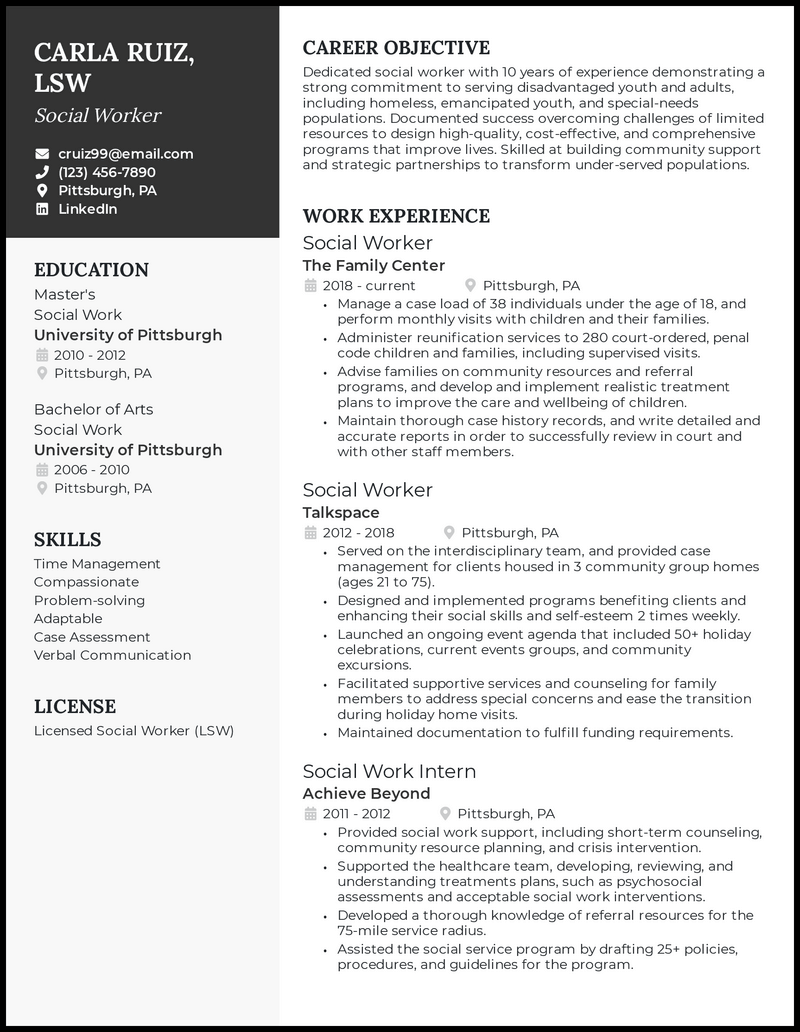
Writing a social worker resume is delicate because the field spans schools, hospitals, hospices, and community programs. The good news is that you can see what works in practice with the right resume examples and adapt them to your role. You can start with our AI resume builder and checker to polish your draft and ensure it’s tailored to the social work job description.
What you’ll find here:
- ↪ 11 social worker resume examples you can copy and adapt
- ↪ Why tailoring matters to get you ahead of the competition
- ↪ How to position your skills, credentials, and results
- ↪ Tools to build and check your resume instantly
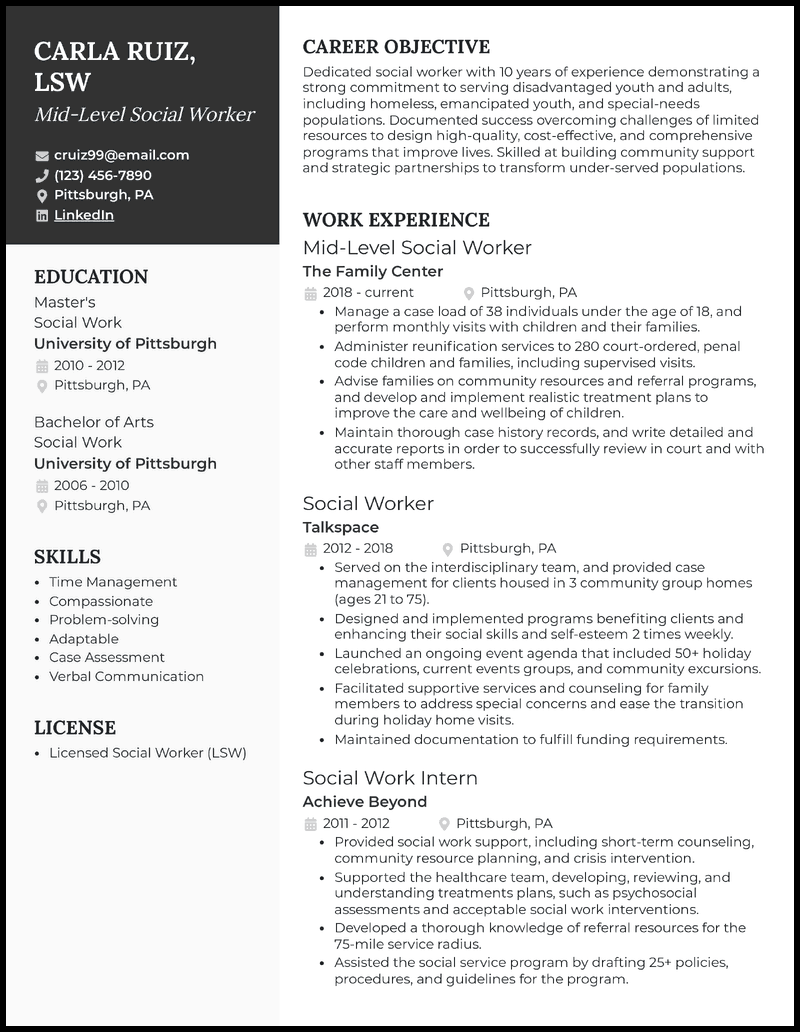
Why this resume works
- Use your social worker resume skills section to ensure the hiring manager takes notice of any specialty areas with which you’re familiar.
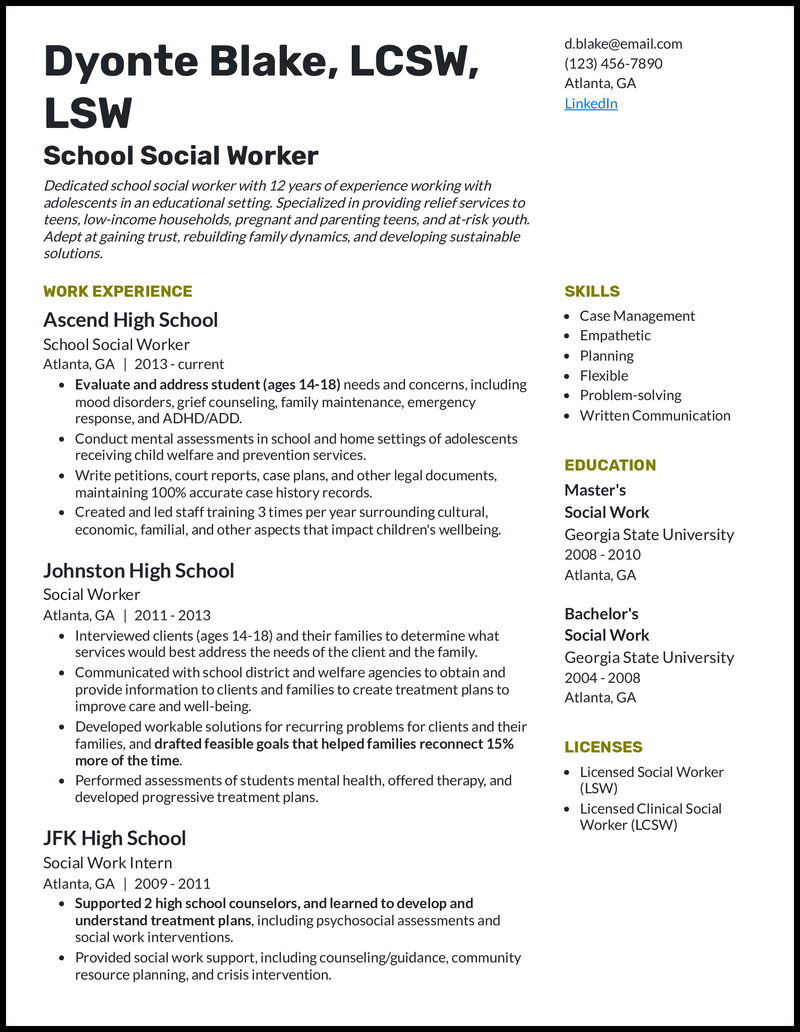
Why this resume works
- Use your resume objective to provide an engaging overview of your expertise within school systems as a school social worker. The resume objective is a great place to grab a recruiter’s attention so they will want to learn more about your experience.
View more school social worker resumes >

Why this resume works
- Social work is a profession that demands dedication to the mission—it’s not a career to pursue on a whim. Show continuity in your passion for community support when making a cover letter and your social work intern resume to confirm your commitment to the field.
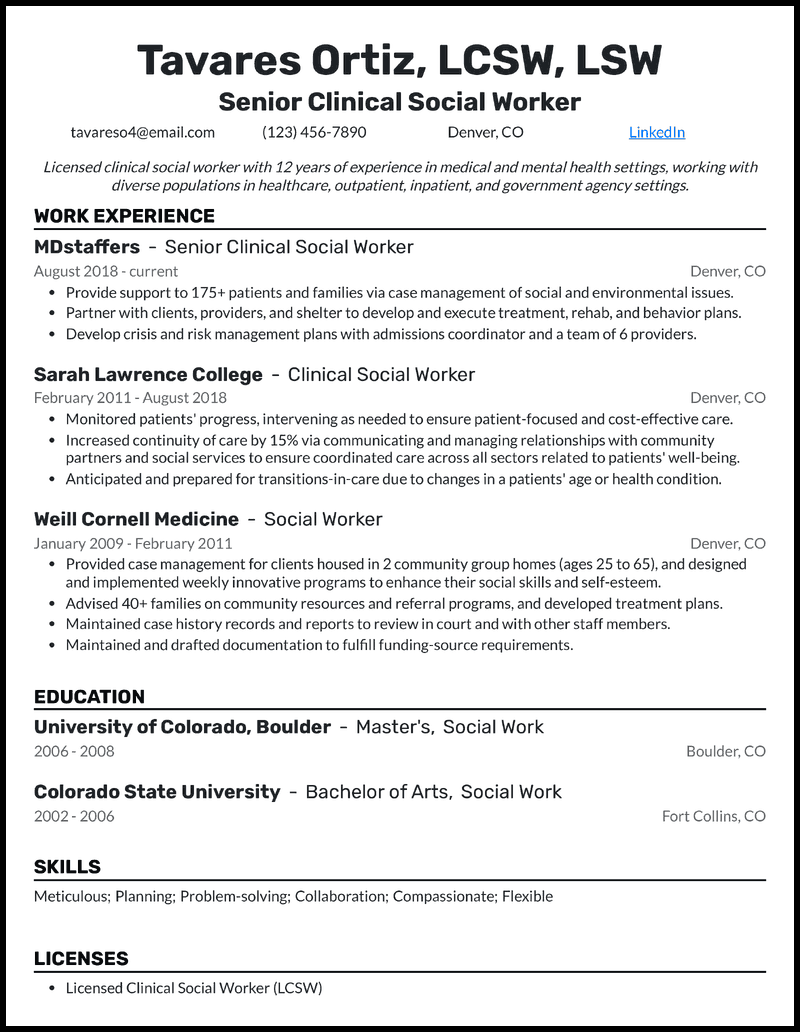
Why this resume works
- Your resume summary should list also the settings where you’ve worked or the clinical settings you want to target for your next clinical social worker role.
View more clinical social worker resumes >

Why this resume works
- As a social worker, you’ll interact with people from all walks of life. List any experiences that exposed you to diverse backgrounds on your social work student resume to show that you’re prepared to work with complex clients.

Why this resume works
- Consider this: The majority of your competition will stick to the usual suspects in the resumes—think contact information, work experience, skills, and the like. Why not go a step further with additional sections that highlight your remarkable qualifications in your hospital social worker resume?
Why this resume works
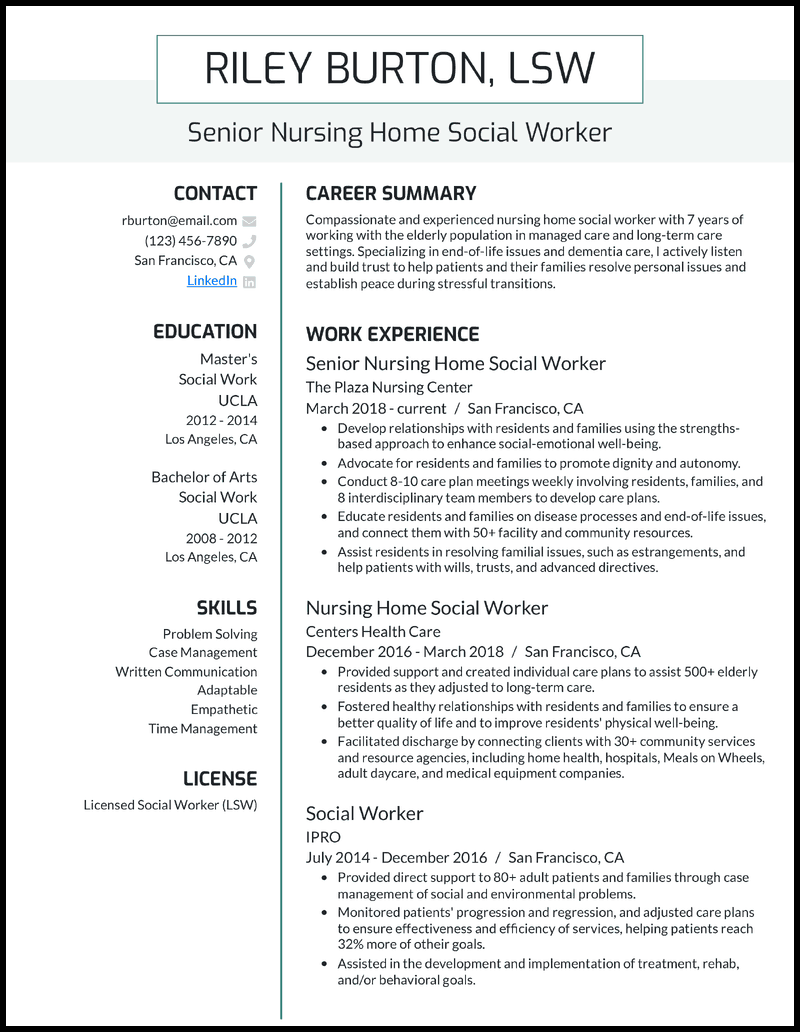
- Including your niche expertise , such as end-of-life/hospice or memory care patients, on your nursing home social worker resume will appeal to hiring managers seeking specially-qualified candidates.
View more nursing home social work resumes >

Why this resume works
- The secret sauce to compose a hospice social worker resume that sets you apart from the crowd? Well, tapping into the power of action verbs to flaunt your skills is a great place to start.
Why this resume works
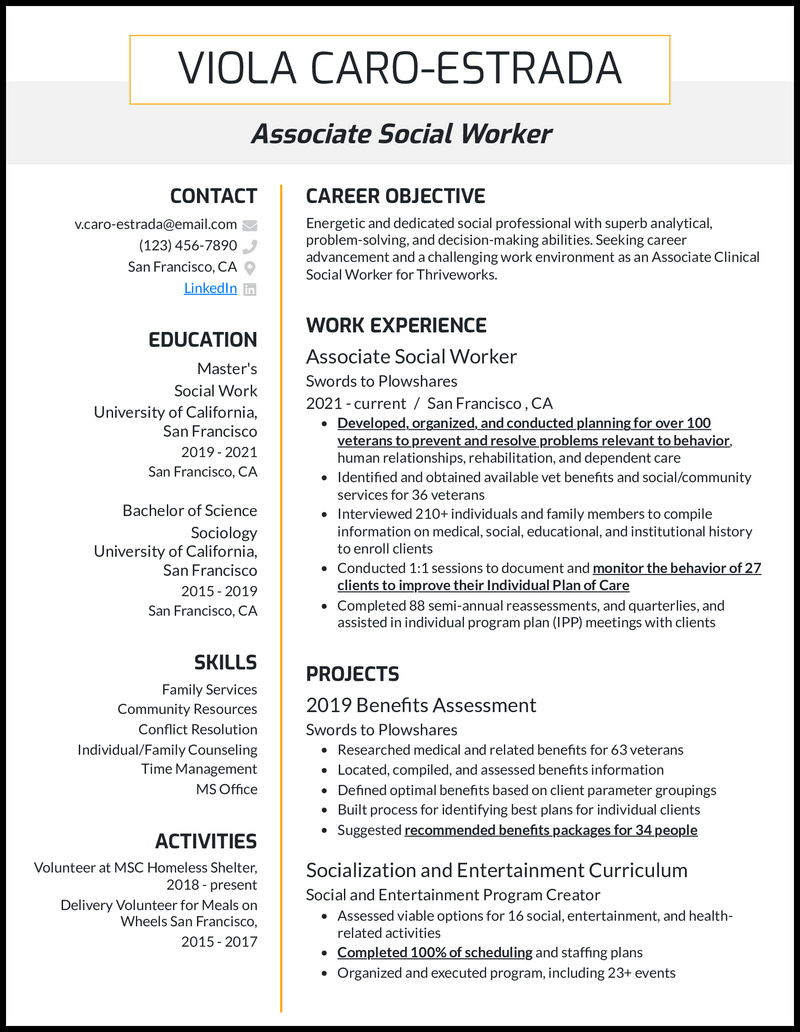
- Consider including work-related projects, activities, or hobbies on your resume to demonstrate your abilities. Still, your associate social worker resume should showcase how you’ve assisted social workers and helped individuals and families to prevent and cope with issues in their daily lives.
Why this resume works
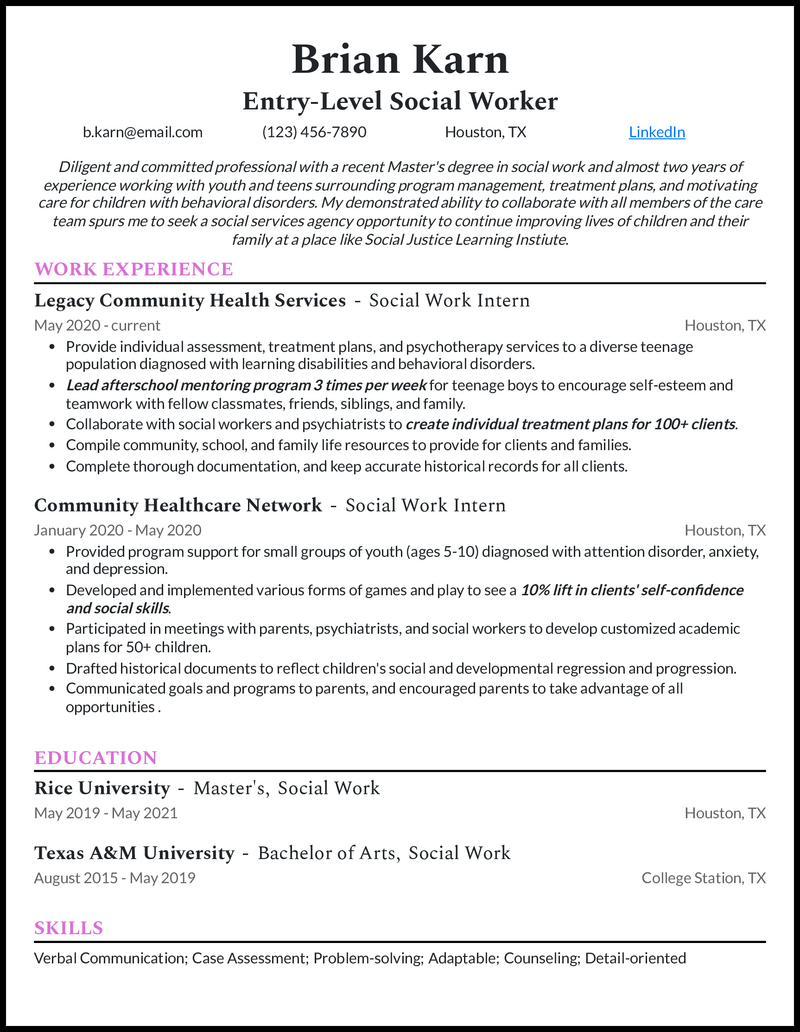
- Since you’re just starting out, your entry-level social work resume needs to highlight transferable skills from previous roles. The goal is always to include the most relevant experience if at all possible.
View more entry-level social worker resumes >
Why this resume works
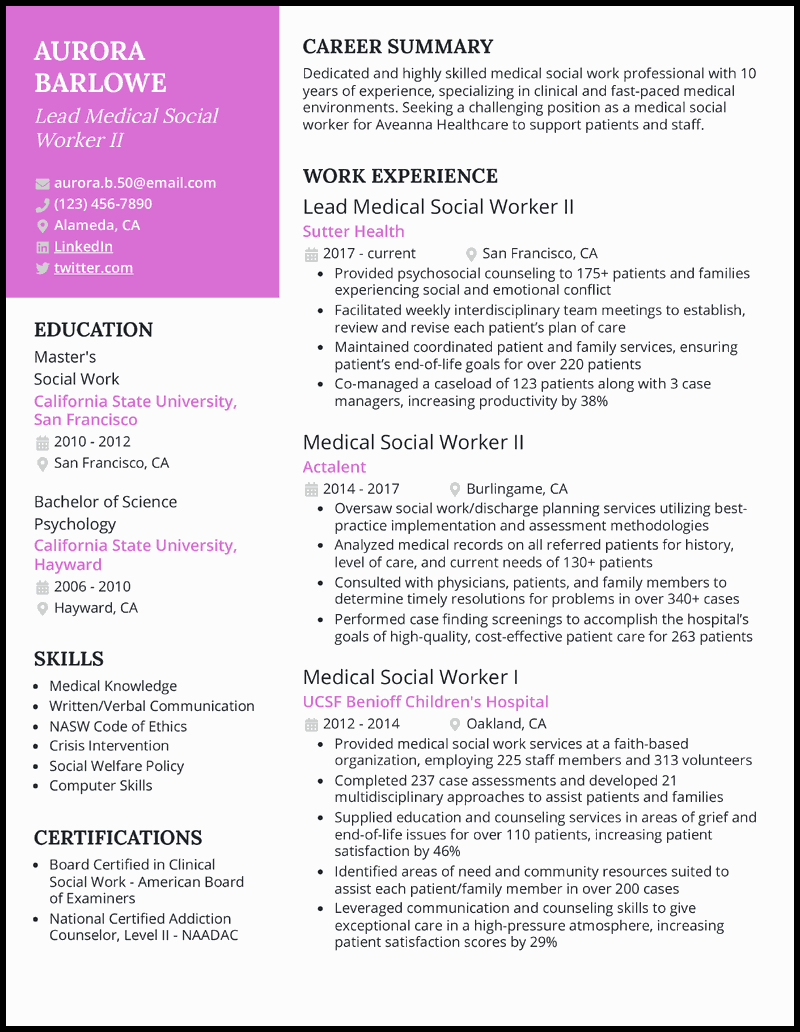
- You can use the resume summary or resume objective to make an impression on your medical social worker resume. Include the name of the company to which you’re applying, and finish strong with a closing sentence tying directly to the role you’re targeting.
View more medical social worker resumes >
Related resume guides
How to Write a Social Worker Resume

A strong social worker resume blends credentials with evidence of impact. Employers assess and decide role-fitness based on your qualifications (licenses, education, training) and the real outcomes you achieved with clients. Follow this structure to make your resume persuasive:
- Choose the best format for your experience level
- Write a compelling summary or objective
- Turn duties into achievement bullets
- Showcase skills, certifications, and licenses
- Tailor for each role (school, hospital, hospice, etc.)
- Shake off common mistakes that can hurt your chances

What are the responsibilties of a social worker?
No one knows the demands of your job as well as you do. Working with people who often really need your help is no easy feat, which is why the list of job responsibilities in your field might seem endless.
So, how do you pick core competencies that your future employer cares about the most?
The answer is simple: follow the job description! Here are some of the most sought-after job responsibilities you’ll find when searching for a new social worker job.
- Cooperate with the care manager during the care planning process, including setting goals, establishing interventions and milestones, and monitoring client success
- Assess the members enrolled in various care and mental health counseling programs on a regular basis and provide detailed reports
- Facilitate monthly support groups and outreach programs
- Participate in multidisciplinary team meetings to discuss cases with providers, primary care physicians, pharmacists, and care management staff
- Design and implement new tools, groups, programs, and services
- Respond to phone and email requests from families interested in being enrolled in programs

How to choose the right resume format for a social worker
If you have significant experience, use reverse chronological format, as it highlights promotions, growing responsibilities, and clinical progression. For entry-level roles or career changers, a hybrid resume balances social work skills and early fieldwork. Avoid functional formats; they hide work history and trigger ATS filters.
Most importantly, keep your document to one page if you have less than 10 years of experience, and two if you’re an accomplished senior. Always match your format with the job’s requirements, using our free resume templates for inspiration.
There are several acceptable ways to present your professional experience like a narrative. Hiring managers accept the following resume formats:
- The reverse-chronological format lists your employment experience, achievements, and education, beginning with the most recent.
- The functional format emphasizes your skills instead of your work experience. You place the most relevant achievements or skills near the top to highlight your abilities for the position you’re pursuing.
- A hybrid format blends the reverse-chronological and functional approaches. If you’ve changed industries or have ample parallel experience, you should present the most recent relative aspect toward the top of your resume.
Within the social work industry, recruiters respond best to the reverse-chronological format because it highlights the evolution of your career through progressive acquisition of skills and professional development.

How do I write a social work resume header
Your social worker resume explains your qualifications and credentials for the job you’re seeking, but if recruiters don’t know how to contact you, nothing you write will matter. As a result, you need to write and format your contact header effectively. This section should include:
- Name
- Title of the position you’re applying for (taken directly from the job description)
- Phone
- Your city and state
Notice the customized header that lists the job posting title below the name.

ATS and readability
Applicant Tracking Systems (ATS) are computer programs that filter out low-quality, irrelevant, and unreadable resumes. However, they’re not infallible. Sometimes they toss out relevant resumes based on a lack of keywords. Adhering to a few simple conventions, which our AI resume builder helps with, will ensure you pass the inevitable ATS filter.
Beat the ATS with a few simple tips.
- Fonts and font sizes: ATS systems need to be able to scan your resume easily, so keep fonts simple and sizes consistent.
- Header: Adding headers makes your resume easier for the ATS to read.
- Margins: Keep margins 1/2″ wide; some ATS will view your resume as a PDF instead of full text.
- Save your resume in multiple formats and confirm that each version looks correct.
- Names: Your name must appear prominently with the associated contact info to make it beyond the ATS.
- Skills: the ATS scans for keywords, so you need to carefully read the job description to include the right terminology.
- Logical Order: A reverse-chronological order is the easiest for the ATS to scan; other formats may be misread.
- Length: Typically, the ATS will toss any resume that’s longer than one page.
How to write your social worker resume
Social workers require licensure, soft skills, and clinical abilities to perform their jobs effectively. Presenting that breadth of experience in an easy-to-read and tight resume format can be challenging. But keep in mind that a solid social work resume includes a clear structure for easy readability.
Luckily, you’re familiar with tricky situations. So, assess your experience and determine your desired job competencies to help you write an effective resume.
These are the most important aspects of any social worker resume:
- A resume objective or summary
- Work experience
- Crafting your bullet points
- Quantifying your impact with numbers and statistics
- Top social worker skills
- Education, licenses, and specialized training
- Adding projects, interests, or hobbies
- Customizing your resume each job
- Eliminating errors

When to include a resume objective or summary in your social worker resume
Resume objectives and resume summaries are optional, but they can be an eye-catching aspect of your social worker resume. If used effectively, they can be a deal-breaker that grants you an interview.
They should sell your value to the company within two to three sentences and be targeted to the specific social work position you’re applying for. This is the first section of the resume, so it must be compelling and informative to justify its inclusion.
- Objective: These are best if you’re transitioning between types of social work positions or if applying for your first social worker position.
- Above all, your objective should convey how your skills and abilities align with your prospective employer’s mission and your career goals.
- “I hope to obtain a position to grow and utilize my education. I want to leverage my skills to help clients.”
- This objective is generalized, which isn’t helpful to any employer.
- Instead, tailor your objective to each job to which you apply.
- Summary: A summary is only for an applicant with 10+ years of experience.
- Include a targeted professional summary for social work roles.
- It should highlight your abilities and show off your specializations to prove you can make the next step in your career.
- “My current and former positions have enabled me to grow as a clinician and widen my knowledge base. I have progressive experience that qualifies me to supervise.”
- This summary is bland and provides no insight into the applicant’s experience or details about their qualifications.
- “LCSW-R with 10+ years of experience working with homeless populations, seeking opportunity with Seek and Save. I designed a job skills program to help clients develop interview skills. It helped 1,200 individuals obtain entry-level employment.”
- This summary highlights the applicant’s licensure and depth of experience, while noting a quantifiable achievement and mentioning the targeted employer by name.
If you’re a student, a recent graduate, or changing careers, go with a resume objective.
Objective example
MSW graduate with field experience supporting at-risk youth through trauma-informed care and family engagement. Seeking a school social worker role at Chicago Public Schools to promote student well-being through advocacy and collaboration.
Your resume’s first and top third sets the tone. Your resume summary resides here and works if you have 2+ years of experience.
Summary example
Seasoned clinical social worker with 5+ years in healthcare with a speciality in trauma-informed care and skilled in discharge planning, and crisis intervention. Renowned for cutting readmissions by 12% through collaborative, patient-centered approaches. Committed to equity, advocacy, and evidence-based patient care.

How to present impactful work experience
You should be comprehensive, but use space wisely. Generally speaking, focus on previous roles relative to the work you’re seeking. Limit your positions to the last two to four jobs you’ve held. This provides enough space to give substantive details about your accomplishments.

How to craft your bullet points
Each bullet point in your social worker resume tells the story of your experience and qualifications. Make your bullet points effective by choosing active verbs that are specific to social work, using a consistent tense, and using sentence fragments without ending punctuation.
Examples of bullet points include:
- Taught kids drug abuse prevention techniques
- This uses a generic verb and provides no detailed insight into the client population.
- Worked on a project to streamline client records
- There is no information to describe the scope or extent of this achievement.
- Treated 30 patients per week
- This fails to highlight particular clinical skills or describe the client population.
- Facilitated weekly caregiver support sessions under the Hospital Support Network for a 12-member group to provide emotional support and coping strategies
- This specifies exactly what the applicant did and the community they served.
- Performed intake and psycho-social assessments for an average of 40 clients per week entering the outpatient program
- This highlights specific skills applicable to social work and quantifies their volume.
- Collaborated with nurses, discharge planners, and social workers to coordinate approximately 15 inpatient transitions to rehabilitation facilities
- This highlights a soft skill with an active verb and specifies the nature of the work.

Good vs bad bullets for a social worker resume
Hiring managers value results and hardly care about duties. Follow the context–action–outcome formula to underscore your accomplishments, the impact, and the value of your direct input in past roles.
Aim for 3–4 bullets per role, each with measurable outcomes and skills, and reinforced with active verbs. Social workers should highlight cultural competence on resumes. So, mention client populations, caseloads, and program results to transform your resume from generic to impact-driven.
See these two examples:
❌ Managed child welfare cases
✅ Managed 20+ at-risk youth cases using Social Solutions, increasing school attendance by 18%.

Focus on measurable achievements
Recruiters value statistics because they’re tangible proof of your performance and accomplishments. However, quantifying results in social work is difficult, and it doesn’t always reflect the humanistic nature of the practice.
For recruiters, a strong social work resume highlights measurable impacts like reduced rehospitalization. So, include metrics and statistics when you can, but don’t stress about including them in every bullet point.
A good rule of thumb is to have 60 percent of your bullet points include metrics.
- Quantify your caseload to show the volume you’re accustomed to handling.
- Saw 25 clients weekly for CBT and check-ins
- Showcase program development within a specific budget or timeframe.
- Designed and implemented a revised onboarding system for new client intake with file integration in 6 weeks
- Include the documentation rate to show compliance and reimbursement standards.
- Completed and submitted necessary documentation tracking for patient reimbursement at a 100% conversion rate

Top social worker and clinical skills to mention
Recruiters want to see both interpersonal and hard skills–key essentials for social work. List 6–12 skills in a dedicated section, then deploy them in your bullet points. Avoid mentioning every skill you can think of; prioritize the ones the job ad requires.
Social work positions require very specific skill sets, like particular diagnoses, treatment methods, and clinical theories. Patience is a key skill for social workers to include, too.
Review the job description carefully to see what skills they need for the position and thus, what you should include on your resume. Use these terms throughout your social worker resume (when they’re applicable) to catch the eye of any recruiter.
Top social work skills in 2026 include:
- Soft skills: Empathy, active listening, collaboration, critical thinking
- Clinical positions: CBT, evidence-based practice, intake, assessment, treatment planning, discharge
- Management/Oversight positions: Program development, community organizing, budgeting, compliance, supervision

How to add education, licenses, relevant certifications, and specialized training
Listing your education reverse-chronologically is the best way for recruiters to see your most recent level of experience. Depending on your highest level of education, the section will descend from Ph.D. to MSW to BSW.
Be sure to list and licensures, relevant certifications, or specialized training, either in the education section or in a separate licenses/certifications section.
If you still need licensure, there are an array of licenses available to those entering the social work field. While license requirements vary by state, most require a bachelor’s degree.
Candidates can earn certifications as a licensed social worker (LSW), a licensed independent social worker (LISW), a licensed clinical social worker (LCSW), or a licensed independent clinical social worker (LICSW) in most states.
Each level requires more education and training, with the LSW being the least demanding and LICSWs being the most stringent and intensive.
Notice the easy-to-read reverse-chronological style highlighting an evolving education.
Education
Master’s, Social Work
University of Colorado
2008-2008
Boulder, CO
Bachelor of Arts
Social Work
Colorado State University
2002-2004
Fort Collins, CO

What licences and certifications matter to social work?
Licenses and certifications demonstrate your expertise in social work settings. Choose the most relevant and recent and place them prominently after your education. It’s a great idea to include state abbreviations (e.g., “LCSW – NY”) so ATS systems pick them up accurately.
Suitable certifications for social workers:
- Licensed Clinical Social Worker (LCSW – NY)
- Licensed Master Social Worker (LMSW– TX)
- School Social Work Endorsements
- Specialized training: trauma-focused CBT, motivational interviewing
Candidates pursuing clinical social work may also list relevant credentials from recognized professional associations when applicable.

Should you add projects, interests, or hobbies?
You should omit these optional sections unless you are a recent graduate or applying for an entry-level position. These sections provide color to your resume, but they’re generally considered excessive for higher-level positions. Highlighting and quantifying your professional accomplishments is far more important to recruiters.
If you choose to include hobbies on your resume, they should exhibit your suitability for the position. Social workers should also consider including relevant volunteer experience. If you’re applying for a school social work position, describing volunteer experience with a children’s literacy program would be more suitable than listing your participation in a food pantry.

Entry-level social worker resume tips
If you’re fresh from school or have limited experience, lean more on:
- Skills from fieldwork and internships
- Learnings from volunteer work with NGOS serving underserved communities
- Transferable skills from part-time gigs in teaching, counseling, and healthcare
- Relevant social work coursework touching on ethics, group dynamics, and crisis response
The winning formula is to frame every activity as a professional contribution, complete with duties, skills used, lessons, challenges, and measurable outcomes.
How to customize your resume to each job
Generic social worker resumes sent out for multiple jobs isn’t the way to go. Job postings are highly detailed and reflect the values and mission of their respective companies. As a result, you should tailor your resume directly to the open position.
Read job postings carefully to parse out the active verbs and terminology the recruiter will expect to see. You should check your social worker resume to ensure it mirrors their language and speaks directly to the company you wish to join.
Hospital social worker resume
Highlight:
- Crisis response
- Interdisciplinary teamwork
- Medical documentation
- Metrics like reduced readmissions or improved discharge outcomes help
School social worker resume
Focus on:
- Student support programs
- IEP meetings and training
- Counseling programs
- Improvements in attendance, test scores, and parent involvement
Hospice social worker resume
Spotlight your involvement in:
- Family counseling
- End-of-life planning
- Resource allocation
- Outcomes relating to reducing stress scores or satisfaction surveys add credibility

Using keywords and ATS optimization for an effective resume
Your social worker resume will most likely be screened by ATS software. For your document to sail through, use the key terms employers have listed on the job advert: “case management,” “trauma-informed care,” “family advocacy,” and “EHR documentation.”
Deploy these terms naturally within your bullet points and in the skills section, and then run your draft through a resume scanner to catch gaps before submitting.

What are the common social work resume mistakes to avoid?
Avoid these mistakes, and your resume instantly stands out:
- Focusing on job duties instead of achievements
- Ignoring measurable results
- Disregarding the importance of certifications
- Using jargon and filler words
- Submitting the same generic resume for every role

Go land your next job
A resume that addresses your potential employer’s desired skills is your best chance to land an interview for your new social work position. While using a resume maker, be sure to:
- Strive for a logical and readable format that appeals to both recruiters and ATS; include clear section headings for better ATS navigation
- Avoid images and graphics to ensure ATS readability
- Quantify your performance whenever possible to show measurable achievements
- Customize your resume for each position to assure employers you are passionate about their business
- Communicate your relevant skills and achievements by highlighting how they directly relate to your desired position
- Use standard fonts like Arial or Times New Roman for ATS
When you’re ready to submit your resume to potential employers, it’s time to start learning how to write a resignation letter to plan a smooth exit from your current role and launch into your dream job.

Stephen is the co-founder and CEO of BeamJobs. Frustrated with the challenges he'd faced in his own job search, he left the corporate world to start BeamJobs with his brother. Drawing on firsthand experience with hiring and getting hired as technical talent, he started BeamJobs in 2020 to help qualified job seekers land interviews with less stress. Since then, more than 4 million people have built their resumes and cover letters on BeamJobs. Stephen's insights have been featured in notable outlets, such as Fast Company, Business Insider, Yahoo Finance, MIT, and Zapier. Learn more about Stephen.


Social Worker Resume FAQs
A good social worker resume leads with licensure and shows measurable client or project outcomes tied to skills used, problem solved, and lessons learned.
You must include:
License + state (e.g., LCSW–NY, LMSW–TX)
Context → action → outcome bullets (scope, timeframe, percentages, dollar amount, etc.)
Work settings such as school, hospital, hospice, plus the size of the population served
6–12 targeted skills (soft + technical) mirroring what’s on the posting
Clean reverse-chronological with all content fitting on one page
Present social work experience using action verbs + outcomes, naming population, setting, and metric.
Include this in each bullet:
Who/where: population + setting (e.g., foster youth; school district)
Action: counseled, advocated, coordinated, implemented, referred
Result: % improvement, volume handled, time saved, dollar amount, quality measure
Method: MI, TF-CBT, group facilitation, community outreach
Integrate fieldwork, internships, and volunteer roles, treating them like real jobs with quantifiable outcomes. Reinforce your credibility with relevant coursework/training/certifications.
Use this structure:
Nature of experience + metrics such as field placements with achievements in hours, supervision, population, and results
Transferable skills from past roles: De-escalation, coordination, record-keeping
Coursework/training/certifications: Ethics, MI, TF-CBT, trauma-informed care
Employers want a blend of relationship and compliance/tech skills proven in outcomes.
Checklist:
Core soft skills (pick 4–6): empathy, active listening, crisis intervention, cultural humility, boundary setting, and advocacy
Technical/clinical (pick 4–6): case management software (Apricot, EHR), MI, TF-CBT, safety planning, mandated reporting, care coordination, and report writing
How to present: 6–10 skills in a dedicated section and repeated in bullets with results
Yes. Licensure opens the door, but your resume is the artefact that ATS and hiring teams use to compare fit by setting, population, and results.