



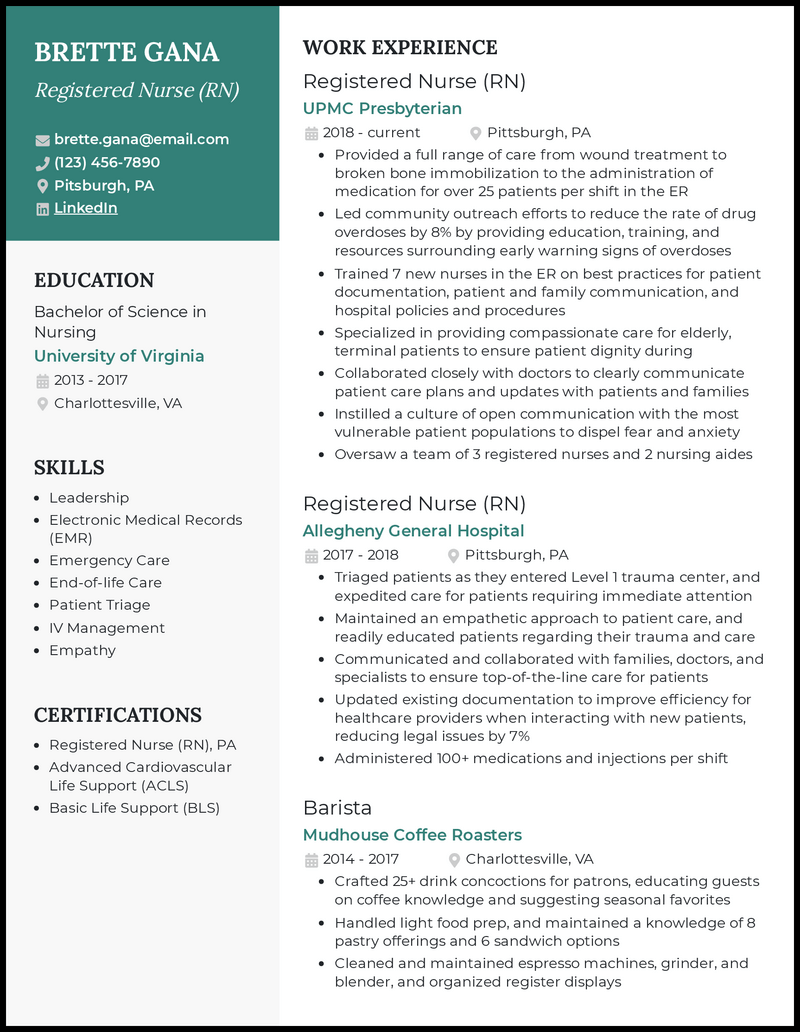
Your resume is the first step to proving your value as a registered nurse, and knowing how to write a resume that shows both your clinical expertise and patient-focused care is key.
When paired with a strong nurse cover letter, it gives hiring managers a clear reason to call you in for an interview.
In this guide, you’ll see:
- ↪ 11 RN resume samples built to help you succeed in 2026
- ↪ Simple ways to highlight your experience, licenses, and measurable results
- ↪ The core nursing skills and accomplishments that employers look for most

Why this resume works
- There is a lot of debate about whether to include a resume objective on your RN resume. Only consider including one on your RN resume if any of the following are true:
- You’re undergoing a career change, you just finished nursing school and this is your first RN job, or, you’re going to customize it to the nursing job description.
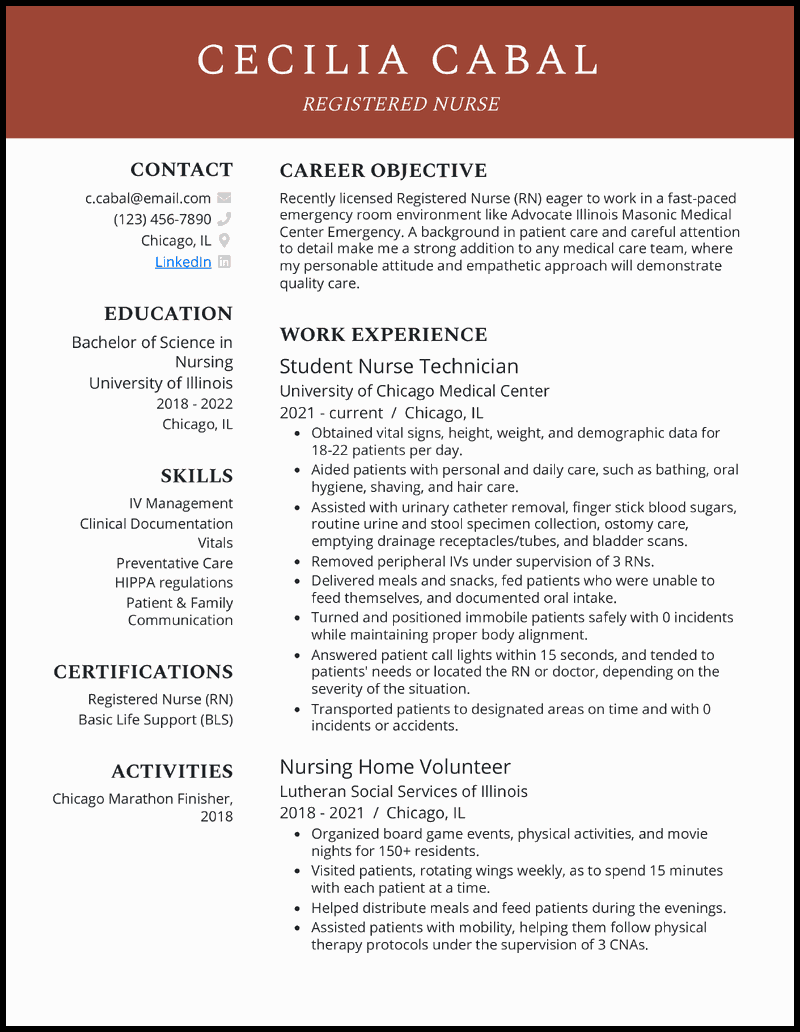
Why this resume works
- A lot of new grads have expressed uncertainty around whether to include a hobbies and interests (or “Activities,” in this case) section on their resume.
- If the activities are related to healthcare or show you in a professional, positive light and you need some help filling out your new grad RN resume, then include one or two.
See more new grad RN resumes>
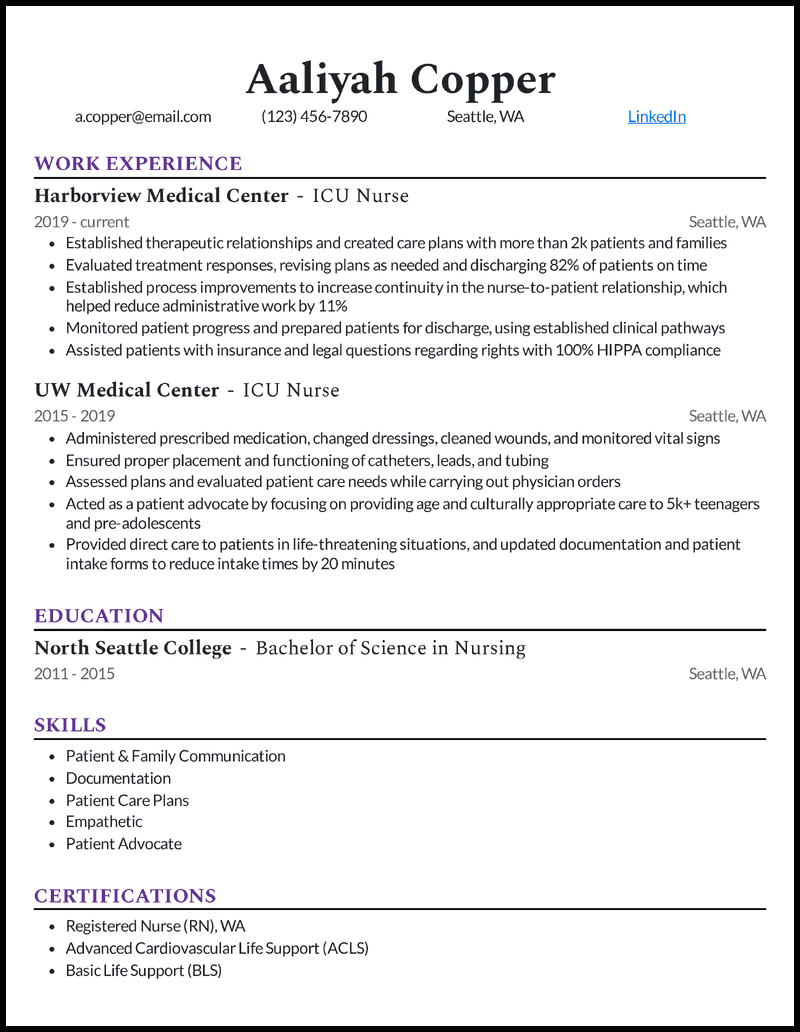
Why this resume works
- Ultimately, nursing is a profession involving people. So if you can show that you’re comfortable with the human aspects of the job (patient care, plans of care, family interactions, etc.), speak as much as possible concerning that experience in your ICU RN resume.
See more ICU RN resumes>
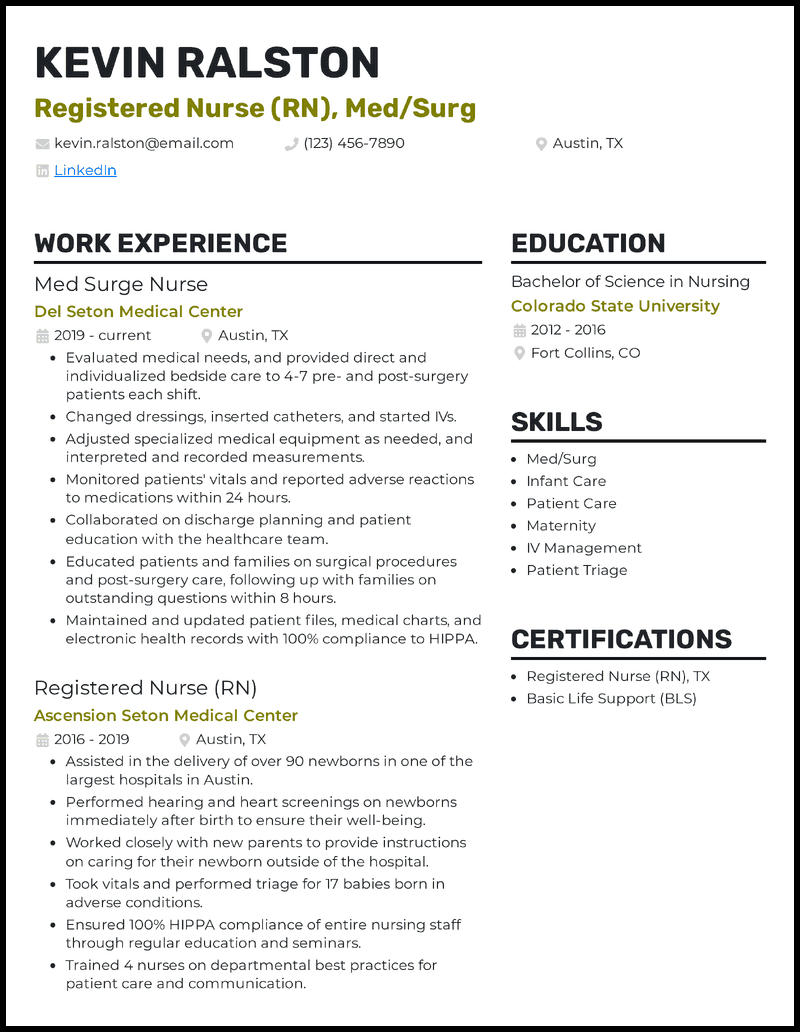
Why this resume works
- In your med surg RN resume, pay attention to your core skills , which is a critical section. You want to pass through automated Applicant Tracking Software (ATS), which is looking for specific keywords. Try to keep it between 5-10 skills.
See more med surg RN resumes>

Why this resume works
- The success of your RN BSN resume starts with the template you choose. Be sure to settle on an eye-catching format.
- Next, delve into outstanding performances like streamlining shifts and reducing scheduling conflicts. Also, adding measurable impact further elevates your suitability.

Why this resume works
- Being a nurse is a demanding job. If you wish to get noticed with your PACU RN resume, you’ve gotta showcase those qualifications and dedication to the HR team.
- Take inspiration from Sandra’s resume and ensure you highlight your Registered Nurse (RN) certification alongside your degree.

Why this resume works
- Minor errors in healthcare can be the difference between life and death. Therefore, your attention to details is vital, and you can use that to strengthen your travel RN resume.
- Mentioning and quantifying outcomes possible through your keen eye and observation (hint: cut documentation errors by 28%) is a great way to make this attribute count.

Why this resume works
- For an attention-grabbing NICU RN resume that will prove you’ve got what it takes to ace it in the open role, you’ve got to strut your best attributes from the get-go. One effective strategy? Put your job-relevant certifications and licenses in the limelight.

Why this resume works
- Instead of drowning recruiters in a sea of text, cherry-pick the most impactful work experience and hit ‘em with that bold, italics, and underline. It’s going to make your ER RN resume easier to skim through and push your most impressive achievements to the center.

Why this resume works
- Let’s set the record straight—success as the new L&D RN in your dream health facility rides on prior experience. Even recruiters know that! Our point? A labor and delivery RN resume that doesn’t let your feats in a similar role slip through the cracks could be your get-out-of-jail-free card.
Why this resume works
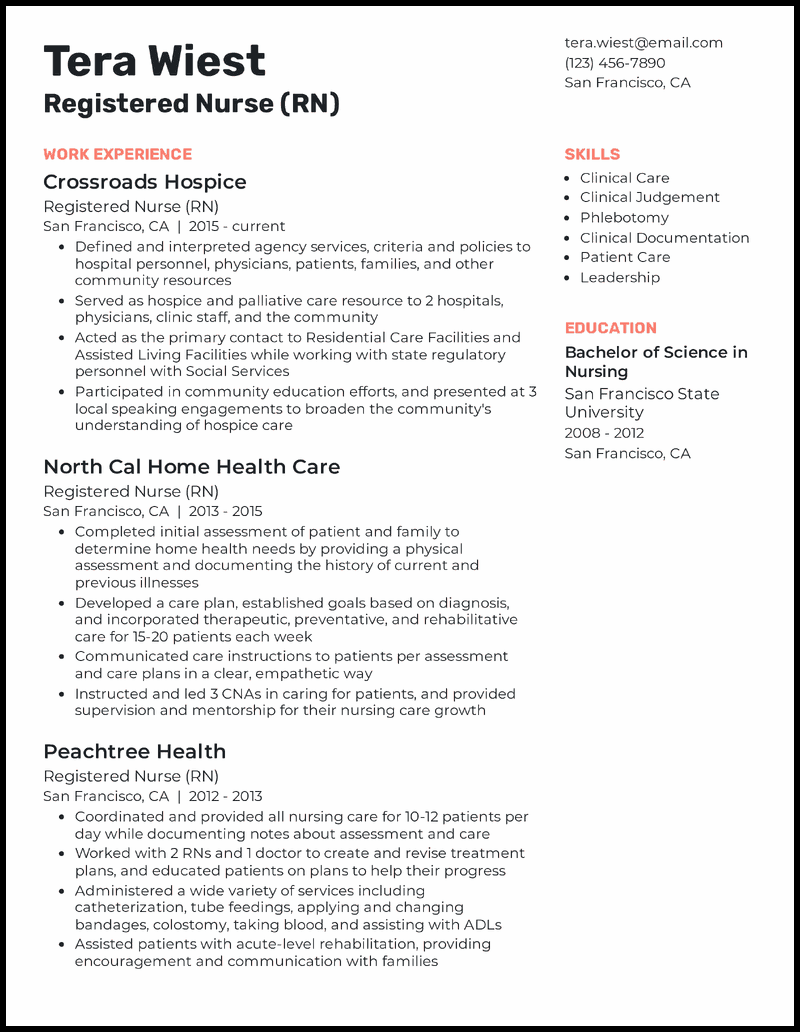
- As you gain more and more experience as an RN, try your best to show a progression in responsibility and ownership on your experienced RN resume.
- To fit more content, reduce vertical spacing and reduce page margins, which is a simple click of a button in our AI resume maker.
Related resume guides
How to Write a Registered Nurse (RN) Resume

Your registered nurse resume must present you as the best care provider, the skills you’ve mastered, and the results you’ve achieved in real clinical settings. Presenting this information in a clear and professional way helps employers quickly see why you’re the right fit for the job.
Summary
Craft a nurse resume that no hospital/medical center can resist with quantified bullet points, healthcare certifications, and strong clinical skills.
Whether you’re a fresh grad or an experienced registered nurse, your resume is your first impression. But here’s the catch: you can’t put generic things like clinical hours and expect to be hired.
Healthcare employers need proof that you’re capable of improving a patient’s life. More importantly, you can only build that trust with a strong resume writing plan.
Key elements to ensure you don’t code blue your application each time:
- Clear contact information section
- Strong career objective/summary
- Clinical skills
- Relevant nursing education and certifications
- Impactful past work experiences
- Action words at the start of bullet points

A professional contact information section
Imagine finding a patient named “Mike” in the ER room, when in reality, everyone knows them as “Michael.” That’s a classic case of using a nickname in the wrong place.
When it comes to your nurse resume, make sure you use your professional name. So, if your name is Michael, write it entirely with your surname. No Mike, Mick, or Mickey allowed.
Other than your name, ensure you add these details in this section:
- Phone number
- Email address
- Location (State, City)
- LinkedIn (if you have one)
Avoid becoming overzealous and mentioning irrelevant details like your social media account.

Radiate your passion/experience with an effective career objective or summary
The first thing a recruiter may notice is your resume objective or summary. You can choose which one suits your profile best. Objectives are better for entry-level candidates, while experienced nurses can use a summary to convey their patient-handling expertise.
Regardless of what you choose, there are a couple of denominators that apply to both:
- Keep it within 2–3 sentences.
- Tailor it to the company you’re applying to.
- Mention specific skills/experiences.
Not sure where to start? Check out the career objective and summary examples below:
Career objective examples:
“Motivated Registered Nurse (RN) eager to work in a fast-paced emergency room environment like Advocate Illinois Masonic Medical Center Emergency. With project experience in patient care and checking vital signs using iHealth oximeters, I am excited about the opportunity to join. your team.”
“Recent graduate looking to get an entry-level RN nurse role at MedStar Union Memorial Hospital. With proficiency in Philips IntelliVue and Biliblanket Phototherapy System, I aim to assist senior nurses and maintain MedStar’s reputation of quality health care.”
Career summary examples:
“Seasoned Registered Nurse (RN) excited for the opportunity to work in the ICU of a Level 1 trauma center like Bellevue Hospital. Known for lowering anxiety levels of critical patients by 29% in one week, I am eager to contribute to your established health care facility.”
“Registered Nurse with experience on the front lines of the COVID-19 pandemic, looking to join Tampa Family Health Center’s clinical environment and help at-risk patients. With strong proficiency in Cerner and IV management, my addition to your nurse team will help the center provide higher quality care to all patients.”

Your clinical and soft skills Have to be on display
While you can get away by only including healthcare software, why take a chance when you have the option to mention soft skills, too? It helps if you segregate them into different groups:
Soft skills:
- Time Management
- Communication
- Patient Advocacy
Clinical skills:
- IV Management
- EHR (Cerner, Allscripts)
- Clinical Documentation
- VisualDx
- eMAR Systems
- Medscape
- Powerschool Health Suite

Show employers you’ve worked Hard to get here
We know nursing requires a lot of schooling and dedication, so props to you for graduating! Add continuous education on top, and you’ve basically become a veteran nurse.
This is exactly what your education/certification and license section deals with. The format below shows how you can edit your education section:
Example
Bachelor of Science in Nursing (BSN)
University of IOWA
2019 – 2023
Iowa City, IA
GPA: 3.8 (only if 3.4 or above)
Apart from license, add any certifications you’ve gained in your journey. The example below shows how you can include this information:


Prove your worth with relevant work experience
This is quite possibly the most important part of your registered nurse resume. Add any three of your best work experiences. Freshers can include things like projects, internships, or volunteer work instead.
Adding relevant experience isn’t the hard part; presenting it is. How do you prove to employers that your work had a positive impact on a patient’s health in simple words? Quantified bullet points are your answer.
Here’s what your experience section looks like without any metrics:
- Was in charge of treatment responses, revising plans as needed, and discharging patients.
- Provided direct care to patients in life-threatening situations and updated documentation and patient intake forms.
- Helped vulnerable patients to uplift their moods and lead a healthy lifestyle post-discharge.
Here are the same points, with the power of metrics sprinkled in:
- Evaluated treatment responses, revising plans as needed, and discharging 82% of patients on time.
- Provided direct care to patients in life-threatening situations, and updated documentation and patient intake forms to reduce intake times by 20 minutes.
- Instilled a culture of communication with vulnerable patients to ensure 87% positive patient-care outcomes.
You see the difference? Quantifying your impact shows the exact impact your work had. If you’ve never done this before, consider using a bullet point generator to get a head start.

Action words do matter
Adding metrics wasn’t the only thing we changed in the examples above. If you take a closer look, we also added a verb at the start of each point, making it more effective.
Here’s a list of clinically relevant words you can use, too:
- Acted
- Administered
- Provided
- Responded
- Monitored
- Evaluated
- Performed
- Assessed
- Encouraged

Formatting your registered nurse resume
As a thumb rule, follow these three tips while formatting your resume:
- Reverse-chronological format: List all your work experiences in descending order, starting from your latest job.
- Personalize your resume: Read the job description and include keywords mentioned in it. You can later use a resume scanner to check whether they are relevant or redundant.
- PDF format: Unless your employer requests otherwise, download and send your resume in a clean, one-page PDF format.

Key takeaways
Before you go and create your nurse resume, remember to keep these points in mind:
- Lead with a strong career objective/summary
- Quantify results wherever possible
- Tailor your resume to the job description
- Include relevant license(s) and certifications
- List your clinical and soft skills
Registered Nurse (RN) Resume FAQs
A professional summary is suited for registered nurses with 10+ years of experience. It includes at least one major (quantified) achievement of your career and conveys how your expertise can help the hospital/medical center provide better patient care.
To describe yourself as a nurse on a resume, you need to use the career objective/summary section. This outlines your passion for the field and gives employers a basic image of the kind of nurse you are.
Ideally, you want to build a one-page RN resume. Going beyond will only lower your chances of getting hired. While professionals with more than a decade of experience can use another page, it’s best if you stick to a single page.

Stephen is the co-founder and CEO of BeamJobs. Frustrated with the challenges he'd faced in his own job search, he left the corporate world to start BeamJobs with his brother. Drawing on firsthand experience with hiring and getting hired as technical talent, he started BeamJobs in 2020 to help qualified job seekers land interviews with less stress. Since then, more than 4 million people have built their resumes and cover letters on BeamJobs. Stephen's insights have been featured in notable outlets, such as Fast Company, Business Insider, Yahoo Finance, MIT, and Zapier. Learn more about Stephen.