



![7 Child Care Resume Examples [& Templates]](https://beamjobs.wpenginepowered.com/wp-content/uploads/2023/02/child-care-resume-example.png)
To find competitive childcare jobs, you’ll need a resume that stands out from the crowd. But, as a professional childcare worker, you shouldn’t also have to be a professional resume writer.
That’s where we come in. We’ve been granted access to numerous child care resumes that landed applicants interviews. We cross-referenced these with unsuccessful resumes to determine what exactly does and does not make resumes effective.
We used this information to create seven free child care resume samples. And along the way, we’ve included helpful resume writing tips for you to make a resume online and write a great cover letter that gets you interviews in 2026.

Why this resume works
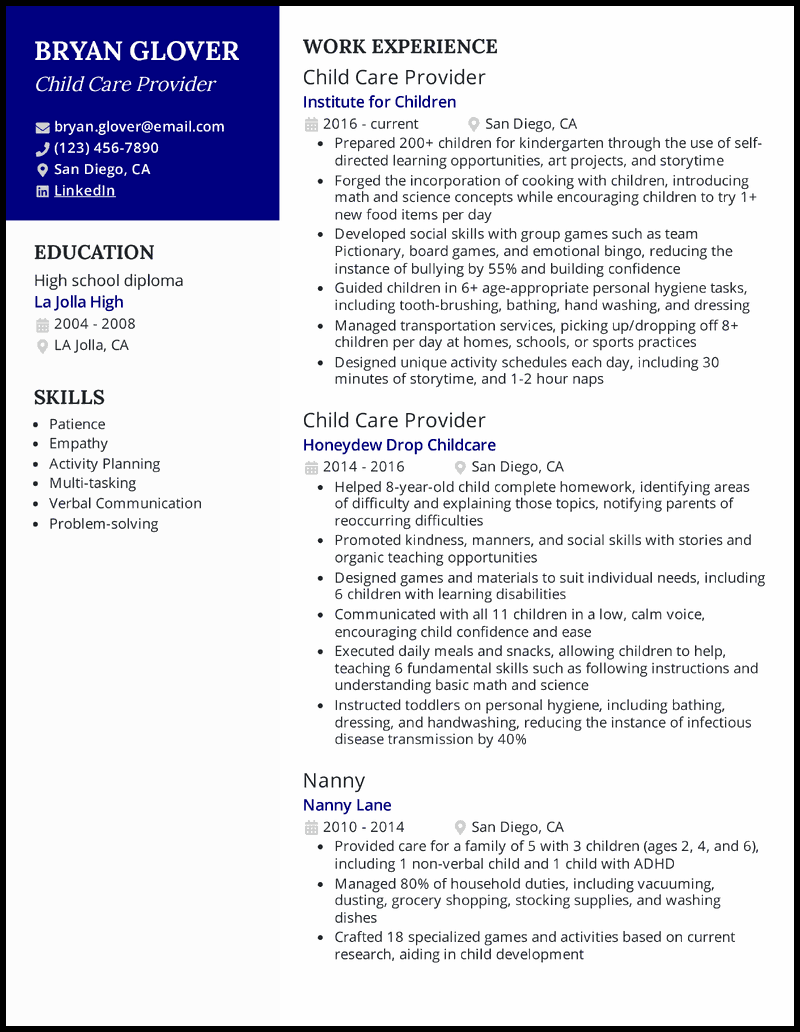
- One of the most important factors in creating a successful child care resume is demonstrating your impact with numbers. Can you guess why numbers are so important?Numbers can double or triple the amount of time they spend on your resume. When hiring managers glance through applicant resumes, they only spend six seconds.
Why this resume works
- The resume skills section on your child care provider resume is one of the most underutilized, but it’s the second most important part of your entire resume. ATS reviews applicants immediately upon application submission, identifying applicant resume skills that match the job description.
View more child care provider resumes >
Why this resume works
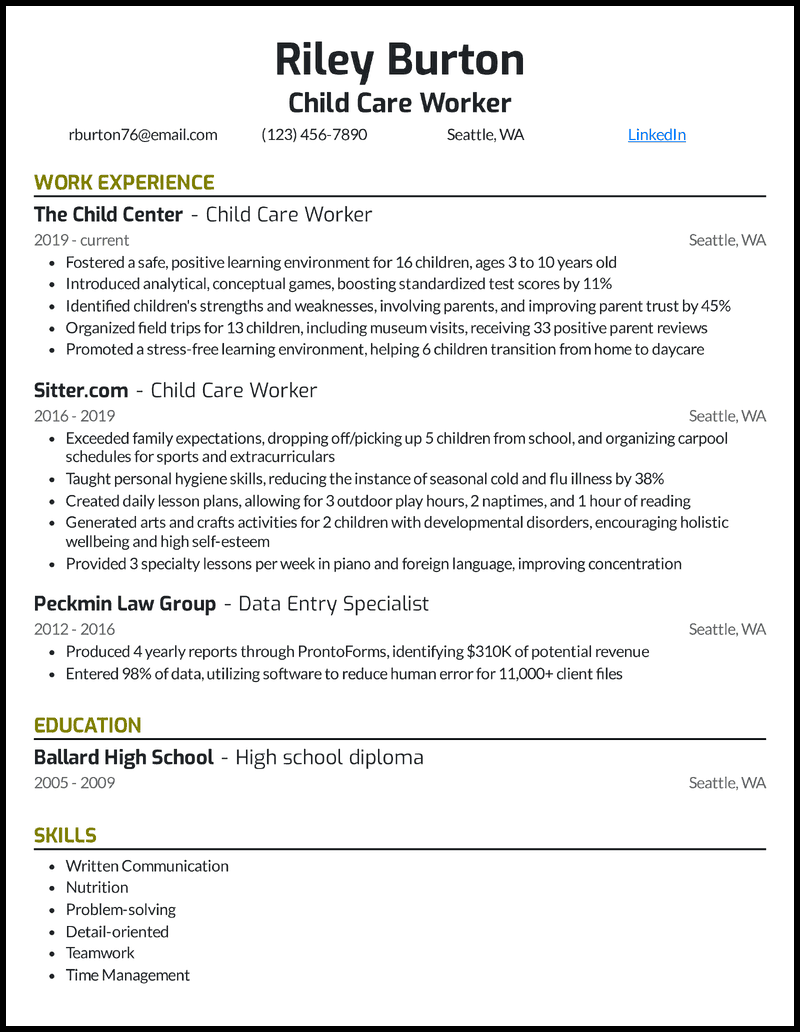
- Avoid the temptation to fill in any extra space with filler words, as it will weaken your child care worker resume by taking up space without adding value. It’s okay if your resume is sparse if you include punchy, direct, and substantive words.
View more child care worker resumes >
Why this resume works
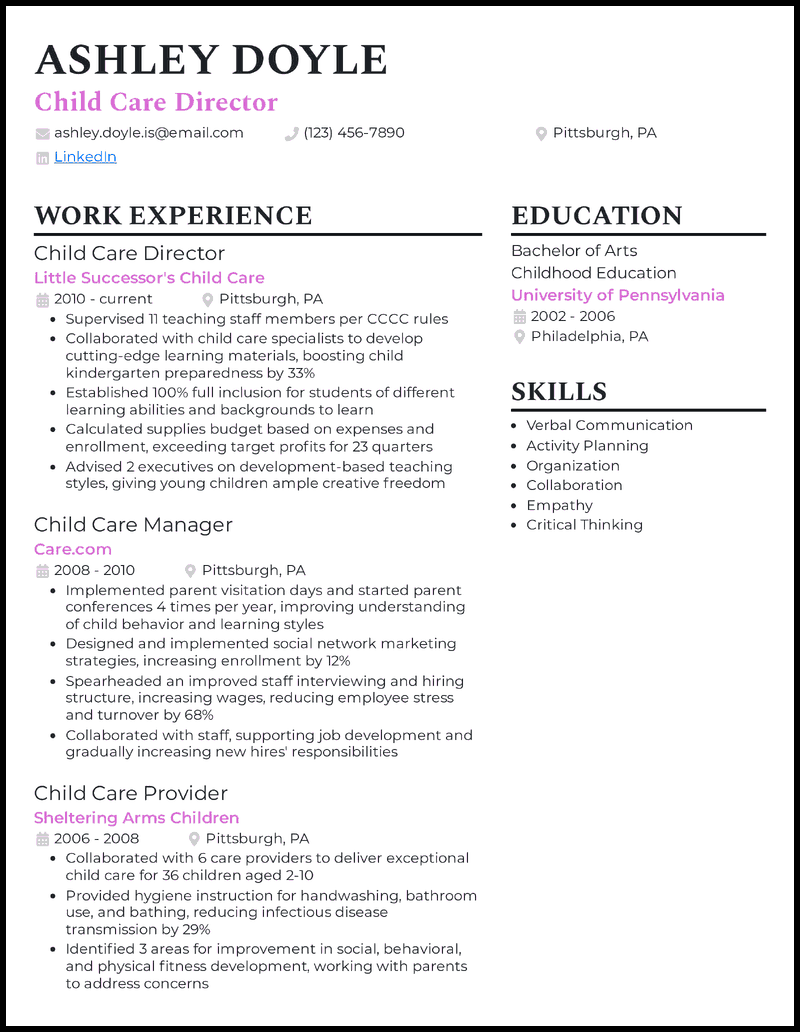
- If your child care director resume boasts many years’ worth of impressive job experience, be sure it doesn’t appear cluttered. Achieving a balance between filling the whole page and making an easy product on the eyes is difficult. Use our free resume checker to ensure you’re using action words and avoid filler words.
View more child care director resumes >
Why this resume works
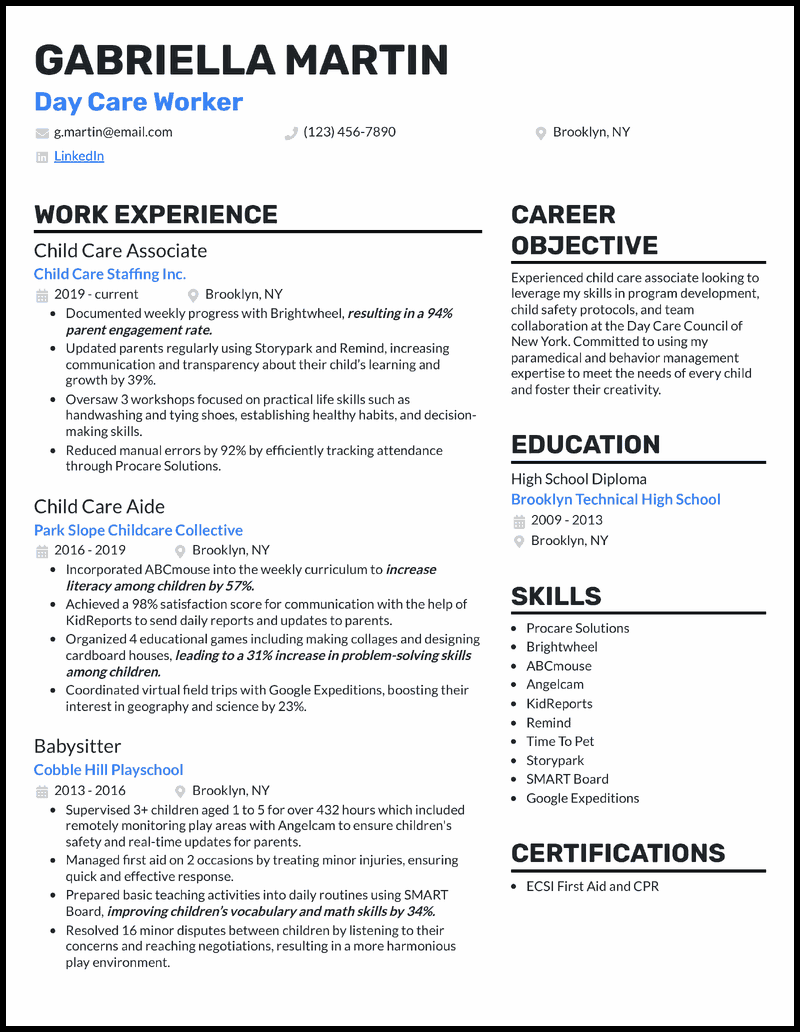
- Mentioning any past experience as an aide will be effective in this situation. Ensure that your day care worker resume contains your skills to handle multiple infants, foster their growth, and of course, prepare delicious food. Also, discuss how you successfully handled multiple infants, fostered growth, and prepped food in your childcare cover letter.
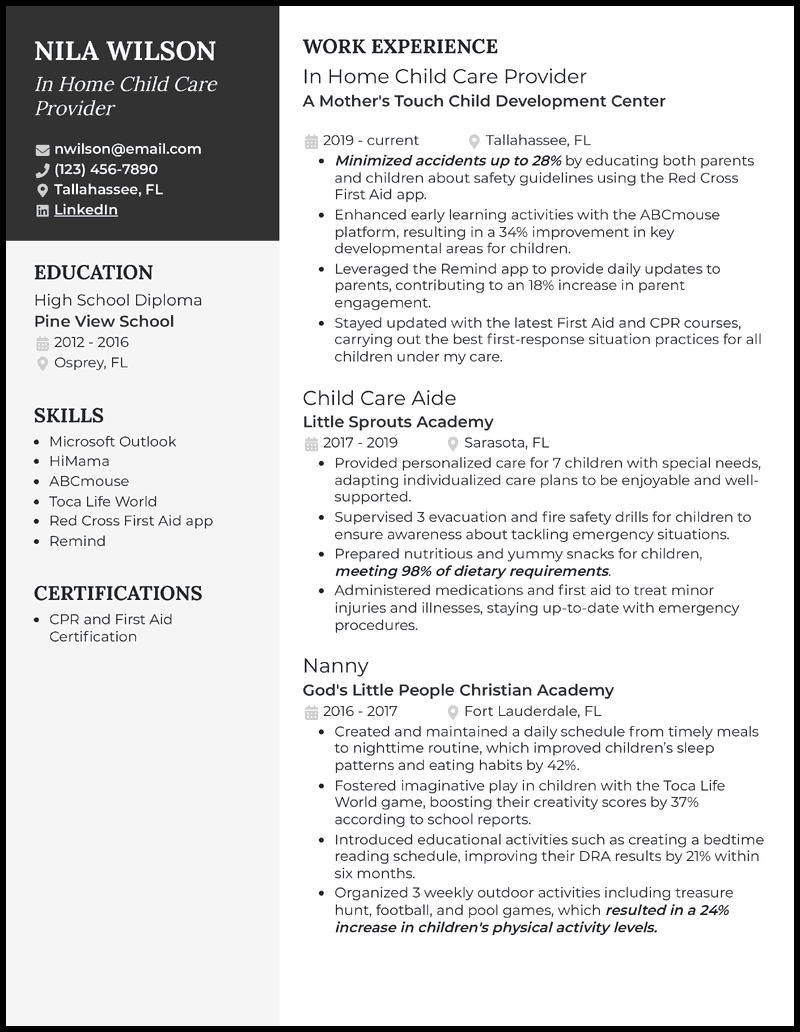
Why this resume works
- How can you get your resume to be noticed? By emphasizing the skills that carry the most weight such as problem-solving, active listening, and let’s not forget communication. Adding a CPR or First-Aid Certification to your in home childcare provider resume will further display your credibility in handling emergencies.
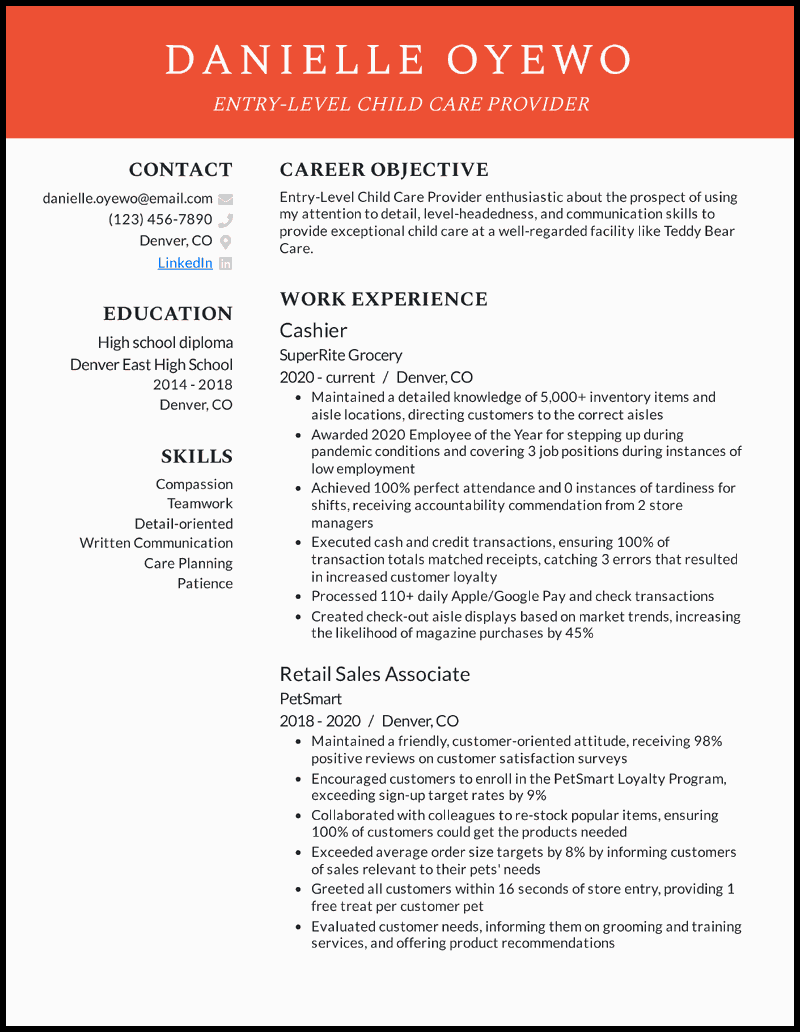
Why this resume works
- We recommend including a resume objective when you’re going through a career change or when you need to fill up space on your entry-level child care resume. However, done well, a resume objective can be a helpful, concise selling point for nearly any resume.
View more entry-level child care resumes >
Related resume guides
How to Write a Child Care Resume

To create a standout childcare resume, you must showcase your qualifications, skills, and passion in a way that resonates with the industry and employers.
To begin, you should use a reverse-chronological resume format that lists your work experiences clearly. Next, build your other parts thoroughly and remember to proofread each section before finalizing it. Also, remember to draft a strong career summary/objective depending on your level of experience.
We know this sounds like a tall order, so we’ve broken down each of them into smaller bits below, which mainly cover:
- The best child care skills to include
- Career summary/objective tips
- Quantifying work experience bullet points

Start with a profile summary of your qualifications
Start your resume with a brief, compelling profile summary that communicates your career and strengths. Use either a career objective if you’re new or a career summary if you’re a seasoned childcare pro.
Career objective example (entry-level):
Compassionate and energetic early childhood education graduate seeking a child care assistant position at Bright Horizons Family Solutions. With strong attention to detail, patience, and terrific discipline enforcer.
Career summary example (senior-level):
Seasoned child care director with over 10 years of leading daycare and running early education programs. Enhanced parent satisfaction rates by 32% and reduced staff turnover by 21% in two years. Expert curriculum developer, staff trainer, and regulatory compliance. Dedicated to serving high-quality care to nurture kids’ growth and development.

How to add your result-oriented work experience
Recruiters want to see measurable success. Demonstrate your past roles with bullet points, highlighting key achievements with numbers and specific outcomes to emphasize impact.
Metric-driven bullet point examples:
- Implemented a preschooler’s reading program that improved literacy readiness by 37% within 6 months.
- Supervised daily activities for 12 toddlers, achieving a 98% parent satisfaction rating in one year.

How do you describe working with different age groups?
To describe your past experience working with various age groups, highlight different metrics that apply to toddlers and adolescents. For example:
- Preschoolers: Emphasize structured learning, social skills, and safety
- School children: Highlight homework support and activity coordination
Employers like child care workers can adapt to different age groups since that means they only need to rely on one person and not over-hire. So, make sure you include how you used each skill/tool to demonstrate versatility.
NAEYC lists some strong Developmentally Appropriate Practice (DAPs) principles that you can highlight and prove you’re updated with modern child care standards.

How to highlight your childcare skills
Present a mixture of hard and soft skills to flex your ability to provide quality care and manage diverse childcare tasks.
Key skills for a child care professional:
- Early Childhood Education
- CPR and First Aid Certified
- Behavior Management
- Curriculum Development
- Emotional Intelligence
- Communication with Parents
- Classroom Safety Procedures
- Activity Planning
- Patience and Empathy

How to include relevant education and certifications
Your academic background and professional training validate your expertise. Start with your highest degree, then follow it with any current and relevant specialized certifications.
Education example:
Associate of Applied Science in ECD (Early Childhood Development)
Houston Community College, Houston, TX — Graduated: May 2024
Certification example:
Child Development Associate (CDA) Credential – Council for Professional Recognition, Issued: March 2023

Do you need a child care cover letter?
A cover letter for this field will tell your career’s story and how you’ve provided unmatched hospitality for children over the years. Maintain a good balance of being personal, yet results-focused.
Here are some extra tips for formatting your cover letter:
- Have only three work experiences
- Don’t exceed more than six paragraphs
- Keep a separate section for enclosures
- Use metrics from your resume

Key takeaways
- Quantify the effect your care had on children
- Include at least one certification, like CPR or CDA
- Tailor your child care experience to the job description requirements
Child Care Resume FAQs

First, highlight the skills that make you the perfect childcare professional. You can find the skills the employer seeks in the job posting. Next, combine those skills and action verbs to create powerful bullet points that showcase impact. It’s also crucial to share your educational background, starting with your highest/most recent level of education and specialized training recognized through the industry-specific certification.
Two critical roles of a childcare professional are proving your ability to nurture and develop the young ones. If you’ve done this before, share the details, including numbers, to emphasize your input. Also, you must be terrific at creating and planning educational activities and building lasting trust with parent and their kids.
The reverse chronological format is best for presenting your qualifications when applying for childcare jobs. This layout presents your career journey from the most recent experiences to past ones. It gives recruiters a feel of your career growth while showing increased responsibilities and getting better at what you do. It also emphasizes your skills and measurable achievements, two of the most important things hiring managers will use to measure your suitability for the open position.
The easiest way to describe your child care experience is using concise, quantified bullet points that highlight a unique impact each time, such as improving sleep schedules or meeting all physical activity goals. While writing your experience, match the tone of the job description to make it even more personalized.

Stephen is the co-founder and CEO of BeamJobs. Frustrated with the challenges he'd faced in his own job search, he left the corporate world to start BeamJobs with his brother. Drawing on firsthand experience with hiring and getting hired as technical talent, he started BeamJobs in 2020 to help qualified job seekers land interviews with less stress. Since then, more than 4 million people have built their resumes and cover letters on BeamJobs. Stephen's insights have been featured in notable outlets, such as Fast Company, Business Insider, Yahoo Finance, MIT, and Zapier. Learn more about Stephen.