



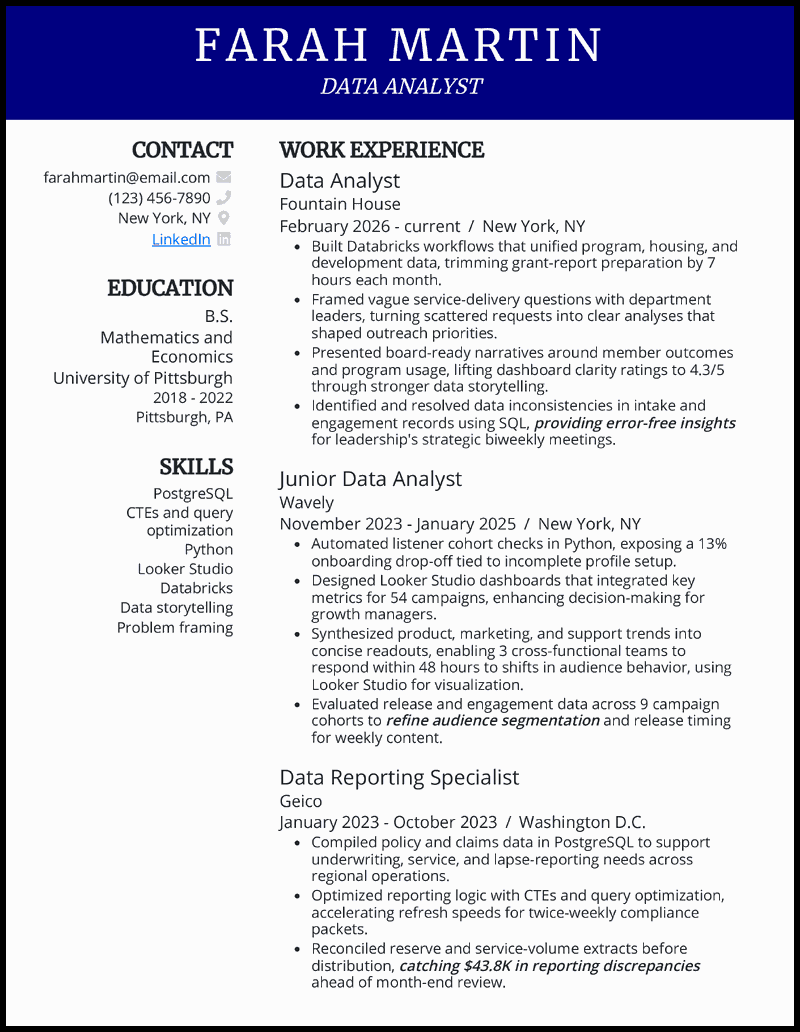
To land a data analytics role, your resume must spotlight technical expertise, measurable business outcomes, and persuasive data storytelling.
Craft a resume that shows you can turn complex data into clear decisions, whether you’re pursuing a junior data analyst, financial analyst, marketing analyst, or data science associate role.
You’ll learn from this guide how to:
- ↪ Review 33 data analyst resume examples that highlight fundamental tools, impact-packed metrics, and achievements
- ↪ Tailor your resume for ATS and recruiter readability to match yourself perfectly to the job
- ↪ Align your resume and cover letter to tell your career story with impact
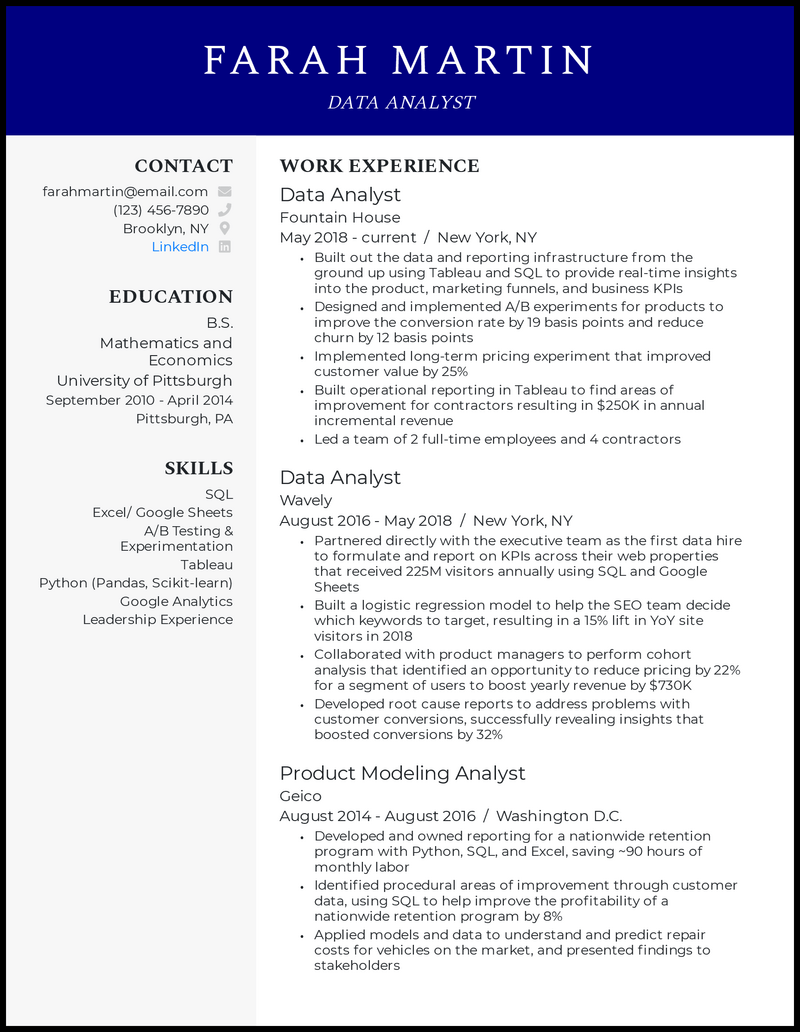
Why this CV works
- If you have a target company or niche in mind, pay special attention to the individual job description, looking for keywords, the mission statement, and even the company culture. Once you know what the employers are looking for, you can include directly applicable keywords and matching language in your work experience bullet points.
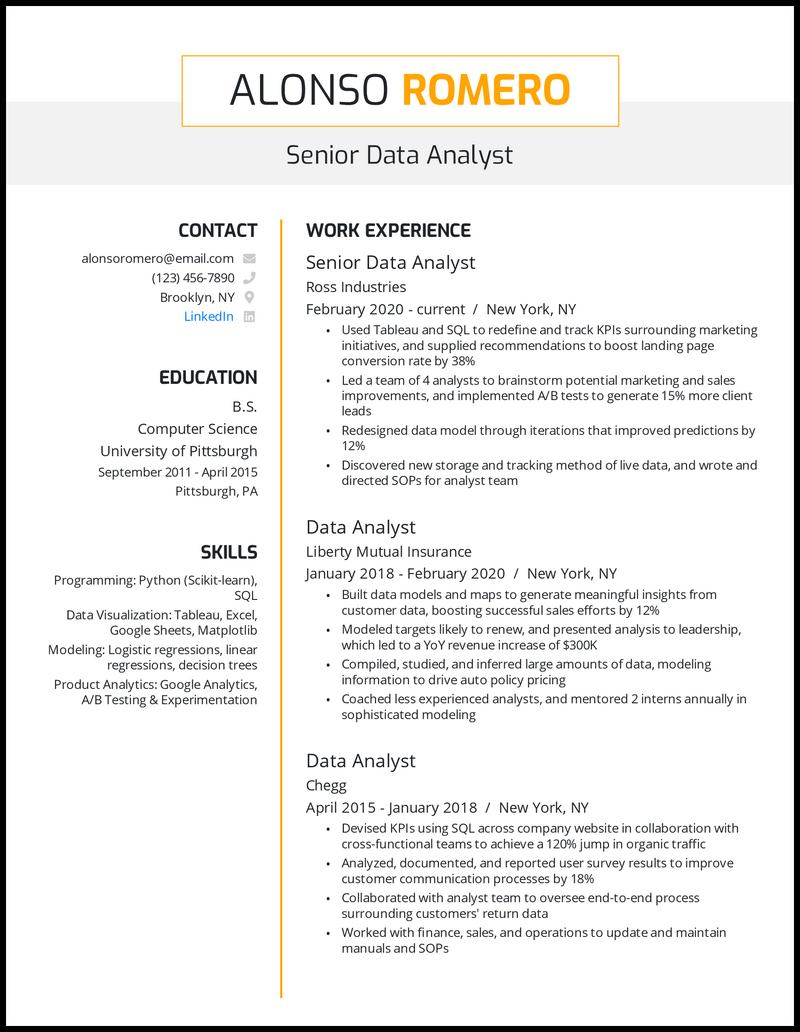
Why this CV works
- As a senior data analyst, the need for a comprehensive career objective dwindles. Your senior data analyst resume should heavily focus on work history, excellent KPIs, and leadership. With experience comes a whole host of skills; however, don’t list every ability you have in your resume skills section.
See more senior data analyst resume >

Why this CV works
- While starting out with your junior data analyst resume, you can boost your credibility and add intrigue by referencing an impressive project you might have tackled. Examples and quantifiable metrics of success can make you outshine the competition.
See more junior data analyst resumes >

Why this CV works
- If you’ve completed a B.S. in Health Care Informatics, it means you’ve spent an extensive period of time learning how to analyze and interpret healthcare data and information—which is what most recruiters will be looking for in your healthcare data analyst resume.
See more healthcare data analyst resumes >

Why this CV works
- If you lack paid work experience in a field, consider it an opportunity to include personal projects on your data analyst intern CV where you demonstrated skills relevant to the position you’re applying for.
See more data analyst intern CVs >

Why this CV works
- Combining marketing and data analysis requires a lot of skill, and we know it can be hard to convey all your credentials on your marketing data analysis resume. That’s where you can include relevant certification to do the talking for you. For instance, if you’ve completed a Professional Certified Marketer (PCM) certification, it’s clear you understand the nuances required to be a marketing professional.
See more marketing data analysis resumes >

Why this CV works
- Even a candidate with years of industry experience can optimise their clinical data analyst CV with an additional qualification. Make sure recruiters can easily see that you’re a Certified Clinical Data Analyst (CCDA) to add an extra level of credibility to your background.
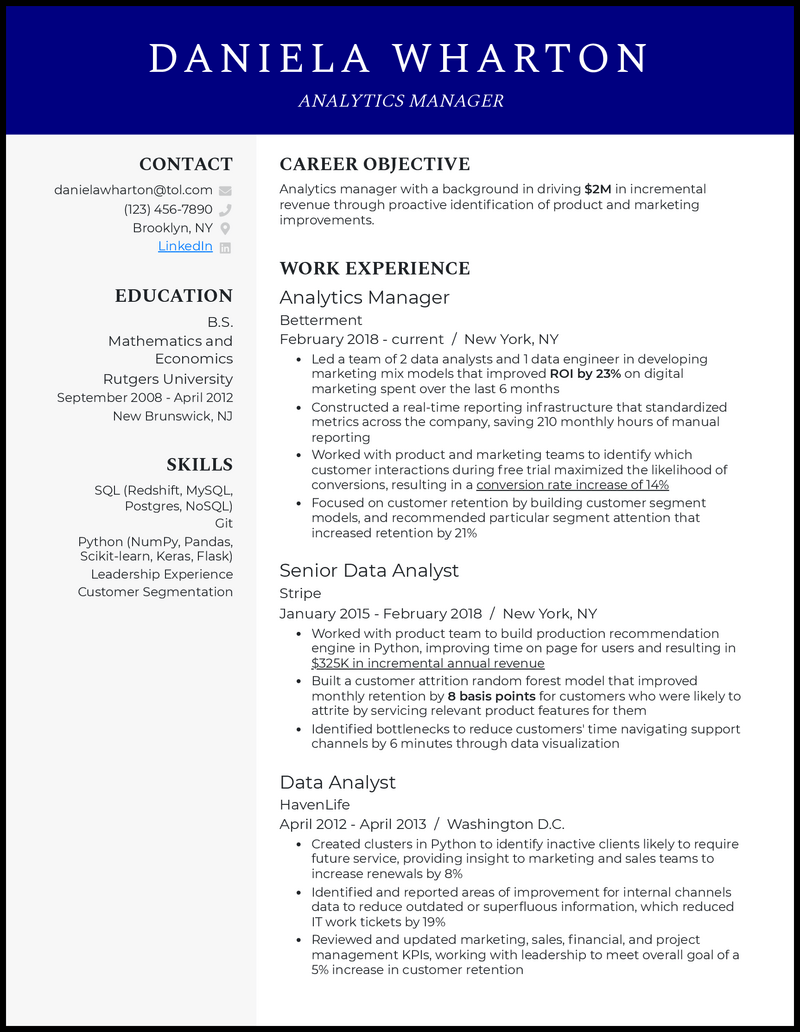
Why this CV works
- Your data analytics manager resume needs to make your credentials and qualifications easy to understand. Therefore,make your resume easy to read using a resume template,condensing your bullet points as much as you can, including metrics, and core skills to boost your credibility quickly, and leaving just enough white space to make it a breeze to skim.
See more data analytics manager resumes >

Why this CV works
- Use a resume format that includes the work experience in reverse-chronological order. By doing so, you put your most recent accomplishments at the very top of your business data analyst resume—which is where a recruiter or your next potential employer is going to look first.
See more business data analyst resumes >

Why this CV works
- As much as your technical skills are vital to the success of your data governance analyst resume, you also must underscore your ability to save time and money. For your case, achievements that touch on cutting costs (cue: saving 13% in infrastructure expenses) and reducing process times (cue: saving 12 hours per week) would propel your candidacy to early success.

Why this CV works
- Enhance your Power BI data analyst CV by emphasising any Power BI-based tasks you’ve led and the impact they had on the company.
Why this CV works
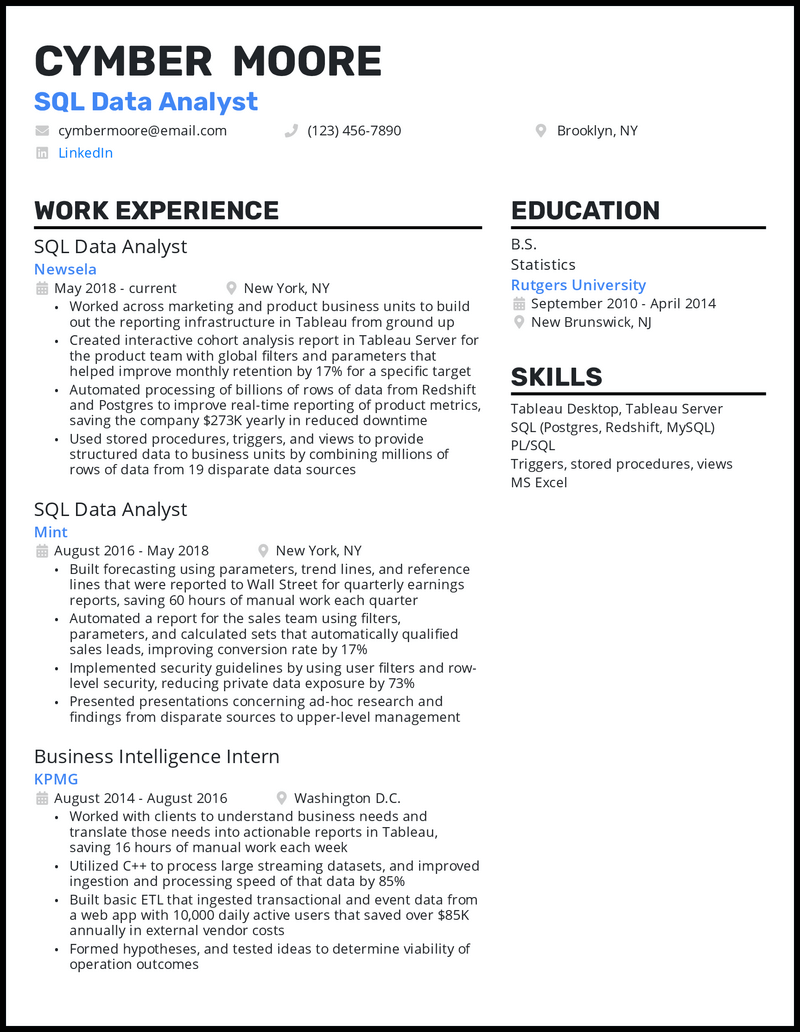
- Your SQL data analyst resume needs to be powerful regardless of you how much experience you have. Even if you only have internships, choose your work experience bullet points wisely. Start by analyzing the requirements in data analyst job descriptions to get an idea of what employers require.
See more SQL data analyst resumes >

Why this CV works
- If being good with numbers under pressure is your thing, then you’re already halfway done. All that’s left is sprinkling your financial data analyst resume with some clear work metrics. List down the best financial institutions like Citi and Deloitte that you’ve worked for and you’ll be on every employer’s hiring list.

Why this CV works
- You may try, but a data quality analyst resume without a solid backing of tools and software competencies will be shunned by recruiters. Therefore, to have a soft landing for your application, don’t spare any skills that you feel are relevant to the job—either in your resume or letting an AI cover letter generator have a go at your application.

Why this CV works
- The Standout template is essentially your best friend as it allows you to add your education, skills, and work experience without squeezing everything in. And to ensure that you’ve included all the essential sections, parse your CV and add anything you may have missed.

Why this CV works
- Here’s an eye-opener: recruiters will scan CVs for a mere 6 seconds. Outrageous, right? Even if your Python data analyst CV happens to be the final piece on the stack and the hiring manager has all the time in the world, drawing attention to your success record of delivering results can increase your appeal.

Why this CV works
- Unsure how to make a resume? Start by using a solid resume outline to help you get a feel for what a resume looks like, then add your experience and skills one at a time. As an aspiring professional, you’ve got options for showcasing your skillset on your entry-level data analyst resume.
See more entry-level data analyst resumes >

Why this CV works
- Trust us; nothing screams “Unfit applicant” louder than an avalanche of grammatical mistakes in your freelance data analyst resume. Clean out any oversights that could torpedo your job chances. After thorough proofreading, you can rid your masterpiece of those nasties using an AI-powered resume fixer.

Why this CV works
- Three solid years—that’s how long you’ve been analysing data and helping your employers solve problems. However, letting the recruiter know that is not enough to get you the job. You need a data analyst CV with 3 years’ experience demonstrating you can actually make things happen to even stand a chance.

Why this CV works
- Bullet points in an Excel data analyst resume can be lengthy so make sure you’ve got the right amount of spacing between points to avoid giving employers an eye exam. Use the Standout template from our library to have enough space for adding all your skills, experience, and education.

Why this CV works
- Don’t send your HR data analyst CV out the door without adding impactful numbers like “Formulated 2 advanced Microsoft Excel models… saving £13,941 in additional talent acquisition costs.” This way you’re not just discussing data, you’re demonstrating its monetary value!

Why this CV works
- A vast majority of hiring managers are nuts about candidates who are all in, which is why we’re all for highlighting relevant certifications in your Snowflake data analyst resume. For example, rocking a SnowPro Advanced Data Analyst certification says you are in for the long haul and are already stacking your arsenal with the skills and knowledge to complete the journey.

Why this CV works
- If you really want to win over the potential employer, you must prove you’re a well-rounded professional. That should make showcasing soft skills in your Microsoft data analyst CV a top priority.

Why this CV works
- Who says all data analysts have to start out as programmers? Even a small beginning such as a data entry clerk is a good addition to your R data analyst resume if it’s relevant. State how you’ve worked with data and specifically (very important!) on R-based frameworks.

Why this CV works
- The career objective on your AWS data analyst resume gives you a little room to talk about your professional skills and aspirations and how they integrate with the role you’re applying to. You only have a couple of sentences to do so, but it’s still a powerful way to tell a recruiter exactly what you bring to the table and what they stand to gain if they hire you.

Why this CV works
- When interpreted with a keen eye, big data can yield surprisingly impactful insights for corporations. But to make a difference, these inferences need to be communicated clearly. Take your big data analyst resume to the next level by demonstrating your prowess in presenting actionable analyses to key organizational stakeholders.

Why this CV works
- Your Alteryx data analyst resume will benefit from assimilating clear examples of your work with abstract skills. For instance, rather than simply listing your proficiency in data manipulation, describe how you leveraged your expertise in this area to free up storage space and increase efficiency for the organization.

Why this CV works
- A lead data analyst CV can’t rely on vague claims despite having an extensive professional background—you need to provide evidence! Use concrete, quantifiable metrics like improvement rates and pound-amount company savings to support your achievements.
See more lead data analyst CVs >

Why this CV works
- As a creative data analyst, your ability to help numbers tell a story distinguishes you. Highlight your dual skill set in analysis and visualisation by demonstrating how data and marketing intersect in your past experience.

Why this CV works
- The first thing recruiters/hiring managers will notice when reading your revenue reporting data analyst resume is whether the fundamental qualifications to perform the job adequately are present. Your resume should be formulated specifically to target the list of requirements from the company job description.
See more revenue reporting data analyst resumes >

Why this CV works
- Including a CV summary on your senior insurance data analyst CV helps you highlight your extensive career with quantifiable data from various sources and can help you secure an interview by setting you apart from less experienced competition!

Why this CV works
- As a data analyst, you look at every aspect of how a company operates to improve business, but how do you prove that you’ve significantly improved their progress? Including numbers and percentages is the fastest way to show employers your qualifications. Use metrics to show how you’ve made significant improvements whenever you can.

Why this CV works
- Your entry-level risk adjustment data analyst CV needs to demonstrate your skills in data gathering, interpretation, and presentation competencies. To gain that kind of experience, you can approach it in a couple of ways: either through scalable projects or a relevant work placement.
How to Write a Data Analyst CV

Creating the perfect data analyst resume involves optimizing your data analyst resume by aligning skills, experience, problem-solving, and the value added from data insights, formatting with employers’ expectations to pass ATS filters and impress hiring managers.
The key points within the data analytics CV will be the appropriate tools, quantifiable achievements, and industry terms specific to the role.
Let’s cover the following so that you can create a top data analyst resume:
- Which hard and soft skills to emphasise
- How to structure your CV from top to bottom
- Importance of metrics and use of results
- How to tailor your CV to each job application
- How to most effectively prepare your CV for applicant tracking systems (ATS)
- How to stand out and pitfalls to avoid

Top hard skills for data analysts in 2026
You need to show you have the right abilities for the job! This means you need to accomplish two goals with the skills section of your data analyst resume. First, you have to be able to get past the automatic keyword filters in the applicant tracking system (ATS), which companies use to filter applicants. Next, you want to demonstrate your technical proficiency to the person reviewing your resume.
If you’re unsure which skills to include, we analysed the data to find out which skills are most in demand for companies hiring data analysts.
These two goals are, unfortunately, mostly at odds with each other. If your aim was simply to get past the ATS, you’d list every skill to get your foot in the door:
Poor—steer clear of a lengthy list of generic skills

The problem? This method is a major warning sign to technical hiring managers. You should only include skills you’d be comfortable discussing in your data analyst interview. Plus, your skills section shouldn’t occupy more than 20 per cent of the page.
Any reasonable employer won’t expect you to know SAS, R, *and* Python. Instead, just list the technical skills that you’ve programmed in before. And avoid including a skill like “data mining” or “data analysis” since a technical hiring manager knows these are just vague terms that don’t mean much. Instead of “data mining,” list actual techniques you’ve used, like “decision trees” or “logistic regressions.”
But even when narrowing it down, sometimes your skills list looks cluttered and difficult to read. Don’t worry; there are several ways to organise your skills section! To begin with, you can list your skills by how proficient you are with them (“Advanced” vs. “Familiar,” for example). Alternatively, you can list your skills by type. You can even mention the years of experience you have with each tool.
For programming languages, mention the libraries and frameworks you use for data visualisation and manipulation in that programming language.
Programming & query languages (SQL, Python, R)
Why it matters: You’ll structure data sets and perform queries, and for that, you need SQL. For better analysis, visualization, and creation of machine learning workflows, you’ll need expertise in both Python and R.
How to list on your resume: Create a sub-category under your “Technical Skills” section and list these competencies under it.
Programming and Query Languages
- Python
- SQL
- R
How to incorporate in bullets:
- Wrote optimized SQL queries to extract customer‑segmentation data from a 10 M‑row dataset, reducing daily data retrieval time by 3 hours
Data visualization & BI Tools: Power BI, Tableau, Alteryx
Why it matters: One of your top responsibilities is to communicate and present insights to stakeholders clearly. Tools such as Power BI, Tableau, and Alteryx help you automate workflows for easy interpretation, even for non-technical staff.
How to list on your resume: Create a sub-category under “Technical Skills” titled “Data Visualization & BI Tools”.
Data Visualization & BI Tools
- Tableau
- Alteryx
- Power BI
Example of how to integrate them in bullets:
- “Automated Alteryx workflow reducing data‑preparation time from 12 hours/week to 2 hours/week.”
Cloud & big‑data technologies: Snowflake, AWS, Hadoop, Spark
Why it matters: Every organization is leveraging cloud platforms and big data platforms to modernize its data storage. These tools are critical to your everyday operations.
How to list on your resume:
Data Visualization & BI Tools
- Snowflake
- AWS
- Spark
- Hadoop
Bullet‑point demonstration:
- “Migrated 3 TB of on‑premises data into Snowflake, reducing data‑warehouse cost by 3.4K per month and query latency by 62%.”
Statistical & analytical techniques: Regression, forecasting, A/B testing
Why it matters: By themselves, tools tell half the story; your interpretation, testing, and forecasting complete your work as a data analyst.
How to list on your resume:
Data Visualization & BI Tools
- Time‑Series Forecasting (ARIMA)
- A/B Testing & Experimentation
- Logistic Regression
How to demonstrate in bullet points:
- “Designed and executed A/B test on landing‑page flows, using logistic regression in R, increased conversion rate by 13%.”
Good—specific skills and modelling techniques


Do you need a data analyst resume objective?
Most of the time, you don’t need to include a CV objective or CV summary; a mistake many data analysts make. If a CV summary or objective doesn’t add value to your application, it’s fine to leave it out.
Here’s a sample data analyst CV objective that you would want to leave off your CV:
Poor—uninformative CV objective

Why include this? It’s unnecessary. If you’ve already shown in your CV that you’ve used tools like Python and SQL to transform data into actionable insights, then your objective doesn’t provide the person reviewing your CV with any new information.
When to include a CV objective
- You’re undergoing a career change. You might say something like, “After 4 years of working in operations, I am now looking to utilise my expertise in transforming data into insights as a data analyst.”
- You have a particular interest in a specific role or company that makes you an especially strong candidate. For example, “Reading Match.com’s data blog sparked my pursuit of a career in data analytics, and I want to further contribute to the data-driven culture at the company.”
Summaries are similar, but they’re for candidates with over 10 years of experience and can include more personal achievements. There isn’t much difference between a CV summary or an objective; all you need to know is when you should include them.

What is the best data analyst resume format?
Your data analyst’s CV structure must capture the attention of recruiters and make it easy to find the most important information that highlights your value.
Here are some quick tips for formatting your data analytics CV:
- Keep it to one page.
- Break up bullet points into small, digestible pieces of information.
- Avoid using “I” or “we,” as it occupies space and appears unprofessional.
- Double, triple, and quadruple-check your grammar and spelling. One error can send your CV into the “no” pile!
- Each bullet point on your CV should be a self-contained, complete thought.
When a hiring manager reviews over 50 CVs for a given role, they quickly look for reasons to say “no.” By using these CV-formatting tips, you make it easier for the hiring manager to see your worth and invite you for an interview, bringing you one step closer to a job.

How to present your contact information
Of all the places to make an error, your contact information is the worst place for it to happen. One of our team members recounted their early days after university as a data analyst. When they were applying for jobs, they accidentally wrote the wrong email address on their CV for seven different positions.
Even if they were perfectly qualified for the role, there was no way to contact them because of a minor mistake. So believe us when we say you need to triple-check this section for any spelling, grammar, or link errors.
As part of your contact information, you should include your name and the position you’re applying for (even if it’s not your current position).
You don’t need to include your full address in this section, but you should list your town or city and postcode. You also need your phone number just in case your employer prefers that method.
Finally, include a link to your LinkedIn profile and update your LinkedIn headline. If you have an active Github, include a link to that. If you do a lot of Kaggle contests, include a link to your profile. Have a personal blog where you talk about election data? Be sure to include a link.


What are some great data analyst projects for your resume?
If you’re just starting out and looking for your first full-time position, including projects on your data analyst CV is absolutely essential. However, the more work experience you gain, the less critical projects become. By the time you have over four years of experience in the field, you should only include a project of which you’re exceptionally proud.
What projects should you list? Anything where you identified (or were given) a problem and you used data to come up with a solution to that problem. It’s fine if it’s a course project, but it’s even better if you took the initiative yourself.
If you don’t have any such projects, now is the time to work on some. Do you have a question you’ve never answered? An experiment you’ve been longing to try? Think of a way to gather and analyse data to satisfy your curiosity.
Here’s an example: one of our founders had a hunch that the major job boards (Indeed, Glassdoor, and LinkedIn) essentially had the same jobs for data science roles. So, he manually collected data, analysed it, and wrote about it to determine the best job board for data scientists.
The projects you include don’t need to be exhaustive or groundbreaking. Employers just want to see that you can ask a question, use data to answer it, and present your findings reasonably and clearly.
Good—demonstrate that you can answer your own questions with data

When discussing your projects, here’s how you should present what you did:
- Clearly state the question you were answering or the problem you were trying to resolve
- Indicate which tools or languages you used to solve the problem
- Explain the impact of the work you carried out
Your projects section is also an opportunity to provide more context around the programming languages and libraries you listed in your “skills” section.

How to use action verbs to pack a punch in your data analyst resume
When recruiters review your work bullet points, they expect impact, not just a list of duties. It’s your opportunity to use dynamic verbs to showcase your technical expertise, analytical skills, and business acumen.
Here’s how the right action verbs enhance a basic bullet point:
❌ Responsible for analysing data trends to improve sales.
✅ Identified and interpreted data trends, increasing quarterly sales by 19%
Top action verbs for a data analyst CV:
Use these verbs to emphasise achievements—not responsibilities—and pair them with measurable results wherever possible:
- Analysed
- Extracted
- Modelled
- Forecast
- Visualised
- Designed
- Automated
- Interpreted
- Optimised
- Presented
- Developed
- Audited
- Cleaned
- Synthesised
- Validated

How to add your education
Similar to the “projects” section, the education section of your CV will be longer for entry-level data analysts compared to more experienced data analysts. You should include relevant courses you took at university related to data analytics for entry-level data analysts.
Courses relevant to data analytics include any mathematics, statistics, programming, and economics modules you studied. To be an effective data analyst, you need to apply the principles you learned in these modules to real-world problems and datasets.
For entry-level roles, include relevant courses you took at school

No matter your level of experience, you should always mention the school you attended, what you studied (including any subsidiary subjects or certifications), and when you graduated. This is also the place to list any intensive courses or relevant online courses you may have completed in the field.
If your background is in academia, you can also list any publications you may have co-authored. Be sure to include the title of the journal and a link to allow the hiring manager to read further if they’re interested.
Only mention your degree classification on your CV if it’s something you want to highlight—generally, only list your classification if you’re just starting out and achieved anything above a 2:1.

What are key certifications for a data analyst resume?
Certifications demonstrate your expertise by validating your skills, showing commitment to continuous learning, and making your CV stand out. You need that competitive edge, especially in the data science field, where you’ll be up against equally qualified candidates and need to convey your value to employers who know what they’re looking for.
Only include certifications relevant to the role and aligning with industry demands, trends, and tools.
How to list a certification in your CV:
Google Data Analytics Professional Certificate — Coursera, 2024
Top qualifications for a data analyst:
- Microsoft Certified: Power BI Data Analyst Associate
- IBM Data Analyst Professional Certificate
- SAS Certified Advanced Analytics Professional
- Certified Analytics Professional (CAP)
- Tableau Desktop Specialist
- AWS Certified Data Analytics – Speciality

How to prioritize and demonstrate work experience
You analyse data for a living, so you know that numbers matter when it comes to information. So when you’re talking about your work experience, your goal should be to highlight your achievements using numbers and estimates.
The formula for discussing work experience
Specific contribution to project mentioning specific tools and skills
+
quantitative effect of the project
Example:
Conducted a customer cohort analysis using SQL and Excel and recommended an email campaign for one customer segment.
+
which increased monthly retention by 10%
Enter your text here…
When discussing your work, especially if it was a team project, emphasise your specific contributions. For example, you may have made a product recommendation based on a previous analysis. You’d want to talk about that particular recommendation on your CV instead of the developed feature.
When discussing the quantitative impact, it’s fine to talk about the project as a whole. Following the example above, it would be impossible to separate the value of your product recommendation from the engineer’s contribution who developed the feature, as it’s a team effort. You’d state that the feature had a revenue impact of $X on your CV.
Data analysts work across many different teams and projects in a company, so it’s not always easy to link your work to a revenue impact. Still, try estimating your contributions using metrics to make your CV stand out.
These can be very rough estimates; you just want to make it clear that you’ve contributed to positive outcomes for the businesses where you’ve worked.
Ways to measure the impact of your analytics work
- Improved customer conversion rate
- Used Python and SQL to identify a specific change in the landing page, resulting in a 10% increase in free trial activation rate
- Saved manual reporting time
- Streamlined and automated a key business report in Tableau, saving the team 10 hours of reporting each week
- Lowered costs
- Used SQL and Excel to recommend terminating contracts with the poorest-performing suppliers, resulting in an annual cost saving of £100,000
- Created data visualisations to assist executives
- Created data visualisations in Excel to demonstrate the effectiveness of the marketing plan, resulting in the closure of a £1.3 million Series A funding round.
- Enhanced customer loyalty
- Using analysis in Python, I determined that emailing customers who had been inactive for 7 days led to a retention improvement of 7 basis points.
- Improved business-specific KPI such as time-to-hire
- Identified procedural areas for improvement in recruitment data to reduce the time-to-hire for key roles by 11 days
- Enhanced customer satisfaction
- Used SQL and Excel to identify common complaints among new customers, leading to changes that improved new customer satisfaction by 14%
When formatting your work experience, always list your most recent work at the top of your CV and list your other positions in reverse chronological order.
To further emphasise our point, here’s an example of the same work experience. One is expressed with a quantitative impact, and one is not.
Poor—no measurable impact

Good—quantitative impact


How to tailor your resume for each job
For each role to which you apply, make minor edits to your CV based on the data analyst job description. Fortunately, you don’t have to completely rewrite your CV; just a few tweaks will do.
For example, let’s say you’ve completed projects in both Python and R, and your CV heavily emphasises your Python experience. If you apply for a job that mentions R, you should modify your CV to highlight your R experience.
Similarly, if you have specific projects that relate to the job you’re applying for, include those projects. If you’re applying for a marketing data analyst role and have experience building marketing mix models, your application will become significantly stronger by mentioning those mix models.
Let’s say you’re applying for this job:

This seems like a demanding data visualisation role. Instead of mentioning predictive modelling, discuss in detail your experience in creating robust data visualisations in Tableau.
Change this:

To this:


Industry-specific data analyst resume tips: Healthcare, marketing, finance, HR, and more
Data analysts work across a wide range of industries. Therefore, recruiters and potential employers will thoroughly vet your application to establish your domain expertise and measurable results that meet their niche needs.
Here are a few examples of how to align your resume with the industry you’re seeking a job in:
- Healthcare data analysts should possess strong expertise in data accuracy, HIPAA compliance, and proficiency in systems such as Epic or Cerner, as well as metrics for reducing readmission rates and improving reporting efficiency.
- Marketing data analysts: Emphasize your role in campaign attribution, ROI, SEO, and PPC metrics, as well as tools like Google Analytics or Tableau.
- Finance data analysts: Lean more on your expertise in forecasting models, variance analysis, and Excel automation, and focus on how that led to budgeting accuracy or cost optimization.
- HR Data Analysts: Present your achievements in workforce trends and turnover reduction.

How to optimize your resume for ATS – For data analysts
Applicant Tracking Systems (ATS) will prioritize finding keywords in your resume that match those from the job description. Therefore, use the language that aligns with the specific tools, expectations, and needs of the potential employer.
How to optimize
- Incorporate exact terms from job listings
- Use a clear format with standard section headings
- Avoid graphics, tables, or multiple columns
- Write in bullet form and not paragraphs
- Save your resume in PDF or Word Docs

Common mistakes on data analyst resumes and how to avoid them
Even as an experienced data analyst, you can make mistakes such as:
- Listing experience without measurable outcomes
- Jargon overload
- Not proofreading
- Using creative formats with graphics and tables
- Not tailoring for the specific job

Key points
Here are the major points you should keep in mind when writing a professional CV:
- Keep it to one page and proofread, proofread, proofread.
- For an entry-level role, mention any maths/stats/econ/programming courses you took at university.
- Otherwise, don’t let your education section take up too much space.
- You don’t need a summary or objective section on your CV unless you’re undergoing a career change or have over 10 years of experience.
- Only include skills on your CV for which you’d be comfortable being interviewed.
- Mention your specific contributions and quantify the overall project’s impact on the business.
By following this guide, you’ll be able to quickly and convincingly demonstrate that you’re an excellent fit for the data analyst position for which you’re applying.
Applying for jobs isn’t easy, but you’ve taken a huge first step towards landing that dream job. Now all that’s left is to write, double-check your CV for errors, and submit it to your dream job!
Data Analyst CV FAQs

Begin with a tailored data analyst CV that aligns with the job descriptions. Next, include your key skills, highlight projects, and work experience with measurable outcomes. It’s also important to support your qualifications with certifications that give recruiters a sense of your professionalism and passion for the field.
A strong data analyst resume should include:
✅A concise professional summary
✅Key technical and soft skills
✅Industry-specific certifications
✅Work experience/projects with quantified results
✅Software and tools such as SQL, Python, and Power BI
Education
Yes—more than ever. The U.S. Bureau of Labor Statistics’ projects that data-related roles will grow 35.8% between now and 2031, making it one of the fastest-growing professions. With a well-crafted data analyst resume, you can capitalize on this surge and open doors in finance, healthcare, and tech industries.
For a compelling entry-level data analyst resume, emphasize the following:
✅Projects showcasing the use of multiple data analytics tools
✅Your genuine interest in data
✅A STEM degree
✅Graduating from a high-ranked school
✅Personal projects, such as in machine learning

Stephen is the co-founder and CEO of BeamJobs. Frustrated with the challenges he'd faced in his own job search, he left the corporate world to start BeamJobs with his brother. Drawing on firsthand experience with hiring and getting hired as technical talent, he started BeamJobs in 2020 to help qualified job seekers land interviews with less stress. Since then, more than 4 million people have built their resumes and cover letters on BeamJobs. Stephen's insights have been featured in notable outlets, such as Fast Company, Business Insider, Yahoo Finance, MIT, and Zapier. Learn more about Stephen.