



![5 Junior Data Analyst Resume Examples [& Templates]](https://beamjobs.wpenginepowered.com/wp-content/uploads/2024/06/junior-data-analyst-resume.png)
Your junior data analyst resume should turn numbers into a story about your skills and potential.
Pair our expert advice with cover letter writing tips and customizable resume templates to give your application an edge.
Here’s what you’ll find inside:
- ↪ 5 junior data analyst resume examples
- ↪ Q&A to give you a great jumping-off point
- ↪ How to beat ATS and impress recruiters
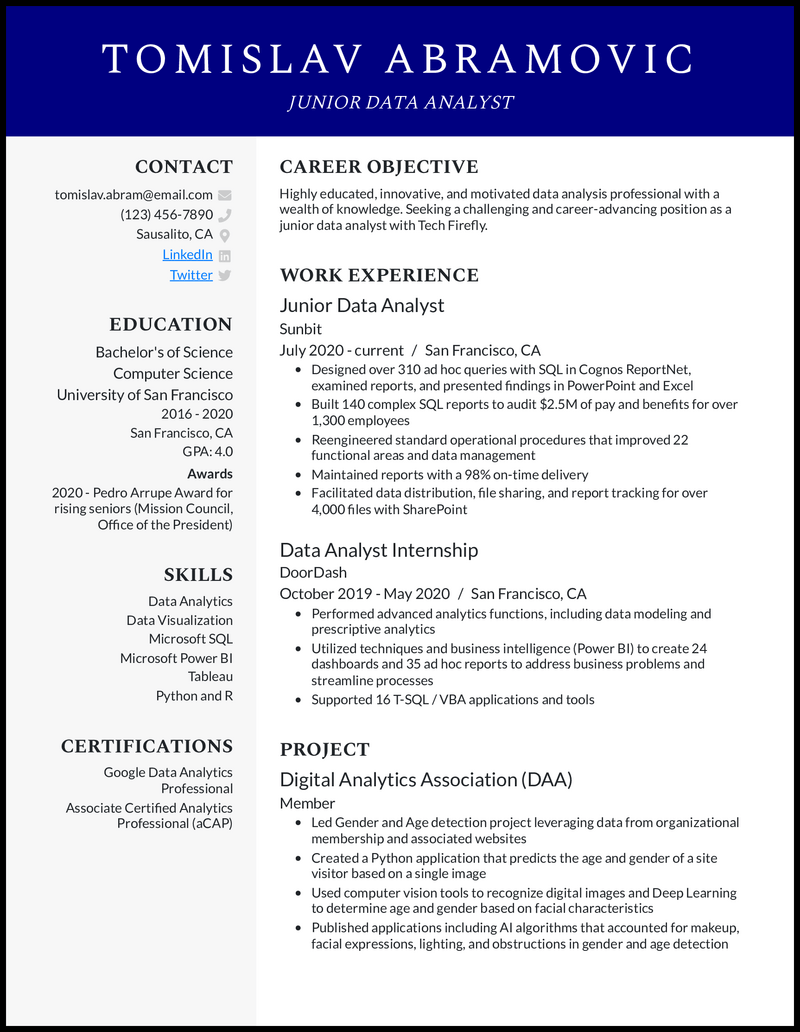
Why this resume works
- Don’t stress things out too much on your junior data analyst resume. No one’s expecting you to do wonders right off the bat, but avoid downselling yourself.
- Use past experiences to show you’ve got a good idea of what this role entails like designing ad hoc queries, presenting data findings, creating dashboards, etc.
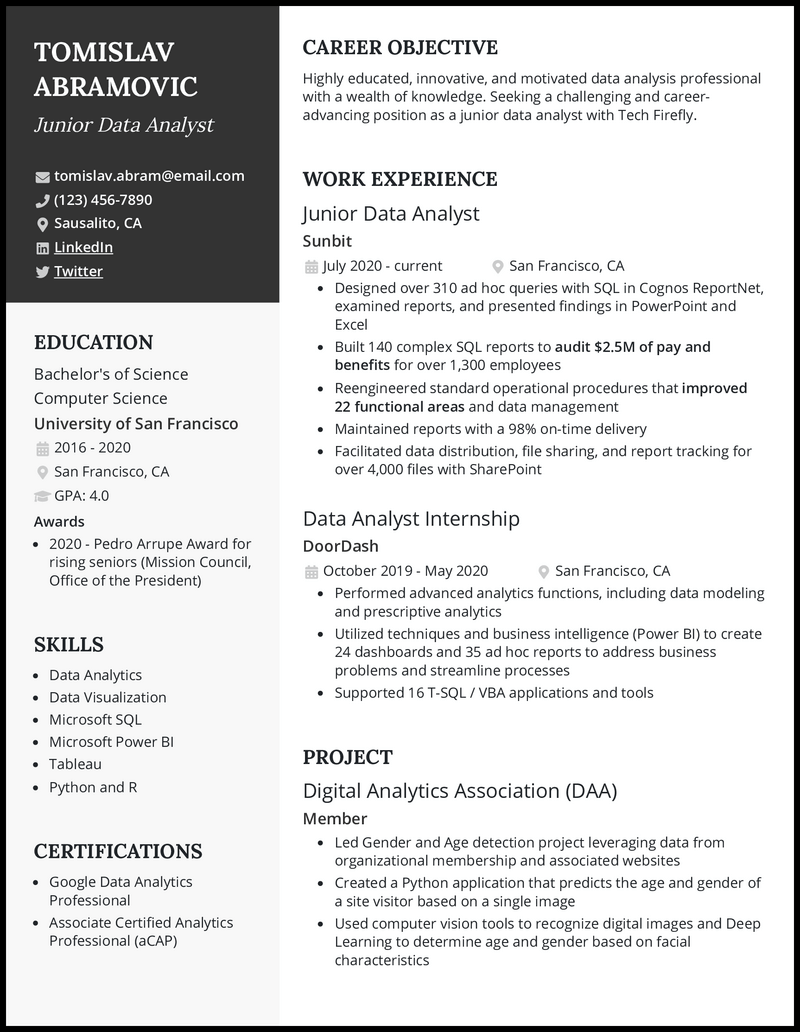
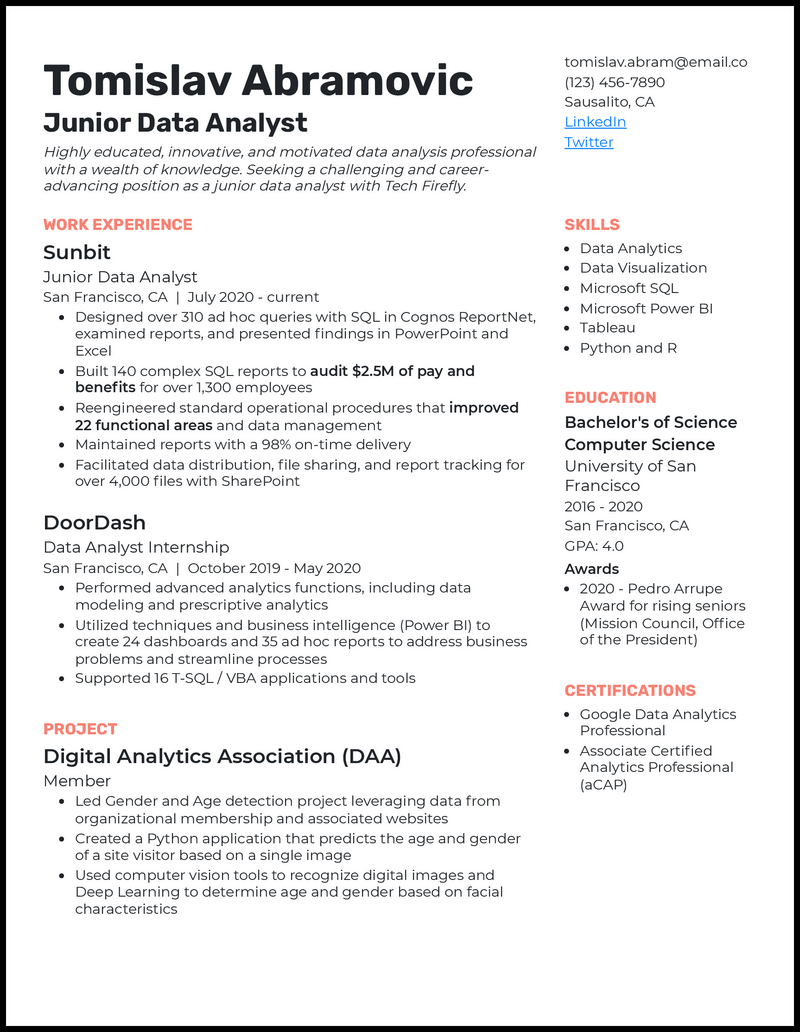

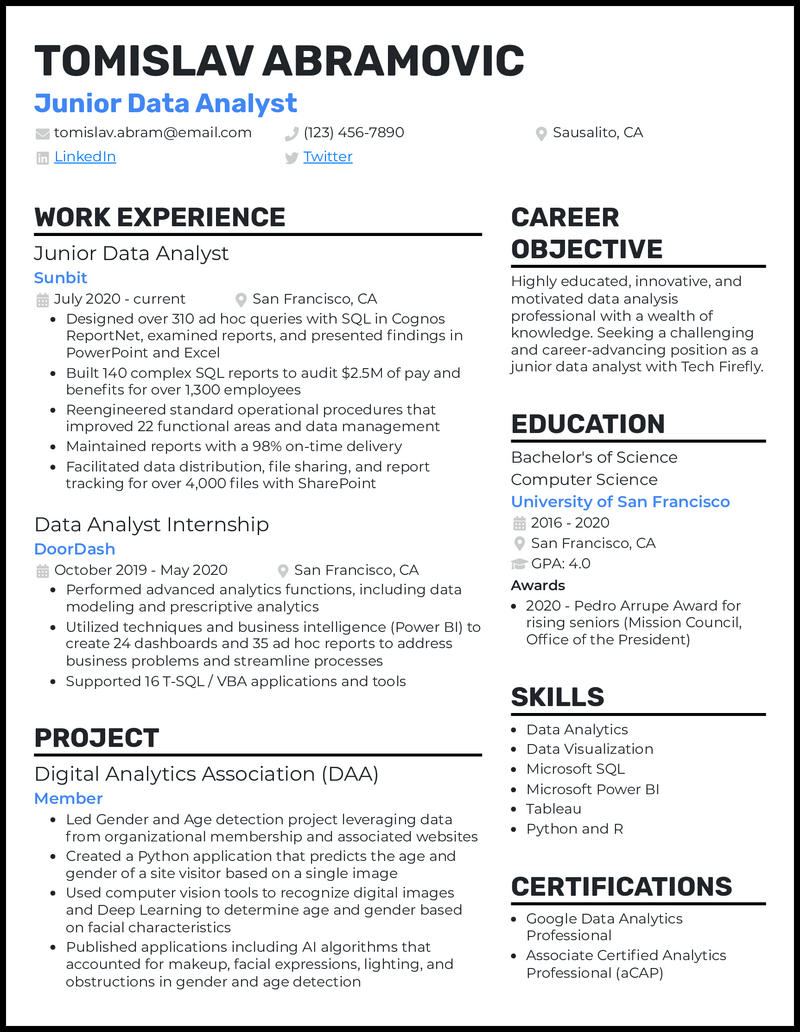
How to Write a Junior Data Analyst Resume

Getting a break into the competitive data analysis space can be exciting and daunting—but the right resume bridges the gap between your skills and the job you’re targeting.
Summary
Ignite your data career by crafting a laser-focused junior data analyst resume that translates your analytical mindset, technical fluency, and measurable results into a powerful, job-winning narrative.
Here, you must prove that you can extract meaning from data, communicate insights effectively, and contribute to business success from day one.
Whether fresh from the classroom or scaling the ranks to a junior role, let’s help you write a resume that tells a story of potential, clarity, and purpose.
This section discusses:
- Using easy-to-follow design
- Loading up your technical chops and data tools you’re confident with
- Tapping projects or internships that confirm your potential
- Giving proof of your value through results and numbers
- Adjusting your resume so it fits the specific job you’re applying for

Structure your resume to win the job
For a resume’s structure that puts you at the lead, use:
- A clean, logical resume structure
- Include header
- Summarize your potential in a career objective
- Spotlight technical skills
- Showcase impactful experiences
- Leverage projects
- Prove credibility with education
- Show commitment with certifications
- Bonus Sections – Awards, publications, hackathons, leadership roles

Pitch your value with a career objective
Your career objective is your opening pitch—make it count. It’s your opportunity to quickly grab the attention of recruiters by selling them your strengths. Before you know it, they’ll be reading the rest of your document.
Example
Budding data enthusiast proficient in SQL and Python with internship and project experience. Eager to drive data-backed decisions and streamline business processes as a junior data analyst at Tech Firefly.

Showcase your expertise
What tools, languages, and frameworks are you competent in? Say them boldly and tell recruiters you didn’t show up to play but act. It’s not merely giving a list of skills; it is using them to get work done and show its impact.
Skills to set your junior data analyst resume apart
- Tableau
- Microsft Power BI
- Data Analytics
- Python and R
- Microsoft SQL
- Data visualization

Highlight your measurable impact
Data analysis is about impact—turning numbers into action. Transform your roles into impact-loaded bullet points that convince recruiters to list you for the interview. It’s all about putting yourself in the shoes of the potential employer and envisioning the perfect candidate getting things done.
To achieve this:
- Underscore impact
- Deploy active verbs
- Use skills
- Don’t talk about duties
Use metrics wherever possible
Quantification creates credibility. Even if your experience isn’t from a formal job, metrics make it tangible. Use numbers, percentages, ratios, timeframes, or counts.
Example
✅Cleaned and analyzed 50K+ records in Excel and SQL, improving report accuracy by 41% and cutting processing time by 32 minutes
✅Built a Tableau dashboard to track KPIs, helping the team spot trends that increased campaign response rates by 18%

Pair skills andaAccomplishments with active verbs
Start every bullet with a strong action verb. This approach energizes your resume and clearly communicates your contributions. Use verbs that show analytical thinking and results, such as:
- Analyzed
- Visualized
- Automated
- Predicted
- Modeled
- Streamlined
- Interpreted
- Optimized
- Extracted
- Synthesized

Leverage coursework and projects
Academic projects are gold—especially if you lack professional experience.
Draw parallels between your role in the project and what your future job expects of you. Did you lead? Work in a team? Make an impactful decision? Use your software proficiency to solve a problem? All these are gems you can use to decorate your resume and sell value to a would-be employer.
Example
Predictive Modeling Project – University Capstone
Co-developed a linear regression model in Python to forecast housing prices using Kaggle dataset, achieving an R² of 0.89.

Add relevant training and education
Your degree signals your foundational knowledge and showcases relevant electives, online training, or certifications that demonstrate proactivity.
Here, include:
- Graduation year
- What you studied
- College’s name
- Location
- Relevant class work
How to list education, awards, and certifications in your junior data analyst resume:


Bonus sections: honors and extracurriculars
What else can you do to cover the gap from your lack of direct work experience? Data club president, second runner-up in a data competition, developed a data simulation program to analyze the impact of a social project in a poor neighborhood. All these are like medals that make your resume shine if properly utilized.

Customize to the specific role
One-size-fits-all resumes fail. Tailor your resume for each job posting by mirroring the language used in the job description and emphasizing the most relevant experiences.
Use tools like a resume-to-job-description match to optimize alignment with applicant tracking systems (ATS).
Pro tip: Save time with a job tracker to organize applications and tweak resumes efficiently.

Avoid these mistakes when writing your data analyst resume
Don’t fall into these pitfalls:
- Being vague: Be specific.
- Overloading jargon
- Ignoring soft skills: Communication and storytelling matter just as much.
- Skipping proofreading: Typos signal lack of attention to detail—fatal in a data role.
- Neglecting formatting: Use consistent spacing, bullet points, fonts, and section headers.
Top 5 tips for your junior data analyst resume
- Kinds of projects to include
- Any projects that show that you can take a question, find and collect data, then analyze it to answer that question should be included. Did you analyze your online dating data? Analyze your likes on social media? Any time you told a story with data is a project.
- Your relevant education
- Your education might be the biggest advantage you have if you don’t yet have relevant data analysis experience. In that case, really put it forward. Include classes you took that are relevant to the role (like statistics or programming).
- Build your resume to the job description
- This is easier than it sounds. First, include any technical skills you’re comfortable with that are mentioned in the job description. Second, highlight any experience or projects that come to mind as you read the job description.
- Employers don’t expect tons of experience
- Most companies are surprisingly reasonable (there are a lot of fun stories from the unreasonable ones). When they’re hiring for a junior or entry-level role, they don’t expect years of relevant experience. Don’t be ashamed of that fact, everyone starts somewhere!
- Keep your skills section in check
- The tendency for junior data analysts (speaking as a former junior data analyst myself) is to mention every skill they’ve ever heard of on their resume. Don’t do this; employers see right through it. Focus on the programming languages/ tools you really know best.

Key takeaways
Keep these in mind:
- Focus on value, not just tools
- Structure your resume for clarity, ATS-friendliness, and easy scanning
- Include projects, coursework, and certifications to fill experience gaps
- Quantify outcomes whenever possible—numbers speak louder than titles
- Tailor every version of your resume to the specific job and company.
Junior Data Analyst Resume FAQs

A junior data analyst should demonstrate ability to collect, clean, analyze, and present data. Do this by showcasing tools used, insights delivered, and how your work impacted decisions even if in academic or internship settings.
The perfect skillset for a data analyst must include technical, analytical, soft, and business acumen competencies. It’s crucial to align your set of proficiencies with the potential employer’s expectations. Structure your skills section so that it is complete and easy for recruiters to see.

Stephen is the co-founder and CEO of BeamJobs. Frustrated with the challenges he'd faced in his own job search, he left the corporate world to start BeamJobs with his brother. Drawing on firsthand experience with hiring and getting hired as technical talent, he started BeamJobs in 2020 to help qualified job seekers land interviews with less stress. Since then, more than 4 million people have built their resumes and cover letters on BeamJobs. Stephen's insights have been featured in notable outlets, such as Fast Company, Business Insider, Yahoo Finance, MIT, and Zapier. Learn more about Stephen.