



When you’re a computer science student looking for an internship or your first full-time role as a developer, understanding what a resume is, deciding what to include in a good resume, and how to format it correctly can be challenging.
We analyzed countless computer science resumes and chose the top 21 examples to help you get started. No matter if you’re looking for your first high-paying job without a degree or are a seasoned campaigner, we have a computer science cover letter and resume designed to match where you’re at in your career.
We’ve helped technical job seekers get interviews at companies like Facebook and Microsoft, so these 21 computer science resume examples are a great place to start.
Embellish the bullet points
- Don’t fall into the trap of writing unquantified work experience bullet points. Whether it be identifying problems in a system, building solutions, deploying applications, or automating monotonous tasks, include metrics in your computer science resume.

Outline career progress
- Choose the reverse chronological resume format. You’ll have your latest experience at the top of your computer science student resume. Pick the three best jobs that prove your ability to build apps, test new programs pre-release, troubleshoot systems, and overall be a great tech person to work with.

Flaunt your certificates
- Here’s a pro resume tip to show hiring managers that you’re a tech expert: List down credible certificates. For instance, if you’re applying to be a software developer where proficiency in Python is a must then add a Certified Associate in Python Programming achievement.
View more computer science internship resumes >

Adding context
- When creating a computer science engineering resume to apply for a job that requires expertise in certain skills like Python for data extraction or Jenkins (Java) for automated testing, don’t just add them to your skills section and play the guessing game with employers. Talk about how you’ve used them in real-life scenarios and the business impact.
Let education speak
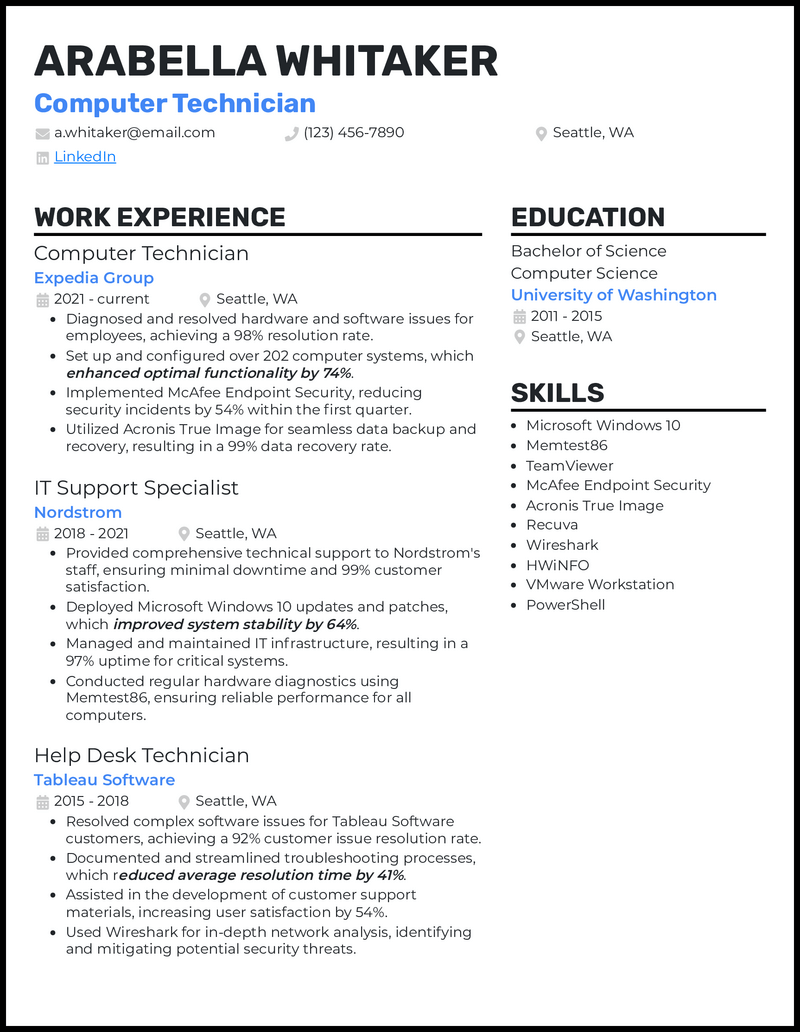
- If you’re applying for a role where minimum education qualification is a requirement, use a resume builder to place your education section on the left/right side of your computer technician resume towards the top. Also add specialized courses like Data Structures, Software Engineering, and Machine Learning.

Understand the company
- Before applying for your next job, take a good look at the company you’re applying to. Do they follow strict corporate culture practices? Or are they lenient and more informal? Let your computer programming resume mirror the type of the compay you’re applying to.
Craft a career objective
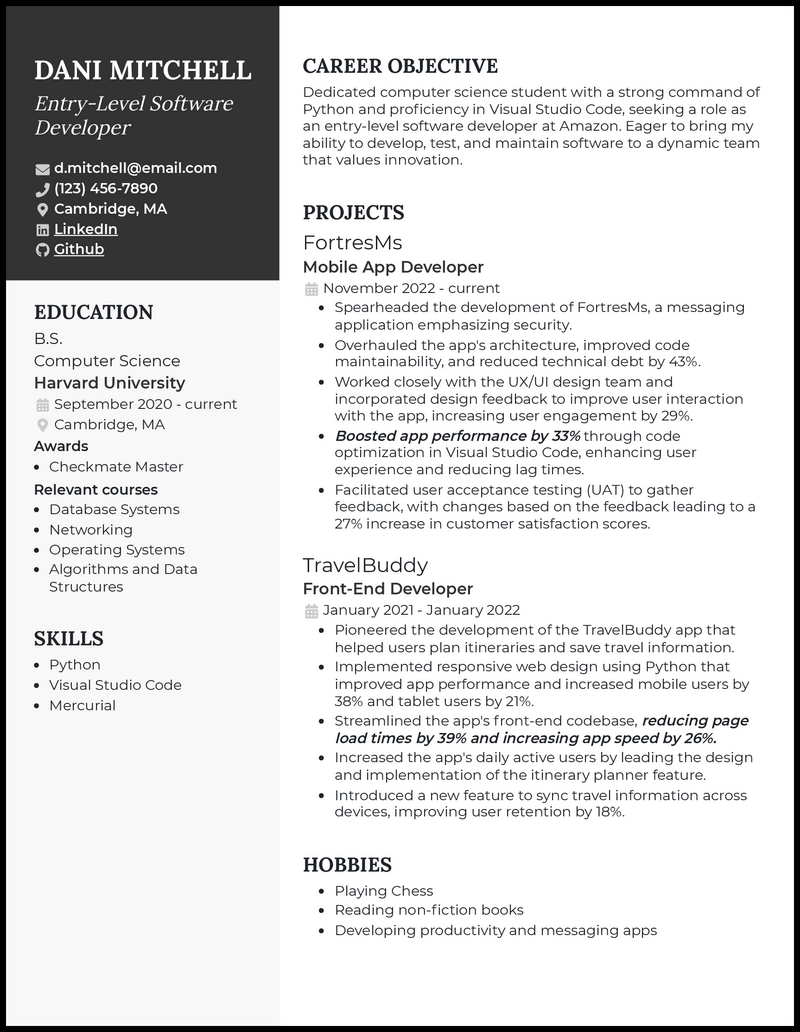
- A career or resume objective is a welcome addition to a computer science major resume. Use it to outline your motivation, ambition, technical skills, and future goals at a new company.

Impress with resume format
- Don’t be afraid to experiment with resume templates and see which design best fits your profile. As long as you check your resume and make sure that all your tech-based experience, skills, and computer science degree(s) are readable with a hint of warm colors, you’re good to go.

Use customized template
- Use a resume template that provides enough space to add your tech-based roles, programming skills, and any software certifications. You can also build a resume from LinkedIn to edit/arrange any sections, change the font size/family, and add various colors.

Splurge on skills
- You don’t need to put every programming language on your computer science no experience resume, but having widely used ones like Python, JavaScript, C/C++, and SQL on your skill set will help. Also, it’s a good idea to categorize skills as languages, frameworks, database management tools, etc to stay organized.

Do your homework on Employers
- Tailoring your computer science LaTex resume is a slick move to make recruiters acknowledge your skills. How do you do that? Detail previous applications of Python and TensorFlow, which could be a prerequisite laid out in the job ad.

Leverage past wins
- Send a computer science research resume showing you know the ropes and could be a real asset if given a chance. Add your research projects’ wins to drive home your value with added clarity.

Add all important info
- Your computer science design resume header is better outfitted with your full name, updated phone number, current location, a LinkedIn profile link, and a professional email address, such as [email protected].

Justify work gaps
- You may not be hired by a tech company every month and that’s fine. Whether they were planned or unplanned, be completely honest about your computer science tutor resume gaps. For such breaks, include what you achieved:Programming skill, personal software development project, or any continuing education proof.
View more computer science tutor resumes >
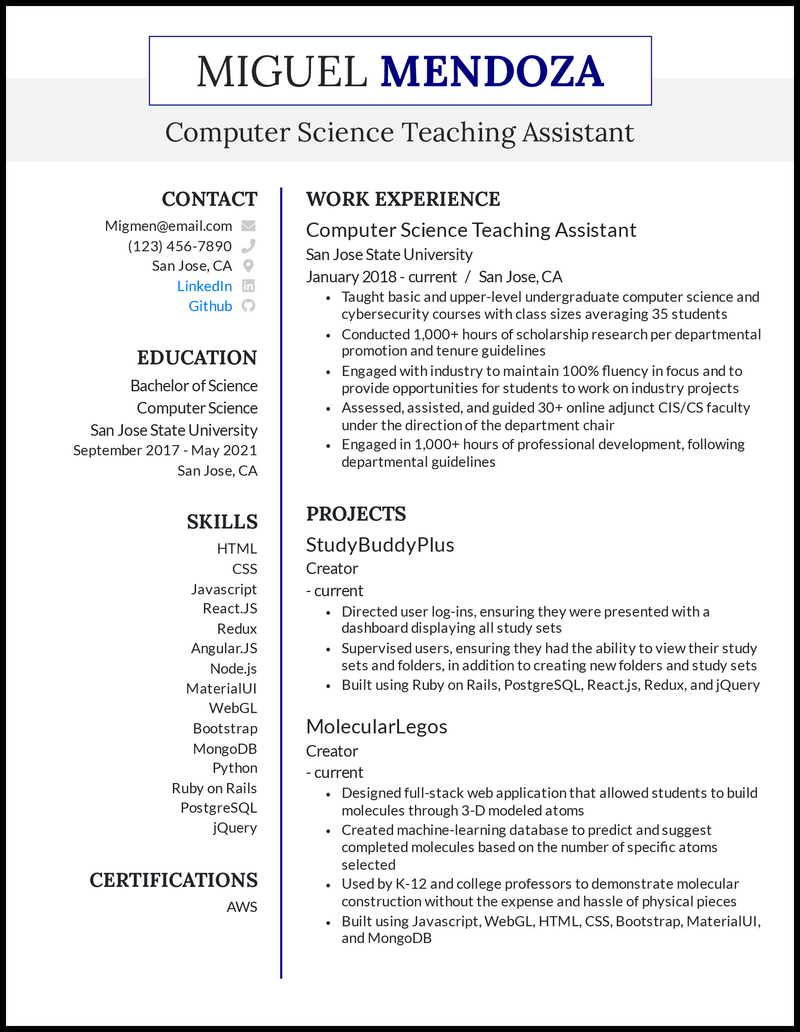
Talk about your competencies
- If your next potential job is a fusion between computer science and another field, then be smart with your resume’s skill set. For example, a computer science teaching assistant resume requires the skills of a programmer and teacher, so maintain a fine balance between your abilities to act as both.
View more computer science teaching assistant resumes >

Use ready-made template
- Highlight your host of soft competencies in your masters in computer science resume. That will cast you as the complete package, that well-rounded candidate ready to bring more than just smarts to the team.

Stick to the job description
- Instead of being among the list of generic candidates, make sure that you thoroughly go through the job description and check your resume to find areas for improvement. Does the job demand experience in Java-based applications? Include all previous jobs where you’ve used Java to create applications.
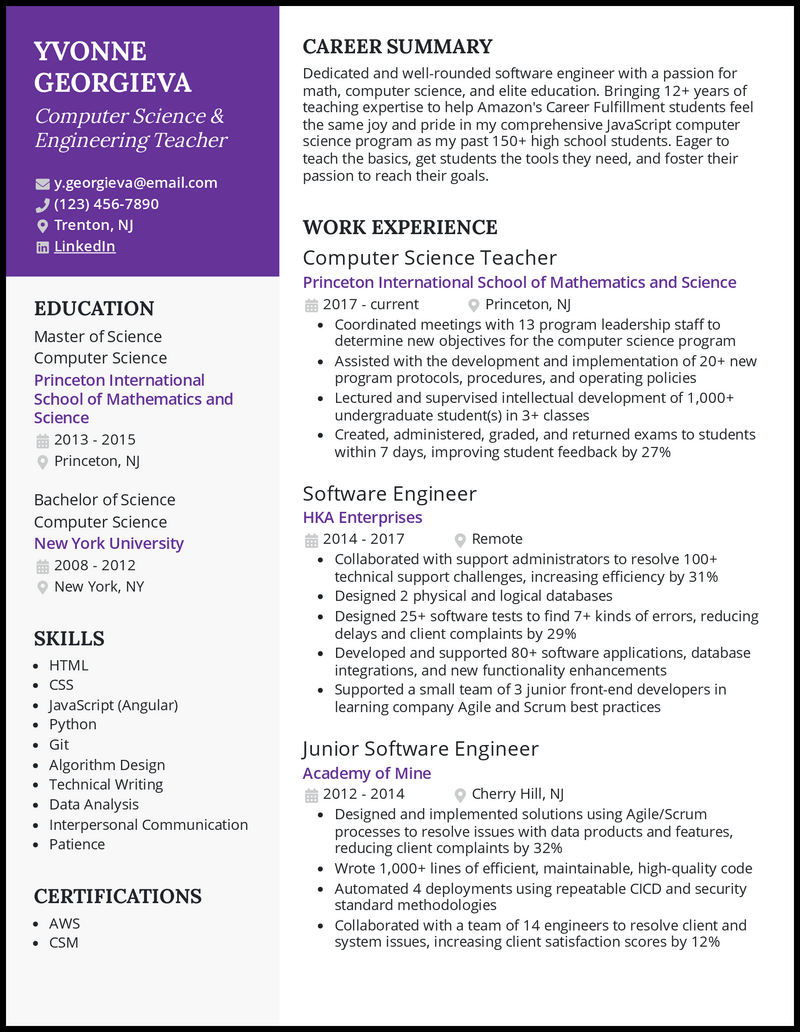
Going ATS-friendly
- To make your computer science & engineering resume to be ATS-friendly, include keywords such as proficiency in Rust or Certified Entry-level Python Programmer certificate. Also, steer clear from including add-ons like pie charts, graphs, or acronyms.
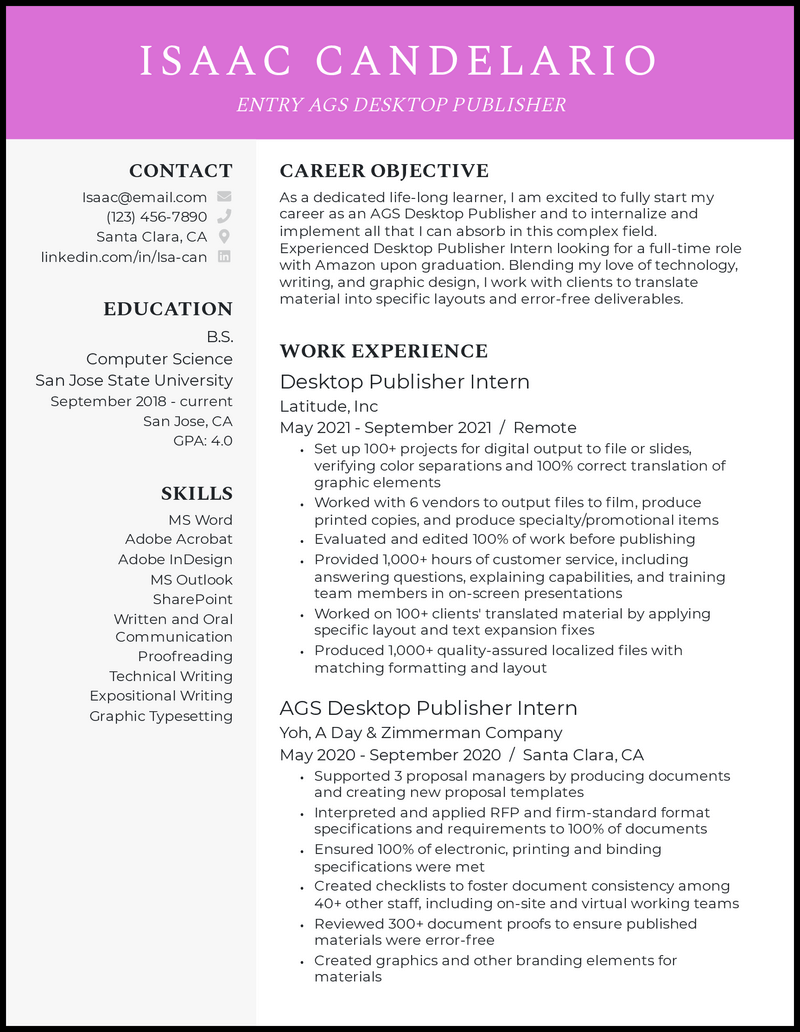
Leverage action words
- When it comes to a entry AGS desktop publisher resume, leveraging words like Deployed, Built, Leveraged, Developed, Led, and Released show your proactivity to take charge of daily job responsibilities.

Define your skills
- Leverage university projects if you’ve only stepped into the IT industry. If you’ve led a team project, talk about your leadership. If not, detail your contributions as a member which align with the job responsibilities.

Amplify your achievements
- For an employer who’s already dealing with a busy day, sending a generic senior computer vision scientist resume is not even an option. Focus on achievements more than your daily duties. These can include bringing out financial impacts using technology or automating tasks to save time.
Related resume guides
How to Write a Computer Science Resume

To make your computer science resume stand out, show your value quickly by highlighting your technical skills, problem-solving abilities, and real-world results. No matter if you want a software engineering job or a machine learning internship, your resume should clearly show what employers and recruiters look for right away.
It’s helpful to look at resume examples that use proven best practices. Before you submit, check your resume for ways to improve and make it stronger.
This section will cover:
- The best way to structure your computer science resume
- Which technical skills to list and where to put them
- How to write a strong summary that fits computer science roles
- How to create a work experience section using your projects, internships, and coding experience
- Tips for getting your resume through Applicant Tracking Systems (ATS)
- How to write a resume if you are a new graduate or do not have direct computer science work experience

What makes a good computer science resume in 2026?
A computer science resume that recruiters want and impresses ATS should put your results first, be AI-friendly, and be tailored to the exact role you are applying for. Use it to prove you can solve problems, write and execute clean code, interact with real data and make it matter, ship projects, and use tools to drive business impact.
In short, let your CS resume:
- Lead with impact and not responsibilities
- Use keywords from the job description to pass ATS
- Showcase role and impact in projects that made a real-world impact
- Present your technical and cross-functional skills
- Use a clean, modern format that’s all device, human, and ATS-readable

How to format your computer science resume
Recruiters typically spend only 5 to 7 seconds scanning a resume. The format you use must be clean, scannable, and optimized for the core sections that present the most important information.
You need a design that separates each section into headers, showcases your work experience in bullet points, and incorporates AI-friendly fonts, as well as other crucial components. This is exactly what the reverse chronological order does, on top of presenting your most recent and relevant experience first.
What should a CS resume look like?
For a complete computer science resume, ensure you have the following sections:
- Header, complete with your name, contact info, LinkedIn (remember to include links to GitHub, portfolio, or personal website)
- Professional summary (optional)
- Skills section comprising tools, languages, frameworks
- Work Experience blending results and technologies used
- Projects: Especially if you’re an early-career
- Education: Degree, GPA (if strong), relevant coursework
- Industry and role-specific certifications
Pro Tip: For all these sections, use standard section headings for ATS-friendly formatting.

Start with a compelling professional summary
Early in your computer science career, you must keep your resume to one page. As such, real estate on your resume is valuable. You should only include a resume objective if it adds value and increases your chances of getting an interview.
So, what is a resume objective for a computer science student? It’s a statement that succinctly states your skills, what you’re looking for in the job you’re applying for, and how you’ll add value in that role.
That sounds like a lot, but it’s not that bad in practice. You should keep it to two to three sentences and customize it to each role for which you apply. Here are a couple of examples from the resumes above:
- “I’m looking for an internship where I can utilize my experience with natural language processing and building web apps for non-technical users to further the mission of Coursera in democratizing education across the world.”
- “Industrious recent computer science graduate with a zeal for innovation. Seeking a position at Sikka Software, where the strategic focus on delighting users aligns with my creativity and desire to enhance social events through technology.”
You can copy the tone and style they use. Alternatively, if you’ve built some valuable experience, you may want to consider a resume summary statement. Only include one if you can successfully and specifically highlight your greatest career accomplishments.
Computer science resume summary
Seasoned software and cloud systems’ developer with over 10 years of experience. Oversaw a platform revamp, which increased performance by 63% and cut downtime by 41%. Proficient in Python, Java, and AWS. Focused on building scalable, efficient solutions that fuel innovation.

How to build an impact-oriented work experience section
Employers don’t want to hear about your responsibilities and list of skills that you think matter. Instead, they want a problem solver who can ensure that systems run efficiently all the time. It’s all about the business value you bring. Use the XYZ formula to structure accomplishments on resumes.
Here’s to ensuring that your work history isn’t just a placeholder but an asset:
- Start each bullet with an active verb
- Integrate skills into your bullet points
- Use metrics to quantify your input
- Be brief and use industry-aligned tone
Metrics that matter for computer scientists
As much as we’re talking about quantifying your contribution, you have to be cautious about the numbers you deploy. For CS roles, these are the metrics that count:
- Improved system performance
- Codebase quantity and quality
- Shipped features and users
- Bug reduction rates
- Time and resources saved through automations
How to quantify your impact
As a computer science professional, you’ve got a broad scope of career choices, so include your top three roles where you outmatched everyone else. Avoid vague statements and quantify outcomes to demonstrate impact.
From software development to a systems architect, as long as you work with computers, you can add it in. But don’t just stop at mentioning jobs, quantify your contribution’s results. A few examples include:
- Tested 9 software features pre-release, mitigating recurring user complaints by 22% within one quarter.
- Mentored 3 juniors in agile methodologies, ensuring 98% of features were released on time.
- Oversaw the company’s IT infrastructure, maintaining 99.4% uptime for critical systems.

How can a computer science student write a resume with no experience?
Fortunately, recruiters pay less attention to role titles but do care about your skills and what you can do with them. It doesn’t matter you’re fresh from college or if this is your first job; show them what you’ve built and the real-world impact you made.
A good strategy is to push the work experience section down further to the bottom of your resume, while prioritizing skills, education, projects, and relevant coursework. Most importantly, emphasize your transferable skills by aligning them with what the job expects you to do.
Here are some sections that deserve significant emphasis in your resume:
- Personal projects such as games, apps, or scrapers created
- Participation in Hackathons, coding challenges, or open-source contributions
- Relevant coursework in areas such as Data Structures, OS, and Algorithms
- Academic projects detailing your team size and tech stack
- A clear skills section with tools and languages you can use confidently

How to add computer science/data science projects to your resume
When you’re looking for a computer science internship or your first full-time role as a developer, projects are a must-have on your resume.
These can either be projects you completed as part of a class or something you went out and built on your own. Projects are the best way to show a potential employer that you can take what you learned in class and apply it to the real world.
More than that, they’re a great way to demonstrate your interest in coding outside of your classwork. In your projects, mention exactly what you built and the languages/ libraries you used. Here are some examples:
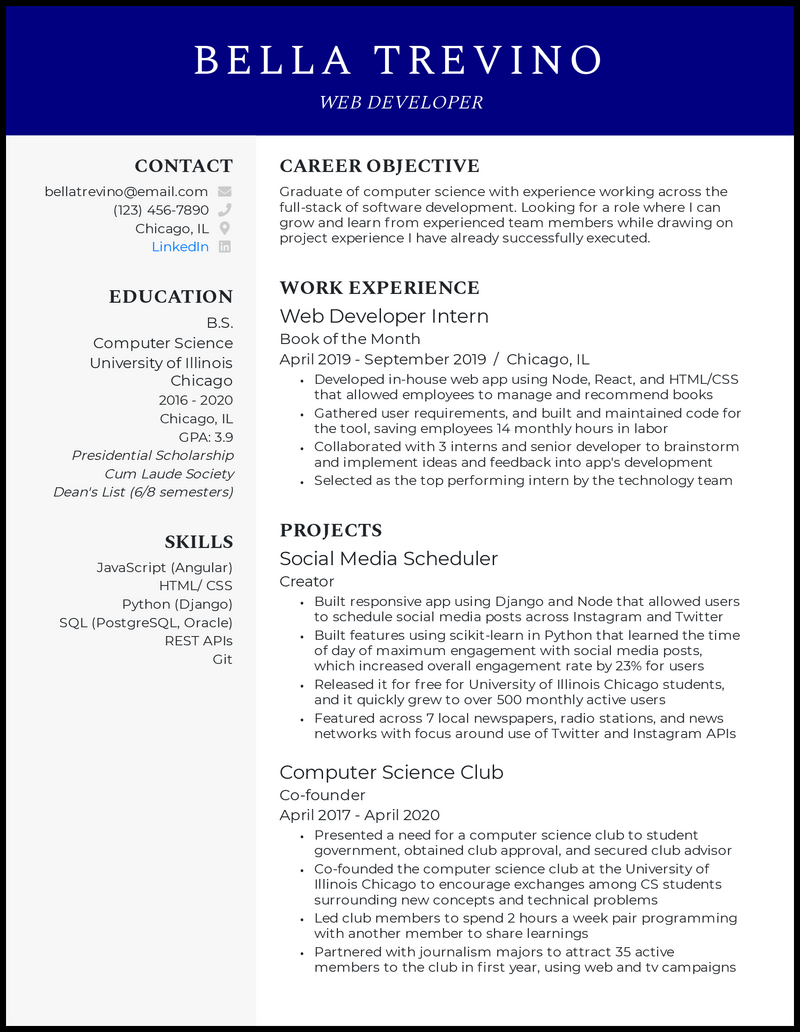
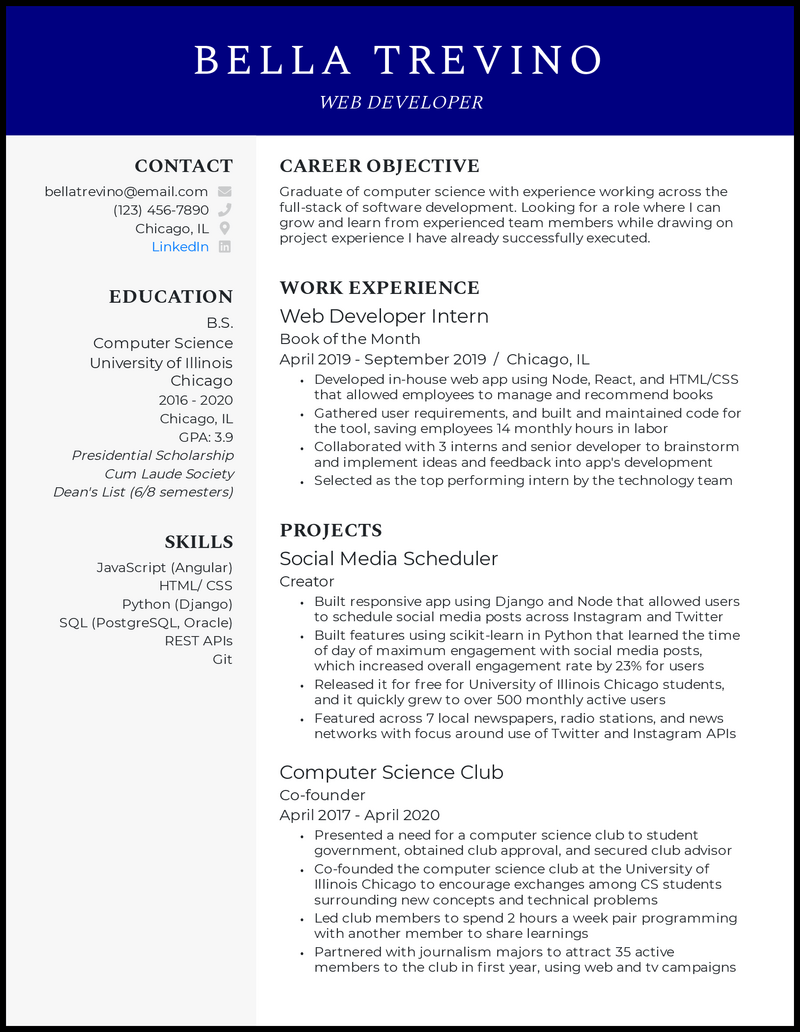
Social media scheduler
- Built a responsive web app using Django and Node that allowed users to schedule social media posts across Instagram and Twitter
- Utilized the Twitter API and Instagram API
- Built features using scikit-learn in Python that learned what time of day maximized engagement with social media posts, which increased the overall user engagement rate by 15%
- Released app for free for University of Pittsburgh students, and it quickly grew to over 500 monthly active users
- Used: Javascript, Python, SQL, HTML/CSS
Poker simulation
- Built a full-stack web app to allow users to simulate and visualize outcomes of poker hands against opponents of different play styles using open-source cards.js on the front-end
- Utilized sci-kit learn in Python to simulate possible outcomes under different scenarios that the users chose
- Used: Javascript, Python, SQL, HTML/CSS

How to showcase your technical expertise to stand out
This is one of the hardest aspects of creating a technical, more specifically, computer science resume. There’s so much you can add, but there’s only so much space. So, be strategic.
Focus on skills that are actually in demand (and no, “vibe-coding” is not a real skill, save it for social media, not your resume):
- Python
- C++
- Git
- React
- AWS
- REST API
- Agile methodologies
- Machine learning
- Algorithm design
- Technical writing
How to use skills on your resume
Beyond putting your skills in a dedicated section, you can use them strategically to pitch your value. Technical skills should be grouped by category for readability. Also, don’t just list them and hope that something sticks. Instead, sprinkle them in:
- Resume summary (if you use one)
- Cover letters
- Certifications, training, and coursework
How to match your computer science resume to the job description using skills
The tools and frameworks you include in your resume are not merely a laundry list of the things you know. In fact, they should mirror the requirements in the job advert.
Spend some time to review the job posting, identify recurring key phrases and incorporate a good number of them into your list of competencies. These keywords could be tools, frameworks, concepts, or languages that you must know to do the job well.

How to list your education
This is a no-brainer but quite easy to overlook. Always list your Bachelor’s in Computer Science or an equivalent degree (Information Technology, Data Science, etc). If you’re a freelancer who’s graduated from a boot camp and has worked in the industry long enough, you can get away with certifications such as CompTIA Security+ or Professional Cloud Architect Certification (Google).
Freshers need to focus on this section more than working professionals, so make sure you:
- Mention your GPA (only if it is 3.5 or above, though)
- Include coursework related to the job you’re applying to.
The key is to make this section work for you and not the other way around, even if you’ve got no experience.

What certifications do you need to secure a computer science job?
Certifications are not a must, but if you have any that are relevant to the job, mention them. It’s also about proving your fitness for the position and saying that you’re the best candidate. If you list certifications, include the title, the body issuing it (if applicable), and the date issued or expiry.
Some examples of certifications for computer scientists:
- CompTIA Security+
- Microsoft Azure Fundamentals
- Certified Kubernetes Administrator (CKA)
Pro Tip: Not sure if you still got the formatting right? Use our resume review tool to get instant feedback on what’s working and what’s not for your CS resume.

Key takeaways
- Format clearly for both ATS and human readers
- Prove what you can do, not just what you know
- Use metrics to quantify your contributions
- Prioritize projects and skills if you lack formal experience
- Use keywords from job descriptions to boost match rates
- For an early career, leverage education and certifications
Computer Science Resume FAQs

A standout computer scientist resume clearly, concisely, and compellingly presents your technical and professional qualifications. It highlights problem-solving skills, programming proficiency, and ability to work on real-world projects.
It should also demonstrate how those skills have been applied through hands-on work experience, such as internships, research, or projects. Lastly, it should be well-organized, easy to read, and tailored to the specific job you’re applying for. Such a document has a high chance of impressing recruiters.
At the top goes the header with your name, personal phone number, professional email address, and, if relevant, your LinkedIn link.
Then follows a professional summary or objective, briefly describing goals and qualifications.
Education is next and includes degrees earned, colleges attended, and graduation dates. A skills section is also important and lists programming languages, tools, and software proficiency.
Finally, you showcase work experience, internships, and academic or personal projects, with descriptions that focus on responsibilities, accomplishments, and tools used.
A computer science resume should be one page for entry-level candidates because of limited professional experience. This ensures the most essential information is presented efficiently.
On the other hand, a two-page resume is acceptable if you have several years of relevant work experience or advanced degrees, as long as the content remains relevant and well-organized. The goal is to showcase qualifications without overwhelming the hiring manager.
The best format for a CS student resume is reverse chronological. This format lets you list your most recent coursework/internships/volunteer work at the top. If you’re short on experience, create a section to add any college projects or hackathons you’ve participated in.
Here’s a senior computer scientist resume summary example:
“Senior Computer scientist with a decade of experience in Java, Python, and cloud (AWS, Azure). Led microservices migration reducing deployment time by 64%. Skilled in CI/CD and team leadership. Committed to building scalable, high-impact systems.”
Summarize your computer science projects within 4–5 bullet points, each reflecting a unique aspect and your contribution. Reference specific tools you’ve added in your skills section and how you used them for measurable outputs.

Stephen is the co-founder and CEO of BeamJobs. Frustrated with the challenges he'd faced in his own job search, he left the corporate world to start BeamJobs with his brother. Drawing on firsthand experience with hiring and getting hired as technical talent, he started BeamJobs in 2020 to help qualified job seekers land interviews with less stress. Since then, more than 4 million people have built their resumes and cover letters on BeamJobs. Stephen's insights have been featured in notable outlets, such as Fast Company, Business Insider, Yahoo Finance, MIT, and Zapier. Learn more about Stephen.