



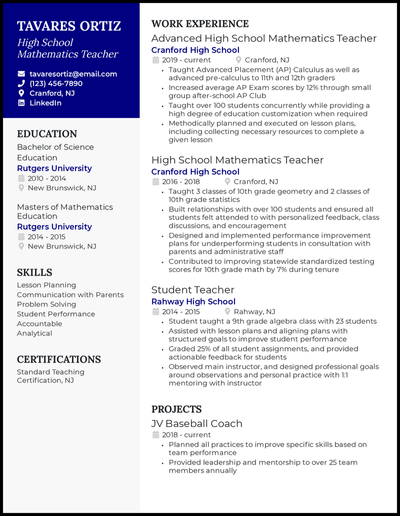
Your teacher resume should reflect how you create impact in the classroom. Whether you’re a new elementary teacher, a high school subject expert, an ESL instructor, or a special education professional, your resume should clearly show how you help students learn, grow, and succeed.
Hiring managers and applicant tracking systems (ATS) look for more than just keywords. They want to see real results, such as improved test scores, innovative curriculum ideas, effective classroom management, and ways you adapt your teaching.
Whether you’re building your resume from the ground up or just making updates, these teacher resume examples show what works in 2026: Layouts, wording, and metrics that help you get interviews. Additionally, write a teacher cover letter to provide more context and personality, and use these same ideas when updating your resume for new jobs or certifications.
This guide includes:
- ↪ 30 teacher resume examples that helped real educators get jobs in 2026, covering elementary, secondary, ESL, and special education roles
- ↪ Actionable strategies to format and tailor your resume for ATS readability and hiring trends
- ↪ Proven tips for showing your teaching impact, from classroom results to leadership and using technology
Please note that this guide is aimed at educators in the primary and secondary education sector. If you’re applying to teach at the university level, you’ll likely need to write a CV.
Why this CV works
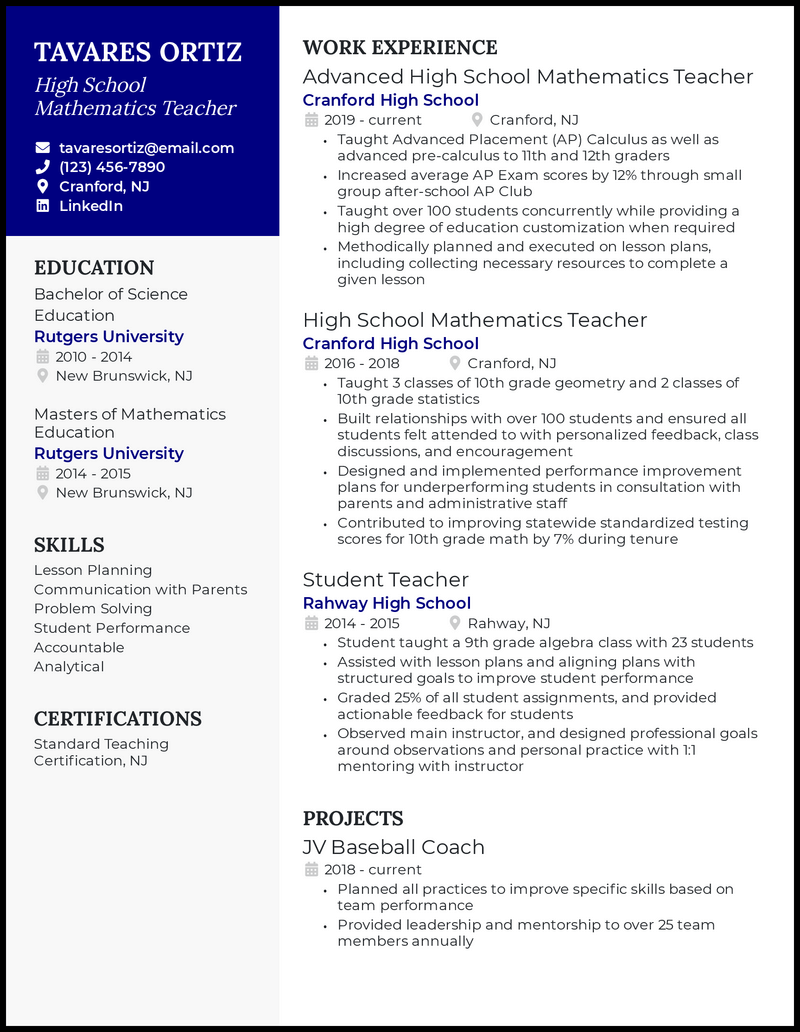
- Most teachers have some form of student teaching experience during their education, which you can totally include on your teacher resume. When listing your student teaching experience, focus on what you contributed instead of your responsibilities, but clearly state the subject and grades you taught in a resume bullet.

Why this CV works
- If you’re a certified substitute teacher (or teacher) in your state, include that in a dedicated “Certifications” section on your substitute teacher resume. This will help you stand out from other applicants, as this is not required in every state.
See more substitute teacher resumes >
Why this CV works
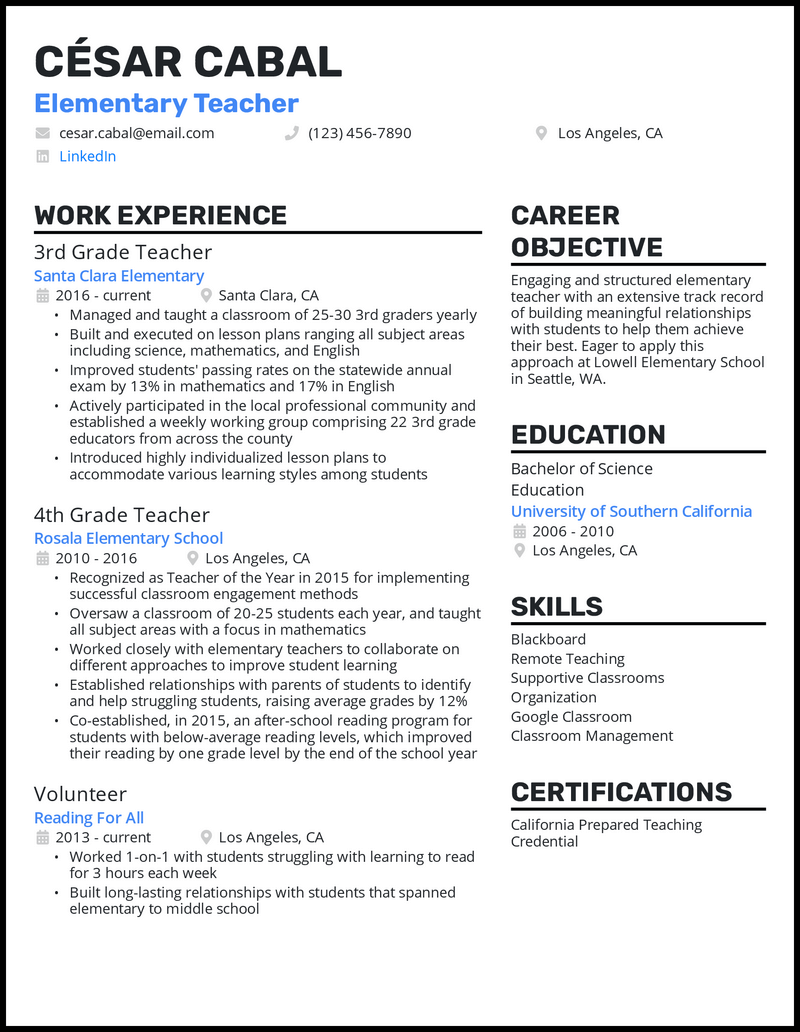
- Include licenses or certifications in a dedicated “Certifications” section on your elementary teacher resume. Our user-friendly resume templates and Google docs resume templates let you add a section just for certificates and licenses.
See more elementary teacher resumes >
Why this CV works
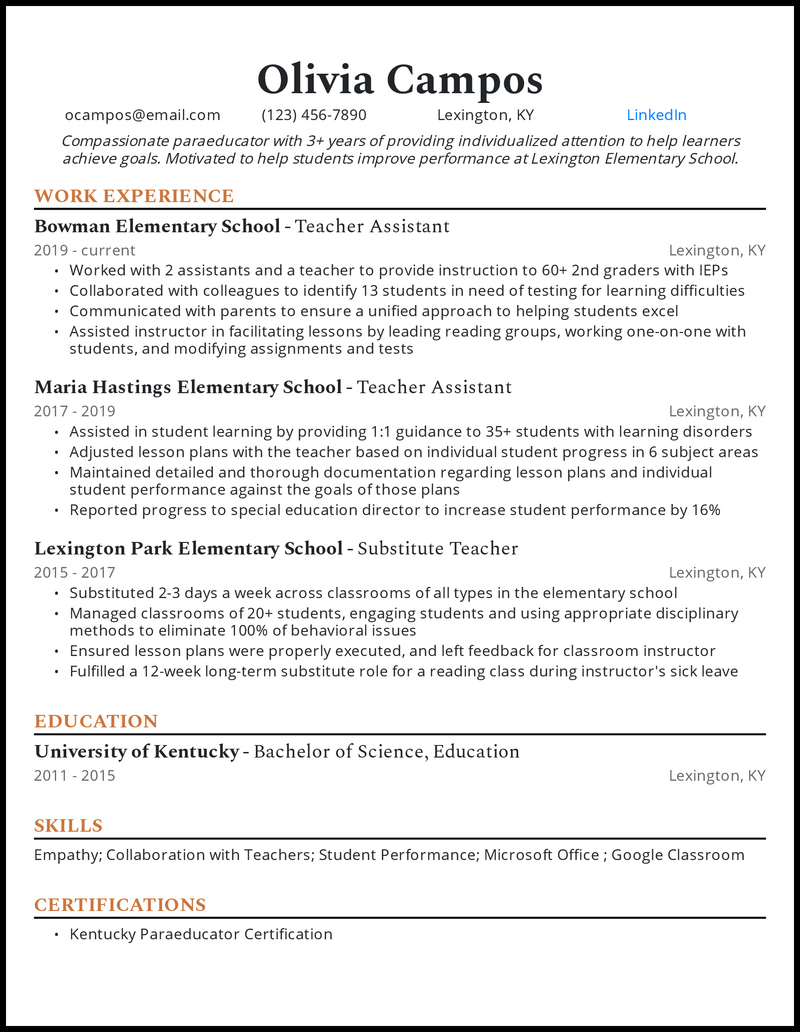
- Tailor your resume objective by mentioning the target school by name and sprinkling in some keywords from the teacher job description, so long as they honestly describe you!
See more teacher assistant resumes >
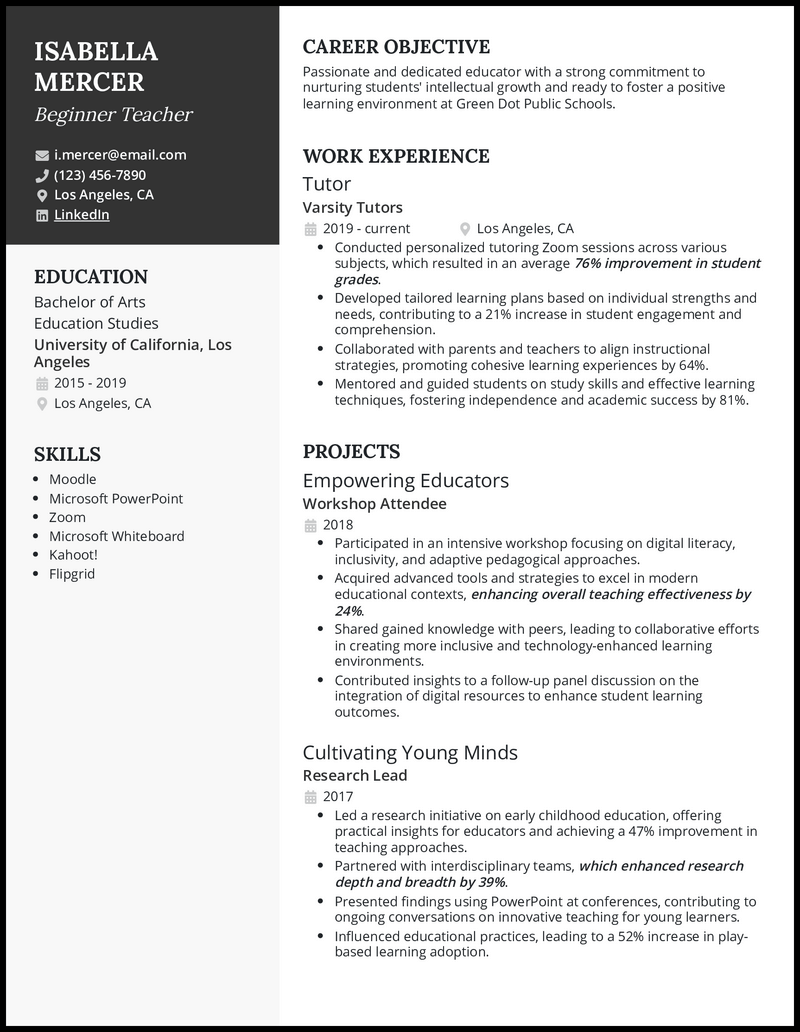
Why this CV works
- Education is a combined effort of different stakeholders, and this is why your new teacher resume should show how it has been a lifelong process for you, and how you are ready to bring in your set of pedagogical skills in the learning environment.
See more new teacher resumes >

Why this CV works
- The skills you put on your resume, you should be able to show an example of when you demonstrated that skill in practice. If you list “collaboration” as a skill, then somewhere in your resume’s work experience bullet points, it should be clear that collaboration is part of your repertoire.
See more high school teacher resumes >
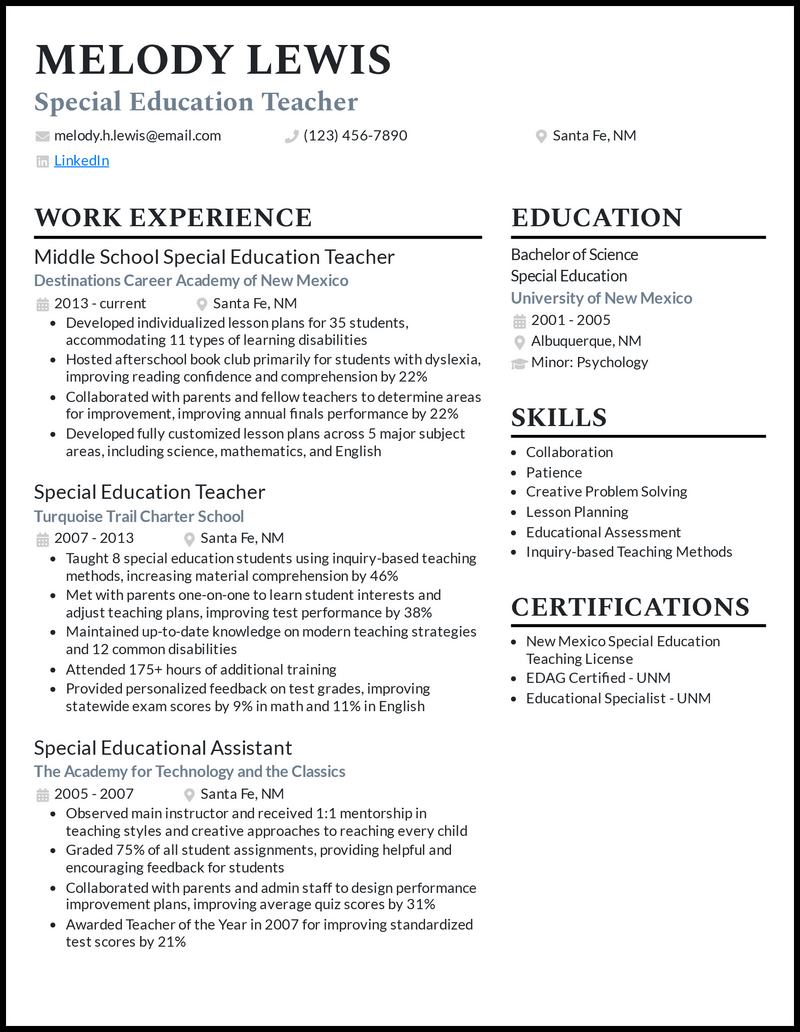
Why this CV works
- When you’ve finished writing your header, experience, skills, and education check your resume before you submit. Details can make or break your special education teacher resume, so don’t neglect the little things before you submit it to the world.
View more special education teacher resumes >

Why this CV works
- Your art teacher resume should stand out by showcasing proficiency in utilizing a wide range of artistic tools and technologies: Schoology, Prezi, Illustrator, and Krita, to engage learners and encourage artistic exploration.
See more art teacher resumes >

Why this CV works
- A tailored career objective could be the game changer for your first year teacher resume. Keep it two to three sentences summarizing your teaching career goals and demonstrating your readiness to help the hiring institution. Also, mention past relevant experiences like a teaching internship.

Why this CV works
- Your AP English teacher resume can include a summary statement if you’re a veteran tried and tested years in the education field and any specializations you’ve honed, such as teaching AP-level courses.
See more English teacher resumes >
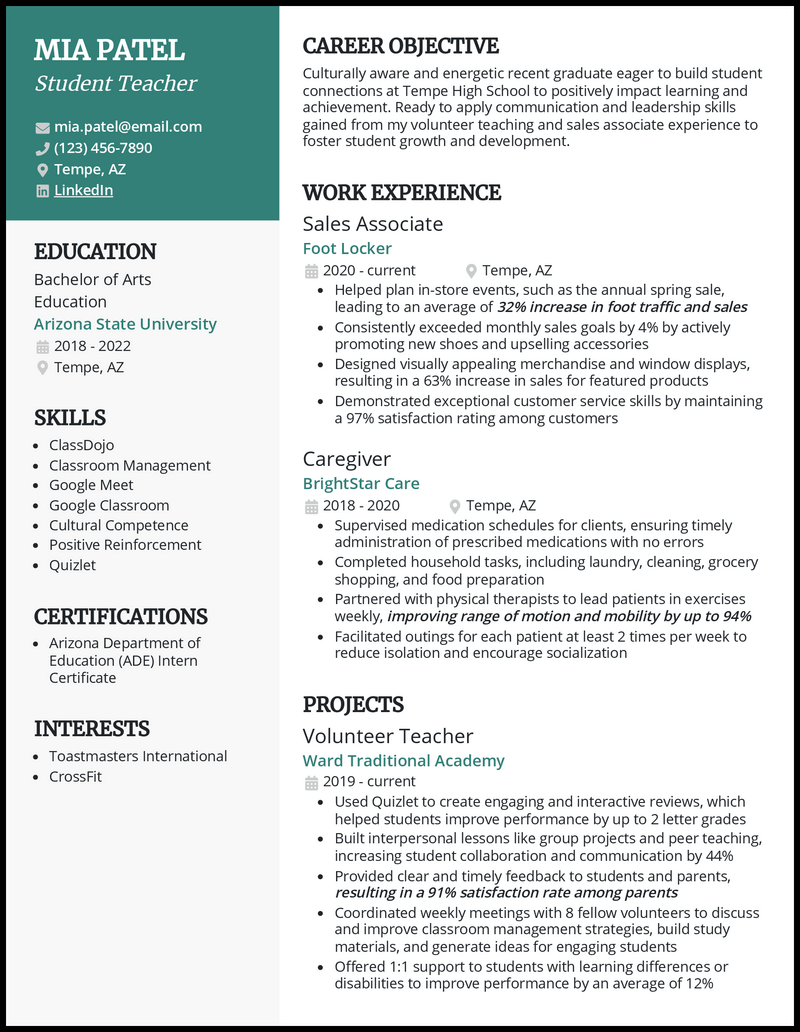
Why this CV works
- When you lack paid experience in the field, never underestimate the power of projects in your student teacher resume. If you’ve volunteered as a teacher after school, provided tutoring or homework help, or even assisted in a teacher’s grading load, you have valuable experience to add to your resume.
View more student teacher resumes >

Why this CV works
- Did you help students prepare for scholarship interviews, and they emerged victorious? Such unique achievements make your math teacher resume shine and grab the attention of your dream employer.

Why this CV works
- Let recruiters know you’re in it for the long haul by flaunting industry-relevant credentials in your kindergarten teacher resume. Just below your list of skills, add a “Certifications” section showing off credentials like Certified Child Life Specialist, Early Childhood Education Specialist, or Child Development Associate (CDA).

Why this CV works
- Flaunt industry-recognized credentials and certifications in your assistant teacher resume. A credential like Child Development Associate (CDA) proves understanding of early childhood education best practices and is sure to get a nod from the hiring manager reading your piece.
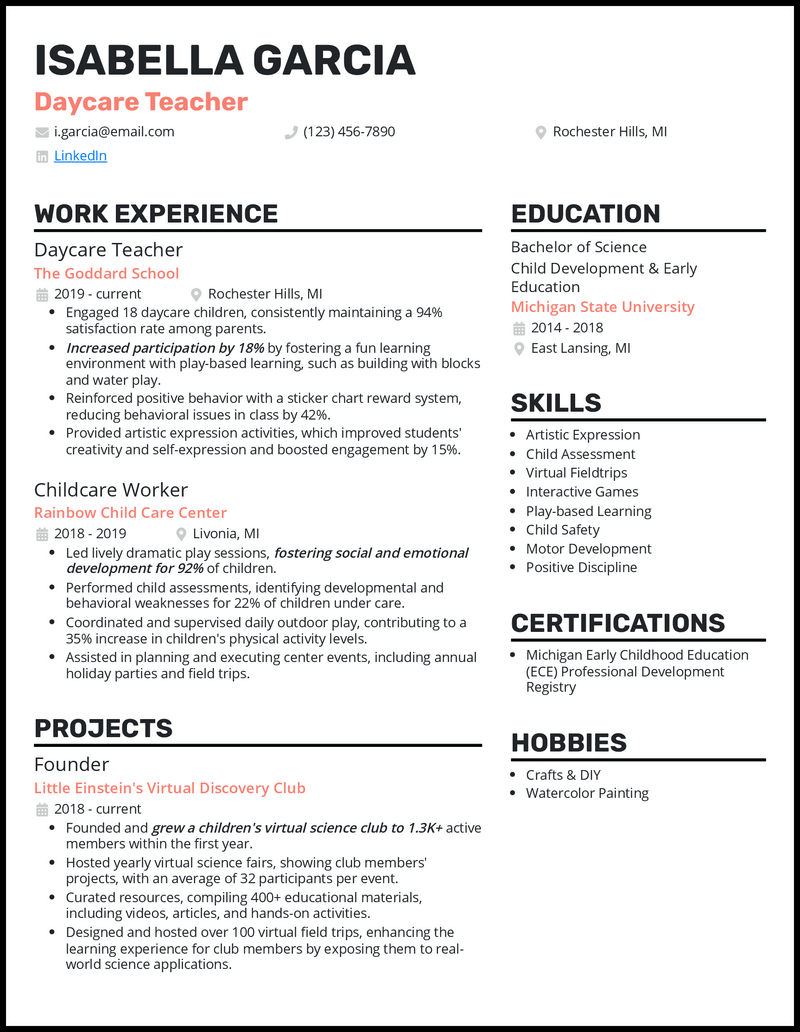
Why this CV works
- Teaching littles is no small undertaking, so focus your daycare teacher resume around the skills the specific school is looking for—and the skills that set you apart. If you’re a pro at integrating play-based learning like building blocks or water play into your daycare environment, do more than list it in your skills section.
See more daycare teacher resumes >

Why this CV works
- Begin by spotlighting your most recent, relevant position (paired with key quantified achievements and relevant tool applications) and backtrack through earlier roles. This technique is golden for illustrating your career progression in your teacher aide resume and should show an increment of responsibilities and wins as you go up.
Why this CV works
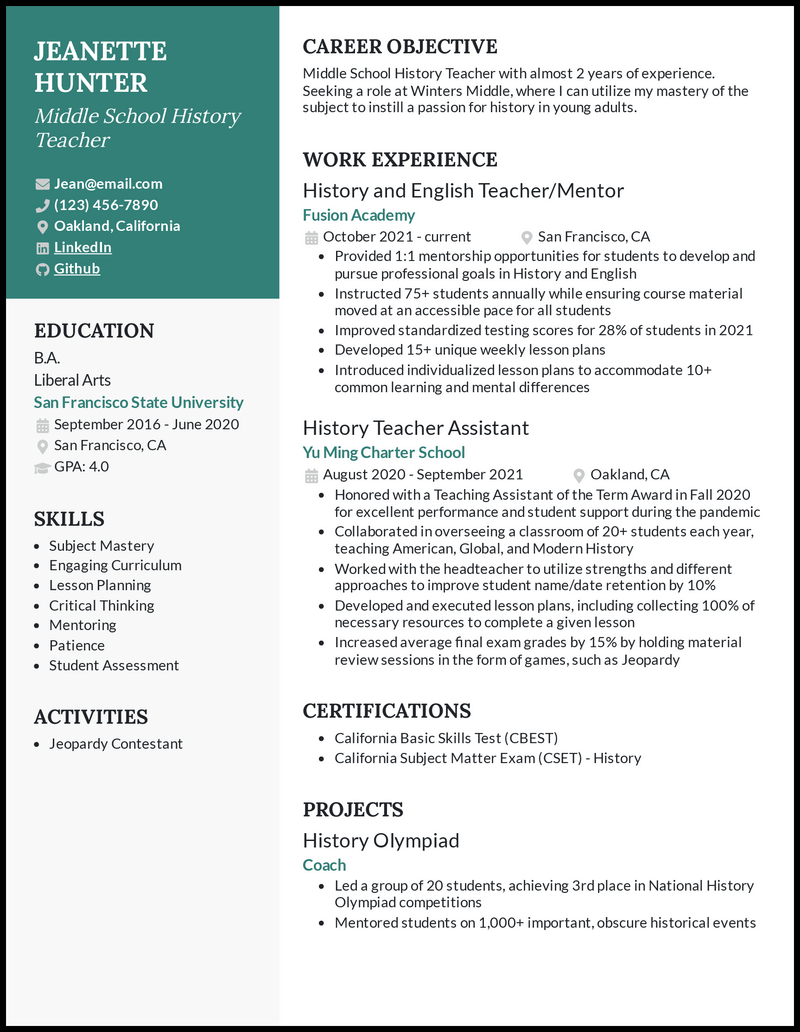
- Your middle school teacher resume may include the following sections: Career Objective, Certifications, Projects, Activities, andhobbies on your resume(just be sure you can explain why they’re relevant when you get an interview).
See more middle school teacher resumes >

Why this CV works
- Your experienced teacher resume must prove you’ve been tested and proven to be a terrific tutor. It’s perfect time to turn to your technology skills and how you’ve tapped them to solve everyday teaching challenges. Show how you’ve leveraged Zoom and Google Classroom for virtual teaching, Quizizz for tailored tests that improved average students score, and so on.
Why this CV works
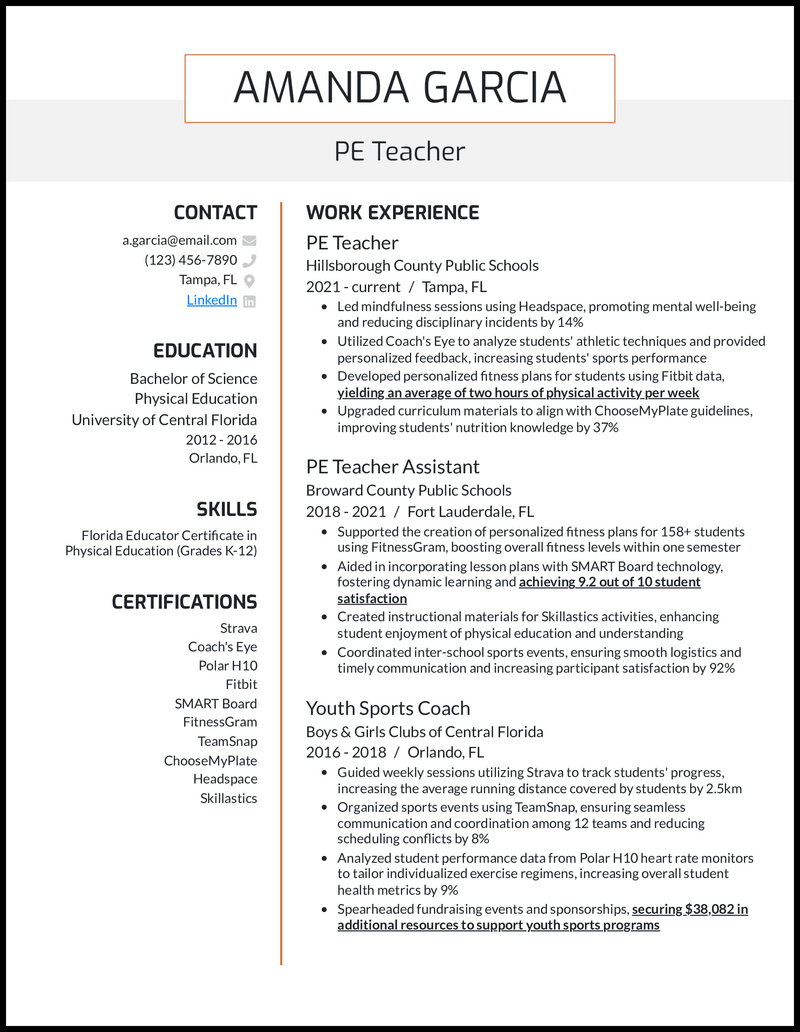
- Save a small section on your PE teacher resume’s side column for role-relevant tertiary educational background, much like how Amanda flaunts her bachelor’s degree (Physical Education) from the University of Central Florida. It’s about showing you’ve put a great deal of work into amassing the necessary knowledge and skills.

Why this CV works
- Is your science teacher resume polished enough to get recruiters sold on your brilliance? Take the time to meticulously proofread yours before hitting the send button. Better yet, involve a second pair of eyes, be it a friend, family member or career coach.

Why this CV works
- Let the hiring manager know what you’re capable of by quantifying outcomes in your piano teacher resume. Throwing in metrics like “Utilized Google Classroom to share updates and progress reports, garnering a 9.3/10 average rating from families” is a potent trick to get in the recruiter’s good graces.

Why this CV works
- Fill your first grade teacher resume with software like ABCmouse, ClassDojo, and Kahoot. It shows potential employers that you’re an expert at dealing with little ones and know exactly what technology to use to develop their test scores and talents.

Why this CV works
- Having a degree like a Bachelor of Arts in Spanish and Portuguese or a certificate like “Single Subject Teaching Credential in Spanish” in your Spanish teacher resume are great ways to prove your professionalism in teaching foreign languages.

Why this CV works
- Stand out by showcasing relevant certifications in your 2nd grade teacher resume. For instance, a Texas Education Certification tells the potential employer you’re recognized for your professionalism.

Why this CV works
- Let phrases like “Designed a new life skills curriculum supported by zSpace’s virtual simulations, increasing student competency in daily tasks by 38%” and “Utilised Kurzweil 3000 to provide reading support for 18 students, improving comprehension and retention of transition materials” take centre stage in the work history of your transitioning teacher CV.

Why this CV works
- An after school teacher resume that showcases your technical expertise can prove that you’re on the ball when it comes to instilling knowledge. If a handy tool like Google Classroom graces your skills section, illustrate how you leveraged it to improve learning experiences.

Why this CV works
- Adding phrases like “Cataloged class materials and assignments through Canvas, ensuring smooth operations for a class of 47 students” and “Organized and tracked daily activities and schedules using Padlet, improving routine consistency by 31%” will boost your chances of scoring an interview with your 4th grade teacher resume.
Why this CV works
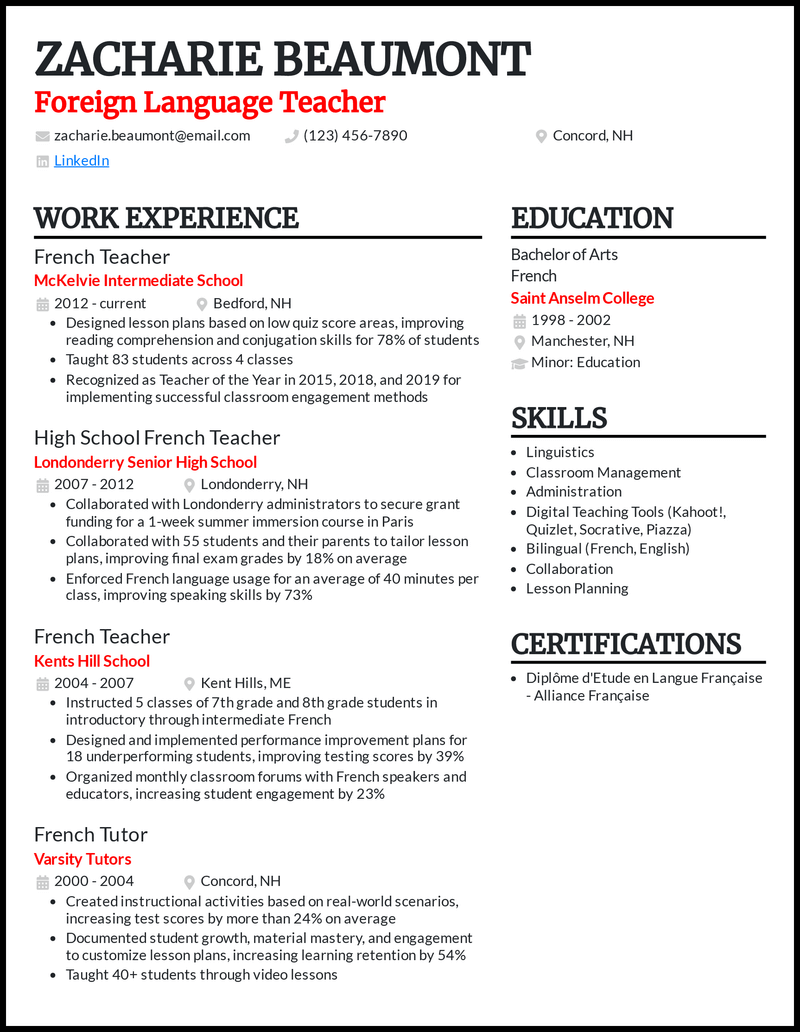
- Make your foreign language teacher resume for the job description is always a good idea, but how do you do that? Start by customizing your work experience bullet points for the job you want.
See more foreign language teacher resumes >
Why this CV works
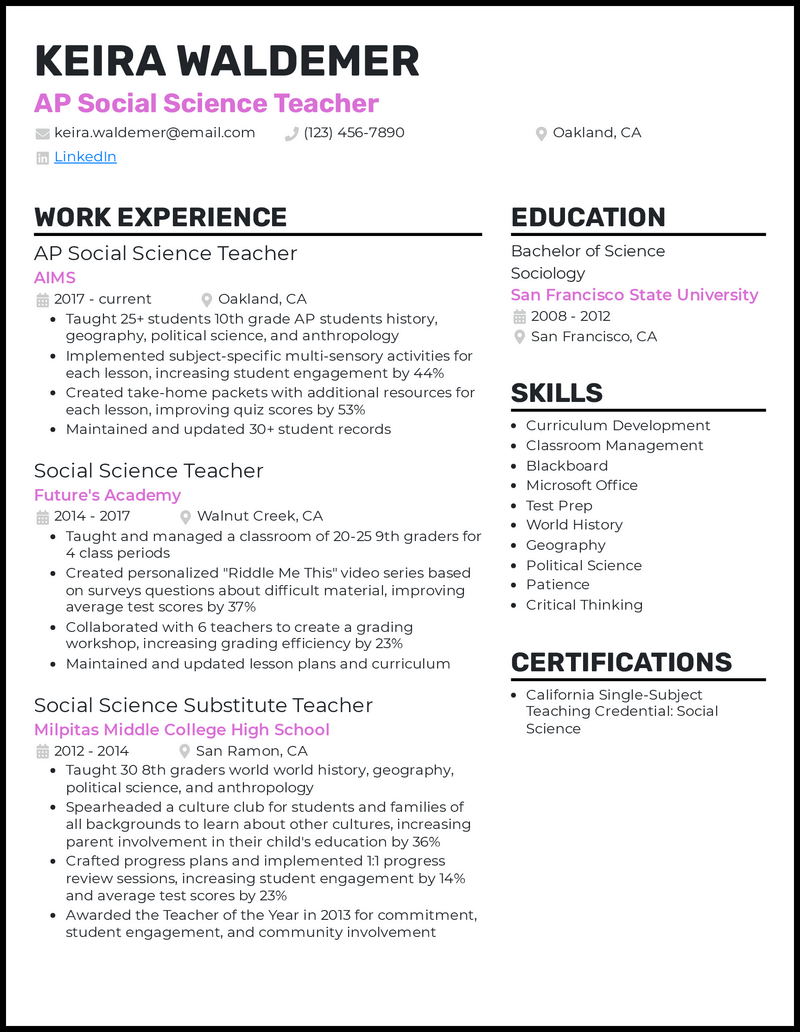
- Ask a friend, colleague, or even a co-worker to proofread your social science teacher resume. If you’re low on time, invest in a spell-check system like Grammarly or run your resume through our resume checker to catch any typos or comma errors.
See more social science teacher resumes >
Why this CV works
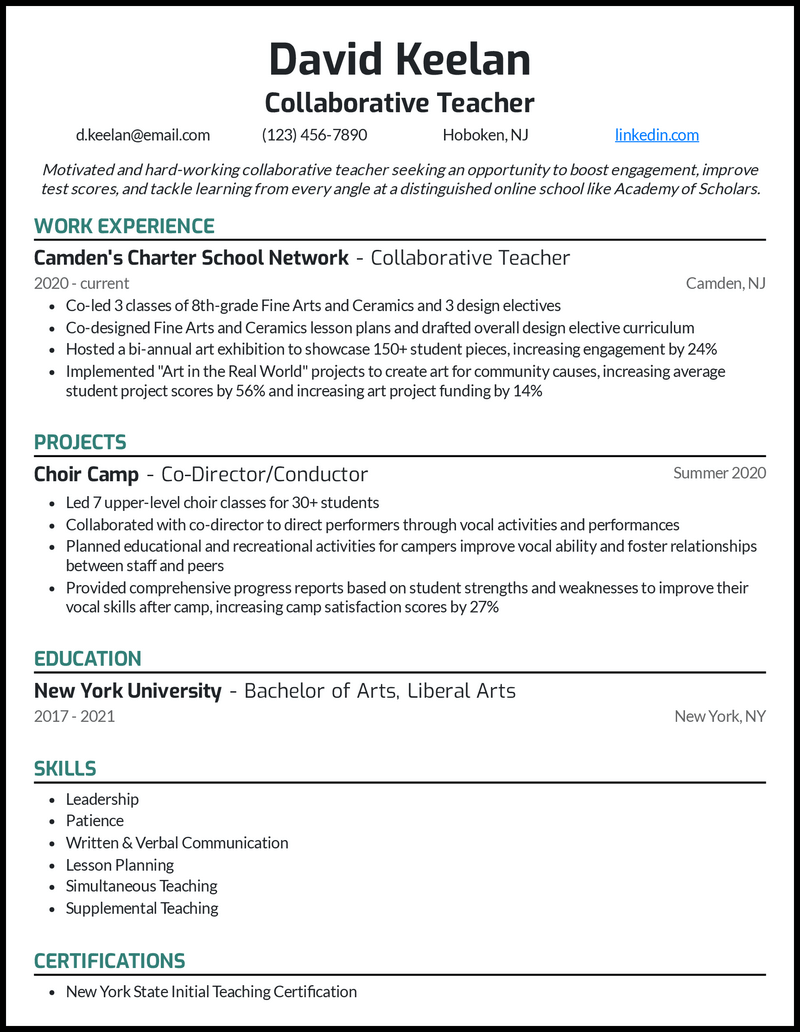
- Proper resume formatting can help your collaborative teacher resume look aesthetically pleasing, helping set you apart in the sea of generic resumes. Choose one or two key areas, such as section titles or your header, to include a pop of conservative color.
Related CV guides
How to Format a Teacher Resume

Formatting ensures your teacher CV is readable, logical, and complete. Imagine trying to understand a book without chapter headings or margins and no discernible organisation. It would be a nightmare to extract any information when nothing follows a clear structure and doesn’t lend itself to being read correctly. It’s an extreme example, but it proves the necessity of formatting.
Just as you create lesson plans to help your class learn best, format your CV so your qualifications are conveyed and understood. We’ll cover three important formatting elements in the following sections: CV formats, your contact header, and CV readability for ATS.

Three CV formats
The most popular resume formats for 2026 are reverse-chronological, functional, and combination/hybrid. Here are some of the pros and cons of each:
- Reverse-chronological: This format highlights your career progression in an easy-to-scan list, making it ideal for recruiters and applicant tracking systems. However, this format exposes time gaps and can be repetitive if you’ve held the same position at multiple schools.
- Functional: This format emphasises your skills, making it ideal if you have limited teaching experience or gaps in your employment history. However, it is often known to confuse potential employers and applicant tracking systems (ATS).
- Combination/hybrid: This utilises a detailed skills section alongside a concise experience section to effectively summarise why you’re the ideal candidate for the role. However, it’s easy to structure this poorly, and it can appear as though you’re concealing a lack of work experience.
We recommend the reverse-chronological format for your teacher CV because it demonstrates you have practical knowledge and a stable career. This format conveys the story of your teaching career in under six seconds, which is how long recruiters will take to read your CV.

Include the right details in your contact header
Your contact header should be easy to find and read. Some suggest not adding contact information in the header, but that’s why formatting your contact header correctly is so important. With good formatting, none of your information gets overlooked, and it can set you apart from other candidates. You should include:
- Name
- Job title you’re applying for
- Phone number
- Town/City, County (optional)
- Professional connections such as your LinkedIn profile (only if relevant)
According to industry standards, place the header either in the top left-hand corner or centred beneath your name. Not enough space? Remove the optional elements or reduce the font size. Choose a sans-serif font that’s no smaller than your CV’s body text.
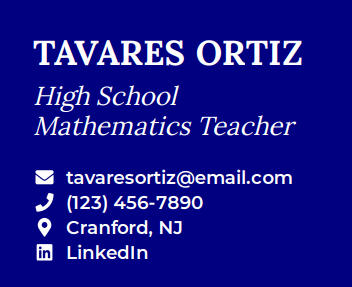
As in the example below, you can place your header in a colour block to quickly capture attention and add character. It’s best to avoid garish colours (neon green would be a definite no), and always double-check that the colour works well with black body text or white font.
Sometimes, the ATS won’t read your CV properly despite having a beautiful header. That’s why we recommend submitting it as a .docx (friendly for ATS) and as a PDF (friendly for employers).
We have plenty of excellent CV samples you can have a look at for inspiration on your header, and if you’re in a hurry, choose one of our free CV templates to start and complete your teacher CV in no time.
How to ensure the ATS and employers can read your resume
To ensure your CV reaches headteachers and department heads, you’ll need to pass muster with the ATS. The good news is that formatting for the ATS also results in a CV that is easy for employers to read.
CV tips to guide you on the right path:
- One page:
- Not only is a one-page CV quicker for recruiters and ATS to scan, but it forces you to be concise and include only what’s relevant.
- File type:
- Most ATS don’t recognise documents in Open Office, Adobe Pages, HTML, or PDF (on occasion). The wisest option is to submit your CV as a .docx and as a PDF to give employers options if one doesn’t work.
- Font sizes:
- The standard 10–12-point font is the best readability range for employers and ATS.
- Fonts:
- Even at a reasonable size, some fonts are hard to read, appear unprofessional, and are not ATS-friendly. Stick to standard sans-serif fonts like Helvetica or Arial.
- Margins:
- One-inch margins are standard, but you can be flexible. Avoid going smaller than half an inch or larger than one inch to keep your teacher CV professional and tidy.
- Header names:
- You may confuse the ATS and the school if you have unusual header titles. Use standardised headers, as you see in our CV samples, to make each section easy to find (and understand).
- Skills:
- ATS uses keywords to determine your eligibility, including skills (Google Classroom, adapting lessons, parent communication, etc.) that match what’s in the job advert.
- Logical order:
- If your CV sections aren’t in the recommended order, they may confuse ATS. Once again, it’s best to stick to the standard by using an AI CV generator.
How to Write a Teacher CV

Summary
This content shows teachers how to craft data-backed, ATS-optimised CVs that showcase classroom impact, leadership, and career growth.
Writing an effective CV may feel daunting, but it’s far more manageable if you take it section by section. You may even want to use one of our fresh Word CV templates designed just for teachers. Let’s dive into each CV section you’ll want to consider:
- Does an objective/summary on your teacher CV matter?
- Teaching history
- Top skills for teachers
- Listing education, qualifications, and optional sections
- Customise your teacher CV for the job
- Revise and edit your teacher CV

Does an objective/summary on your teacher CV matter?
Headteachers and their hiring teams may see hundreds of CVs across a wide range of teaching roles, so it’s crucial to showcase your talents and personality quickly. Objectives and summaries can serve as excellent introductory tools, but many end up being generic, dull, or vague.
First, consider whether you’ll use an objective or summary statement (or neither). An objective highlights your interest and qualifications for the role, while a CV career summary distils your specialised skills and experience in a few lines. Use an objective if you’re seeking your first teaching position or switching from teaching one subject to another. On the other hand, experienced teachers may opt for a summary (or no statement at all).
Regardless of your circumstances, if you use either of these introductory statements, you should always tailor your message to the role. Let’s look at specific examples to contrast a D+ CV objective with one worthy of an A.
A generic, vague objective tells recruiters nothing about you beyond the bare minimum:
New secondary school teacher seeking employment at a local secondary school closer to family. Skilled at communicating with teenagers and teaching. Received many compliments and letters at last place of employment.
The objective above lacks personality and fails to mention anything specific. This next objective, however, is focused and informs the headteacher about the applicant’s skills:
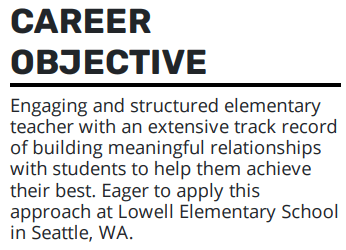
Compassionate maths tutor with over 4 years of experience. Excellent at coaching students in formulas and helping them develop analytical thinking skills and mathematical competency at all levels of ability. Seeking to use my communication and interpersonal skills to build meaningful student relationships and improve their mathematical abilities at Joaquin Secondary School.
Similar to the visual example below, the objective above is effective because it outlines the applicant’s experience and how it relates to their new goals within the classroom.
Summarising years of experience into a single paragraph can be challenging, so they often end up looking like this:
Skilled and experienced teacher who loves working with young children. Proficient in communication and care. Eager to apply my skills at Sunnyside Primary School.
To begin with, repeating “skilled” and “experienced” won’t convey anything to employers. A good summary should highlight your experience and qualifications, making headteachers wish they had the opportunity to hire you years ago:
Primary school teacher with over 12 years of experience managing classrooms of 25-30 Year 1, Year 2, and Year 3 pupils. I am a patient, personable, and compassionate professional eager to bring my expertise to Sunnyside Primary School. Awarded Teacher of the Year in 2020 and 2021 for creating online individualised lesson plans for over 65 students during the height of the pandemic.
This summary is effective because it informs the recruiter of their specific qualifications, namely personalised lesson plans and classroom management, as well as their skills (in this case, two awards).

What and how to measure metrics and evidence of impact
It’s tempting to list every job you’ve ever had to prove you’re qualified, but this becomes either overwhelming or repetitive. It also means you can’t include much about each position, which won’t inspire headteachers to hire you.
Instead, choose two to four of your most relevant teaching roles. Quantify your responsibilities and incorporate skill keywords to improve your ATS score with each.
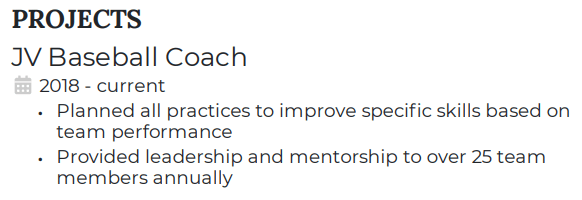
No teaching experience yet? Include placements, student teaching, volunteering, or other special projects like the example below that can showcase your soft skills such as leadership. Qualifications and awards are useful additions, too.
How to write your job description bullet points
Whether you’re describing a previous job, a work placement, or a university project, you’ll need to craft your bullet points with care. Every word counts, so use active verbs, definitive language, third-person pronouns, and consistent verb tenses. Pay careful attention to consistency with punctuation—using full stops at the end of some bullets while none for others is untidy.
Based on these CV writing tips, here are some examples of well-crafted bullet points suited for a teacher CV:
- Taught maths, English, general science, art, geography, and history to over 60 Year 4 pupils
- Collaborated with parents to discuss pupil performance and options for an improved learning experience, such as personalised instruction for students with learning difficulties.
- Organised an annual fundraising event to raise £6,500 for over 10 teachers to attend the RAISE conference and led yearly trips to RAISE meetings, resulting in more effective teaching strategies and a renewed passion for academia.
These bullet points work because they’re descriptive and results-focused. Aim for conciseness and specificity with your job description bullet points.
How to maximize your classroom impact with numbers
From an employer’s perspective, metrics validate your abilities by demonstrating that your actions led to a desirable outcome. If possible, include metrics in 50 per cent of your job description bullet points to highlight the results of your effective teaching.
When discussing previous teaching positions, it’s a good idea to talk about the following metrics:
- Increase in test scores, pass rates, or grade point averages
- Number of students/classes taught
- Increase in student participation/improved behaviour
The following examples use the metric types listed above to describe a teacher’s impact further:
- Co-founded a STEM club with the help of four fellow teachers, increasing student pass rates in science and maths by 13%
- Set up weekly one-to-one student conversation sessions to deliberately foster student-teacher relationships, leading to a 15% overall increase in classroom participation and attendance.
- Hosted monthly Write-Til-You-Drop sessions for secondary school students struggling with English and provided expertise in outlining thesis development and argument structure, which led to a 31% increase in essay scores for participating students.

What are the top skills for educators?
The skills section of your CV is a quick guide to what you bring to the table as a teacher. That means choosing the right skills for each job is crucial. You might be organised and great at time management, but if employers want to see that you’re compassionate and great at lesson planning instead, your CV may be set aside.
Since teachers fulfil many roles, employers will want to see a range of varied skills, including soft, hard, and technical abilities, such as these:
Common teacher skills
- Collaboration
- Problem-solving
- One-to-one communication
- Blackboard
- Organisation
- Classroom management
- Empathy
- Active listening
- Lesson planning
- Google Classroom
- Parental communication
- Markbook software
These skills demonstrate aptitude and support the responsibilities a teacher must fulfil in their role. Remember that while the above list outlines common and popular teaching skills for your CV, prioritise what the job description is explicitly seeking.

How to include education, certifications, and optional sections
You’ll need to include different elements on your CV depending on your education level, years in the workforce, and any specialisations or areas of focus you possess. All teaching positions require a bachelor’s degree, and an increasing number of teachers hold a master’s. Also, ensure you’re up-to-date on your relevant certifications, like the candidate from California below.

If you hold many qualifications, you don’t necessarily need to include them all if you’re applying for one specific role. For example, suppose you’re a TESOL-certified teacher with a postgraduate TESOL certificate seeking a TESOL role. In that case, you’ll need to include that qualification either in a summary/objective, in your work experience, or in your education.
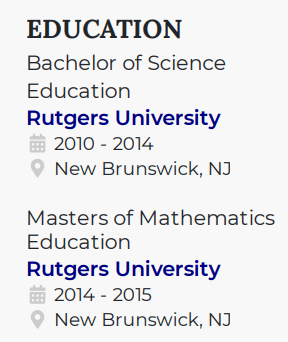
The education of this candidate speaks volumes with a classic bold font and colour.
While including education and qualifications is required, a projects section is optional. If you’re a drama teacher, for example, new to directing but experienced with leading drama camps, including a projects section to describe the drama camps you’ve led or assisted with can add a relevant impact. List and discuss projects on your CV, just like a paid position.
Additionally, consider adding interests and hobbies to your CV. Most teacher CVs should save room for other information, but it’s a good idea to add these sections when the job you’re applying for emphasises the importance of school spirit and culture.
Select your interests that align with the school’s values. However, be selective about what you include. Discovering every Easter Egg in the entire timeline of Zelda games might be your favourite hobby, but that doesn’t mean you should list it on a CV (unless you’re applying to Nintendo, in which case this might be appropriate, and you’re reading the wrong CV guide).
It’s up to you whether you include any optional sections on your CV, but always make sure to be as specific as possible. Your interests should also be specific. “Reading” doesn’t say much about you, but “leading classic book clubs” is far more likely to get you a job as an English teacher.

How to customize your teacher resume for the job
Generic CVs are easy to spot and will likely get discarded. To avoid the bin, tailor your CV to every position you apply for. This shows headteachers that you’ve researched the school and the role, and you genuinely care about the position.
To customise your CV, scan the job advert to understand which responsibilities, achievements, and keywords to include in your skills section and bullet points. You should also tailor your objective/summary (if used) to include the school’s name and mention anything unique about the school that particularly interests you. Compare your CV with the job description to ensure you’re addressing their requirements.

Revise and edit your teacher CV
As a teacher, you already know the pitfalls of submitting drafts before they’re revised, so don’t let minor mistakes slip through the net. Instead, take a break and hand your CV over for peer review. You can also use our free CV checker to get tips from our AI software.
After a day, return to your CV and consider the constructive criticism you received. Edit and check for errors, inconsistencies, or gaps. Read through your CV at least twice more, once for content and once for proofreading. Once you’re sure it’s error-free, you can submit it with confidence.
Start Setting up Your Classroom (Almost)

Go ahead and celebrate because if you’ve made it this far, you’re well on your way to that A+ CV! By spending more time throughout each phase of the writing process, you’re propelling yourself closer to your next teaching job. It’ll be time to hand in a simple resignation letter at your current job and start setting up your new classroom before you know it!
If you’re not quite satisfied with your current CV, upload it to our CV checker for our AI-powered tips. If it’s time to start from scratch, use our free CV maker to work with our AI from the ground up. We can’t wait to see you land your next teaching role!
Teacher CV FAQs

Teaching is strictly governed by professional conduct, competencies, and mandatory qualifications before you can step into a classroom. This strictness means that your teaching licences, whether national or otherwise, and profession-specific certifications deserve a prominent place in your CV. The next important aspects are your skills and impact both in and outside the classroom. Therefore, you should also include your teaching skills and how you’ve utilised them to make an impact on the cognitive growth and development of pupils.
Yes! However, for an experienced teacher with a rich, extensive work history, including all your work experience in your CV isn’t straightforward. You must add your experience with your top accomplishments, but that doesn’t mean listing more than three different roles you’ve held in your 10+ years of teaching. Choose the most recent, more senior experiences and their measurable achievements to demonstrate what you can do. You can discuss the other experiences when you write a covering letter to reinforce your application.
A postsecondary lecturer’s CV should look different from any other teaching CV, such as a primary school teacher’s CV. To highlight this distinction, emphasise the teaching environment you wish to work in, such as a postsecondary teaching setting. The rest of the details will vary depending on your level of experience, education, and the requirements outlined in the job advert.

Stephen is the co-founder and CEO of BeamJobs. Frustrated with the challenges he'd faced in his own job search, he left the corporate world to start BeamJobs with his brother. Drawing on firsthand experience with hiring and getting hired as technical talent, he started BeamJobs in 2020 to help qualified job seekers land interviews with less stress. Since then, more than 4 million people have built their resumes and cover letters on BeamJobs. Stephen's insights have been featured in notable outlets, such as Fast Company, Business Insider, Yahoo Finance, MIT, and Zapier. Learn more about Stephen.