



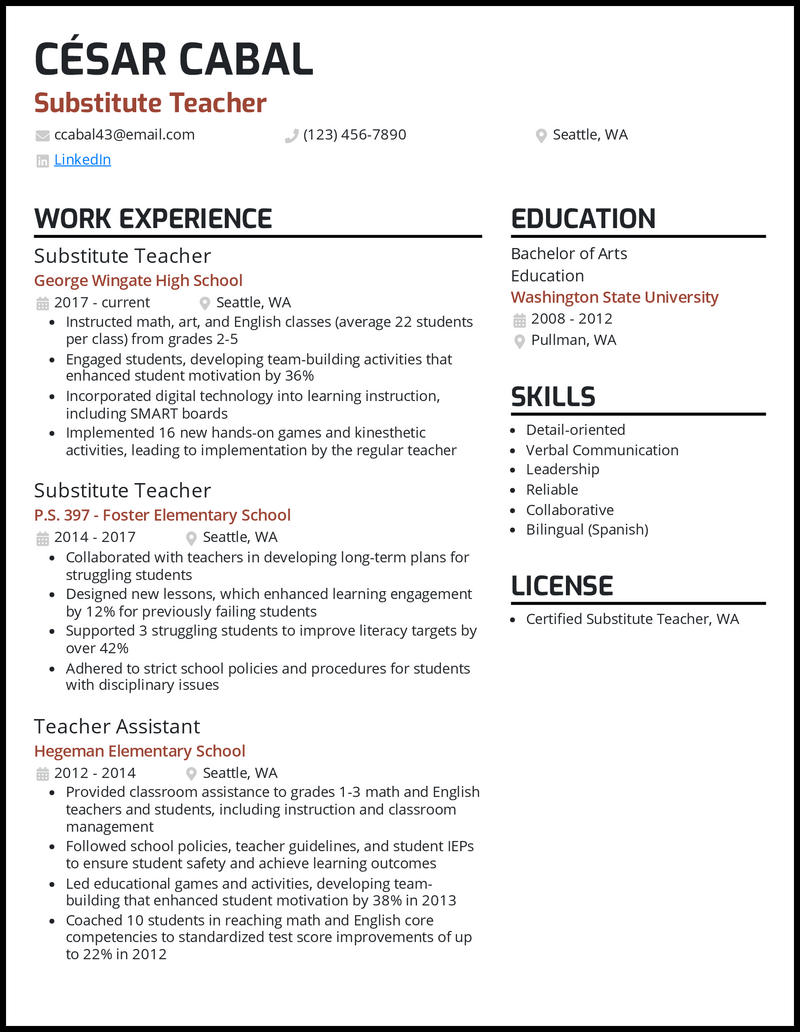
From patience for classroom management to the latest EduTech software, you must clearly communicate your best bits to hiring managers in your substitute teacher resume.
This guide will help you write a resume that emphasizes EduTech skills, relevant experiences, and teacher-specific accomplishments to make sure you become the next student favorite. By the end, you’ll learn how to:
- ↪ Use a resume builder to conquer strict ATS systems
- ↪ Tailor each section to meet the job description
- ↪ Highlight your resume’s best points to build a cover letter
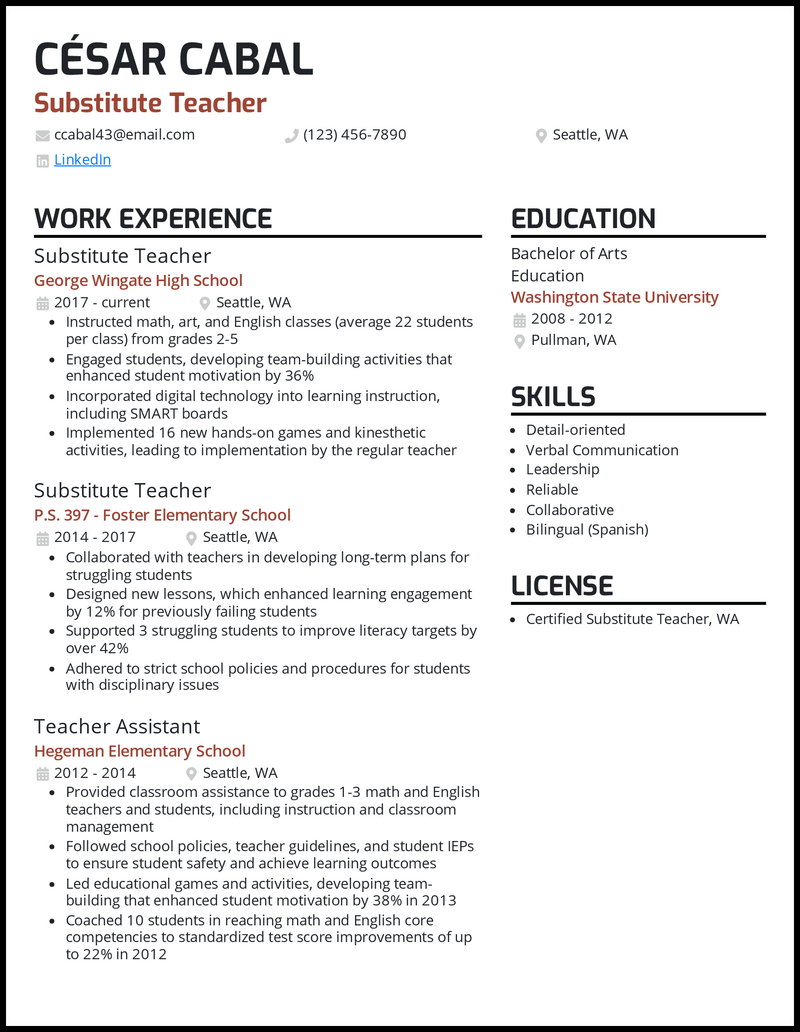
Why this resume works
- Make sure you’ve checked your resume to ensure a high-quality submission. If something takes up more than one bullet point, include it on your substitute teacher cover letter instead of your resume.
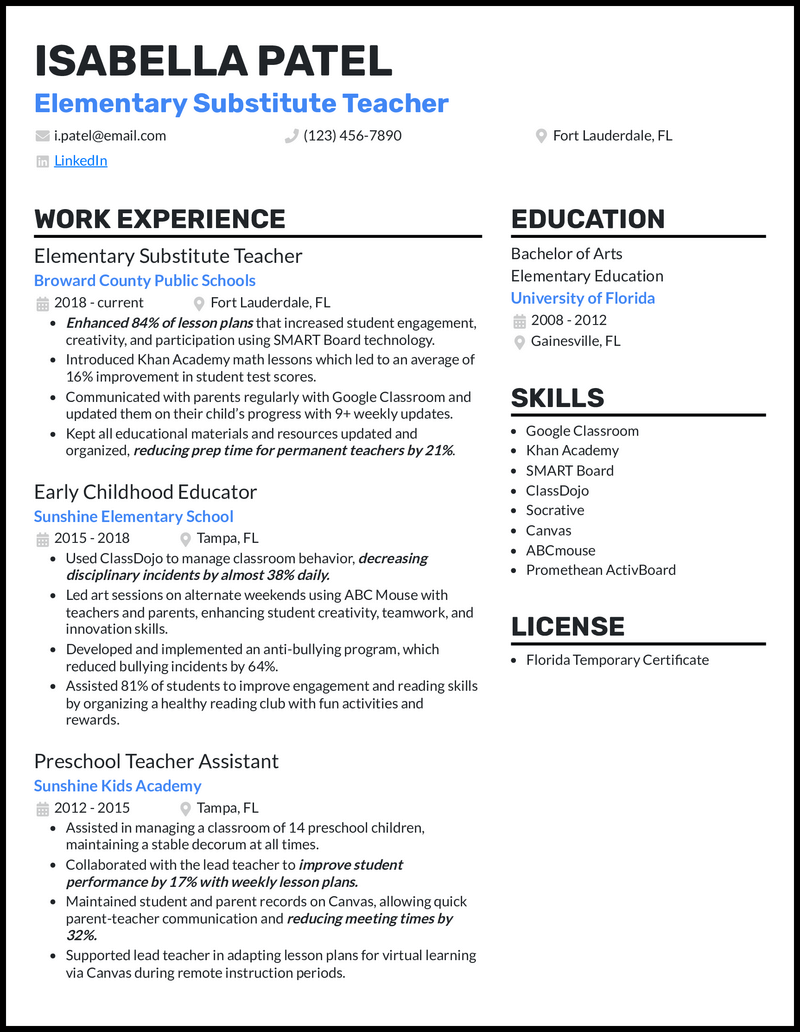
Why this resume works
- List any projects you’ve developed that have helped students improve their social and academic skills. You can also showcase any programs that you created to help children from bullying. Don’t forget to add tools like Google Classroom, that you’re well-versed with.
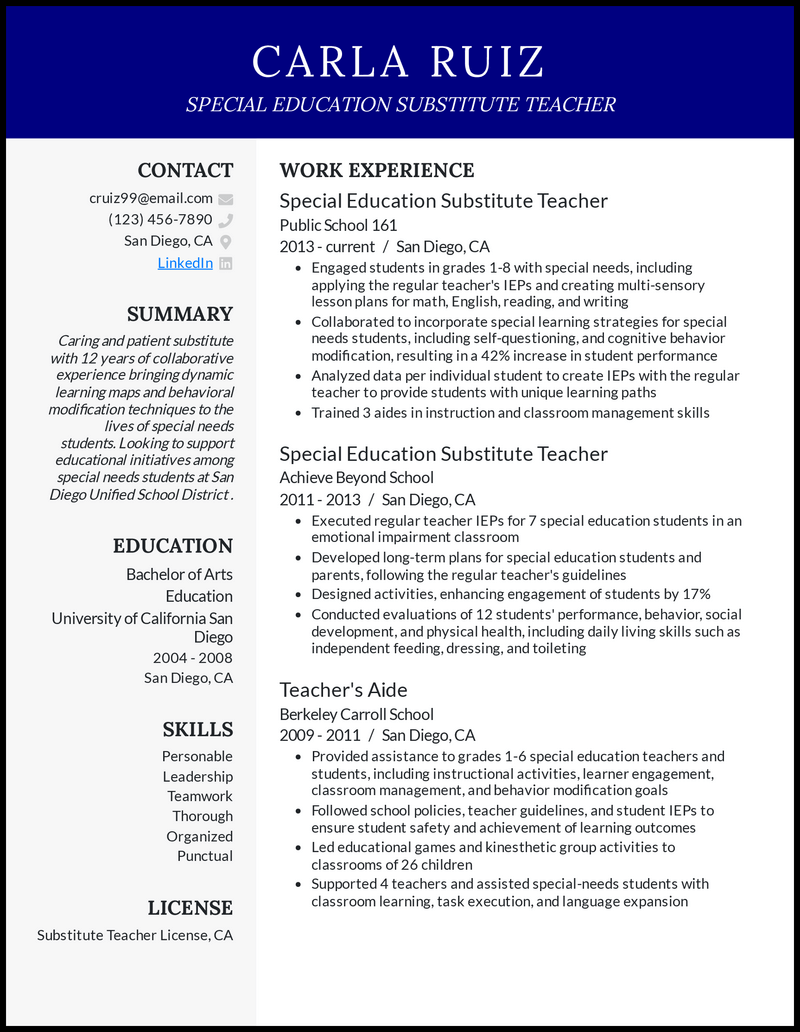
Why this resume works
- Discuss your biggest professional accomplishments while also mentioning a few keywords from the teacher job description to create a perfect summary.
See more special education substitute teacher resumes >
Why this resume works
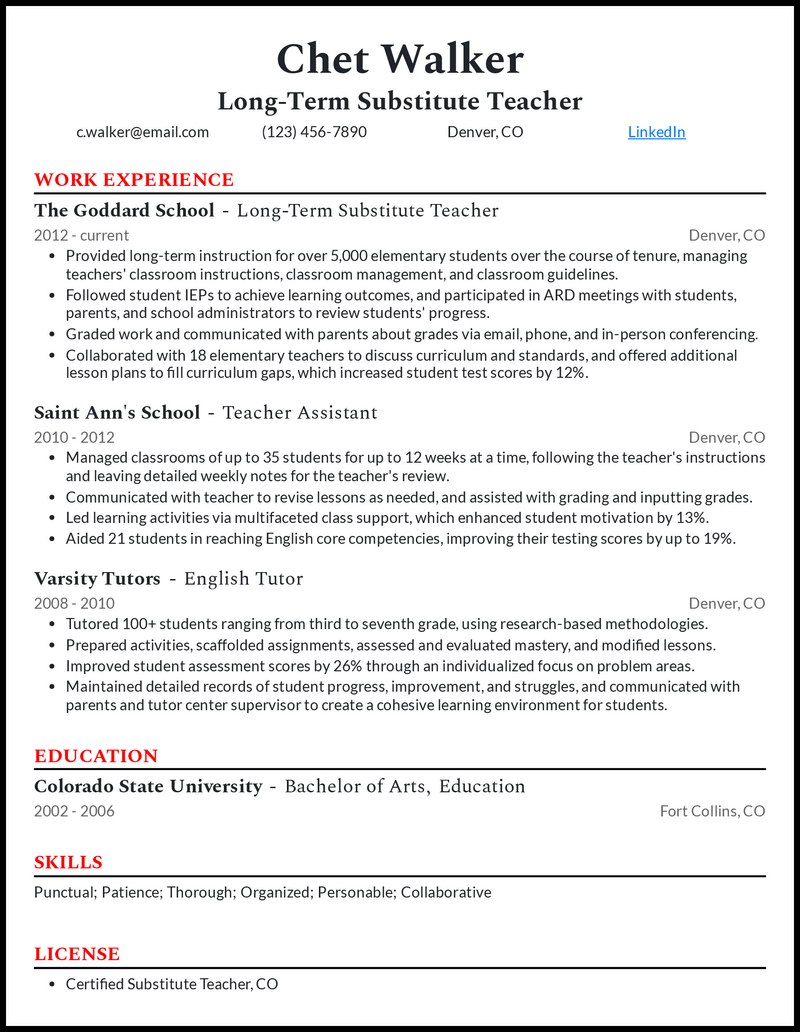
- Be sure to highlight any new programs or initiatives you implemented and managed. Did your efforts improve your students’ test scores, engagement, or productivity?
See more long-term substitute teacher resumes >

Why this resume works
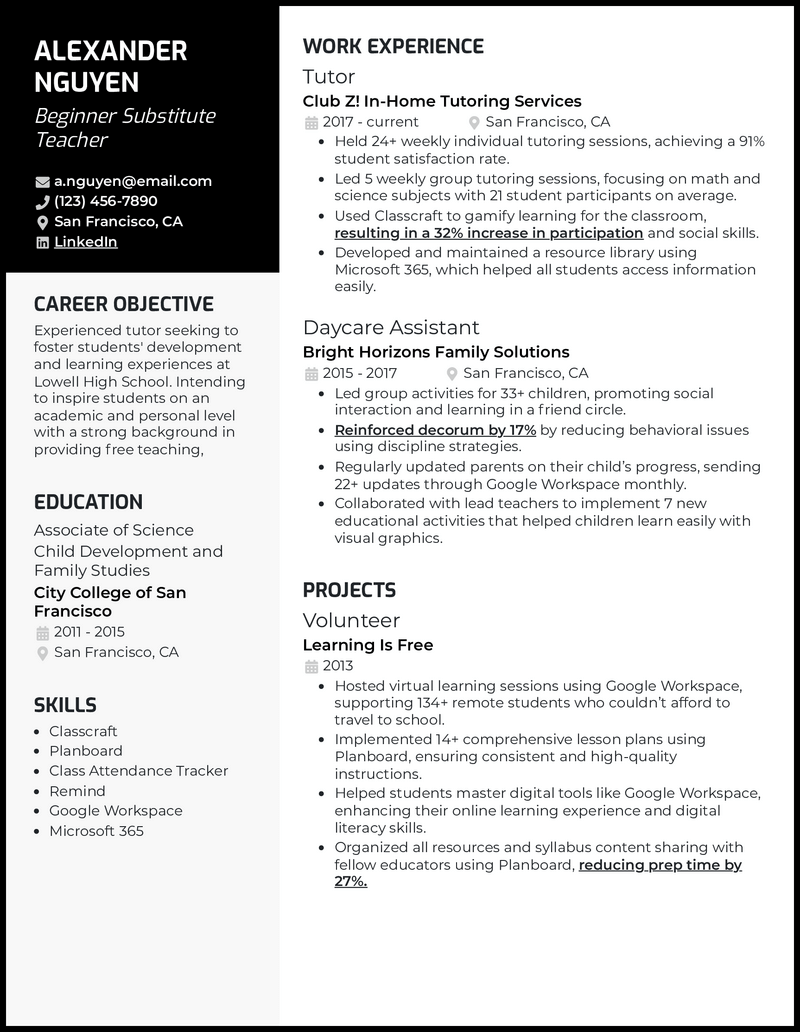
- List down every educational software that you’re good at like ClassDojo, ABCmouse, and Storybird to prove that you’re more than capable of creating fun in classrooms with modern-day software.
Why this resume works
- Add details of how you have helped children understand a concept better or taught them a skill needed in the modern world, like Google Workspace. Remember to list how you can handle the behavior of a classroom and make learning fun in your substitute teacher no experience resume.

Why this resume works
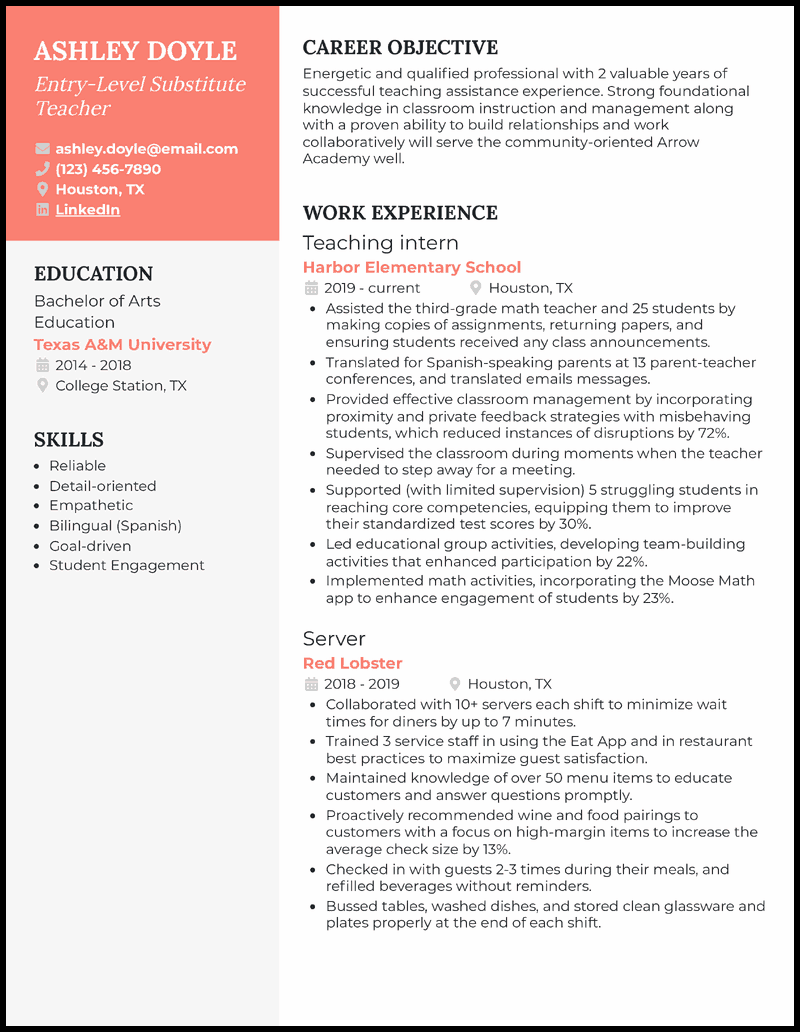
- Wondering how to draw instant attention to your substitute paraprofessional resume? Emphasizing noteworthy achievements (whether underlining, bolding, or italicizing) could be your golden ticket.
Why this resume works
- As an entry-level candidate, using a resume objective can help you discuss your relevant experience and why you’re a perfect fit as their substitute teacher.
See more entry-level substitute teacher resumes >

Why this resume works
- Using CamScanner to organize student’s health records, Quiziz to make classroom sessions more interactive, and Canvas to create and upload assignments mirror perfect examples for a winning public school substitute teacher resume. Demonstrate similar moments like the tech-savvy you are.
Why this resume works
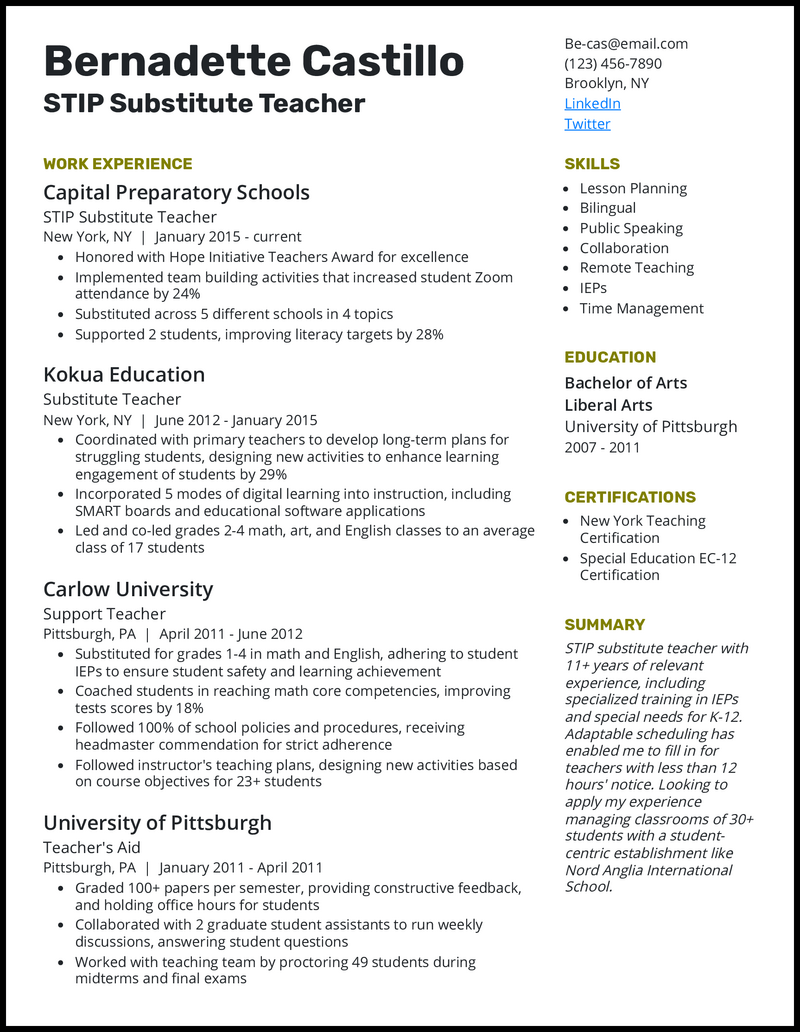
- Including a resume summary statement can be just the special touch you need to set you apart from other candidates, especially if you have specific highlights to share.

Why this resume works
- Mentioning an accredited document like a Substitute Teacher Certificate will help you put your point across and instill trust in employers.
Related resume guides
How to Write a Substitute Teacher Resume

Summary
To craft a standout substitute-teacher resume, use clear formatting, active language, quantified teaching achievements, and EduTech skills.
Whether it be elementary education or college, substitute teaching demands quickness to adapt, and a successful resume should clearly highlight relevant experience and skills while showing that you can handle these challenges and support the school’s learning environment.
For starters: avoid using fancy graphics to “show off your teaching skills in style.” Instead, focus on what employers look for when they hire substitute teachers.
Your main focus on the resume should be about previous substitute teacher work experience, a strong skillset, and your education qualifications in teaching.
Below, we’ll cover how you can:
- Craft an objective/summary to show your teaching prowess
- Quantify your teaching work experiences
- Use a template that displays your career in a clean format
- Add EduTech skills to show you’re keeping up with modern teaching standards
- Write a strong cover letter for your application

How to format your resume for ATS and recruiters
Don’t underestimate the importance of good resume formatting. When done well, it ensures that your substitute teacher resume is easy to read, flows logically, and is complete.
When you’re formatting your resume, focus on the following:
- Using the best resume format option
- Ensuring contact info and headers are prominently displayed
- Making your resume readable for ATS

Resume format options
You can format your resume in many different ways, but reverse-chronological, functional, and combination/hybrid formats are the most popular in 2026 for a reason. Let’s go through each one:
Retail resume format choices:
- Reverse-chronological: This format emphasizes your career progress by your most recent job at the top of your resume.
- This format showcases your skills, which can be helpful if you have gaps in your job history.
- This format lists work experiences in reverse-chronological order while simultaneously emphasizing skills.
Though every format has unique advantages, we recommend using reverse-chronological formatting. It’s the most common format, and it’s the easiest to read.
Unlike in your classroom, individuality isn’t always rewarded when it comes to resume formatting. Instead, use the content of your resume to set yourself apart from the crowd!

What is the best resume template for a substitute teacher?
The resume design is the first thing employers see, so the best substitute teacher resume template is one that contains all your key details and experience while having enough white space.
Choosing the right template can be difficult, and if you can’t set your heart on one, simply choose the highlight BEAM template from our list. Its design suits all professions and helps you stand out from the crowd.

How do you describe being a substitute teacher on a resume?
Describing your substitute teacher work experience on a resume is simple: Use strong action words and action verbs to describe your teaching experience and achievements, focusing more on qualified results and less on generic wording. Include specific metrics that prove your contribution had a positive effect on students.
You should use strong action words to show your substitute teacher experience, such as:
- Engaged
- Developed
- Taught
- Improved
- Grew
- Fostered
- Assisted
Since this is a teaching role, refrain from using causative verbs like “Lowered” or “Reduced” since they can put out a negative vibe. Instead, pick augmentative action words like “Increased” or “Improved” to instantly grab an employer’s attention.

How to craft the contact info and header
Thought you’d learned all the rules for formatting your resume? Well, it turns out that the overall layout across your resume is critical for creating good flow and helping hiring managers make sense of who you are as a candidate.
To avoid looking like a student who was struggling to meet the minimum page requirement, try using a 10-12 point font for your body text. It’s big enough to be readable without being huge (and a space-filler) or too small (to make extra room). For headers, you can go with a 20-24 font, and you can use a touch of color to really make them pop. Here’s one example from our resume samples:
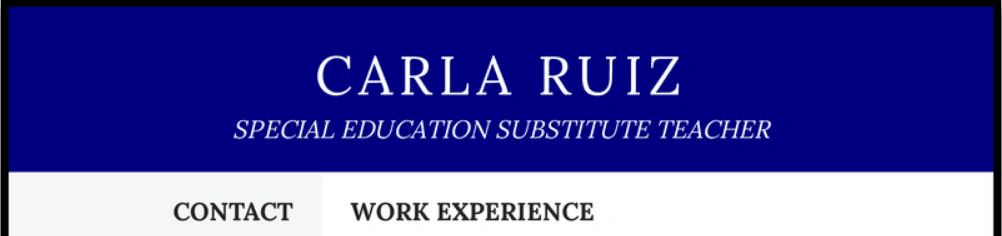
Don’t forget proper alignment, too! Having 1-inch margins will make your resume look that much more polished.
Of course, don’t leave a recruiter wondering how to reach out to you. Include a proper header including your contact information at the top left, right, or center of your resume.
Make sure you include:
- Your name
- The job title you’re seeking (rather than the job title you already have)
- Your professional email (i.e. not the email address you made when you were 12, like “[email protected]”)
- Your phone number
- Your city and state (optional but recommended for local jobs)
- Professional links to your LinkedIn, portfolio, or other key links (optional)
There are countless ways you can format your resume contact information and headers. Need inspiration? Check out this picture from one of our resume examples, complete with two links:

If you want more formatting help for your contact information, there are plenty of resume examples you can use to brainstorm. Our top tip: keep this information at the top of your resume and easy to read.

How to ensure ATS and readability for your resume
ATS, or Applicant Tracking Systems, is more than just software. It’s the natural nemesis of countless job seekers. Dozens of applicants aren’t considered for jobs solely based on the ATS’ recommendations.
Luckily, if you know how ATS works, you can unlock the full potential of your substitute teacher resume and impress hiring managers. ATS is mainly used to pre-filter through resumes by matching selected keywords to words used on your resume.
You can help ATS read your resume correctly by:
- Using the proper (1-inch) margins
- Sticking to basic fonts (no pacifico, please)
- Using headers appropriately
- Strategizing what goes into your skills section to match keywords
- Organizing your resume in reverse-chronological order
- Sticking to a single page
If you’re getting overwhelmed by all these formatting rules, don’t worry. As a substitute teacher who’s busy educating the next generation, you don’t need to spend your precious time nitpicking over formatting decisions. Try using an AI resume builder or a really good resume template to do the hard work for you and make formatting your resume a breeze.

What are the key components of a substitute teacher resume
We know that writing an effective resume is a serious challenge, but you can accomplish more (and not feel overwhelmed) by going one section at a time.
Let’s go through all the essential (and optional) sections on your substitute teacher resume, including:
- The resume objective/summary
- Work experience
- Substitute teacher skills
- Certifications, hobbies, interests, and projects
- How to customize your resume
- And the value of diligent proofreading

What’s the objective/professional summary all about?
Few job applicants understand the subtle, but important, differences between a resume objective and professional summary. While both are optional resume sections that consist of two to four short sentences, they serve different purposes.
A resume objective focuses on your eagerness for the job and why you’d be a good fit for a substitute teacher position. It works best if you’re light on work experience (less than two years) or if you’re shifting careers.
A resume summary, on the other hand, highlights how you’ve used your skills over the course of your career. You should only use one if you have 10+ years of experience.
The most important aspect of a good objective or summary is customization. They’re only valuable if they’re specific, so your statement should always include a specific job title and relevant skills and be customized for each job application.
Let’s check out some examples:
- Poor objective: Several years of experience in the education industry with a passion for children. Wanting to take the next step at a K-12 school.
- Poor summary: Patient teacher with many years of education experience with a background teaching students several subjects. Looking for a job at a nearby school to care for students and help them get good grades.
- Why these don’t work: These statements are broad and unspecific. They don’t really add value to your resume, and with real estate so limited, that means they’re not worth the space.
- Strong objective: Creative substitute teacher with 2+ years of experience ensuring early childhood education during the Covid-19 pandemic. Seeking an opportunity to continue ensuring educational excellence for 5th and 6th grade children at Gollach Middle School by collaborating with primary educators to develop customized lesson plans.
- Strong summary: Results-driven substitute teacher with more than 13 years of educational experience managing classrooms of 5-40 students. From discussing student performance with parents and faculty to collaborating with teaching teams to ensure curriculum continuity, I can contribute meaningfully to the educational value students need to return to pre-pandemic testing levels as a substitute teacher for The Friends School.
- Why these work: These are both specific, including job titles, school names, and metrics. They mention specific skill sets and highlight why they’d be a valuable contribution to each specific school.

How to present your impactful work experience
We understand that every job experience has value and has likely helped you develop into the educator you are today. Unfortunately, there’s just not enough room to include everything.
Plus, hiring managers should only see the very best (aka the most relevant) jobs you’ve had when they read your resume. So that means your time working as a barista isn’t a great addition to your substitute teacher resume.
Instead, focus on your most recent two to four job experiences. If you don’t have much experience, shift to including projects, internships, and volunteer experiences (don’t worry, we’ll talk about these in more detail below).

How to write your job description bullet points
So, how exactly do you write about your work experience entries on your resume (aka the meat and potatoes of your resume)?
First, eliminate lengthy paragraphs. Use three to five bullet points per work experience entry to make your resume easier for hiring managers to scan, easier for you to write, and more visually appealing.
At least half of those bullet points should include quantifiable metrics.
The content of your bullet points matters, too.
- Focus on using active language throughout. For example, you should say “sorted teaching supplies” instead of saying “the teaching supplies were sorted.”
- Avoid personal pronouns like “me” or “I” to keep your bullet points professional.
- Be consistent with periods. Use them or don’t, but don’t do both together.
- Use past-tense for past work experience. You can choose to use past or present tense on your current work experience.
Here are some substitute teacher bullet points that take these tips to heart:
- Engaged students by developing team-building activities in learning management systems that grew student participation rates by 36%
- Followed established lesson plans for 10 special education students in an emotional impairment classroom
- Managed classrooms of up to 35 English language learners for 12+ weeks at a time, leaving detailed weekly notes for teacher’s review
These bullet points are good because they’re written in past tense using active voice, with consistent punctuation without any personal pronouns.
We know, it’s a tall order right?
To begin, just write your resume however you want. Then you can go back and look for these things one at a time. Start by adjusting to an active voice, then look for personal pronouns, and so on and so forth.

How to quantify your impact in past substitute teacher roles
You may have noticed one other thing about the bullet point examples listed above: they all include quantifiable metrics (numbers).
Metrics are the key to making your substitute teacher resume successful since they increase readability and credibility. Try including metrics in at least 50 percent of your bullet points.
As a substitute teacher, there are plenty of ways to leverage metrics. For example, take a look at the questions below:
- What’s the average size of the classrooms you teach? Grade ranges?
- Have you been able to improve the average testing grades and student progress in your classroom if you’ve had a long-term substitute position?
- Have you received positive feedback or awards for your teaching methods and work?
These examples use metrics to create succinct and impressive bullet points:
- Instructed math, art, and English classes (with an average of 22 students per class) from grades K-5, improving classroom behavior and mitigating monthly disruptions by 19%.
- Supported 3 struggling students to improve literacy targets by over 42%
- Collaborated proactively with parents, receiving 97% positive parent feedback
If you’re worried about specifics, know that your numbers don’t have to be exact. Just an estimate will do. The numbers are there, so find and use them!
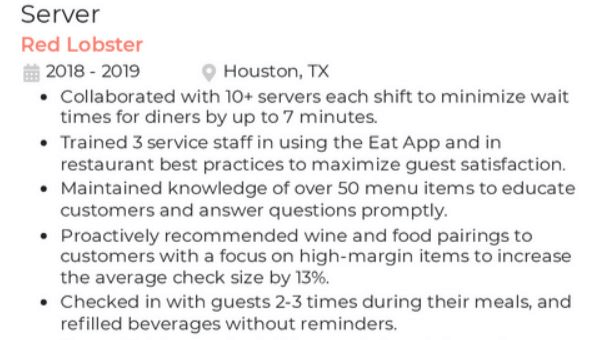
Want a good example? Check out this picture from one of our resume examples with metrics in every bullet point:

Top substitute teacher skills to include
It might not be the most exciting part of your resume, but it’s important you to pay special attention to the skills section on your resume.
This section is an excellent resource for hiring managers to see if you could be a good fit for their substitute teaching position. Think of it as your key skills list, and make sure it highlights the abilities most relevant to the role. There’s no better place to see if you’re right for the job in varied classroom environments.
It’s also critical that you get this right if you want to pass the ATS scan, since school administrators and recruiters often scan this section first for fit. Without enough matching words, your resume might never see the eyes of HR.
Soft skills can play supporting roles to your hard skills. Aim to include six to 10 relevant skills selected to match the job requirements and job description, such as:
- Classroom Management
- Lesson Planning
- Engaging Lesson Plans
- Smart Boards
- Special Education
- Creative Problem Solving
- Curriculum Development
- Bilingual (then list the other language)
- Record Keeping
- Test Prep
These are appropriate because they focus more on hard, measurable skills rather than soft, less-relevant abilities.
The key to getting this section right is by reading the job description. Scan it carefully to find repeated keywords that you can highlight on your versatile substitute teacher resume.
Pro Tip: Focus primarily on hard skills and technology that meet classroom needs, which are much easier to demonstrate and measure. For substitute teachers, excellent classroom management skills are among the most important abilities to show, and adaptability across different classroom environments is also useful when the posting calls for it.

How to add education, certs, projects, interests, and hobbies
Typically, substitute teachers are required to have a bachelor’s degree, and many schools prefer or require an education bachelor. However, requirements still vary by district and school. Preferred candidates may have studied:
- Psychology
- English
- Early childhood education
- Simple secondary education
Of course, some hiring managers may still be fine with an associate’s degree. When you’re listing your education level, focus on the basics, like university name, graduation year, degree title, awards, and any professional development that strengthens your teaching background.
If you have an associates degree or higher, you don’t need to include your high school diploma.
Certain states or organizations may require you to have (and maintain) teaching certifications. This calls for a new section, even if you only have one certificate or license. Whatever you have, include it, whether it’s a state license in Substitute Teaching or a Special Education Certificate.
Finally, if you’ve got a bit of wiggle room, you can consider including an optional section to outline your interests and hobbies on your resume. Though most substitute teachers don’t need this section, it can be helpful in the following circumstances:
- If you’re applying to work at a school that is passionate about creating diverse learners and creating a unique culture for students to thrive.
- Schools like this may be much more interested in your beekeeping hobby than more rigid, regimented schools.
- If your hobby or interest is particularly relevant.
- Hiring managers may be more interested in your successful 3-episode campaign on Jeopardy, rather than your interest in home improvement projects.
Pro Tip: Don’t have a valid teaching certificate, but still have a lot of space? Specific certifications such as CPR and First Aid are advantageous for substitute teachers.

How to customize your resume for every substitute teacher job listing
Make sure your resume is specifically tailored to each job to which you apply. We’ve touched on customization throughout this guide, but it’s an important enough point that it bears repeating.
Focus your attention on altering your objective/summary (if used), skills section, and job description bullet points for every job ad.
To make your life easier, you can create a master list of your skills, potential work experiences, and drafts of possible objectives/summaries in a separate document. Then, you can pull from this document to make fully customizing your resume less of a hassle.

Edit for a flawless substitute teacher resume
As a substitute teacher, you’ve probably advised countless students to carefully proofread their essays and exams before they submit them. Although you probably just want to get this whole job application thing over with, it’s worth taking your own advice.
Step away from your resume for a day, and consider having friends or family review your work. Once you’ve had other people look it over, make sure you check your resume yourself one final time. You can even reach out to your alma mater to inquire about resume editing services they might provide for alumni.

How do I write a substitute teacher cover letter?
You want to include the key parts of your resume in a cover letter or simply use a cover letter generator to do the same. If you’re writing one yourself, convert 2–3 bullet points into small paragraphs and include your best skills.
Give the employer a date when you’re available to discuss your application further and don’t forget to give your thanks. Before hitting send, quickly proofread it and make sure your passion for teaching is visible throughout.

Wrap up
Give yourself a pat on the back, because you’ve just taken a major step toward perfecting your substitute teacher resume! Even if you’re not yet done editing your resume, you’ve started your journey by putting in extra research time.
If you want to see how your resume formatting and content stacks up, you can use our resume checker to get AI-powered tips and tricks. Or, if you want to start from scratch, our resume builder deals with the formatting headache for you and provides AI-powered tips for improvements.
We know you’re going to do an awesome job teaching the next generation!
Substitute Teacher Resume FAQs

A substitute teacher steps in for an absent teacher, helping schools stay on track during teacher absences. They manage classroom activities, maintain order, follow pre-designed lesson plans to ensure educational continuity, and ensure lessons continue based on the provided curriculum.
Since the role can be unpredictable at times, a dedicated substitute teacher must quickly adapt to various subjects, grade levels, and classroom dynamics, maintain a safe learning environment, and foster a positive learning environment.
Here is a resume objective and career summary for an entry-level and experienced substitute teacher, respectively:
Entry-level substitute teacher resume career objective:
“Adaptable recent graduate with a Bachelor’s in Education, seeking a substitute teaching role. With practical classroom management and experience in keeping students engaged via volunteering and internships, I am keen to create a productive and growth-oriented learning environment at Colorado Academy.”
Experienced substitute teacher resume summary:
“Seasoned substitute teacher with 5 years of experience managing dynamic K–12 classrooms. Proven record of maintaining continuity in student learning, enforcing discipline, and quickly adapting to different teaching styles and environments. Dedicated to building lasting rapport with students and school staff while delivering high-quality instruction.”
The skills section on a substitute teacher resume highlights core competencies demonstrating your ability to manage classrooms, support student learning, and maintain order in various educational settings. This section should include a blend of hard and soft skills.
Example of a skills section:
✅ Classroom Management
✅ Student Engagement
✅ Lesson Plan Execution
✅ Conflict Resolution
✅ Time Management
✅ Verbal Written Communication
✅ Adaptability Across Grade Levels
✅ Google Classroom EdTech Tools

Stephen is the co-founder and CEO of BeamJobs. Frustrated with the challenges he'd faced in his own job search, he left the corporate world to start BeamJobs with his brother. Drawing on firsthand experience with hiring and getting hired as technical talent, he started BeamJobs in 2020 to help qualified job seekers land interviews with less stress. Since then, more than 4 million people have built their resumes and cover letters on BeamJobs. Stephen's insights have been featured in notable outlets, such as Fast Company, Business Insider, Yahoo Finance, MIT, and Zapier. Learn more about Stephen.