



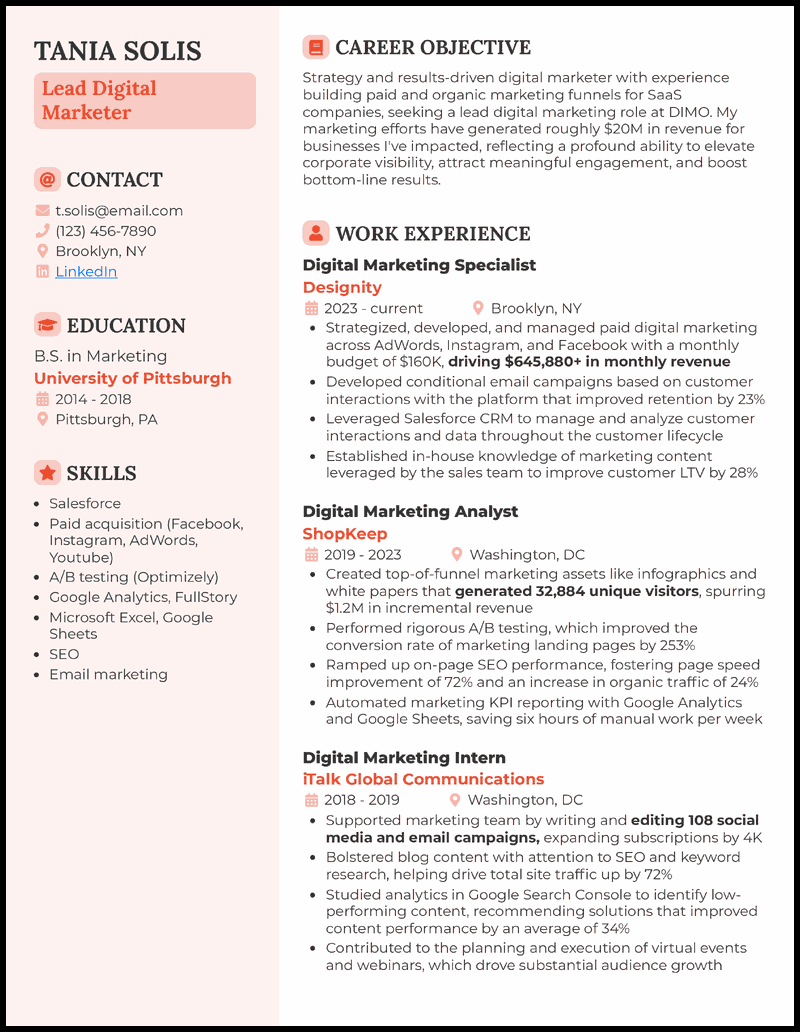
You’ve heard the saying that the hardest part is getting started. When it’s time to write your digital marketing CV or create a covering letter, staring at a blank page is undoubtedly the worst and most intimidating part of the process.
To help alleviate this stress, we’ve researched what hiring managers want to see on digital marketing CVs. Now, we’re sharing our findings with you so you can build a CV with confidence.
These digital marketing resume samples have helped digital marketers get interviews at companies like Slack and Stripe, so they’re a great place to get inspiration for your own resume. No matter what digital marketing role you’re striving for, use our writing tips and templates to help you land more interviews (and get the job) in 2026!
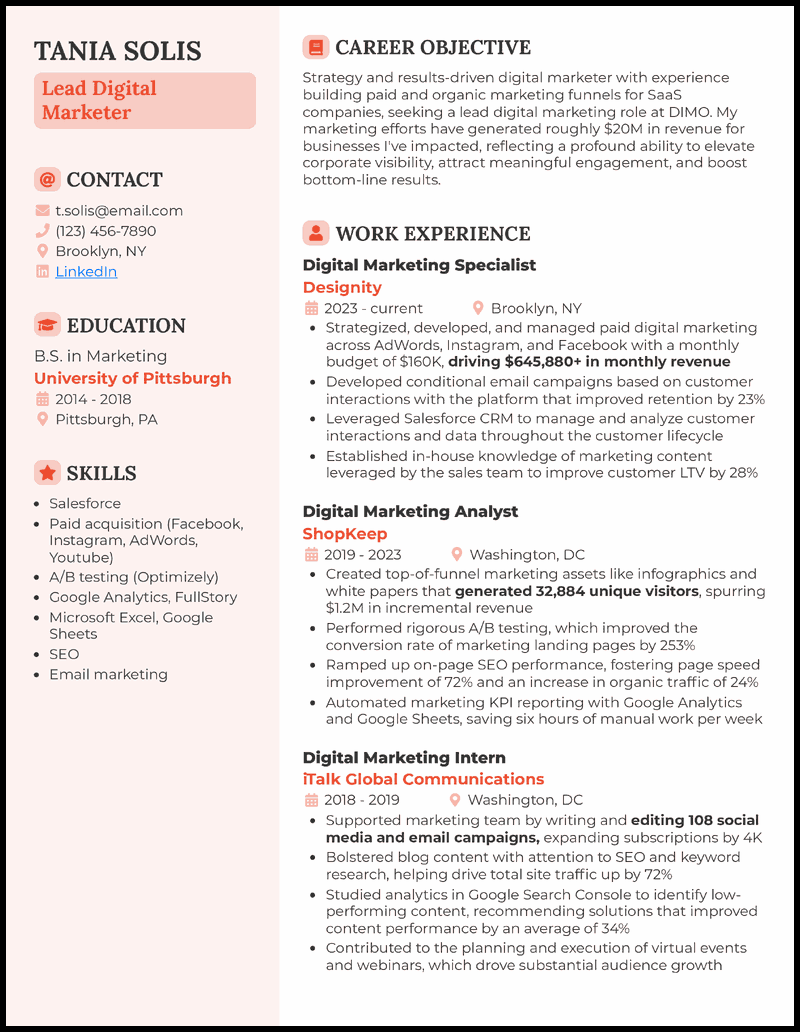
Be ATS-friendly
- CV screeners can be harsh and may outright reject your entire application if you don’t include the job description details.
- Before writing your digital marketing CV, make sure to read the job advert carefully and note down important points like being skilled in HubSpot, a degree in marketing, or an AMA Professional Certified Marketer certificate.
- Next, sprinkle these throughout your entire CV and avoid showcasing complicated designs such as pie charts or graphs and acronyms. Keep your language simple and to the point.
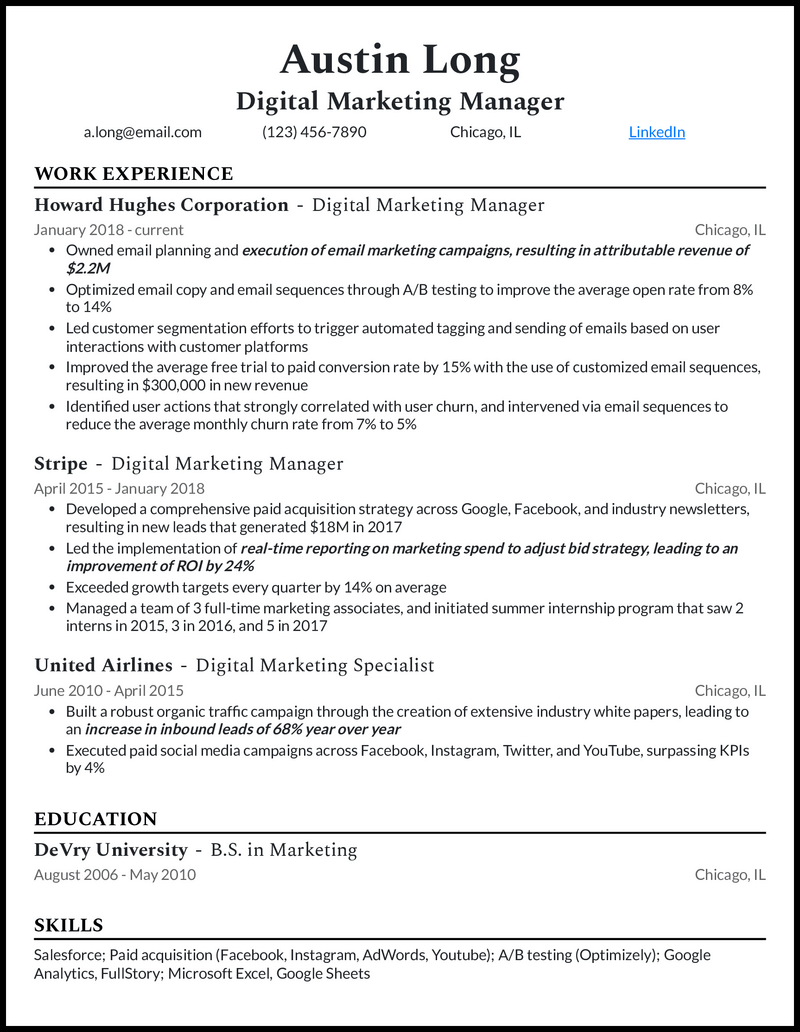
Format the education section
- If the job you’re applying for clearly states education as a minimum requirement, don’t forget to include your Bachelor’s in Marketing or any relevant degree.
- Also, it’s best to place your degree where employers can easily see it. Using a CV builder will help you make any placement arrangements if you want to include multiple degrees.
- Remember the modules you took while at university? Include them! Subjects like Consumer Behaviour and Social Media Strategy are crucial for promoting any brand!
See more digital marketing manager CVs >
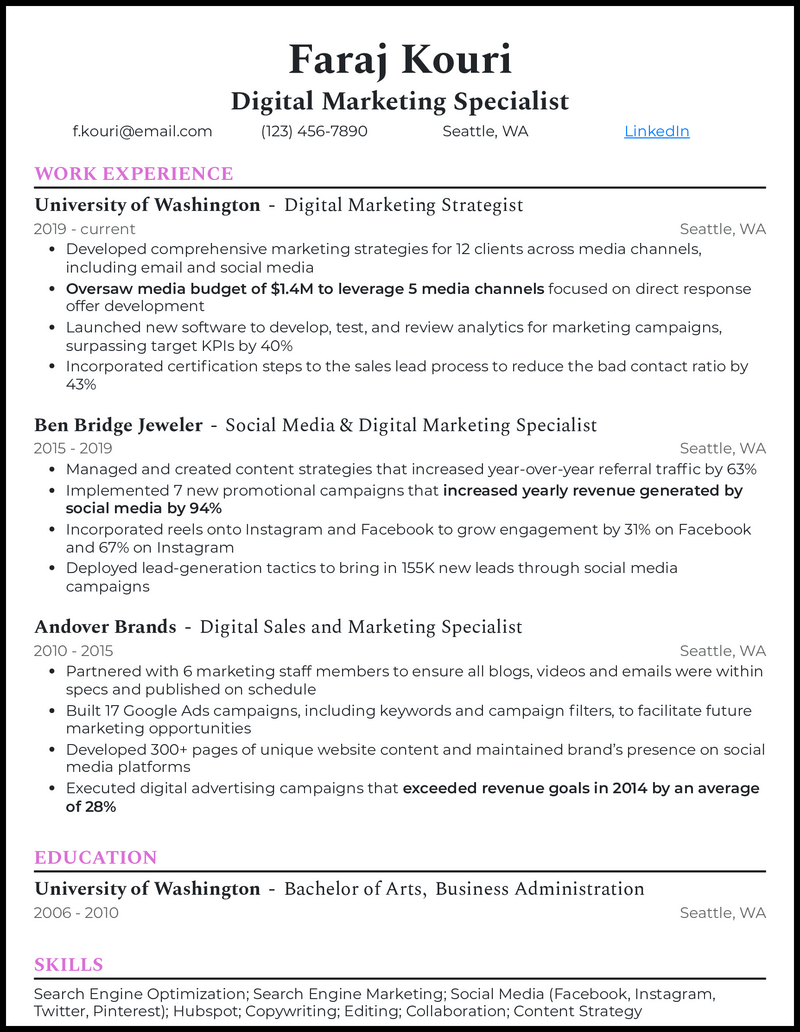
Use pre-made templates
- A common mistake is not using the correct CV format. Of course, employers want to see your best marketing results, but at the same time, they don’t want to wade through blocks of text with no design.
- Avoid cramming every work experience into a small design and make use of pre-built templates that provide ample space for longer bullet points and evenly space out each job.
- Feeling particularly creative? Try using an AI-powered CV builder to experiment with different fonts, spacing options, and colour tones available to you.
See more digital marketing specialist CVs >

Show certificates
- You may not always need a certificate in a marketing CV, but if you’ve got the space, including one won’t harm your chances of getting hired.
- A good tip is to include certificates that match exactly what the job description requires.
- So, if the job is looking for candidates well-versed in HubSpot, add a HubSpot Content Marketing Certification. Similarly, if they need someone to enhance their social media presence, try including the Meta Blueprint Certification to demonstrate your expertise in Instagram and Facebook simultaneously.

Showcase educational background
- Your digital marketing consultant CV should highlight your commitment to your career. How do you do that, though? A smart move is to spotlight your job-relevant educational qualifications.
- Suppose you have a degree in Marketing; make it stand out in the education section of your CV. Naturally, you need to do more than just mention the degree name—include your university, the institution’s location, and the graduation date or dates attended in that section as well.
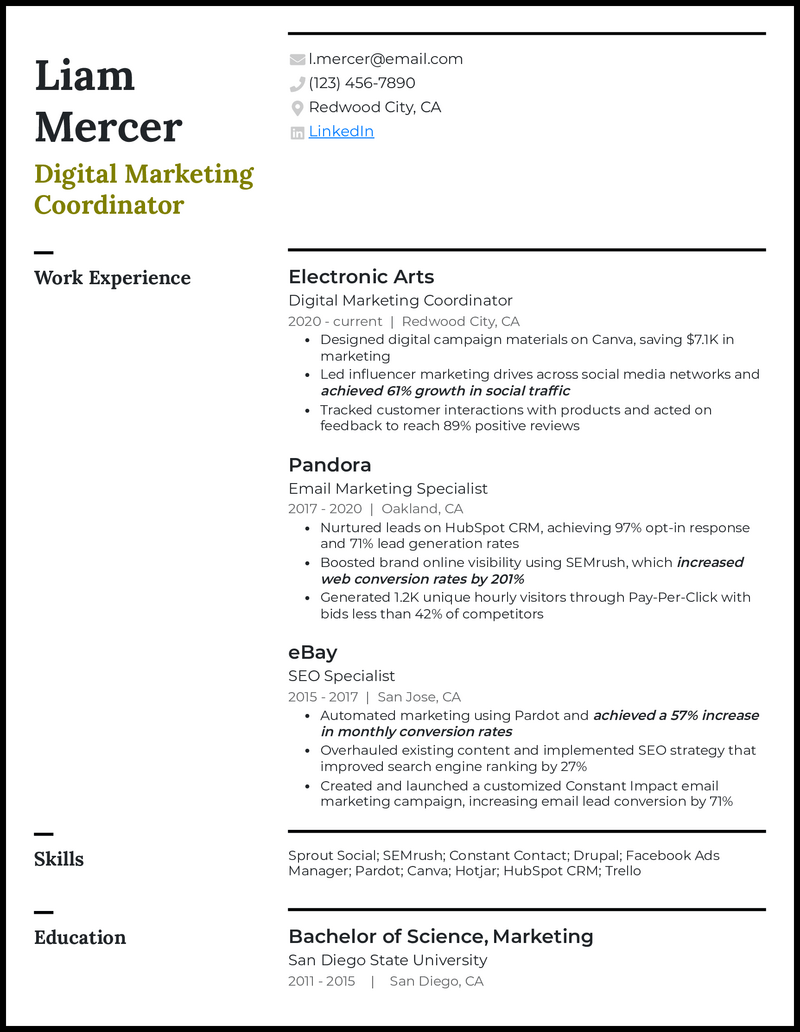
Enhance your skills
- You’ve probably used a variety of marketing software throughout your career, but what really matters are the ones that companies rely on today.
- Overwhelming employers with a skill set that doesn’t align with the job will get you nowhere, so, check out the job description and include all the skills they’ve listed that you’re proficient in.
- From Google Analytics, Mailchimp, and ActiveCampaign, to modern automation platforms like Klaviyo, be as specific and relevant as the job requires you to be.
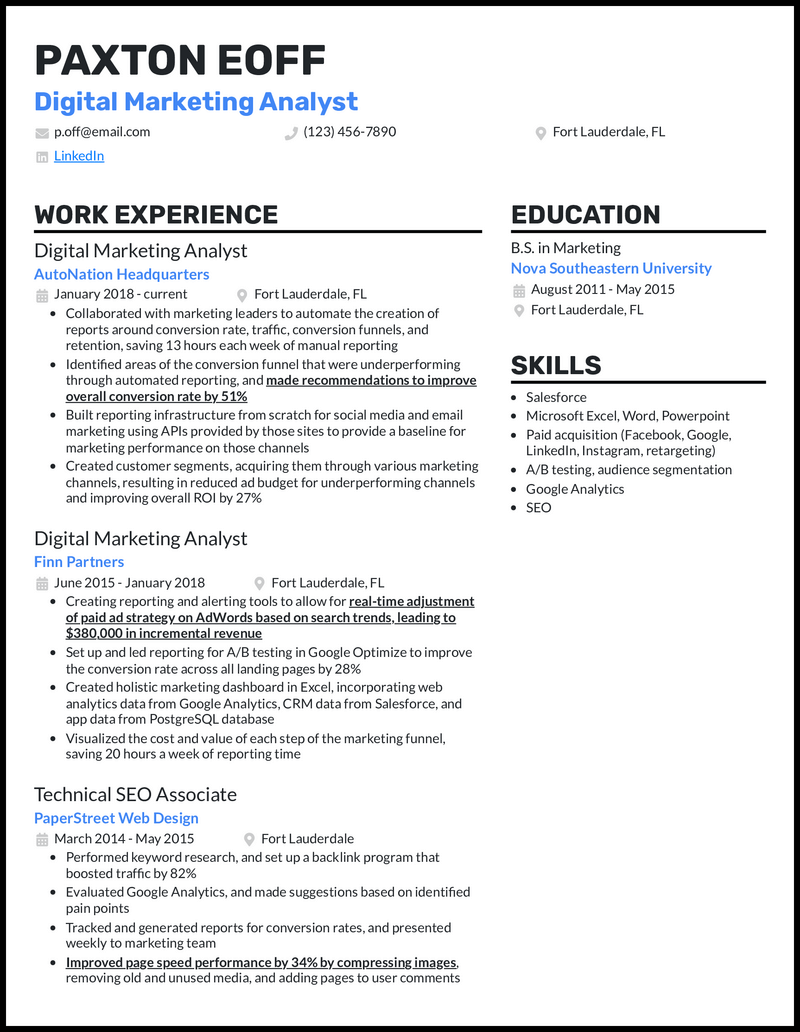
Quantify more
- Digital marketing is all about achieving results. If your efforts don’t help companies achieve a good return on investment or make any impact, they’re not worth mentioning.
- Take a good look at your work experience bullet points and identify as many areas as you can to quantify impacts such as increasing traffic or improving email click-through rates.
- Use this for inspiration: Launched an SEO campaign targeting high-tail keywords, which attracted 11,000 unique visitors every month to the company’s blog page.
View more digital marketing analyst CVs >

Demonstrate enthusiasm for the position
- Yes, personalising your CV could really impress hiring managers. However, using the first-person pronoun (I) in your freelance digital marketing CV is not advisable—that’s a deal breaker that could ruin your chances.
- Using the first-person narrative without “I” adds a professional touch to the piece while keeping it concise (ensuring it doesn’t spill onto a second page). Moreover, it avoids repetition, a common risk when that pronoun leads every sentence in your employment history.
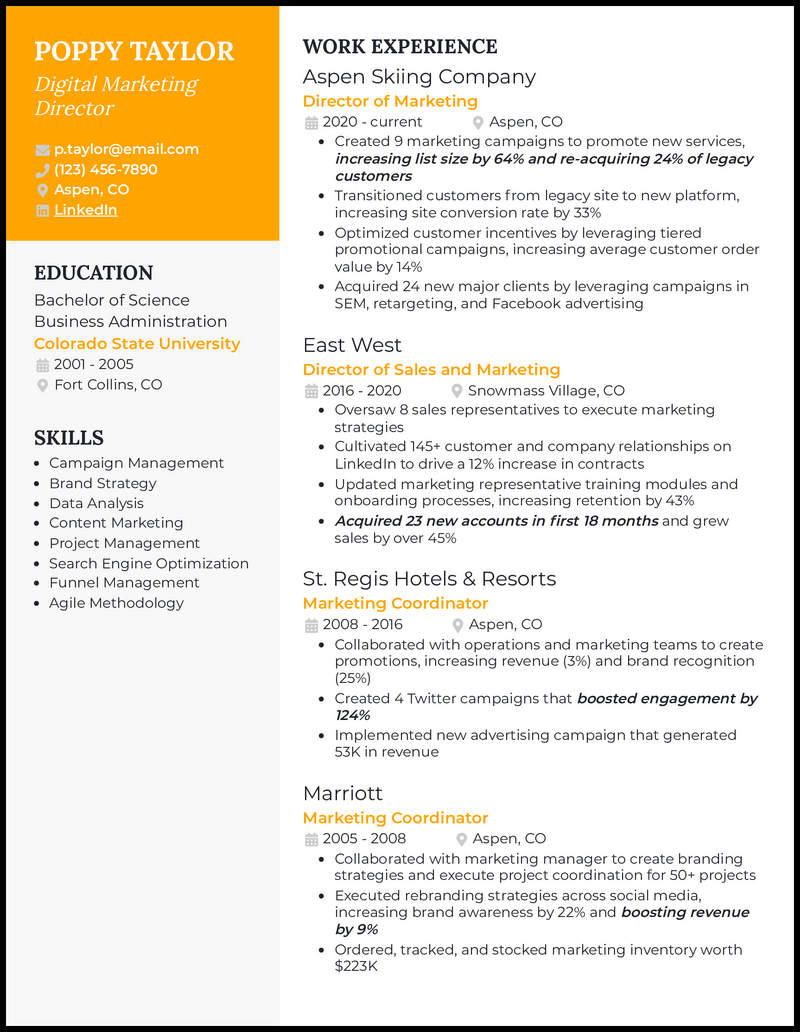
Integrate into company culture
- Before you send in your CV, take a moment to research the type of company you’re trying to join. What is the company’s culture like? Strictly corporate? Or perhaps a team that’s completely informal?
- Try to align your language with their tone. If they’re formal, keep your sentences concise and start sentences with strong action words like Improved or Enhanced.
- For informal companies, you can take a breather and use more detailed points and include any personal hobbies to match their wavelength.
See more digital marketing director CVs >

Display career path
- Digital marketing often involves trying out new things at different agencies, so ensure that your CV outlines how you’ve reached your current level.
- To begin, use a reverse-chronological CV format to add your three best work experiences. Starting from the top, add your most recent roles and go back in time as you continue downwards.
- Not sure which ones to include? Choose the ones that align best with the job. For a marketing manager role, try something like (from top to bottom) Brand Manager, Marketing Specialist, and Social Media Coordinator.

Showcase remarkable achievements
- In digital marketing, success hinges on your ability to capture your audience’s attention. Guess what? The same applies to job hunting. On your digital marketing associate CV, strategically bolding a couple of your most remarkable achievements can command attention like a well-placed call to action on a landing page.
- You noticed bits like “…driving 9K additional interactions…”, “…surged article reach by 14,338 clicks…” and “…analysed 3,649 survey responses…” in Lucan’s masterpiece as well, right? Expect them to catch the hiring manager’s eye in the same manner.

Put projects in the spotlight
- For candidates with no experience working for digital marketing agencies, it’s best to include projects that demonstrate your skills in creating campaigns and attracting an audience.
- Think about your university days and recall any projects where you worked to raise awareness about a cause, event, or competition. But, remember to write how you used specific skills to come up with ideas and carry out marketing tasks.
- Try something like, “Used Buffer to create engaging social media posts and increase the charity’s online traffic by 28%.”
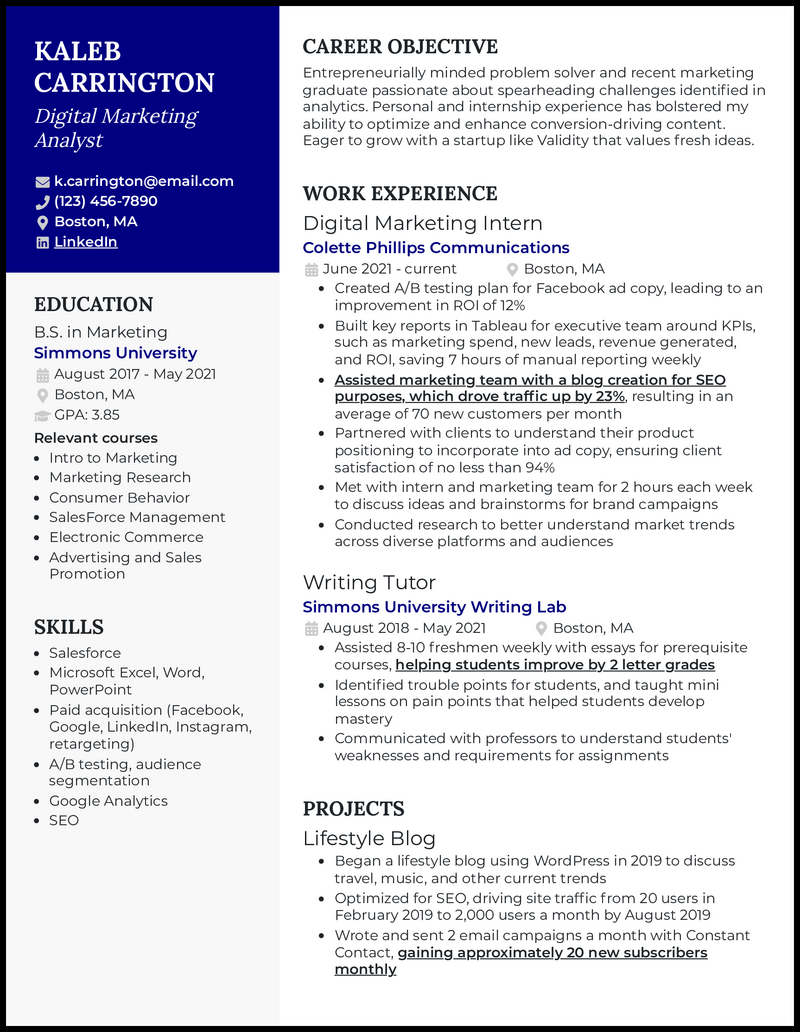
Eliminate ambiguity
- From looking up customer records in Salesforce to creating social media posts using Hootsuite, digital marketers use a variety of software to complete their daily tasks.
- It’s a great idea to include skills with which you’re proficient; however, not providing context can make employers question whether you’re being truthful.
- Instead of simply listing these skills down, mention them in your work experience bullet points and how you’ve used them. For example, “Automated daily social media posting using Hootsuite, helping the marketing team complete two additional tasks each day.”

Use action verbs
- Though sometimes overlooked, using action words in your digital marketing assistant CV ranks among the most effective ways to catch the recruiter’s eye and win their favour.
- So, action verbs (such as developed, led, managed, directed, guided, and spearheaded) make it easier for hiring managers to understand your contributions in previous roles and potential impact in the available one. Any caveats? Yes — using the same word too frequently will irritate recruiters, highlighting the need to vary those verbs.

Begin with a career objective
- Your VP digital marketing CV could really benefit from a customised CV objective that informs the hiring manager of your intentions for the role while highlighting the unique aspects that make you the best person for the job.
- The top of your CV (either in the header or the sidebar) is the ideal place for your career objective statement, with a hint of relevant experiences such as VP of digital marketing, CMO, and digital marketing manager adding extra credibility. And remember, brevity is essential here; anything more than a brief paragraph of two or three sentences is a cardinal sin that could undermine your attempt at making a great first impression.
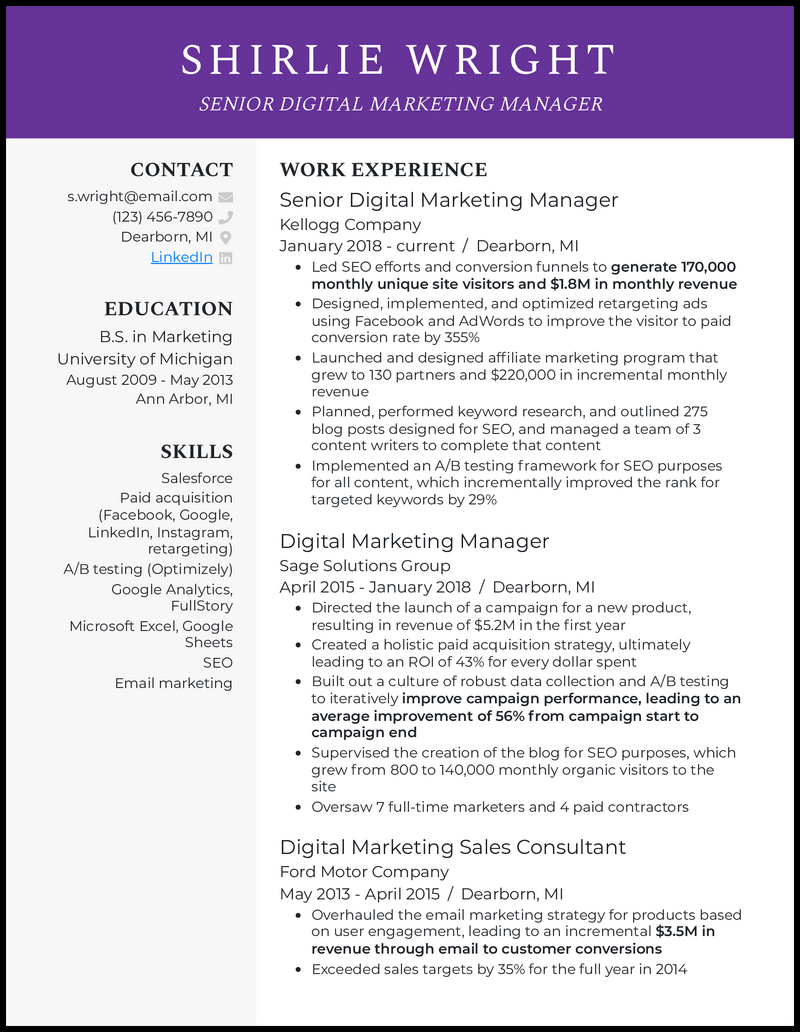
Use a career overview
- Candidates with substantial experience in digital marketing can utilise a career summary to highlight their expertise and greatest achievements.
- Don’t overdo this though. Keep things short and simple. A straightforward four-line summary will be more than enough to help you add the skills you’ve mastered over the years and any significant impacts you’ve made with marketing campaigns.
- Here’s an example to get you started: Experienced digital marketer with 11 years of experience and high proficiency in HubSpot seeking a role at your company…”
See more senior digital marketing manager CVs >

Showcase your skills in action
- For a self-taught digital marketing CV that will help you secure your dream job, focus on your initiative, a sought-after skill that demonstrates your drive and how serious you are about advancing your career.
- Using the right action words (think delivered, secured, chaired and generated, etc.) can get the job done here. To make it even more appealing, go ahead and add some numbers to those achievements. “Sparked community involvement by launching a UGC initiative, collecting over 1,460 unique photos for city promotion” is a good example.
Related CV guides
How to Write a Digital Marketing CV

Summary
Master the art of crafting a job-winning digital marketing CV by selecting the right format, optimising for ATS, using metrics, showcasing technical skills, and tailoring content to each role.
Your digital marketing CV serves as your first impression to employers, which means you want it to be formatted correctly for prospective employers. Correct CV formatting ensures your digital marketing CV is readable, logical, and professional.
The most popular formats for CVs are the reverse-chronological, functional, and combination/hybrid formats.
Reverse-chronological, functional, and combination formats
- Reverse-chronological: This format is the most popular and the most preferred by employers. (It’s the tried and tested CV standard!) It’s the best format if you have a strong work history with no employment gaps. It’s also the best option to showcase experience because it provides a clear timeline of your career progression. In this format, your work history and experience are listed in reverse-chronological order, starting with your most recent position.
- Functional: The functional format is typically used by individuals who have gaps in their employment history, have changed careers several times, or have limited relevant experience. In this format, your skills and abilities are listed first instead of your employment history.
- Combination: This format blends the reverse-chronological and functional styles to give equal importance to skills and work history.
It’s difficult to know which format to choose when writing your CV. If you’re unsure which to choose, it’s best to use the reverse-chronological format because it’s easy to read with a logical flow. Plus, it’s the unofficial standard for CVs, so employers (and the ATS) know how to scan it quickly.

Digital marketing CV header
You already know the importance of marketing, so when it comes to your CV header, this is where you should display relevant information prominently. It should be located at the top of your digital marketing CV.
The font you use for your name should be larger than that of the rest of the CV, and you should also include the job title (slightly smaller than your name) of the role you’re seeking.
Underneath your title and name, you need to include your contact information, starting with your email address. Avoid using the email you created in secondary school—if the only address you have is [email protected], it takes just a few minutes for a tech-savvy individual like yourself to set up a new Gmail account with a professional address.
After your email, add your phone number in case employers wish to contact you directly. Then it’s up to you whether you list your location (just your town and county) and social media links. Your location may be important to alert employers to your availability for a face-to-face interview, but you can leave it out if you’re out of the area.
If you have a LinkedIn profile or other professional websites, list the URLs in your contact header. This is a good way to showcase your skills and experience to employers. (Plus, many employers require your LinkedIn profile on your application.)

What you need to know about the ATS
When you’re applying for a digital marketing position, it’s important to know about applicant tracking systems, also known as the ATS. Employers use the ATS to scan CVs and filter through potential candidates. If your CV isn’t formatted correctly or lacks keywords, it will be filtered out, and you won’t be considered for the position.
If you’re using a Google Docs CV template or a Word CV template, consider certain formatting elements to beat the ATS:
- Use standard 2.54 cm margins on all sides of your CV; reduce it by 1.27 cm if needed. This makes it easier for employers to read, and your digital marketing CV won’t look cramped.
- Choose a simple, standard font, such as Arial, Calibri, or Times New Roman. Don’t use a script or ornamental font because it will be difficult to read.
- Use a font size of 10-12 points for the body of your CV. Section headers should be larger at 14-16 points.
- Organise your CV logically with the most important information at the top. The easiest way to do this is to list your experience and education in reverse-chronological order. This format will ensure the reader sees your most recent experience and education first.

Your digital marketing CV writing guide
Even though you’re an expert in marketing, it can be intimidating to promote yourself with just a single page. Creating a CV is never going to be straightforward, but it can be much simpler when you tackle it section by section with a CV builder.
Important factors in building your digital marketing CV:
- CV objectives and summaries
- Work experience
- Digital marketing skills
- Education and qualifications
- Projects, interests, and hobbies

Do you need a CV objective or summary?
A CV objective is a short statement explaining what you’re looking for in a job and what you can offer. A CV summary is a longer, more detailed explanation of your accumulated skills, experience, and achievements.
You won’t need to use either one for your digital marketing CV most of the time. For an objective or summary to work, it must be specific. Skip this section altogether if you can’t commit to customising your objective/summary to each job for which you apply.
Thinking about including an objective or summary anyway? Here’s when you should consider using an objective:
- You’re changing careers
- You do not have much experience
And here’s when a summary might be the key to saving the day:
- You have over 10 years of experience
- You want to highlight a successful work history
Excellent aim
Analytically-minded digital marketing graduate with a 12-week internship experience in social media management, analytics implementation, email acquisition, and web analytics. Keen to develop my skills under expert guidance within a team environment, where I can contribute to paid search and social media campaigns for Ritchie Bros.
Why this objective is effective
This objective clearly states the company and the specific role the job candidate is seeking, incorporating keywords such as “paid search” and “social media campaigns” from the marketing job description. The job seeker demonstrates why they are a good fit for this role by starting with relevant background information and skills.
Excellent summary
Experienced and goal-oriented digital marketer with 12 years of experience in managing and executing successful marketing campaigns across multiple channels, including online, offline, and mobile. I have a proven track record of increasing website traffic and conversions by more than 25% through SEO/SEM, social media, email marketing, and content strategy. I am keen to join a tech start-up like Steadily, where I can drive the company’s growth through over a decade of experience and mentoring junior digital marketers.
Why this summary works
This summary highlights 12 years of experience in digital marketing and explains why the candidate is suited for the role with quantifiable metrics aggregated across their entire work history. The summary also includes keywords such as conversions and SEO from the job description.

Digital marketing work experience
When writing the bullet points for your work history, consider relevant experience. Three to four job experiences are ideal, but if you have fewer than two, we have some tips that will enhance your digital marketing CV. If you’ve had many jobs, keep them handy on a master CV, but don’t list every position; just include the most relevant ones that match the job description.
Using action verbs to demonstrate achievements
When listing work experience in bullet points, active verbs are the best way to describe your expertise and demonstrate your work in action. As a digital marketer, the following active verbs could be particularly useful:
- Strategised
- Launched
- Created
- Automated
- Optimised
- Led
- Improved
- Exceeded
- Co-ordinated
- Executed
Avoid using passive language such as “was responsible for.” Similarly, personal pronouns (I, me, my) take up unnecessary space.
The following three work experience bullet points are a good start but still lacking:
- I managed a team of 10 staff members
- Managed all online marketing campaigns
- Worked with management to improve automation
To be fair, these bullet points contain some solid information we can utilise, but they’re still too vague. They fail to demonstrate how your responsibilities led to achievements.
With active language, role specifics, and measurable metrics, these become much stronger bullet points:
- Managed a team of 8 junior digital marketers to increase online sales conversions by 10% within 3 months
- Led an email campaign that increased website traffic by 22% in 2020
- Worked with marketing leaders to automate the production of reports on conversion rate, traffic, conversion funnels, and retention, saving 13 hours of manual reporting each week.
Does every bullet point need some sort of metric or quantifier? No. However, it should be an aim to strive for.

Utilise data and metrics to demonstrate impact
Let’s delve further into metrics. Metrics are important because they enable the reader to assess your effectiveness in your role and whether you met expectations. These figures must show how you impacted the company directly or indirectly.
When listing your work history, include metrics that support your experience. Aim to have metrics in 60 percent or more of your bullet points, so you’ll be ahead of your competition. Metrics can be derived from several areas:
- SEO and site traffic performance
- Marketing campaign results
- Conversion rate improvements
For example, your job experience bullet points could look something like those you apply to. If you’d rather not take the time to tailor it to each position, you’re better off leaving this section out.
- Led SEO efforts and conversion funnels to generate 170K unique monthly visitors and £1.8M in monthly revenue
- Tracked email and social campaigns and identified areas to optimise in SEO, design, and content, resulting in an average of 7% more customers per month
- Developed reports on paid marketing funnels and utilised these to incrementally improve the conversion rate by 210%

Find a balance between hard and soft digital marketing skills
There are two kinds of skills to include on your CV: hard and soft skills.
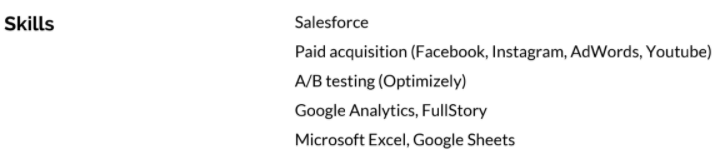
Hard skills are technical abilities specific to the job, like A/B testing or Google Analytics. Soft skills are more general traits that employers appreciate across most jobs, like teamwork or communication. While soft skills are important, your digital marketing CV should contain mostly hard skills.
The most important thing is to ensure that you include important qualities that the job advert is looking for.
Examples of hard skills might include:
- Social media advertising
- Brand awareness
- Google Analytics
- Email campaigns
- Lead generation
- Conversion funnels
- SEO/PPC
- HubSpot
Soft skills (again, not the focus) might include:
- Interpersonal communication
- Self-motivated
- Detail-oriented
These are common hard and soft skills used in digital marketing, but there are many more that an employer might be seeking. Pay close attention to the keywords listed in the marketing job description, then use that to tailor your skills section with six to ten relevant keywords.

Enhance your CV with education and qualifications
At a minimum, you’ll need a bachelor’s degree to begin your career in digital marketing. This means you can skip listing your A-levels if you’ve got a degree. If you have a master’s degree, include your bachelor’s as well and list them in reverse chronological order.
Especially once you’ve got some years under your belt, you don’t need to include anything fancy. Just list the basics:
- The name of your college or university
- Your degree
- Your degree subject
- How many years you attended (it’s fine just to list the year of graduation)
If you want to showcase additional training, you can include a dedicated certifications section. Certifications don’t replace a degree, but some employers might require specific ones from you. There’s a wide range of certifications available for you to pursue through Google, Coursera, Facebook, YouTube, and many more.
Certificates vary in experience level, price, and requirements. If you have a certificate(s) or plan to pursue one, it’s easy to include this sort of thing. You can briefly list it in the sidebar or at the bottom of your CV.

Do you need to add projects, interests, or hobbies?
Most CVs don’t include projects, but sometimes they can be helpful to give the recruiter more information about you, especially if you’re short on previous work experience.
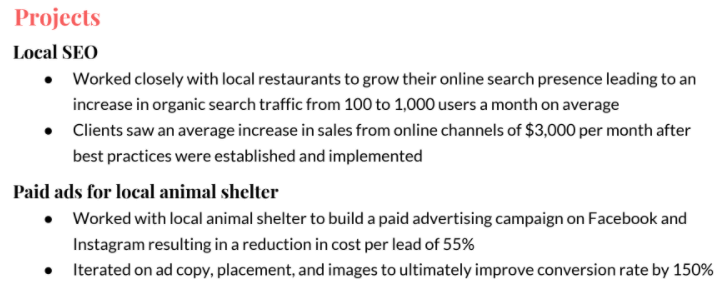
If you’re including projects on your digital marketing CV, treat projects as you would your work experience section by listing three to six bullet points under each. Like your work experience bullet points, your project bullet points will demonstrate your role in the project and the positive outcomes. It’s also encouraged to include metrics here.
Projects could range from developing a social media campaign for a small business to tinkering with a personal blog and optimising SEO performance.
Adding an interests and hobbies section isn’t the same as a projects section. Consider including this section if the job description mentions the importance of a good company cultural fit or if they appear quite informal. Even if the company is informal, it’s not acceptable to list just anything. Binge-watching Netflix and having a nap at the weekend are not the sorts of things you want to advertise to potential employers (but we do understand the importance of a good nap).
Instead, choose interests and hobbies for which you can intelligently demonstrate relevance to the job if asked during an interview.
For example, as a digital marketer, experimenting with French cuisine demonstrates that you’re a self-starter who is creative and doesn’t mind trying new things. As another example, playing rugby throughout university shows that you’re well-rounded and can balance your time well.

Tailoring your digital marketing CV to each job
If you’ve made it this far, you’re nearly there, just hang in there for this crucial piece of advice. Tailor your digital marketing CV to each job you apply for.
Tailoring your CV is easier than you think. You only need to slightly adjust the following sections:
- Work experience bullet points
- Skills
- Objective/summary (if you included one)
We’ve discussed the importance of reading the job description carefully and including the keywords mentioned. Don’t just copy and paste, and be honest about your abilities. Include keywords strategically to show your employer that you have the skills and experience required.

Ensure your CV is flawless
Lastly, don’t let your CV fall into anyone’s hands until it’s perfectly polished and error-free. Let your CV rest overnight before you return for a final look. For best results, check your CV multiple times and even better, have a friend or trusted colleague look it over, too!

Common mistakes to avoid in your digital marketing CV
In addition to everything you’ve learned, avoid these mistakes when creating your CV to ensure better chances of getting a job:
- Using buzzwords for the sake of it—using terms like “results-oriented”, “growth-hacker”, and “forward thinker” without evidence to support them reflects poorly on you.
- Ignoring ATS optimisation – hiring bots will struggle to parse your application if it doesn’t contain keywords from the job description.
- Including irrelevant skills – skills that don’t align with the specific role you’re applying for have no place in your document
- Exceeding CV length – anything over a page is considered too long. Only include relevant information.

Secure your digital marketing role
At last, you’ve made it! Perhaps you still need to finish writing your CV, but we’re confident that your CV will be better with these tried and tested tips.
Just remember:
- The format of your CV is very important, and the reverse-chronological format is your best ally.
- Place your contact header at the top of your document to market yourself swiftly.
- Plan to outsmart the ATS by including keywords from the job description.
- Including an objective or summary is optional, but if you choose to add one, make sure it is tailored to the role.
- Use active language and metrics in your work experience bullet points to highlight your abilities.
- Technical skills specific to the job, especially those mentioned in the job description, carry more importance than soft skills.
- List your education in reverse chronological order.
- Projects, interests, and hobbies might be appropriate to add if you’re lacking in experience.
- Tailor your CV for every job application.
- Never submit a CV unless it’s error-free, so check it multiple times!
There you have it! With these tips, you’re one step closer to landing your dream digital marketing job. Now, you can become a professional CV builder and work on your digital marketing cover letter, so you can secure more interviews.
We’re rooting for you!
Digital Marketing CV FAQs

Recruiters want to know that you’re results-driven and can adapt to ever-changing digital technologies and working environments.
To provide them with those two things, ensure your CV includes the following:
✅Quantifiable achievements
✅Proficiency in niche tools
✅Campaign experience on the most prominent digital platforms
✅Clear metrics, including ROI, CTR, conversions, traffic growth, cost per lead, etc.
✅Soft skills highlighting your creativity, excellent communication, analytical thinking, and adaptability.
✅Certifications, e.g., Google Ads, HubSpot, Meta Blueprint, etc.
For an outstanding digital marketing CV, highlight your strategic planning, technical skills, and achievements from previous roles.
You can achieve this by:
✅ Tailoring your CV for each role by using keywords from the job description
✅ Leading with figures to demonstrate impact
✅ Adding a portfolio link
✅ Highlighting qualifications
✅ Keeping it up-to-date with the latest tools

Stephen is the co-founder and CEO of BeamJobs. Frustrated with the challenges he'd faced in his own job search, he left the corporate world to start BeamJobs with his brother. Drawing on firsthand experience with hiring and getting hired as technical talent, he started BeamJobs in 2020 to help qualified job seekers land interviews with less stress. Since then, more than 4 million people have built their resumes and cover letters on BeamJobs. Stephen's insights have been featured in notable outlets, such as Fast Company, Business Insider, Yahoo Finance, MIT, and Zapier. Learn more about Stephen.