





Manager


Best for candidates with 3+ years of experience
Resume Builder
Like this template? Customize this resume and make it your own with the help of our Al-powered suggestions, accent colors, and modern fonts.
 Build my resume
 It’s not easy being the boss. In management, you help employees advance their careers, improve the business’s bottom line, and juggle priorities without dropping the ball.
While it’s not a walk in the park, you’ve learned to handle whatever corporate life throws at you. Yet, demonstrating your abilities on a manager resume is challenging. How do you showcase experience and knowledge on one page?
We have the top resume tips to help you make a resume with LinkedIn or from scratch and we’ll also walk through the manager resume writing process.
These 15 manager resume samples are helping managers land their next role in 2026, and they can help you write a resume that will catch any hiring manager’s attention.
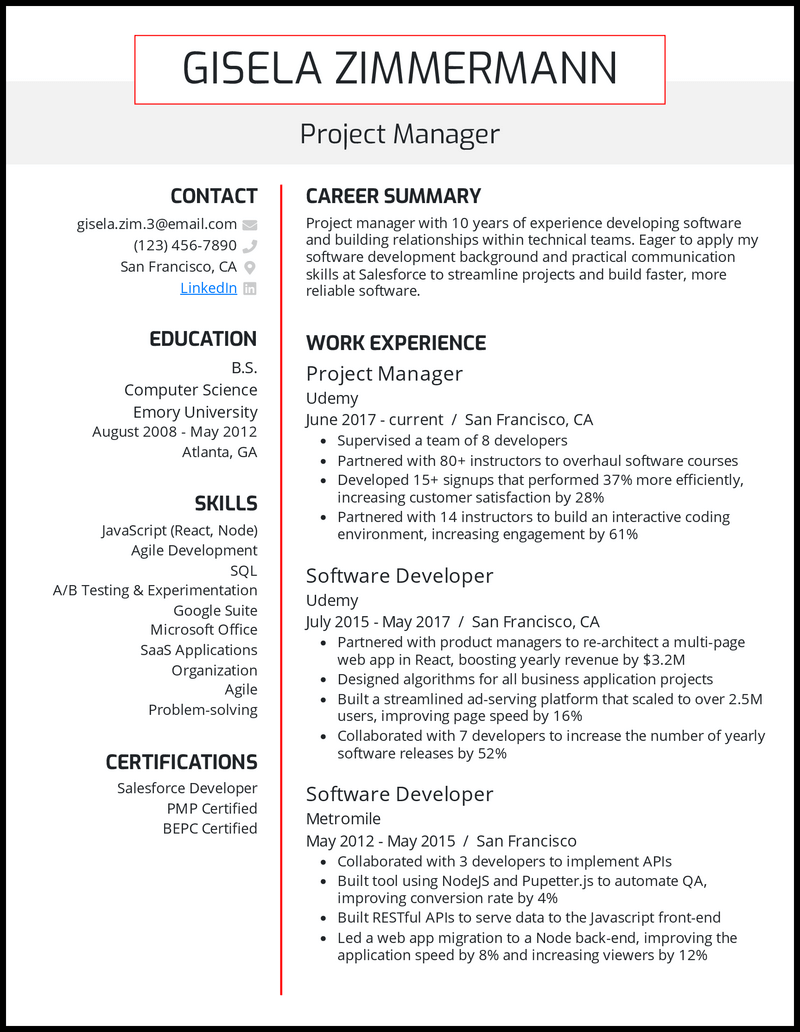
Why this resume works
- Starting your manager resume from a blank page can feel overwhelming, so try a resume outline to organize your thoughts. If you’re a senior manager, tailor your work experience only to include the most relevant positions and technical skills, but if you’re newer to the field, consider adding a resume objective to convey your passion and abilities further.
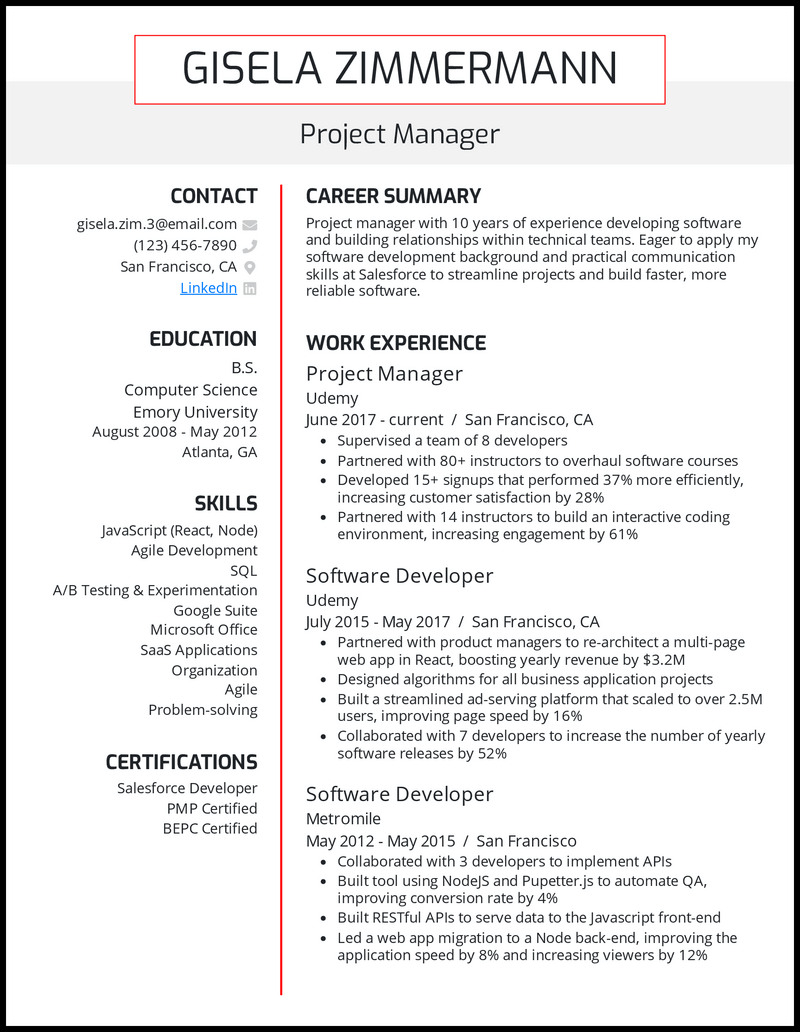
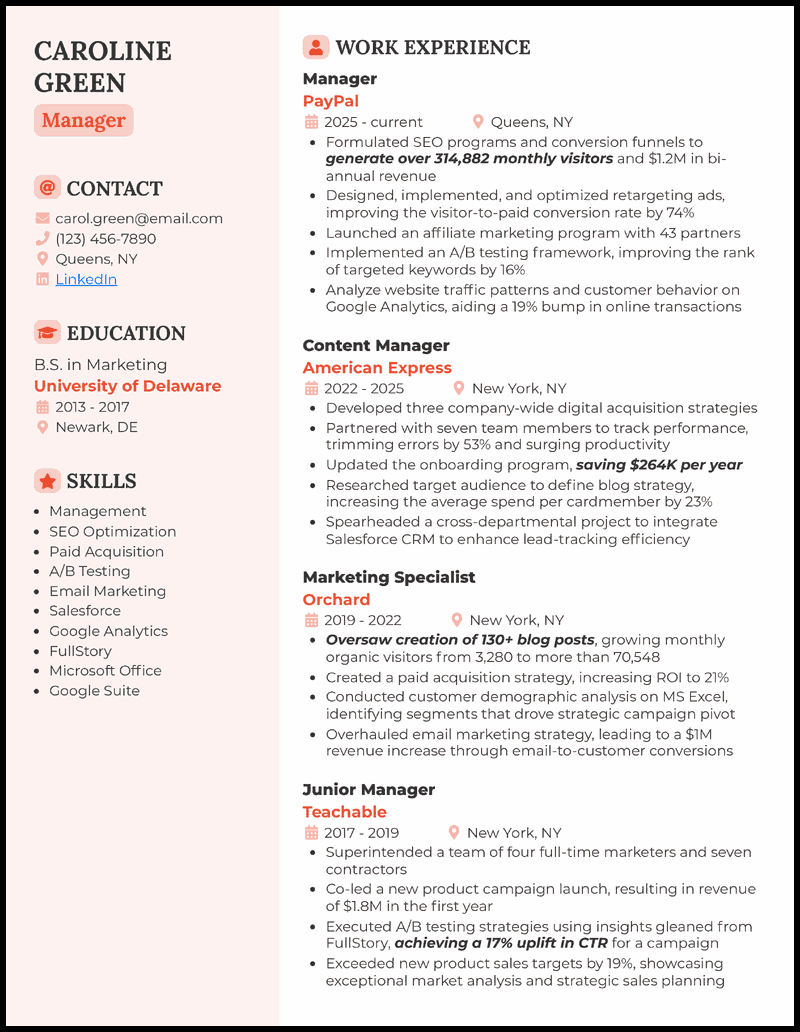
Why this resume works
- If you’ve been a project manager for over 10 years, consider adding a resume summary. Also, including an optional certifications section on your project manager resume is another way to get your foot in the door.
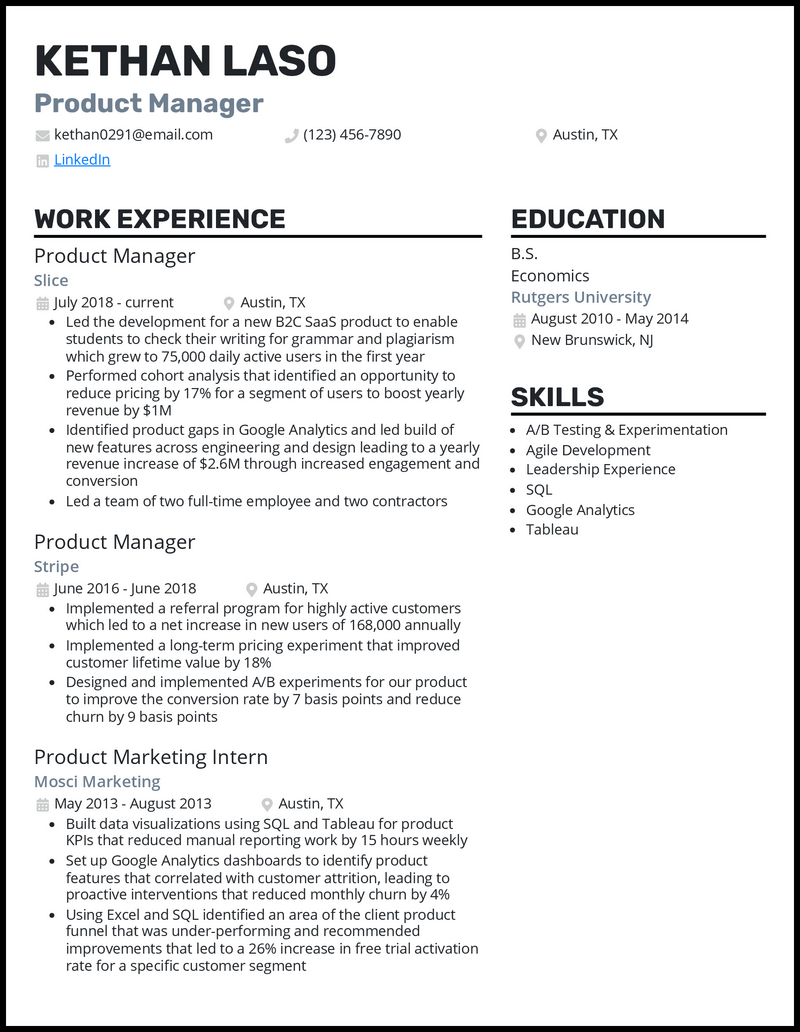
Why this resume works
- Tailor your work experience and skills to the product manager job description by using specific responsibilities and keywords. To do this right, your product manager resume should explicitly state your role, project goals, and impact for each position listed in your work experience.
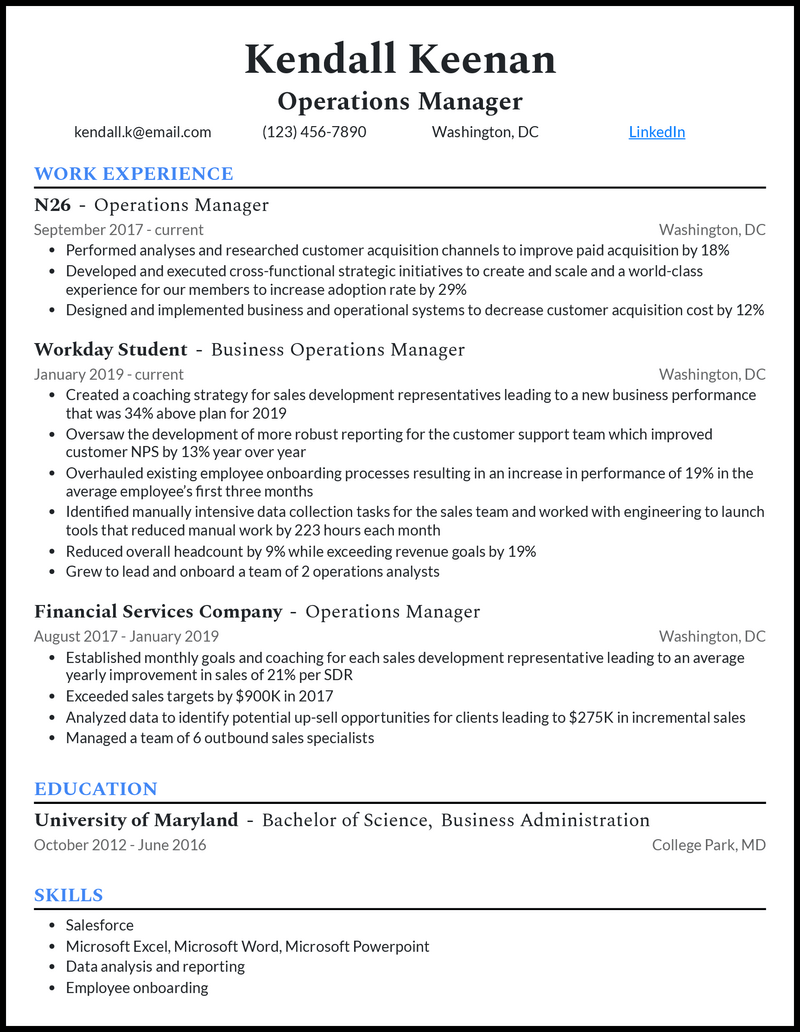
Why this resume works
- As you gain more operations management experience, limit the number of skills in your “skills” section to make your past experience the focus of your operations manager resume. Ideally, you should limit this list to five to seven technical skills.
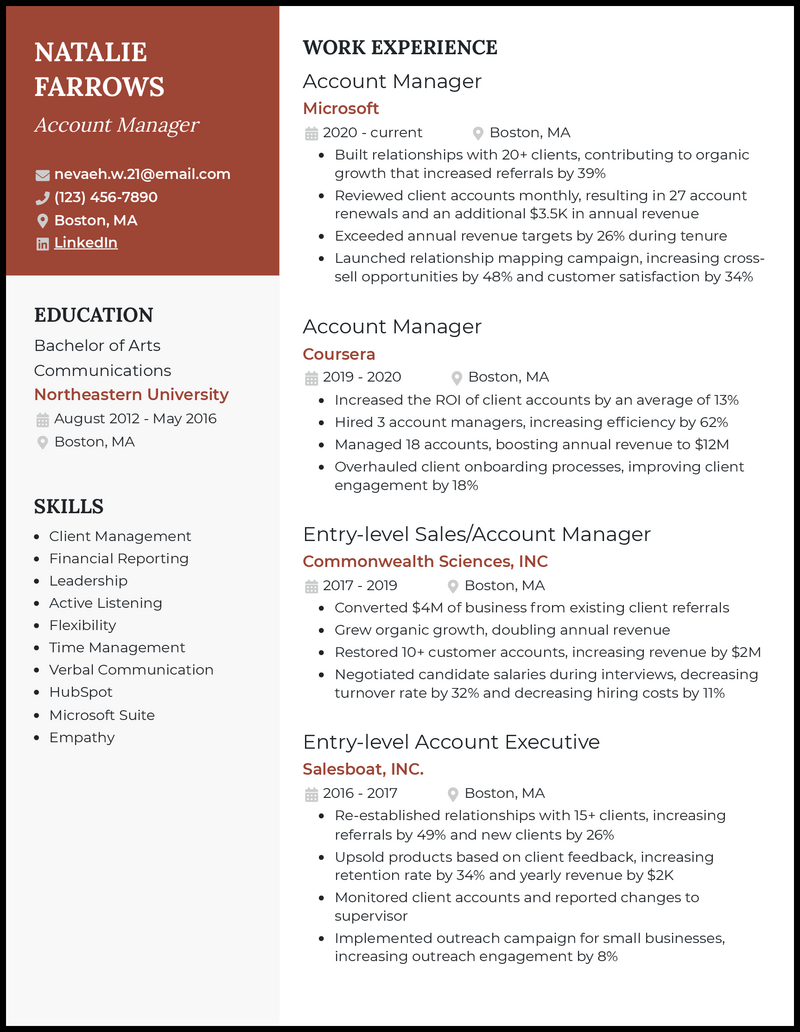
Why this resume works
- Writing an account manager resume from scratch can be overwhelming; consider using a resume template to help you decide what to include and how to format your resume. When choosing a template, make sure you choose one that allows plenty of room for work experience, skills, and contact information.
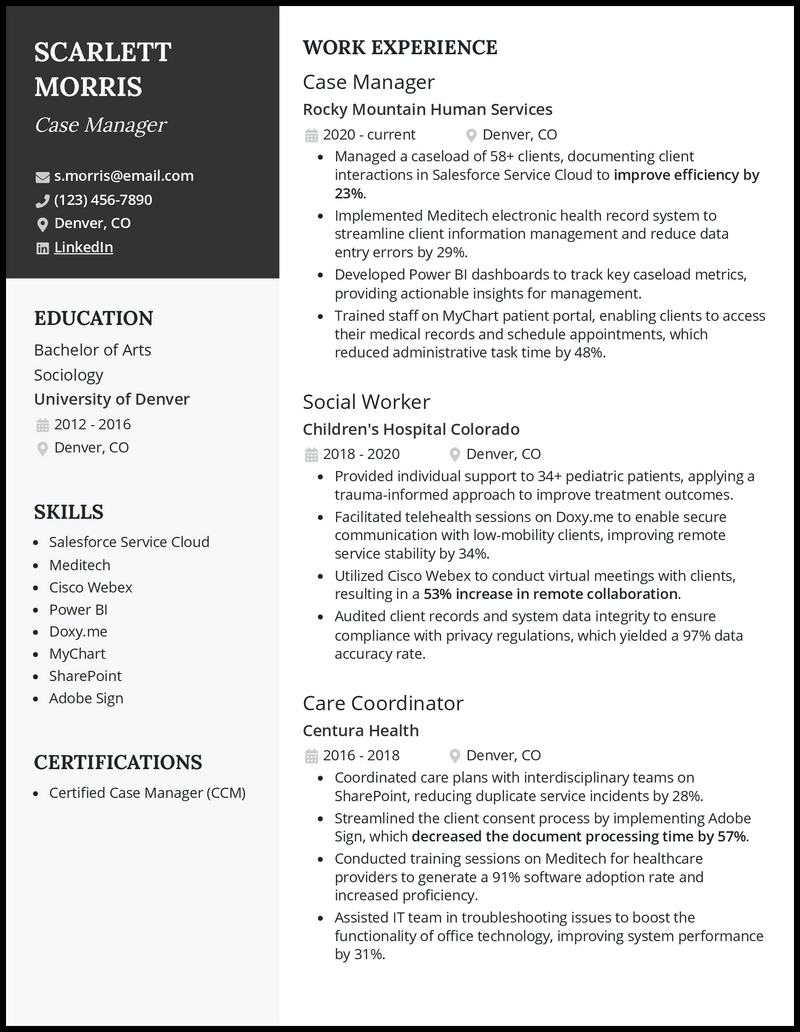
Why this resume works
- Case managers need to wear a lot of hats as they coordinate care plans for clients. The more examples you have of collaborating with interdisciplinary teams, the better. Elevate your case manager resume by harnessing the power of a cover letter maker to weave in different ways you’ve supported diverse populations.
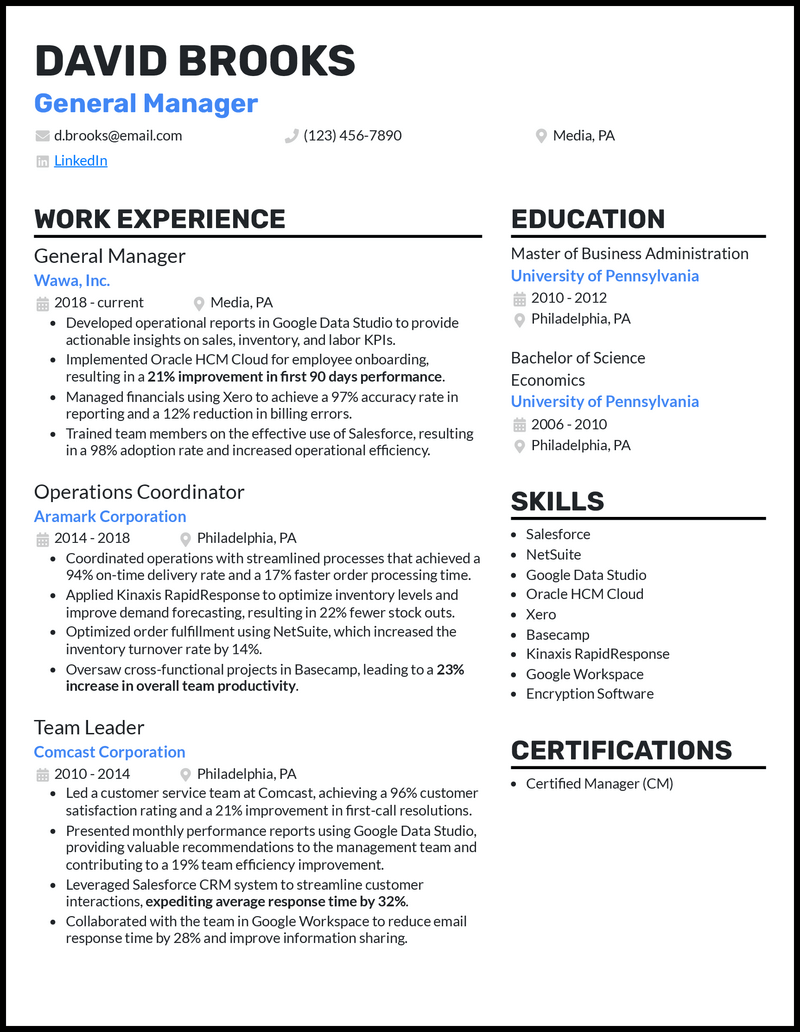
Why this resume works
- Strategically placing your MBA at the top of your general manager resume sends a clear message that you’re prepared to help a business run smoothly by meeting all goals for individuals and teams.
View more general manager resumes >

Why this resume works
- A great way of proving that you’re an indispensable stage manager in your resume is adding names of the best theaters you’ve worked for such as The Franklin Theatre. It’s also brilliant idea to highlight your best impacts in each job and convey that you’re ready to work.

Why this resume works
- If you’ve got more than two work experiences, using the Elegant template will be enough. Also, don’t go for tiny font size unless you want employers to feel like they’re giving an eye exam while reading your bar manager resume.

Why this resume works
- Quantifying your work is the secret sauce to prove your leadership qualities for a district manager resume. Numbers aren’t for show—they testify to your career highlights. Whether bringing more money or making store operations more efficient, always back your claims with data.

Why this resume works
- Having a degree in culinary arts can get your kitchen manager resume favored by ATS to reach hiring managers. So, ensure you include your education qualification and let employers know you’re not just managing orders but are professionally trained to handle the entire back-of-the-house with finesse.

Why this resume works
- Ensure your maintenance manager resume highlights your command in engineering and analytical software such as CMMS, Power BI, AutoCAD, or even ERP software. Don’t just stop at listing them, show how they helped you lead teams and keep complaints from piling up faster than a leaky faucet.

Why this resume works
- Showcase your career growth using a reverse-chronological format and highlighting your best roles. Including a journey in your safety manager resume displays your expertise and reassures employers that you’ve got the experience to keep the workplace compliant, safe, and, most importantly, incident-free.

Why this resume works
- When crafting your community manager resume, skip the generic list of duties and focus on results. Were you responsible for improving engagement or ensuring all posts/conversations were in accordance with regulations? Mentioning such impacts shows you’re the ultimate community builder, not just a forum referee.

Why this resume works
- A spacious design will let your achievements shine and be easy to read for employers. Use our Standout template to get enough room to go wild on your bullet points. Next, choose warm color tones for your training manager resume and prove why you’re the professional who turns rookies into rockstars.
Related resume guides
How to Write a Manager Resume?

For a manager’s resume that lands you the job, adding relevant experience backed up by measurable achievements and leadership examples is the way to go. You must also be a critical thinker who nurtures teams and is competent in managerial tools.
So, how can you write a strong manager resume? By showcasing your leadership and managerial experiences. Review our resume examples and follow the steps below to convince recruiters you’re the manager they’re looking for.

What’s the best format for your manager resume?
Given your experience and the demands of a manager’s role, the reverse-chronological resume format works best. It highlights your latest and most relevant work, helping recruiters and applicant tracking systems (ATS) quickly see your career growth and leadership. This format is also familiar and easy to read, especially for online applications.
Your resume should have a simple design, consistent spacing and margins, clear headings, professional fonts, and be easy for both AI systems and hiring managers to scan.
The correct order for your resume sections
- Contact information
- Professional summary
- Work experience (reverse-chronological)
- Skills section
- Education
- Certifications (if you have any relevant ones)
- Additional sections if they add value

How to add your contact information correctly
Make sure your contact details are accurate, current, professional, and easy to find. Even a small mistake here could mean missing a recruiter’s call or email. Use a professional email, one active phone number, and leave out anything unnecessary. The goal is to make it easy for employers to reach you if they’re interested.
What to include in your contact section
- Full name
- Phone number (with voicemail enabled)
- Professional email (e.g., [email protected])
- City and state (omit street address)
- LinkedIn URL (has to be customized and active)
How to use your professional summary to pitch value in your manager resume
Hiring managers only spend a few seconds on each resume. Use a resume summary to highlight your skills, leadership, and unique experience so you stand out quickly. You may not always need a summary, but if you include one, make it count.
What are the components of a great professional summary?
Your career snapshot should include:
- Title of the job you’re seeking
- Years of experience
- Leadership strengths
- Industry-specific expertise
- At least one quantifiable accomplishment
An example of a summary for a project manager’s resume
Project manager with 10 years of experience developing software, building relationships within technical teams, and exceeding 98% of project deadlines. Eager to apply my software development background and practical communication skills at Salesforce to streamline projects and build faster, more reliable software.

How to include your education to stand out
Do you have a diploma, undergraduate, or graduate degree in management or a similar field? Include them in your educational background to add another layer of credibility to your qualifications. When you list your education, share the institution’s name, specific field of study, location, and graduation date.
How to add education to a manager’s resume
Bachelor of Science
Economics
Rutgers University
Aug 2010 – May 2014
New Brunswick, NJ

How to write job descriptions to pitch your management value
Every part of your resume should add value, but the experience section is often the deciding factor. Focus on what the job requires and show how your background matches what the employer wants.
To impress recruiters and online systems, write bullet points that show your impact, relevant skills, and leadership. Instead of listing duties, answer these questions in each bullet: What did you improve? Who and how many did you lead? What was the business result?
Summary of how to structure your high-impact manager resume bullets
Follow this formula:
Action verb (e.g., Led, Improved, Directed, Increased)+ Action taken (Project, task, process) + The why, what, and how it mattered to the business (Metrics, team outcomes, efficiency)
Examples
- Increased quarterly revenue by $22.8K by coordinating a team of 9 sales reps across 3 regions
- Improved annual retention by 18% by implementing personnel-focused performance reviews
- Oversaw a $1.2M marketing budget for 3 national campaigns, completing them within budget and ahead of schedule
How to include numbers that matter in manager resumes
Metrics that prove your results are strong evidence of your leadership, teamwork, and ability to meet goals. These qualities are essential for management roles.
Management metrics that matter
Metrics for managers can include:
- Revenue growth in percentages and dollars
- Size and composition ot teams managed
- Budget planning and management
- Project delivery timelines
- Improvements in retention rates
- Efficiency boost with cost reduction
How to write a manager resume with no experience
If you’re just starting as a manager, you may not have a long list of achievements yet. Still, you can show your value by highlighting transferable skills from projects, internships, volunteer work, or coursework. These experiences show your potential and willingness to learn.
Present your experience just like regular work experience, focusing on results that made a difference. Use bullet points to show your contributions and demonstrate to recruiters that you can lead, work in a team, and deliver the results employers want.
Use your career objective as a way to pitch your strengths, not just as filler. Show how your skills and goals match the job description, and you may stand out even more than candidates with unrelated experience.
Example of an entry-level manager resume objective
“Aspiring entry-level manager with strong communication, team coordination, and problem-solving skills. Eager to grow into a leadership role at Target, contributing reliability, fast learning, and commitment to team success.”

What are some key skills for a managerial resume?
Your skills and how you use them are sure to separate you from other candidates. Showcase what’s unique about you and use that to let recruiters know that you’re the best person to fill the open role.
Examples of management skills
- Conflict resolution
- Budget management
- Strategic planning
- Performance monitoring
- Team leadership
- MS project
- Power BI
- Client relationship management
How to include your skills in your resume
Listing skills without context can make it seem like you don’t know how to use them. Show you understand your skills by demonstrating how you’ve used them in:
- Dedicated section for “Skills”: Keep the list between 8 and 12, depending on your level of experience. Blend technical and soft skills, ensuring they mirror the job ad and the industry
- Work experience bullets: Use your skills as the driving forces of your actions and outcomes
- If you use a summary or objective, put in a few core skills for visibility and alignment with the job’s requirements
What certifications do managers need on a resume
Certifications are industry-specific credentials that show your management skills have been tested and approved. If you have any recognized certifications, be sure to include them on your resume.
List each certification’s title, the organization that issued it, and the date it was issued or expires.
Here are some top certifications that can make your manager’s resume stand out:
- PMP (Project Management Professional)
- Certified ScrumMaster (CSM)
- Six Sigma (Green or Black Belt)

What other sections should you add to your manager resume?
Don’t include every possible detail in your resume. Instead, add sections that make your application stand out and better match the job, such as:
- Awards: Can be academic or work-related, e.g., “Regional Manager of the Year, 2022”
- Professional Associations: e.g., Member, American Management Association
- Volunteer Leadership: e.g., Community resource organization board member

How to tailor your resume to the management job you’re targeting
Generic resumes often get filtered out by applicant tracking systems. Tailored resumes are more likely to reach hiring managers and land you the job. To do this, customize your resume for each job, company, and industry by:
- Using keywords from the job posting
- Including the most recent and relevant experience
- Quantifying your impact as much as possible
- Presenting your qualifications in the right resume design
- Aligning your skills with what the company is looking for

Key takeaways
- Tailor and clearly format your resume
- Ditch responsibilities for results
- Optimize for AI screening and recruiter readability
- If anything doesn’t add value, don’t include it
Manager Resume FAQs

It’s one of your job application documents, which sums up your professional achievements, skills, and work experience at a management level. To make your manager resume stand out, it’s essential to highlight skills such as strategic thinking, team collaboration, problem-solving, and leadership.
It must present abilities in the best light and align with the requirements from the job posting. To do this, you should demonstrate your leadership, accomplishments, impact, management skills, innovative mindset, and the ability to manage teams. You must also detail a rich history of experiences that prepare you to step into the big shoes of a manager.
It’s essential to showcase your managerial capabilities through past similar roles, measurable achievements, proper knowledge and application of tools, and a track record of success wherever you go. These things are what convince employers to pick you ahead of other applicants.
If you’re looking to move up the ladder rungs, the best thing you can do in your manager resume is to show how you’ve exercised ownership and autonomy in your experience.
In your work history section on your resume, write about experiences where you headed up your own projects from start to finish, volunteered mentorship or suggestions that left a positive impact, and demonstrated a high aptitude for time management, organization, and problem-solving.

Stephen is the co-founder and CEO of BeamJobs. Frustrated with the challenges he'd faced in his own job search, he left the corporate world to start BeamJobs with his brother. Drawing on firsthand experience with hiring and getting hired as technical talent, he started BeamJobs in 2020 to help qualified job seekers land interviews with less stress. Since then, more than 4 million people have built their resumes and cover letters on BeamJobs. Stephen's insights have been featured in notable outlets, such as Fast Company, Business Insider, Yahoo Finance, MIT, and Zapier. Learn more about Stephen.