



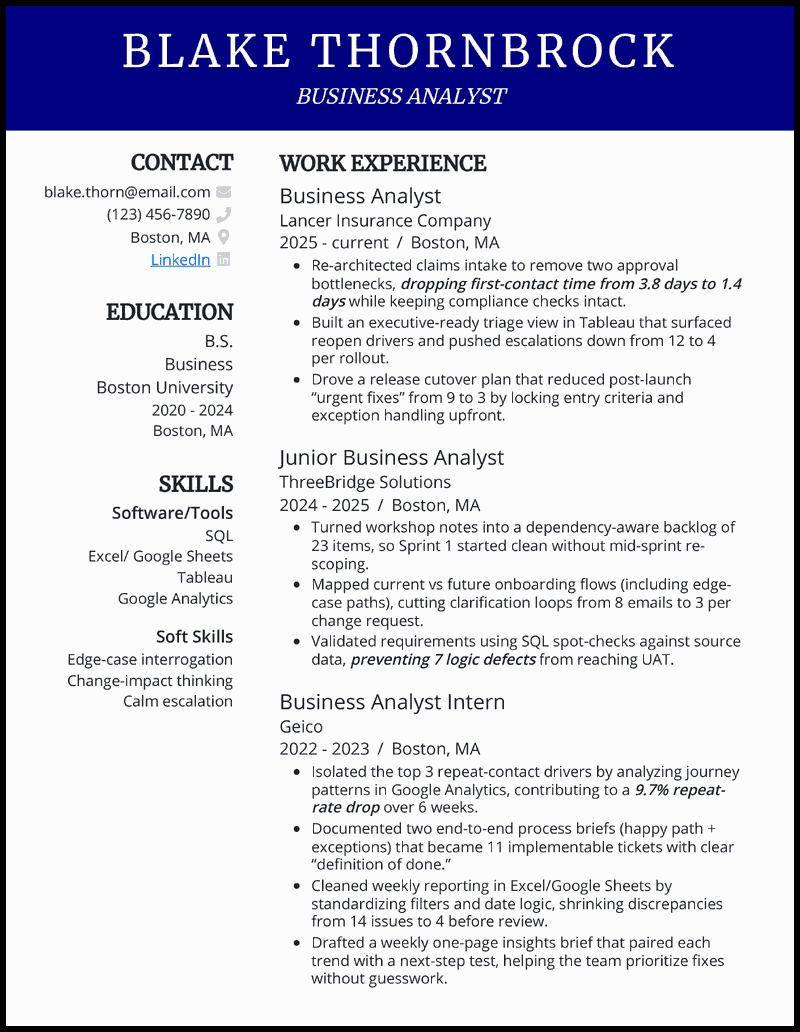
Building a business analyst resume or cover letter means demonstrating to employers that you can effectively present key metrics that inform profitable business decisions. Simply mentioning that you cleaned up raw data is never a good idea.
So, buckle up your business seatbelts and brush up on your Power BI skills, because this guide will cover:
- ↪ 27 Best Business Analyst Resume Examples
- ↪ A Comprehensive Guide on Creating a Business Resume
- ↪ The Top Must-Haves in a Business Analyst Resume
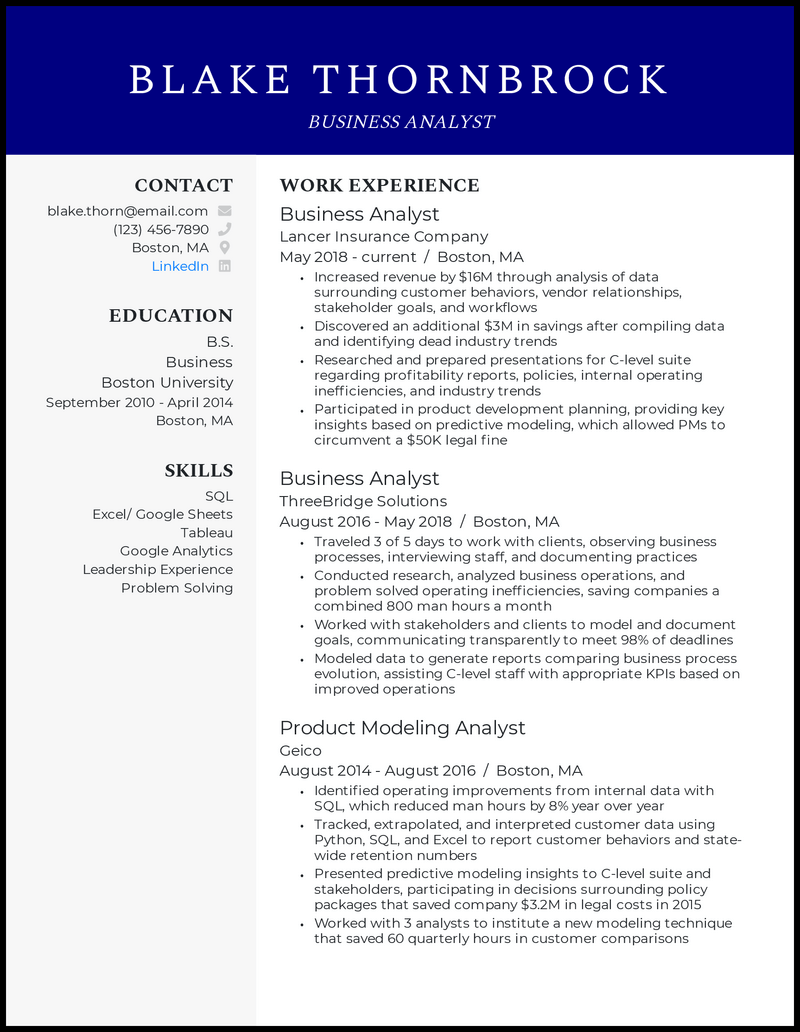
Why this CV works
- Your business analyst resume works best by illustrating a blending of a well-defined career path and a data-driven resume outline. Therefore, you’re on track to success if you’ve started your business analyst career by pursuing a bachelor’s degree in business.
View more business analyst resumes>
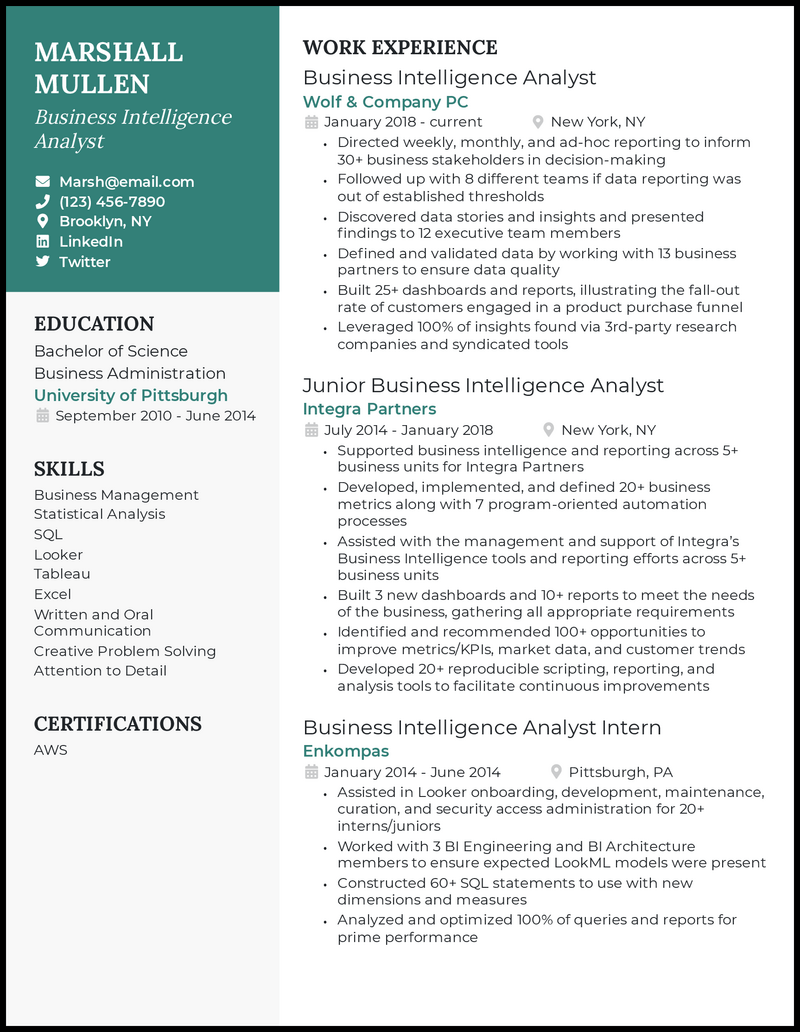
Why this CV works
- Having a well-established career trajectory of College Graduate → BIA Intern → BIA Junior → BIA provides a proven and well-documented history of growth and improvement over time.
See more business intelligence analyst resumes >

Why this CV works
- There are hundreds of different technologies that can be utilized to achieve the mission of a business systems analyst. It’s paramount to research the job market to see which skill specifics apply to you: Looker, Tableau, and SQL rank highly in this specialized job market.
View more system analyst resumes >

Why this CV works
- The second source takes a general look at desired job titles in a specific geographic location. After evaluating the market’s desired skill requisites, emphasize specific bullet points with KPIs to complement and enhance your credibility.
See more senior business analyst resumes >

Why this CV works
- You need to show how those skills are applied practically and how they can drive meaningful business results. Include specific projects where you utilized Salesforce Agile Accelerator or Informatica Cloud to streamline business processes, demonstrating your hands-on experience.
See more Salesforce business analyst resumes >

Why this CV works
- Deploy your ServiceNow business analyst resume’s career objective to paint a picture of a passionate hard worker who will inspire the team to perform and achieve goals. Merge that passion with the willingness to unleash your expertise and experience to help the potential employer be ahead of the competition.

Why this CV works
- The best way to prove that you’re actually a pro at the skills you list is to show those same skills in action in your work experience section. As you write your bullet points, look for ways to integrate these skills naturally.
See more IT business analyst resumes >

Why this CV works
- If you can demonstrate that you’re already up to speed on the skills and systems required to succeed, recruiters will take notice. For example, highlight your Certified Professional in Healthcare Information and Management Systems (CPHIMS) credential.

Why this CV works
- Add a direct link to your LinkedIn profile in the resume’s header section. Be careful, though; a run-of-the-mill profile can make the hiring manager think twice about bringing you on board, so optimize yours accordingly.

Why this CV works
- Highlight times you’ve taken the initiative to streamline systems to showcase your knack for spotting bottlenecks—and fixing them. Besides, a cover letter writer is a fantastic tool to discuss relevant personal projects to bridge your gap in professional experience.

Why this CV works
- Spotlight how you’ve used (and will use) Appian, Celonis, or Tableau to enhance business operations. This approach gives your resume a practical edge, proving your tech proficiency and ability to leverage it in real-world scenarios.
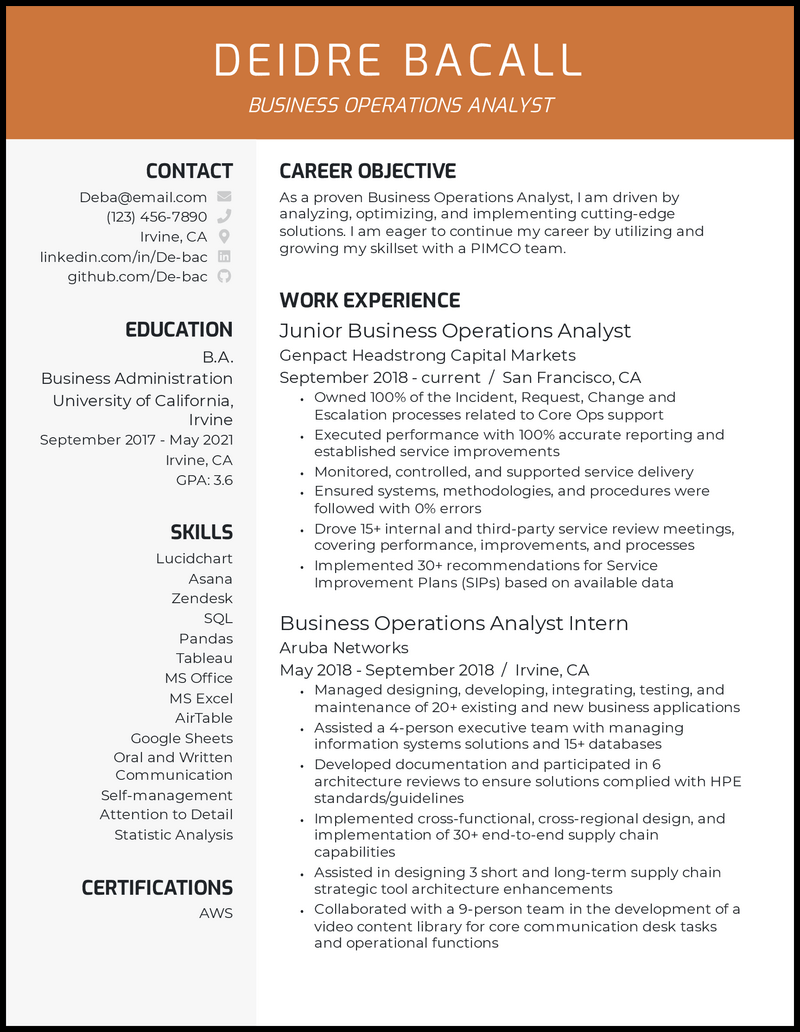
Why this CV works
- Your operations analyst resume should focus on one obvious thing: operational analysis, primarily. Reinforce as much operational, analytical data as you can by including improvement/enhancement KPIs to showcase the overall impact on the company’s bottom line.
See more operations analyst resumes >

Why this CV works
- When you’re applying for an entry-level role, you might lack relevant work experience. Including a career objective helps an employer link your past achievements with the position you’re aiming for.

Why this CV works
- Having tools like IBM Watson Natural Language Understanding and Microsoft Azure ML will create a strong impression on the employer and suggest that your RPA business analyst CV is well above the average candidate.

Why this CV works
- For a strong banking business analyst CV, let the experience section serve as a record of your business acumen and keen problem-solving skills. This approach could make it easier to propel your application to the top of the pile, attracting significant interest from the hiring manager looking for a candidate with your expertise.

Why this CV works
- In the world of business analysis, utilising stacks of data to find solutions is the name of the game. What can give you a head start and get recruiters to choose you over someone with more experience is demonstrating your ability to cut the Gordian knot and grow the business.

Why this CV works
- Include a phrase like “analyzed SQL queries for performance optimization, cutting query execution times by 49% and boosting database performance for over 1,084 users”. It’s the kind of evidence that proves your prowess and translates your technical achievements into clear business value.

Why this CV works
- Showcase your ability to build new systems with a prominent skills section. For example, highlighting SQL on your technical business analyst resume proves that you can create databases for the enterprise.
Why this CV works
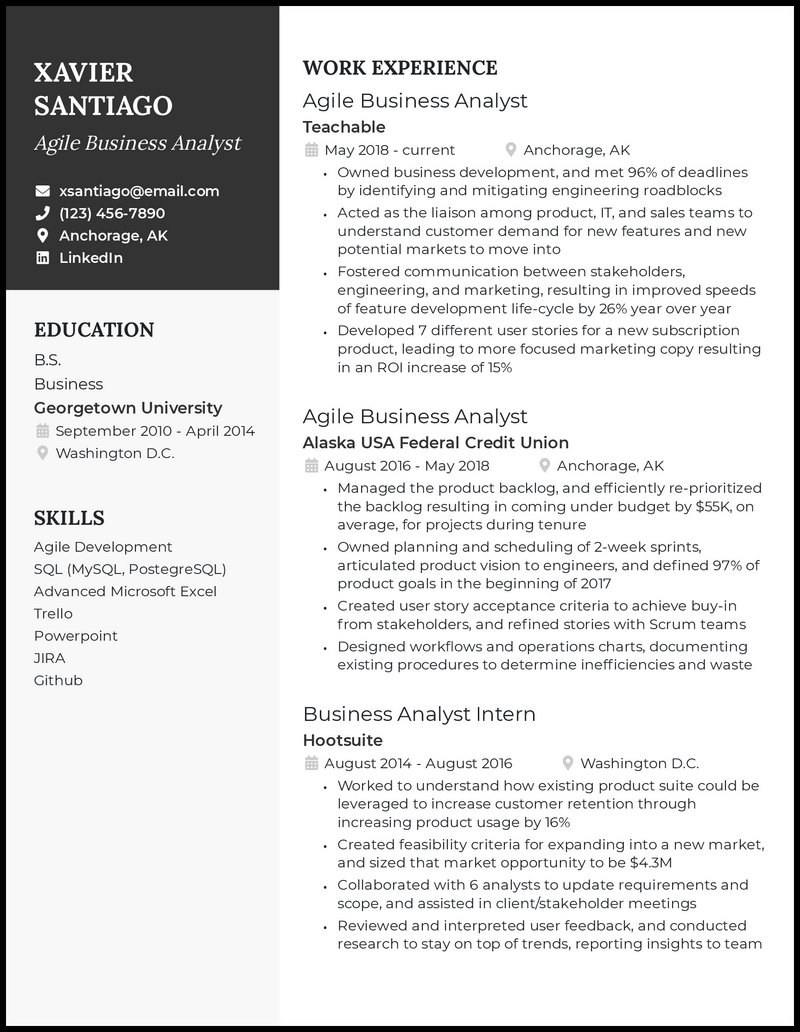
- Build credibility by starting with a firm foundation via a bachelor’s degree in business and then completing that foundation with a lengthy internship. Once one to two years of experience has been gained, including multiple KPIs, it will demonstrate a history of driving value.
See more Agile business analyst resumes >

Why this CV works
- Showcase your risk management skills: recognizing and prioritizing risks, assessing impact, and developing effective strategies. Then add results such as, “Invested in redundant backup infrastructure that slashed data loss risk by 98%”.

Why this CV works
- Put your outstanding skills and impressive capability to drive business decisions in the limelight and have recruiters instantly know you’re the right fit for their business. For instance, mention that you used SAP ERP for supply chain management and cut procurement costs by 16%.

Why this CV works
- Two things should outshine everything else in your finance business analyst resume: accurate data reporting and reliable financial trend and pattern forecasting. In that regard, achievements such as reducing errors by 21% and 14% improvement in forecasting accuracy deserve to be highlighted.

Why this CV works
- If you’re looking to create an outstanding Jira business analyst CV, focus on using numbers to set a high standard for other applicants and demonstrate a highly sought-after data-driven mindset.

Why this CV works
- A bachelor’s degree in business is an extremely versatile tool that can be leveraged in many ways. If your resume includes an excellent GPA, it will ensure the reader’s eye will see a 4-year degree has been completed.
See more entry-level business analyst resumes >

Why this CV works
- Emphasise how you’ve applied your knowledge of AEM to manage impactful projects in a company. Clear examples will build your credibility and improve your chances of securing an interview.

Why this CV works
- This is a great time to add bullet points like “realizing $1.5M+ in cost savings through optimized vendor negotiations”. Don’t forget to add metrics for other finances such as cash flow and profit margins, too!

Why this CV works
- Don’t even think about using jargon in your e-commerce business analyst CV. In an attempt to demonstrate that you’re at the top of your game, you might alienate the hiring manager and ruin your interview chances.
Related CV guides
How to Write a Business Analyst CV

While writing your resume, you must focus on including quantified impacts that show how your insights brought actual business value. Also, make sure that you’re doing each section justice by adding adequate information.
Overall, just keep your experiences concise, measurable, and results-driven. The section below will take you through:
- Best tips for quantifying your past analytical experiences.
- Formatting techniques that will get you past any ATS system.
- Ideas for including projects if you’re new to the field.

What you sohould know about BA roles
My favourite part of being a business analyst was that no two days were the same. One day I might be deeply immersed in complex SQL queries, and the next I’d be talking to customers to understand how they used our products.
This wide range of responsibilities made the job exciting and challenging. No two business analysts have the same role, so it can be really difficult to know what to include on your CV to satisfy hiring managers at different companies.
I’ve hired business analysts, I’ve applied for roles as a business analyst, and I’ve reviewed thousands of business analyst CVs at this point in my career. Fundamentally, you have to demonstrate that you’re capable of having a meaningful impact on the business you’re applying to.
This holds true whether you’re a junior business analyst looking for your first full-time position or you’re a senior business analyst seeking a promotion to management. Present your case that you’ll have a significant, positive impact in the role you’re applying for.
In summary, here are the ways to ensure you achieve that:
- Start your CV with a personal statement if you’re aiming for a senior role or a career objective if you’re a beginner.
- Demonstrate a strong and relevant work experience
- Use the skills section to demonstrate your technical and interpersonal skills
- Use CV examples that have worked for other business analysts to secure their dream jobs

How to highlight your business analyst skills
Compared to other tech roles, the range of hard skills that business analysts need to have is relatively consistent across companies.
While the type of analysis that a business analyst conducts can vary significantly from one role to another, the fundamental principles of the role remain unchanged. A business data analyst collects data and uses their insights to enhance business processes or operations.
Whether that happens through forecasting, pricing, reporting, or statistical analysis, the toolkit that a successful BA needs to have is well defined.
First, you need to be able to prepare data for analysis. More often than not, companies store their data in relational databases. So this means you need to know SQL to extract and clean that data.
If the quantity of data that a company has is significantly smaller, you might get all the data you need to analyse right in (usually very sloppy) Excel workbooks.
After the data is prepared, you need to carry out your analysis. This could involve using interactive models (in which case you’ll likely be using Excel), or you might need to conduct a more sophisticated analysis in Python or R.
Finally, you need a way to present your findings. Sometimes this can simply be visualisations in Excel (Excel is the true business analyst MVP), sometimes it can be through data visualisation in a BI tool like Tableau or Looker, and sometimes it might be through a presentation in PowerPoint.
Skills to include on your business analyst CV
- SQL (MySQL, PostgreSQL, SQLite, SQL Server)
- Excel, Google Sheets
- PowerPoint, Google Slides
- Tableau, Looker, Chartio
- Python, R
- Salesforce, Netsuite, Hubspot, Pipedrive
- A/B testing, linear regression, logistic regression
Notice a pattern here? Only include hard skills in your skills section. Think of it this way: if you were reviewing a CV and someone listed they were a “team player” in their skills section, would that tell you anything about their qualifications?
No, it wouldn’t. Soft skills are best demonstrated in an interview. Listing them on a CV just doesn’t add any value.
The other thing you have to consider is that there are two stages of CV review:
- Companies use an Applicant Tracking System (ATS) to automatically filter out resumes based on certain keywords used in your bullet points, skills, and LinkedIn headline.
- The hiring manager or HR person responsible for screening for the role will look at your CV.
When companies use keyword filters, they only ever screen for hard skills. So soft skills won’t help you get past phase 1. And as I mentioned earlier, simply listing soft skills on your CV won’t convince the hiring manager you actually possess those skills.
How can you balance your skills section to satisfy both the ATS and the hiring manager? First, don’t include a long list of skills. This is a major red flag to the hiring manager even if it will help you get past the ATS.
For example, there is no reason you would include Python, R, Matlab, and SAS on your CV. When it comes to your skills section, you want to avoid coming across as a jack of all trades and a master of none.
It’s much better to demonstrate expertise in a few skills than a superficial understanding of 15-20 skills.
When you’re deciding whether or not to include a particular skill on your CV, just ask yourself if you’d be comfortable answering questions about that skill in an interview.
Lying on your CV is one of the few guaranteed ways to ensure you’ll never be able to get a job at a company in the future. Personally, I also couldn’t cope with the anxiety of potentially being exposed for a CV lie during an interview. It’s not worth it!

How to get your business analyst resume format right
Formatting your CV properly may matter more than you think. For any given BA role, a hiring manager reviews over 100 CVs. To that end, they’re looking for a reason to say “no” to any given application they review.
Formatting your CV incorrectly is a quick way to end up in the “no” pile. Your goal with formatting your business analyst CV is to make the job of the hiring manager as easy as possible.
Put yourself in their shoes. Given the exact same experience for two candidates, would you be more likely to approve the CV that extends to 5 pages or the CV that concisely makes the case for their qualifications?
Here are the key formatting tips you should keep in mind for your business analyst CV:
- Keep it to one page. If it’s longer than a page, the hiring manager will likely only skim through it.
- Unless you’re customising your business analyst CV summary, don’t include it on your CV. It’ll just take up space.
- If you’re a senior business analyst, keep your education section very brief. If you’re an entry-level business analyst, include relevant courses you took at university that make you suitable for the role.
- Don’t get too creative with your formatting. Your CV needs to be machine-readable, so don’t include any images or charts.
- Include links to any relevant work, projects, or write-ups you have.
- This could be your LinkedIn, Github, personal blog, publications, etc. Anything that demonstrates your skills as a business analyst.
Since your goal is to keep your CV to one page, every inch of space is valuable. If you’re a senior business analyst, this means you need to keep your education section concise to allow more room to discuss your work experience.
Conversely, as a graduate business analyst, you need to demonstrate that you’re qualified to be a BA without much (or any) work experience. To do that, you should include relevant maths/statistics/economics/programming modules you took at university.
Education section for business analysts: senior vs entry-level
- Senior business analyst
- Only include the essentials. Your university, the degree you earned, and your subject.
- You don’t need to include your grade point average.
- Junior business analyst
- You need the essentials (school, degree, subject)
- Include relevant courses you took that make you qualified to be a BA
- This can be classes in mathematics, statistics, economics, programming, business studies, etc.
- Include your degree classification if it’s a 2:1 or above.
What certifications strengthen a business analyst resume?
The best certifications to add to a business analyst resume are:
- PBA — Project Management Institute
- ECBA — International Institute of Business Analysis
- Agile Analysis Certification — International Institute of Business Analysis
- Certified ScrumMaster — Scrum Alliance

Business analyst CV summary or objective
Spoiler alert, most (90%+) of business analyst job applicants don’t need a CV objective or CV summary.
Why? The vast majority of them are too long, too generic, or don’t offer any new information about a candidate’s qualifications for the BA role they’re applying for. Because of this, many hiring managers have become accustomed to overlooking this section (particularly when it’s too lengthy).
If you’re going to include a CV objective, make sure it actually adds value to your CV. Here are some ways you can do that:
- Discuss why you are particularly interested in working as a business analyst at the company you are applying to.
- Tailor your CV objective for each job you apply for; this means carefully reading each of those business analyst job descriptions!
- Read what you’ve written. Is it just generic, meaningless jargon? If so, then it’s better not to include it.
- Keep it to two lines or fewer. If it’s longer than that, the hiring manager probably won’t read it.
To clarify this point, here are some examples of good and bad business analyst CV objectives and summaries.
If you’re looking for more inspiration, we’ve compiled over 100 CV objective examples you can use.
WRONG – meaningless jargon bingo
Aiming to utilise my analytical skills to transform disorganised data into practical insights for a purpose-driven company
WRONG – far too long
Business analyst with over 7 years of making significant impacts through my analyses. Comfortable collaborating across various teams, from product to engineering to leadership. Skilled at transforming unclear product requests into business requirements that are implemented efficiently. Throughout my career, I have generated £3.7 million in value through my analyses and recommendations.
RIGHT – showing a specific interest in the company
As a former small business owner, I’m excited about the prospect of utilising my experience in leading data-driven product recommendations to further Stripe’s mission of making payments accessible to businesses of all sizes.

How to quantify impact on your BA resume
The goal of a business analyst is to utilise data to make recommendations that have a demonstrable impact on a business or product. More than anything, you need to make it clear on your CV that you have this capability.
How can you do that? By demonstrating that you’ve done it before! You need to estimate the impact of the projects you’ve worked on.
One of the toughest challenges of being a business analyst is trying to quantify the seemingly unquantifiable. How can you estimate the potential revenue impact of a feature that hasn’t been launched? How can you estimate the impact of a pricing change on customer attrition?
These are challenges that business analysts have to deal with in their day-to-day work. By estimating the quantitative impact of your past work, you’re clearly demonstrating you have a knack for logical, numerical reasoning that is essential to succeed as a business analyst.
The impact of your projects doesn’t just have to be expressed in terms of revenue impact. Here are some other ways you can approach it.
Ways to measure your work as a business analyst
- Improved customer conversion rate
- Example: Utilising Google Analytics and Excel identified a gap in the product funnel and made a recommendation that improved customer conversion rate by 10%
- Saved manual reporting time
- Example: Streamlined and automated a key business report in Tableau, saving the team 10 hours of reporting each week.
- Reduced costs
- Example: Using SQL and Excel, it was recommended that we terminate our contracts with our worst-performing suppliers, resulting in an annual cost saving of £100,000.
- Created data visualisations to assist executives
- Example: Created data visualisations in Excel to demonstrate the effectiveness of our sales operations and marketing, resulting in the closure of a £1.3M Series A.
- Enhanced customer retention
- Example: Determined through analysis in Python that emailing customers who had been inactive for 7 days resulted in a retention improvement of 7 basis points.
- Enhanced customer satisfaction
- Example: Using SQL and Excel, identified common complaints among new customers leading to changes that improved new customer satisfaction by 14%.
When it comes to demonstrating the impact of your work, it’s important to focus on the most important metrics relevant to a given project. Being able to determine the success versus failure criteria of an experiment is crucial to being a good business analyst.
Just to drive the point home one last time, I want you to compare these two work experiences. Now, this is the same business analyst discussing their experience in a particular role in two different ways.
Which do you think is more effective in convincing the hiring manager they’re a highly qualified business analyst?
WRONG – unclear description of work experience
Insurance Company
August 2014 – August 2016, Washington DC
Business Analyst
- Identified procedural areas for improvement through customer data to help enhance the profitability of a nationwide retention programme
- Using Python, SQL, and Excel, developed and managed the reporting for a nationwide retention programme
RIGHT – specific projects with demonstrable impact
Insurance Company
August 2014 – August 2016, Washington DC
Business Analyst
- Identified procedural areas for improvement through customer data using SQL to help increase the profitability of a nationwide retention programme by 7%
- Using Python, SQL, and Excel, developed and managed the reporting for a nationwide retention programme, saving approximately 100 hours of labour each month

Project ideas for junior business analysts
If you’re a junior business analyst, I know what you’re thinking: “Stephen, this whole section is focused on work experience but what if I don’t have work experience as a business analyst?” (P.S. I don’t actually know what you’re thinking, I just needed a decent way to transition)
The beauty of being a business analyst is that you don’t need work experience to demonstrate the skills needed to succeed in a full-time position!
Fundamentally, a business analyst needs to ask a question, gather data to answer that question, and analyse the data to provide a convincing answer to that question.
You can do that on your own! Discussing a project you worked on to address your own needs shows a hiring manager that you have the motivation and skills to succeed as a business analyst.
Get creative! Have you had a question you’ve long pondered? Think of some data you can collect and write up your findings.
To get your creative juices flowing, here are some questions I’ve given a lot of thought to and how I might go about answering them.
Sample business analyst projects for your CV
- Have the New York Mets (my favourite team) had bad injury luck?
- I would collect data on the value of each player in the squad in terms of their performance over the last 10 years and the number of matches they missed each season. I’d then compare this to other teams in the league and write a report.
- Are graduate business analyst jobs really entry-level?
- I’d look at some of the most popular job boards for business analyst job descriptions. I’d manually gather attributes about each of the job descriptions and do a write-up.
- What is the most valuable skill for a business analyst to possess?
- Examine salary data and job descriptions for business analyst roles across the country. I would account for confounding factors such as years of experience and attempt to determine which individual technical skill is most associated with a higher salary.
- Do people actually like BAFTA films?
- I’d look at the box office and public reviews of films nominated for the “best picture” Oscar as far back as I can get reliable data and conduct an analysis to try and answer this question.
- Do ultra-runners from the west coast perform better than those from the east coast? (Ultra-running is a hobby of mine)
- I would gather public data on the top 200 ultramarathons each year, going back as far as data is available. I’d then compare the hometowns of top performers to see if access to trails and favourable weather correlate with performance on race day.

How to write a great business analyst resume
Whether you’re a senior business analyst or an entry-level business analyst seeking your first position, the guiding principle of your CV should be to show the hiring manager that you’ll make a significant impact on their business!
- Only include hard skills in your “skills” section. If you would not feel comfortable being interviewed about a particular skill, don’t include it.
- Keep your CV to one page and triple-check for spelling and grammar errors. More often than not, you should not include a CV objective or summary.
- Showcase your numerical reasoning skills by quantifying the impact of your previous work as a business analyst. If you’re seeking your first BA position, include projects you’ve worked on in your CV.
It took me 66 applications before I secured my first business analyst role in 2010. I know looking for a new job is generally disheartening, so try to keep your spirits up.
You’ve got this! I’m cheering you on. If there’s anything I can do to help you secure your next business analyst role, please don’t hesitate to get in touch.

Key takeaways
- Include BA certifications directly mentioned in the job listing
- Choose specific action words depending on your analytical experience
- Always quantify how your analytical work impacted business decisions
- Include the top industry in-demand skills like SQL and Tableau
- Follow the bwest formatting practices to ensure your business analyst resume passes any ATS system
Business Analyst CV FAQs

A technical business analyst should highlight roles in developing software solutions, bridging collaboration gaps between IT and business teams, and enhancing systems through data-driven insights. Emphasise skills in requirements and compliance, system analysis, technical documentation, and collaboration with cross-functional teams to bring robust, scalable, innovative solutions to life.
Ensure it is results-focused, concise, and tailored to the role. It should include your job title and level of experience, list key business analysis skills, demonstrate measurable achievements, and conclude with your career mission and vision. Keep it between 2 and 3 lines and focus on the value you bring to the employer.
Here’s an example of a powerful CV summary:
“Detail-oriented principal business analyst with over 10 years of experience driving process improvements and delivering data-backed insights for FTSE 100 clients. Led a CRM optimisation project that reduced customer churn by 18%. Skilled in SQL, Tableau, and Agile methodologies. Passionate about leveraging analytics to shape future-ready business strategies.”
A business analyst’s CV should demonstrate how you analyse data, streamline processes, and implement innovative solutions that drive measurable business outcomes. Use verbs like “led,” “analysed,” “optimised,” and “solved” to reflect how you applied business analytics to solve problems with a forward-thinking approach.
Your business analyst CV should be one page if you’re at the entry to mid-level stage to ensure clarity and impact. For senior-level professionals with extensive experience and achievements, going beyond one page is acceptable—just ensure every line adds value.

Stephen is the co-founder and CEO of BeamJobs. Frustrated with the challenges he'd faced in his own job search, he left the corporate world to start BeamJobs with his brother. Drawing on firsthand experience with hiring and getting hired as technical talent, he started BeamJobs in 2020 to help qualified job seekers land interviews with less stress. Since then, more than 4 million people have built their resumes and cover letters on BeamJobs. Stephen's insights have been featured in notable outlets, such as Fast Company, Business Insider, Yahoo Finance, MIT, and Zapier. Learn more about Stephen.