



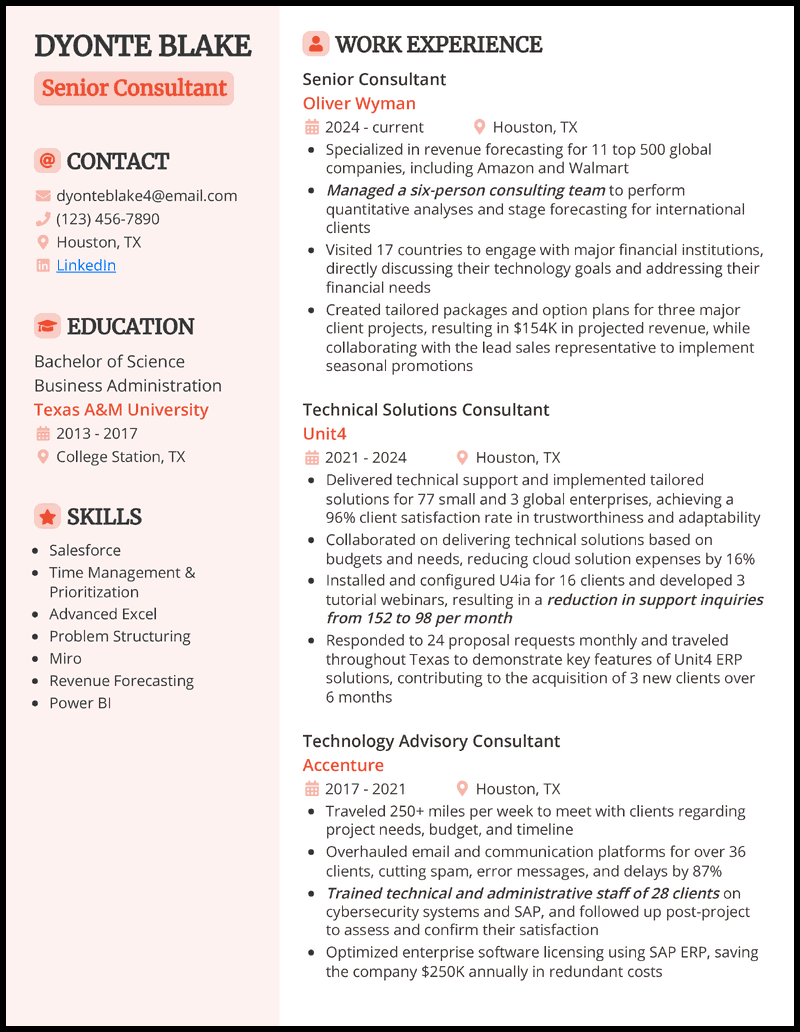
A high-impact consulting resume balances clarity, structure, and measurable results. Whether you’re applying to MBB, a niche firm, or a downtown boutique, your formatting and phrasing should reflect the analytical rigor expected in the role.
Inside, you’ll find:
- ↪ 13 consulting resume examples you can use as inspiration
- ↪ Tips for making a consulting resume that highlights leadership, results, and analytical thinking
- ↪ Advice on writing a resume that passes both ATS filters and impresses human screeners — plus how to align it all with your cover letter
If you need actionable resume advice tailored to the consulting industry, you’re in the right place.

Why this resume works
- In your work experience bullet points, be brief but specific and sprinkle in relevant keywords from the consulting job description. If you specialize in revenue forecasting or another area, think about how you can include more about your specialty on your consulting resume.
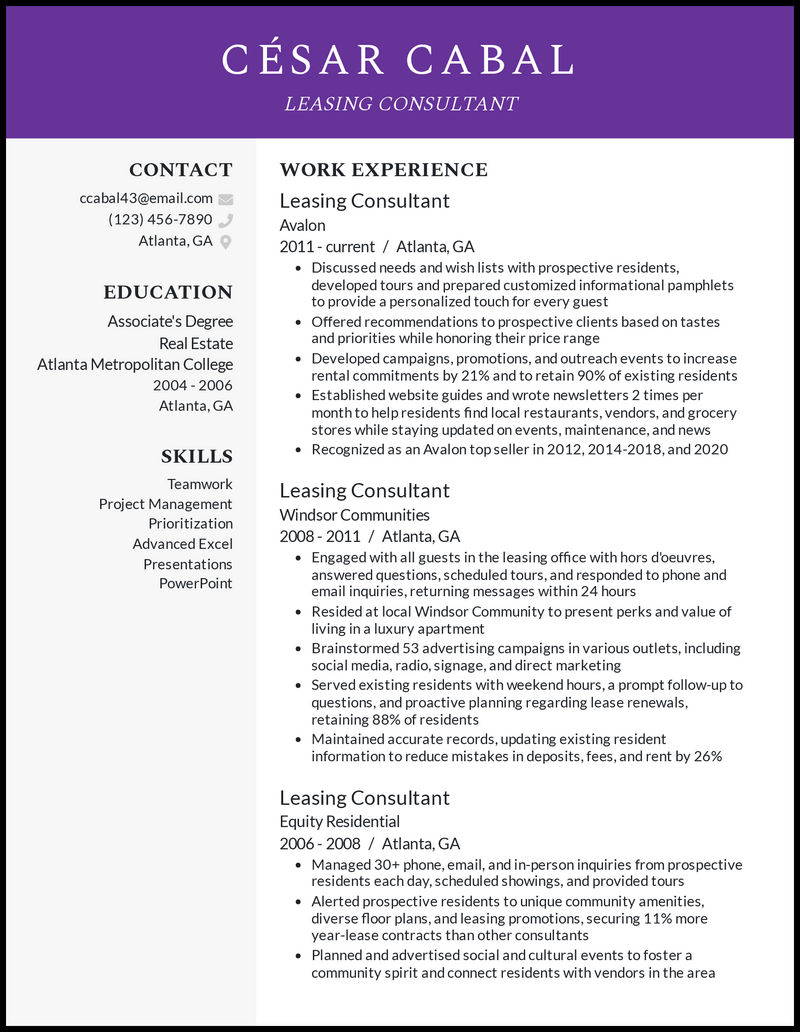
Why this resume works
- Skills like “project management,” “Google Workspace,” “negotiation,” and “sales,” are all excellent inclusions on a consulting resume. Just ensure you back these up with evidence.
View more leasing consultant resumes >
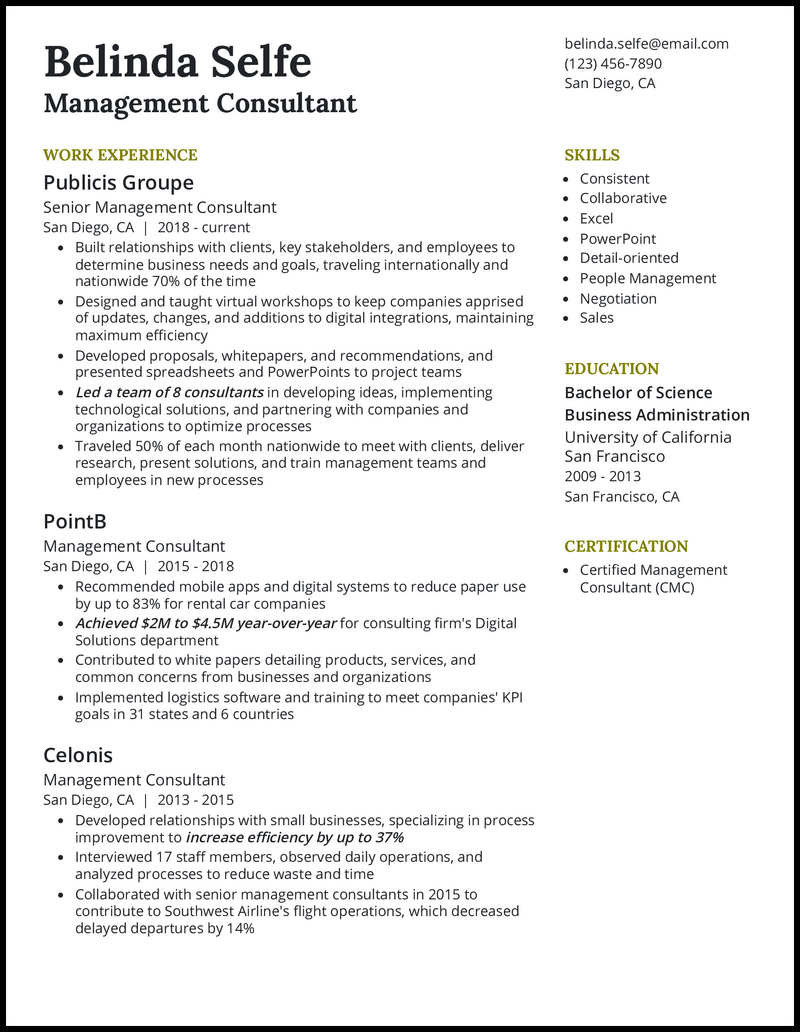
Why this resume works
- A certifications section tells recruiters you’re good at what you do and keep up with industry trends. Here, put credentials that strongly establish your value to a would-be employer.
View more management consultant resumes >

Why this resume works
- Having ten years of experience under your belt is a strong start, but highlighting the results you achieved throughout your storied career is what will really sell your marketing consultant resume. Ensure you measure the revenue impact of your contributions as a marketing professional, and style it so those metrics stand out.
View more marketing consultant resumes >

Why this resume works
- Graduating from a prestigious institution alone isn’t enough to stand out—you need to show how you continued your education to gain invaluable consulting experience. A solid business consultant resume will dedicate space to key certifications, like a CFA, in addition to a degree.
View more business consultant resumes >

Why this resume works
- Percentages relating to saving money, increasing efficiency, or resolving conflicts are always good. You can also shoot for numbers relating to the number of employees you helped or the locations/departments you oversaw.
View more HR consultant resumes >

Why this resume works
- Want to craft a consulting internship resume without hands-on experience? Don’t sweat it—you’re not out of the running yet. Lean on credible college projects that prove your ability to understand market shifts like no one else.

Why this resume works
- What are the key pieces that form this winning McKinsey consultant resume? Capturing the recruiters’ attention with impressive accomplishments and contributions to their previous organizations.
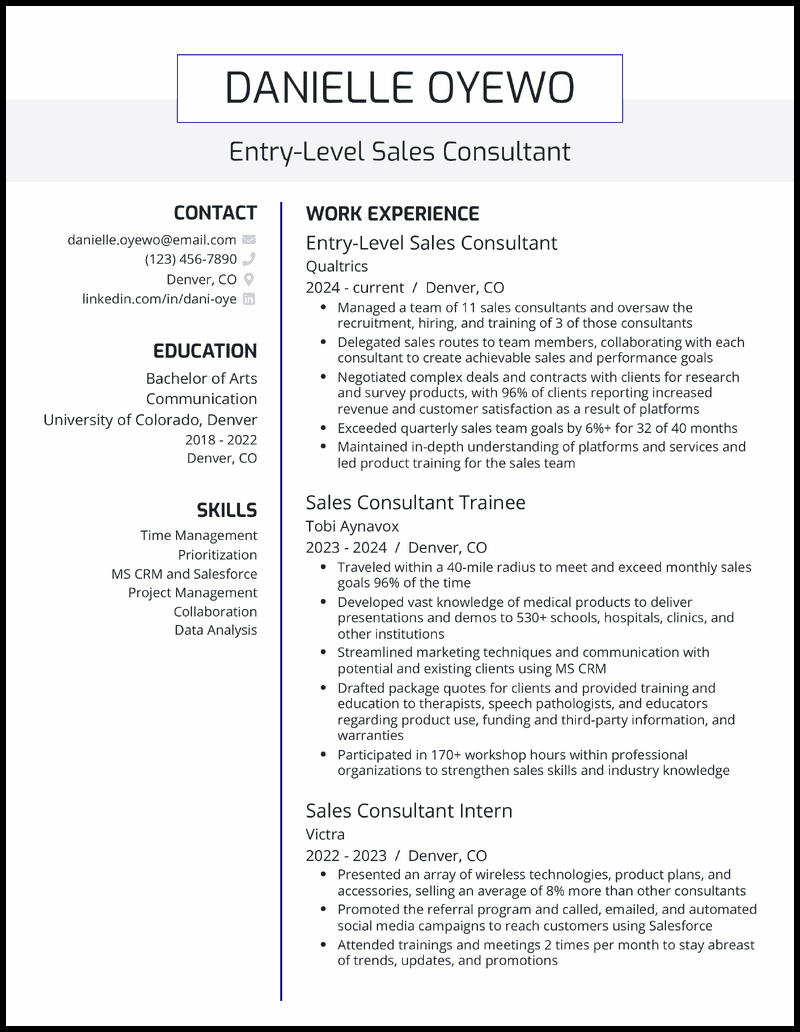
Why this resume works
- At the risk of stating the obvious, sales consultants must be persuasive, determined, and, well, sales-minded. This means metrics should be the star on your sales consultant resume. Also, include the specific software programs you know about in the skills section of your resume.
Why this resume works
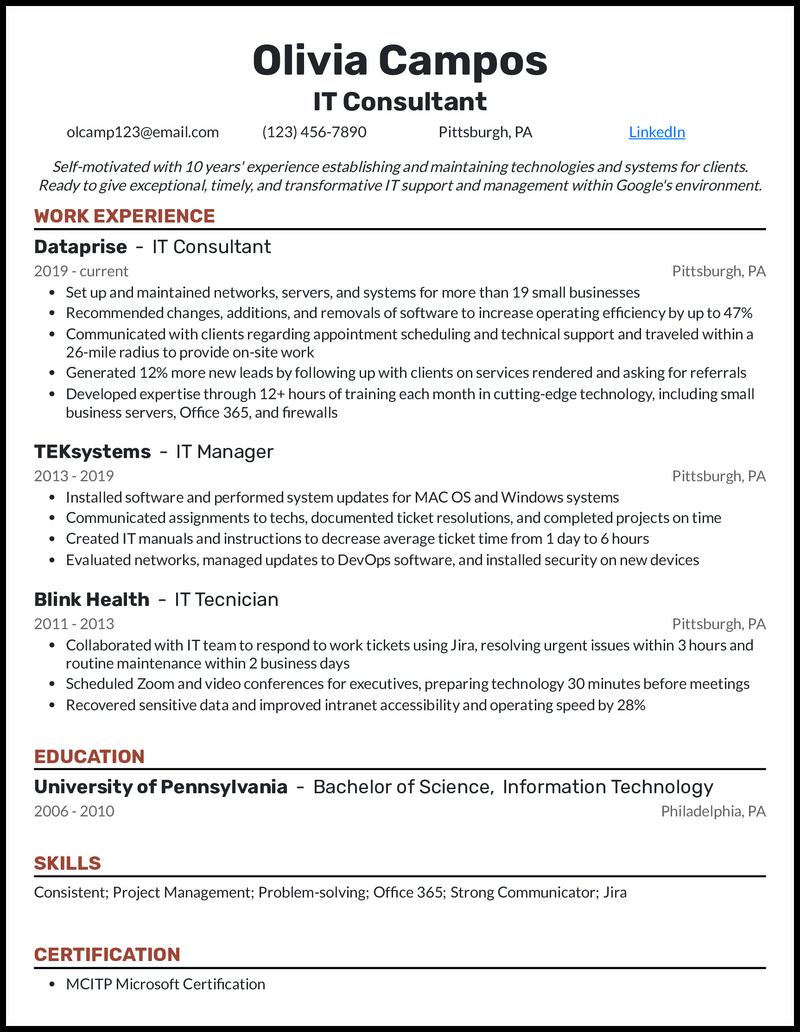
- IT consultants seem to do it all, so it may be challenging to fit everything onto one page, yet, that’s what you need to do to ensure your resume doesn’t get the boot. Correctly formatting your resume can help you fit everything you want without sacrificing aesthetics.
View more IT consultant resumes >

Why this resume works
- Having a powerful skills section might just be your ticket to landing that job. Take a look at David’s strategy consultant resume—he’s smart to highlight skills like Microsoft Excel and SPSS.

Why this resume works
- Take a trip down memory lane—did your guidance help clients skyrocket their marketing ROI? Help them save operational costs? Or maybe grow their lead conversion rates? Numerate such impressive feats to create a standout Deloitte consulting resume.
Why this resume works
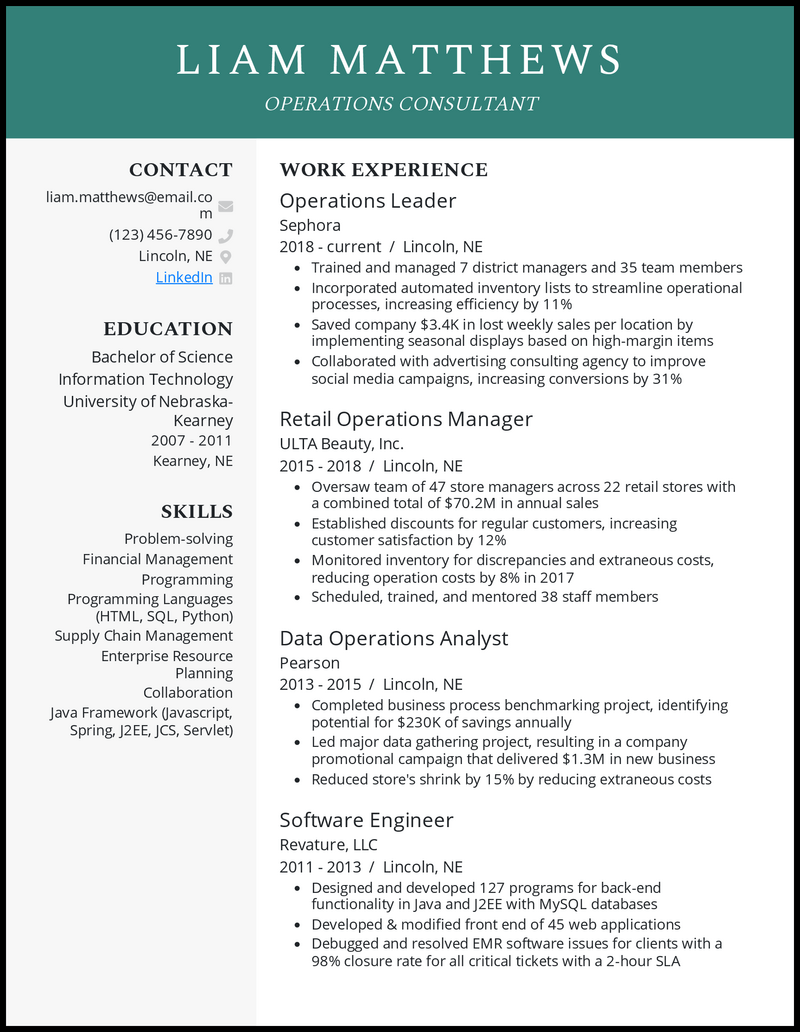
- Keep your operations consultant resume short, sweet and to the point to demonstrate your efficiency and effectiveness. If you can’t fit all your work experience onto one page, remember that you can share more details in your consulting cover letter.
View more operations consultant resumes >
Related resume guides
How to Write a Consulting Resume

A winning consulting resume needs a clean layout, quantifiable achievements, and a tone that mirrors the potential employers’ expectations. To stand out, you must include targeted keywords from the job ad, structure your most relevant experience like a case study, and back every claim with measurable results.
You’ll learn:
- How to use job-winning resume templates to frame your achievements with clarity and impact
- Why you should run your final copy through a resume checker to flag weak phrasing, formatting issues, or keyword gaps
- How to build each section — from summary, work experience, to education and certifications — to reflect the analytical style consulting firms expect

What is a consulting resume?
A consulting resume is a tailored document presenting your analytical skills, problem-solving abilities, and client-facing experience to an interested employer. It emphasizes structured thinking, quantifiable impact, and a track record of achieving results in diverse environments; the kind of traits that recruiters value the most.

What are employers looking for in a consulting resume?
Top consulting firms all have one thing in common: they employ the best minds in the industry. So, what makes the ideal candidate for a consulting job in these top companies?
- Showcase problem-solving track record
- Demonstrate impact from previous roles
- Be entrepreneurial driven
- Demonstrate leadership and teamwork

What you must put in a consulting resume
From resume examples that have won high-paying consulting jobs, these are must-have things:
- Measurable accomplishments
- Use of active verbs
- Hard and soft skills
- Work and project-based approach
- Simple and clean layout

Essential sections for a consulting resume
To craft a consulting resume that wins you the job, organize it in five crucial sections:
- Resume Header
- Education
- Work Experience
- Achievements
- Skills
For a clean professional layout, ensure you do the following
- Use a professional, consistent font type and size
- Use bullet points for job descriptions
- Keep formatting neat and consistent
- Use adequate white space to avoid clutter
Let’s now write your consulting resume section by section.

What should a consulting resume header include?
Your header should clearly display your full name, professional email, phone number, and LinkedIn URL (if relevant). If applicable, add your current city or region. Avoid clutter — clarity and accessibility are more valuable than creativity.
This section is where your details should be. They include:
- Name
- Job title
- Professional email address
- Personal phone number
- City and state Social media links such as LinkedIn (only if relevant)
Your first and last names will do the same for your name. Also, use a larger font to make it stand out more than other sections. Every detail here must be professional, so avoid using fancy names for your email address or decorative fonts.
Example of a business consultant resume header section

How do you write a consulting resume summary (or personal statement)?
Use a resume summary generator to craft a concise personal statement. A strong summary highlights your specialization (e.g., strategy, operations), one top result, core skills, and 2–3 differentiators — such as a top-tier MBA, startup experience, or language fluency.
Example
Management Consultant with cross-industry experience and a record of $2.7M annual savings for a client. Skilled in strategic planning and client engagement; bilingual with global project exposure.

How should I highlight education?
Here, you’ll add different degrees, starting with the most recent/highest one. You should not include your high school diploma here. For a recent graduate, the education section should come right after the header section. However, for an experienced consultant, your educational background should come after your work experience.
For each entry, include the institution, specific field of study, city, state, and graduation date. Only include your GPA if it’s 3.5 and above, and if you have less than one year of work experience.
Scholarships, certifications, awards, theses, and other academic recognition should also go here. However, these additions are unnecessary if you have an impressive career history.
Example of how to add education in a consulting resume:
Example
Bachelor of Science
Business Administration
Texas A&M University
2013-2017
College Station, TX
How to order education and certifications vs experience for consultants
If you’re a recent grad, put your education at the front and center. However, if you have at least a year of relevant experience, then prioritize your work history.
After your education, include certifications like PMP, CFA, or data boot camps, but only if they directly relate to your consulting focus.

How should you structure work experience entries for consulting?
Follow a CAR (Challenge–Action—Result) or PAR (Problem–Action—Result) format. Start with the role title, company name, and years worked, followed by 2–4 bullet points emphasizing business impact, client collaboration, and analytical complexity. Use past tense and active verbs.
From your work experience, show potential employers why you deserve the job more than any other candidate. Highlight your achievements, show unique application of specific skills, and use active verbs to emphasize your impact. To do it right, here are the things you must pay attention to:
- Use the reverse chronological format to show your career growth
- Spread your skills evenly across your bullet points
- Use active voice and active verbs
- Focus on measurable results and not responsibilities

What metrics and results should you include in consulting bullet points?
Numbers, percentages, frequencies, time, dollar amounts: Quantify everything. Use a bullet point generator to highlight achievements like:
- Reworked forecasts using Excel/Python and helped the team unlock an 18% revenue boost in Q3
- Reduced turnaround time by 6 hours via process automation, leveraging VBA macros to streamline workflows
- Led a team of 4 analysts to deliver a $1.2M cost-savings proposal using Tableau for data visualization

How do you frame consulting projects?
Create a section titled “Projects” or “Consulting Engagements”. Give the client’s name, industry (e.g., nonprofit, startup), duration (years), your role, and the standout outcomes. Identify the biggest, measurable wins and present them in bullet points with clear impact.
Examples
- Redesigned SKU-level inventory system using Airtable; improving stockout prediction accuracy by 38%
- Developed pricing model that increased projected ARR by 28% within 12 months
- Designed a KPI dashboard using Google Sheets, improving board-level visibility into program outcomes

How to show leadership, teamwork, and initiative in consulting roles
In your bullet points, incorporate phrases that show you being in charge, working with teams, and making decisions. Use a strategy that demonstrates ownership, collaboration, and strategic thinking — all of which consulting firms value heavily.
Great examples:
- “Led cross-functional team…”
- “Initiated new market analysis…”
- “Facilitated client workshops…”

What hard & soft skills belong on a consulting resume?
Your specific skills will contribute to your success and how recruiters view you as a potential candidate. Your technical and soft skills will align you with the job demands you’re about to get. Don’t just list skills that match the job advert; show them in action.
Your skills, metrics, and use of industry-specific tools add authority to your resume. They show employers how to bring more business, and retain and attract new clients. A great strategy here is to set aside a section for skills and then incorporate them when you generate bullet points.
Hard skills
- Advanced Excel
- Power BI
- SQL
- Porter’s Five Forces
- MS Project
- KPI Development and Tracking
- Financial Modeling
Soft skills
- Problem-solving
- Communication skills
- Client management
- Teamwork and leadership
- Creativity and Innovation
- Adaptability and Flexibility

When and how to include additional sections (publications, speaking, awards)
Set aside an “Additional” section if:
- You’ve spoken at conferences
- Published industry articles or case studies
- Won academic or professional awards
Use 2–4 bullets for each, and only include what reinforces your consulting prowess.

How to tailor a consulting resume to strategy vs operations consulting roles
For strategy roles, lean more on market analysis, financial modeling, and business cases.
On the other hand, for operations, focus on process improvement, supply chain, Lean/Six Sigma, or systems implementation.
A table comparing how you should approach strategy-oriented vs operations-centered consulting roles:
| Section | Strategy Consulting | Operations Consulting |
|---|---|---|
| Summary | Emphasize market research, modeling, business strategy | Highlight process optimization, efficiency, system rollout |
| Experience | Focus on analysis, growth initiatives, strategic plans | Emphasize implementation, logistics, and executional wins |
| Metrics | Revenue growth, market share, valuation impact | Cost savings, cycle time reduction, throughput increase |
| Skills | Financial modeling, competitive analysis, slide decks | Lean/Six Sigma, ERP systems, project management |
| Education and Certifications | MBA, CFA, strategy-related bootcamps | PMP, Six Sigma, Agile/Scrum credentials |

How to optimize your consulting resume for Applicant Tracking Systems (ATS)
Keep your design simple and semantic for parsing bots by sticking to the script below:
- Use standard headers like “Experience” or “Education”
- Avoid embedded images or charts
- Only plain text, no tables
- Use keywords from the job description naturally

What common mistakes should you avoid on a consulting resume?
- Fluffy phrases and statements (“team player,” “hard worker”)
- Passive voice and vague results
- Disregarding metrics or context
- Over-designing templates that disrupt parsing
- Duplicate or redundant bullets across jobs

Key takeaways
Ready to start applying for consulting jobs? Before you do, follow the best practices you learned in this guide.
- Include the things that employers are looking for
- Your resume layout and format are neat and consistent
- The contact information is correct
- You’ve quantified achievements with skills, metrics, and active verbs
- All essential sections are there and are easy to scan and read
Consulting Resume FAQs

What should be included in a consulting resume?
A consulting resume clearly showcases your skills, results-centered experience, and value-add to the job. At a minimum, include:
Work experience with measurable outcomes
Education and credentials
Key skills, including analytical, industry knowledge, and client management tools
Industry-specific keywords pulled directly from the job description
Unique selling points that propel you to the top, such as language fluency, certifications, or niche speciality
A typical McKinsey resume reflects innovation, leadership, and a structured problem-solving mentality. They look for these qualities:
Academic excellence (GPA, test scores, honors for recent graduates)
Impactful leadership experience, both at professional and extracurricular fronts
Structured thinking, shown through bullet-point PAR formatting
Interpersonal and team skills
To get the most from your consulting projects:
Present them in the Project-Role-Results formula
Be specific: Describe the client, role, problem, your actions, and measurable outcomes
List challenges and what you learned to show reflection and adaptability
Use bullets to break up dense content and emphasize wins
A management consultant resume is a power-packed presentation of your qualifications for senior consulting roles. It should:
Demonstrate your leadership and full-cycle project ownership
Show strategic thinking via past initiatives taken and their outcomes
List relevant industries or sectors you’ve advised in
Demonstrate your ability to drive results, not just participate

Stephen is the co-founder and CEO of BeamJobs. Frustrated with the challenges he'd faced in his own job search, he left the corporate world to start BeamJobs with his brother. Drawing on firsthand experience with hiring and getting hired as technical talent, he started BeamJobs in 2020 to help qualified job seekers land interviews with less stress. Since then, more than 4 million people have built their resumes and cover letters on BeamJobs. Stephen's insights have been featured in notable outlets, such as Fast Company, Business Insider, Yahoo Finance, MIT, and Zapier. Learn more about Stephen.