



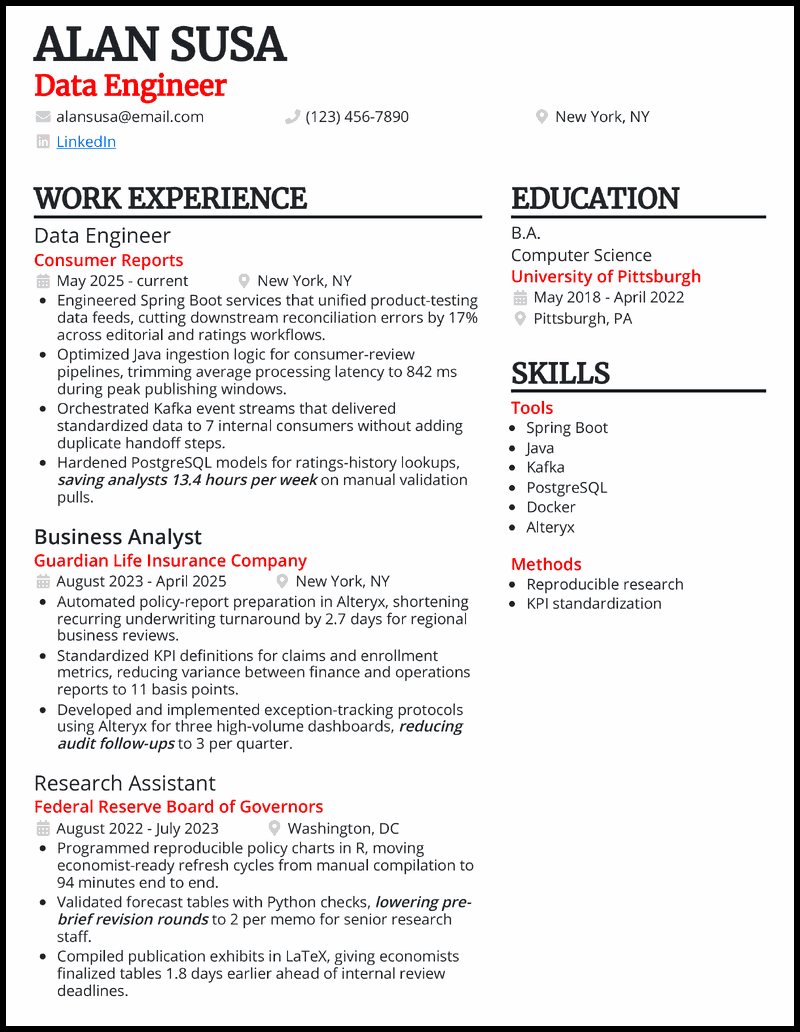


Data Engineer


Best for professionals eager to make a mark
Resume Builder
Like this template? Customize this resume and make it your own with the help of our Al-powered suggestions, accent colors, and modern fonts.
 Build my resume
 Reviewed by Beth S., Talent Architect
The best data engineer resume shows, in seconds, that you can design pipelines, manage data infrastructure, and turn messy data into reliable business value.
Data engineers are in demand across nearly every industry, from tech and fintech to healthcare, eCommerce, logistics, and consulting, so writing the right resume can be the difference between getting overlooked and landing interviews.
That’s why we built this 2026 guide with input from hiring coaches and insights from thousands of data engineer job descriptions, so you can see exactly what works in today’s market.
In this guide, you’ll learn:
- ✅How to write a resume that is clear, targeted, and competitive for data engineering roles
- ✅Why these 28 resume examples work, and how to apply the same strategies to your own resume
- ✅The most important resume tips, plus when to strengthen your application with a data engineer cover letter
Add metrics
- Let metrics do the talking in your data engineer resume. Examples: “Saving analysts 13.4 hours per week on manual validation pulls” and “Cutting downstream reconciliation errors by 17%” clearly demonstrates the business value you’d bring to the employer.
Include certifications
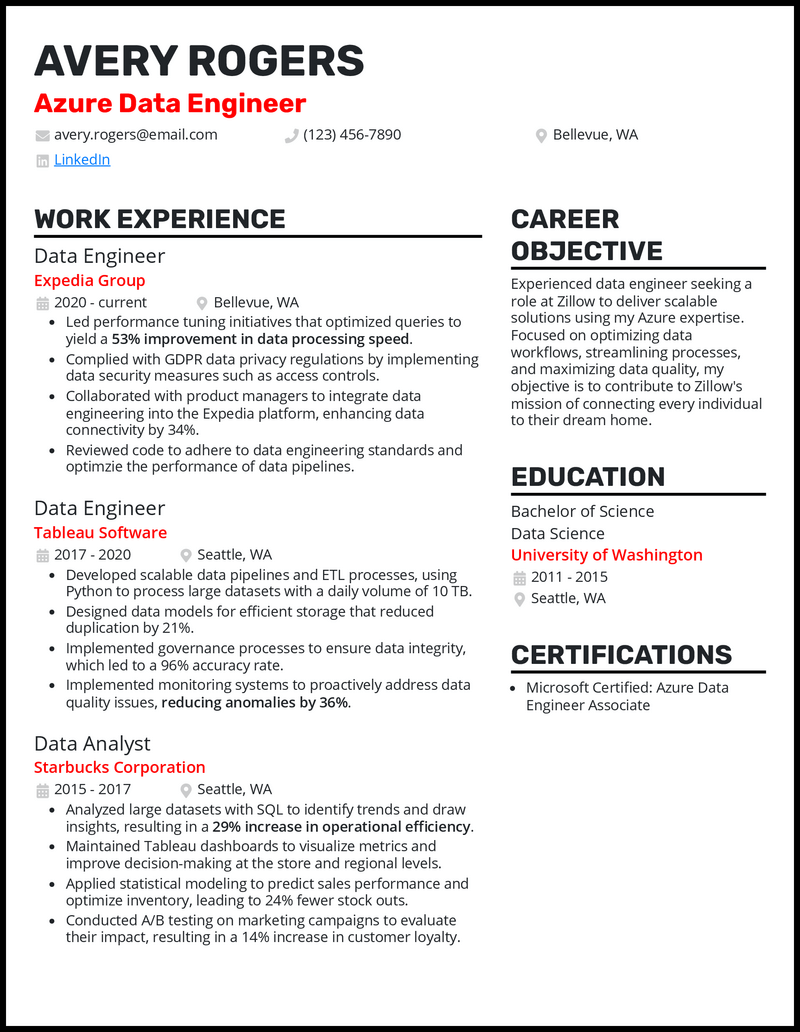
- This Azure data engineer resume lays a strong foundation for success with proven experience with Azure Data Factory and Azure Synapse Analytics. For such an Azure-based role, recruiters and the job description will prioritize these two core technologies to identify the best candidate.
- Also, including the Microsoft Certified Azure Data Engineer Associate credential adds another layer of authority and evidence that the candidate is ready to deliver upon hire.
See more Azure data engineer resumes >
Demonstrate leadership
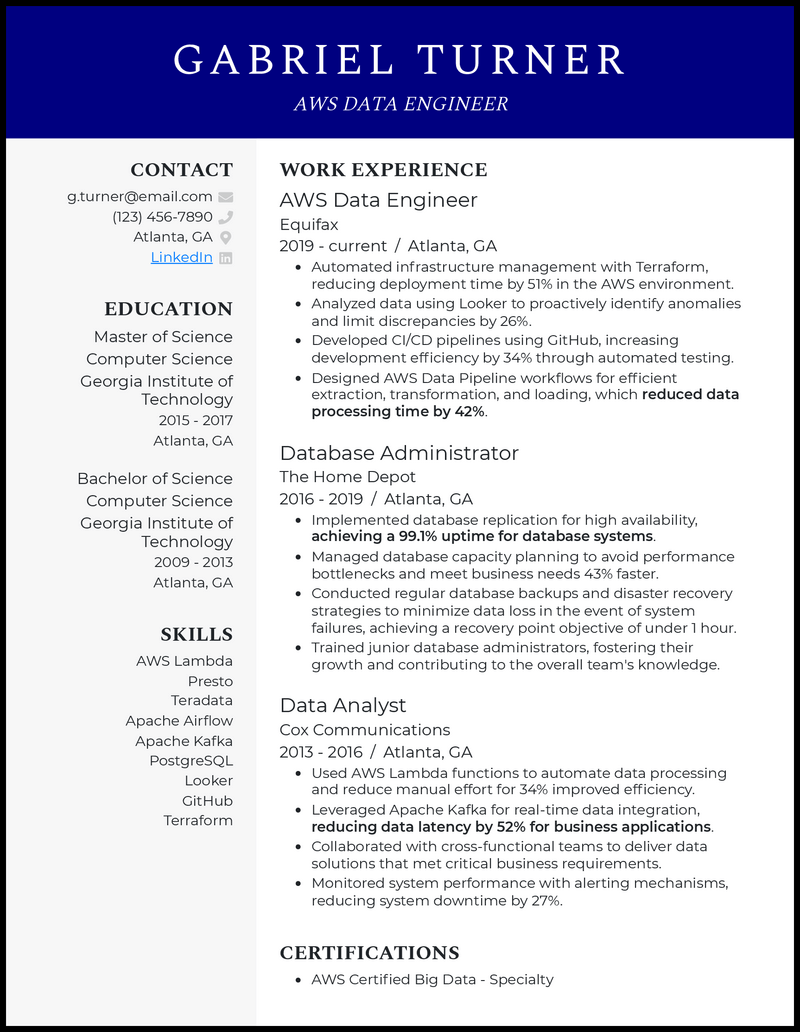
- Let your AWS data engineer resume do a little, targeted brag about how you managed projects, led teams to success, mentored junior team members, interacted with stakeholders, and even spearheaded problem-solving efforts with clear results (such as cutting downstream load failures by 18.3% and restoring $184,273 in recoverable charges) that emphasize your business value.
See more AWS data engineer resumes >
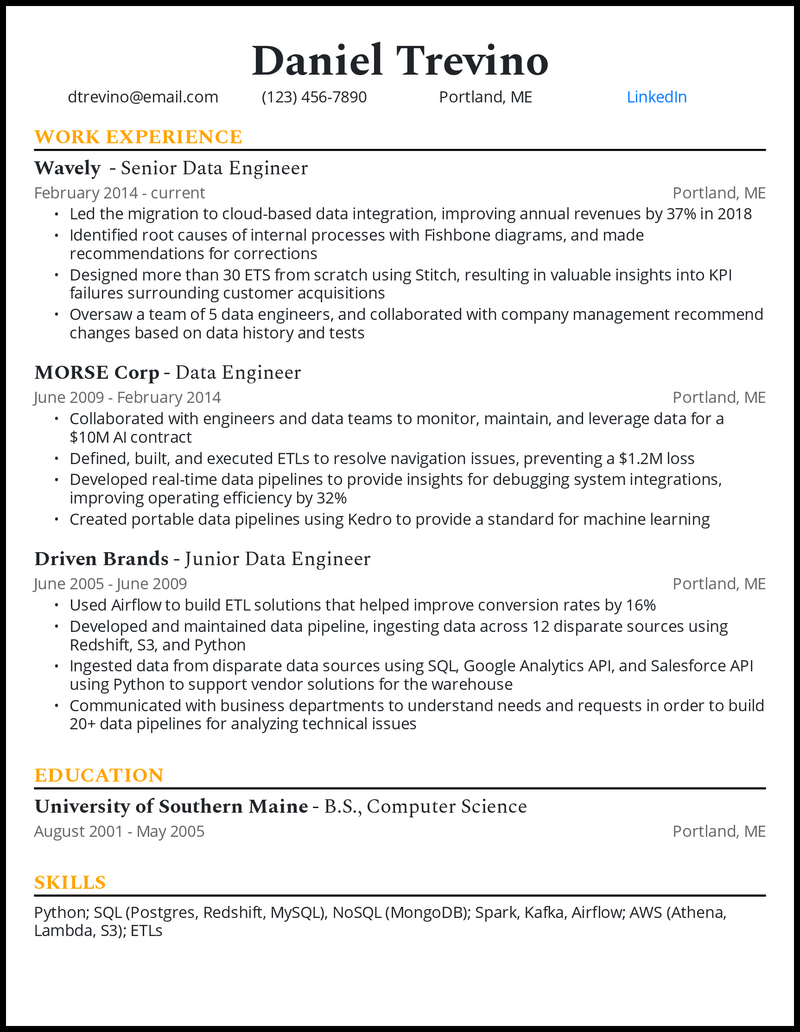
Match the job description
- Fine-tune your resume so it matches the job description to a T. See those keywords and phrases (such as Apache Airflow, MATLAB, ROS 2, and System-level judgment) mentioned a couple of times in the job description? Make sure they find their way onto your senior data engineer resume. Take things a notch higher by ensuring your experiences speak to the hiring company’s needs.
See more senior data engineer resumes >
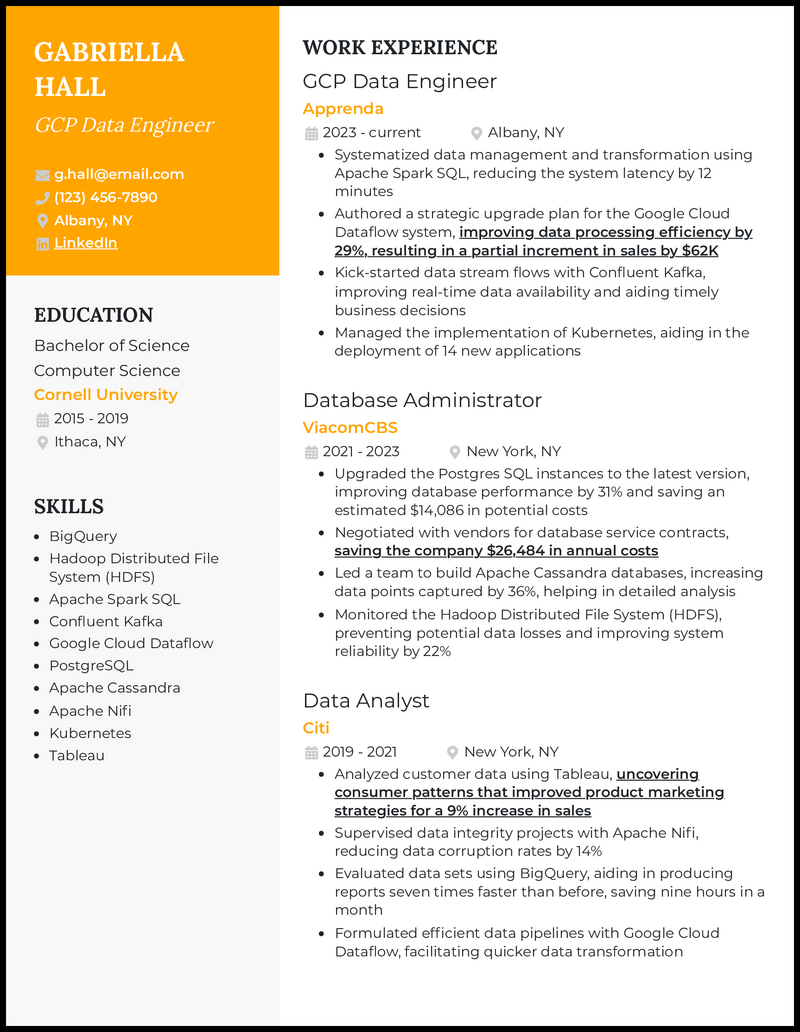
Use compelling lingo
- Used at the beginning of resume bullet points, action words, industry-relevant keywords, and phrases like “built”, “structured”, “standardized”, “streamlined”, and “resolved” amplify the chances of your GCP data engineer resume making it through the ATS and actually reaching a human recruiter.
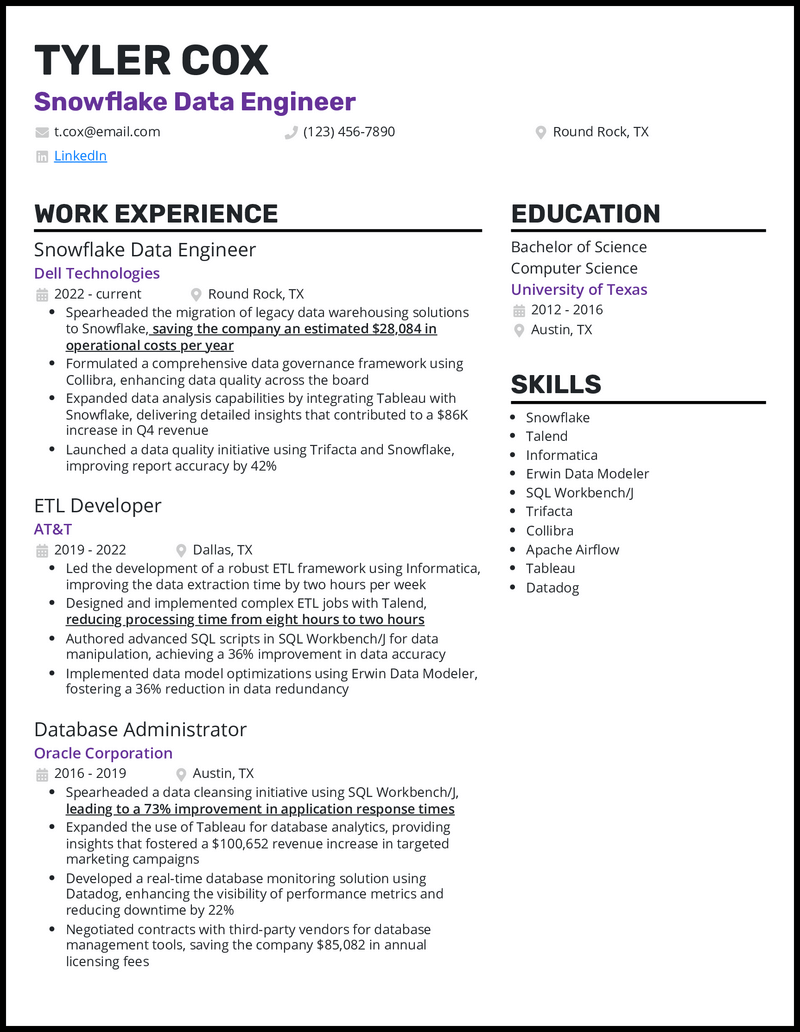
Add resume components
- By making the most of standard resume sections, you can showcase your professionalism in the best light and seriously amp your fighting chance. The must-have resume sections of a Snowflake data engineer resume include a header, work history (results with impact), a rundown of your skills, and contact information.
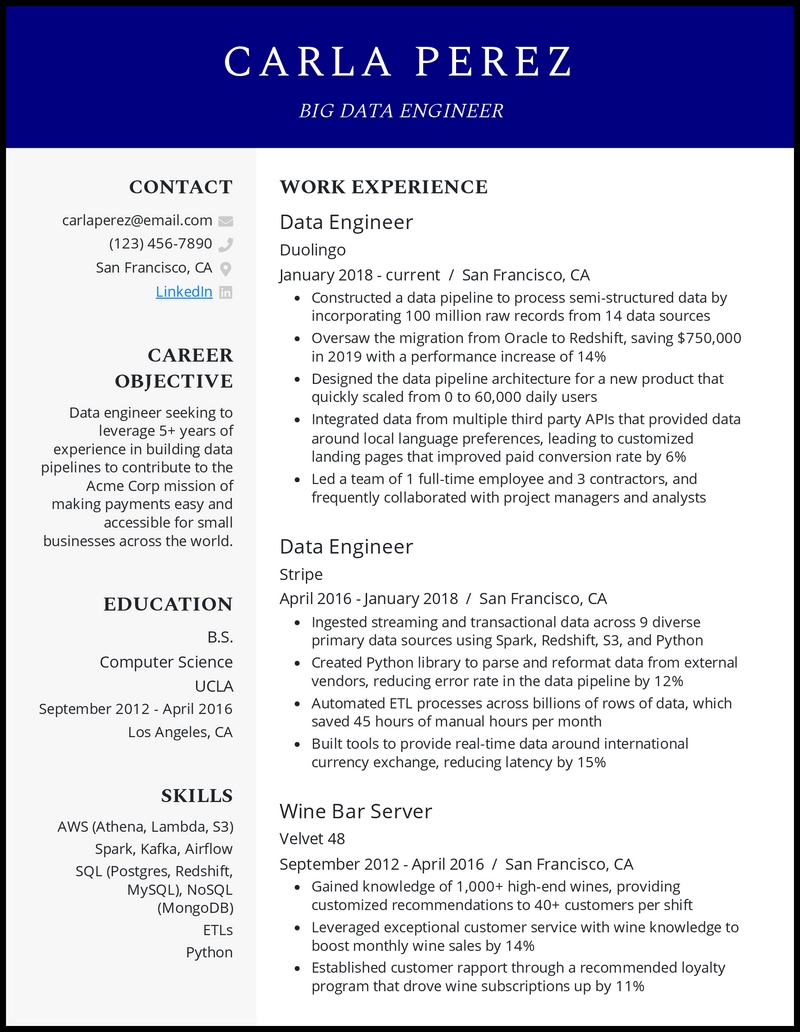
Mirror the tech stack
- Carefully review the job description to identify the technical terms the employer uses. Integrate some of those key phrases, such as Apache Spark Structured Streaming, Google BigQuery, and dbt Cloud in your big data engineer resume bullets. Also, run your piece through our free resume checker to ensure you hit most of the marks.
See more big data engineer resumes >
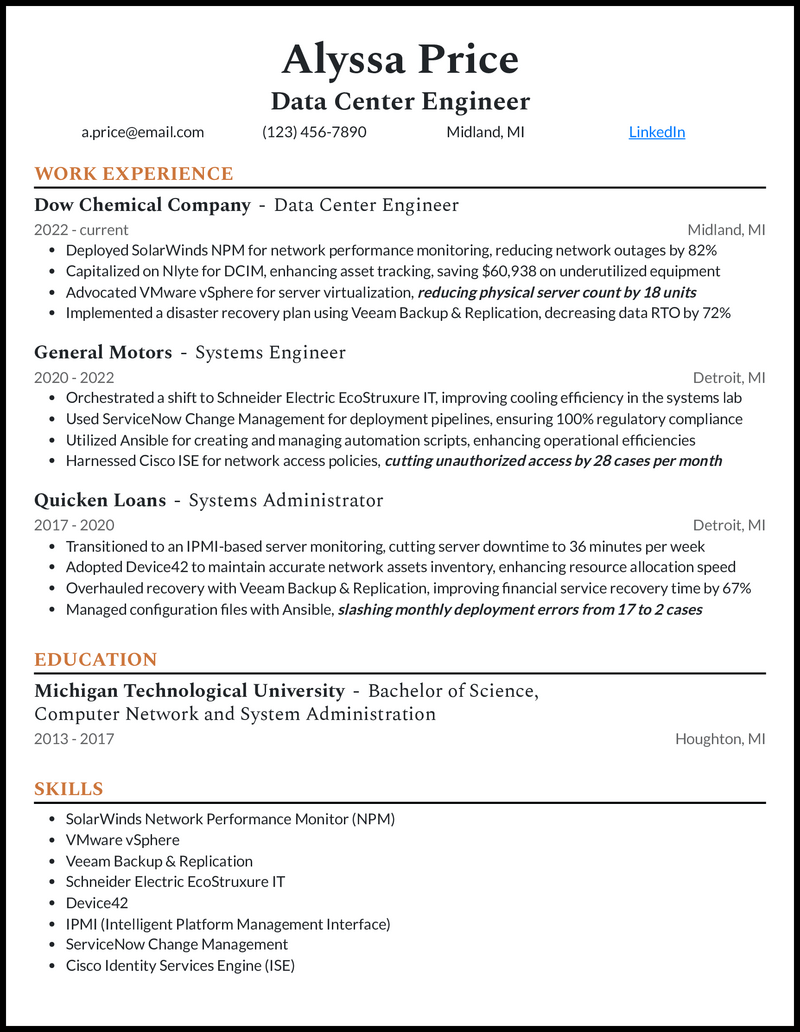
Offer Solutions
- Use your data center engineer resume to pay tribute to those moments when you played tech detective and resolved technical issues. Or did you identify recurring problems and roll out long-term solutions? And what about instances where you harnessed various technologies to boost data center operations?

Diversify your skills
- A diverse mix of the right technical competencies in your Databricks data engineering resume(think Databricks Delta Live Tables, Unity Catalog, Apache Superset, and more), when clearly illustrated in your work history, speaks to your eligibility for the role. Leadership, communication, and collaboration skills give your professional profile additional depth and appeal.

Leverage past roles
- Prove that you’re not the new kid in the block by proving your experience is at par with seniors in a similar position in your junior data engineer resume. For example, showcase how you automated data ingestion workflows and maintained data pipelines using relevant tools like Apache Airflow and dbt Core.
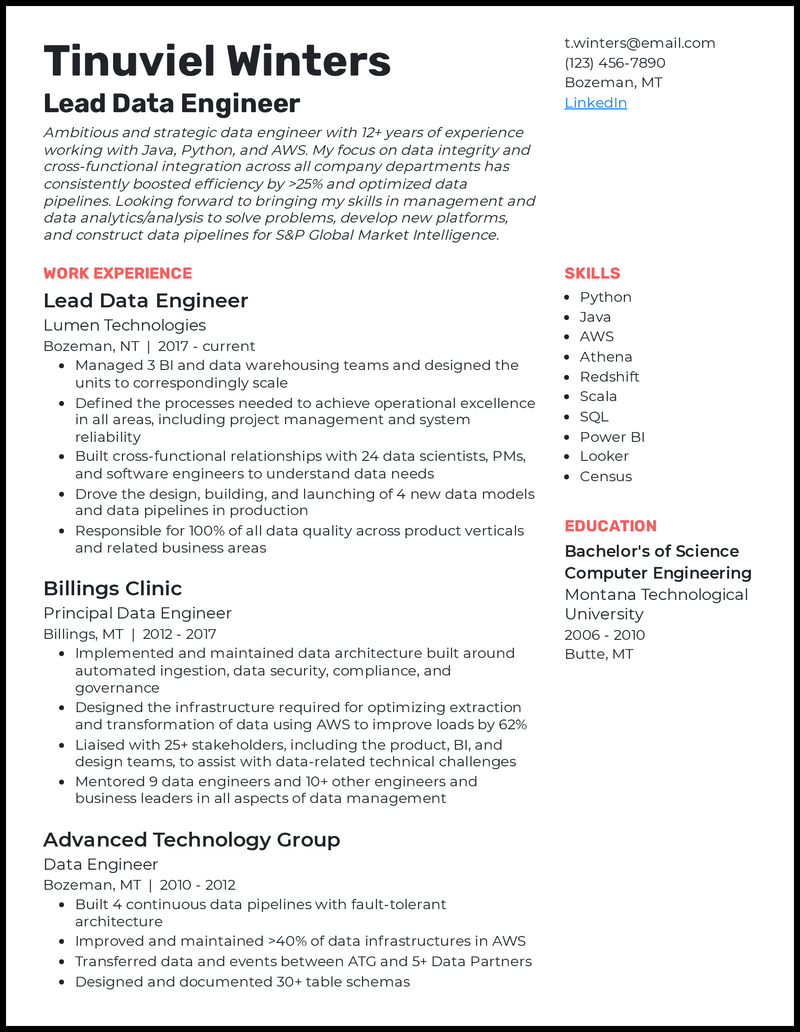
Include a resume summary
- A compelling resume summary for a lead data engineer should flaunt your skills (such as Apache Airflow and Teradata Vantage) and if possible, a standout achievement. Wrap it up with the difference you intend to make at the hiring company. Done well, it could be your first shot at making a positive impression.
See more lead data engineer resumes >

Add academic credentials
- Sure, a bachelor’s degree isn’t always a must-have to bag a cloud data engineer job. But let’s be real—flaunting one can make all the difference because lots of organizations will go for a professional with nothing less. Therefore, let your degree in computer science, data Science, or software engineering grab the spotlight in your resume’s education section.

Highlight impact and expertise
- Use your PySpark data engineer resume to add credibility to your work performance, PySpark expertise, and character. This means starting with your most relevant work experience, using metrics to highlight your impact (for example, shortening signoff lag to 46 hours on reporting-related requirements), and expertise in tools, such as PySpark and Databricks Delta Live Tables.

Prioritize your achievements
- To amp the effect of action words (cue “Engineered”, “Refined”, “Accelerated”, and more) in your Python data engineer resume, use numbers to give your wins some hard-hitting weight. “Engineered Apache Airflow workflows for mortgage-data dependencies, cutting overnight pipeline failures by 17%” makes for a great example here.

Apply reverse chronology
- Capitalize on the renowned reverse chronological format in your data warehouse engineer resume. Highlight your latest role (and the respective accomplishments) as a member of Salesforce’s team of data warehouse engineers and go back to your days as a senior associate to show your career has been on the fast track.

Use the right format
- Help recruiters see if you’re fit by serving the information they need in a clean, visually appealing data engineer intern resume format. Most importantly, pack all the essential information (contact, header, projects, skills, and education) in a single page that ensures the recruiter won’t struggle to evaluate your qualifications.

Leverage niche expertise
- For a job-winning Facebook data engineer resume, your expertise in tools that drive business and operations at Meta would be a great way to stand out. Show how you used Trino, Apache Spark, Oracle PL/SQL Developer, and more to streamline processes, save time, and cut costs.
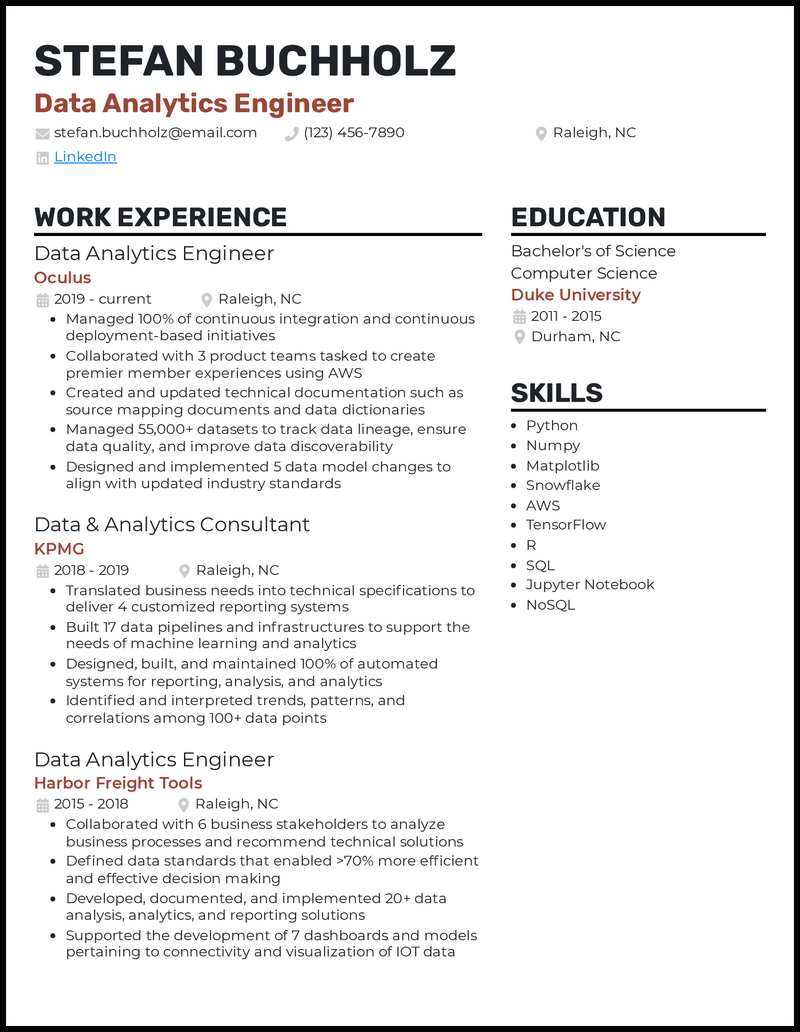
Pitch your knowledge
- Just dropping names of technical proficiency like Presto, Apache Kafka, and Airflow, for example, in the resume skills section is the bare minimum—recruiters want to see those skills in action. So, they should show up in the work history (bullets) of your data analytics engineer resume.
See more data analytics engineer resumes >

Showcase your leadership skills
- Illustrate that you’re exactly what the recruiter wants by highlighting your leadership prowess in your data engineer manager resume. For example, “Negotiated roadmap tradeoffs across search, analytics, and platform teams, protecting $2.46M”, says that you can negotiate, guide teams, and at the same time support business revenue growth and protection.

Lead with metrics
- Spice up your resume with metrics to showcase your love for data and present concrete evidence of your ability to deliver results, and yours could be a smooth waltz to victory. Statements like “Trimming failed pipeline retries by 13.9% across the ETL schedule and surfacing $210K in addressable operational leakage during one advisory engagement,” in your ETL data engineer resume make for great examples.
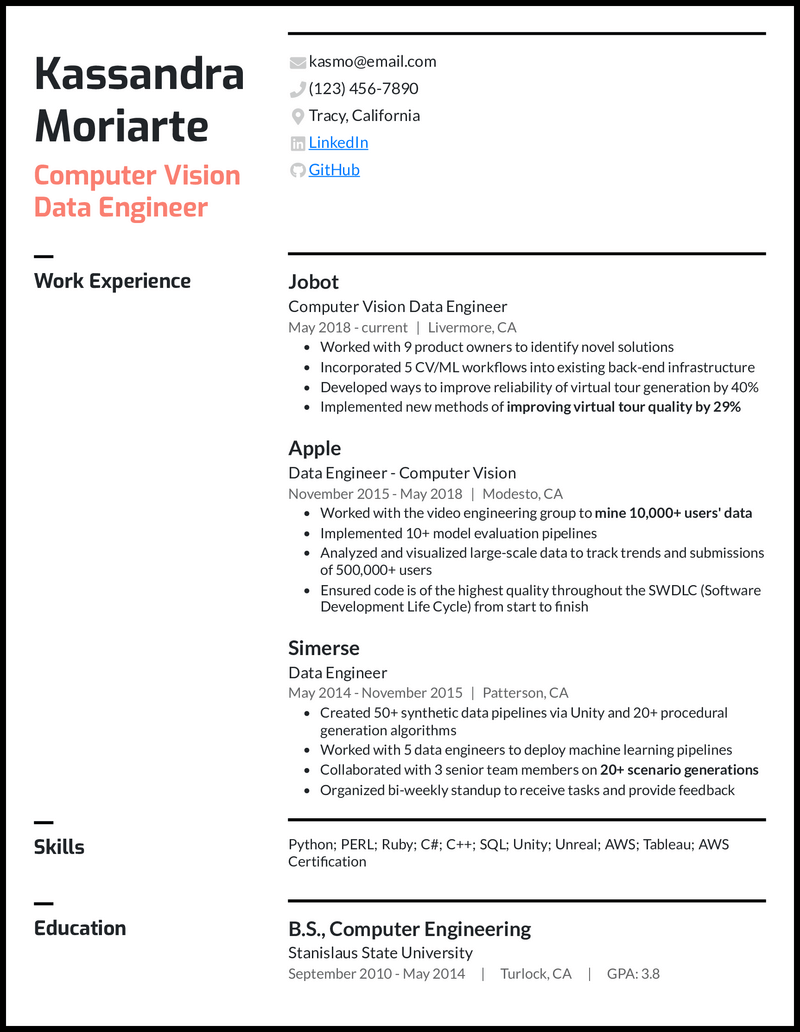
Benchmark with numbers
- Recruiters are on the prowl hunt for better-than-average computer vision data engineers. Therefore, embellish the resume template of your choice with numbers: Percentages, dollar amounts, response times, and the number of things or users that transform your achievements from bland to concrete (for example, cutting dataset-readiness turnaround by 1.4 days per release package and sparing 146 GPU-hours during one model-selection window).
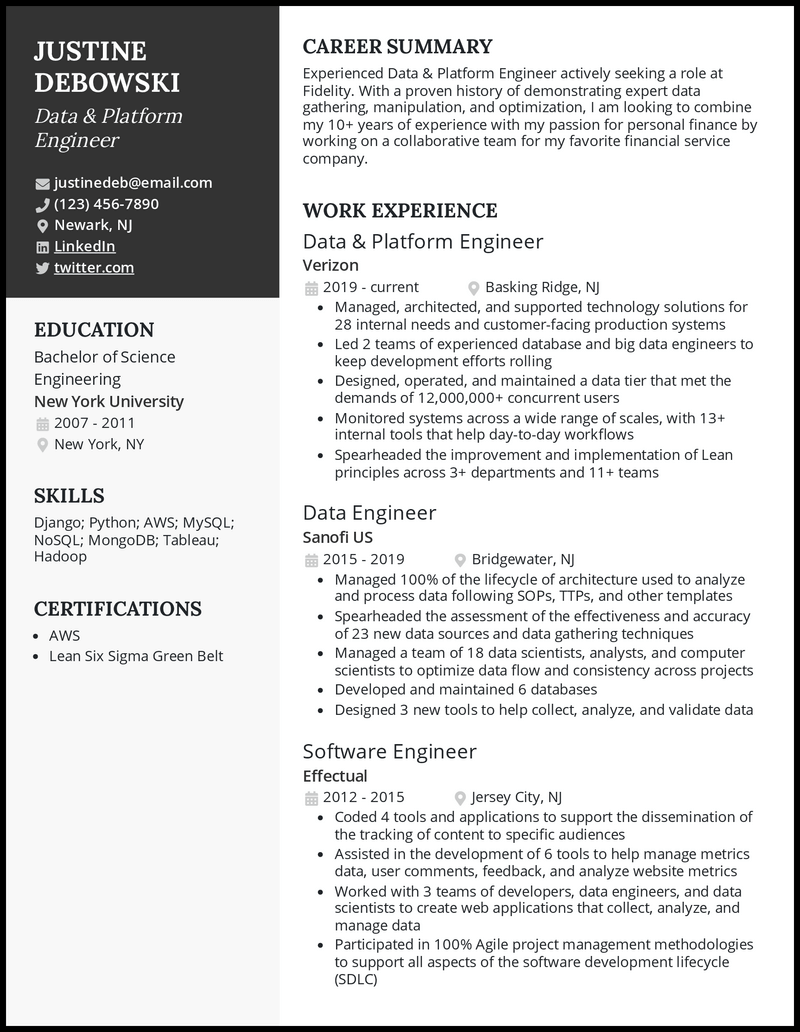
Pack the resume header
- A standout data & platform engineer resume’s header that introduces you in a flash and sets the tone for the epic story your work history is about to tell. Position it (header) at the top of your resume (centered or aligned left), and include your full name, job title (as advertised), contact information, LinkedIn profile, and location.
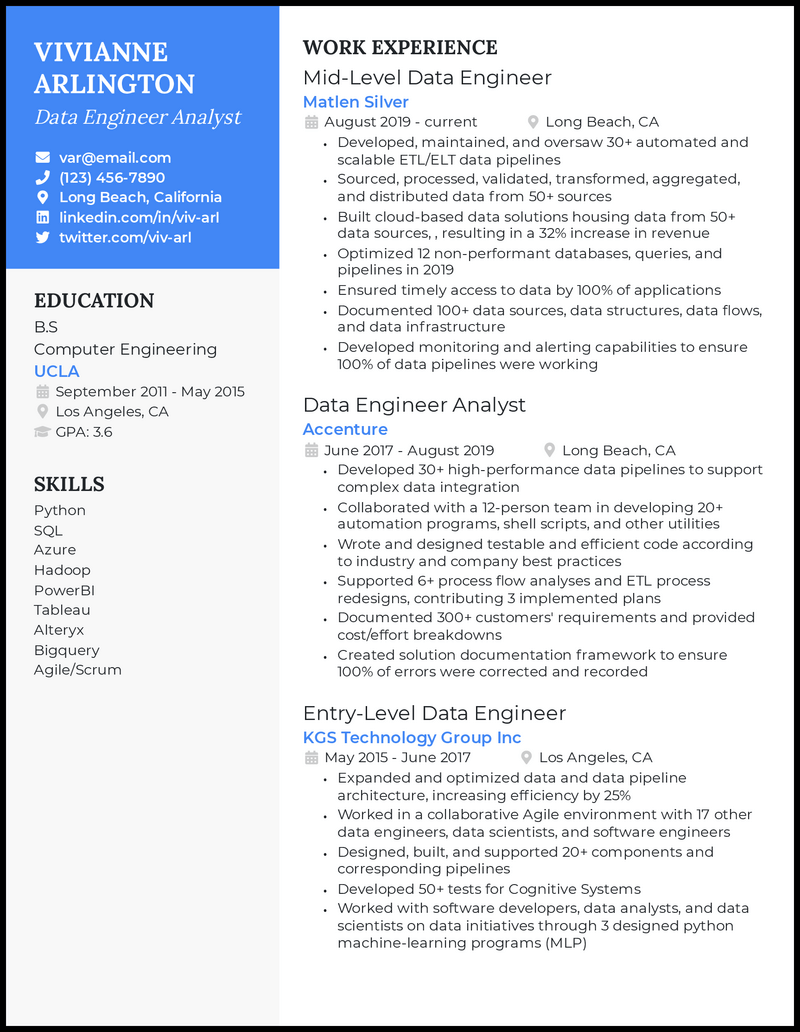
Use the appropriate format
- The best data engineer analysts can bear out that efficient data management demands top-notch and in-demand technical skills. Then, make a point of ensuring your data engineer analyst resume structure vouches for your strengths in Snowflake, Python, Tableau, Power BI, and more.
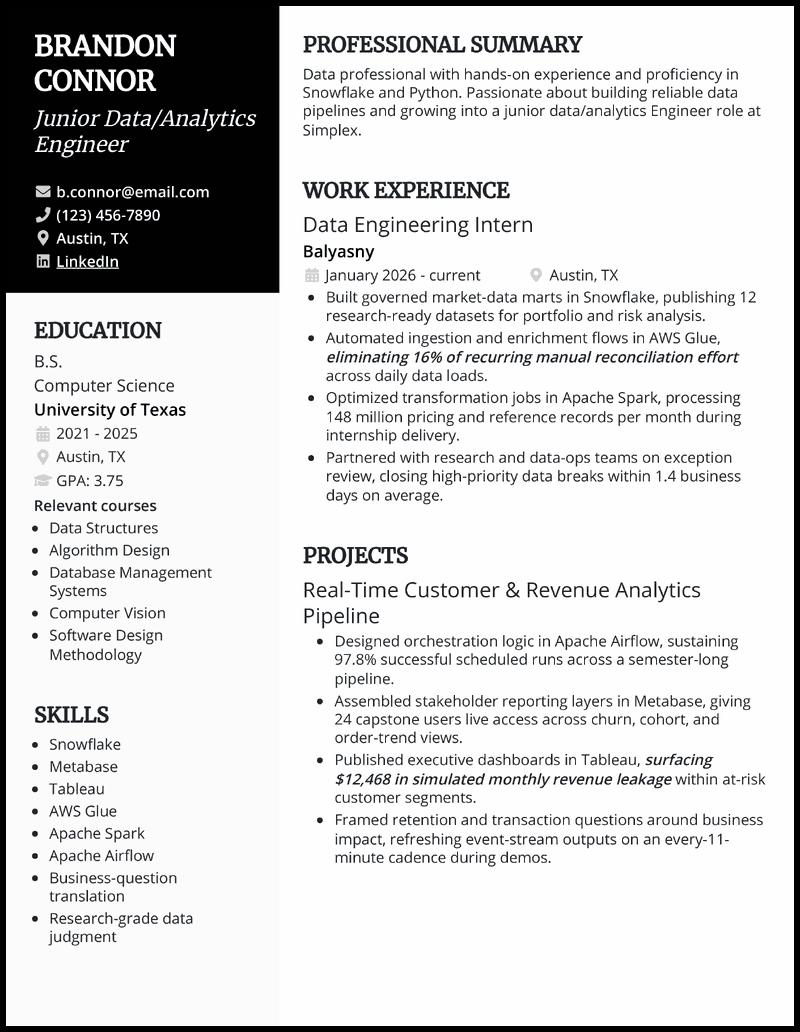
Beating ATS bots
- You must first outsmart the applicant tracking system (ATS) to ensure your entry-level data engineer resume lands in front of the people who matter. While at it, optimize the professional summary, work history, skills section, relevant courses, and education credentials with keywords (such as Snowflake, Metabase, AWS Glue, and research-grade data judgment) from the job description.
See more entry-level data engineer resumes >
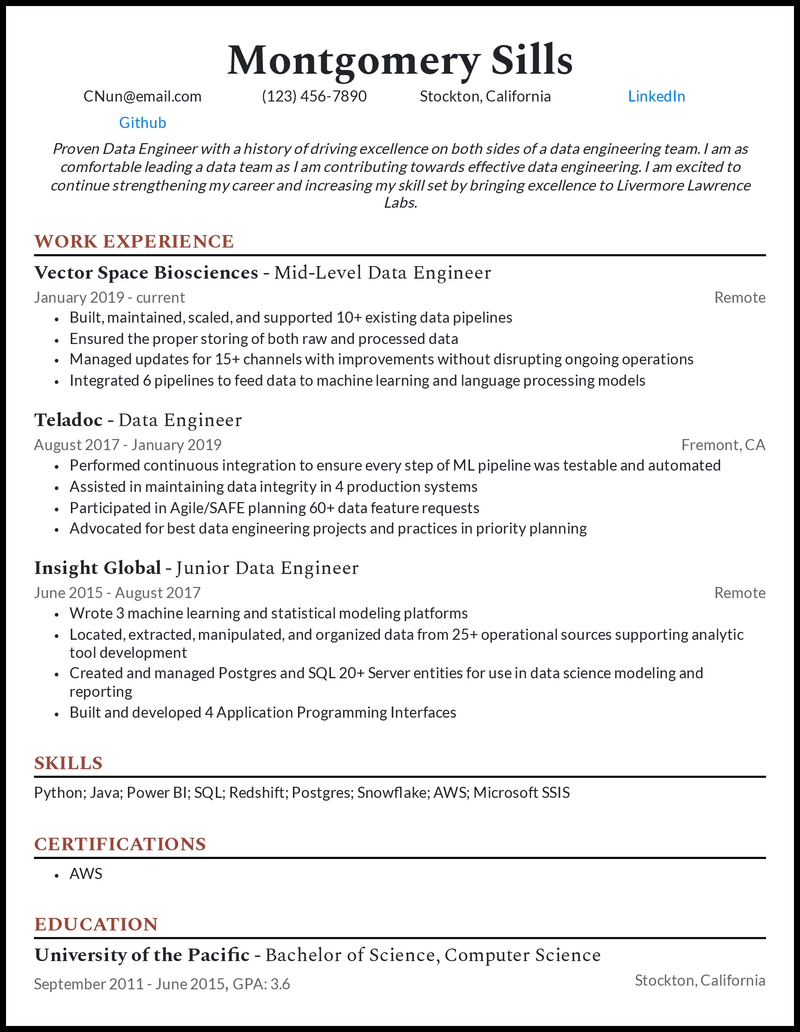
The ideal resume length
- Hitting the sweet spot means keeping your mid-level data engineer resume to one page. Keep things concise only adding the essentials, including a resume skills section, certifications (AWS), and snappy bullet points summarizing your previous experiences, and educational background (Bsc. Computer Science).
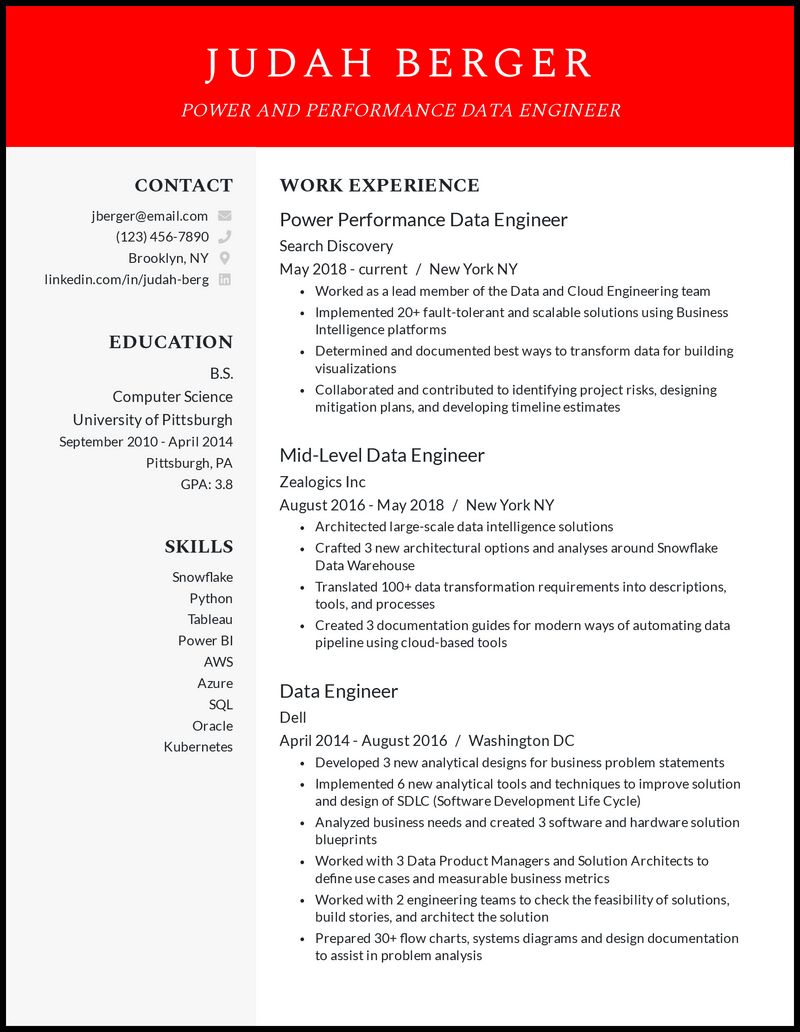
Show academic success
- Recruiters are usually taken with candidates who come out on top—it’s a sure sign they can help smash company goals. So, how about adorning that Google Docs template or resume template with your academic wins? For example, a B.S. in Computer Science paints a picture of a winner, setting you up for some good fortune.
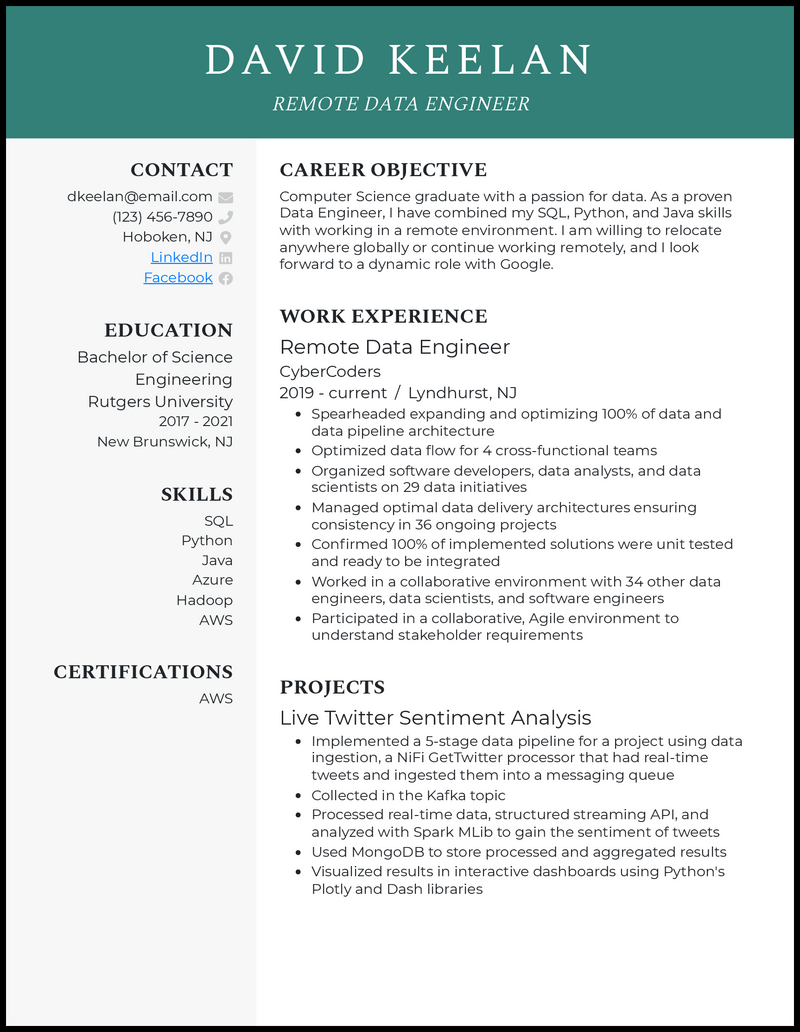
Prove your track record
- Comparison skills aren’t just valuable for sizing up algorithms—it’s a real asset in the hiring world, especially when recruiters are on the prowl hunt for better-than-average remote data engineer resume and candidate. Therefore, make their work easier by embellishing yours with numbers that highlight impact (for example, giving leadership visibility into 11 pipeline stages and surfacing 8 assortment risk flags before weekly transfer decisions).
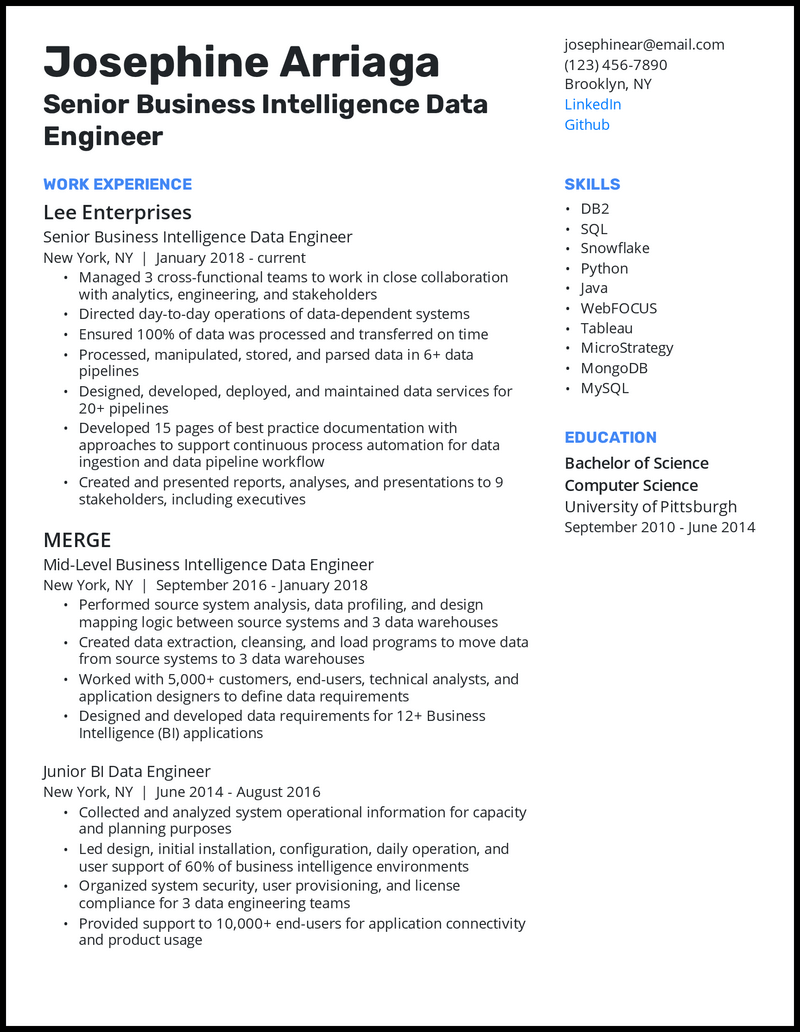
When to add links
- Yes, you’re not penning a blog to drive traffic to your site, but don’t downplay the power of adding relevant links to your senior business intelligence data engineer resume. It’s a smart move to add depth to your accomplishments and resume skills. Think about links to your LinkedIn profile and GitHub portfolio; and ensuring they’re updated/tailored to the requirements of the role.
Related resume guides
How to Write a Data Engineer Resume

Summary
Build a job-winning data engineer resume by showcasing relevant hard skills, quantifying impact with metrics, and tailoring content to match each job description.
According to the US Bureau of Labor Statistics (BLS), the median salary for data engineers is $94,000. At the same time, the expected annual growth rate is nine percent year over year (faster than average).
It’s no wonder software engineers are flocking toward data engineering roles, but data engineers require a rare combination of skills to succeed.
They need to be great developers and have an appreciation for how other members of their team use data. While data scientists need data that can be plugged into their predictive models, data analysts need a queryable database to create visualizations for executives.
It’s not easy to demonstrate in a single-page resume that you can build robust data pipelines, create ETLs for different data sources, and ensure uptime of all data congestion. How can you ensure you cover all your bases in your data engineer resume?
While there are no hard and fast rules, we’ve talked to hiring managers at top tech companies to distill what works and what doesn’t to help ensure you get that first-round interview. In short, here’s what you need to do:
- First and foremost, you should include the right skills in your resume skills section. Companies use automated software to weed out applicants at this stage, so use specific keywords in your skills section to get past these filters.
- Make sure your resume is in the right format. You have to not only get past the automated filters but also make your resume appealing to the hiring manager.
- Quantify the impact of your work experience. Numbers speak louder than words, so use quantitative metrics to shout about your qualifications for the role to which you’re applying.
- Tailor your resume to each role to which you’re applying. It does take a bit of time, but you will land significantly more interviews by customizing your resume to each data engineer job description.

How to build the perfect data engineer resume skills section
In 2026, the data engineering niche in the U.S. top-tier job market as supported by the current report byO*NET Online profile for Data Warehousing Specialists confirm that more value is now attached to candidates that prove impact-backed expertise in cloud data platforms, SQL and Python, ETL/ELT pipeline design, data quality testing and assurance, metadata governance, and API integration that can support operations at massive business scale. Therefore, for your resume, emphasize pipeline reliability, governed datasets, transformation frameworks, warehouse performance, and cross-functional delivery over generic data experience.
You should also know that before a human reviews your resume, an automated filter scans it, and you need to appease the automation wizard. Companies use an Applicant Tracking System (ATS) to manage all applicants they get for a given role. In addition to helping companies manage applicants, an ATS allows the hiring manager to filter out candidates based on certain keywords.
So first things first, you need to get past this filter before a person ever even considers your qualifications for the job to which you’re applying.
You need only to include the hard skills that qualify you for the given data engineering role. Exclude soft skills (unless you can clearly define them to show value). For example, saying you have “strong communication skills” is meaningless without context.
For data engineers explicitly, there are more existing technical skills than you could ever have. For this reason, companies only use ATS filters to screen for hard resume skills. Here are some common ones you can list to get past the keyword filters.
Key hard skills for a data engineering resume
- Programming languages: Python, Scala, Java
- Data processing: Spark
- SQL: Redshift, Postgres, MySQL
- NoSQL: MongoDB, Cassandra, ElasticSearch
- Storage: Parquet, Avro, Arrow, JSON
- Orchestration tools: Airflow, Luigi, Azkaban
- Cloud providers: AWS, Azure, GCS
- AWS tools: EMR, Lambda, S3, Athena, Glue, RDS
You would never be expected to have all of these. Instead, you should demonstrate a mastery of a few tools and languages instead of a light breadth of a whole host. Having a laundry list of skills is a big red flag to the hiring manager who will review your data engineer resume.
As a rule of thumb, only include skills for which you’d be comfortable being interviewed. A surefire way to get on an employer’s blacklist is if you lie on your resume. Don’t do it; it’s just not worth it. You would be much happier landing a data engineering job that you’re a good fit for than having to scramble on day one.
How to format your resume correctly
Ensure the format of your data engineer resume format is appealing to the employer and consumable by the automated filters. To that end, here are some quick resume formatting tips:
- Keep your resume to one page.
- Don’t put your full address. Just your city and zip code.
- Avoid any graphics, images, or charts on your resume. The ATS can’t read these.
- Triple and quadruple-check for grammar and spelling errors. Don’t let this be the reason you’re skipped over for an interview.
- Only include a resume objective if you have a particular passion for the job you’re applying to or undergoing a career change. Otherwise, leave it out.
- If you’re fresh out of college looking for your first full-time data engineering role, include relevant classes you took.
- Every bullet on your work experience should be a complete thought. Avoid big blocks of text.
You should have one simple goal as your north star with your resume format: make the reader’s job as simple as possible.
Put yourself in the shoes of the person reviewing hundreds of resumes for a given role. You don’t want to read walls of text spanning multiple pages. You want to read something concise that conveys why the applicant is a good fit.

How to treat education for senior vs. entry-level data engineers?
When you’re a data engineer with a few years of experience under your belt, your education matters less than your work experience.
For that reason, the education section of your resume will vary if you’re an experienced data engineer vs. fresh out of college or boot camp.
Education section differences
- Entry-level data engineer:
- Include relevant software engineer, statistics, or math classes you studied in school
- Include your GPA if it was greater than 3.5
- Experienced data engineer:
- No need to include college classes on your resume; use this space to talk about your experience
- No need to include your GPA
Don’t waste space with classes you took in school. Since your goal should be to keep your resume to one page, optimize that space as a senior data engineer. Similarly, your GPA won’t make a convincing case of your qualifications once you have a few years of work under your belt.
As an entry-level data engineer, you need to demonstrate your capacity for learning new technical skills. What better way than talking about the tough classes you studied?
Relevant certification for entry-level data engineers
As someone without much data engineering experience, certifications can set you apart and win your dream job. Here are some examples of certifications that would be great for entry-level data engineers:
- IBM Data Engineering Professional Certificate (Coursera)
- Airflow or Kafka Certifications
- Microsoft Azure Fundamentals (AZ-900)
- Google Cloud Professional Data Engineer

Do you need a resume objective for data engineers?
Most data engineers should not include a resume objective on their resume. Why? It comes back to the aim of making your resume one page.
Most resume objectives only mention generic information that can otherwise be gleaned by reviewing your resume.
As a rule of thumb, if you’re using the same resume objective for multiple job applications, just exclude it.
There are two instances in which it’s worth it to include a resume objective.
- If you have a particular interest in the role or company to which you’re applying
- You’re undergoing a career change
WRONG—generic resume objective
Looking for a data engineering role where I can leverage my Python knowledge to turn disparate data sources into actionable insights for a data-driven organization.
RIGHT—resume objective that conveys passion for the company’s mission
Data engineer seeking to leverage my experience in building data pipelines to contribute to the Stripe mission of making payments easy and accessible for small businesses across the world.
RIGHT—resume objective for a career change
Data engineer transitioning from a career in software engineering looking to work with Apple to leverage my experience with ETLs to create products that make it easier for non-coders to build businesses.

How to translate your work experience into data engineering impact
You’re a data engineer, so using numbers is the best way to talk about your work experience. Data engineers are unique because you know exactly how much raw data you’re consuming and how much clean, polished data you’re pushing out to your data warehouses.
You need to convince the hiring manager that you’re the best fit for the data engineering role to which you’re applying. To make your data engineer resume better than 95 percent of others, quantify the impact of your work.
Metrics that matter on data engineer resumes
- Magnitude of data with which you worked
- Example: Built a data pipeline that ingested 3 billion rows of data daily from 17 different data sources and piped that data into Azure
- Cost savings
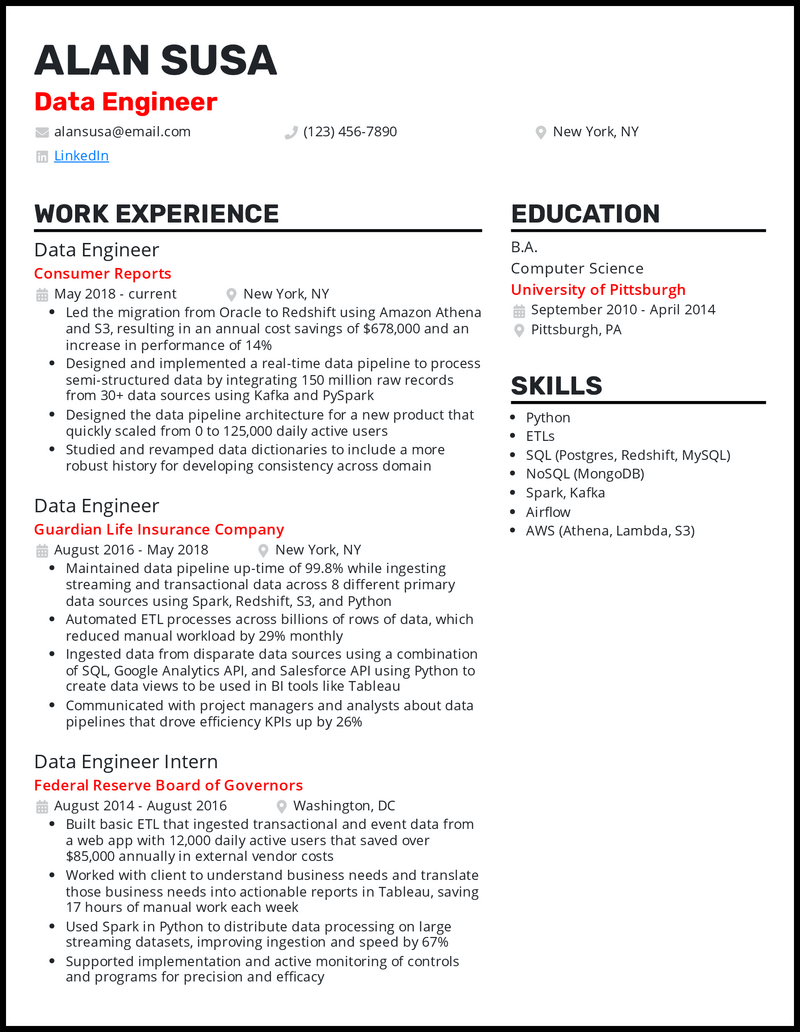
- Example: Built a more efficient ETL using Airflow and Redshift that saved the company $320,000 annually
- Revenue lift
- Example: Created consistent data sources that were used by the data science team to create marketing mix models, resulting in $1.2M in annual revenue
- Uptime
- Example: Created monitoring alerts for data pipelines that improved the uptime of the network by 17% year over year
- Speed improvements
- Example: Used Spark Streaming to consolidate and clean transactional and event data, resulting in speed improvements of 24% in the production web app
Numbers are more convincing than vague accomplishment statements. Whenever you can (even if they’re estimates), try to quantify the impact of the work you did in previous roles.
No matter where the hiring manager looks on your resume, they should come away feeling that you deserve a phone interview. The best way to make such a convincing case is to let the numbers speak on your behalf.
Just to hammer home the point one more time, consider which work experience is more convincing:
WRONG—vague work experience
AT&T
April 2015 – January 2018, New York NY
Data Engineer
- Automated ETL processes to streamline data workflows
- Created data pipeline that ingested streaming and transactional data and output cleaned data to Redshift
RIGHT—quantify the impact of your work
AT&T
April 2015 – January 2018, New York NY
Data Engineer
- Automated ETL processes across billions of rows of data which reduced manual workload by a monthly 33%
- Maintained data pipeline up-time of 99.9% while ingesting streaming and transactional data across 7 primary data sources using Spark, Redshift, S3, and Python

How to demonstrate impact from data engineering projects
If you’re an entry-level data engineer without any work experience (or “fresher,” as the kids call it these days), you need to convince the hiring manager that you’re worth interviewing.
Employers love to see candidates going above and beyond by highlighting personal projects they’ve worked on related to their careers. How can you do that? By talking about past projects on which you’ve worked.
For an entry-level data engineer, anything counts! As long as you were ingesting data and making it usable for another party, it’s worth including it on your resume.
If you have no such projects, now would be a great time to work on one. Here are some project ideas you can include:
Sample projects for entry-level data engineers
- Created web scraper in Python for fantasy football and developed a data pipeline to output that data into a MySQL database
- Created a stored procedure in the database for the D&D club to monitor the performance of all players over time
- Volunteered with a local flower delivery company to automate the ingestion of their vendor data, saving 25 hours of manual work each month
- Worked with the university theater company to create a database of all patrons who came to paid shows over the last 5 years
- Used the Rottentomatoes API to create a robust time-series database of all movie scenes since 2015
It doesn’t matter if the project you worked on is relevant to the role. Hiring managers just want to know that you have the know-how and passion for learning what it takes to become a successful data engineer for entry-level positions.

How to tailor your data engineer resume for each job
We know it’s the news you didn’t want to hear. Unfortunately, customizing your data engineer resume for each job you apply to drastically improves your chances of getting an interview.
Fortunately, only 15 percent of data engineers customize their resumes for each job, so if you go that extra mile, you’re in the top 15 percent automatically (#math)!
How do you tailor your resume for a given job? First, read the job description, responsibilities, and qualifications. Do any projects you’ve worked on come to mind as you read those?
Similarly, does anything come to mind as you read about the company? Even if what you’re thinking about seems like a stretch, it’s worth including on your resume.
Another way to assess is by asking yourself how you can best frame your work experience to be relevant to the role for which you’re applying. For example, if you’re applying for a position seeking someone to build ETLs from scratch and have experience working for startups, you should talk about that as much as possible!
Here are some ideas for tailoring your work experience to a specific role:
AWS data engineer resume tips
- If you’re looking for an AWS data engineer role, you should be able to show you know the right tool or framework to use at the right time.
- AWS has so many different services and data offerings that it will make your head spin. Rather than trying to demonstrate a knowledge of all these tools, show the context in which you’ve used the tools with which you’re most comfortable.
Azure data engineer resume tips
- If you’re comfortable with any other cloud provider, you most likely can adapt to Azure.
- Having Azure on your resume will allow you to apply to any role looking for a data engineer with Redshift or GCP experience.
- Azure is the classic example of “if you know one, you know them all.”
Big data engineer resume tips
- We don’t mean to burst your bubble, but “big data” is a nonsense phrase used by business professionals to convince themselves that they know what they’re discussing.
- Including “big data” on a resume is a bit of a red flag for any discerning hiring manager. It makes the hiring manager think the data engineer is more buzz than substance. Only use “big data” if you can quantifiably back it up with solid metrics.
- Stick to tangible outcomes and results. Rather than saying “big data” on your resume, include the actual scale of data with which you worked. Again, numbers speak louder than words.

Common mistakes to avoid when writing a resume for data engineering
Before you can send your resume with confidence, ensure that you’ve not committed these mistakes:
- Being shallow when highlighting your experiences
- Ignoring your impact and instead showing off your mastery of software
- Focusing more on jargon than simple communication
- Leaving out relevant portfolios such as GitHub
Data Engineer Resume FAQs

Only include hard skills (for example, MongoDB, Azure, and RDS) in your resume skills section that you’re comfortable discussing in an interview. In your work experience section, use numbers to convey the impact of prior work (like using ETL processes to reduce workload by 13%). And finally, tailor your resume to the job by highlighting projects that speak to the challenges and needs of the data engineering position you’re hoping to snag.
Running out of room? Save the extra details of how you used ETL processes when using a cover letter maker.
Read the job description to see what the company specifically wants in its next data engineer. Consider any programming languages, data processing, SQL, NoSQL, storage, orchestration tools, cloud providers, and AWS tools mentioned in the job ad, and in a brief list, honestly include the skills you have that match.
Your one-page resume should look professional—free of grammar and spelling errors and organized in a reverse-chronological format to share your data engineer career history logically and clearly. Using a resume template can help you order your data engineer experience and qualifications.

Stephen is the co-founder and CEO of BeamJobs. Frustrated with the challenges he'd faced in his own job search, he left the corporate world to start BeamJobs with his brother. Drawing on firsthand experience with hiring and getting hired as technical talent, he started BeamJobs in 2020 to help qualified job seekers land interviews with less stress. Since then, more than 4 million people have built their resumes and cover letters on BeamJobs. Stephen's insights have been featured in notable outlets, such as Fast Company, Business Insider, Yahoo Finance, MIT, and Zapier. Learn more about Stephen.