



Struggling to create a CV for a university student that gets the attention of recruiters? It’s not just you! As a current university student or a recent graduate, you may feel overwhelmed with tracking job applications. Ironically, you have more to offer than you might think.
Whether you’re applying for a part-time job, internship, or your first job after graduating, the right university student CV can open doors.
In this guide, we share:
- ↪ 17 expert-verified university student CV examples
- ↪ Step-by-step cover letter writing and CV tips
- Insider’s advice on what to include, and how to avoid common pitfalls
- ↪ Plus, editable CV samples and answers to all FAQs so you can confidently send your CV.
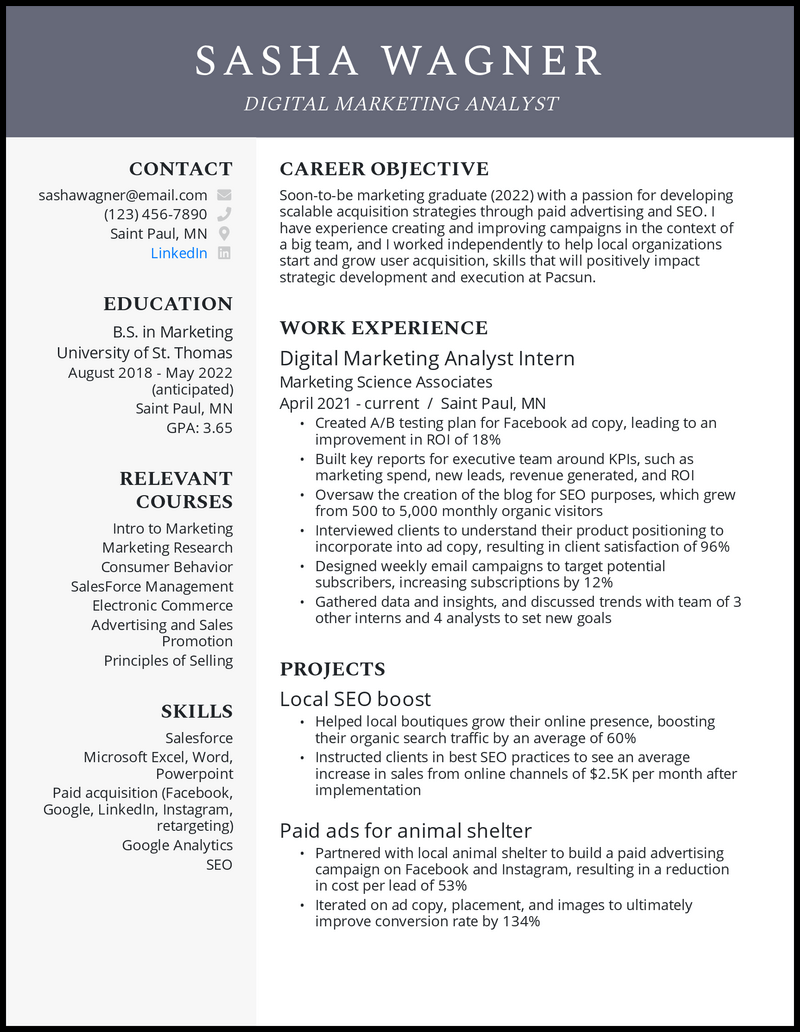
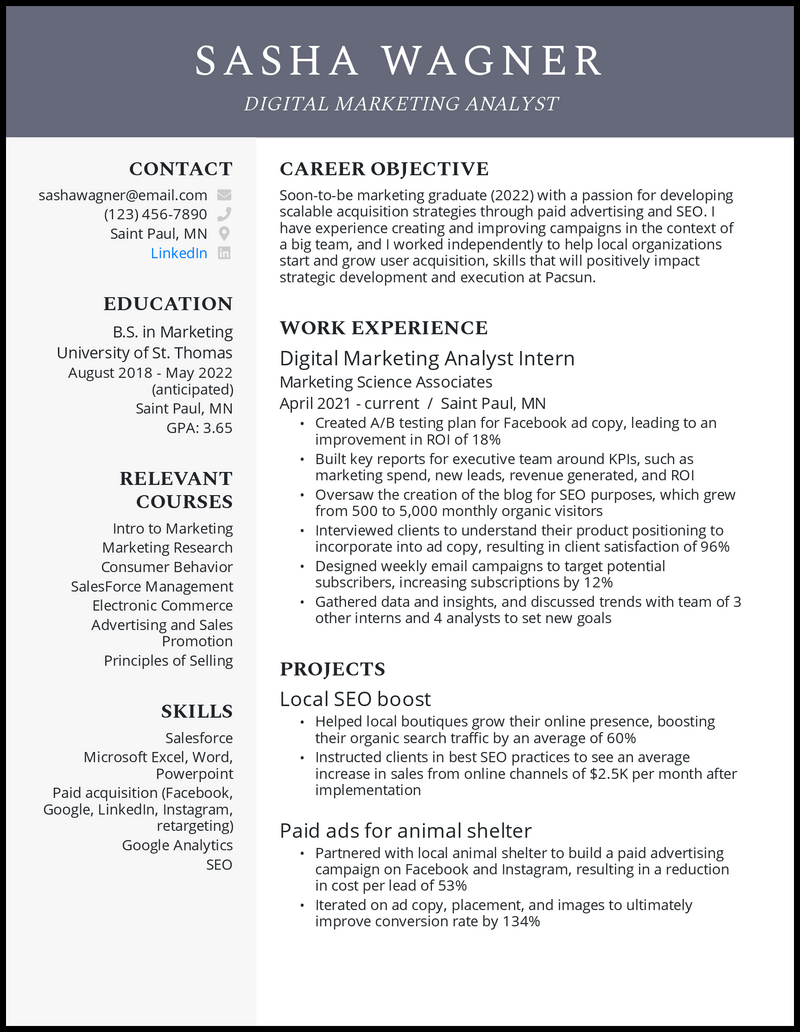
Why this CV works
- At the top of your university student CV, include an objective overview of your professional aspirations, experiences, and skills. Use that space to highlight your passion for developing scalable acquisition strategies through paid advertising and SEO, as well as collaborative projects.

Why this CV works
- Suppose your university application CV is for a Bachelor of Arts in education. Convey your passion for teaching and your eagerness to enhance your understanding of educational theories and practices. Even better, highlight your long-term ambition to shape future generations through innovative educational methods.

Why this CV works
- Use past projects to your advantage here, even if they only lasted a year. Clearly state how you utilised skills such as Canva and Microsoft Teams to make specific impacts during this time. Another great addition to your university first-year CV is any work experience you have.
View more university first-year CVs >

Why this CV works
- Your undergraduate student CV must highlight your adaptability in every new role you undertake. Like this example, you want to demonstrate your willingness and openness to take on new positions to utilise your skills and gain experience.

Why this CV works
- Your accounting internship can be the perfect opportunity to demonstrate what you can offer to the real-world job market. In that case, your university student CV can capitalise on your analytical skills, which helped identify cost-saving opportunities and reduce overall expenses by six per cent.

Why this CV works
- For a university admission CV tailored for an engineering programme, let the admissions committee envisage you mastering valuable skills in the real world. Your experiences as a restaurant server, project presenter, and volunteer portray a well-rounded character who can tackle the varied challenges of an engineering programme.
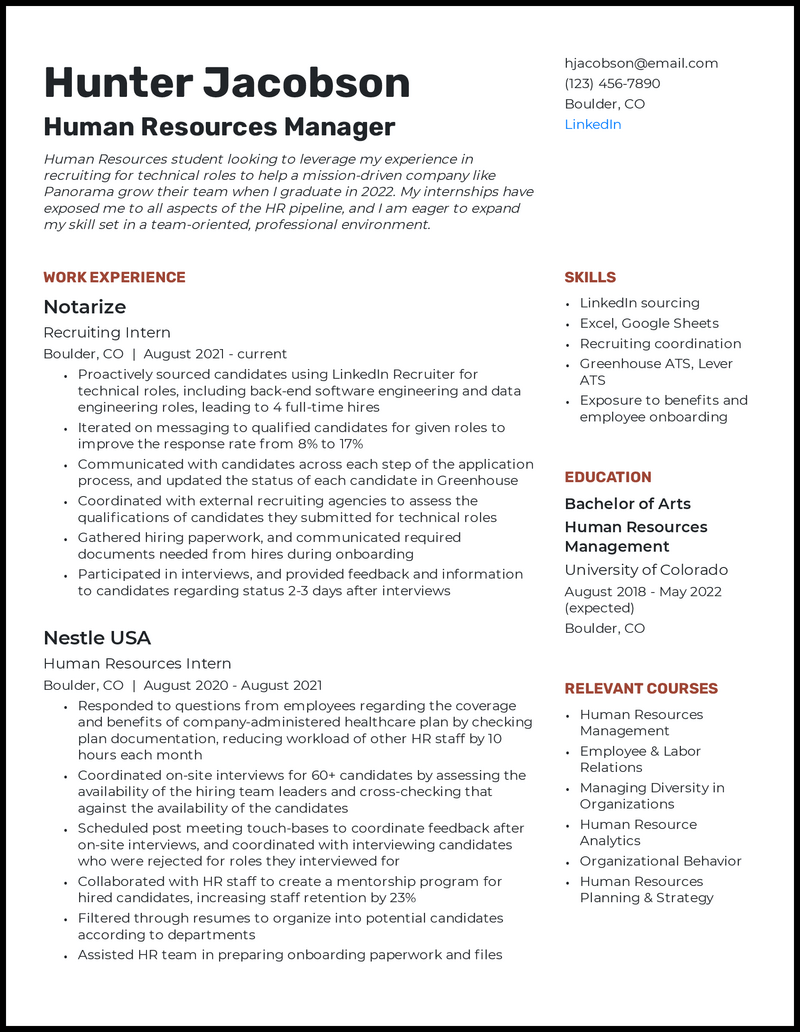
Why this CV works
- Recognised as the most popular CV format, reverse chronological order can highlight your experience in recency on your current university student CV—perhaps a recruitment internship (your latest role), not forgetting an earlier stint as an HR intern.
View more current university student CVs >

Why this CV works
- Use a career objective statement, typically a brief 1-3 sentence pitch, to highlight your motivation for the role (internship, in this case), but with a twist—it’s better tailored to match the hiring company’s needs.

Why this CV works
- Your personal hobbies might not always be relevant to a professional position you’re applying for—and that’s perfectly fine. However, if you do spend your own time on activities that align with your academic or professional goals, you definitely want to include them in your first-year university student CV.
View more first-year university student CVs >

Why this CV works
- Creating a CV with limited experience can feel like biting off more than you can chew. The secret to succeeding is exploring as many CV templates as possible and choosing one that allows you to highlight your strengths best (read relevant qualifications) even for a university student no experience CV.
View more university student no experience CVs >
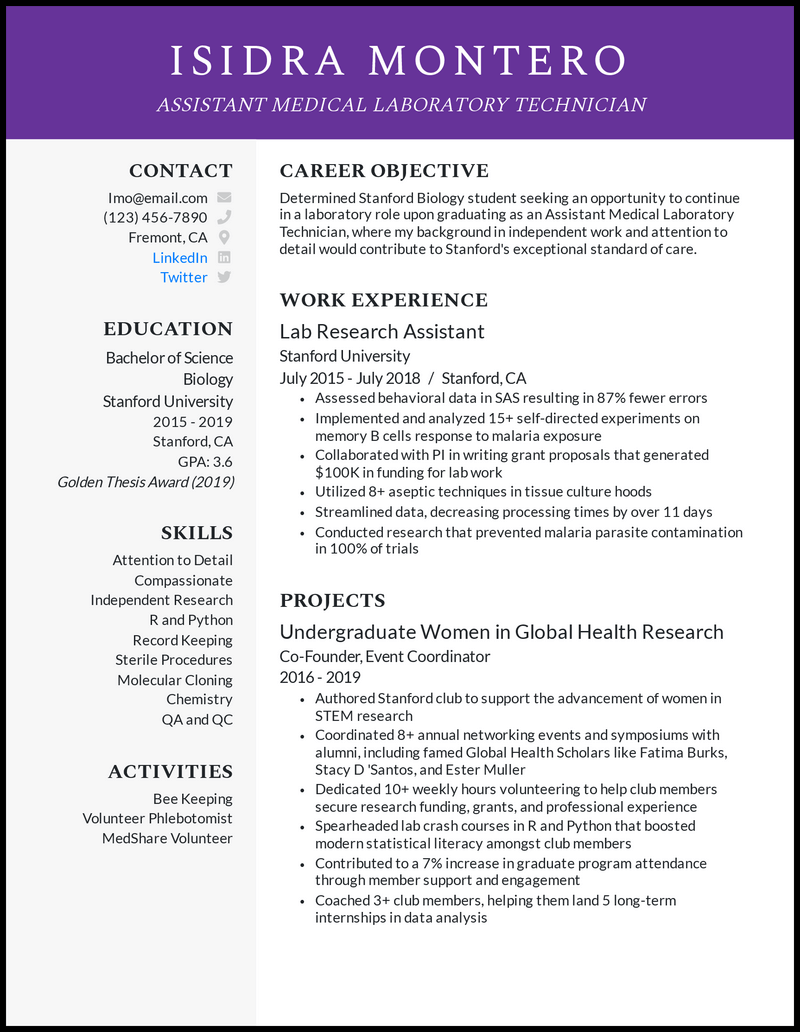
Why this CV works
- Just because you’re in a science field doesn’t mean you spend all your days in the lab. Keep recruiters informed by adding a hobbies/interests section to your CV; it can portray you through your university student assistant medical laboratory technician CV as a cultural fit, make your sales pitch stand out, and, even better, serve as an ice breaker during the interview.

Why this CV works
- An aesthetically pleasing university student case assistant CV will undoubtedly make an impression and help you earn some extra points with hiring managers. You can make it easy by using our ready-to-build CV templates and handy Google Docs interactive CVs for inspiration.
Why this CV works
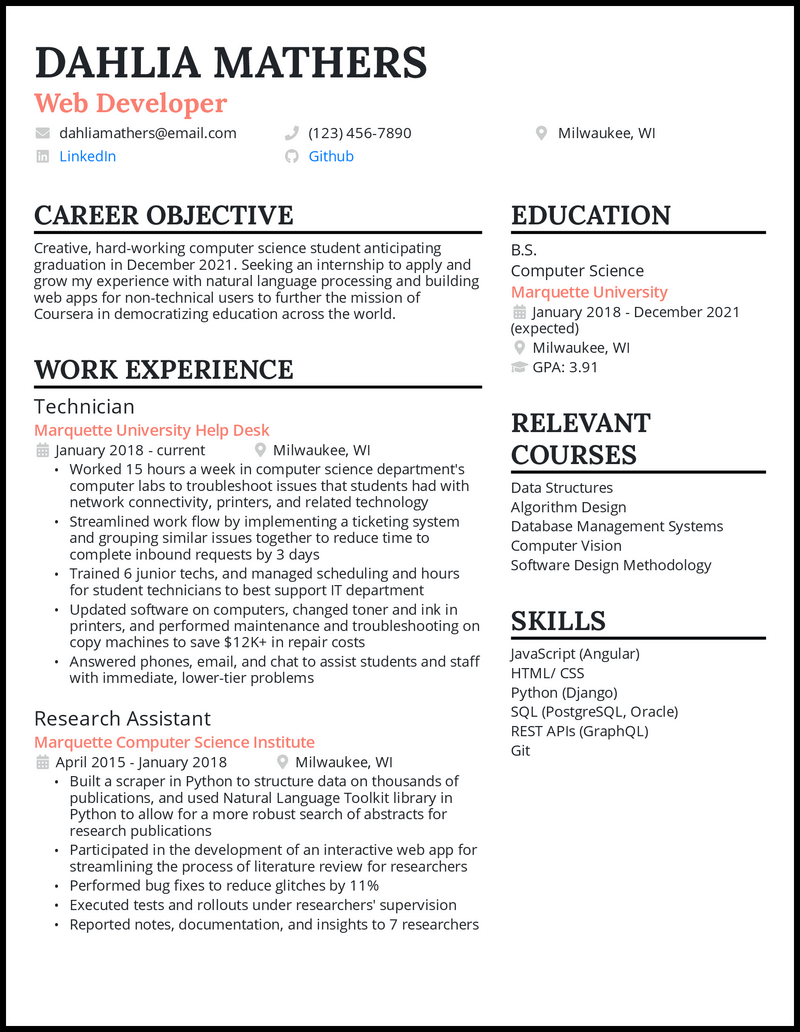
- Contrary to popular belief, you can easily secure a work placement at your dream company. Take our advice and review as many university student internship CV examples as possible; and read the job description a couple of times and note down the skills the potential employer is looking for.
View more university student internship CVs >
Why this CV works
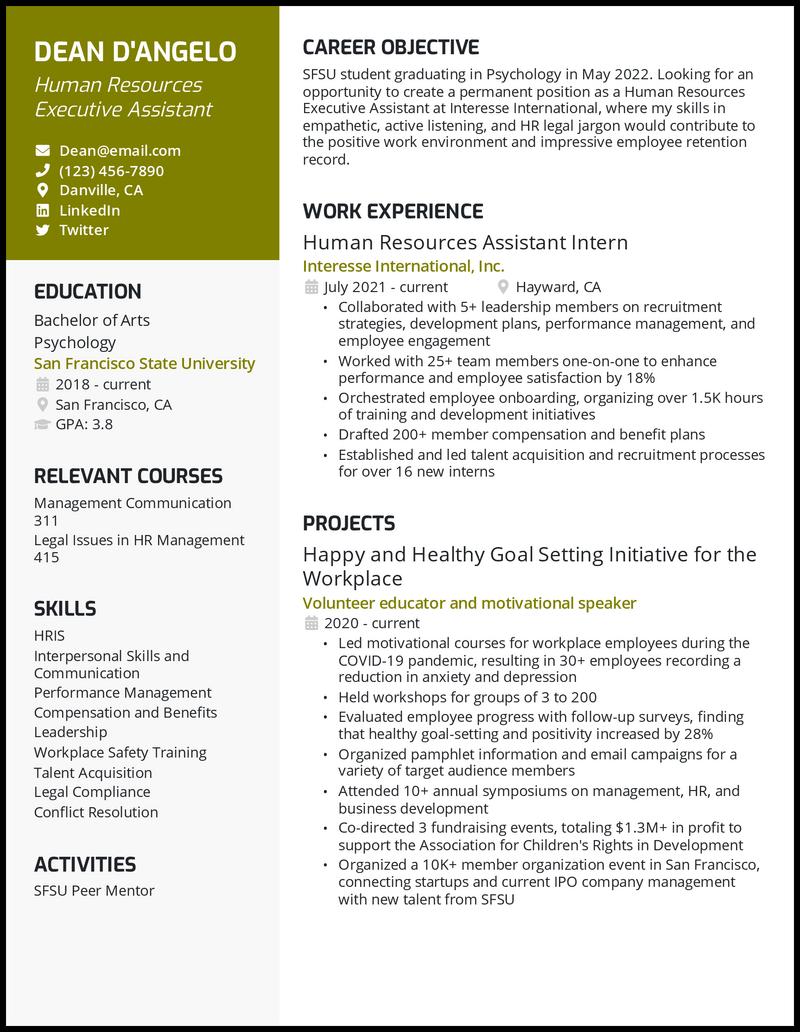
- Strategically positionskills on your CV (think active listening, empathy, and HR jargon) to show potential employers your availability for a full-time role. This section is better off nestled at the third top of your university student HR executive assistant CV’s sidebar.
Why this CV works
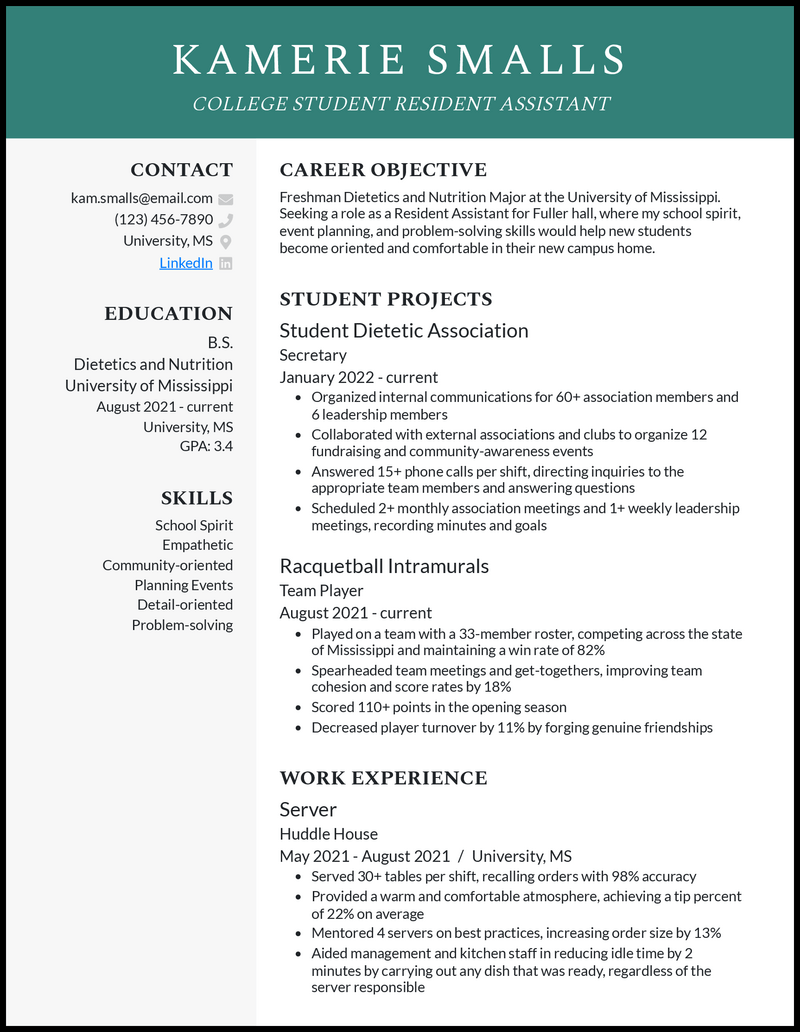
- Let your university student resident assistant CV make the most of your time as a secretary in a student society, a squash player, or a waiter to highlight useful transferable soft skills (think communication, problem-solving, communication, and empathy).

Why this CV works
- Your university student warehouse worker CV’s work experience and projects sections should enhance your credibility and appeal with quantified achievements. “Conducted over 35 field and laboratory tests of concrete…” and “Wrote over 30 ECN reports,” and “…built 7 proof-of-concepts” serve as perfect examples.

Why this CV works
- Since you’re just starting out at university, nobody expects you to have paid experience on your first-year university student CV. Still, you can significantly increase your chances of coming across as a well-rounded individual by including your work with personal or academic projects.
View more first-year university student CVs >
Related CV guides
How to Write a University Student CV

Writing a CV for a university student, especially with limited or no work experience, can be daunting. However, by choosing the right CV template and emphasising relevant skills from projects, placements, voluntary work, coursework, and extracurricular activities, you can catch the attention of recruiters.
The winning strategy here is to emphasise your education and skills rather than your work experience, which you don’t have anyway.
Here’s what this section includes:
- How and why a compelling CV objective matters for university students
- How to format your CV correctly
- Essential elements for a successful university student’s CV
- How to demonstrate impact from projects, volunteer work, and extracurricular activities
- How to impress recruiters with education and other academic achievements
- how to adapt your transferable skills to meet the needs

How to write a strong CV objective for a university student
When you’re applying for a job or internship as a university student, you likely won’t have extensive work experience. So, we’d recommend including a CV objective instead of a CV summary.
The goal of your CV objective is to set the stage for your CV. It should highlight your skills relevant to the job in question, and it should be specific for each job to which you’re applying.
Most CV objectives are dull and generic. By taking the time to craft a customised and effective CV objective, you give yourself an advantage over other candidates and increase your chances of securing an interview.
Before we dive into the rules for creating a strong CV objective, let’s look at some examples.
Sample university student CV objectives
- Recent university graduate with a degree in marketing seeking a full-time position where I can utilise my experience in social media and paid advertising to help an up-and-coming brand like Club Z! Inc. increase awareness and attract more users.
- Hardworking university student at the University of Pittsburgh who is equally committed to academic excellence (2:1) and service (student leader at the local food bank) seeking an opportunity at Unidos as a part-time employee to utilise these talents to enhance customer satisfaction.
- Recent graduate with a Master of Business Administration (MBA) seeking an opportunity within an established management organisation to utilise my organisational and quantitative abilities. Epic appears to have a culture of empowering employees to take ownership of their challenges, and that culture aligns perfectly with my work style.
You can see that all of these CV objectives specifically mention the company that the student is applying to. Tailoring is the golden rule of CV objectives.
What are the rules for making your objective the best it can be?
- Once more, make sure to tailor your CV objective for each company to which you’re applying.
- Don’t be afraid to inject your personality. Making an impression will help you stand out among the hundreds of other candidates.
- Keep it to two to three sentences.
- Mention any relevant skills or qualifications you have for the role to which you’re applying.

Which CV format should a university student choose?
One of the hardest parts of using a CV maker as a university student is the blank page. The “getting started” part is overwhelming—you’re unsure what your CV should look like, let alone what should be in it!
When it comes to formatting your CV, the best advice is to keep it simple. You need to convincingly make the case that you deserve an interview for the role to which you’re applying.
In short, your CV should probably contain the following sections:
- Header: This is your name and job title. Ensure your job title matches the job title for which you’re applying.
- CV objective: We discussed this earlier, a brief summary of your skills and what you’re looking for.
- Education: As a university student, this should include your expected graduation date, the subject of study, and relevant modules.
- Skills: List six to ten technical skills relevant to your profession.
- Work experience: If you have any relevant work placements or part-time jobs, mention them here.
- Projects: Have you undertaken any side projects that showcase your competence? Include them!
Not all of these sections need to be included in your CV. Your CV should focus on your strengths.
If you don’t have much relevant work experience, you can omit that section in favour of discussing your projects or coursework.
However, no matter which format you choose, there are a few writing guidelines you should adhere to throughout your CV.
Formatting guidelines for your CV
- Keep your CV to one page. It should only extend to a second page if you have over 10 years of experience.
- Avoid any spelling or grammar errors by double-checking your text and having a friend review your CV. Don’t let typos be the reason why you don’t get an interview.
- Break up your work experience into small, digestible bullet points. Nothing is harder to read than a large block of text.
- Use reverse-chronological order to keep your most recent experience/projects at the top.
- Don’t include fancy images or graphics. It’s highly likely a computer will read your CV before a human ever does, and images are hard for computers to scan.
- Don’t list more than ten skills on your CV. (We’ll elaborate on this below.)

What skills should a university student include on a CV?
When creating your skills section, it can be tempting to list every skill you know. You’ll need to resist this temptation.
Before a human reviews your CV, an automated system called an Applicant Tracking System (ATS) will score your CV based on whether or not it includes the “right” keywords. These filters are largely screening for specific skills, so get an AI CV review before you apply for jobs.
Doesn’t this mean that you should include as many skills as possible to beat the ATS? Unfortunately, you need to make your CV appealing to both the ATS and a human, and nothing is a bigger red flag to a hiring manager than a candidate with a long list of skills.
You’re much better off focusing on six to ten skills you’re an expert in than including more that you sort of know. Generally, if you wouldn’t be comfortable being interviewed on a particular skill, don’t include it on your CV.
Technical skills
Examples
- Google Slides
- SQL
- Adobe Photoshop
- Bloomberg Terminal
- HubSpot
- Report writing
Interpersonal skills
Examples
- Relationship building
- Time management
- Attention to detail
- Critical thinking
- Collaboration
- Excellent communication
- Leadership

How to quantify relevant work, projects, and extracurricular activities
In any CV, regardless of your career stage, your work experience and projects should occupy at least 70 per cent of the overall space. These will determine whether you get an interview or not.
Once you have a few years of experience, the size of your projects section will decrease as the size of your work experience section expands.
If you have a placement relevant to the job you’re applying for, this should be listed in your “work experience” section. As a university student, your work experience can also include any part-time jobs you had while at university, even if they don’t seem relevant to the position for which you’re applying.
It’s not easy to balance work and studies, so having a part-time job demonstrates responsibility and determination.
When discussing your work experience, there are a few key tips you should follow:
- Mention the skills you demonstrated in the role.
- Quantify the impact of your work whenever possible.
- Discuss your specific role; avoid being too vague.
- Use action verbs like “owned” or “led” to highlight your leadership abilities.
Numbers truly speak louder than words, especially on your CV. By providing numerical context around your work, you demonstrate your ability to contribute meaningfully to your workplace.
Compare these two descriptions of a work placement. Which do you think would be more compelling to a hiring manager?
WRONG – general work experience descriptions
Marketing Science Associates
April 2020 – Present, New York, NY
Digital Marketing Intern
- Created testing plan for Facebook advert copy
- Created essential reports for the executive team regarding KPIs
- Managed the development of the blog for SEO purposes
- Worked closely with clients to understand their product positioning to incorporate into advert copy
RIGHT – specific, quantified descriptions
Marketing Science Associates
April 2020 – Present, New York, NY
Digital Marketing Intern
- Created A/B testing plan for Facebook advert copy, improving ROI by 15%
- Created essential reports for the executive team on KPIs such as marketing expenditure, new leads, revenue generated, and ROI
- Supervised the development of the blog for SEO purposes, which increased from 1,000 to 5,000 monthly organic visitors
- Worked closely with clients to understand their product positioning to incorporate into advertising copy, resulting in 99% client satisfaction.

How to show impact from projects if you have no work experience
If you don’t have much (or any) relevant work experience for your CV, don’t worry. You can still create a highly effective CV by showcasing your projects.
As a university student, you’ve likely completed many course projects that are relevant to the job or work placement you’re aiming to secure. This is the ideal place to discuss those projects. You can even mention projects you undertook outside of your coursework. Discuss your objectives, the methods/skills you utilised, and the project’s outcome.
The key is to include anything that will convince the hiring manager you have the drive, skills, and ability to translate your academic knowledge to the real world and contribute to the roles for which you’re applying.
Here are some potential projects you can work on for different degree courses:
Project ideas for university students
- Are you a business student? Detail a case study that you analysed and presented in a lecture.
- If you’re a marketing student, you can write a short blog post about how you’d enhance the paid marketing strategy for a company you admire.
- As a graphic designer, this is a great opportunity to discuss some of the projects in your portfolio.
- If you’re looking for a data analyst role, talk about how you analysed stock data to determine areas of opportunity.
- As a human resources student, you’ve probably developed processes for companies as part of a course, so discuss that.
- Software engineering students regularly complete meaningful coding assignments. Discuss one of these or talk about your side project.
- If you’re looking to break into product management, discuss a hackathon you participated in or create a case study for a feature your favourite product is missing.
Essentially, the projects you include on your CV can be almost anything. They just need to show that you understand what is expected in the type of role you’re applying for, and that you can fulfil those expectations.

How to include your education
As a university student, it should go without saying that you need to include an education section on your CV.
Here’s what you need to include in your education section no matter what:
- The school you’re currently attending (or recently graduated from). You do not need to include your secondary school.
- Your graduation date (or expected graduation date). You can provide just the month and year.
- The type of degree you’re working towards (Bachelor of Arts, Bachelor of Science, Master’s, etc.).
- Your subject area.
When to include coursework and grades: What’s the threshold?
Once you include all that, there’s more flexibility. If you have a strong degree classification (upper second class or first), you should include it, too.
If you don’t have much experience yet, you can add relevant courses or awards to your education section, provided they’re pertinent to the job for which you’re applying.
For example, if you’re applying for a role as a data scientist, then it makes sense to include any maths, economics, or programming courses you completed.
Here’s an example of an effective education section for a university student looking for a marketing role:
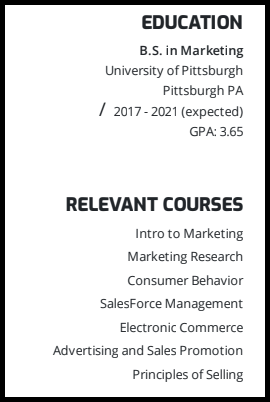
If you received any awards or honours during your time at university, list them here. These can include being on the Dean’s List, any department-specific awards relevant to your course, or formal recognition for your work or volunteer efforts.

What other elements should a university student include in a CV with no experience?
Hobbies aren’t considered necessary for CVs. They’re better off elsewhere and not on your job application. However, hobbies and interests can significantly impact a university student’s CV. The key here is they have to be relevant and enhance your chances of standing out.
Here’s how to do it properly:
When to include hobbies and interests
- When highlighting transferable skills
- When they demonstrate soft skills such as leadership, problem-solving, teamwork, etc.
- Give the hiring manager a sense of your personality and potential
- When they align with a scholarship, work placement, or first job
What you can include
- Sport
- Debating society
- YouTube channel monetisation
- Blogging
- Programming
- Photography
- Student union
How to list hobbies and interests
Examples
- University ice hockey team captain – reached regional semi-finals, enhancing teamwork and leadership skills
- Competitive Shogi player – county tournament finalist, honed critical thinking and problem-solving skills
- Podcasting – started a YouTube finance podcast with 5,000 subscribers and monetised it on AdSense
What not to include on a university student’s CV
- A-levels
- Projects that don’t relate to the role
- Irrelevant details
- Controversial topics such as gambling
- General activities like listening to music and watching films

Key points
There you have it—we’ve discussed the building blocks to help you secure a job or work placement as a university student.
In summary, here are the keys to creating an effective CV as a university student:
- Inject your personality into your CV objective and tailor it for each company to which you apply.
- Your CV format should include a header, personal statement, skills section, education, and work/project experience.
- Include any relevant internships or part-time jobs you’ve had during university and quantify the impact of your work.
- If you don’t have much work experience, include relevant projects you’ve completed either in the classroom or in your own time.
- Your education section is your opportunity to highlight courses you’ve completed that will persuade the hiring manager you have the right skills for the role.
Finding a job or internship as a university student can be incredibly stressful. Building anAI CV is a huge first step, so give yourself a pat on the back. After you’ve finished writing, you can check your CV against our AI-powered tips to see how your CV measures up.
Just remember, it does get easier once you’ve gained some experience. We can’t wait to see where you’ll go!
University Student CV FAQs

Read through the job description until you understand what the employer seeks. You will find keywords, skills, and qualifications that describe the best-fit candidate as you read. Now, you should tailor your piece to meet those expectations.
You’re a college student, and lack of work experience shouldn’t give you a hard time. You already have more to offer than you think: your internships, projects, volunteer activities, charity work, and sports can add value to your potential.
All you have to do is to demonstrate transferable skills from each of those experiences. Show what you learned and how you can use it in the job you’re applying for.
Your coursework can also compensate for your lack of specific job experience. Showing the competencies in software such as QuickBooks, HubSpot, and Excel can also fill the gap.
For a university student’s CV, highlight your professional aspirations, relevant experiences, and transferable skills gained from practical activities, coursework, and voluntary work. Allow the hiring manager to sense your enthusiasm for the industry and your general understanding of how things operate, and the job will be yours. Additionally, including a career objective will clarify why you are the best candidate for the position.
Yes, if your grade point average is 3.5 and above and you don’t have industry-specific experience. Including it demonstrates your commitment to learning and achieving the best, which could persuade recruiters you’re the right candidate. However, you should remove your grade point average once you gain considerable work experience.

Stephen is the co-founder and CEO of BeamJobs. Frustrated with the challenges he'd faced in his own job search, he left the corporate world to start BeamJobs with his brother. Drawing on firsthand experience with hiring and getting hired as technical talent, he started BeamJobs in 2020 to help qualified job seekers land interviews with less stress. Since then, more than 4 million people have built their resumes and cover letters on BeamJobs. Stephen's insights have been featured in notable outlets, such as Fast Company, Business Insider, Yahoo Finance, MIT, and Zapier. Learn more about Stephen.