



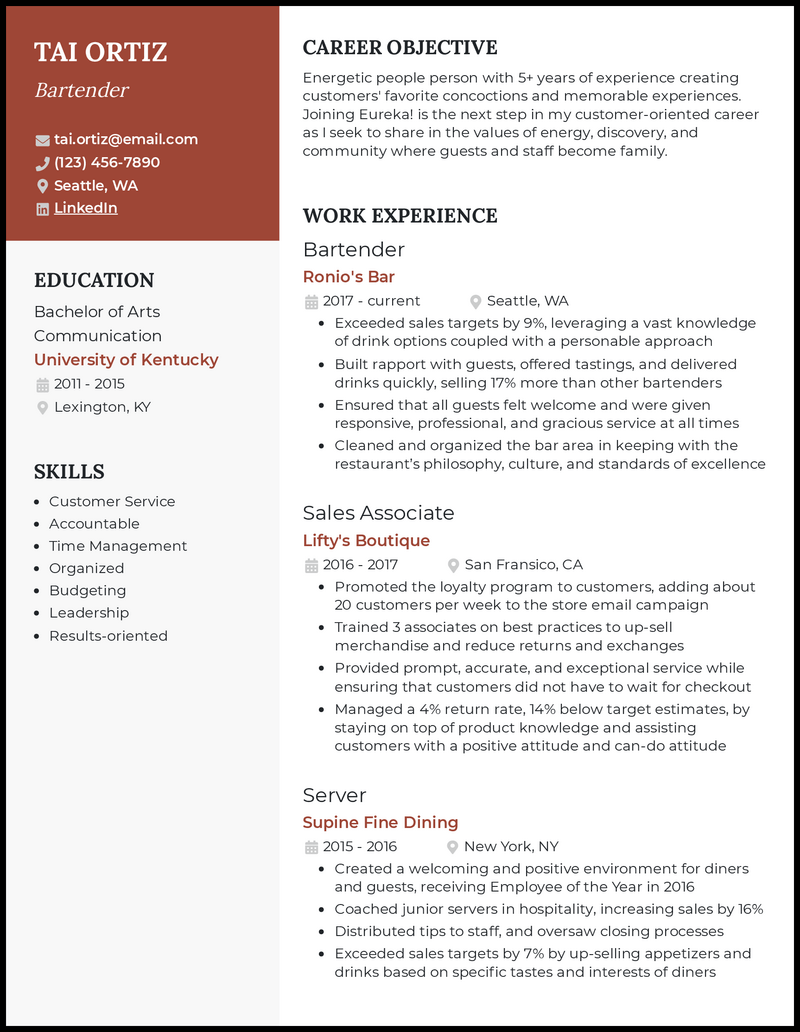
Crafting the best bartender resume depends on clarity, confidence, and relevance. Whether you aim to land your first barback job or step into a lead mixologist role, your application materials must show hiring managers you’re both skilled and dependable. That means focusing on three essentials:
- ↪Creating a resume that demonstrates your most relevant experience
- ↪Writing an effective cover letter aimed at a specific bar or hospitality venue
- ↪ Using a proven resume template that balances design with readability
This guide breaks it down into modular, easy-to-skim sections so you can confidently hit “send” and at least expect an interview call.
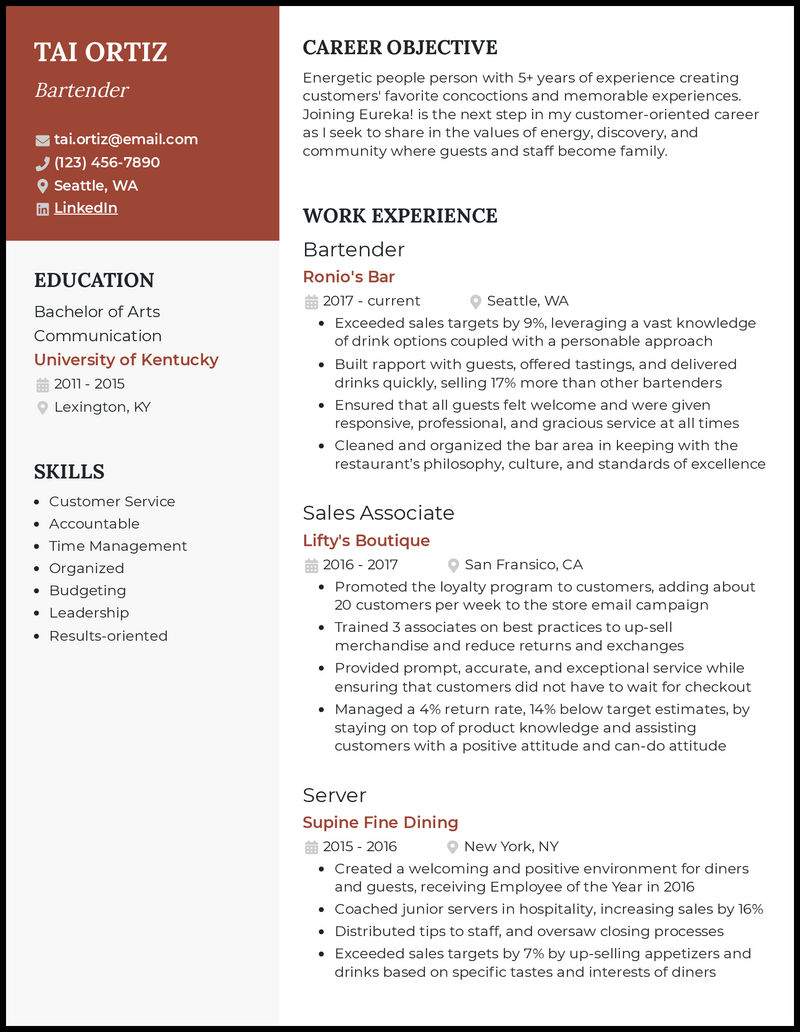
Why this CV works
- Any sort of leadership experience will help your resume stand out among the hundreds of other applicants for the bartender roles you’re applying to.
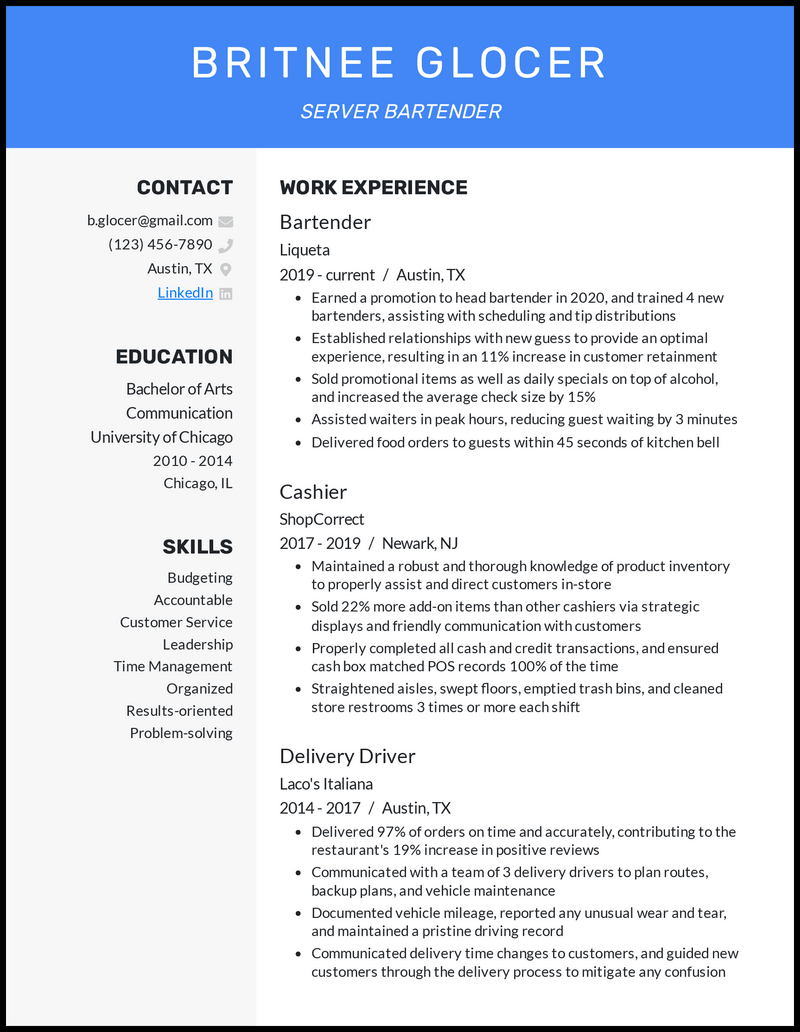
Why this CV works
- Your resume should be formatted with education taking up less space as work experience increases. In addition to highlighting your skills, present your content like a pro with a stylish resume template for a successful first impression.

Why this CV works
- Concise bullet points should take precedence in your work experience section; they give your high volume bartender CV a tidier, more professional appearance and ensure brevity and easy skimming.
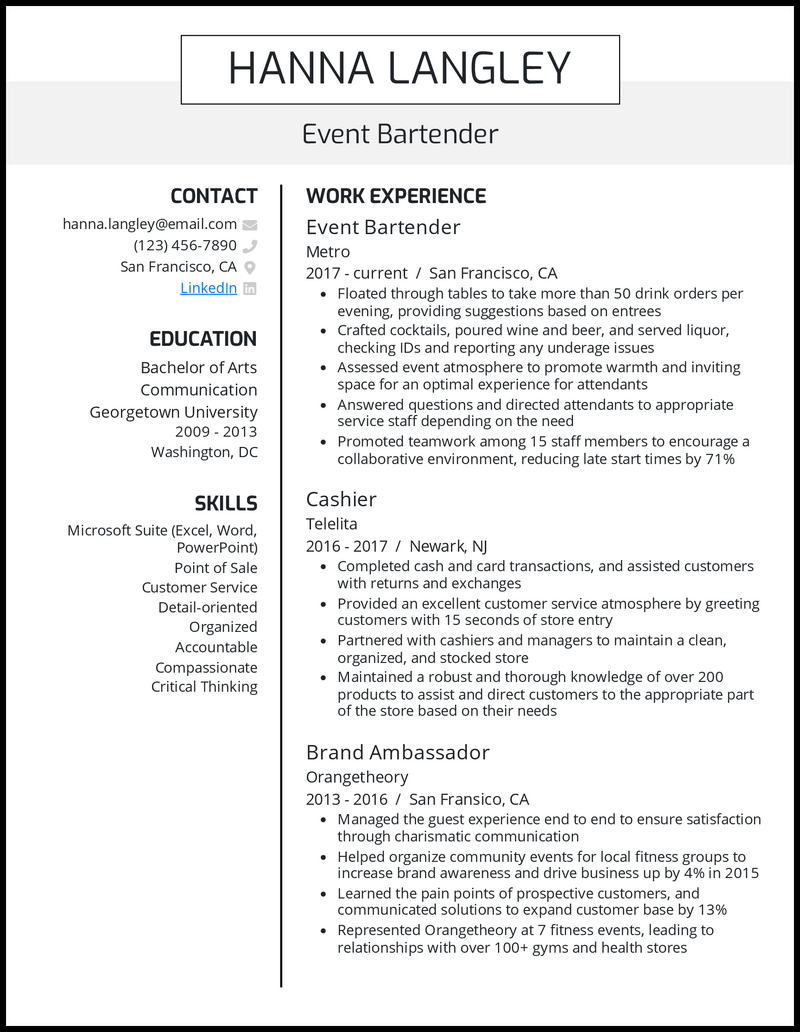
Why this CV works
- If you’ve worked in high-end fashion events, you can showcase those kinds of skills on your CV. Conversely, if you’ve worked events for programmers, demonstrate your flexibility to bartend for an entirely different crowd (a geeky audience?).
View more event bartender CVs >

Why this CV works
- Starting your fine dining bartender CV is a smart move, and then listing your other hospitality roles as bartender and waiter adds more weight to your application. You see, relevant experience gives you an advantage by building your credibility and proving you’re a match for the available job.

Why this CV works
- Practicing responsible beverage service can keep a banquet a classy affair. Therefore, highlight your certifications in Responsible Serving or Health and Safety to emphasize professionalism on your banquet bartender resume.

Why this CV works
- Mentioning tools like Toast POS, BevSpot, Adobe Photoshop, and Canva in your lead bartender resume is your ace. Ensure to start with those listed in the job posting (if any), and show you’re a wizard at using them to make things happen.
View more lead bartender resumes >

Why this CV works
- Nightclubs are high-volume environments that demand high levels of service. Adding a career objective to a nightclub bartender CV is an effective way to demonstrate your competence.

Why this CV works
- As an experienced bartender, it’s important that you show an increase in the level of leadership you’ve taken on throughout your career. For example, try writing your work experience bullet points with action verbs like “led,” “exceeded,” and “provided” to display leadership.
View more experienced bartender resumes >

Why this CV works
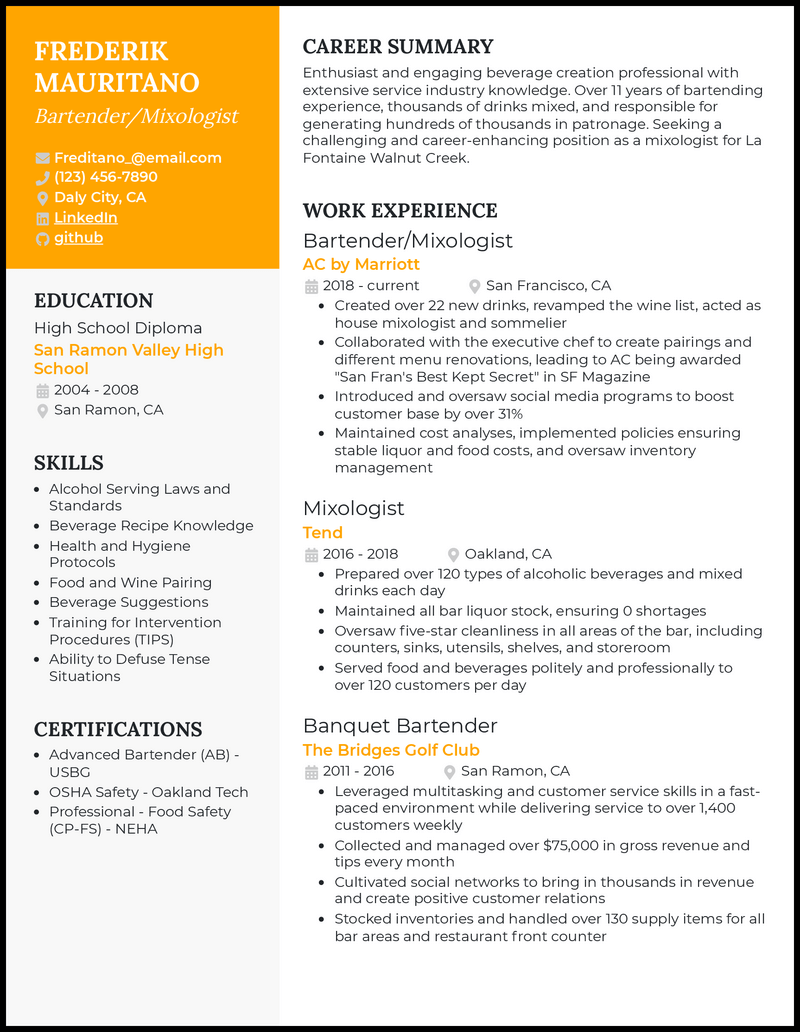
- Take a cue from Aurella and sell yourself on one neat page. The tricks to keep it crisp and not tumble onto the second page is capitalizing on punchy bullet lists and lace them with action-oriented lingo.
Why this CV works
- Opt for a clean design that enables the resume reader to easily view previous employers, work experience, education, and time frames. Also, make important features stand out by using contrasting fonts or small pops of color. And be consistent in your resume format for each work experience.
View more mixologist resumes >
Why this CV works
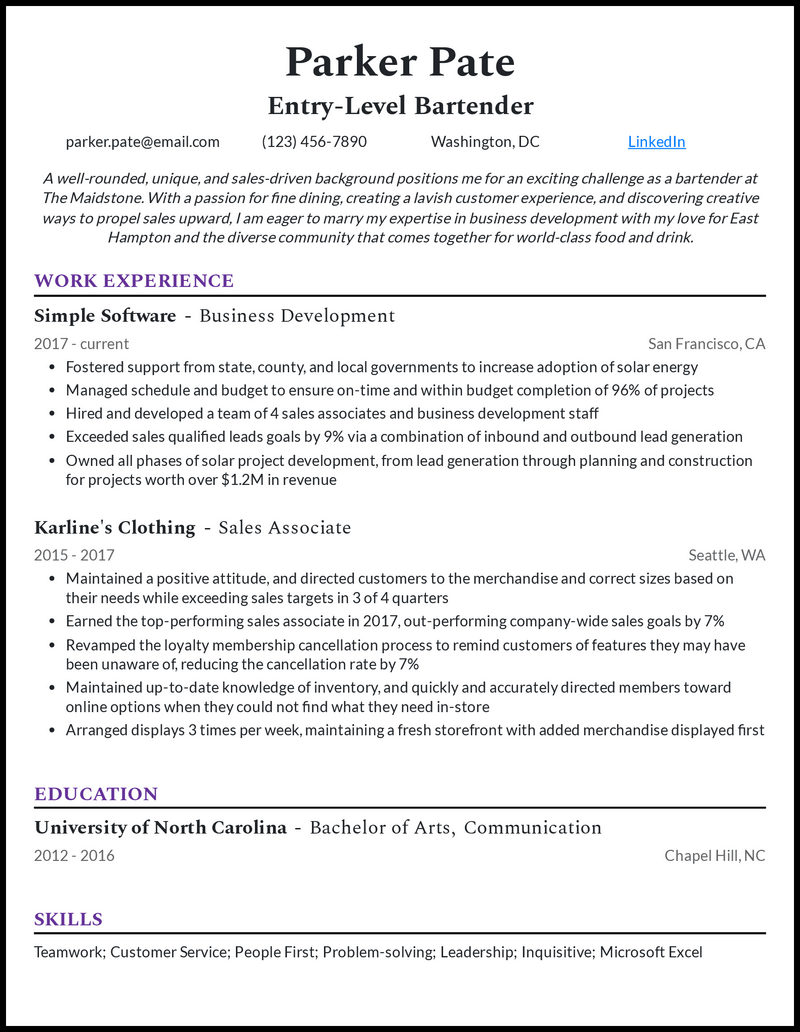
- If the job description repeatedly mentions “customer service” or “people first,” then be sure to list those as skills, so long as they honestly describe you.
View more entry-level bartender resumes >
Why this CV works
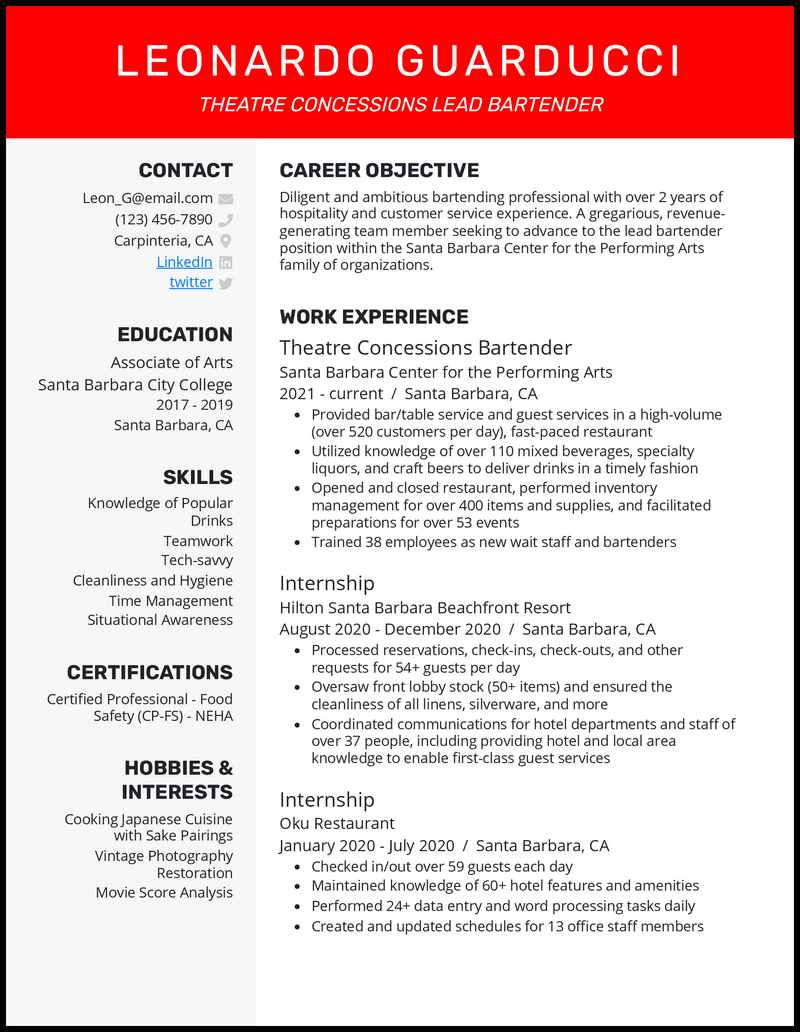
- Pick a resume format that places education, skills, certifications, and relevant hobbies in a column beside your experience section to continuously draw the reader’s attention to selling points that make up for the limited experience.
See more lead bartender resumes>
How to Write a Bartender CV

A strong bartender resume should quickly prove you’re skilled, dependable, and great with guests in varying settings.
To stand out, focus on:
- Clear structure
- Measurable achievements backed up with core skills
- Role-relevant keywords
The hospitality sector is competitive, so you need a compelling bartender CV to secure more interviews. Recruiters want to be sure that you have the right skills, that you’re reliable, and that you can meet customers’ high expectations. To write a CV that ticks all these boxes, follow the steps below and keep up with applications using a free Google Sheets job tracker.

What should a bartender resume include?
Pack your bartender resume with relevant experience and guest-focused skills and format it for scannability. Include hospitality-related keywords to ensure each section responds to the job description.
At a minimum, include:
- Professional overview
- Relevant work history with measurable accomplishments
- Education, certifications, and mixology training
- Technical and soft skills in action
- Simple, ATS-compliant resume layout

What is the best bartender resume format for ATS?
The best format for your bartender resume and ATS is reverse chronological. This format prioritizes your most recent work experiences and is easy for AI systems to scan.
Be consistent and clear to help your document pass automated filters and reach and impress human reviewers.
Stick with these formatting tips for the best results:
- Use simple fonts (Arial, Calibri, Helvetica)
- Don’t use graphics, columns, and embedded tables
- Segment your content in semantic headings: “Work Experience,” “Education,” and “Skills,” etc.
- Save the file as PDF or Doc (unless otherwise specified)
Remember, automated application systems (ATS) will review your CV before it reaches a hiring manager. Your CV must have a simple, professional layout that is easy to scan and read. Use simple fonts without excessive graphics and images. You want to create a professional document showcasing your suitability for the role.

Should I include a career objective or summary on a bartender resume?
Choose a career objective if you’re early in your career or changing fields. Use a summary statement if you have extensive relevant experience and worthwhile achievements.
The winning formula is to choose the option that best frames your value to the prospective employer.
What does a good bartender resume objective statement look like?
Motivated team player seeking an entry-level bartender role at Tipsy Fox to deliver outstanding guest experiences, master classic cocktails, and grow in a fast-paced hospitality environment. Skilled in bar prep, customer service, and eager to learn from experienced staff.
Example of a career objective for a trainee bartender
Motivated and personable entry-level bartender seeking to join the team at The Dead Rabbit in New York City. Eager to apply strong customer service skills, a solid foundation in mixology, and a passion for hospitality to create exceptional guest experiences in a fast-paced bar environment.

When should you use a bartender CV summary?
A summary statement is effective when you have an impressive work history and achievements to use as your bargaining tool. Highlight past accomplishments, skills from years of excellent customer service, working in high-pressure environments, and a proven record of leadership and organisation.
Example of a summary statement for a bar manager
Bar Manager with over 10 years’ experience leading high-volume venues, specialising in bar operations, team management, stock control, and guest experience. Proven track record of boosting sales, streamlining service, and maintaining top hospitality standards.

How to highlight measurable bartender work experience
Your previous work experience must align with the requirements of the new role. Therefore, you should not only list your responsibilities but also include metrics to demonstrate your impact in past relevant positions. A useful tip here is to use action verbs, utilise your skills, and highlight measurable achievements.
For example, discuss the number of customers you served, events you successfully managed, sales revenue generated, etc. By doing so, you’re demonstrating your value to potential employers by showing them you can exceed their expectations as you have done in the past.

How do you describe bartender duties on a resume?
Use action verbs to describe your responsibilities and pair each duty with measurable results. Steer from vague statements like “responsible for drinks”—focus on what you did and the business value it brought.
Examples of how to turn your duties into value-packed bullet points:
- Mixed and served drinks to 200+ patrons nightly using Toast, maintaining 99.8% customer satisfaction based on real-time survey feedback
- Maintained a clean, organized bar environment during high-volume shifts by utilizing Partender and adhering to HACCP sanitation protocols
- Upsold specialty cocktails using suggestive selling scripts, boosting daily revenue by 12% and improving average order value (AOV)

What are examples of measurable achievements for bartenders?
Recruiters are impressed by quantified results. Measurable accomplishments prove you’ve delivered real impact and position you as the perfect fit for the open role.
Examples of how to quantify results:
- Cut inventory shrinkage by 14% by conducting weekly stock audits using BinWise, ensuring real-time tracking of usage variances, and reducing over-pouring
- Trained 5 junior bartenders using structured modules built in Typsy for standardized onboarding and hospitality compliance
- Increased bar sales by 21% through leveraging POS analytics from BevSpot to identify high-margin items

Include relevant bartender training and qualifications
Your educational background in hospitality significantly highlights your professionalism and suitability for the available position. Additionally, formal training in mixology, beverage handling, and customer service strengthens your application.
Example of how to add education to your bartender CV
Foundation Degree
Culinary Arts
California Culinary Academy
2014 – 2016
San Francisco, CA
What certifications improve a bartender resume?
Certifications signal professionalism, safety and health awareness, and compliance with legal requirements. To add credibility, always include the issuing body, year, and expiry date (if applicable).
Some great bartender certifications:
- TIPS Certification (Training for Intervention Procedures)
- Responsible Beverage Service Certification (RBS)
- Food Handler’s Certificate
- Mixology School Certificate
How do you list mixology training on a resume?
Use the “Certifications or Education & Training” section to house your mixology training. Pack it with details of the lessons and how you can apply them in real-world work situations.
Example:
Certified Mixologist
American Bartending School – New York, NY
Completed: 2024
- Hands-on training in cocktail building, garnishing, and speed pouring
- 40+ classic and signature drinks mastered

What are the top bartender skills to highlight on a resume?
Focus on software, interpersonal, and business operational skills directly impacting guest experience and bar performance. Frame each skill in context—don’t just list; accompany it with results.
Top bartender skills:
- Mixology & drink presentation
- Multitasking & calm under pressure
- POS & payment systems (e.g., Toast, Square)
- Inventory and stock management
- Customer interaction & upselling
- Conflict resolution and de-escalation
- Cleanliness, safety, & workspace organization
- Supervision and staff training
- New employee onboarding
It’s not a matter of listing relevant skills; you’re supposed to show them in action. When you generate bullet points, demonstrate the use of skills to show impact and let employers know the value you can bring to their business.
Don’t just focus on your mixology skills; demonstrate your interpersonal skills, such as excellent communication and conflict resolution.

What action verbs work best on a bartender resume?
Deploy an action-oriented verb at the beginning of each bullet point and announce that you can do it better than any other candidate. These action-oriented words drive clarity and convey your professional authority.
Effective verbs for bartending roles:
- Managed
- Resolved
- Mixed
- Served
- Upsold
- Restocked
- Trained
- Boosted
- Operated
- Maintained

What mistakes to avoid on a bartender resume
These common mistakes can hurt your chances of getting hired (avoid them at all costs):
- Vague work experience descriptions
- Skills without context
- Fancy resume design
- Grammar and factual errors
- Unrelated experience

Key takeaways
- Keep sections clear and precise
- Show impact: Numbers > adjectives
- Use clear, direct headings to match search queries
- Align keywords to the job posting
- Tailor for the job posting, ATS, and recruiters
Bartender CV FAQs

A complete bartender resume includes:
Selective measurable outcomes from relevant work experience
Core bartending skills
Education and training in hospitality or customer serviceSafety, health, and customer service certifications
A professional snapshot that positions you as a results-driven professional
Choose a clean, ATS-friendly bartender resume template with clear sections for experience, skills, and certifications. Prioritize readability—use bullet points, bold job titles, and concise descriptions.
Begin with any bar work experience from your employment history. Don’t just list responsibilities; demonstrate measurable achievements. Next, emphasise your skills, education in communication or hospitality, and qualifications. This information shows that you’re not just any bartender but a professional who understands the craft to serve customers, increase revenue, and adhere to safety and legal regulations.
Include 6-10 skills that align with the job you’re applying for. Avoid generic competencies; instead, list those that demonstrate job readiness. Reinforce these skills within your bullet points that show practical use.
You must focus on transferable skills from work placements, projects, and voluntary work. For example, if you were part of a charity event, you learned about time management, handling money, communicating with large crowds, and resolving conflicts. These are skills you can use as a bartender.
Secure your next job with our AI-powered, user-friendly tool.
Eliminate the guesswork in your job search. Upload your current CV to check your score and make improvements. Create a CV with one of our eye-catching, recruiter-friendly templates.
• Work in real-time with immediate feedback and tips from our AI-powered experience.
• Utilise thousands of pre-written, job-specific bullet points.
• Edit your CV in-line like a Google Doc or let us guide you through each section step by step.
• Enjoy peace of mind with our money-back guarantee and 5-star customer support.

Stephen is the co-founder and CEO of BeamJobs. Frustrated with the challenges he'd faced in his own job search, he left the corporate world to start BeamJobs with his brother. Drawing on firsthand experience with hiring and getting hired as technical talent, he started BeamJobs in 2020 to help qualified job seekers land interviews with less stress. Since then, more than 4 million people have built their resumes and cover letters on BeamJobs. Stephen's insights have been featured in notable outlets, such as Fast Company, Business Insider, Yahoo Finance, MIT, and Zapier. Learn more about Stephen.