



![22 Barista Resume Examples [& Templates]](https://beamjobs.wpenginepowered.com/wp-content/uploads/2024/07/barista-resume.png)


Barista


Best for senior and mid-level candidates
Resume Builder
Like this template? Customize this resume and make it your own with the help of our Al-powered suggestions, accent colors, and modern fonts.
 Build my resume
 Hiring managers don’t read barista resumes—they scan them like drink tickets at rush hour. Your resume has a few seconds to make a strong case: you have the skills, show up on time, know your grind sizes, and can texture milk with precision.
Therefore, your barista resume should start with clean formatting, highlighting core competencies, and using bullet points that demonstrate capability without unnecessary fluff. You can take advantage of resume templates that have worked for other baristas and use proven tips for writing a resume that makes it skimmable. Additionally, creating a cover letter demonstrates that you understand the assignment—and the espresso machine.
In this guide, you’ll get:
- ↪ 22 barista resume samples covering beginner to leadership roles
- ↪ How you can customize your piece to reflect the wishes of recruiters and employers
- ↪ Tips for ensuring your application passes both human and AI screening

Why this resume works
- Include relevant work experience. Even if you’ve worked as a server, a hostess, or something else related to customer service, this experience can show your adaptability to new positions as well as demonstrate your abilities in similar job duties.
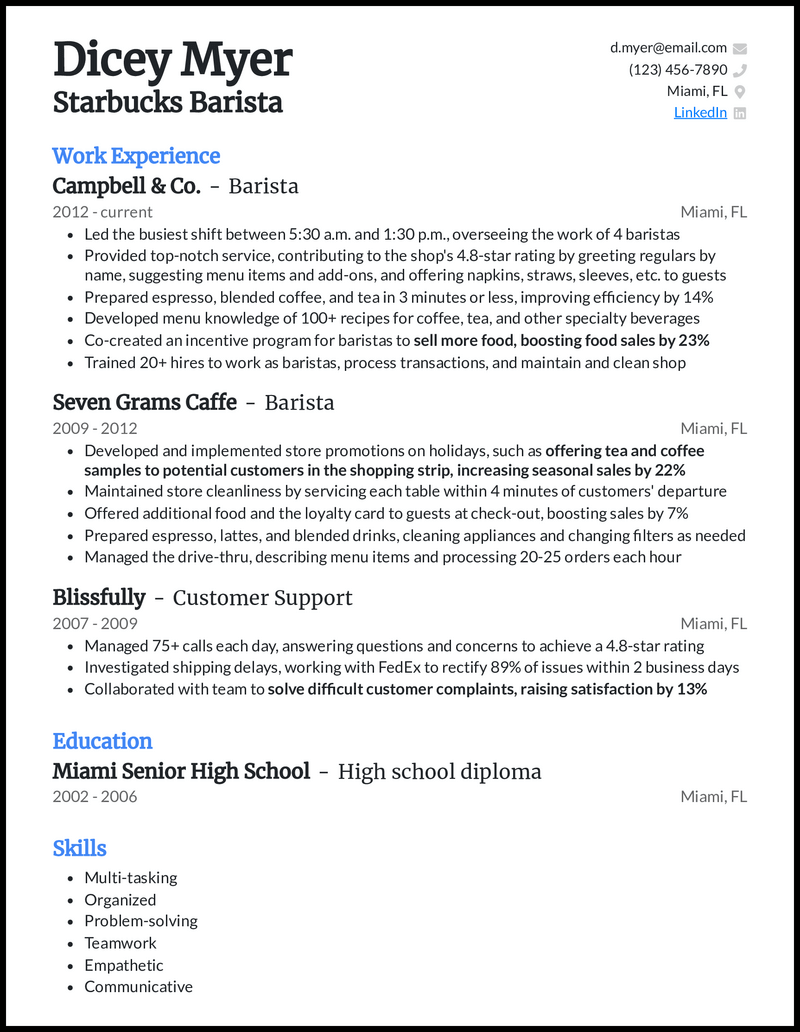
Why this resume works
- Your Starbucks barista resume ought to show your ability to collaborate, partner, and work with your fellow baristas and kitchen staff. While it’s important for any coffee shop, Starbucks is known for its long lines, both in the drive-thru and in-store. Your ability to be a team player is key.
View more Starbucks barista resumes >
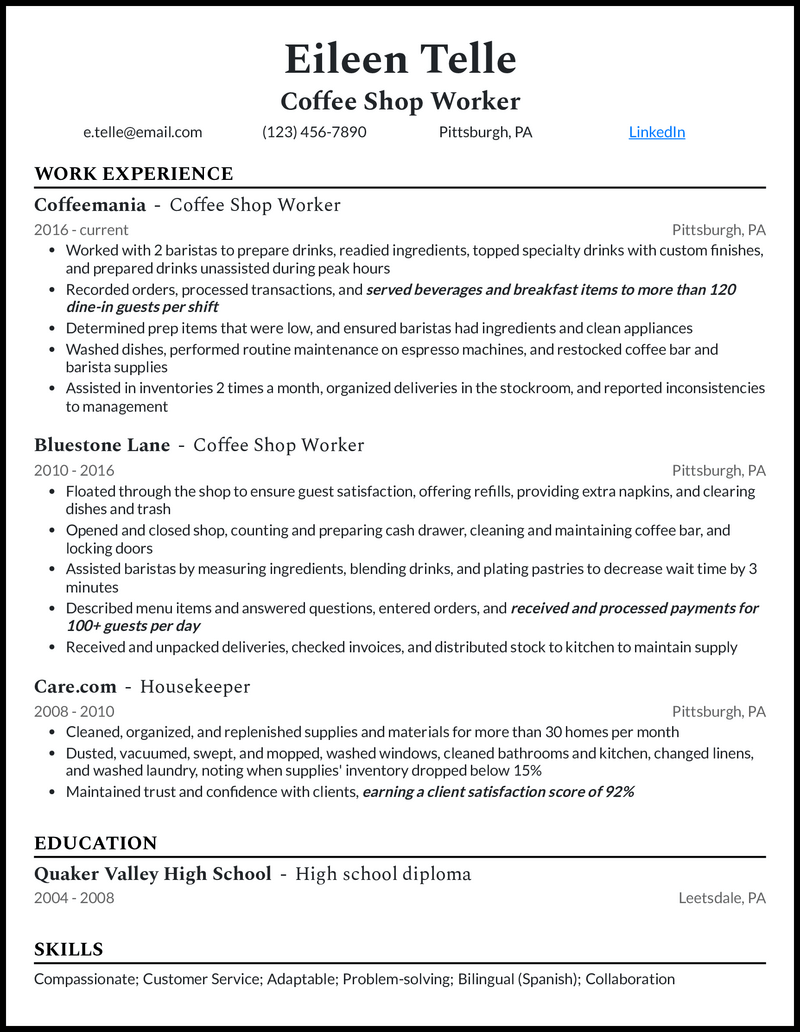
Why this resume works
- Find a template and resume format that will work for and not against you. While you want to maintain professionalism throughout your resume, coffee shops are known for their unique culture and vibe. Use our free resume checker that will allow you to find a professional yet creative template that will speak to your personality and impress the employer.
View more coffee shop resumes >

Why this resume works
- Delve into how your managerial skills helped improve customers’ satisfaction to attract new and retained customers. For instance, show how you nurtured customer relations to achieve an 89% retention rate.
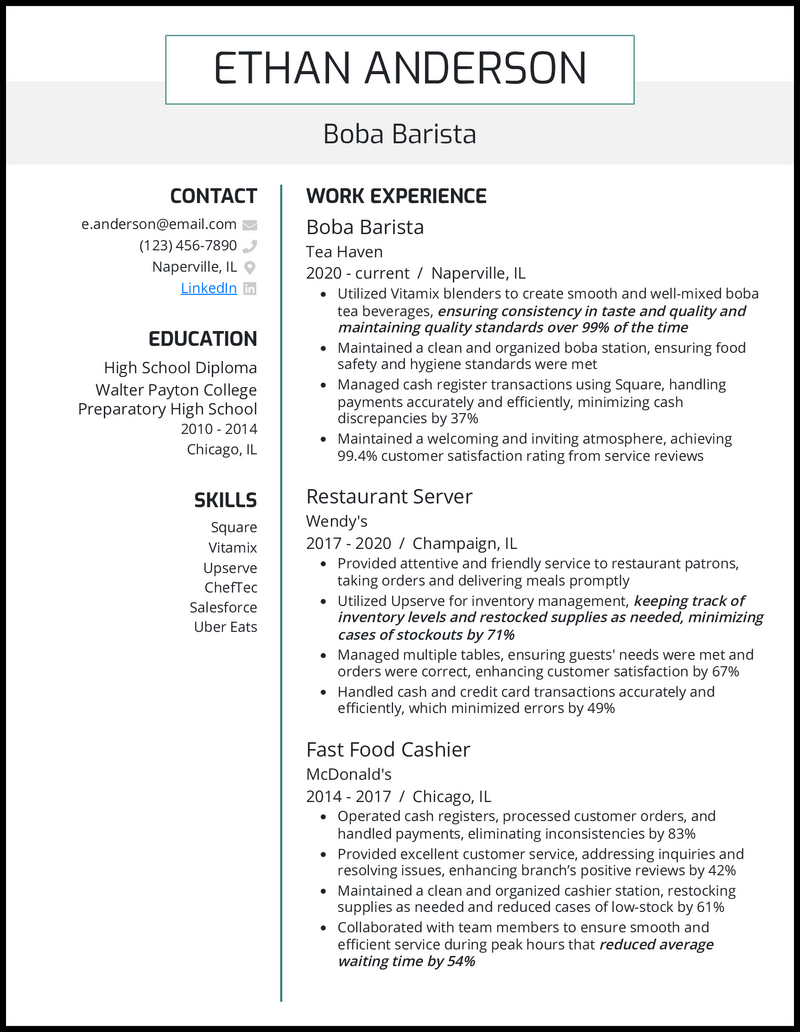
Why this resume works
- Let your Boba barista resume prove your excellent performance track record; it’s an effective way to catch recruiters’ attention. Don’t just state how good you are in these roles. Go beyond in your barista cover letter and elaborate exactly how you impacted workplace operations using your skills and knowledge.

Why this resume works
- A numbers-packed phrase like “Designed and launched promotional campaigns through Shopify, generating an additional $7.4k in sales during a two-week coffee festival” sounds (and looks) better than a plain statement such as “improved sales,”.

Why this resume works
- Ensure to catch the recruiter’s eye so that they can see your value; bolding and underlining (and/or italicizing) some phrases on your resume can do just that. For example, bold or italicize, “Informing three new menu offerings that elevated sales by $2,208 in three months” on your barista trainer resume.

Why this resume works
- Let your high school diploma, relevant courses (read Certificate Specialty Coffee Association (SCA) Courses), or certification (cue SCA Barista Skills Certificate) hold the reins in your resume’s education section.

Why this resume works
- Demonstrate your leadership and mentorship acumen, cost-saving prowess, or revenue-generation prowess. For example, trimming labor costs by a cool $9K+, onboarding and mentoring the new hires, improving employee communication, and driving sales up by $7K+.

Why this resume works
- Let your administrative skills be evident when you streamlined business processes, increased sales, boosted customer satisfaction, and even slashed costs. When done right, that alone can enable you to score an interview, presenting the opportunity to make a case for why you’re the best choice for the job.

Why this resume works
- Throw in a phrase like “Developed and maintained an inventory management system using MarketMan, cutting waste by $1,218 per year” to your lead barista resume, and you no longer have to struggle to get recruiters sold on your worth.
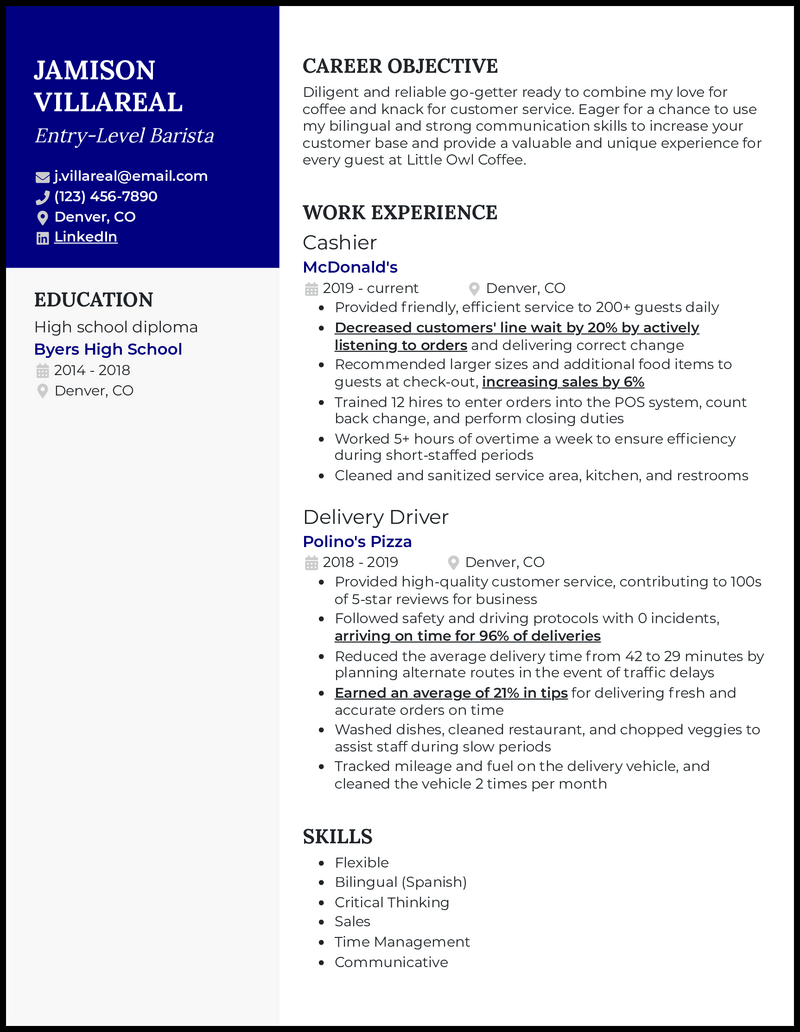
Why this resume works
- Be sure to include metrics, or numbers, that quantify your past job experience. Just as actions speak louder than words, so numbers speak louder than general statements.
View more entry-level barista resumes >

Why this resume works
- When matched, your resume and LinkedIn profile pack a powerful punch. Why? The duo adds to your credibility, keeping doubts about your trustworthiness and professional background at bay. A hyperlink to your LinkedIn profile just below your contact details works great.

Why this resume works
- Your Dunkin Donuts barista resume should be more than a mere introduction or a supplement for your cover letter. You want it to illustrate how well you stuck up against the tens, if not hundreds, of hopefuls gunning for this position. And one surefire trick to ace just that is to tailor your showpiece to the job description.

Why this resume works
- The reverse chronological format is the gold standard for organizing your work history. Make the most of it to give recruiters a clear timeline of your professional journey from the early days as a barista through the ranks of a barista team lead up to a supervisor.

Why this resume works
- Stay away from buzzwoirds such as “collaborative”, “self-motivated”, and “detail-oriented” because they don’t showcase your skills; instead, they make you appear insincere. Plus, these buzzwords don’t do much to set you apart from the hundreds of other applicants.

Why this resume works
- Keep your eyes peeled for typos, punctuation errors, clumsy language, and run-on sentences that seemingly don’t quit. And while spellcheckers like Grammarly and QuillBot are great proofreading sidekicks, a fresh set of eyes—cue your savvy friend or family member—is priceless.

Why this resume works
- Ditching the commonplace “was responsible for” in favor of action-oriented verbs like Directed, Managed, Harvested, and Elevated earns a heavy endorsement from us. You can always count on these choices to energize your narration and slice through the unnecessary while branding you as a proactive force—exactly what you need to stand out in supervisory roles.

Why this resume works
- Keep your bullet points concise, focusing only on the duties and applications of relevant industry software complemented by quantified outcomes. For a two-column template, keep the bullet points to three lines max. But one to two lines per bullet point will be just right for a single-column version.

Why this resume works
- Don’t just talking put together a flashy skills section with a list of resourceful gems (cue Square POS, Shopventory, Waring Commercial Blender, and Bunn Commercial Tea Brewer); your work history must show that you’ve actually gotten your hands dirty with this equipment or software and gotten great outcomes out of it.

Why this resume works
- Your resume must have the header, contact information, work history, skills, and education sections. Are there any optional components? Objective/summary, certifications, and hobbies are in that lot. And if you want to be on the safe side, don’t even think about references, as they only take up space that should instead flaunt your qualifications.
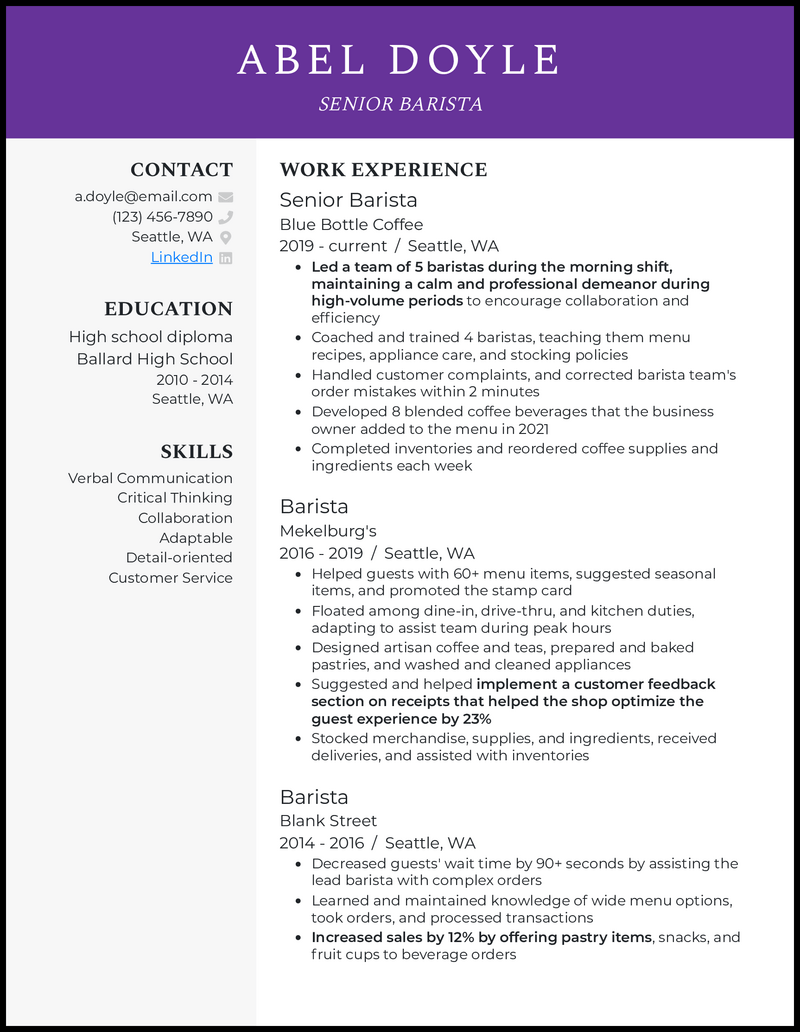
Why this resume works
- Play with the format and template of your resume. As a senior barista, you may have more work experience and job description bullet points than someone who’s been in the field for a couple of years. This means, your resume might fill up quickly.
Related resume guides
How to Write a Barista Resume

Whether you’re aiming for your first café job or climbing the coffee career ladder, knowing how to write a barista resume that stands out is your first victory. Hiring managers care about specific skills and experience, so getting inspiration from targeted resume examples is a good place to start.
Choose a clean format, use a resume checker to identify areas for improvement, and refine it until your document clearly demonstrates that you’re ready for the next step. The ultimate goal is to structure your resume in a way that makes every bullet count—like a perfectly timed pour-over.
Key sections we’ll cover:
- What should a barista resume include?
- Skills that show you know your craft
- How to format your document for clarity and ATS-friendliness
- Writing a resume with bullet points that demonstrate impact
- How to align your resume with job descriptions
- How to customize your resume for café chains vs. local shops
- Optional extras: Education, certifications, latte art, and more
- Common mistakes baristas make on resumes

Format your barista resume right
Use a reverse-chronological order that highlights your most recent and relevant experience. By so doing, hiring managers can quickly assess your suitability for customer-facing roles.
Unless your barista resume is brewed well with ATS-friendly formatting, employers won’t bother giving it a sup. In simple words, presentation matters more than you think it does, and we’re here to help you master the art of serving up a cafe-ready resume using the right formatting:
- Length: Let’s discuss your resume’s length first. Keep everything within one page unless you want to win the best espresso novel prize.
- Reverse-chronological format: While keeping everything under one page, remember to stack your past work experiences in a reverse-chronological order to highlight your recent achievements at the top.
- Bullet points: Include 4–5 bullet points per job to bring out unique contributions in each sentence, like boosting customer satisfaction or improving repeat visits.
Why reverse-chronological format works best
Barista roles lean heavily on hands-on experience in fast-paced environments. When you list your most recent roles first, this format surfaces your latest café, customer service, or hospitality experience at the top—the exact place where recruiters look first.
However, this order comes with a caveat that you must adhere to:
- Best for candidates with relevant work history
- Avoid if you’re changing careers or have employment gaps, and instead use a functional or hybrid format

Is a resume summary or objective better for a barista job?
If you’re new to the food service industry, particularly the coffee sector, or changing careers and entering the job market, a resume objective is the more natural choice. It communicates your passion in this line of work and outlines your career goals—a strategy that’s effective in showing enthusiasm even without experience.
Example
Friendly, fast-learning graduate excited to join Blue Bottle Coffee as a barista trainee. Passionate about coffee, skilled in customer service, and eager to grow into a long-term café career.
Use a resume summary if you already have experience as a barista or in a related field. A summary instantly highlights your top qualifications to hiring managers. Ensure to include at least one measurable accomplishment, career vision, and customer service skills demonstrated in past roles.
Example
Seasoned barista with 4 years at Starbucks, hitting 60+ drinks/hour, and named “Partner of the Quarter”. Skilled with Mastrena machines and POS; aiming to step into a shift lead role.

How to demonstrate your top work experiences
This is the moment of truth, the central attraction of your barista resume. So remember to quantify, but not in vain. Instead of saying, “I brewed 19 coffees daily,” be more specific about the results of your work. We’ve listed a few results-driven bullet point examples to give you a better idea:
- Introduced Square POSt for payments, facilitating 89 transactions daily, shortening the average checkout time from 7 to 2 minutes.
- Oversaw the cafe’s beverage inventory on MarketMan, using data to reorder raw ingredients, reducing annual stockout rates by 21%.
- Posted trending latte art on the cafe’s official social media handles, attracting an extra foot traffic of 116 customers within one week.

How can I describe a barista’s experience with metrics?
Combine specific numbers, active verbs, and tools to showcase outcomes with impact. Quantifying your barista experience enables hiring managers to gain a clear understanding of what you’ve accomplished, what you’re capable of, and the overall value of hiring you.
Examples:
Good: “Served 150+ drinks per shift during peak hours.”
Better: “Reduced average customer wait time by 33% by streamlining drink prep.”
Best: “Trained 3 new hires on espresso protocols, boosting order turnaround by 2 minutes.”
Think in terms of:
- Number of tables and patrons served
- Order speed and accuracy
- Satisfaction scores from customer surveys
- Goals tracking and performance reporting
Why metrics matter:
Metrics show that you’re results-driven instead of task-focused—signalling professionalism and helping you stand out in both automated resume scans and human reviews.
Entry-level vs senior barista metric-based phrases
| Metrics | Entry-level barista | Senior barista |
|---|---|---|
| Volume | Served 100+ drinks per shift during peak hours | Managed 200+ orders per shift across two registers |
| Speed | Maintained under 3-minute ticket times during rush periods | Reduced average wait time by 4 minutes by streamlining prep flow |
| Leadership | Assisted in restocking and opening procedures | Covered shift supervisor duties during manager absence |
| Teamwork | Supported team during peak rush with drink running and cleaning | Led team of 4 during morning shifts, ensuring smooth open and handover |
| Tech Tools | Accurately used Toast system for 50+ daily transactions | Optimized register-to-bar workflow using Square analytics |

What hard skills belong to a barista resume?
Barista roles at all levels demand practical, hands-on skills — and employers want proof you’ve got and can use them effectively. Hard barista skills are technical abilities specific to the barista role, and they should appear in the “Skills” section as well as be used to create action-driven bullet points in your work history.
Common hard skills for baristas
- Espresso machine operation: La Marzocco, Mastrena
- Milk steaming and latte art
- POS systems: Square, Revel, Clover, or Starbucks POS
- Cash handling and register balancing
- Food safety & sanitation procedures
- Drink recipe memorization and speed prep
- Inventory tracking and restocking

Should I list soft skills on a barista resume?
Yes — but show, don’t just tell. Soft skills are essential for customer-facing roles, such as barista work, but you must demonstrate them through accomplishments.
Examples of barista resume soft skills and how to prove them
- Customer Service: “Assisted an average of 55 customers per shift with accuracy and a friendly attitude.”
- Adaptability: “Kept up with seasonal menu changes, ensuring consistency in taste and quality of drinks.”
- Time Management: “Prioritized first-time clients while ensuring top quality service to existing clientele.”
- Communication: “Handled customer complaints instantly with a 99% success record without acceleration.”
- Teamwork: “Mentored 3 interns who helped the team cut down wait times by an average of 2.4 minutes.”

How do I write a barista resume with no experience?
Use these components:
Focus on transferable skills:
Demonstrate lessons and competencies from roles in retail, customer service, or food prep where you were multitasking, working under pressure, and engaging with customers.
Use a strong objective to show potential and enthusiasm:
Use a clear and confident objective within the top third of your resume to underline your passion for the company and role, your eagerness to learning, and your long-term interest in the role.
Example: Motivated learner excited to join Bean Master’s fast-paced café to apply strong people skills and grow into a skilled barista.
Highlight relevant coursework or certifications:
If you’re a recent graduate from high school or college, you may want to lean more on:
- Food safety credentials such as ServSafe
- Coursework in communication or hospitality
- Volunteer gigs in cafés, community kitchens, or catering at public events
Emphasize soft skills:
Employers hiring entry-level baristas often favor attitude over experience. Showcase interpersonal skills in:
- Time management
- Team collaboration
- Clear communication
- Adaptability during rushes or shift changes

What should I put under education on a barista resume?
Education announces to employers your reliability, training, and professional discipline.
Yes, a barista role doesn’t require a degree. However, your education section still builds credibility and context — especially when you highlight coursework or training that connects to food service, hospitality, or customer care.
Education section example:
ExampleHigh School Diploma
Lincoln High School
2020-2024
Portland, OR
Certifications:
ServSafe Food Handler Course, National Restaurant Association, 2024
SCA Barista Skills Foundation, Specialty Coffee Association, 2024

What certifications should I include on a barista resume?
Certifications say you’re committed, trained to industry standards, and ready to work. Including relevant certifications on your barista resume adds instant credibility, especially if you’re entering environments or premium cafés that prioritize professionalism and food safety. Besides, with these credentials, you stand out from the crowd, even for entry-level jobs.
Best practices for listing certifications:
- Be specific and dated
- Only list what’s current: Most certifications expire — include only valid ones
- Create a dedicated “Certifications” section for clarity
Common certifications for baristas
- ServSafe Food Handler
- Allergen Awareness Training
- Local Food Handler Permits

How do I tailor my barista resume to the specific role and employer?
Generic resumes are skipped. Targeted resumes land interviews and jobs.
When applying to a barista job at a specific company — say, to a major chain like Starbucks — tailor your resume to emphasize professionalism and attention to detail.
Here’s the best strategy to do it:
Match the employer’s language
Use the lingo that mirrors the brand’s job descriptions and internal culture. In the case of Starbucks, swap these as follows:
- Partner instead of employer
- POS systems and not a cash register
- Don’t say, “helped customers,” but say, “created welcoming experiences for guests.”
Use brand-relevant keywords
Identify the dominant keywords in the role advertisement and incorporate them into the skills, experience, and summary sections, while avoiding unnecessary content.
For a Starbucks barista resume, include:
- Partner support
- POS system operation
- Drive-thru service
- Shift coverage
- Beverage consistency
- Store cleanliness
- Customer connection
- Mission and values alignment

Key takeaways
- Use appropriate formatting rules and line up all your work experience in reverse chronological order.
- Mention any barista or coffee-related diplomas/certifications to give yourself an extra edge over other applicants.
- Leverage real metrics on each bullet point, and write about every impact you made, from growing foot traffic to customer satisfaction rates.
Barista Resume FAQs

The easiest way to write a barista resume is to include your best coffee-making and communication skills, use a professional font style, and include your best work experiences in reverse chronological order.
You should add a healthy mix of soft, brewing, and POS system skills. Ensure you’re also listing specific skills directly mentioned in the job description. A few examples of barista skills include:
✅ Latte art and milk frothing
✅ Grinder calibration
✅ Relationship building
✅ Square POS
✅ Toast CRM
✅ French press brewing
As an experienced barista, you have more work experience than the average candidate, so you can be flexible with your resume format and template. Add a strong career summary and quantified bullet points, and stick to a one-page resume to be a standout candidate.

Stephen is the co-founder and CEO of BeamJobs. Frustrated with the challenges he'd faced in his own job search, he left the corporate world to start BeamJobs with his brother. Drawing on firsthand experience with hiring and getting hired as technical talent, he started BeamJobs in 2020 to help qualified job seekers land interviews with less stress. Since then, more than 4 million people have built their resumes and cover letters on BeamJobs. Stephen's insights have been featured in notable outlets, such as Fast Company, Business Insider, Yahoo Finance, MIT, and Zapier. Learn more about Stephen.