



To write a restaurant resume, focus on clearly showcasing the skills and experience that reflect your ability to succeed in fast-paced, customer-focused environments.
A strong restaurant resume should include your past roles, specific duties, soft and hard skills, certifications, and any results that show what you can do, not just what you’ve done — a principle emphasized in the restaurant hiring playbook.
Here’s what we’ll cover:
- ↪ How to write a resume for any restaurant job
- ↪ What to include in a restaurant resume
- ↪ Tailoring experience to restaurant roles
- ↪ Highlighting customer service and teamwork
- ↪ Valuing potential over credentials
- ↪ Listing certifications like food safety or bartending
- ↪ Formatting tips for quick scanning
- ↪ Keyword usage for applicant tracking systems
- ↪ 9 restaurant resume examples for various roles
Before we start, you may want to check out these resume examples to understand what your end product should look like.
Ready? Let’s go.

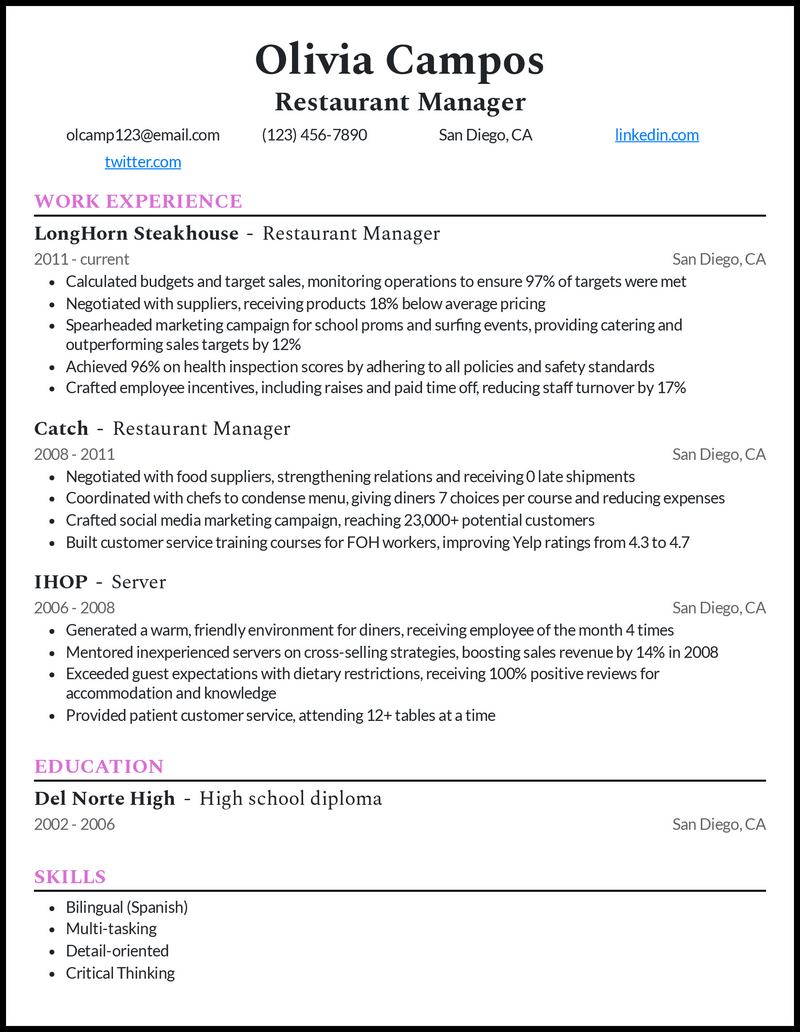
Why this resume works
- When you have years of experience, it’s important to demonstrate growth and increased responsibility over time.
- Formatting your resume in reverse-chronological style demonstrates this best with its natural progression of work history from most recent to oldest.
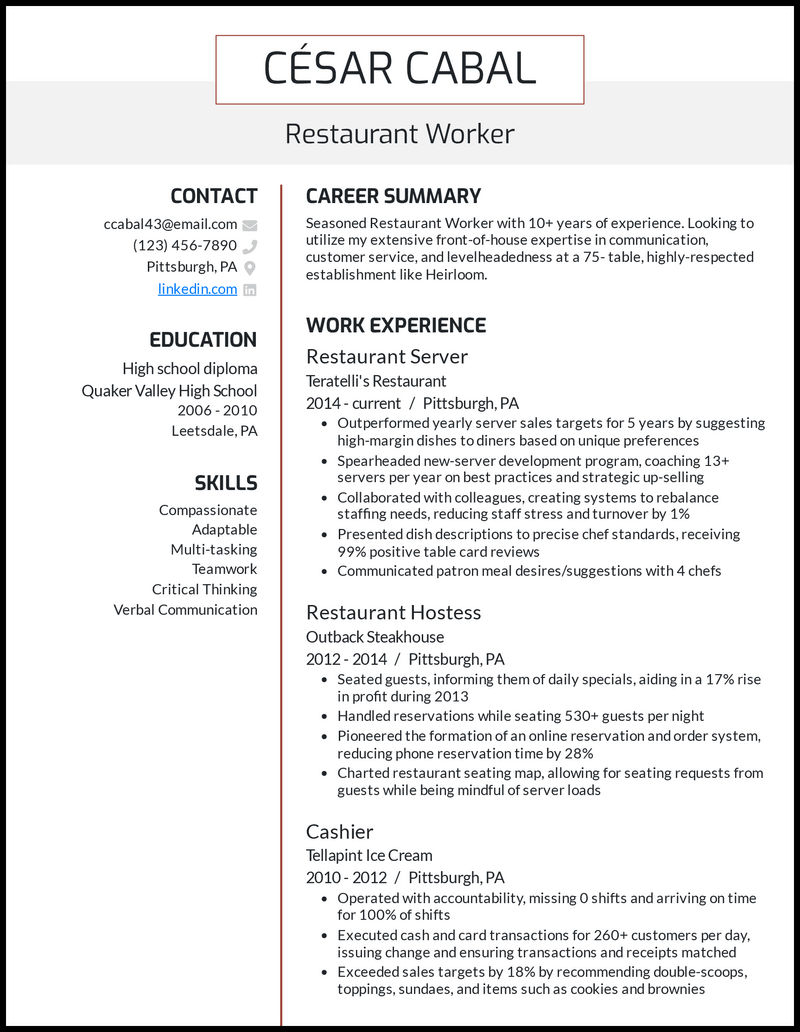
Why this resume works
- If you opt for a resume summary, it should be a concise two to three-sentence snapshot of any specializations you’ve acquired in your many years (10+ for a summary) in the field.
- Avoid vague statements, and customize it for each job to which you apply.
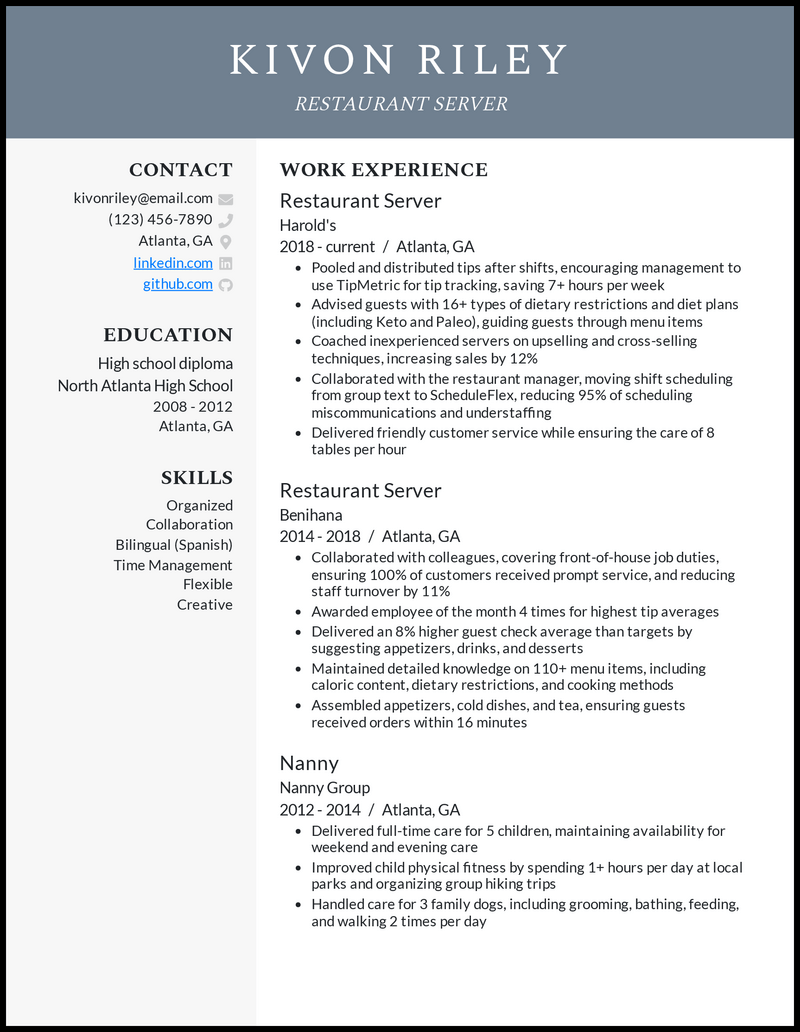
Why this resume works
- Your restaurant server resume should keep things short and to the point. If you have a lot of information to include, make sure you quantify your experience in numbers and break it up into concise bullet points. Bullet points should all be under 200 characters.
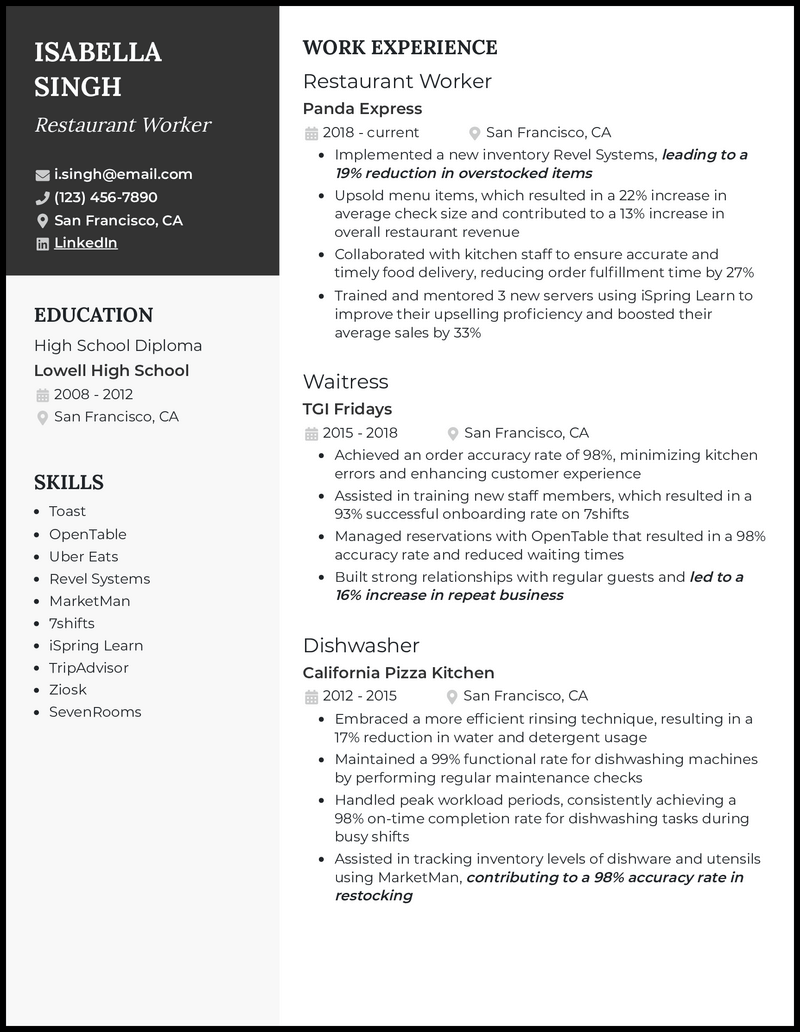
Why this resume works
- Nurturing customer relations is the best way to build a sustainable business. That’s why you notice how this restaurant worker resume emphasizes the role of building strong customer relationships.

Why this resume works
- Know what takes an average restaurant supervisor resume to the next level? One that can prove a candidate’s versatility across multiple restaurant operations.

Why this resume works
- Aim to have two to four work experience sections and three to six bullet points for each work experience on your fast food restaurant resume. With so little space, include metrics and active voice while avoiding unnecessary filler words.
- When working in an AI resume builder, write your work experience in a reverse-chronological style.
See more fast food restaurant resumes >
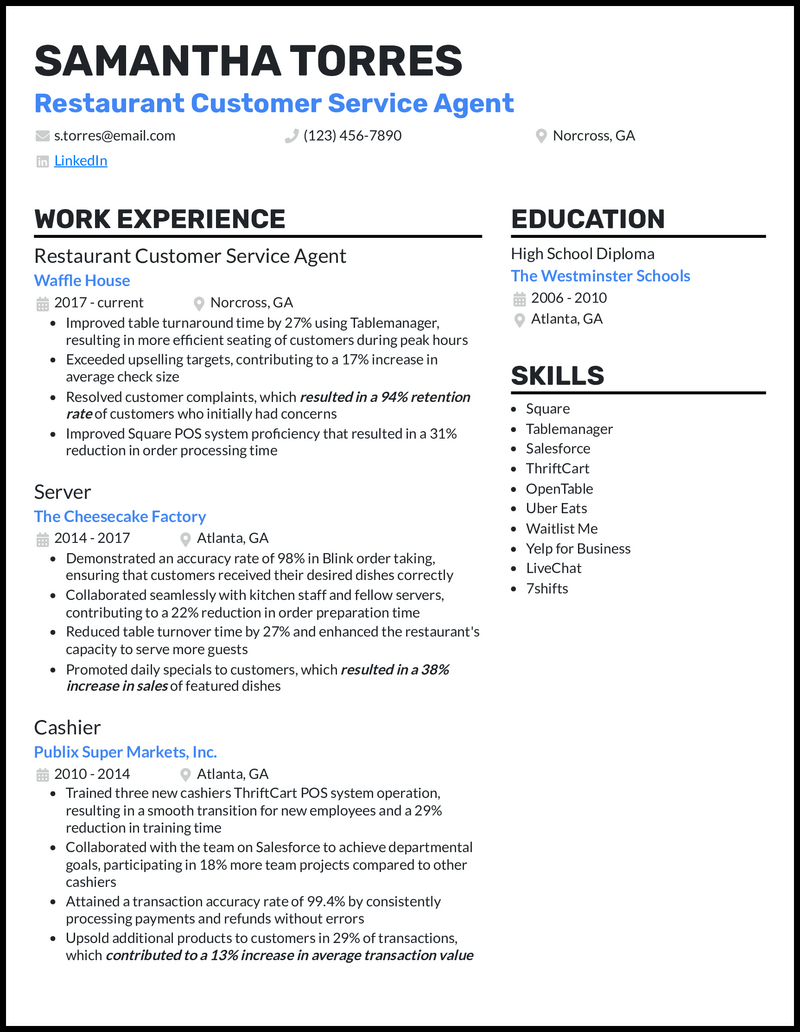
Why this resume works
- It’s not common to see a restaurant customer service resume that goes off the grain to highlight skills and experiences in other areas. But this one expertly merges customer service competencies with cash handling skills to make a solid case to recruiters.

Why this resume works
- Whether or not you’re an entry-level restaurant worker, you need to write your resume skills carefully.
- If you omit a skills section, your entry-level restaurant resume may pass through automated scanners and into the trash before a hiring manager ever sees it.
See more entry-level restaurant resumes >

Why this resume works
- A resume’s design can very well set good or bad impressions on potential employees. The last thing you need is restaurant managers not reading your achievements because they simply don’t like the appearance of your food service restaurant resume.
Related resume guides
How to Write a Restaurant Resume

Let your restaurant resume be clear and relevant, and mirror the experience your target employer is looking for.
Summary
Craft a restaurant resume that serves your strengths, sharpens your skills, and gets you hired—no fluff, just flavor.
From your past roles, select key responsibilities and achievements, relevant skills, and your team contribution, and ensure that customers’ needs always come first.
In this section, we’ll cover:
- How to format your resume for restaurant jobs
- What hiring managers look for in food service resumes
- The most important skills to highlight
- How to write an effective professional summary
- Tailoring your experience to fit the job description
- Using action verbs to describe your responsibilities
- When and where to list certifications (like food handling or alcohol service)
- Tips for standing out if you’re new to the industry

Use any experience that can demonstrate the right skills
Whether you’re looking for a restaurant management position, hoping to get your first job in the industry as a server, or somewhere in between, you won’t always have past job experience that seems directly applicable. The good news is that just about any project or seemingly irrelevant job can still demonstrate the skills and abilities you’ll need at the restaurant.
Listing retail experience can show positive customer service and sales skills. Working as a bank teller can speak to your expertise in handling money accurately. Talking about childcare can attest to creative thinking and problem-solving.

Unlock successes, not restaurant responsibilities
Discuss your success in the restaurant (or wherever you worked). The majority of job seekers are just going to regurgitate (isn’t that an awful word?) restaurant duties they performed day in and day out on the job. But what if you went beyond that? What if you took the time to show how you actually impacted the restaurant?
For example, did your strength as a collaborator help the restaurant manager reduce scheduling miscommunication? Did you earn higher tips than your coworkers because you consistently memorized dinner specials and took the time to personally recommend wine pairings to guests? Did you identify gaps in servers’ skills and revamp customer service training?
Remember, though, that you want to keep your bullet points to a sentence each, so if you have more to say, those details are best saved for your restaurant cover letter.

Write with action in mind
Lead your restaurant resume with active verbs, and be careful to write with an active voice through each bullet point. Active verbs like “collaborated,” “delivered,” “calculated,” “suggested,” “presented,” “exceeded,” and “operated” will help you tell your career story. And writing in an active voice means you get right to the point. You’ll know right off the bat which job description bullet point uses active voice and which one is passive:
- Pooled and distributed tips after shifts, encouraging management to use TipMetric for tracking, saving 7+ hours a week
- Tips were pooled and distributed after shifts and management was encouraged by me to use TipMetric for tracking, saving 7+ hours a week

Let numbers prove your points
Add dollars, percentages, and other units of measurement for serving up the best restaurant resume bullet points and writing a great cover letter. Did you:
- Impact the bottom line by upselling wines or cross-selling side dishes or desserts?
- Manage and encourage servers so that you decreased employee turnover rate?
- Consistently serve more tables or guests than your coworkers?

Writing a restaurant resume with no experience
Others like you landed jobs without experience because restaurants may care more about your attitude than your work background. Bring on your transferable skills from gigs, school projects, and volunteering. You’re about to get an interview invite, as long as you can show your impact and align your past work with the role.
A career objective would also be a good idea. Discuss your work ethic, communication and teamwork skills, reliability, and willingness to learn and give it all when it matters.

Emphasize hard skills
Show what you can do because HR managers want to know. Can operate the POS machine and clear customer queues in minutes? Serve a dozen tables without getting one order wrong? Prep a specialty for a long-time patron without missing any tiny detail? You’re a gold if you can do this; restaurants would be happy to have you.
Divide your skills types as below:
- Technical: Knife skills, drink mixology, espresso machine operation
- Systems: Micros, Toast, Aloha, OpenTable
- Food Safety: Safe food handling, FIFO rotation

Don’t forget soft skills
Care for the hard truth? Soft skills can do two things: get you hired or rejected. Can listen without interrupting a customer? Help colleagues even without them asking? Address complaints before they reach the manager? Keep calm even when you’re under pressure to get orders out? Those traits are exceptional; you should tell managers you have them.
Soft skills that restaurants care about:
- Excellent Communication
- Collaboration
- Time management
- Organization
- Attention to detail
- Problem-solving
- Adaptability

Include relevant training and certifications
A culinary degree isn’t a requirement, but if you have one, include it. Certifications and short hospitality and customer service courses can get you a job. They say that you’re a reliable professional with the foundational knowledge to do what’s right.
Certifications that can make a difference:
- ServSafe Food Handler or Manager
- Alcohol Server Permit, such as BASSET

Bonus sections: languages and awards
- Do you speak Spanish or French or know basic sign language? If you’re applying for a job in a touristy area, you can turn any of this into a strength. List the language and your level of fluency.
- Ever been the “Employee of the Month,” or feted for “Top Sales,” or “Best Attendance”? These recognitions can elevate your resume and have recruiters pick you over the competition.

Tailor your resume to specific job
A one-size-fits-all resume won’t cut it. For example, a bartender’s role in a high-end steakhouse differs from that of a fast-casual line cook. Examine the job posting to identify skills, tools, and the general work environment. Use these as keywords to get past online job-screening bots and have your day with a real-life hiring manager.

Key takeaways for your restaurant resume
No matter your experience level, whether you’re looking for your first job or have been in the restaurant industry for years, our industry-specific resume tips will ensure you serve up the best application to hiring managers:
- Emphasize results, not tasks
- Include hard and soft skills
- Use metrics to show speed, volume, accuracy, and guest satisfaction
- Boost credibility with certifications
- Customize your resume to each role
- Keep the layout clean, modern, and easy to scan
- Use active verbs
- Stick to one page as much as possible
Restaurant Resume FAQs

A restaurant resume is a concise, factual, and compelling account of who you are, what you can do, and why a potential employer would benefit if they hire you. It showcases your impact from results and skills used to get jobs done from previous and current roles. In brief, you say you’re qualified with run of success at similar roles.
Yes! Using a resume template ensures that you get the design right and start at an advantage over any other applicant who doesn’t. The pre-designed templates are ATS-friendly and approved by HR managers, boosting the chances of your application getting reviewed by a real employer.
Keenly reviewing the job description and understanding what it expects from a potential candidate. Pay attention to keywords, skills, tasks, and other phrases that hint at what the specific restaurant wants in the ideal candidate. Now align your resume to that by including abilities, results, and experiences that match the needs of the would-be employer.
Land your next job with our AI-powered, user-friendly tool.
Gut the guesswork in your job hunt. Upload your existing resume to check your score and make improvements. Build a resume with one of our eye-catching, recruiter-friendly templates.
• Work in real-time with immediate feedback and tips from our AI-powered experience.
• Leverage thousands of pre-written, job-specific bullet points.
• Edit your resume in-line like a Google Doc or let us walk you through each section at a time.
• Enjoy peace of mind with our money-back guarantee and 5-star customer support.

Stephen is the co-founder and CEO of BeamJobs. Frustrated with the challenges he'd faced in his own job search, he left the corporate world to start BeamJobs with his brother. Drawing on firsthand experience with hiring and getting hired as technical talent, he started BeamJobs in 2020 to help qualified job seekers land interviews with less stress. Since then, more than 4 million people have built their resumes and cover letters on BeamJobs. Stephen's insights have been featured in notable outlets, such as Fast Company, Business Insider, Yahoo Finance, MIT, and Zapier. Learn more about Stephen.