



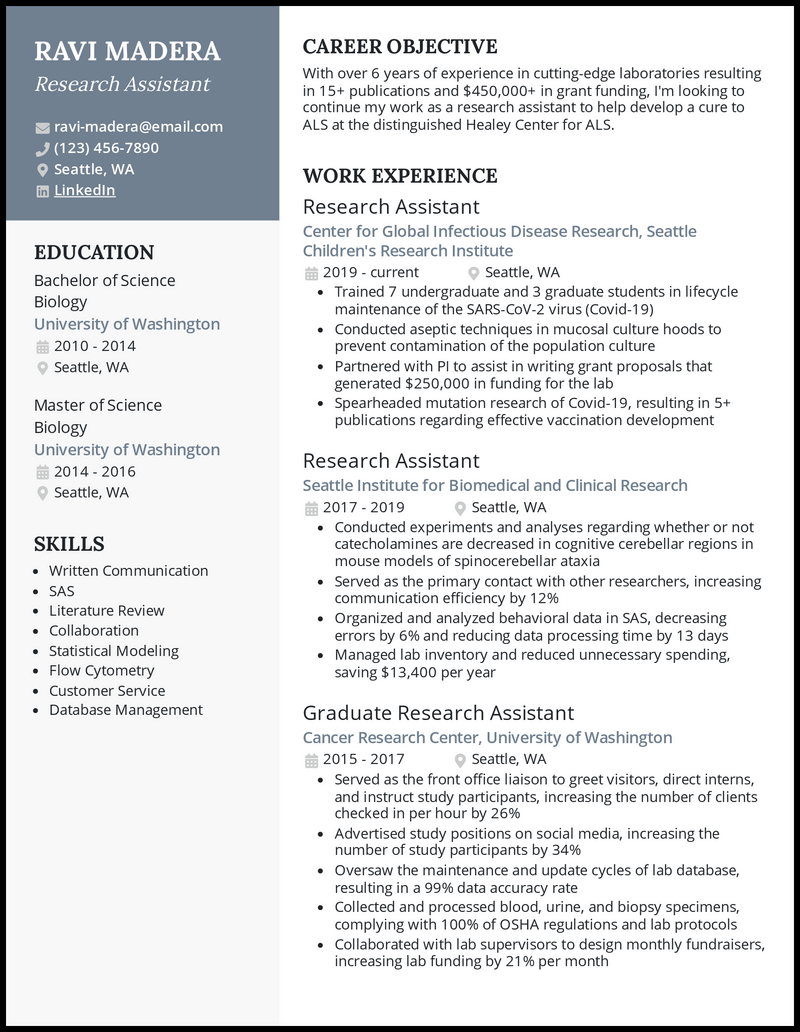


Research Assistant


Best for senior and mid-level candidates
Resume Builder
Like this template? Customize this resume and make it your own with the help of our Al-powered suggestions, accent colors, and modern fonts.
 Build my resume
 To write a strong research assistant CV, focus on presenting your academic background, research experience, and technical skills in a clear, organised format—our CV templates can help you get started.
Also, include relevant publications, laboratory work, and software proficiencies. When you’re ready, craft a standout CV and write a covering letter for a complete application.
In this section, you’ll learn:
- ↪ 13 genuine research assistant CV samples you can use for inspiration and structure
- ↪ How to organise your CV for clarity and academic relevance
- ↪ What skills and tools hiring managers seek in research assistant candidates
- Ways to highlight independent research, collaboration, and data analysis
- ↪ Common CV pitfalls specific to academic job seekers and how to avoid them
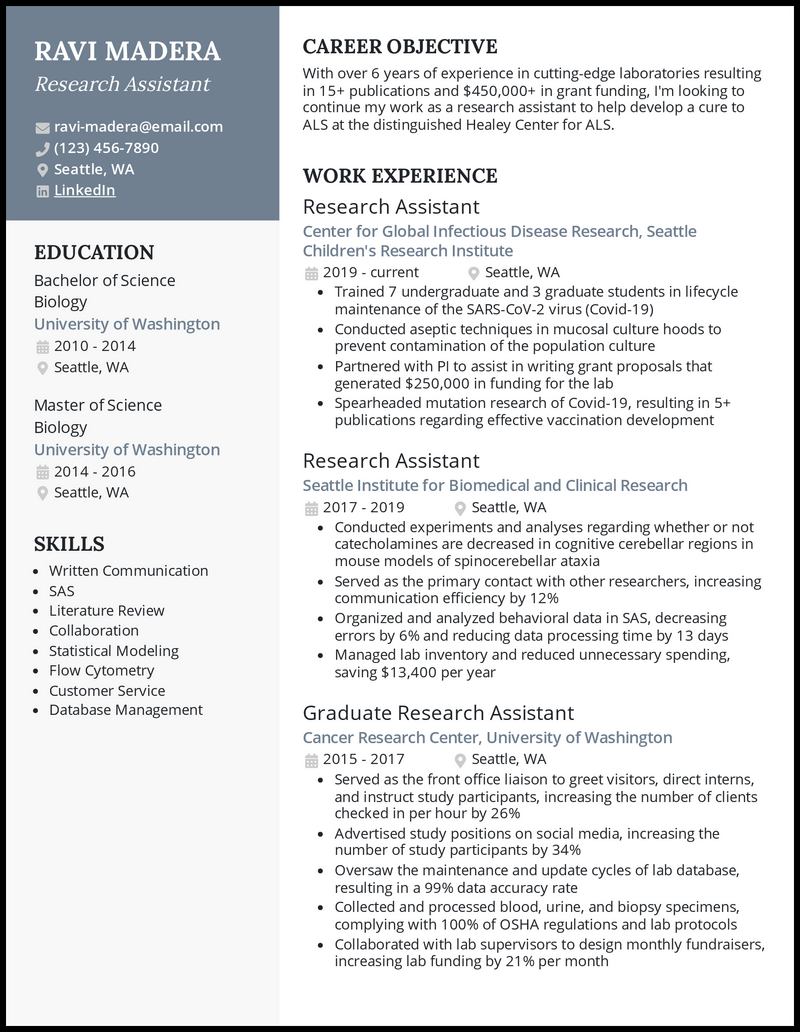
Why this CV works
- Although you’re likely applying for several positions, tailor your research assistant CV to each application. It’s tedious, we know, but it demonstrates your attention to detail and commitment.
- Ensure your CV includes keywords from the job description, especially in your skills section of the CV.

Why this CV works
- Regarding your undergraduate research CV, choose a template that allows you to add sections (such as projects) to compensate for a lack of experience while also filling the page.
See more undergraduate research CVs >
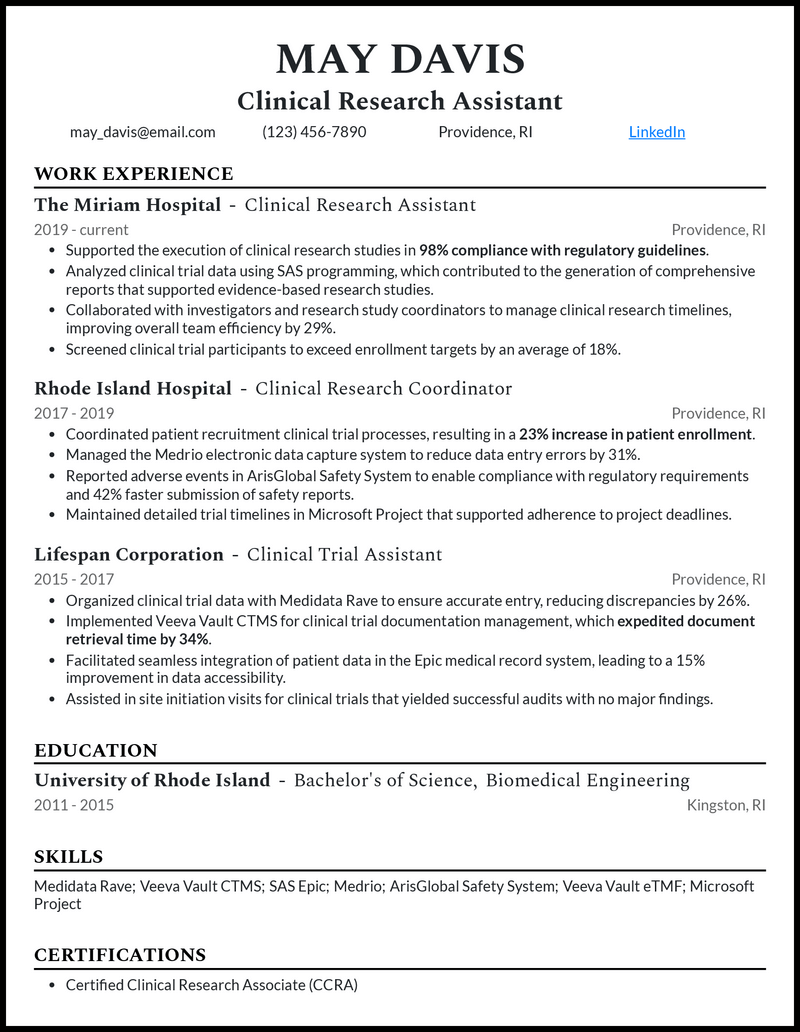
Why this CV works
- Clinical research studies are strictly regulated. Your ability to adhere to procedural processes can mean the difference between a lab’s work succeeding or losing funding.
- To make your clinical research assistant CV stand out, highlight your track record of adhering to guidelines in past trials.

Why this CV works
- Creating your biology research assistant CV the traditional way could take up hours. Here’s a brilliant shortcut: get yourself a top-notch CV builder, and voilà, you’re crafting a winning CV in a fraction of the time.
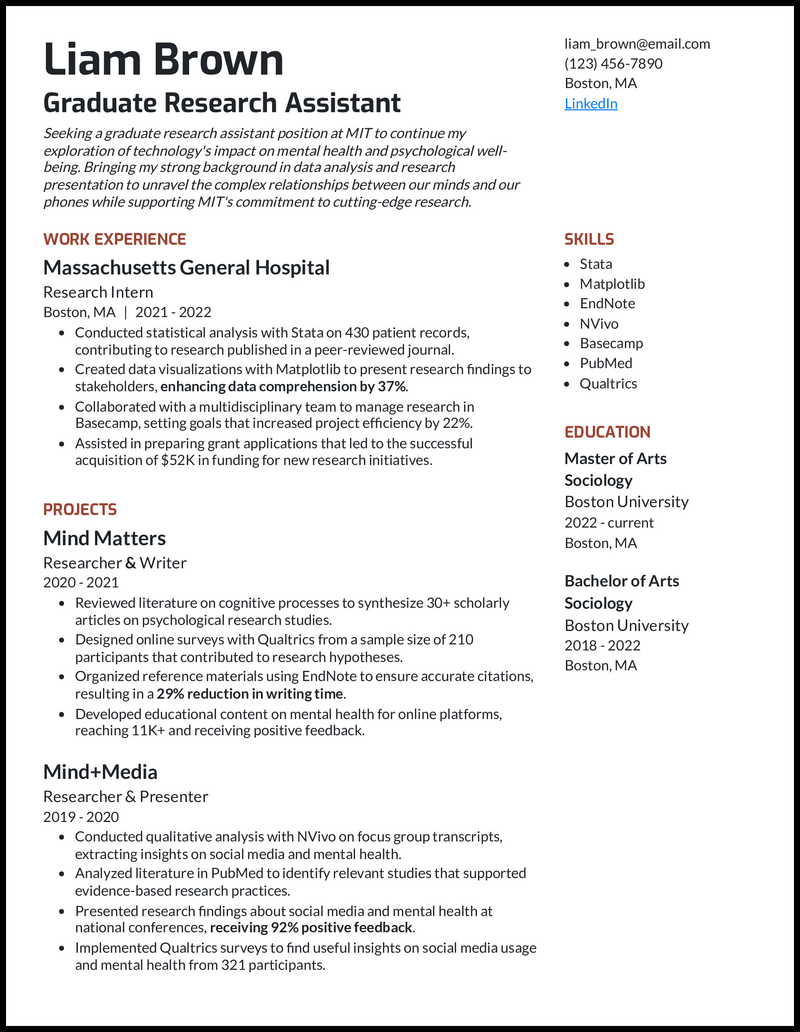
Why this CV works
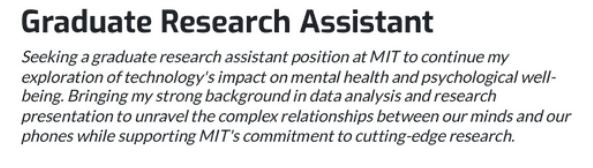
- A strong graduate research assistant CV should include a career objective that describes your area of interest. Tell prospective programmes how you’ll contribute to their legacy as a research institution through your work in the field.

Why this CV works
- You’ve heard the saying: Less is more, as they say. How about letting your work history section focus on your three most recent roles that align with the job you want? This way, your psychology research assistant CV won’t be a trip down memory lane but your ticket to that interview seat.

Why this CV works
- A relevant educational background? Check. An impressive skill set? Check. Years of experience? Check. We have no doubt you can be one of the front-runners for that open position. Ensure you don’t ruin your chances by overloading your sociology research assistant CV with jargon.

Why this CV works
- Get yourself on the “Could be an ideal fit” list by using action verbs to start your bullet points in your public health research assistant CV.
- You can be sure that will set you apart from the rest of the pile that didn’t bother.

Why this CV works
- The chances of your science research assistant CV getting more than 10 seconds of the recruiter’s time are pretty slim. Want to know how you can secure an hour-long interview before they move on to the next one? Opt for a straightforward structure.
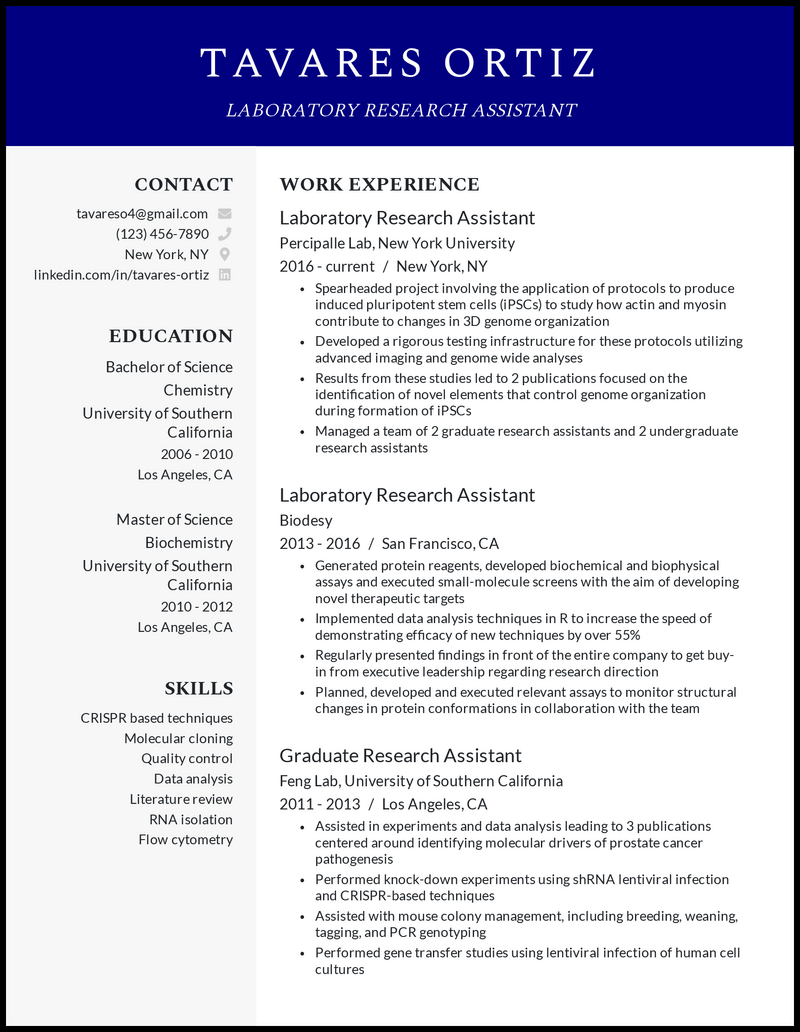
Why this CV works
- When it comes to your laboratory research assistant CV, numbers speak louder than words. Numbers quantify your claims and catch the eye of the person reviewing your CV.
See more laboratory research assistant CVs >

Why this CV works
- It will definitely take more than a run-of-the-mill student research assistant CV to impress the potential employer, especially with your limited experience. What should you do? Well, consider showcasing achievements from relevant projects.

Why this CV works
- If there’s space, try to include a CV objective in your entry-level research assistant CV.
- This section allows you to discuss an interest in a particular field (and in a specific research assistant role).
See more entry-level research assistant CVs >
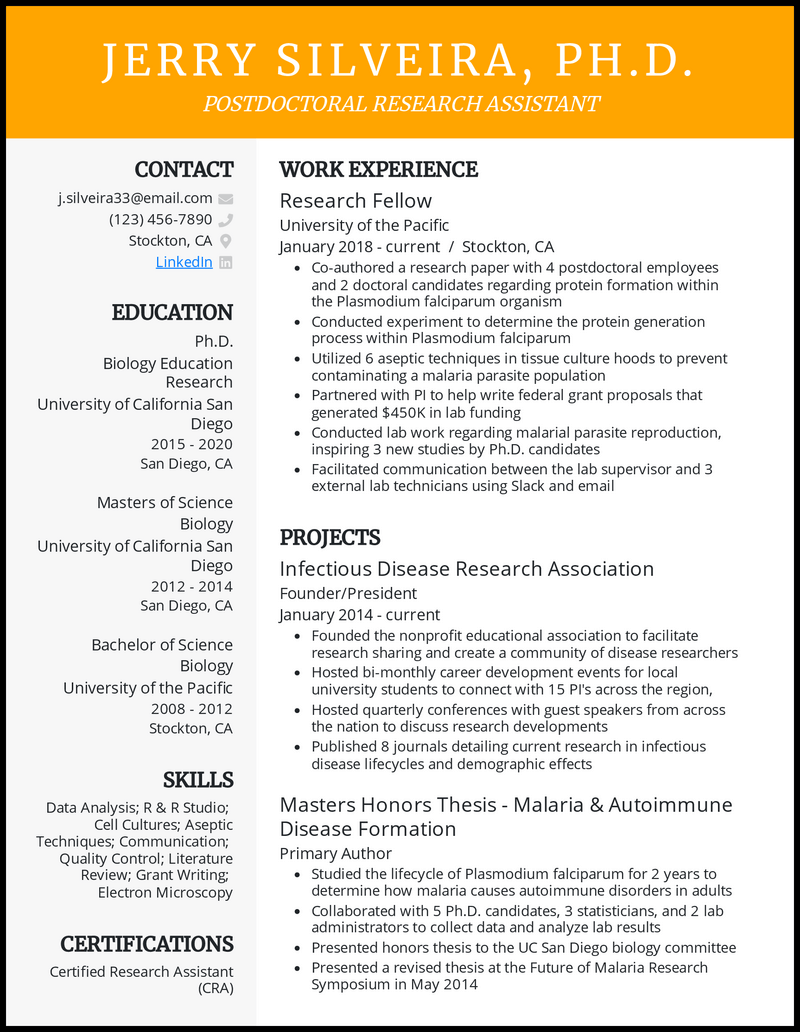
Why this CV works
- Although it takes up space, adding a CV summary is a great addition to your postdoctoral research assistant CV.
- This section highlights your expertise, years of experience in your field, and achievements. Just remember to tailor it for each application.
- Projects also make great examples to discuss in your research assistant cover letter.
How to Write a Research Assistant CV

You must write a research assistant CV showcasing your mastery of technical tools, intellectual prowess, and track record of being at the forefront of innovations and advancements.
Summary
Capture attention with a meticulously crafted research assistant CV that showcases your academic determination, analytical expertise, and results-oriented contributions.
You need a CV demonstrating your critical thinking, problem-solving, and standout contributions in the scientific field.
This section teaches you:
- How to format your CV for academic or research-focused roles
- Key sections every research assistant’s CV should include (education, research experience, skills, etc.)
- Tips for showcasing lab work, data analysis, and technical skills
- How to quantify research contributions and highlight collaboration
- Which keywords and phrases help pass applicant tracking systems (ATS)
- How to tailor your CV for different types of research positions
If you feel lost and could use a hand in figuring out where to start, these job-winning resume examples for 2026 can be eye-openers.
Ready to land that elusive research assistant role? Let us show you how.

What does a research assistant do?
You’re the perfect person to create a stellar CV. After all, impressing an employer or a lecturer is all about research, and that’s something you’re already great at! However, with a vast number of research roles available, you may find yourself staring at a blank CV with no idea where to start.
We know—start with the job description! The responsibilities listed there will help fill your CV with useful skills and experiences. Which of these best apply to your background?
- Collect, organise, and analyse data using surveys, interviews, experiments, and field observations
- Prepare materials and research cases for further analysis
- Conduct literature reviews, including organising results, writing summaries, and searching for sources
- Maintain clear and concise records, including confidential information
- Manipulate, clean, and visualise data, providing weekly and monthly reports to senior faculty members
- Participate in research meetings and present interim and final results

Create a lasting impression with an appropriate header
In digital life, you also need to shake hands with recruiters. What better way to make that powerful connection with a potential employer than with an accurate and precise CV header?
Include the following:
- First and surname
- The job’s exact title, such as Senior Research Assistant, Research Assistant, Junior Research Assistant, etc.
- Professional email address
- Your current phone number
- Location: Town and county
- LinkedIn, if applicable

Set the tone with a compelling summary of qualifications
Time is a precious asset for recruiters, especially when they must review hundreds of CVs and fill a vacancy within a limited timeframe. That means they can only dedicate a few seconds to your application before moving on to the next.
To ensure you make a strong impression, create a summary of qualifications and position it in the top third of your CV. Keep it concise, 2-3 sentences, and impactful by showcasing your strengths through skills, experience, achievements, and your value.
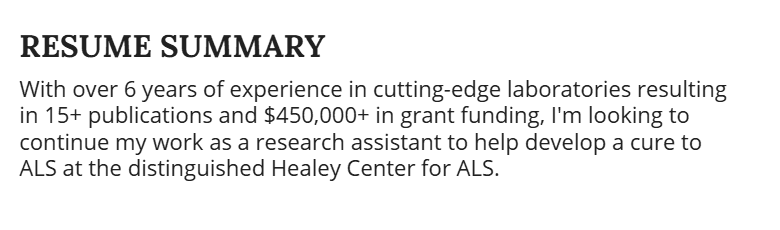
A CV summary is the way to go if you have experience and an impressive record of achievements. On the other hand, use a career objective if you’re a beginner or changing careers. It’s also important to generate a LinkedIn headline that matches your summary or objective to optimise online visibility.
Summary example:
Example of a career aim

Showcase your influential research work
This section is the core of your CV as it demonstrates what you can achieve. The best approach here is to highlight your impact using numbers, active verbs, and skills. Avoid the common mistake of simply listing your responsibilities; hiring managers will lose interest.
In every bullet point you create, ask and answer the following questions:
- What was the theme of the research project?
- What was your contribution?
- What skills/tools/methodologies did you employ?
- What were the results?
- Was the research cited, presented, or published?
If you answer those questions satisfactorily, potential employers will see you as the driving force behind discoveries that have a significant impact on their projects.

Showcase your technical expertise
To be in the driving seat of research comes with the demand for particular CV skills. You must know how to use tools, software, and methods. Most importantly, you must keep up with new trends to remain relevant in this ever-evolving field.
Review the job advert for repeated phrases, responsibilities, and keywords to understand what competencies the recruiters are looking for in the ideal candidate. Right there, you’re looking at the skills the job expects, and you must incorporate them into your CV.
You have no choice but to use those phrases because applicant tracking systems (ATS) will scan for them. If they don’t find them in your document, that’s the end of the line for your application. You didn’t work so hard to fail when it matters most, did you?


Incorporate your soft skills
Your data, coding, and understanding of technical tools may get you noticed by recruiters, but you can’t overlook the importance of soft skills in a research role. There will come a time when you have to manage a team, collaborate with others, train junior staff, write reports, present findings, and so on.
When that time comes, don’t just say you’re an excellent team leader or communicator; demonstrate it through action. For example:
- Simplifying data into straightforward briefs
- Preparing presentations
- Training trainees
- Collaborating with cross-functional teams
- Leading meetings

Boost confidence with action verbs
Don’t present yourself as a passive assistant; instead, be a proactive contributor to every project you work on. To do that, use active verbs at the start of every bullet point. You’ll add much-needed impact to your work experiences, which is one way to win the hearts of hiring managers.
This set of active words would make your research assistant’s CV stand out:
- Compiled
- Analysed
- Developed
- Led
- Collaborated
- Modelled
- Presented

Include education, qualifications, and publications
Even if you’ve proven to be a top research assistant, you can never disregard your education. It is the validation to show you have the foundational knowledge and discipline to adhere to professional codes. It also emphasises your dedication to the field and willingness to learn emerging trends.
Equally important are certifications and publications that demonstrate your passion, professionalism, and eagerness to stay up to date with everything related to your specialisation.
When listing your education, include the specific field of study, institution, location, and year of graduation. If relevant, provide the title, awarding body, and expiry date for any certification.

Utilise coursework and projects
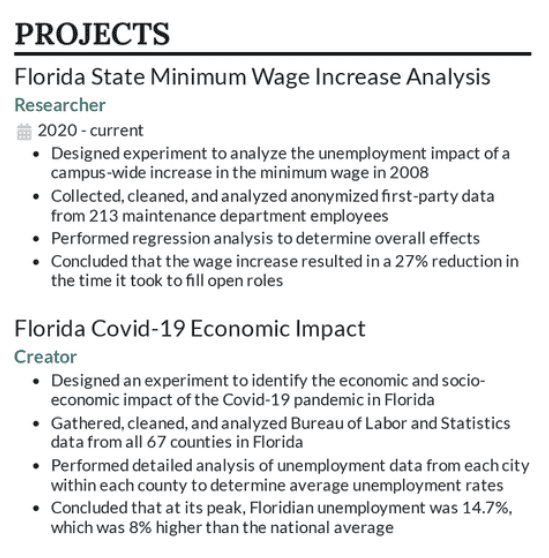
If you lack relevant work experience, you can turn to your coursework, projects, work placements, and volunteering activities. These have the potential to equip you with transferable skills that are useful for a research assistant role. Focus on activities related to research design, literature reviews, writing, or data analysis.

Tailor your CV to the specific job
Each job is different, and so should your CV. If you want to impress recruiters when they start reviewing your application, ensure your document reflects the requirements highlighted in the job advert.
To tailor your CV to the specific role:
- Use keywords from the job advert
- Align your work experience with the job’s responsibilities
- Include only relevant information
- Use an ATS-friendly, clean, and professional format
- Send your document in PDF format unless otherwise specified

Key points
Keep these tips in mind:
- Use a clean, professional layout
- Emphasise your technical expertise and tangible results
- Match the job by using the right keywords
- Demonstrate your initiative and ability to work as part of a team
- No waffle, say what you mean
Research Assistant CV FAQs

The perfect research assistant CV should include contact information, a summary of qualifications, relevant work experience, skills, projects, and any other information that demonstrates you’re suitable for the role. Using the correct format, you must present your strengths concisely and impactfully to impress recruiters.
A good job description for a research assistant must showcase measurable impact, use pertinent skills, and action verbs to highlight the impact. Moreover, use metrics wherever possible and include some of the keywords from the ad.
Example:
Analyzed behavioral data in SAS, cutting errors by 6% and reducing data processing time by 13 days
Yes. You can use an understated template since research assistants typically find jobs in academic or scientific settings. You’ll not be starting from scratch, which gives you a good head start to build a document optimized for the role and industry. You can pick one from this comprehensive collection of HR-approved resume templates to stay ahead of the competition.
If you have previous experience as a research assistant, include it on your CV. However, having direct experience in the role you’re applying for is not always possible. In that case, mention projects, placements, and coursework as long as they provide you with transferable skills that you can use in a real-world setting.

Stephen is the co-founder and CEO of BeamJobs. Frustrated with the challenges he'd faced in his own job search, he left the corporate world to start BeamJobs with his brother. Drawing on firsthand experience with hiring and getting hired as technical talent, he started BeamJobs in 2020 to help qualified job seekers land interviews with less stress. Since then, more than 4 million people have built their resumes and cover letters on BeamJobs. Stephen's insights have been featured in notable outlets, such as Fast Company, Business Insider, Yahoo Finance, MIT, and Zapier. Learn more about Stephen.