



Data entry professionals encompass all industries, wear multiple hats, and can provide specialized services. It can be difficult to determine what content is important to a hiring manager and understand what to include in your resume for this data-driven field.
We analyzed numerous data entry resume samples from all experience levels, industries, and scopes and learned what works to help you get more interviews in 2026. We created 21 resume templates to help data entry professionals like you build an AI resume and data entry cover letter to showcase your accomplishments.
The hardest part of writing your resume is getting started. These resumes helped data entry pros find outstanding jobs at top-notch companies, so they’re a great place to start!

Why this resume works
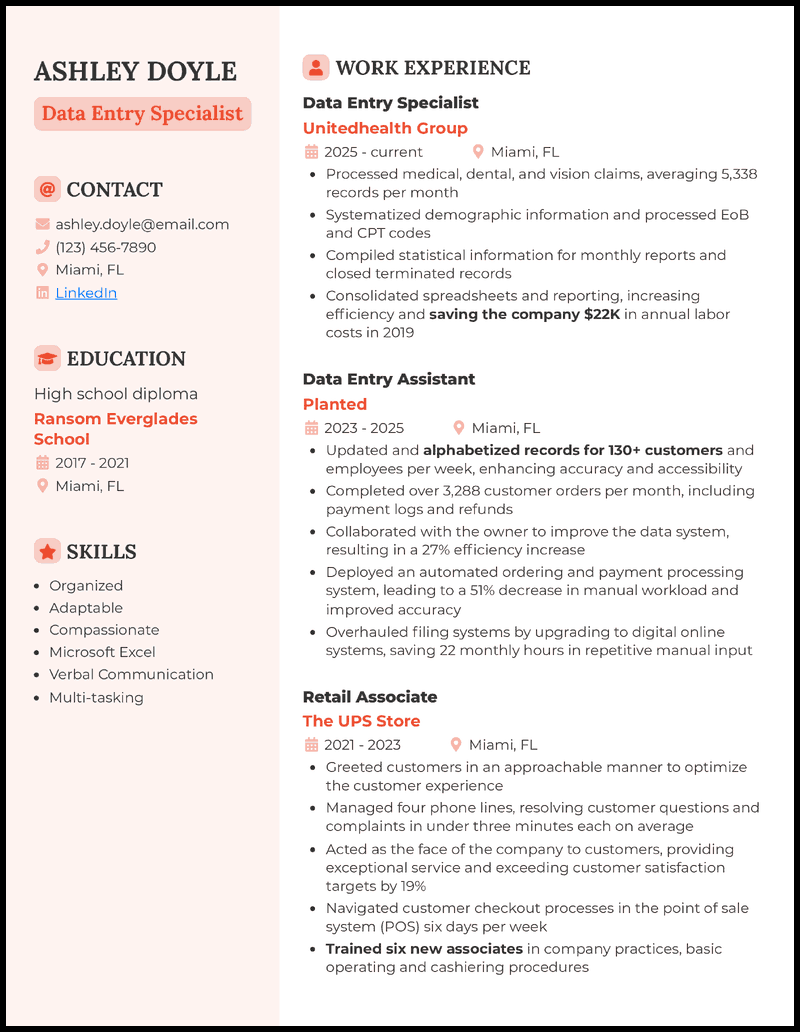
- Data entry professionals manage data. Therefore, your data entry resume should emphasize your accomplishments in terms of data. Be sure to focus on how your work improved data accuracy, process efficiency, and revenue growth.
Why this resume works
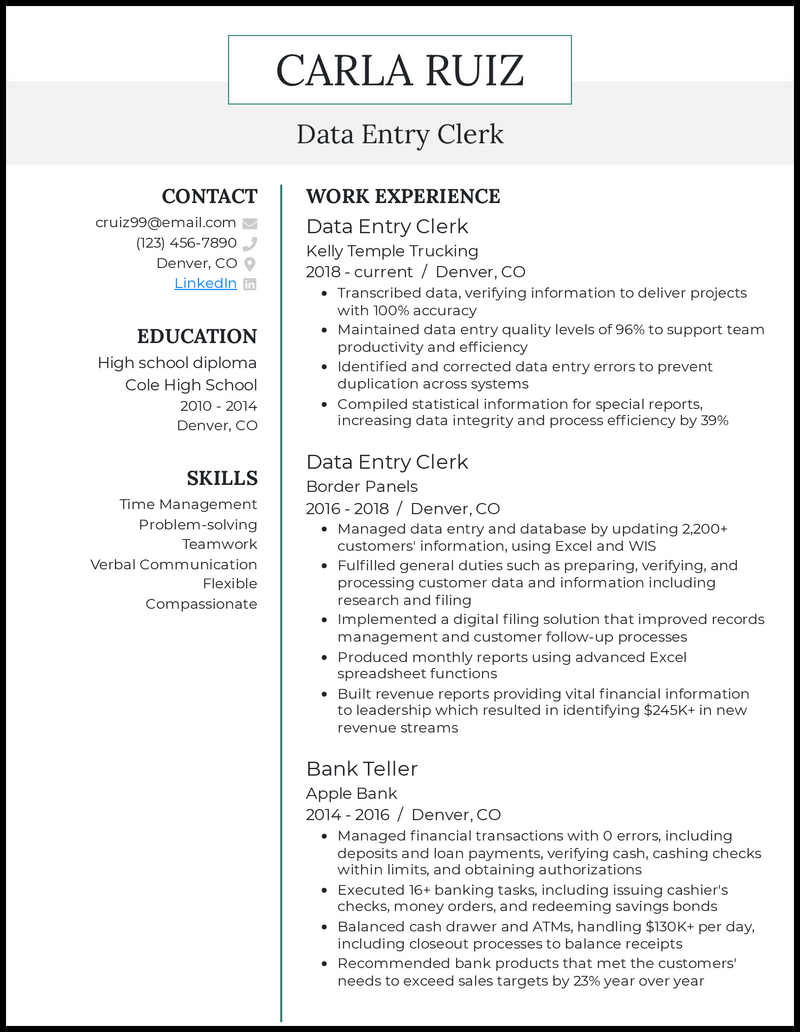
- As a data entry clerk professional, focus on any specialty areas or skills to list on your resume (for example, Excel, WIS, problem-solving, or time management) that you want the employer to notice about your experience, especially if the job description prefers candidates with your specific skill set.
View more data entry clerk resumes >
Why this resume works
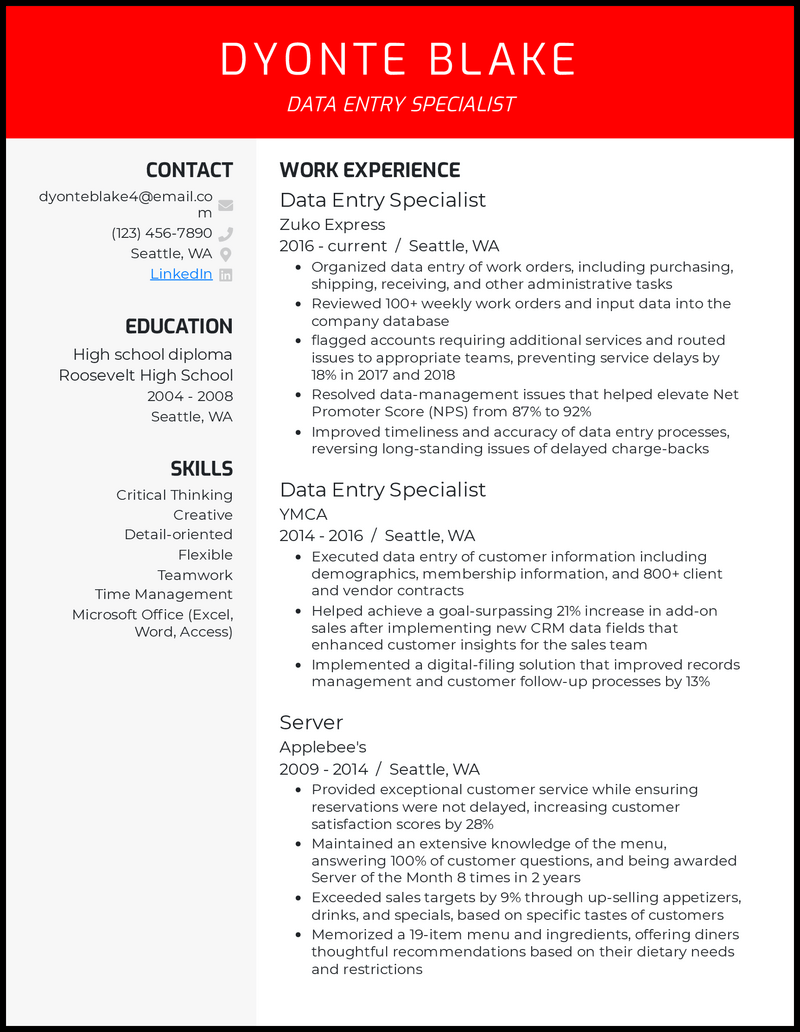
- A data entry specialist resume needs to highlight the scope and responsibilities of your previous roles and any industry-specific experience you have. For example, if you have data entry experience in a healthcare setting, you likely have worked with data that must remain private and confidential.
View more data entry specialist resumes >
Why this resume works
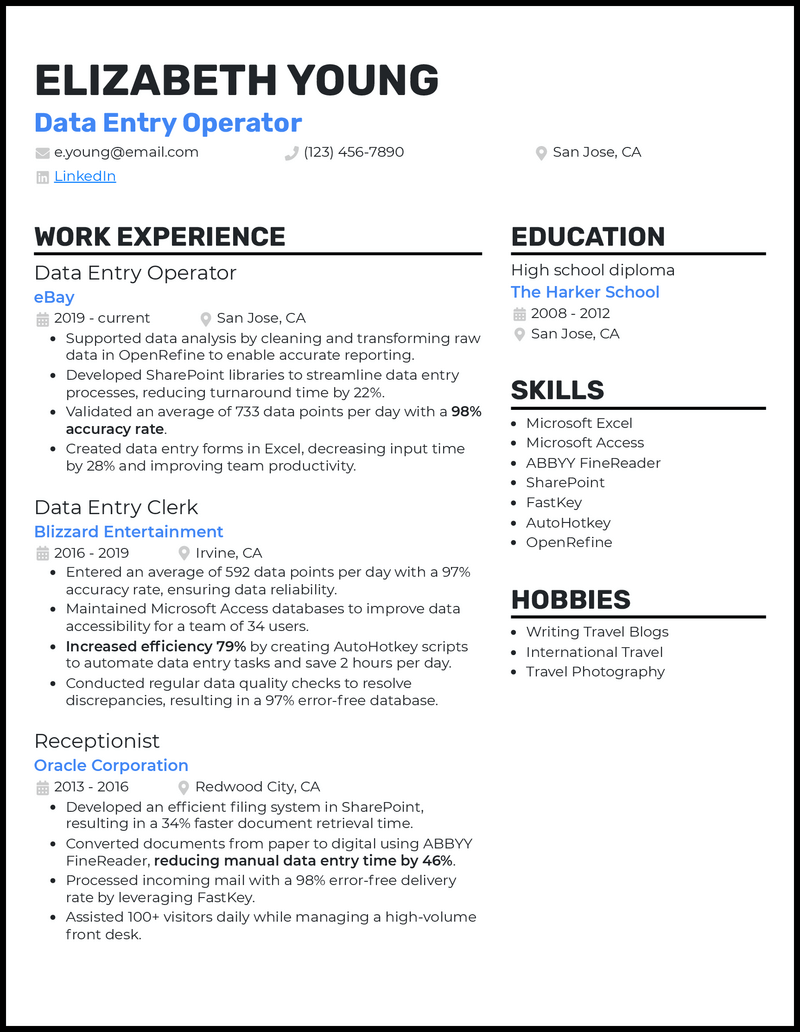
- Don’t underestimate the power of including personal hobbies on your data entry operator resume—especially those that may seem unrelated like travel photography, is one way to add depth to your profile.
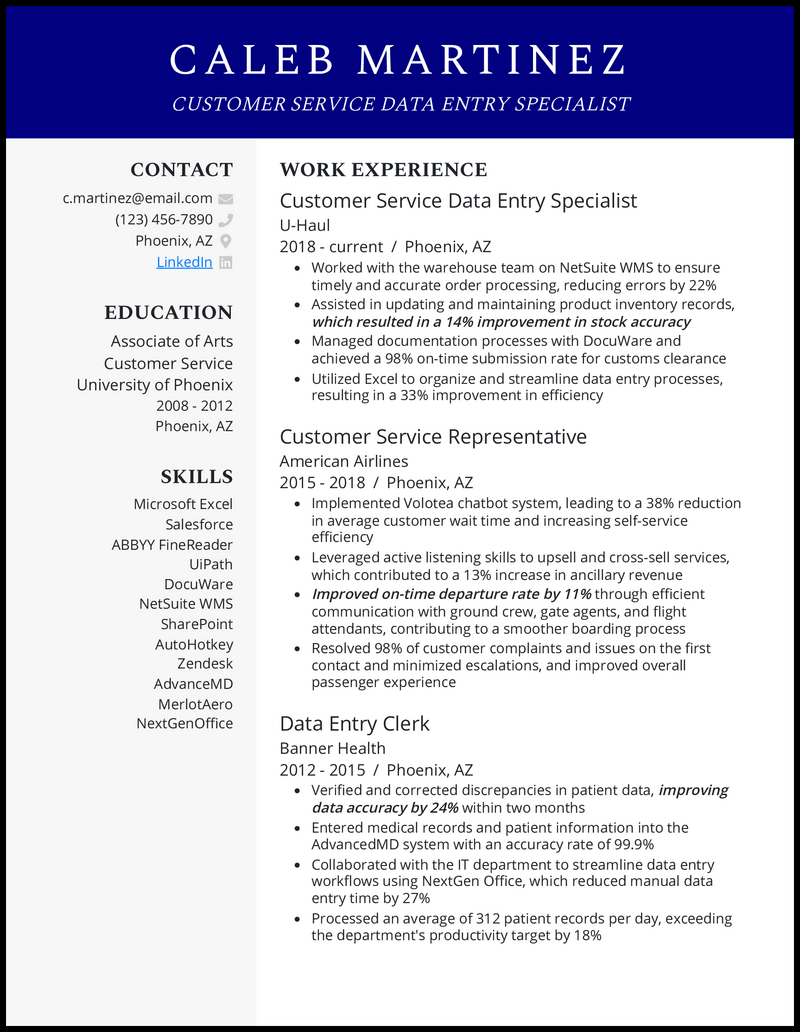
Why this resume works
- Take advantage of that achievement and highlight it in your customer service data entry resume to give potential employers a hint of what you’re bringing to the table of solutions. Then, drive home your expertise in dealing with the public by sharing real stories as you’re making a cover letter.

Why this resume works
- Even for a beginner-level field like this, add past roles that can increase your chances of being hired. Take Ethan’s typing resume as an example and see how he does a great job of mentioning his role in “reconciling inventory discrepancies” to show that he’s got an eye for detail and can take on the typing job easily.

Why this resume works
- A transcriptionist resume is incomplete if it can’t show the candidate’s proficiency using auditory tools. Don’t let your skills section catch dust. The right ChatGPT resume prompt can help you think of and add all the tools you’re well-versed with, such as Google Speech-to-Text, Express Scribe, and TranscribeMe.
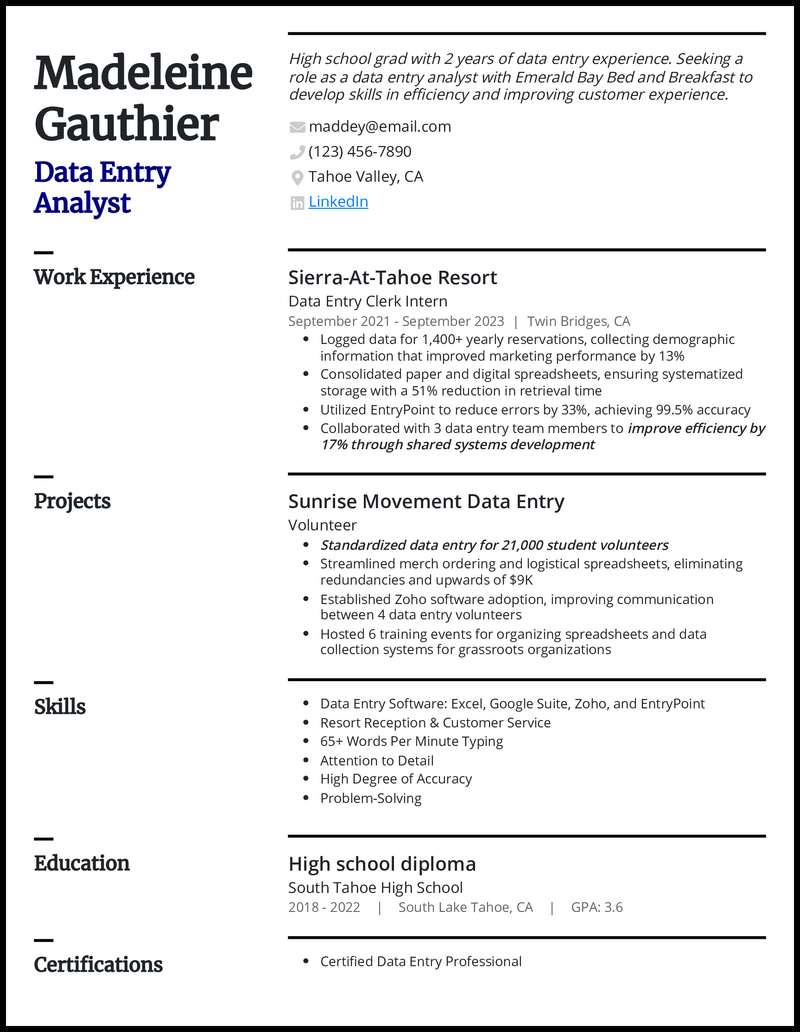
Why this resume works
- Have you glanced through resume examples and now wonder whether your data entry analyst resume would benefit from a resume objective? Add it if you’ve just started out in your career and don’t have much experience, or if you’re going through a significant career change.
View more data entry analyst resumes >

Why this resume works
- Your medical data entry career is quite something—you started at the bottom rung and have made notable strides. Such ambition and resilience, combined with a great resume format, could make a lasting impression, prompting the hiring manager to ping you.

Why this resume works
- Accentuating three or four phrases in your resume’s work history (maybe italics, bold, or underline) can draw attention to what makes you shine. However, overdoing it risks overwhelming your remote data entry resume, which certainly won’t work in your favor.
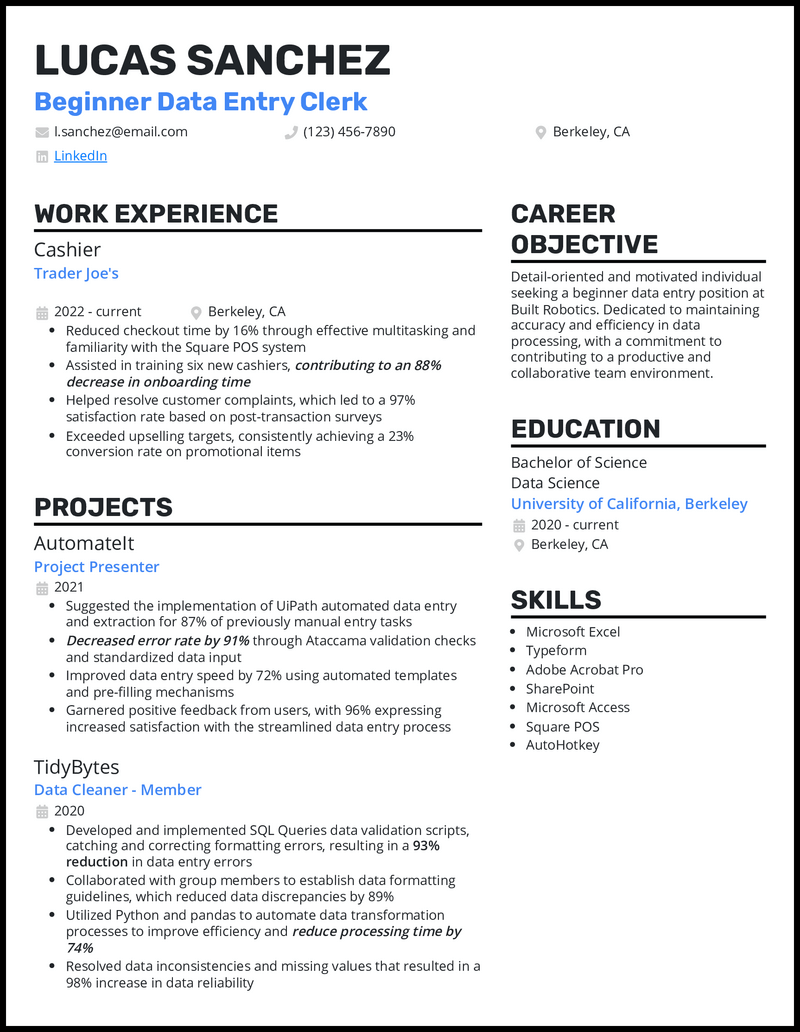
Why this resume works
- Let your beginner data entry resume tap from your experience and achievements in your coursework projects by emphasizing how they can be applied in real-world work.

Why this resume works
- A one-size-fits-all approach to a tax data entry resume will only get on the recruiter’s nerves. Instead, dig into that job posting, pick apart what the potential employer is looking for—and then write your resume to hit those marks.

Why this resume works
- If making a splash is #1 on your list, add a LinkedIn hyperlink to your office data entry clerk resume (in the header section). It invites the hiring manager to dig deeper into your professional life and could boost your chances. Bonus: Customize your application with our LinkedIn resume builder, leveraging your professional profile to build a compelling case for your candidacy.

Why this resume works
- Many recruiters can attest that nothing is as off-putting as a lengthy warehouse data entry resume packed with irrelevant details. All you need is a one page with an informative header, three most recent and relevant roles summarized in bullet lists and action-oriented language, and skills and education sections.

Why this resume works
- The first step to prove that you’re an organized data entry professional is using a sleek and clutter-free design. Show it in your data entry administrator resume by neatly fitting personal details, education, work experience, and skills, while still leaving room to breathe, keeping things easy for employers to navigate.

Why this resume works
- Present an online data entry clerk resume so good that the recruiter will select you from a list of hundreds. And the trick? Evidence of a successful stint in a similar role. For example, you implemented new data entry protocols using Microsoft Excel and reduced processing times by a whopping eight hours per month.

Why this resume works
- Your data entry associate resume should list skills like LibreOffice Calc, FreshBooks, or Basecamp to prove you can organize any type of data—finance, customer information, or even project-specific records. Don’t forget to write how you’ve used them to organize data and save the office from Excel-induced meltdowns.

Why this resume works
- When you’re a seasoned veteran in the industry, your data entry processor resume and resume summary should reflect that. Therefore, your CV is a better place to include more of your previous work, but generally, you should try to limit your resume to three to five work experience sections.
View more data entry processor resumes >

Why this resume works
- Already have relevant experience but want to take your accounting data entry resume up a notch? Show how your education and certifications make you a dynamic applicant. Listing your bookkeeping certification and four-year accounting degree paints a picture of a professional who possesses a deep understanding of both sides of the business.
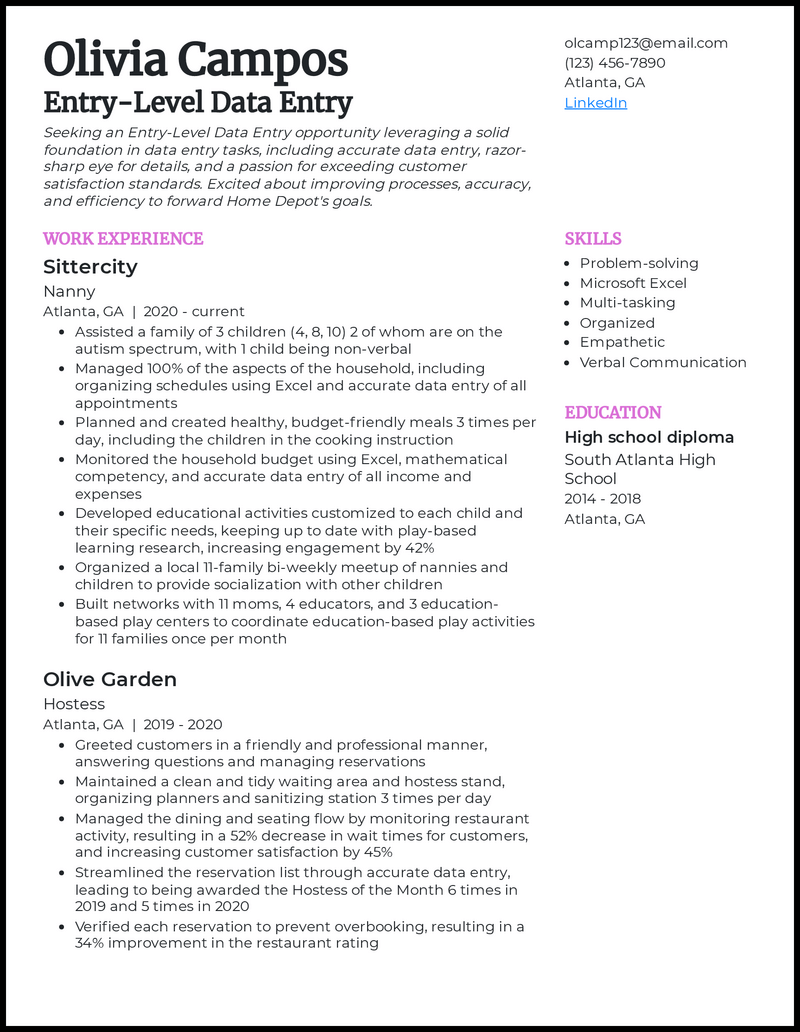
Why this resume works
- Your entry-level data entry resume should have a clear resume objective indicating foundational skills and experience in the data entry field, your goals, and how you’ll support the company.
View more entry-level data entry resumes >
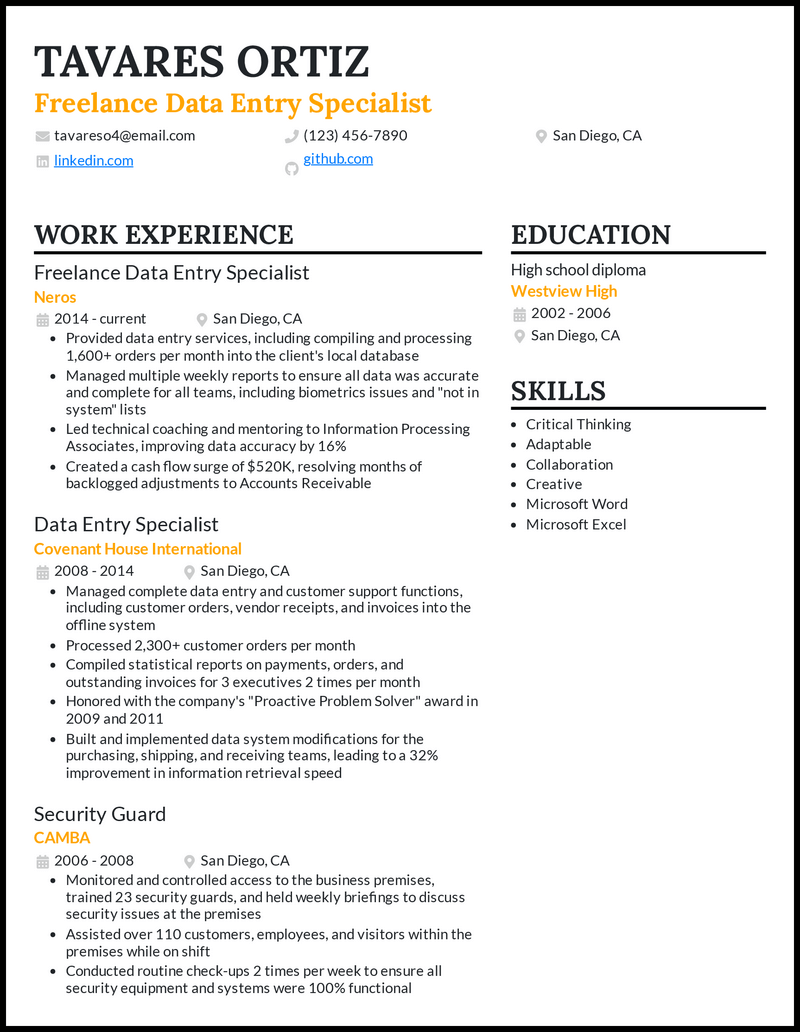
Why this resume works
- Package your metrics and well-written masterpiece in a stylish resume template; be sure to indicate the number of clients with whom you’ve worked. Metrics can serve to showcase your organization, leadership skills, and ability to manage multiple projects in freelance data entry resume.
Related resume guides
How to Write a Data Entry Resume

Speed and accuracy are the backbone of any great data entry resume—but what gets interviews in 2026 is how well you communicate your efficiency, focus, and tech skills on paper. To stand out, highlight your typing speed, relevant software proficiency (like Excel or database tools), and examples of error-free work under pressure. Before you apply, run your final draft through a resume checker to catch issues, use modern resume templates to format it professionally, and don’t forget to generate a cover letter that shows you’re not just fast—you’re reliable.
Here’s what this section will cover:
- How to format a data entry resume that passes ATS filters
- What skills, metrics, and tools hiring managers look for
- Tips for writing strong bullet points—even with limited experience

How to format your data entry resume right
As a typing professional, your precision in entering records must be unmatched, even if it takes extra coffee to pull out overtime hours. A cluttered layout will instantly raise red flags (or, in this case, red keys) even before an employer reads your resume.
To ensure your data entry resume reflects your attention to detail and keystroke accuracy skills from the get-go, follow the following tips:
- Personal details: Include your basic details and contact information. As someone who makes a living from typing, you should be able to write your details accurately.
- Reverse-chronological format: As the name says, you list your work experience in descending order, giving employers a quick view of your latest accomplishments and career growth.
- Length: No matter what, stick to a one-page resume, even if your fingers are itching to take on a resume typing challenge. Employers only spend seconds to review your resume, so why take the chance?
- Bullet points: Avoid explaining your work experience in paragraphs; those are for cover letters, not resumes. Use an average of 3–4 bullet points to describe each past job.

What is a good resume summary for a data entry job?
A good resume summary for a data entry job should be short, results-oriented, and focused on your accuracy, speed, tech skills, and reliability. Here are a few polished examples for different data entry experience levels:
Entry-level data entry resume summary (No experience):
Versatile, reliable, and tech-savvy professional with a knack for accuracy and efficiency, seeking an entry-level data entry role at Quantica. Proficient in Microsoft Excel and Google Workspace, with a typing speed of 70+ WPM.
General data entry resume summary (1–3 years experience):
Detail-oriented data entry professional with 2+ years of experience accurately entering, verifying, and maintaining large volumes of data. Skilled in Excel, Google Sheets, and proprietary database systems. Known for meeting tight data entry deadlines without errors.
Senior/specialized data entry resume summary:
Seasoned data entry specialist with a leadership track record in overseeing high-volume databases across companies in fintech and healthcare. Specialist in Salesforce, EHR systems, and Excel automation tools. Recognized for maintaining data integrity while improving processing speed by 31%.

How to include impactful work experience on your data entry resume
This section matters most since it’s the only way of demonstrating that your keyboard skills are worthy of making a business impact. So, make your big claims, but back them up with concrete numbers.
Hiring managers don’t just want to see that you’ve worked in data entry—they want proof that you’re accurate, efficient, and dependable. The best way to do this is by writing bullet points that focus on results and measurable outcomes, not just what you did.
How to make your experience stand out:
- Use a strong action verb to start each bullet. Examples: “Entered,” “Processed,” “Maintained,” or “Verified”
- Include numbers where possible to show speed and accuracy
- Mention the specific tools/software you used
- Show impact beyond helping, supporting, or assisting others
Examples of good work bullet: Before and after
❌ Weak:
- Entered customer data into spreadsheets
✅ Strong:
- Entered and verified 1,200+ customer records weekly using Excel, reducing processing time by 3 hours.
Here are a few examples of work experience bullet points done right:
- Entered and organized customer records with 97% accuracy in Salesforce CRM, enabling the sales team to look at customer data 4 minutes quicker on average.
- Mitigated manual errors by 36% using a double data validation system for invoices.
- Used Microsoft Access to build company databases, improving data retrieval speeds by 8 minutes.

What skills should be included in a data entry resume?
To stand out in a data entry role, your resume should showcase a combination of technical skills, typing speed, software proficiency, attention to detail, and reliability. Employers don’t simply want you for data entry; they also want to know that you can do it quickly, accurately, and with minimal supervision.
Besides, having the right skills isn’t only great for recruiters to notice, it also boosts your chances of passing applicant tracking systems (ATS), which scan resumes for specific keywords.
Technical & task-focused data entry skills
These are the practical, job-specific skills you use daily in your job. Whenever possible, pair these skills with measurable results or tools you’ve mastered.
Top hard skills for data entry resumes:
- Microsoft Excel
- Google Sheets / Google Workspace
- Salesforce, HubSpot
- SQL
- EHR/EMR for healthcare
Work ethic & personal strengths
Data entry jobs often require long periods of focused, independent work. Soft skills demonstrate that you can navigate this kind of work environment while remaining productive and accurate.
Top soft skills for data entry:
- Attention to detail
- Time tracking, planning, and management
- Confidentiality
- Self-driven
- Problem-solving
- Working under pressure
- Clear communication
How to match skills to the job description
Avoid the temptation of putting any skills you can think of on your resume. Study the job post, identify the keywords used, and mirror them. If they prefer someone who’s “proficient in Excel and fast typing,” make sure those exact phrases appear in your resume (as long as it’s true about you). This helps you pass through ATS filters and says to hiring managers, “I get what you’re looking for.”

How to include and use skills in a data entry resume
Listing your skills is one thing. However, proving that you can make an impact through them is what actually gets you hired. To make your data entry resume stand out, your skills should appear in three key places: the skills section, your work experience, and your resume summary.
Here’s how to do it right:
Create a targeted “Skills” section: Quick and easy to scan
Use a dedicated “Skills” section near the top or sidebar of your resume. This helps both hiring managers and ATS quickly recognize your qualifications.
Keep it concise, relevant, and tailored to the specific job posting. Incorporate the same terms that appear in the listing for better ATS matching and give recruiters the right signals.
Weave skills into your work experience bullets
Do more by showing how you’ve used the skills to get results. This makes your resume performance-driven, something employers value.
Weak example (too vague):
- Used Excel for data entry
Strong example (skill + result):
- Entered and validated 2.5K records weekly in Excel, using VLOOKUP and conditional formatting to catch and correct errors
Pro tip: Each bullet should demonstrate:
- The skill (e.g., Excel, CRM, data accuracy)
- The action you took
- The impact or result
Reinforce key skills in your summary
Your resume summary is your first and most formidable pitch. Use it to highlight your most valuable skills and match the job post early on.
Example:
“Detail-oriented data entry specialist with 4 years of experience managing high-volume records in Excel and Salesforce. Proven track record of maintaining perfect data accuracy and improving reporting speed by 31%.”

How to add education and certifications that matter for data entry roles
For data entry jobs, your education and certifications don’t need to be extensive—but they matter if they’re relevant and presented in a way that adds value. From your academic and professional recognitions, hiring managers can find proof that you’re detail-oriented, tech-savvy, and trained in tools that make data work smoother.
Stick to relevant education
You don’t need a degree to land a data entry role—but if you have one, mention it. If you don’t have one, your high school diploma, certificate, or vocational training is adequate.
Coursework:
Community College of Denver
2022
Denver, CO
Example
High School Diploma
Ransom Evergaldes
2020-2024
Miami, FL
Include certifications that say you’re job-ready
Certifications say that you’re tested and proven in accuracy, working under pressure, and delivering consistent results.
Data entry certifications to include:
- Microsoft Office Specialist (Excel, Word)
- Google Workspace Certification
- Typing Speed Certification (70+ WPM or 10,000+ KPH)
- Data Entry Clerk Certificate – Alison or similar platform

Key takeaways
- Use a one-page data entry resume and include your work experience in reverse chronological order.
- Avoid mentioning daily duties. Instead, quantify the impact of your work.
- Use a mix of soft, typing, and technical skills to stand out from the average applicant.
- Include any relevant education and certifications that prove your ability to use a keyboard like no one else.
- Tailor your resume to the job description. This includes your work experience, skills, and even hobbies (if you plan to add them).
Data Entry Resume FAQs

Focus on core data entry skills, such as typing speed and attention to detail. If software tools like Excel or Salesforce CRM are mentioned directly in the job description, include them in your skills section to present yourself as the ideal candidate.
A strong data entry objective can be: “Detail-oriented professional with a typing speed of 45 WPM, seeking an entry-level data entry role at Oracle. Proficient in Microsoft Excel and Word, with a strong commitment to accuracy and supporting administrative operations.”
Without formal experience, include projects, internships, or volunteer work where you handled data entry tasks. Highlight the tools you used (like CRM platforms or documentation software) and mention your accuracy rate or any measurable impact you made.
The best way to present your data entry experience is in a reverse-chronological format. This format places your most recent work experience and achievements at the top, giving employers a quick view of your current skills and capabilities.

Stephen is the co-founder and CEO of BeamJobs. Frustrated with the challenges he'd faced in his own job search, he left the corporate world to start BeamJobs with his brother. Drawing on firsthand experience with hiring and getting hired as technical talent, he started BeamJobs in 2020 to help qualified job seekers land interviews with less stress. Since then, more than 4 million people have built their resumes and cover letters on BeamJobs. Stephen's insights have been featured in notable outlets, such as Fast Company, Business Insider, Yahoo Finance, MIT, and Zapier. Learn more about Stephen.