





Programmer


Best for professionals eager to make a mark
Resume Builder
Like this template? Customize this resume and make it your own with the help of our Al-powered suggestions, accent colors, and modern fonts.
 Build my resume
 To build a programmer resume that lands you the job, let each section mirror the role, use a clean format, and spotlight skills that solve real-world problems.
You should include your top languages, relevant projects, certifications, and impact—using tools like resume templates, a free cover letter generator, or a solid make-a-resume tool to streamline the process.
In this section, we’ll cover:
- ↪ What hiring managers want to see on a modern programmer’s resume
- ↪ How to showcase technical projects without sounding robotic
- ↪ The best way to format your experience for easy scanning
- ↪ 13 programmer resume examples that landed real jobs in 2026 (front-end, back-end, full-stack, and more)
Why this resume works
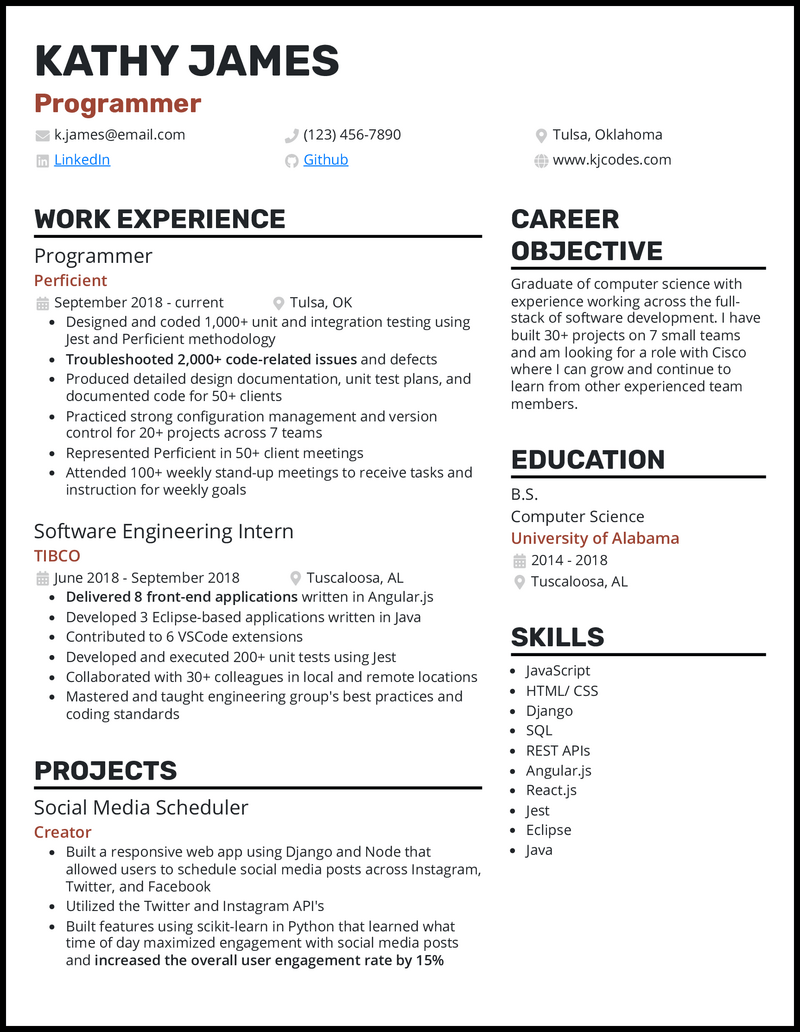
- As a programmer, you need to list your top technical skills in the resume skills section, but you also need to demonstrate those skills in the context of any jobs or personal projects on which you’ve worked.
- Check out our how-to-write-a-resume guide for expert resume-writing tips!

Why this resume works
- Developing new algorithms and features for a website/mobile app are key elements to add to a computer programmer resume.
- Therefore, if you’ve managed systems that have handled high volumes of traffic or data, make sure to add them too!
Why this resume works
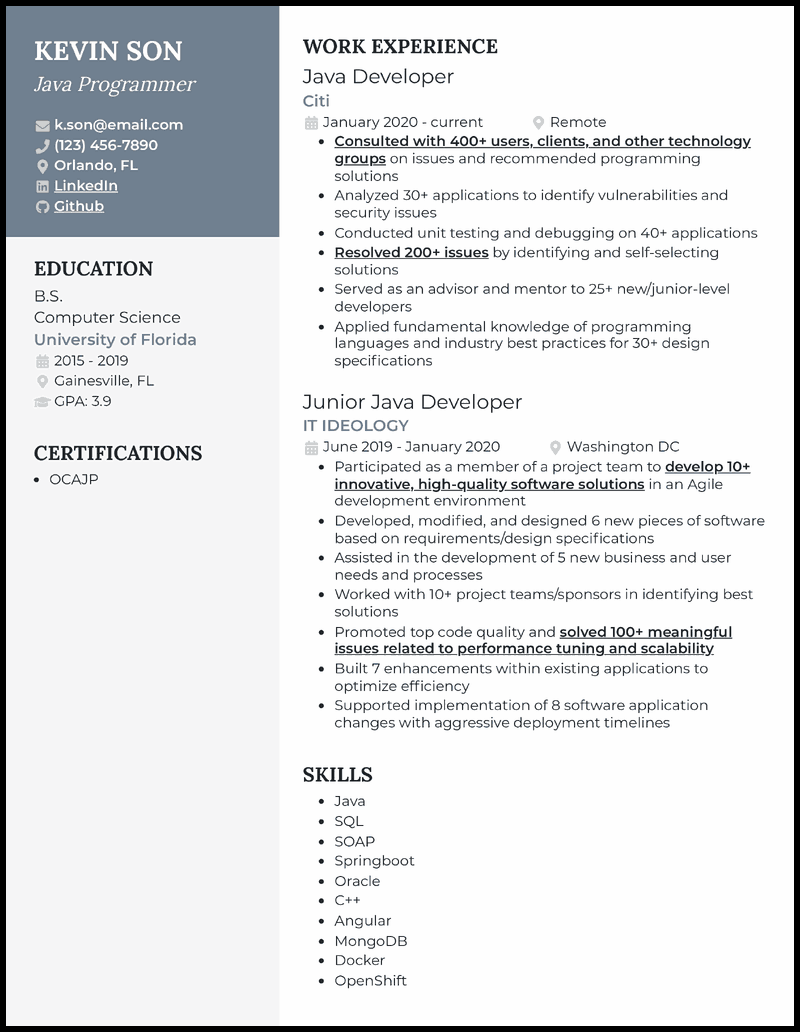
- Your Java programmer resume skills should not be a long list. Only include skills for which you’d be comfortable being interviewed.
- Be sure to mention all the frameworks you have experience with when applying for a specialized programming position like a Java or Python developer.

Why this resume works
- Enrich your CNC programmer resume with the mention of brands like Rolls Royce. However, working at an A-list company isn’t going to be enough. Highlight how you’ve maintained high product quality and customer satisfaction rates using automation software like Siemens NX CAM.

Why this resume works
- In such a highly competitive industry, you must add experiences that show you’ve directly contributed to improving the user experience in your programmer analyst resume.
- Also, mention in your resume and write in your programmer cover letter about any software developments you’ve led that have met a company’s goal and made profits.

Why this resume works
- A phrase like “Led seven programmers in cleaning and analyzing data for a $6 million clinical trial, leveraging STATA for logistic regression and multivariate analysis” in Isla’s statistical programmer resume, for instance, says they can contribute to the potential employer’s goals if hired.

Why this resume works
- If you really want to score an interview, you must show recruiters you’re worthy of a few minutes of their time, which brings us to the essence of accenting job-relevant tertiary education in your game programmer resume.

Why this resume works
- Your Python programmer resume can do a great job of demonstrating the context of how you’ve used Python (and Django) in your work projects.
- Only include a resume objective if you think it will stand out to the resume reader.
Why this resume works
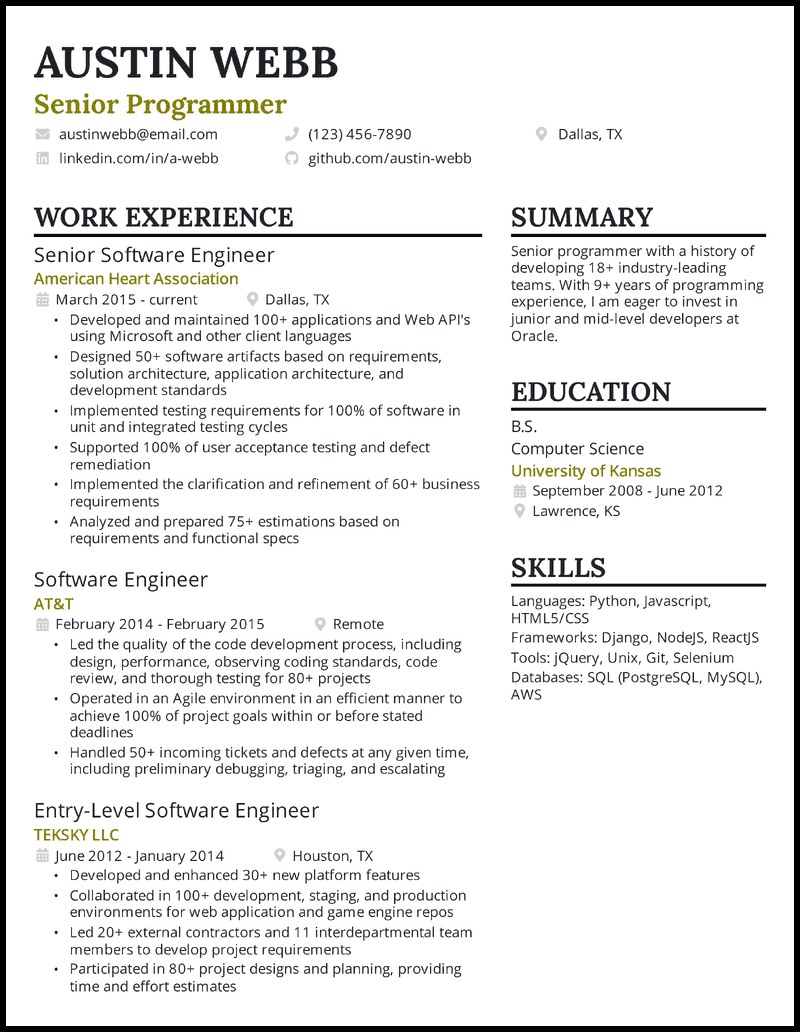
- Your senior programmer resume should demonstrate your growing responsibilities and value. Numbers are a quick way to make a convincing case that you’ve had a meaningful impact in your past roles. If you need help with these details, take advantage of a free AI resume checker!

Why this resume works
- Don’t send in your junior programmer resume without showcasing your technical expertise.
- Curating a list of the industry-relevant software (we’re talking Visual Studio, Eclipse, and GitHub) is good. However, show how you leveraged them to meet (or exceeded) your employer’s expectations in your work history.

Why this resume works
- We do not doubt you’re among the best self-taught programmers in town. You can clue in the hiring manager (who’s still out of the loop) on that by putting your relevant soft skills in the limelight in your self-taught programmer resume.

Why this resume works
- Play to your strengths on your entry-level programmer resume. If that’s your education, that’s okay. Just expand on that section.
- Talk about meaningful projects you’ve worked on, whether for a class assignment or on your own. Projects demonstrate interest and the ability to start a project from nothing.
See more entry-level programmer resumes >

Why this resume works
- Can ChatGPT write a resume and help you with discrete sections like an objective? Combined with the right prompts and Ava’s example for creating a stellar career objective in your SAAS programmer resume, it’s more than possible.
- Start by adding how you’re ready to apply your previous work experiences to this job to succeed. Then, link it to your commitment to helping the company keep growing.
Related resume guides
How to Write a Programmer Resume

To write a programmer’s resume that gets noticed; keep it clean, focused, and tailored to the job you’re applying for.
Summary
Command attention and land interviews with a programmer resume that proves you don’t just code—you solve real problems.
Include your best projects, the programming languages you use confidently, certifications (if any), and real results that show what you’ve built or improved.
In this article, we’ll take a look at four ways to perfect your programmer resume:
- Including the right programming skills
- Formatting your programmer resume
- Leveraging your metrics to best quantify your impact
- Adapting your resume to each job

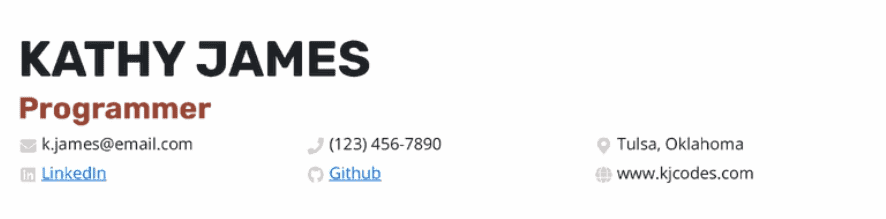
Open with the job title and contact information
Before recruiters review your code or resume, they’ll start with the header. Therefore, your contact info section isn’t filler but a much-needed digital handshake.
In this section, include:
- First and last name at the top and in bold
- The same title from the job description, such as “Full-Stack Developer,” “Software Engineer,” or “Mobile App Developer”.
- Professional email without nicknames or aliases
- Personal phone
- City & state
- LinkedIn, if it aligns with your resume.
- GitHub is where you share your code as your best asset.
- Portfolio site (if available)

Choose your programmer skills wisely
The skills section on your programmer resume helps recruiters and hiring managers determine whether you could be a good match for the job vacancy. However, not including the right ones could pull you out of the game before your application is even viewed by a human, especially for more competitive roles.
Most companies use automated applicant tracking systems (ATS) that rely on algorithms to scan resumes for certain keywords, such as required skills. Without the right type (or amount) of skills, the ATS will reject your resume. However, use those keywords wisely to pass these bots and have your resume land on the desk of real-life recruiter.
To ensure that doesn’t happen, use bulleted keywords in your skills section to highlight your hard skills, so the ATS will move you on to the next round. Make sure only to include skills you’d be comfortable being interviewed about, and try to have no more than 10.
To beat the ATS consistently, you need to customize your resume for all the jobs for which you apply—based on the job description. By carefully reading the programmer vacancy, you can make sure to include the skills employers want to see while best highlighting your capabilities and knowledge.
Let’s look at a fictional example of a job vacancy excerpt, so we can look at some possible skills to include on your programmer resume.
The senior Python developer will develop back-end components and write scalable code. Must have experience in cloud technologies and implementing Agile methodologies. They will also improve existing systems’ functionality and regularly test and debug programs. Should have a deep knowledge of Python and relevant frameworks and at least one other back-end language and database management skills.
For a programmer job description like the above example, you could include the following skills:
- Python
- Django
- AIOHTTP
- Falcon
- React.js
- R
- JavaScript
- AWS
- SQL
- Git
Since this is a specialized programmer role, it’s important to include several Python-related skills, such as the language and relevant frameworks. The vacancy also emphasizes skills in another back-end language, so it makes sense to have JavaScript and React.js. You should also include at least one cloud technology (in this case, AWS) and then one or two relevant tools to provide a well-rounded overview of your expertise in other skills, like database or coding management.
Even though you should customize your programmer skills section to each job description, some skills will pop up in most vacancies, which means you should probably include at least some of them on your resume.
While not an exhaustive list, some of the top in-demand skills include:
- Python (Django)
- Ruby (Ruby on Rails)
- HTML
- CSS
- SQL (MySQL, NoSQL, etc.)
- Cloud technologies (AWS, Azure, etc.)
- Git
- PHP
Notice the specific job title listed beneath the applicant’s name in a simple, classic font.


Deciding whether you need a resume objective or summary
One last point: what’s the difference between an objective and a summary? While they’re both about two or three sentences long and go at the top of your resume beneath your contact info, there are some important differences.
Objectives explain why your interests and experience are a good match for the vacancy you applied to, while summaries provide a high-level recap of your work history and accomplishments. You could use an objective if you’re transitioning into programming from another field or if you’re applying for an entry-level position. Meanwhile, a summary is great if you’ve got years of knowledge and niche expertise.
That said, you should only include either if it’s a strong, customized summary or objective that truly adds value. Recruiters spend just a few seconds reading your resume, and if it’s just fluff, it’s best to skip the statement.
Example
Experienced programmer with knowledge of several programming languages, frameworks, and database management tools. Strong affinity for creating and troubleshooting applications.
This summary, while it uses nice vocab words like ‘affinity,’ is very generic and says nothing that a recruiter wouldn’t already expect from a programmer.
Instead, try:
Seasoned programmer with 12+ years of experience, having developed and maintained 150+ applications and 110+ software artifacts in 4 different languages. Have managed 13 junior programmers and am passionate about mentoring early-stage programmers.
With this summary and the example below, you provide a quick overview of your biggest achievements and a snapshot of your work history—all with quantifiable facts to keep recruiters invested in your resume.

Returning to the objective, don’t write something like this: Seeking a Python programmer role to deepen my expertise in Python, Django, and other frameworks. Passionate about code maintenance and development.
Again, this objective adds no new information; this is all something a recruiter would quickly glean from the rest of your resume.
Compared with:
Experienced freelance programmer with 4+ years of experience in Python, Django, and other frameworks supplemented by 6+ years of data analysis skills. Looking to transition into a Python programmer to design scalable, user-friendly solutions at Deloitte.
This objective and the example below clearly show how your experience can transfer into the specific role you’re applying for while quickly stating your expectations, thus, adding value, not fluff.


Leverage metrics in your programmer resume
The best way to concretely showcase your accomplishments on your CV is by leveraging metrics to quantify your impact. Including hard data and statistics will help you avoid a generic and vague resume while also helping your achievements stand out to your potential employer.
Not sure what metrics you should quantify? Consider:
- Solutions: Give a concrete number of applications, projects, features, etc., you’ve developed, worked on, or maintained.
- Revenue: If your solutions increased a company’s revenue, include it.
- Management and collaboration: If you ever managed a team or worked with other stakeholders and departments, quantify it.
- Other activities: From estimations, tickets, project designs, or code reviews, include a number (or an honest estimate if you’re not exactly sure).
Let’s look at one job description bullet point you could write for each of the above based on the resumes on this page.
- Solutions: Developed and maintained 100+ applications using Microsoft, Ruby on Rails, and CSS.
- Revenue: Crafted 4 new tools to assist in big data analysis, increasing revenue by 10%.
- Management and collaboration: Collaborated with 20+ business users and the core technology team on system designs, reducing total development time by 15%.
- Other: Participated in 80+ project designs and planning and proposed 12 solutions to potential bottlenecks and product roadblocks.
If you take the time to quantify your programming accomplishments, you’ll be well on your way to getting shortlisted for that interview.

Action verbs for a programmer’s resume
When recruiters review your resume, they’re on autopilot. You must stir them to pay particular attention. How? Use action words that complement a programmer’s job. Examples included
- Debugged
- Build
- Launched
- Streamlined
- Debugged
- Integrated
- Launched

List education and certifications
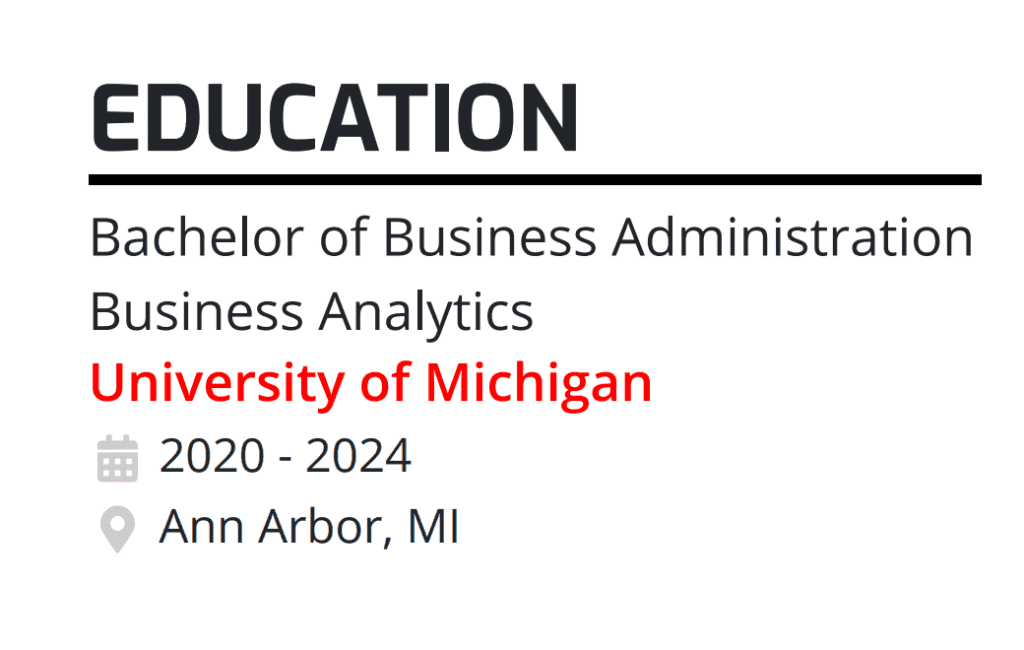
A degree isn’t a must to go past the door as a programmer, but it may be what you need to stand out. Give the title, institution’s name, graduation year, location, and relevant course (for a recent graduate).
Example of education section:
When it is tough competition for the open position; a relevant certification can get you to the top of the pile. Did you learn the programming ropes by yourself? Or are you coming from a different professional background? If you have any or more of these certifications, list them:
- Google Associate Cloud Engineer
- Oracle Java Certification
- Certified Kubernetes Application Developer (CKAD)

Optional sections
Everything you’ve done to become a programmer will not fit under the experience section. Still, you may want to include it extra sections to highlight your unique abilities:
- Projects in open-source communities, contributions to apps, and automating scripts show your initiative and outstanding skills, especially without direct work experience.
- Awards and recognitions from a bootcamp or hackathon add to your credibility and should be on your resume.
- Won a hackathon? Got featured on Product Hunt? Accepted into a selective bootcamp? These validate your credibility.

Key takeaways
- Pick the right format
- Craft a strong summary
- Show your programming skills in languages, frameworks, and tools, and back them up with results.
- Include relevant experience with a focus on impact
- Use action verbs to emphasize results and clarity
- Tailor to each job
Make a Unique Resume for Each Programmer Job

If there’s one point we’re trying to get across, it’s the importance of customizing your programming resume for each job vacancy. By submitting a unique, well-formatted resume, you’ll significantly increase your chances of getting the job.
Don’t worry; we’re not saying that you need to create a new resume from scratch every time. Instead, adjust, include, or add certain details to ensure it matches the vacancy to which you’re applying. Some of the sections you can customize to each programmer application include:
- Resume objective/summary: Let’s say you’re applying for a Python programmer role. Suppose you mostly worked in general programming positions. In that case, you could use the objective to highlight specific expertise in Python frameworks and any niche nice-to-have skills in which you’re proficient.
- Skills: It goes without saying that you should list required skills and any preferred requirements in which you’re knowledgeable. Don’t just mention languages or frameworks, but also include tools and stacks, such as Selenium or Django stack.
- Job description: A good place to include soft skills is in your job descriptions. For example, if a job ad is looking for someone with great innovation skills, you could highlight projects you’ve worked on that required an inventive mindset and creative skills like those shown in the example below.

Now, let’s make this a bit more practical and look at how you could tailor various programmer resumes depending on the job vacancy.
Programmer resume
- Include a diverse range of skills you have experience in as long as you’re comfortable being interviewed on them. Try to keep it balanced between front- and back-end skills, frameworks, and other tools.
- Make sure you leverage quantifiable metrics and soft skills throughout your job descriptions.
- Keep it to one page. Unless your objective/summary is absolutely invaluable, skip it.
Entry-level programmer resume
- Use your objective to showcase how your strengths and skills make you a great fit for the role, even if you’re short on experience.
- Include programming projects you’ve worked on, whether for college or as a personal project.
- Even adding relevant hobbies or interests to your resume could be appropriate.
- Mention relevant courses you’ve taken, and consider including your GPA as a strength.
Senior programmer resume
- Make sure there’s a clear progression in your increase in the level of responsibility throughout your resume.
- All of our resume templates use the reverse-chronological format by default, making it a snap to concentrate on increased responsibility.
- Include a good amount of metrics for more challenging achievements you’ve accomplished, so recruiters can quickly see your expertise.
- If you have a lot of skills, consider grouping them into categories, such as languages, databases, frameworks, and other tools.
Python programmer resume
- Use your objective/summary to highlight experience, and showcase why you’re a great fit for a Python programmer role.
- Focus on Python frameworks in your skills section.
- Clearly show how you’ve used Python and Django throughout projects in your job description.
Java programmer resume
- Add the title of the role directly under your name, and make sure it matches the job position to which you’re applying.
- Include relevant JavaScript frameworks in your skills section.
- Use the job description to weave in other Java-related hard skills you may not have had room for in the skills section.

The synopsis
It’s been a journey, but you’ve made it to the end of our guide on improving your programmer resume. While it can be challenging to create a resume for programming job apps, you’re well on your way by taking it seriously and putting your best foot forward.
You’re now well-equipped to:
- Choose the best programmer skills
- Choose the right resume format
- Quantify your experience
- Customize your resume
Our resume tips will help you create a great programmer resume that’ll get you shortlisted for an interview sooner rather than later. If you need help starting your resume, leverage a free AI resume builder. Already have a resume, but need a sanity check? Use our free resume checker to get AI-powered tips, so your resume is at its very best.
That’s it: you’re good to go. Good luck (not that you need it because knowledge is empowerment) landing your next programming job!
Programmer Resume FAQs

The job advert is the key to writing the perfect programmer job description. There you’ll find key phrases, the keywords you need on your resume to pass online job-screening bots and impress recruiters. It’s also advisable to use action verbs and metrics to present yourself as a results-minded candidate.
First, reflect the skills the prospective employer seeks in the job posting. Those are your fastest ticket to striking interest from recruiters and convincing them to review the rest of your resume. Your technical competencies in relevant software, frameworks, and languages take center stage here. Also, don’t forget to mention soft skills, highlighting your communication, critical thinking, problem-solving, and collaborative skills.
The best programmer’s resume for 2026 showcases your approach to real-world problems and use of technical and soft skills to find practical solutions. This means assembling your skills, spreading them across work experience bullet points, and using action words and metrics to demonstrate measurable accomplishments.
One page. In this space, you can instantly grab the attention of recruiters, pitch your skills and achievements, and convince them of your value if hired. You only need to include the most valuable information that recruiters care about in the few seconds they review your resume.
Land your next job with our AI-powered, user-friendly tool.
Gut the guesswork in your job hunt. Upload your existing resume to check your score and make improvements. Build a resume with one of our eye-catching, recruiter-friendly templates.
• Work in real-time with immediate feedback and tips from our AI-powered experience.
• Leverage thousands of pre-written, job-specific bullet points.
• Edit your resume in-line like a Google Doc or let us walk you through each section at a time.
• Enjoy peace of mind with our money-back guarantee and 5-star customer support.

Stephen is the co-founder and CEO of BeamJobs. Frustrated with the challenges he'd faced in his own job search, he left the corporate world to start BeamJobs with his brother. Drawing on firsthand experience with hiring and getting hired as technical talent, he started BeamJobs in 2020 to help qualified job seekers land interviews with less stress. Since then, more than 4 million people have built their resumes and cover letters on BeamJobs. Stephen's insights have been featured in notable outlets, such as Fast Company, Business Insider, Yahoo Finance, MIT, and Zapier. Learn more about Stephen.