



A strong Tableau resume must quickly highlight your exceptional skills and achievements, using key phrases that match the tone and expectations of the job posting. When writing your resume, use a value-first approach to capture recruiters’ attention and present everything in a format that easily passes through applicant tracking systems (ATS).
To get it right, review resume examples that landed jobs and craft a cover letter that adds context to what you couldn’t say in your resume.
In this guide, you’ll find:
- ↪ 10 high-impact Tableau resume examples with notes on why they worked
- ↪ Actionable tips to highlight Tableau expertise that recruiters look for
- ↪ Proven strategies to showcase value for entry, mid, and senior-level roles

Why this resume works
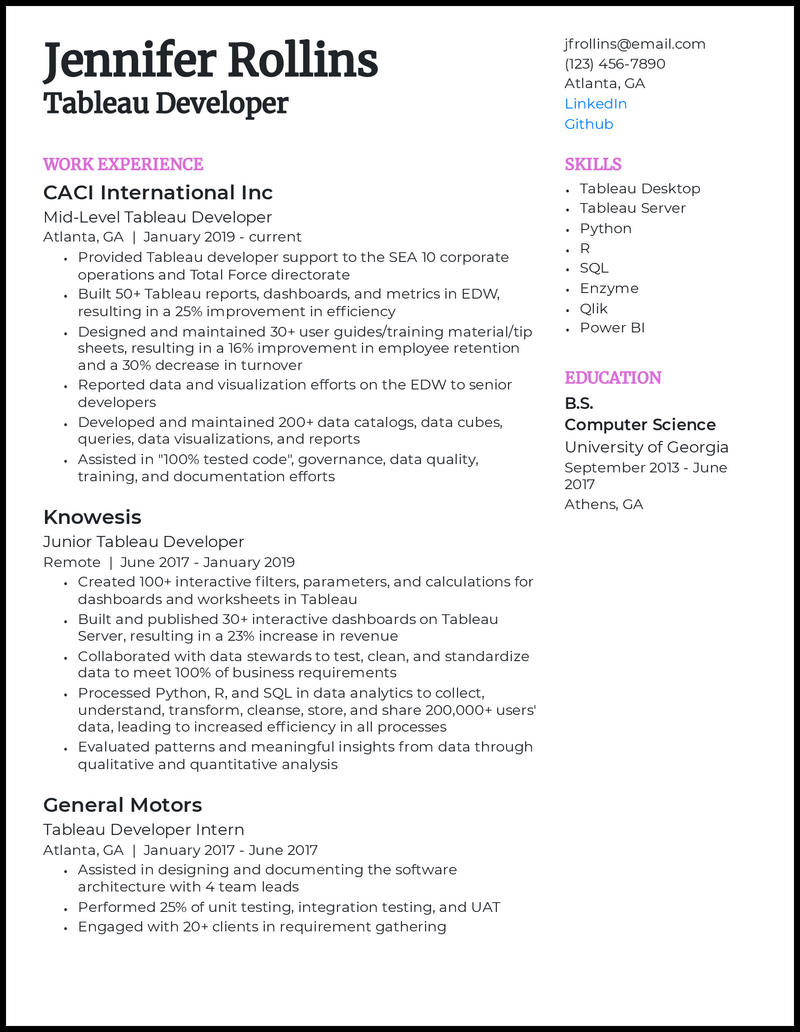
- You can round out your Tableau developer resume with lots of metrics. For example, listing KPIs showing that you drove down turnover can help flesh out your resume skills by wrapping them in the context of your work experience.

Why this resume works
- Career objectives exist to support and enhance whatever work experience you list. Instead of opting for a lengthier Power BI developer resume that includes irrelevant skills, use a career objective to instill confidence in the reader that you’ve got a proven, albeit short, history of driving value.
View more Power BI developer resumes >

Why this resume works
- When seeking a specific position, customize your BI developer resume by including current or previous job titles to fit the desired role best. Commonly interchangeable job titles such as BI developer, power BI developer, and ERP developer have virtually identical responsibilities.
View more BI developer resumes >

Why this resume works
- To position yourself ahead of every other expert, your Tableau administrator resume must emphasize your competencies in the latest tools. Don’t stop with the tools; show how you applied, for instance, SQL Queries and Kafka to streamline processes and make it easy for everyone to function at optimal capacity.

Why this resume works
- As an experienced developer, it’s extremely common to see many skills. However, refrain from inundating the resume reader with proficiencies that will have little to no impact on the role to which you’re applying.
View more ERP developer resumes >

Why this resume works
- Highlight your quantifiable achievements such as visualizing data to improve the pace of making decisions by executives, reducing the cost of data infrastructure, and so on.

Why this resume works
- The main focus of your experienced Tableau developer resume needs to be a proven work history, excellent KPIs, and leadership. You can highlight a 6+ year career in Tableau-specific roles, quantifiable data in the form of dollars and hours saved, as well as leadership of employees and contractors.
View more senior Tableau developer resumes >

Why this resume works
- Try to include projects you’ve worked on as a Full-Stack BI developer. If you have a specific target company in mind, try to build a project similar to their product, or even better, showcase where you could make improvements through optimization and feature creation.

Why this resume works
- Your resume can build upon Tableau-specific certifications, a BS in computer science, and a lengthy internship. Additionally, a junior to mid-level role, held for several years, including multiple KPIs, will further prove authenticity and ability.

Why this resume works
- As a Tableau visualization developer, it’s a good idea to show ownership over the projects on which you’ve worked. To that end, fill your resume with action verbs and quantifiable results.
See more Tableau visualization developer resumes>
Related resume guides
How to Write a Tableau Developer Resume

A great Tableau resume must instantly establish your value through your visualization and analysis skills, as well as past achievements that make you stand out, with everything neatly displayed in a resume format that is easy for ATS scanning and readable by recruiters.
Strive to lead with clarity, customization, and credibility; making it easy for potential employers to see why they should hire you and not anyone else. To ensure that you tick all the ready-for-hire boxes, base your layout on ATS-HR-compliant templates, and check your resume for errors before you can confidently submit your application.
This section covers:
- How to format your resume for instant AI visibility and recruiter-friendliness
- Strategies to position your skills and achievements to prove your value
- How to leverage keywords to align your resume to the job description, industry, and role
- Examples to model each section to mirror modern HR standards
- Common mistakes for Tableau resumes and how to avoid them

What do recruiters expect in a Tableau developer resume?
Since its founding in 2003, Tableau has achieved explosive growth to warrant a $15.7 billion acquisition by Salesforce in 2019.
The adoption of Tableau as the data visualization platform for companies, both small and large, has been nothing short of incredible.
For this reason, companies are flocking to hire Tableau developers to help make sense of their data. Tableau developers combine skills in data processing, data visualization, and business understanding to enable business leaders to make data-driven decisions.
It’s not easy to demonstrate the wide range of skills needed for this role on a single-page resume. Here are some must-haves for your Tableau resume:
- You need to include the right skills to get past automated filters without making your skills section a big wall of text.
- Your resume needs to be in an easy-to-read format for automated software and humans. Avoid complicated formatting or images.
- The most common mistake that Tableau developers make is that they talk too much about their technical work. Focus your resume on your business impact.
- Tailor your resume to each job for which you’re applying. Read the job description and see if any projects you’ve worked on come to mind.

What should a Tableau developer resume summary say?
Your resume summary should instantly tell recruiters who you are, what you bring to the table, and why they should hire you.
H4 Key components of a resume statement
- Tableau expertise
- Key achievements
- Quantifiable accomplishment as an individual and within data-driven teams
The role of a summary statement in your resume
- Define your professional title
- Mention your years of experience
- Go beyond listing skills, but showing you know how to use them
- Provide measurable results and the direct impact of your involvement in projects
- Present a career vision of where you are and where you want to be
Example of a resume summary
Example
Results-driven Tableau Developer with 6 years of experience turning complex datasets into interactive dashboards for 3 Fortune 500 clients. Proficient in SQL, ETL pipelines, and advanced data visualization. Proven ability to reduce reporting time by 12 hours through scalable BI solutions.

How do I tailor my resume for Tableau job descriptions?
Your resume must mirror the tone and structure of the job listing. Begin by identifying keywords and terms that are important to the potential employer. Use those phrases in your skills and work experience bullet points to send a message that you’re qualified for the job.
Decoding the job posting
Use a resume keyword scanner to look for the following:
- Tools
- Responsbilties
- Hard and soft skills
Customize the skills section
In your list of skills, incorporate a fair number of the key terms from the job advert. This strategy ensures maximum visibility when your resume is scanned by ATS and reviewed by hiring managers.
Reflect Tableau-themed terms in your bullet points
Generate bullet points that use the core competencies mentioned in the job ad, as well as use active words that are relevant to the role.

What Tableau developer skills do you need on your resume?
When recruiters scan your resume, they care about skills that prove both your technical command and business impact. Therefore, you must tailor your skills in a way that responds to the needs of the employers as described in the job post.
Here are the typical steps that happen at a company when they receive an application for a Tableau developer role:
- They use their Applicant Tracking System (ATS) to filter out candidates based on their skills and experience automatically.
- A non-technical HR person from the company reviews your resume.
- The hiring manager (usually technical) will review your candidacy to see if they think you’re a good fit.
That’s a lot of different parties that you have to satisfy with your resume. Let’s go step by step through each phase of this process to see how you can best position your resume to get an initial phone interview.
For step 1, the Applicant Tracking System automated filter, you need to include the right skills for which the job description says the company is looking. Don’t include soft skills in this section.
Why? ATS filters are only used to filter for hard, technical skills, and humans reviewing your resume won’t be impressed if you include “communication” or related soft skills. You need to demonstrate soft skills; they’re not something you can convincingly list.
With that said, here are some common resume skills companies filter for Tableau developer roles. You shouldn’t have all of these skills; this is just a guideline for what you can potentially include:
Which technical skills do employers look for in Tableau developer resumes?
Tableau developer jobs depend on your hands-on experience in data skills to streamline and scale reports using dashboard and pipeline tools. Here’s what you should emphasize:
- Programming languages: C, C++, Python
- SQL: Redshift, Postgres, MySQL, Microsoft SQL Server
- ETLs, data warehousing
- Tableau types: Tableau Server, Tableau Desktop
- Tableau skills: parameters, calculated fields, filters, groups, sets, dashboards
- Graphing: heat maps, scatterplots, bar charts, slicers, drill-downs
- Cloud providers: AWS, Azure, GCS
- Spreadsheets: Microsoft Excel, Google Sheets
Congrats, you got past the automated keyword filters! You need to impress the HR employee and the hiring manager, who will review your candidacy. To do this, you need to avoid having an exhaustive list of skills on your Tableau resume.
Having a long paragraph of skills listed is a big red flag to the hiring manager. It signals one of two things:
- You’re a jack-of-all-trades, but a master of none
- You’re lying
It’s much better to demonstrate expertise in a handful of skills than a passing knowledge of 15-20. As a rule of thumb, don’t let your skills section take up more than 25 percent of your resume.
WRONG – a long list of hard and soft skills
- Creative, analytical, and a critical thinker
- Detail-oriented and problem-solving skills
- Effective communicator with excellent presentation skills
- Self-starter
- Results-oriented
- Excellent multi-tasking ability
- Great interpersonal skills
- Natural leader
- Team player Digital Competency
- Knowledge of R Language
- Knowledge of SQL
- Knowledge of SAS
- Knowledge of core programming
- Proficient in the use of EPIC CADENCE
- Proficiency in CRM, CRP, BW in SAP
RIGHT – smaller list of hard skills in which you’re an expert
- Tableau Desktop: Certified Professional (2017)
- Tableau Server: Certified Associate (2016)
- Programming Languages: C, C++
- Databases: SQL Postgres, Redshift, MySQL, PL/SQL
- Database Objects: Triggers, Stored Procedures, Views
- Spreadsheets: MS Excel, Google Sheets
It goes without saying that you shouldn’t lie on your resume. Only include skills on which you’d be comfortable being interviewed. If you can’t answer basic interview questions about SQL Server, for example, don’t list it on your resume.
Example in a bullet point:
“Built Tableau dashboards on top of PostgreSQL using optimized joins and CTEs, reducing report load time by 27 minutes.”

What soft skills should Tableau developers show on their resume?
Even if Tableau developer roles are highly technical, you’re going to be part of the decision-making and leading process. For that reason, you should demonstrate your ability to align with stakeholders, lead, and effectively communicate with non-technical teams.
Top soft skills for Tableau developers:
- Communication
- Stakeholder Management
- Problem-Solving
- Adaptability
You should know that any soft skills without context add zero value to your application. Instead, embed such competencies in bullet points and showcase what you did and achieved.
Here’s an example of how to illustrate your collaboration skills:
“Partnered with marketing and finance teams to refine dashboard KPIs, resulting in a 32% improvement in campaign reporting accuracy.”
In summary, here’s what you need to do for your skills section:
- Include the skills you have relevant to the Tableau developer role to get past the ATS filter.
- Make sure your skills section is concise (avoid a laundry list) to satisfy the HR person who will review your resume.
- Don’t lie. The technical hiring manager will see right through the lies if you can’t talk about the skills you list in an interview setting.

How to format your resume correctly
Like your skills section, your resume needs to be formatted properly to appease automated software and humans who review your application. Here are quick tips for formatting your Tableau resume properly.
- Keep it to one page.
- Include relevant certifications in your education section.
- In your contact information, include the job title to which you’re applying.
- Don’t list your specific address; city and state will do.
- Include your visa status if you’re on an H1B or OPT visa.
- Quadruple-check that your spelling and grammar are correct.
- Only include a resume objective or resume summary if you can customize it for the role to which you’re applying.
All of these tips are in service of a singular goal: make it as easy as possible for the person reviewing your resume to think you’re a great fit for the role.
If your resume extends to multiple pages, the hiring manager will gloss over what you wrote. In this case, they’ll be looking for a reason to reject your application.
Put yourself in their shoes. You have received 100+ applicants for your Tableau developer role, and you’ve just received a resume that spans five pages. Are you going to give all details on that resume the same care you would a resume that is one page?
Of course not; you’ll spend the same amount of time reviewing each resume. Therefore, you need to quickly and concisely make the case on your resume that you deserve a phone interview.
What is the best format for a Tableau developer resume?
The best format for your Tableau resume is the reverse chronological order because it is effectively:
- Prioritizes the most recent and relevant experience first
- Highlights growth and track record in Tableau fluency over time
- Conforms to what recruiters and ATS expect for a technical resume

Certifications on your Tableau resume
In most cases, online certifications are utterly useless on your resume. However, when you’re applying for Tableau developer roles, they’re incredibly effective.
Tableau certifications are offered directly from Tableau, so if you’ve passed their Tableau Server or Tableau Desktop certification exams (either at the associate or professional level), you need to include them.
What better signal to a hiring professional that you know how to use Tableau than a certificate directly from Tableau?
How do I list Tableau certifications on my resume?
To get full value from your training and Tableau-specific credentials, structure the certifications section clearly and strategically, starting from the most recent role-aligned recognitions.
RIGHT – include your Tableau certifications
Tableau Desktop – Certified Professional
February 2017
Tableau Server – Certified Associate
September 2017
Suppose your current company offers an education stipend to employees (as many tech companies do). In that case, you should think about using that to pay for one of these certification exams before applying to your next role.
When talking about these certifications on your resume, either include them in your education section if they won’t extend the length of your resume or give them their own mini-section.
The hiring manager and the HR professional reviewing your resume will be more inclined to interview you if you have a Tableau certification.
Where should Tableau certifications go?
Your industry-specific recognitions should be presented in a dedicated “Certifications” section,either:
- Below your Experience or Education section, or
- In a sidebar column if you go with a double-column layout
This structure ensures instant visibility and scanability by HR managers and parsing by applicant screening bots.

Resume objective for Tableau developers
One of the biggest mistakes you can make on your Tableau developer resume is to include a generic resume objective.
Not only is a generic resume objective useless, it actively hurts your candidacy. If you’re not customizing your resume objective for each role you’re applying to, it’s better to exclude this section altogether.
You know you should keep your resume to one page. A generic resume objective doesn’t give new information to the hiring manager that you’re a good fit for the Tableau developer role to which you’re applying.
If you will include one, we compiled over 50 resume objective examples to help you get started.
Here’s a typical Tableau resume objective:
WRONG – generic resume objective
Tableau and SQL expert with 5+ years of experience transforming raw data into actionable insights. Skilled in collecting business requirements and translating those into data dashboards.
RIGHT – specific resume objective
Experienced Tableau developer who is an expert with MySQL databases seeking to leverage my skill set to contribute to the Stripe mission of making payments easy and accessible for small businesses across the world.
This is a great resume objective. It specifically lists a skill mentioned in the job description (MySQL) and talks about the company’s mission. This kind of resume objective will help you get an interview.

How to add Tableau projects
If you can include a link to a data project you’ve worked on, including a link to a Tableau visualization, you will jump to the top two percent of all applicants for the given Tableau developer role.
Unlike software engineers who openly and proudly display their Github profiles, Tableau developers rarely link their work in their resumes.
This makes sense because you can’t link to Tableau dashboards containing proprietary data from a private company for which you’ve worked.
However, if you can include a link to a personal project, you will demonstrate the two qualities that hiring managers are most looking for: curiosity and Tableau competency.
You can use Tableau Public for free. So now you just need to come up with project ideas. Here are a few examples.
Sample Tableau resume project ideas
- Are you interested in a particular sport or activity? Pull public data on it and draw a conclusion.
- Example: Examining the year-over-year increase in pitching performance in the MLB.
- Like the stock market? Plenty of published data on that!
- Example: Looking at the correlation between presidential statements and Fortune 500 stock performance in the US.
- Interested in cooking? There are plenty of recipes posted on the web.
- Example: How often are salt and pepper used as ingredients in vegetarian food recipes?
- Look at Amazon reviews of books that became movies if you’re a reader.
- Example: Do Hollywood movie producers favor highly reviewed books, or are they just interested in popularity?
- Rotten Tomatoes has a treasure trove of data.
- Example: Using NLP to estimate whether a given review is “fresh” or “rotten.”

How to quantify the impact of your work
Show your accomplishments rather than narrating them because recruiters want proof of what you can do. Translate each work experience into 3-4 specific, outcome-oriented resume bullets by doing the following:
- Use keywords from job descriptions
- Format your bullet points in this formula: Tool → Action → Impact
- Quantify your actions to prove contributions
- Integrate Tableau hard and soft competencies across work experiences—not just in the “skills” section
- Tailor bullets to the job’s focus: reporting, automation, or analytics
The biggest mistake that Tableau developers make on their resumes is that they don’t talk about their business impact.
When you talk about your work experience, remember that you have to appeal to both a non-technical HR employee and the hiring manager at the company to which you’re applying.
Far too often, I see Tableau experts focus on their technical skills without talking about the impact that they’ve had on the business.
The HR person who reviews your resume is the gatekeeper. They decide whether the hiring manager will even get to review your candidacy. If you’re not appealing to them, you won’t get an interview.
How can you impress a recruiter? Make it clear that you’ve had a measurable business impact in your past roles.
Consider these two work experiences. Which do you think is more convincing for a non-technical audience?
WRONG – too focused on technical details
- AT&T
May 2018 – Present, New York NY
Tableau Developer - Automated the processing of transactional data from Redshift and Postgres
- Used stored procedures, triggers, and views to provide structured data to business units
- Using C++ cleaned data from disparate sources and created a workbook used in Tableau Server dashboard to display time series analysis of customer performance
RIGHT – focused on business impact
- Mike’s Tech Shop
May 2018 – Present, New York NY
Tableau Developer - Automated the processing of billions of rows of transactional data from Redshift and Postgres to improve real-time reporting of product metrics, saving the company $273,000 annually in reduced downtime
- Used stored procedures, triggers, and views to provide structured data to business units by combining millions of rows of data from 19 disparate data sources
- Created interactive cohort analysis report in Tableau Server for the product team with global filters and parameters that helped improve monthly retention by 17% for a specific customer segment
This doesn’t necessarily mean you have to make your company more revenue directly. Here are some ways you can quantify the impact of your Tableau development work:
How to quantify your work experience as a Tableau developer
- Reduced manual work
- Example: Automated reporting of business KPIs reducing manual reporting by 27 hours each week.
- Enabled faster decision-making
- Example: Create real-time dashboards for the pricing team, allowing them to increase the speed of their price changes by 18%.
- Reduced product downtime
- Example: Ingested streaming data into Tableau Server and created notifications for the product team, reducing product downtime by 21%.
- Improved retention
- Example: Created a customer cohort analysis report using Redshift and Tableau Desktop, which helped marketing improve monthly retention by 11%.
- Reduced costs
- Example: Enabled automation of previously manually intensive dashboards, allowing our company to reduce vendor costs by $145,000 annually.
- Increased revenue
- Example: Created ROI Tableau dashboard for marketing, allowing them to double down on more profitable customer acquisition channels resulting in a revenue increase of $314,00 annually.
Examples of Tableau developer resume bullet points
Blend active verbs, tools, and metrics to describe your Tableau work, making it easy for ATS to scan and impossible for hiring managers to ignore.
Entry-level Tableau resume examples
- Created 12 interactive dashboards in Tableau Desktop for a capstone project, visualizing sales trends across 3 regions
- Used Tableau Public to publish a COVID-19 case tracker viewed by 5,000+ users globally
- Combined Excel and Google Sheets data sources to Tableau to visualize weekly KPI reports
Mid-level Tableau developer bullet examples
- Designed Tableau dashboards for a small high-end boutique, reducing monthly reporting time from 4 hours to under 16 minutes
- Supervised migration of 42 dashboards from Tableau Server to Tableau Cloud with zero downtime
Senior-level Tableau specialist bullet examples
- Managed 34 analysts to run a Tableau Center of Excellence, reducing dashboard development errors by 67%
- Integrated Tableau with Salesforce via REST API, boosting weekly lead conversion rates by 2.4K

Tailor your resume for each job
Tailoring your Tableau resume for each job you apply to will put you in the top five percent of applicants. When you’re applying for jobs online, this is the kind of advantage you can’t afford to give up.
How can you customize your resume?
- Read the job description. As you do so, do any projects you’ve worked on come to mind?
- Read about the company. Does any of your experience relate to what the company does?
- Read the requirements of the job. Do you have any skills they’re looking for that you haven’t included on your resume?
What does this look like in practice? Let’s say, for example, that I was a Tableau developer who had this work experience on my resume.
ALTRU LABS, INC.
April 2015 – January 2018, New York NY
Tableau Developer
- Automated a Tableau Server report for the sales team using filters, parameters, and calculated sets that automatically qualified sales leads resulting in a lift in conversion rate of 27%
- Implemented security guidelines by using user filters and row-level security, reducing private data exposure by 72%
- Built robust forecasting using parameters, trend lines, and reference lines that were reported directly to Wall Street for quarterly earnings reports, saving 42 hours of manual work each quarter
Suppose I was applying for a role working directly with a marketing team to help measure and report on the ROI of different customer acquisition channels. In that case, I might alter that work experience to the following:
AMPLIFY
April 2015 – January 2018, New York NY
Tableau Developer
- Automated a Tableau Server report for the sales team using filters, parameters, and calculated sets that automatically qualified sales leads, resulting in a lift in conversion rate of 27%
- Implemented a real-time marketing dashboard to analyze the source of all qualified leads, leading to an increase in spend toward the most profitable marketing channels of 130% year over year
- Built robust forecasting using parameters, trend lines, and reference lines for the marketing team to help identify the top 5% of organic search terms that drove new customer acquisition
How should a senior Tableau developer resume differ from a junior one?
For a junior analyst breaking into Tableau or a senior architect already leading enterprise data strategy, you should present value propositions that align with what recruiters expect.
If you’re a senior candidate, emphasize your achievements in leadership, cross-functional thinking, and long-term business impact. Let tools take the back seat and lead with your strategy and systems-level thinking.
Junior-level resumes strongly underscore your tool fluency, project contributions, and a learning-growth mindset. Don’t use vague phrases like “familiar with Tableau,” but instead prove what you can do with it.
Senior vs junior Tableau resume
| Level | Focus | avoid |
|---|---|---|
| Senior | Architecture, cross-team collaboration, mentoring, scalable impact | Detailing minor achievements without an organizational impact |
| Junior | Tool proficiency, learning attitude, contribution to builds/teamwork | Vague phrases that add no value: “passionate about data” |

How do I write a Tableau resume with no experience?
Focus on transferable skills and translate any achievements from projects, internships, and volunteer work into bullet points that demonstrate initiative, potential, and a result-driven mindset.
Focus on what you did in these areas, spotlighting accomplishments, lessons learned, and problems solved:
- Boot camps
- Class projects
- Internships
- Part-time/freelance work
- Volunteer activities

What if I’m switching from a BI or data analyst role to Tableau developer?
You already have the foundation, and what makes your transition a success is how you reframe your BI experience to what a would-be employer looking for a Tableau developer prioritizes.
Rework on your job titles, experiences, and relevant training to fit the profile of what the job posting requires. It would also be a great idea to update your profile using a LinkedIn resume builder to reflect your current ambitions.

Tableau developer resume—expert tips
Follow these tips, and you’ll increase your chances of getting an interview. Here’s a quick summary of what we’ve shared:
- Include the skills mentioned in the job description on which you’d be comfortable being interviewed. Focus on Tableau, SQL, and database management skills. No soft skills!
- Keep your resume to one page. Include any Tableau certifications you have. If you have any personal projects, include them, as they’ll put you in the top 3 percent of applicants.
- Focus your work experience on your business impact. Don’t get lost in the technical details of your projects. Hiring managers want to know you’ll have a meaningful impact on the bottom line.
- Customize your resume for each job application. Read each job description, and be sure to mention any projects that come to mind.

What are common mistakes in Tableau developer resumes?
Don’t fall to any of these pitfalls:
- Overusing visual components
- Lack of context for soft skills and dashboard builds
- Generic resume
- Ignoring key technical tools and impact
- Disregarding format and grammar mistakes
Tableau Developer Resume FAQs

The best way to write your Tableau developer resume is by highlighting your experience using the reverse-chronological format. While writing your job descriptions, mention how you used Tableau and other relevant tools to drive business results.
Example: Build 3 Tableau dashboard to visualize consumer behavior trends, boosting the company’s sales by 11% within one quarter.
It is the engine that makes your tableau developer resume shine. It demonstrates your hands-on skills and aligns to the specific requirements recruiters want in the best-fit candidate.
Apart from using Tableau itself, here are a few more skills you can consider adding to your resume:
✅ Data visualization
✅ SQL
✅ Analytical thinking
✅ ETL
✅ R
✅Python
✅ Power BI
One of the greatest mistakes you can make on your Tableau developer resume is failing to showcase your business impact. Employers are more interested in what you bring, and you must use numbers to emphasize your accomplishments.
You can avoid this mistake by quantifying your achievements and using key skills to fit into the role. As long as recruiters can get a hold of what you can do, be ready to land more interviews that lead to job offers.
The perfect Tableau developer resume should be:
Formatted for both human recruiters and ATS
Lead with core skills and results
Put the most relevant experiences, training, and certifications first
Tailored for the specific role and industry you’re targeting
Keep your resume in one page by prioritizing the most important information that the job description, recruiters, and ATS care about. It’s acceptable to go to the second if you’re a senior developer with impressive work experience and a track record of outstanding achievements that add value to your application.

Stephen is the co-founder and CEO of BeamJobs. Frustrated with the challenges he'd faced in his own job search, he left the corporate world to start BeamJobs with his brother. Drawing on firsthand experience with hiring and getting hired as technical talent, he started BeamJobs in 2020 to help qualified job seekers land interviews with less stress. Since then, more than 4 million people have built their resumes and cover letters on BeamJobs. Stephen's insights have been featured in notable outlets, such as Fast Company, Business Insider, Yahoo Finance, MIT, and Zapier. Learn more about Stephen.