





Data Scientist Resume


Best for candidates with 3+ years of experience
Resume Builder
Like this template? Customize this resume and make it your own with the help of our Al-powered suggestions, accent colors, and modern fonts.
 Build my resume
 Writing a resume for your dream data scientist job involves structuring your experience to answer exactly what hiring teams and applicant tracking systems (ATS) are looking for. Every section must prove your capability to solve business problems with data. But it’s not enough to say you can; you need solid proof with impact-focused bullet points, quantified results, and clear formatting.
Use templates that work: leverage clean, readable formats from Word resume examples, Google Docs resume templates, and an AI-optimized resume builder. Think of your resume as a series of mini case studies, not a job diary.
Below, we’ll walk through the essential pieces of a winning data scientist resume. What to include, how to format each section, and how to structure it for both AI retrieval and human review.
What you’ll learn here:
- ↪ 24 data scientist resume and cover letter templates to inspire your writing
- ↪ How to structure each section of your resume from proven Word and Google Docs templates
- ↪ Data points, metrics, and tips to generate bullet points that show measurable impact and value
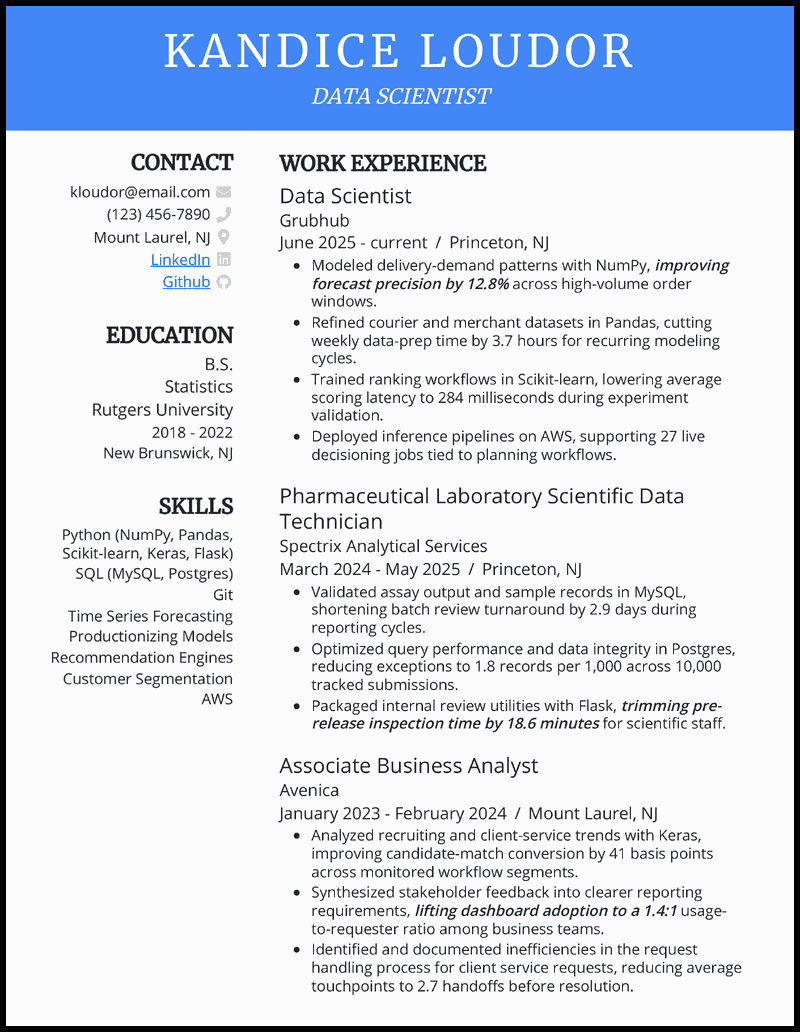
Why this resume works
- We can’t stress it enough. Quantify your impact! The numbers on your data scientist resume can be rough estimates (for example, improving forecast precision by 12.8%, trimming pre-release inspection time by 18.6 minutes, and lifting dashboard adoption to a 1.4:1 usage-to-requester ratio). They’re a way to quickly display your achievements and convince the employer that you’ll bring that same kind of energy to their team or company.
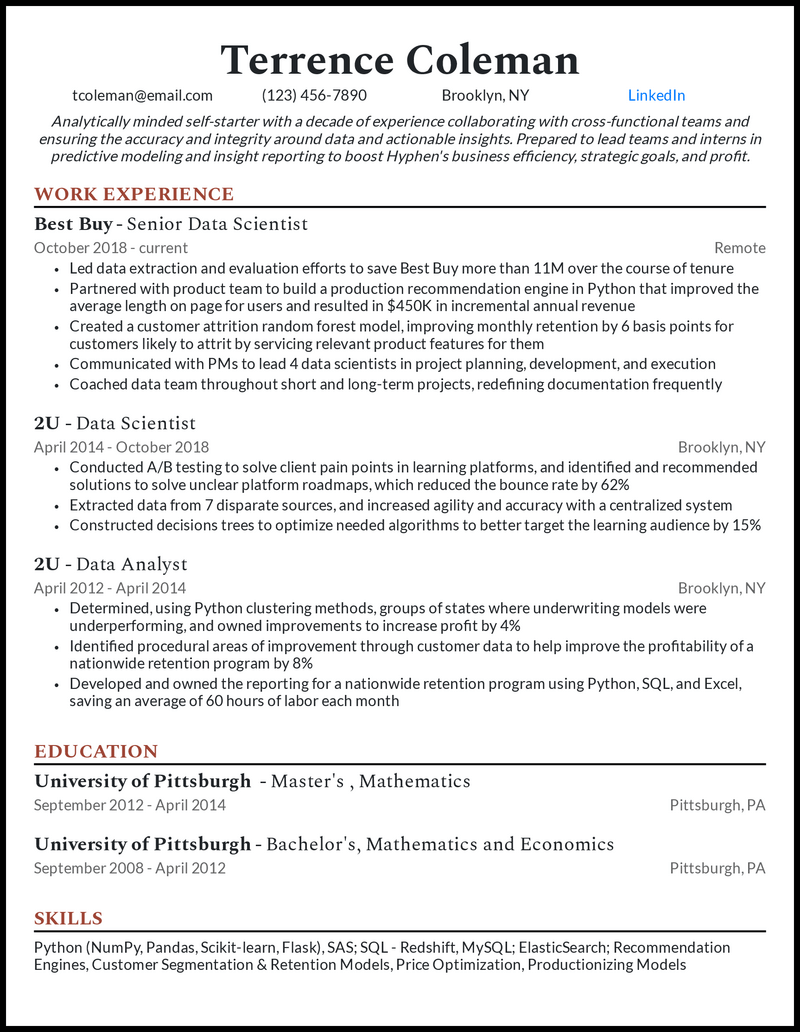
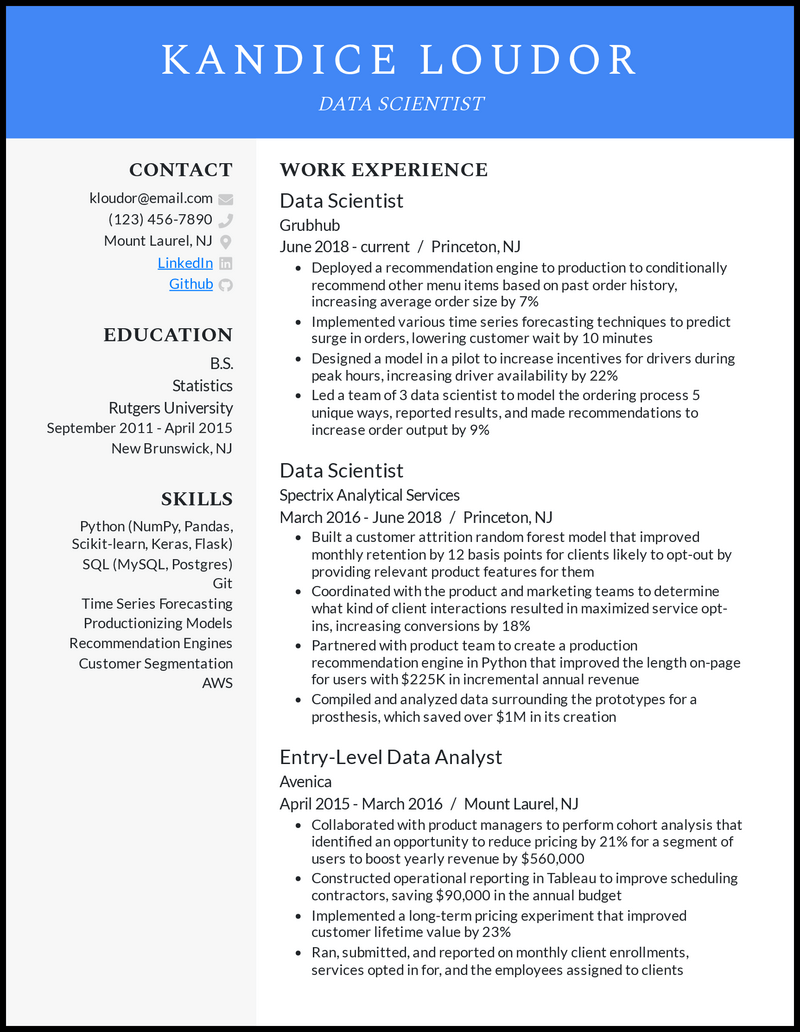
Why this resume works
- If you have 10+ years of experience and heavy domain knowledge, use a resume summary to give a quick snapshot of your career highlights in two to three power-packed sentences. Show career growth and transferable skills, particularly those useful for senior data scientists and candidates transitioning fields.
View more senior data scientist resumes>

Why this resume works
- For a data science manager resume that stands out, focus on leadership and project ownership. Highlight the results of your work by clearly stating tangible impact, such as lifting margin capture by 13.8% across production planning cycles and improving nomination planning by $2.7M in annualized imbalance avoidance.
View more data science manager resumes>

Why this resume works
- Whether it’s geospatial analysis, real-time data monitoring, or even creating standard visuals, make sure to quantify the impact of each and clearly state the benefit these tasks brought to the company (for example, protect $1.94M in renewal revenue, cutting escalation volume by 22 cases per month, and increasing recommendation adoption to 91.3%. ) to strengthen your data visualization resume.

Why this resume works
- For a splendid data science student resume, demonstrate a diverse skill set, prioritizing in-demand options (think Python, Jupyter Notebook, Pandas, Excel, SQL Server, etc.). Soft skills, such as hypothesis-driven thinking and learning agility are a welcome addition to your piece.

Why this resume works
- If you have relevant skills that you gained relevant work or projects, a career objective is an excellent place to highlight them. Call attention to your expertise in computer science by listing your proficiency in advanced programs like Keras.

Why this resume works
- You’re stepping into shoes of a manager, thus, your data science project resume should project leadership and mentorship abilities that not only lead to success but also build reliable teams that keep delivering results with business impact.

Why this resume works
- A former Google recruiter once said, “A resume is showcasing you in a 10-to-60-second format on paper.” Creating a strictly text-based Google data scientist resume that doesn’t convey any achievements is only going to turn off would-be employers.

Why this resume works
- Let your experienced data scientist resume focus on impactful outcomes that reflect your data science experience from previous roles.
- For instance, talk about how you prevented $1.92M in duplicate validation and moved replenishment decisions ahead by 2.8 days. Mention how you provide value to businesses and win for any prospective employer.
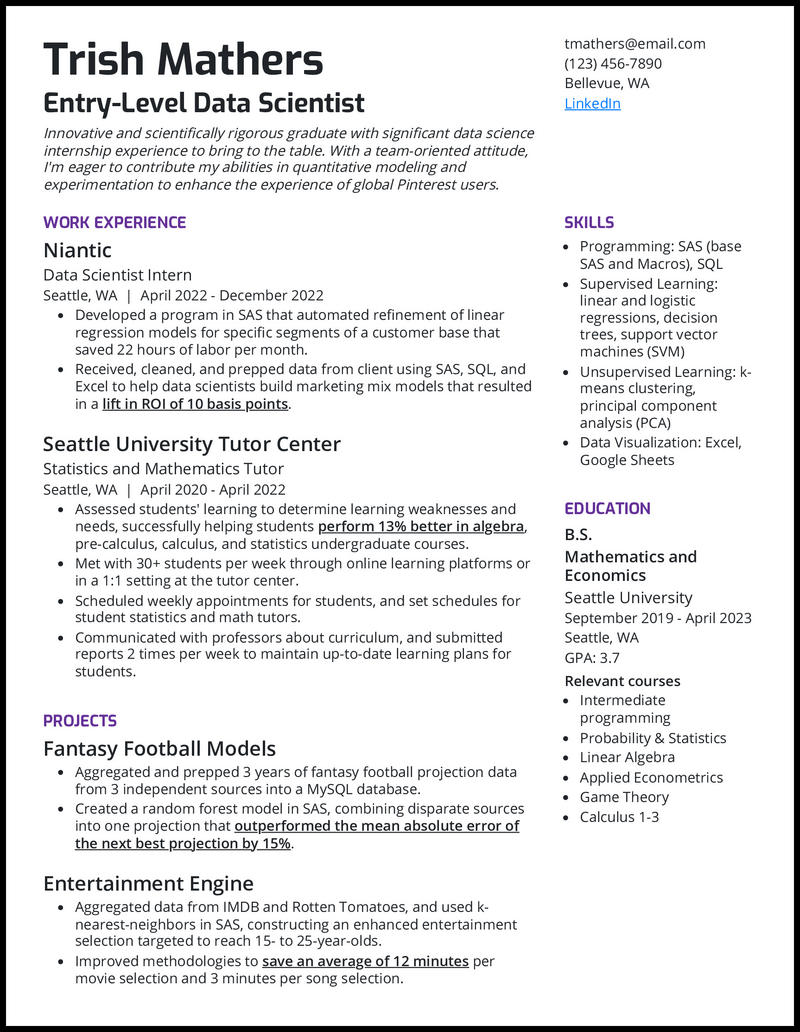
Why this resume works
- Top off your piece with a professional summary and customize it to match your target job. Customizing looks like: mentioning the target business by name and reflecting the job requirements with relevant keywords pulled from the job description.
View more entry-level data scientist resumes >

Why this resume works
- Adding a GitHub link to your data science engineer resume can make a great difference. Ideally, the link to your GitHub should go right in the header.
- Remember to set your projects that demonstrate relevant technical work as public so recruiters can see them!
Why this resume works
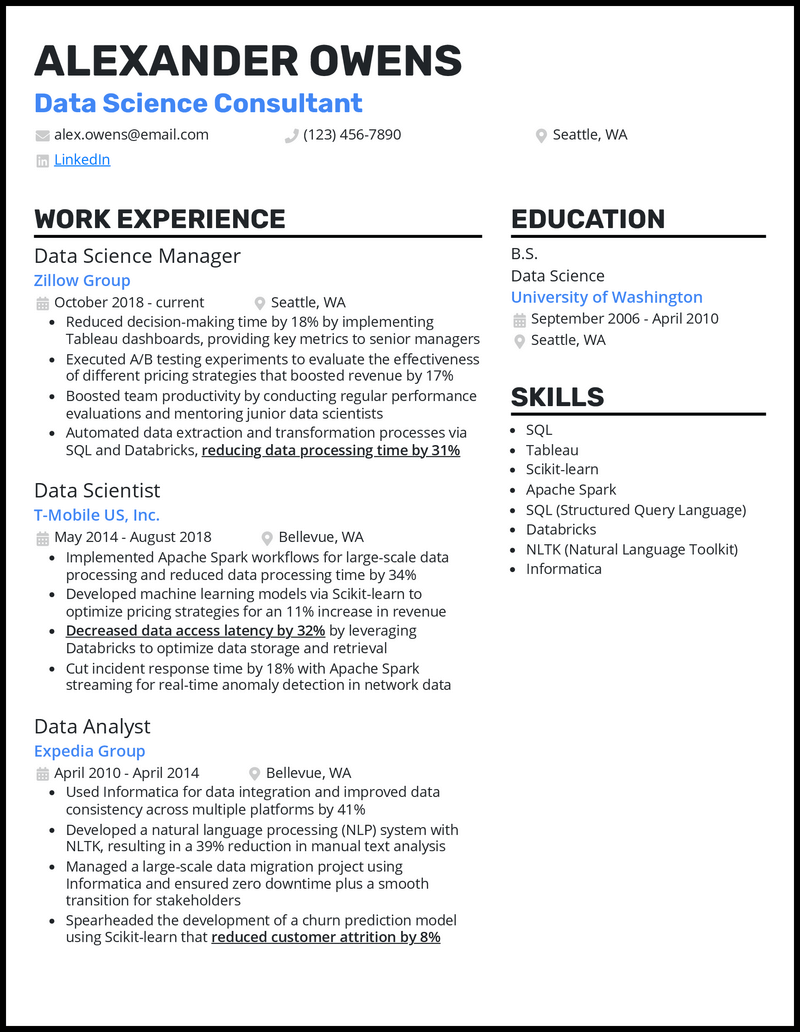
- Your work experience is the most crucial component of your data science consultant resume. To best represent your capabilities, use metrics to talk about your accomplishments, such as improved lead-to-tour conversion by 7.4%, 17% increase in successful upsells, and trimming experiment runtime by 31 GPU-hours per training cycle.

Why this resume works
- When you’re trying to figure out what to put on your resume for a more specialized role like an NLP data scientist, it’s important you showcase your proficiency in niche-specific tools (for example FAISS, Amazon SageMaker, and LangGraph) that would make a big impact on the business.
View more NLP data scientist resumes>

Why this resume works
- Start your journey from a a projected that tested your skills in MongoDB and Gensim, then a intelligent analyst internship where you mastered detection algorithms and building highly precise forecasting models. If anything, it shows that in just two years, you’ve turned raw data into pure gold.

Why this resume works
- Give your data scientist machine learning resume a competitive edge by providing evidence that you’re a Certified Machine Learning Engineer (CMLE). On top of your technical skills (such as Kubeflow, BentoML, and Great Expectations), this credential is a stamp of approval and recruiters will love it.

Why this resume works
- This Python data scientist resume stands out because it’s strictly customized both to the role and the potential employer. Do you notice the use of very role-and-company-specific tools (DataRobot AI Platform, DataRobot AI Observability, and DataRobot AI Governance)? That’s one great way to beat ATS and ensure that your resume is reviewed by a real human recruiter.
Why this resume works
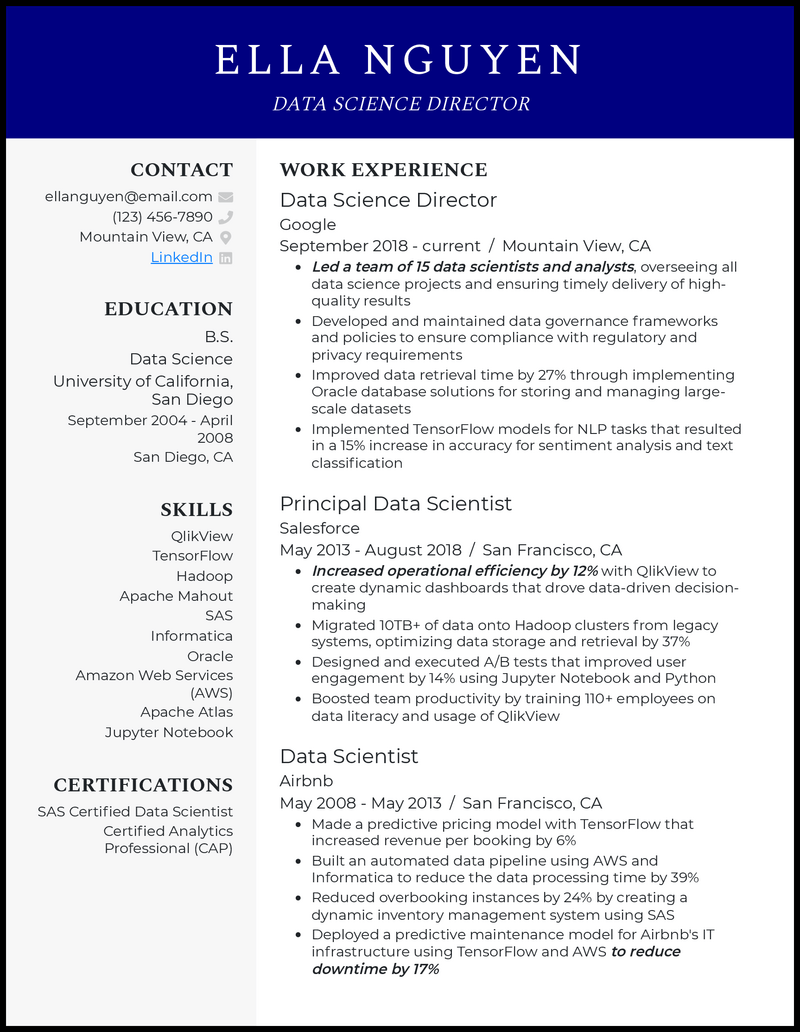
- For an effective data science director resume, use a clean and simple resume template and format your work experience (backed with outstanding measurable achievements, such as generating $3.18M in projected annual impact and reducing drift noise to a 1.7:1 alert-to-action ratio after launch) in reverse-chronological order. Doing so will put your most recent and relevant accomplishments at the top, making it the first thing a recruiter will look at.
Why this resume works
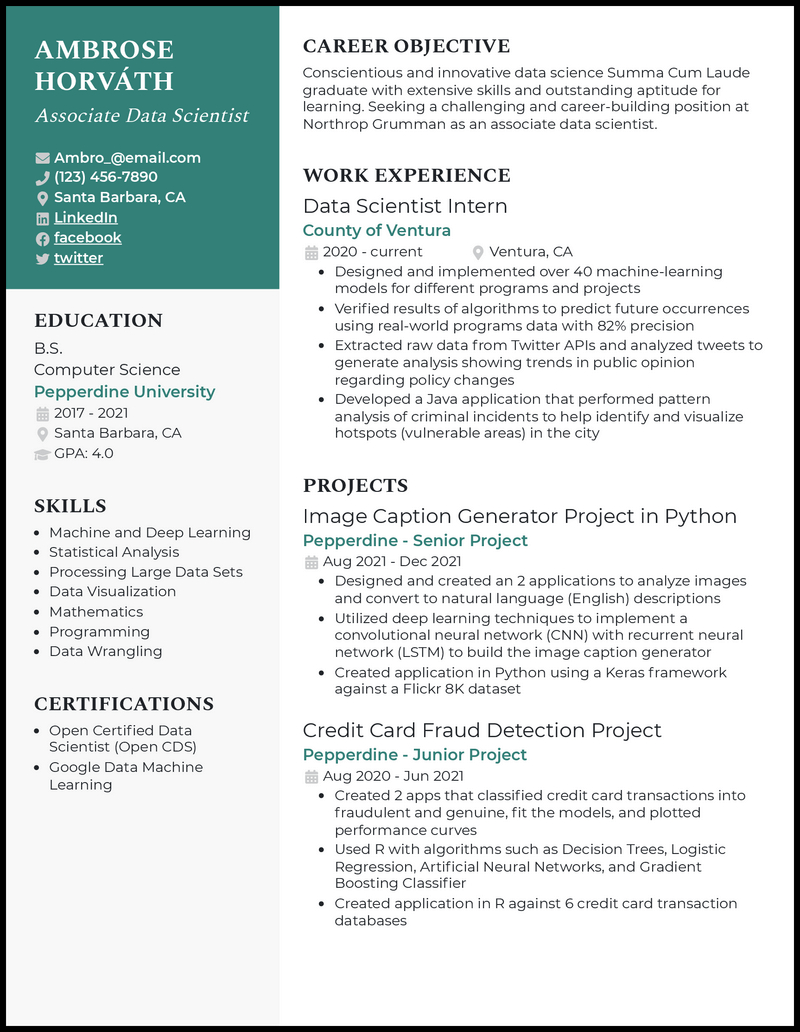
- When you have an internship and practical projects as your professional background, the skills you list on your associate data scientist resume matter more than ever. And your abilities aren’t just selling points—they’re also a springboard for you to demonstrate your willingness to learn.

Why this resume works
- This being a very specialized role means your healthcare data scientist resume must be as far away from generalizations as possible. Include your competency in healthcare-specific tools (such as Epic Clarity, Epic Caboodle, Epic SlicerDicer, and Power BI) to emphasize your alignment with the sector, employer, and role.

Why this resume works
- Your Amazon data science resume should be a tailored account of the value you’d bring to the marketplace giant. Include in-house tools, like Amazon Redshift and Amazon QuickSight in your technical stack.
- Next, back them up with measurable accomplishments from previous positions, especially if they came from tech companies.

Why this resume works
- Recruiters review essential qualifications first. List Azure Databricks, Qualtrics, and Glue ETL to show mastery and impact in your data scientist analytics resume. Ensure you tailor your application to the job description and specifically to the expectations of the potential employer.
Why this resume works
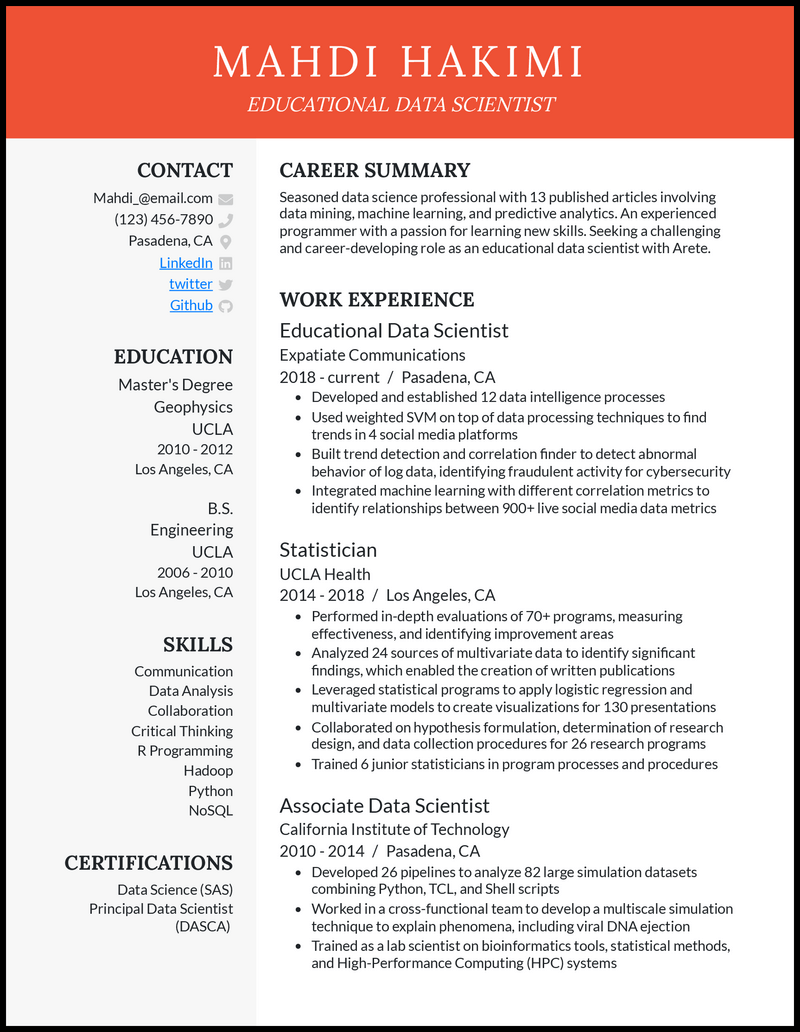
- Let your educational data scientist resume dazzle recruiters with solid achievements that speak to their own relevance within the field. A statement such as, “helping district teams focus case reviews on the highest-need learners first,” present the value you’d bring if hired.

Why this resume works
- As a finance data scientist, your dashboards aren’t just pretty visuals—they’re your career pitch, and strengthening them with quantified metrics shows you turn numbers into profit. Think of it as your financial mic drop moment. Instead of saying, “Improving efficiency,” hit recruiters with ” … removing 97 manual touchpoints from the month-end reporting workflow.”
Why this resume works
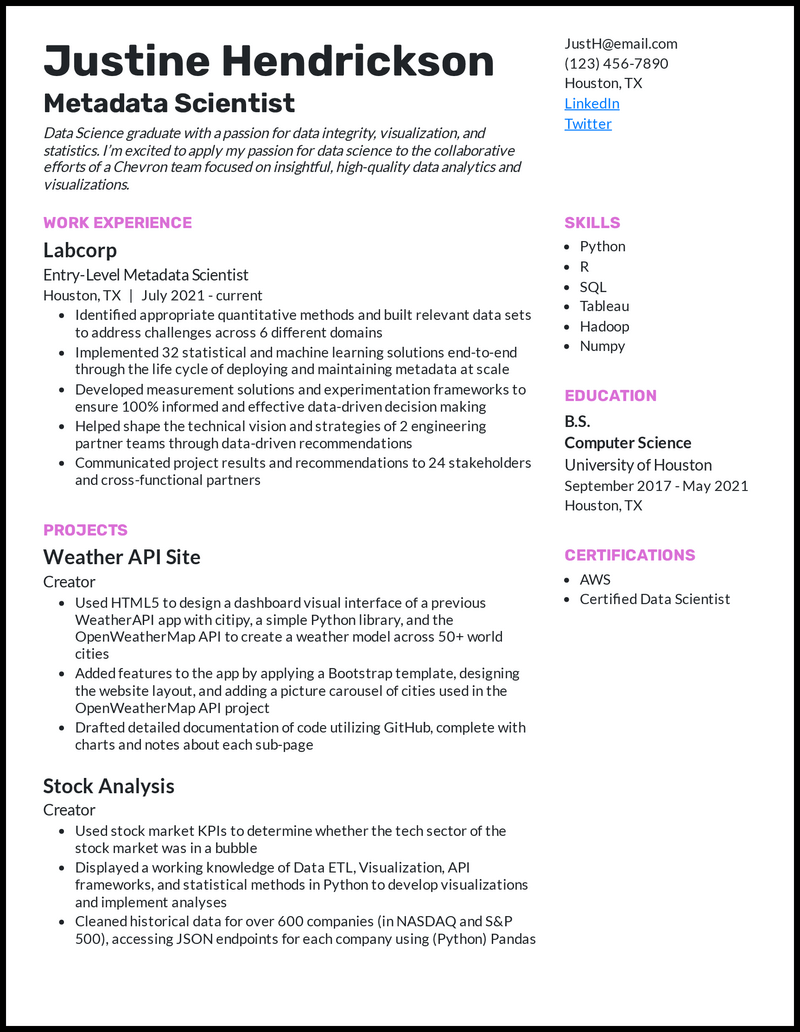
- Your metadata scientist resume can be an excellent way to display large-scale data-manipulation skills required by the industry.
- Prove your experience in programming, testing, modeling, and show your data visualization skills through well-designed projects that solve real problems through code.
Related resume guides
How to Write a Data Scientist Resume

To land a data science role today by following the best practices, your resume must survive automated screenings, highlight quantifiable impact, and surface the exact skills recruiters value the most. Whether you’re tailoring your resume for a job at one of the top tech giants or a startup in your city, you must learn how to frame each line with precision.
It makes the difference between getting filtered out and getting an interview invite. Strong resumes also show how you solve business problems through data analysis and support data driven decision making. One of the current hiring industry trends is that in 2026 and the future, AI will continue to dictate how information is searched for and retrieved.
Most importantly, recruiters and employers are increasingly relying on AI to assess relevance, which means easy-to-read, understandable resumes get preferential treatment when ATS systems scan and humans review them.
A 2025 study dove into manual assessments in TREC-style evaluation and their correlation with LLM-generated relevant assessments. Here, NIST identified a point of convergence that underscores the need to write resumes that are easy for human recruiters and AI screening tools to review, understand, and rank.
To conform to all these, use our proven resume examples to benchmark your formatting and content strategy, and test your draft with a free resume checker to see how it compares to the competition and performs in AI scans.
Key elements every data scientist resume should include:
- Professional summary
- Technical skills section
- Project highlights and featured projects
- Work experience (focusing on impact-first bullet points)
- Education & certifications
- Publications or GitHub portfolio
- Keywords from the job description (including key skills from job postings)
Short on time? Here are the quick-hit summaries of each section you can apply to your resume:
- Projects & Work Experience
- Whether for a company or yourself, what you’ve worked on should be the focus of your resume. Always try to include a measurable impact of your work.
- Summary/ Headline/ Objective
- Make this the job title you’re looking for (e.g., “data scientist”), and don’t worry about a summary unless you’ve got 10+ years of experience.
- Skills
- Only include technical skills that you’d be comfortable having to code with/in during an interview. Avoid a laundry list of different skills.
- Education
- Include relevant courses if you’re looking for an entry-level role. Otherwise, make your work the focus of your resume. If you went to a boot camp or have continuous learning certifications, list them here.
- Contact Info
- Double-check everything. This is not the place you want to make a mistake. You don’t need to put your exact address. City, state, and zip are fine.
- General Formatting Tips
- Try to keep it to one page. Keep your bullets brief. Triple-check your grammar and spelling, and then have someone else read it.
- Customization for Each Job
- Read the data scientist job description. See if any projects you’ve worked on come to mind while reading it. Incorporate those specific projects into your resume.

What is the best resume format for a data scientist?
The best resume format for a data scientist in 2026 is the reverse chronological layout, which prioritizes your most recent and relevant roles and measurable impact. This format helps recruiters quickly assess your fit. It also shows career growth for experienced candidates targeting senior positions.
Follow these format tips:
- Stick to one page (two pages if you’ve 10+ years of experience)— Brevity is an asset here
- Use clear headers for each main section, such as “Contact Details,” “Work Experience,” “Project,” and “Skills.”
- Put the most relevant experience and results at the top
- Keep critical info (like GitHub links or major projects) visible and not at the bottom
- Avoid a functional format unless you’re making a career shift

What is the best resume template for data science jobs?
The most effective resume template for data scientists is a clean, one-column layout optimized for ATS and human scanning.
Template must-haves:
- Clear section heading (Projects, Experience, Skills)
- Bold job titles
- No graphics, charts, wild fonts, or headshots
- Room for GitHub/portfolio link (if available)

How to format your data science resume for ATS
Remember that ATS systems parse raw text, so what looks stylish to your eyes may be invisible to the bots. To ensure a real human recruiter reviews your resume, stick to these formatting rules:
Do:
- Go with simple and professional fonts (Arial, Calibri, Times)
- Save and submit in PDF unless directed otherwise
- Use clear and stand-alone headers: “Work Experience,” “Skills,” “Education”
Don’t:
- Use icons, emojis, or charts
- Submit scanned or image-based resumes
- Use tables, graphics, and multiple-column layouts

What do recruiters look for in a data science resume?
When recruiters review your data science resume, they’re looking for three things: impact, technical expertise, and clarity.
Recruiters often spend only 6-8 seconds on initial resume reviews. In not more than the first 7 seconds, they typically scan for:
- A job title right under your name, in this case, Data Scientist
- Tools/skills/software that match the job description and highlight the key technical skills recruiters expect to see (Hint: Python, SQL, & ML)
- Quantified results from past relevant work or niche projects. This proves you can deliver results using unstructured data.
- A clean, readable design without walls of text

How to present your data science projects and work experience
Numbers are your most powerful persuasion tools.
Quantify Everything.
Even estimates with percentages, dollar amounts, frequencies, and timelines.
If you’re unsure how to go about this, ask: What changed after I performed this task? If the result can’t be quantified, it doesn’t add value to your candidacy.
Effective ways to showcase impact:
- Revenue: “…increased annual revenue by $250K”
- Efficiency: “…automated reporting to save 12 hours/week”
- Engagement: “…boosted clickthrough rate by 12%”
- Growth: “…led to a weekly average of 3.1K new sign-ups via optimized model”
The template for successfully talking about your experience as a data scientist is:
- Clearly state the goal of the project
- Demonstrate what you did
- You can mention the programming languages you used, the libraries, modeling techniques, data sources, data processing, data models, etc.
- State the quantitative results of your project
Strong bullets can also show work in data engineering or big data environments when relevant.
You’re a data scientist, so highlight your value by demonstrating the quantitative impact of your work. These can be estimates. For example, did you automate a report? Roughly how many hours of manual work did you save each month? Did you ever contribute to developing predictive models?
Structure achievements in your experience section using the action, outcome, and results framework. Here are some ideas for how you can quantitatively talk about your work:
How to define the impact of your data science work
- Increased revenue
- Example: You developed a pricing algorithm that resulted in a $200k lift in annual revenue.
- Improved retention or conversion rate
- Example: You built a model to predict who would cancel their subscription and introduced an intervention to improve monthly retention from 90% to 93%.
- Increased growth
- Example: You built a marketing attribution model that helped the company focus on marketing channels that were working, resulting in 2,100 more users.
- Improved engagement rate
- Example: You ran an experiment across different product features, which resulted in a 25% increase in engagement rate.
- Saved labor
- Example: As a side project, you built a movie recommendation engine that now saves you 26 minutes each time you need to decide which movie to watch.
- Lift in consumer satisfaction
- Example: Since you built a customer segmentation model to determine how to communicate with different customer types, customer satisfaction is up 17%.
- Grew business performance
- Example: You used data analytics to identify checkout friction points, which increased completed purchases by 12%.
Numbers draw attention, are convincing, and make your resume more readable. Which of these two ways to describe reporting is more compelling?
- Used Python, SQL, and Tableau to conduct daily reporting for the business
- Using Python, SQL, and Tableau, combined 11 data sources into a comprehensive, real-time report that saved 10 hours of work weekly
If nothing else, please take this away from this guide: state the results of your projects on your resume in numbers.

What are the trade-offs between projects and work experience?
Simply put, the more work experience you have, the less space “projects” should take up as a section on your resume. In the sample resumes above, you’ll notice that only the more entry-level data scientist resumes have a section for projects.
The senior-level resumes focus on projects in the context of experience within companies. Real estate is precious on a one-page resume, so you’ll want to focus on the bullets that most clearly demonstrate how you’re a great fit for the job. Companies want to hire data scientists who have demonstrated success at other companies.

How to include entry-level data science projects for resume
Junior data scientists should include projects on their resumes. Whereas entry-level candidates should highlight projects and industry knowledge that prove relevant ability. Try starting with a resume outline, where you can brain dump anything and everything about your projects. Then, you can distill the best of it into your final resume. Can you share the Github link? Do you have a link to a write-up you did about your project?
The more initiative you can show for entry-level data science projects, the better. Do you have any questions to which you’ve always wanted the answer? You can probably think of some clever ways to get data around that question and come up with a reasonable answer. For example, I wanted to know which data science job boards were best, so I pulled together some data, laid out my assumptions and methodology, and made my conclusions.

No matter what projects you include on your resume, be sure to clearly state the question you were answering, the tools and technologies you used, whether you designed or evaluated machine learning models when applicable, the data you used to answer the question, and the quantitative outcome of the project. Succinctly stating conclusions and recommendations from your analysis is a highly sought-after skill by employers in data science.

What’s the difference between entry-level and senior data science resumes?
| Experience/Emphasizes | Entry-Level Data Scientist | Senior Data Scientist |
|---|---|---|
| Projects (with GitHub links) | Work experience at companies | |
| Bootcamp or course details | Business impact (revenue, efficiency) | |
| Technical skills and modeling knowledge | Ownership of systems or teams |
Rule of thumb:
If you have more than three years of experience, consider reducing the scope of your project section to focus on your key achievements. If you’re new, make it the shining star.

What about the data scientist resume summary?
Since you have limited space on your resume, you should only include a resume objective if you take the time to customize it for each role to which you apply.
You may want to include a resume summary if you’re experienced (10+ years) or an objective when you have no experience or you’re making a big career change. If you do include one, make sure to keep it specific about your goal and experience. This is valuable space you’re going to be using on this statement, so take the time to personalize it to each job.
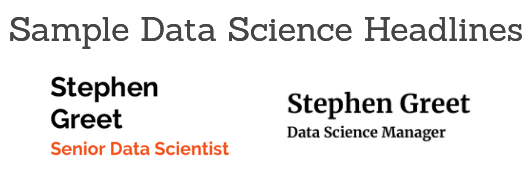
Include the title of the job you’re looking for under your name. If you’re a data analyst looking to apply for data scientist jobs, you would put “data scientist” under your name as the headline:
What skills belong on a data science resume?
Only include skills you’d be confident in and defend during an interview. Recruiters can tell “skill vomit” at a glance.
Your skills section alone can get you hired. Ideally, it should reflect the key skills repeated across relevant job postings.
The most common mistake we see on data science resumes is what we call skill vomit. It’s a laundry list of skills in which no one person could have expertise.
A quick rule of thumb: If the skills section takes up a third of the page, it’s a big red flag for hiring managers.
A big reason people make such an exhaustive skills section is to get through the keyword filters. If you’re changing your resume in small ways for each job you apply to (for example, put Python for jobs that mention Python and R for jobs that list R if you know both, and add data mining, data wrangling, or statistical modeling only when the posting clearly asks for that experience), you’ll have no problem with those keyword filters.
We always recommend one advice: if it’s on your resume, you should be comfortable coding with/in it during an interview.
So that means if you’ve read a few articles on Spark or adversarial learning, but you can’t use them in code, they should not be on your resume. If you only have a handful of tools under your belt, but you can use them effectively to answer questions with data, you’ll be able to find jobs looking for that skill set.
We can assure you there are all kinds of data science jobs available. Our scraper that indexes jobs across thousands of company websites shows over 5,000+ full-time data science job openings in the US across all tenures and skill sets. And our scraper has a lot of room for improvement, so that’s significantly lower than the actual number.
There are tons of fish in the job market sea; you just need a fishing rod.
Do list:
- Python, SQL
- Key libraries: XGBoost, Dask, pandas, scikit-learn, matplotlib
- Cloud tools: AWS, GCP
- Skills you can back up with data visualization tools used and outcomes delivered
Don’t list:
- Buzzwords that you only know in theory (statistical analysis, regression analysis, feature engineering, etc)
- Special skills, unless you’re fluent in them, are in demand in the job description

Entry-level vs. senior skills sections
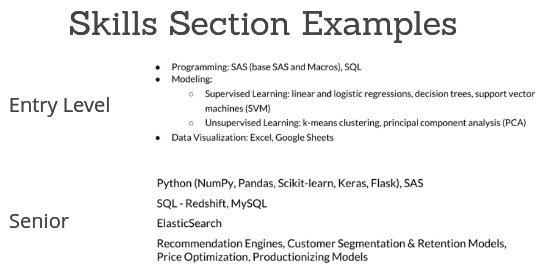
Generally, the more senior you are, the shorter your skills section needs to be. If you’re a senior data scientist, you should talk about the major tools and languages you use but save specific modeling techniques for the “Work Experience” section, where you can show how you used particular models and large datasets in the context of your work.
This is especially useful for senior data scientists, whose resumes should prioritize impact over long skills lists.
When you’re a junior, you likely haven’t had the chance to use many techniques or machine learning frameworks you’re comfortable with within work or a project. That’s okay! It’s expected. But you still want to make it clear to a potential employer that you can use those statistical methods.

Essential soft skills for data scientists
While technical skills say you know the job, soft skills help you succeed by communicating and working with teams effectively.
Most-preferred soft skills in data science resumes:
- Communication: Presentations, delivering goals and explaining results to even non technical audiences
- Critical Thinking : Using problem-solving skills to ask and respond to business questions in the best way possible
- Initiative: Do you use a proactive approach in finding insights?
- Collaboration: Can you team up in cross functional teams for common goals?
Don’t just list these skills; put them in context within your work bullet points as in the example below:
Example
Partnered with the product team to define experiment goals, resulting in a 12% feature adoption lift = teamwork, and excellent communication

How to list education and continuous learning for data scientists
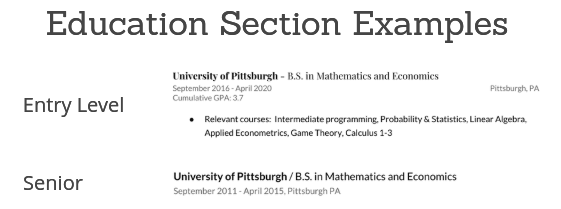
Education is a lot like skills in that the more senior you are as a data scientist, the less space the education section should take up on your resume. When you’re looking for a first data science job, you might want to include courses, such as machine learning algorithms or natural language processing to demonstrate you have a strong foundation.
Classes in subjects like linear algebra, calculus, probability, and statistics and any programming classes are directly relevant to being a data scientist. If you’re looking for your first job out of college, you should include your GPA on your resume. When you have a few years of work experience, it’s not necessary to include it.
If you just finished (or are finishing) a data science boot camp, this is the place to list where you went. You can include the relevant lessons or classes you took. Be sure to have a few projects from your boot camp (especially if it was an original project) in your resume’s “Projects” section.
The education section should include:
- Field of study (e.g., B.S. in Computer Science)
- College/university’s name
- Years attended
- Location: city and state
- Relevant coursework (if entry-level)
- GPA (only if recent and >3.5)
Example:

How to add your contact information
The takeaway from this section is simple: this is not where you should make a mistake.
Storytime! When I was first applying to jobs out of college, I realized about 20 applications in, I had spelled my name “Stepen” instead of “Stephen.”
Don’t pull a Stepen.
Data suggests that when your email is wrong, your response rate from companies drops to zero percent. That’s just math. We’ve seen exactly four data science resumes where the email address on the resume was incorrect.
Make sure your email address is appropriate. While we don’t doubt the authenticity of your “[email protected]” email, maybe don’t use it when applying for jobs. To play it safe, stick to a combination of your name and numbers for your email.
This is the section you can include anything you want to show off for a data science role. Have a blog where you document the analysis you do for Dungeons & Dragons? Active on Github or an open-source project? Include a link to anything relevant to data that will help you stand out in your application.

General resume formatting tips
This section is just a list of one-off styling and formatting tips for your data science resume:
- Keep it brief. Bullets should be informative but should not drag on for paragraphs.
- Each bullet point in your resume should be a complete thought. You don’t have to have periods at the end of each bullet.
- Keep your tense consistent. If you’re referring to old projects in the past tense, do that for all old projects.
- Please, please don’t get your contact information wrong.
- Use Grammarly or similar to check the spelling and grammar in your resume. Then do that two more times. Finally, have someone else review it just for spelling and grammar.
- Don’t give the person reviewing your resume a silly reason to put it in the “No” pile. Check your resume carefully.

How to customize your resume for each job
You don’t need an overhaul, but a few edits should align your resume to the target job for each role.
How to customize:
- Read the job description carefully and add the exact job title in your resume headline
- Let your projects use as many keywords from the job description as possible
- Fill your skills section with the tools and job requirements that the potential employer lists
- If applicable in your case, showcase domain overlap in your bullet points(e.g: project management skills)
Pro tip: Create a Python-focused and R-focused version of your resume if you’re an expert in both and swap copies depending on the role.
Here are the steps we recommend to customize it for each job:
- Ensure that for each language you have extensive experience in (Python and R, for example), you have separate resumes emphasizing specific projects in each language.
- So in this example, we’ll have one “Python” resume and one “R” resume depending on what the job is seeking.
- Read the data scientist job description and compare your experience to the role’s job requirements. Do any specific projects you worked on come to mind as you read it? If so, include those projects as bullet points on your resume. Here are some sample questions to help you think of specific projects:
- For example, if you have experience with attribution modeling or sentiment analysis and this is a marketing data science role, you should include that experience.
- Do you have experience with a certain library or modeling technique they mention?
- Do you have experience in the domain of the specific job?
- Do you have any relevant industry experience with the company?
Let’s walk through a specific example to highlight what we mean by including particular projects for different jobs. Let’s say that a senior data scientist is applying for the position below.
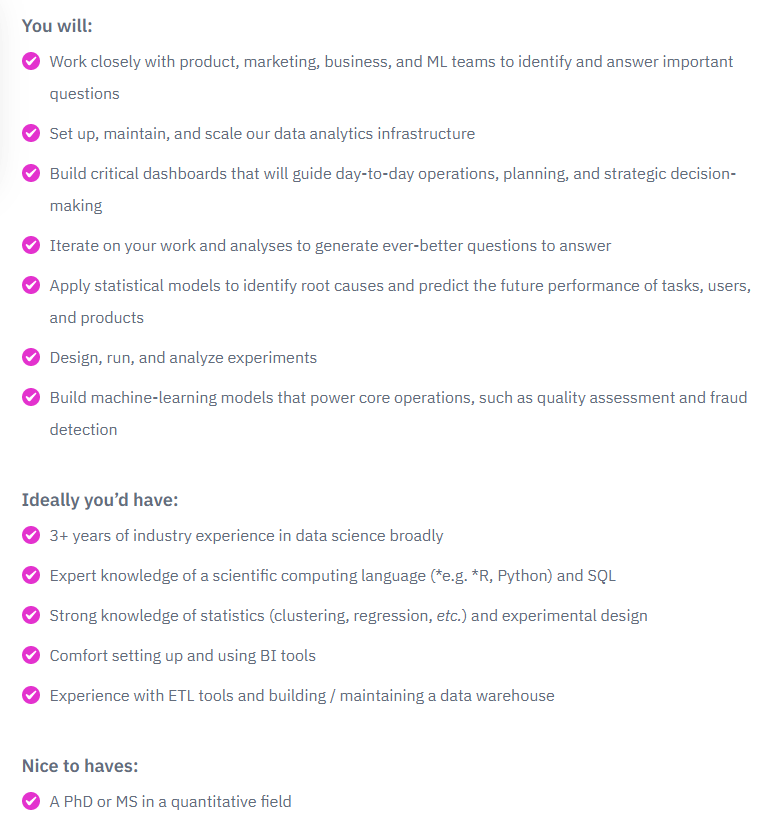
In the “Ideally, you’d have” section, they mention they want someone who has “Experience with ETL tools.” Let’s say that in reality, the candidate had a large role in building out data pipelines in his fictional role as a senior data scientist at EdTech Company.
So all we’d do is change that section of his experience at EdTech Company to talk about that project, as you see below:
Data science resume customization example
Original bullet on the resume: Worked closely with the product team to build a production recommendation engine in Python that improved the average length on the page for users and resulted in $325k in incremental annual revenue
Customized for the role: Built the company’s ETL pipeline with Airflow, which scaled to handle 2M+ concurrent users with robust alerting/ monitoring

How to customize your data science resume for startups
For early-stage startups (anything less than 50 employees), one of the most important qualities they’re looking for in a hire is ownership. That means they want someone who is:
- Constantly evolving
- Can ask a question and come up with an answer themselves.
If you want to stand out, you should demonstrate ownership (even if it’s just for data cleaning) in the way you list projects on your resume. Start bullet points with strong action verbs like ‘analyzed’ or ‘developed’ and avoid passive language like “worked on” or “collaborated on.”
We know it seems nit-picky, but this matters to early-stage companies. Hiring managers at companies this size are strained for time and will use any signal to weed people out.

Resume tips for data science bootcamp grads
For a bootcamp graduate, lean more on your projects for credentials.
To showcase them well, include:
- Bootcamp name, when, and where
- Relevant tools/languages learned
- Capstone project with clear impact—results, audience, and tech used
- GitHub
Example project bullet:
- Built a movie recommender system using collaborative filtering in Python with Scikit-learn, which saved 22 minutes per session and reached 96% satisfaction in user tests.

Common mistakes to avoid on a data scientist resume
Regardless of how strong a candidate you are, you can lose interviews over these avoidable mistakes. Here are some key tips for what to avoid:
- No quantified results
- Stuffed skills section
- Inconsistent formatting
- Wrong or missing contact info
- Generic content without focus on the specific role
Concluding thoughts
There you have it. A compelling, easy-to-read data science resume built for 2026. Now you can celebrate by doing something as fun as writing a resume. Maybe your taxes? Or go to the dentist?
By building or updating your current resume, you took a huge step toward landing your next (or first) data science job. We can’t repeat this enough, but check your grammar and spelling again and have someone else read your resume. Don’t let that be the reason you don’t get an interview.
Congrats! The first and hardest step is done. You have a data science resume! With great power comes great responsibility, so go and apply wisely.
Land your next job with our AI-powered, user-friendly tool.
Gut the guesswork in your job hunt. Upload your existing resume to check your score and make improvements. Build a resume with one of our eye-catching, recruiter-friendly templates.
• Work in real-time with immediate feedback and tips from our AI-powered experience.
• Leverage thousands of pre-written, job-specific bullet points.
• Edit your resume in-line like a Google Doc or let us walk you through each section at a time.
• Enjoy peace of mind with our money-back guarantee and 5-star customer support.
Data Scientist Resume FAQs

A data scientist resume must list and use technical, statistical, and communication skills. Show evidence of using these core tools/skills:
Python
NumPy
TensorFlow
Power BI
Storytelling with data
Stakeholder communication
Collaboration skills
GCP
Always keep your resume to one page, unless:
You have 10+ years of experience
You’ve published papers or patents
You’re applying for a role in academia or research
Pro tip: For most roles, relevance > completeness. Leave out projects or skills that don’t match the job.
A high-performing data scientist job description = clarity + context + niche/industry keywords.
As much as possible, include these elements:
Role overview
Key duties
Required stack
Team/leadership context
Outcomes + impact
Example:
Developed predictive churn models for a telecom SaaS platform, using Python, scikit-learn, and Snowflake, collaborating with CX and CRM teams, resulting in a 22% reduction in customer churn over 6 months.
Present your data scientist resume in a clean, ATS-optimized format that prioritizes technical credibility and project impact.
Follow this structure:
Single-column layout
Consistent fonts and spacing
Standard headers— Contact, Experience, Skills, Projects, Education, Certification, etc.
In PDF or DOC unless otherwise stated
Stephen is the co-founder and CEO of BeamJobs. Frustrated with the challenges he'd faced
in his own job search, he left the corporate world to start BeamJobs with his brother. Drawing
on firsthand experience with hiring and getting hired as technical talent, he started BeamJobs
in 2020 to help qualified job seekers land interviews with less stress. Since then, more than 4
million people have built their resumes and cover letters on BeamJobs. Stephen's insights have
been featured in notable outlets, such as Fast Company, Business Insider, Yahoo Finance, MIT, and Zapier. Learn more about Stephen.