



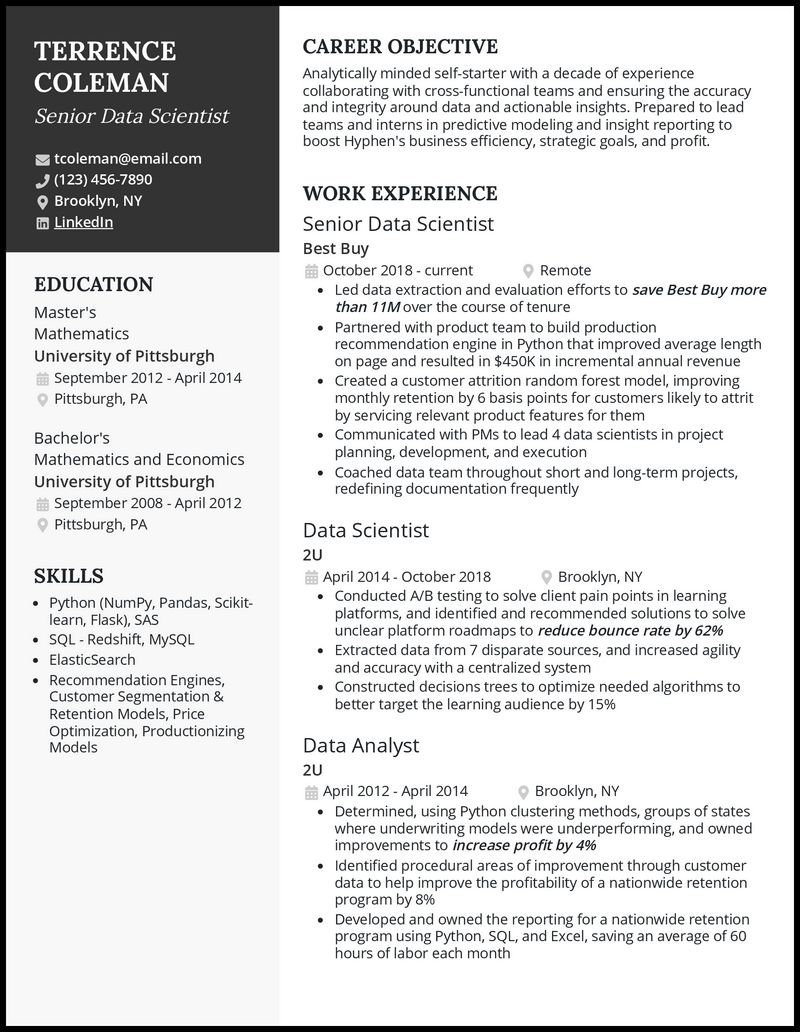


Senior Data Scientist


Best for senior and mid-level candidates
Resume Builder
Like this template? Customize this resume and make it your own with the help of our Al-powered suggestions, accent colors, and modern fonts.
 Build my resume
 Break into top-tier data science roles by learning how to create a resume that showcases both your technical expertise and your ability to drive business impact.
This guide reveals what separates a good resume from a great one and shows how an AI resume builder can help you organize complex achievements into a clear, recruiter-friendly format.
Here’s what we’ll cover:
- ↪ 5 senior data scientist resume templates you can adapt to your career path
- ↪ How to prioritize the right programming languages, tools, and methodologies
- ↪ Smart ways to present projects, publications, and measurable results
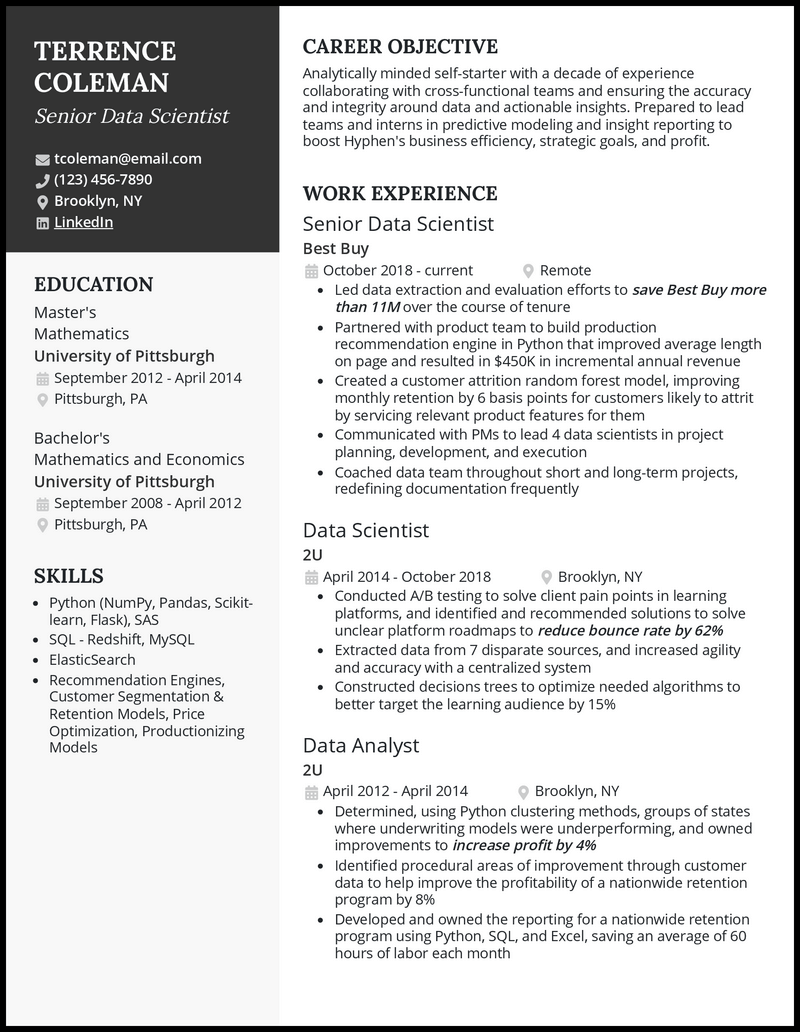
Why this resume works
- Let’s be real here, if there’s one thing that businesses need from you, it’s extracting data that can actually help them make profits.
- Sure, people love visual dashboards and clearing raw data is important but try revisiting times in your career when you helped companies with financial success. Include clear, metric-based points in your senior data scientist resume like saving X company $1.2M or increasing annual revenue by $450K and prove that your work drives profits.


How to Write a Senior Data Scientist Resume

Stand out in one of the most competitive fields by crafting a senior data scientist resume that highlights both your technical depth and your ability to turn data into business value.
Summary
Showcase your value by crafting a senior data scientist resume that not only highlights advanced technical skills and leadership experience but also quantifies impact through clear metrics that prove your ability to solve complex problems and drive business results.
In this section, we’ll break down exactly how to present your expertise in a way that recruiters and hiring managers can’t overlook.
What we’ll cover:
- The most critical technical and soft skills for senior data scientists
- How to structure experience so it shows progression and leadership
- Using metrics to prove measurable impact
- Showcasing projects, publications, and real-world problem solving

Start right with a career summary
Your summary is the very first impression, so make it specific and memorable. In two or three lines, highlight your years of experience, your strongest technical focus areas, and the kind of business results you consistently deliver.
Go beyond a list of skills—frame yourself as a leader who connects data with outcomes. If you need inspiration, a resume headline generator can help spark ideas for phrasing that captures attention.

Showcase business acumen backed with impact
At the senior level, hiring managers expect you to demonstrate how your work shapes strategy, not just models. Show how you’ve turned data into actions that reduced costs, boosted revenue, or launched new product features. Every example should answer the question: how did this make the business stronger?

Pack the skills section with data science competencies
Your skills section will give recruiters a speedy snapshot of your capabilities. And, while your senior role is bound to involve interpersonal finesse, you’ll still want to focus on technical abilities like Production Models.
Recruiters want to see advanced, honed skills if you’re applying for a senior role. If you’re at a senior level, you should easily be able to list names like Redshift and NumPy to show you’ve been sharpening your knowledge for years.
Keep your skills list extremely relevant to your profession, and get specific! Be crystal clear about each complex process and program you use:
9 most popular senior data scientist skills
- NumPy
- Scikit-Learn
- Redshift
- My SQL
- Elasticsearch
- Retention Models
- Price Optimization
- Production Models
- Customer Segmentation

Show why you deserve this role with past measurable achievements
If your skills section is like a “preview” telling recruiters what to expect, then your experience section is the main event! Your experience shows how you apply your abilities, like customer segmentation, in creative ways to benefit the company’s strategies and revenue.
Recruiters also want to see a strong advancement trend throughout a senior data scientist’s resume. They also want to see that you’ve left a significant and positive impact through your data usage and informed strategy along the way!
It’s crucial to measure your impact with quantifiable data, too—just like you’d verify success metrics on the job.
Here are a few examples:
- Partnered with product team to build production recommendations in Python that improved average time spent on page, increasing incremental annual revenue by $447K
- Developed and owned the reporting for a nationwide retention program, using Python, SQL, and Excel to save an average of 63 hours of manual labor monthly
- Led data extraction and evaluation efforts to save over 11M over the course of tenure
- Used Python clustering methods to pinpoint groups of states where underwriting models were underperforming, owning improvements that increased profits by 6%
- Constructed decision trees to optimize algorithms that improved learning audience targeting by 14%

Present your measurable contributions in projects
Numbers tell your story best. For each project, describe the problem you solved, the tools or models you used, and the results in measurable terms—improved accuracy, time saved, or revenue gained.
For example:
- “Improved forecast accuracy by 22%” or “Cut reporting time by 15 hours a week through pipeline automation.”
Using resume templates can help you present these results clearly and consistently.

Pack your value in bold data science active verbs
Strong verbs keep your resume energetic and credible. Words like built, deployed, scaled, engineered, optimized, automated, delivered show leadership and impact right away. Avoid softer phrasing like “helped with”—you want every line to sound like ownership.

Detail your career growth
Employers want to see how you’ve advanced, not just what you’ve done. Highlight promotions, added responsibilities, leadership of junior staff, or cross-functional projects. This proves you’ve grown into senior-level influence.
If your earlier roles feel repetitive, an AI resume rewriter can help polish older entries so they emphasize your progression without overwhelming the page.

Leverage relevant education appropriately
Education matters, but it should support—not overshadow—your professional achievements. List your highest degrees and any advanced coursework in machine learning, statistics, or computer science. Keep it concise, but make sure it reinforces the expertise you bring to the table.

Highlight data science certifications (if available)
Certifications say you’re credible and show that you’ve kept pace with evolving tools. Credentials like AWS Machine Learning Specialty, TensorFlow, or Microsoft Azure Data Scientist add weight to your profile. List only those that are recent, recognized, and directly relevant to the role.

Customize your resume to the role, company, and industry
Every senior data scientist role is unique. Tailor each version of your resume to the employer’s priorities, whether that’s healthcare analytics, e-commerce personalization, or enterprise AI.
Tools like a LinkedIn resume builder can help align your online presence with your submitted resume, while a professional resume review ensures your content hits the right notes for each industry.
Top 5 tips for your senior data scientist resume
- Don’t squander your career objective
- Only generate a headline, summary or objective statement if it adds value, especially in a senior role. It’s reasonable to sum up your vast data analysis and modeling experience with an intro paragraph—just don’t repeat your experience points! Make it worth the space.
- One page only!
- No, really. Even for someone with your level of experience! In fact, successfully condensing your accomplishments into a clean, one-page resume demonstrates your ability to consolidate data like a pro.
- Don’t forget to exhibit growth
- Recruiters want to see a clear demonstration of your ability to learn and grow throughout your career. Avoid citing examples in your recent experience sections that are just as simple as those you started with—mention A/B testing and forest models.
- Highlight your versatility
- As a senior data scientist, you’ll be working with a wide variety of programs, strategies, and teams. Make sure you show your ability to stay versatile and adapt to new environments by including a variety of experiences and metrics.
- Show project ownership
- There’s lots to do at your level, and recruiters need to know you’ve got this! Demonstrate project ownership by working in bullet points that address all parts of the strategy planning and project lifecycles. Project management is something you should spend time focusing on when writing a cover letter, too.

Key takeaways
- Impress with role-aligned career summary
- Connect your expertise to outstanding results
- Showcase direct input to projects
- Deploy active verbs as value backups
- Detail steady career growth
- Use education and certifications to be unique
- Customize for each role, aligning with industry priorities
- Don’t submit with a single error
Senior Data Scientist Resume FAQs

Let your personality shine through your resume by referencing the senior data scientist job description for any key phrases or values (like efficiency or quick results) that you align with. Reflect these concepts in your writing style. You can also use a small burst of color for a header or two—but keep it minimal!
It should be simple, structured, and achievement-driven. Place a career summary at the top, followed by skills, detailed work experience with measurable results, education, and certifications. Keep formatting clean and ATS-friendly.
Senior data scientists are best off using whichever resume template emphasizes their experience the most. Your skills and education are important, but nothing can hold a candle to quantified examples of the previous impact you made with your programming skills!
Reverse-chronological works best. It showcases your most recent experience first and highlights your career progression into senior or leadership roles.
Yes. Bolding your titles makes it easier for recruiters to see your career trajectory quickly. Use consistent formatting—bold for titles, italics for companies if desired, and keep dates aligned.

Stephen is the co-founder and CEO of BeamJobs. Frustrated with the challenges he'd faced in his own job search, he left the corporate world to start BeamJobs with his brother. Drawing on firsthand experience with hiring and getting hired as technical talent, he started BeamJobs in 2020 to help qualified job seekers land interviews with less stress. Since then, more than 4 million people have built their resumes and cover letters on BeamJobs. Stephen's insights have been featured in notable outlets, such as Fast Company, Business Insider, Yahoo Finance, MIT, and Zapier. Learn more about Stephen.