



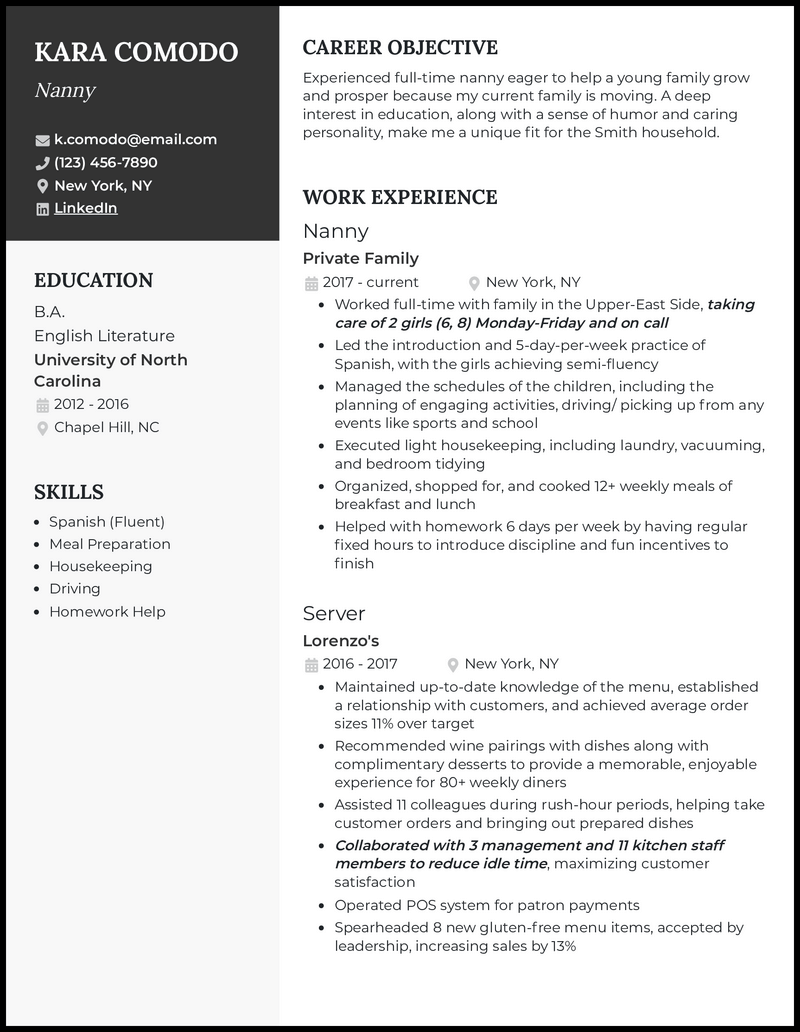
Families and recruitment agencies want to see more than basic childcare skills — they want proof that you can provide safe, family-friendly, and developmentally supportive care. Your nanny resume should highlight your hands-on experience, present relevant childcare certifications, and specify the age groups or specialties you are qualified to work with.
Whether you’re applying for a live-in nanny, infant care specialist, travel nanny, tutoring-focused caregiver, or special needs nanny, build a resume anchored on trust, adaptability, and genuine warmth — the traits every modern family values most.
You’ll learn in this guide how to:
- ↪ Use 17 real nanny resume examples that helped caregivers land jobs in 2026
- ↪ Put context to your strengths by writing a strong cover letter that showcases empathy, organization, and reliability
- ↪ Tailor your experience and skills to match the exact role and family needs
Why this CV works
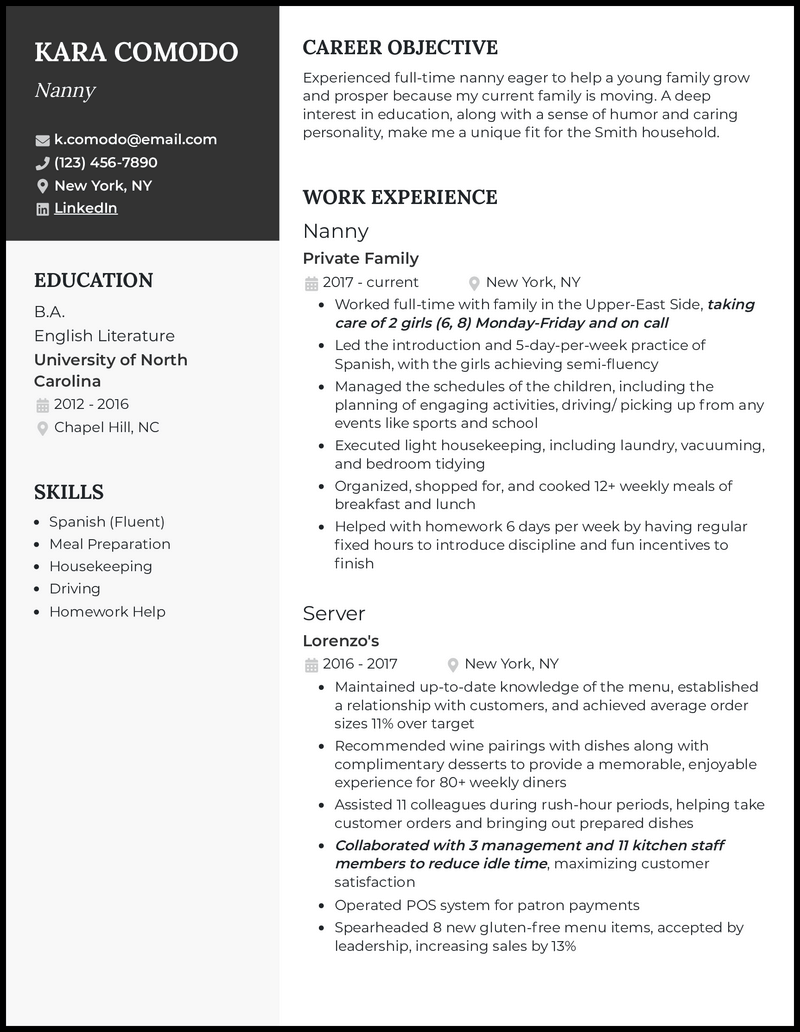
- Your nanny resume should paint a picture of the overall breadth of your work experience. If you’re new to nannying, you can consider adding a resume objective to give a short overview of your experience, skills, and enthusiasm for the position.
Why this CV works
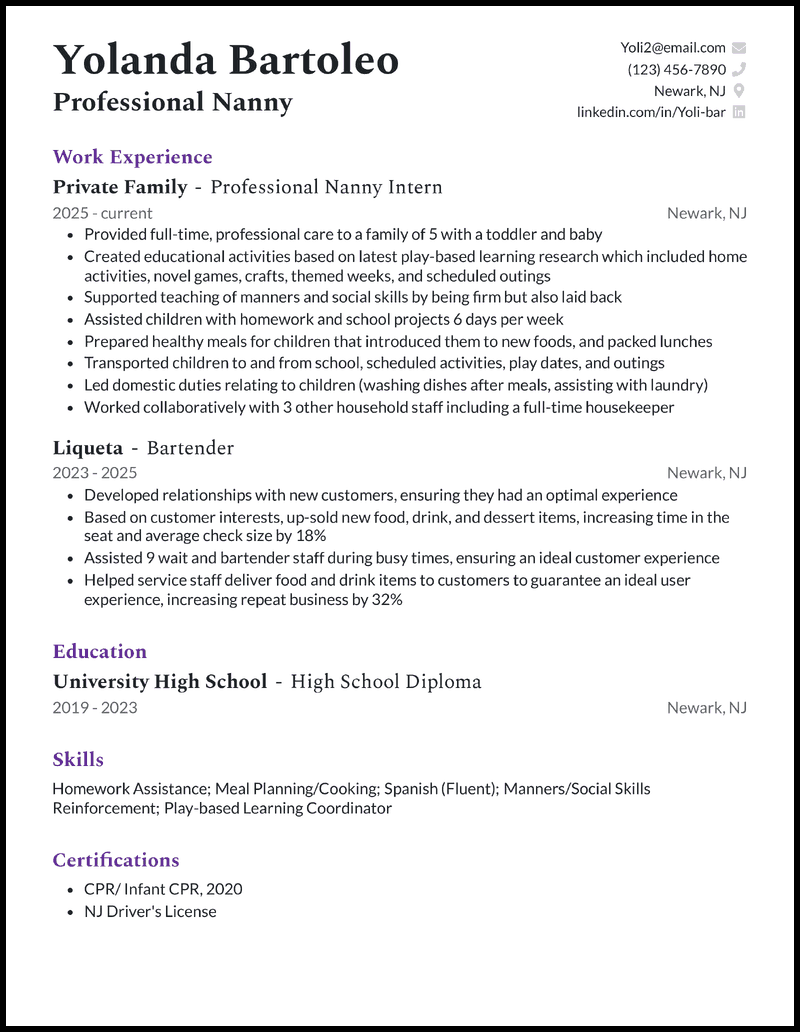
- Most families require qualifications before they hire a nanny, so it’s essential you add (and frequently update) a qualifications section on your professional nanny CV as well as use a CV format that has room for such.
Why this CV works
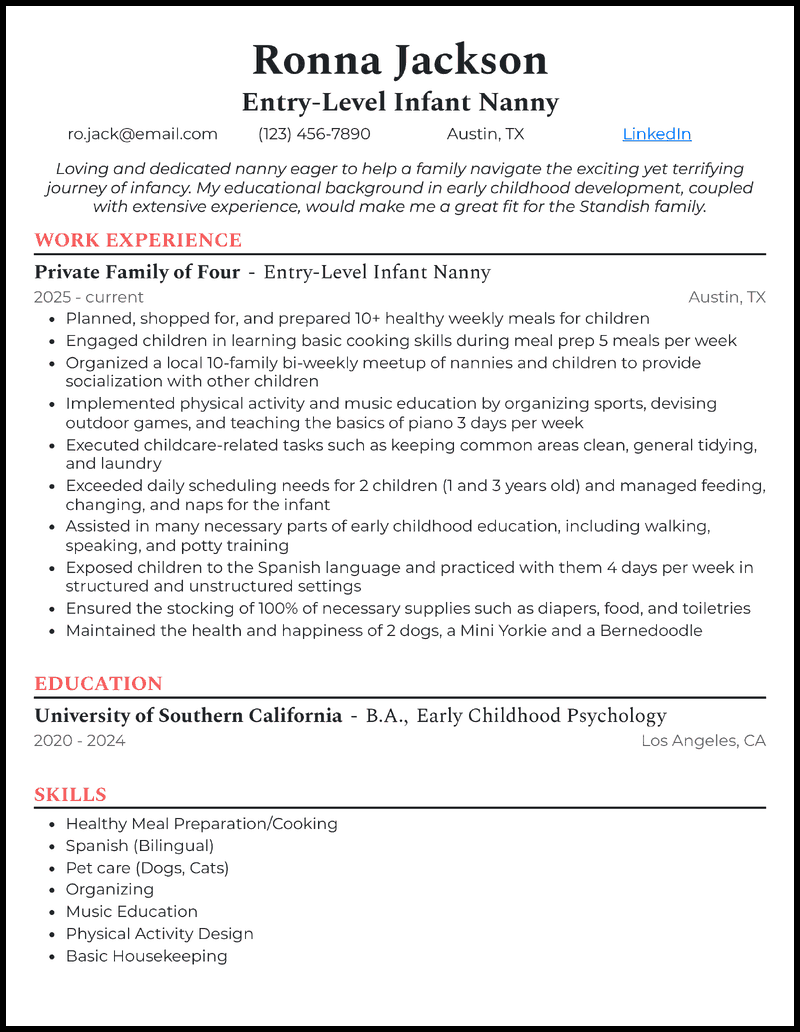
- No matter what nanny job you’re shooting for, always customize your infant nanny resume for each job to which you apply. Read the nanny job description thoroughly and mirror its language in the objective
See more infant nanny resumes >
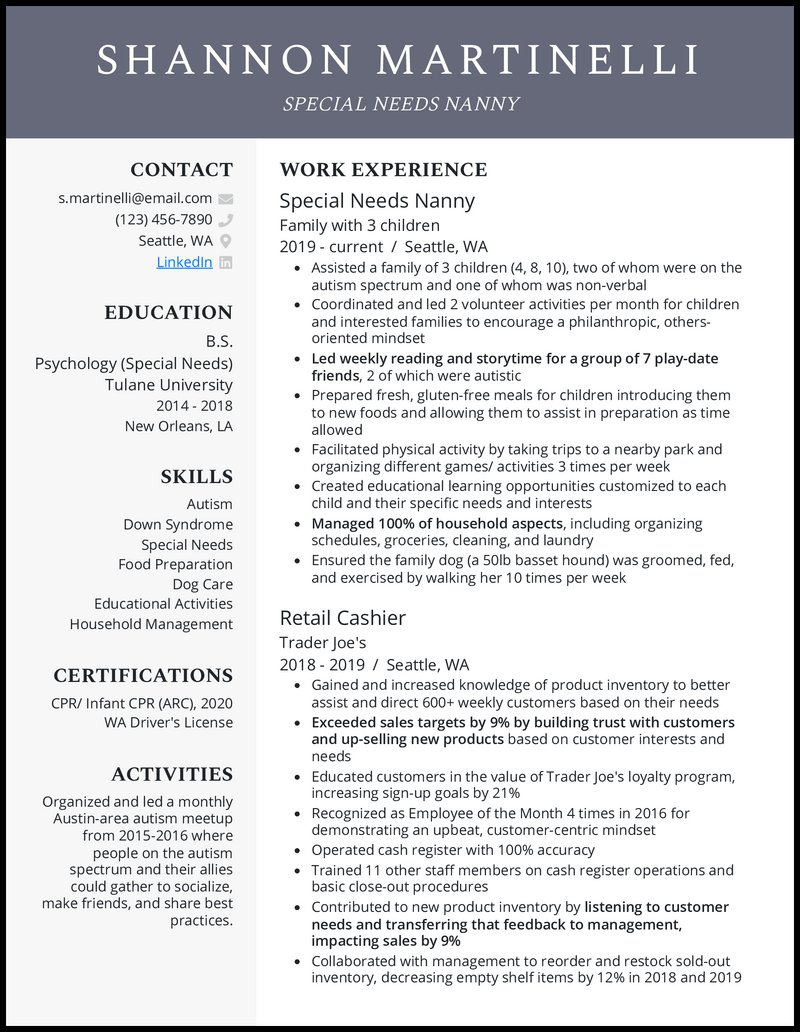
Why this CV works
- Be as specific as you can on your special needs nanny resume with your work experience bullets and skill keywords so your future employer knows exactly what you can handle. If you’ve got the room, adding a hobbies and interests section can help you show off your personality and reinforce your skills.
See more special needs nanny resumes >

Why this CV works
- Use quantified metrics to ensure your newborn nanny resume proves you’re the ideal fit for the job. Impacts, such as “reducing safety incidents by 11%” and “increasing weekly toddler engagement by 32%,” are evidence that you’re a pro at keeping little ones safe.
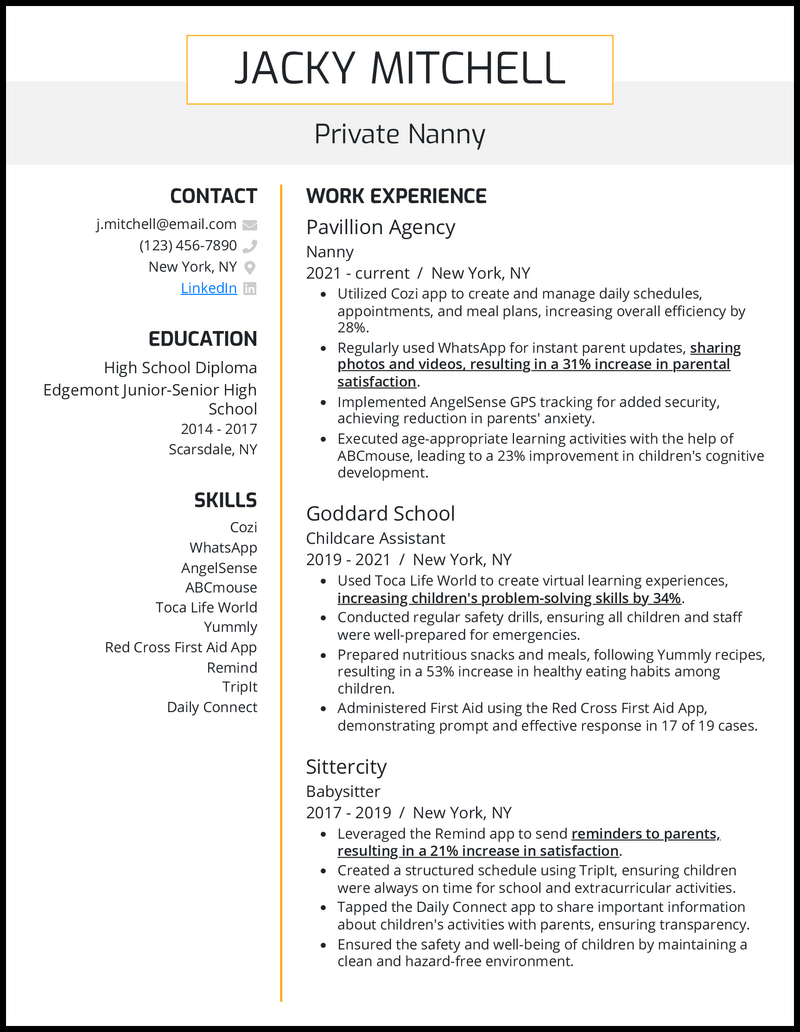
Why this CV works
- Much of your work will involve young children who are in their early developmental stages. Therefore, an appropriate highlight in your private nanny CV would be how you set the little ones on a path to success in various areas.

Why this CV works
- Showcasing your mastery of communication tools like WhatsApp and child-friendly apps on your high-profile nanny CV is like revealing a treasure trove of modern-day Mary Poppins-like skills.
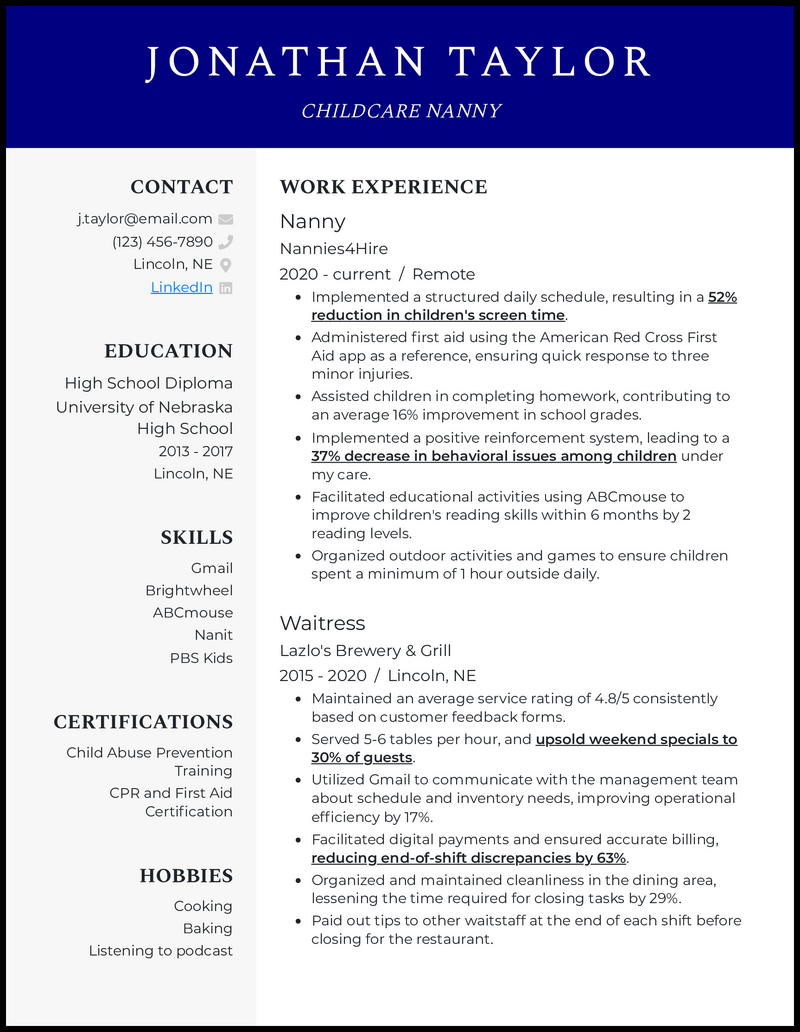
Why this CV works
- Highlight First Aid or CPR certifications doesn’t only make your childcare nanny resume standout but also underlines your commitment to child safety and professional development.

Why this CV works
- From highlighting key achievements from each role and showcasing your teaching software expertise, to including personal details without feeling cramped, it mirrors your teaching capabilities: structure, clarity, and a touch of finesse. It’s almost like an educational equivalent of a well-organised lesson plan.

Why this CV works
- A live-in nanny CV stands out when tailored to the job description. At the very least, use keywords from the job advert to ensure your CV passes through the applicant tracking system’s filter that scans application documents for relevance before they reach the hiring manager.

Why this CV works
- Customize your family nanny resume to echo the job description. Let’s assume time management is on the list of must-have skills. Throw in a line about reducing the completion of chores by 32 minutes in your employment history.
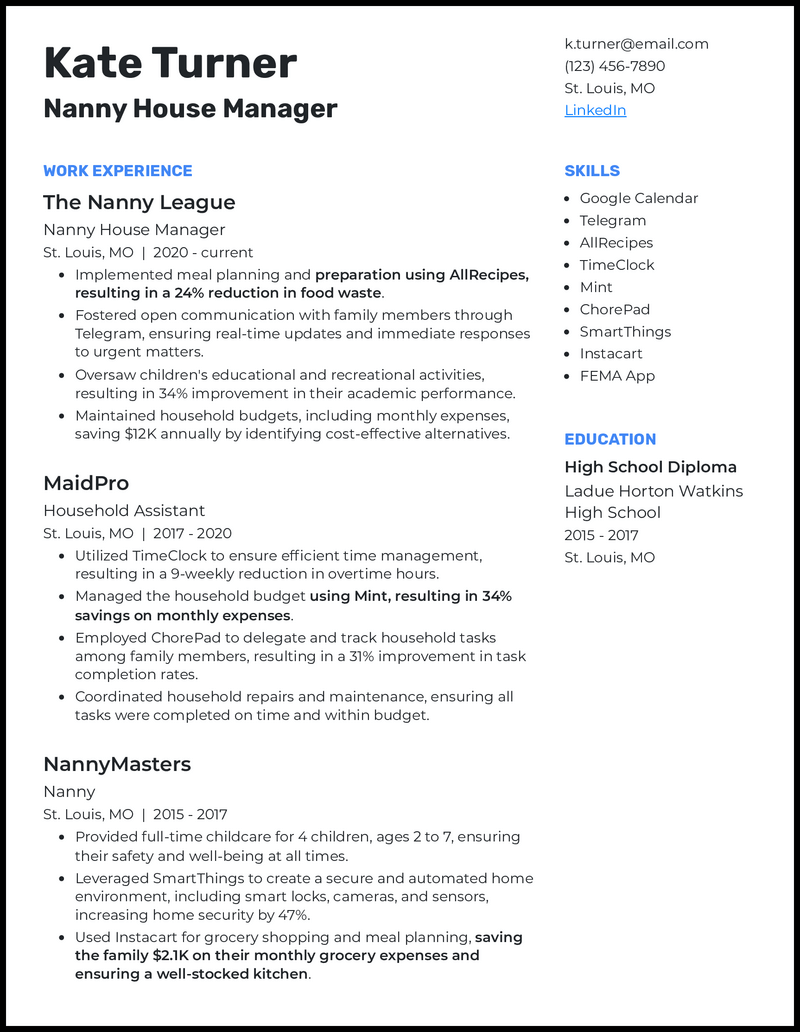
Why this CV works
- How brilliant are you at saving on household expenses? You’d better be, and make sure to demonstrate it in your nanny house manager CV, as families are tightening their belts with rising bills.
Why this CV works
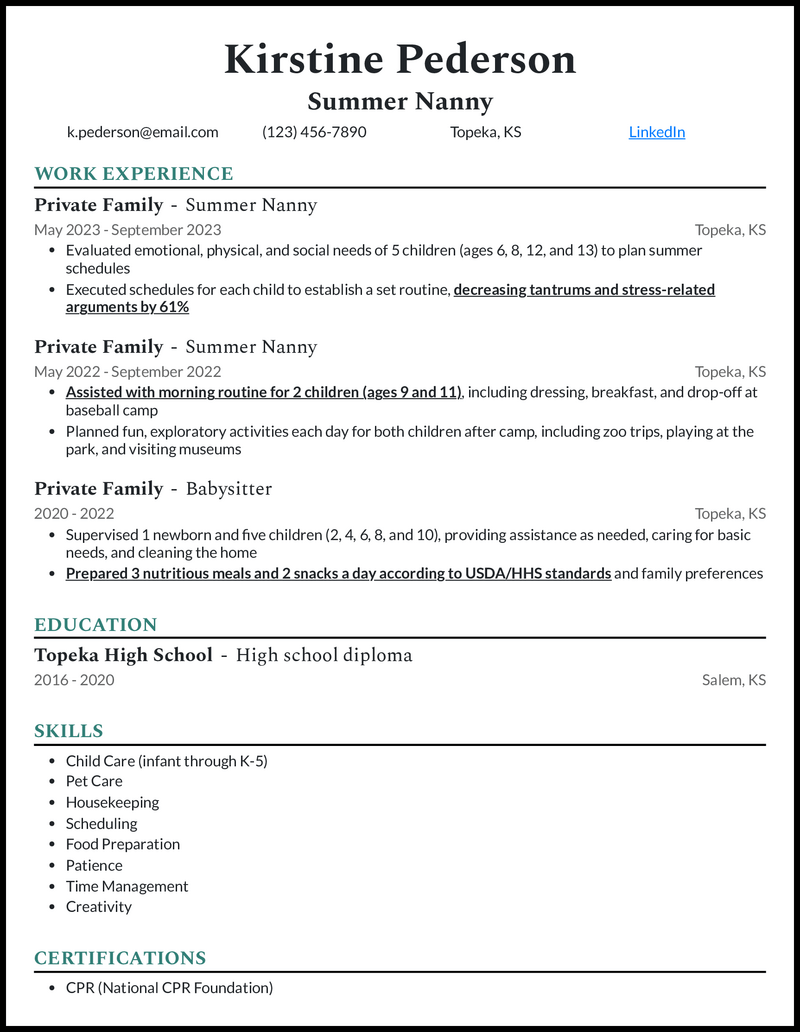
- To make your summer nanny resume cohesive, align your resume skills section with your work experience. For example, if you made schedules for three children, then mention that in your work experience and list it as a skill.

Why this CV works
- Your babysitting nanny resume should tout proficiency in child-friendly apps and communication tools -Draw It and JustTalk Kids- to emphasize your dedication to both care and communication.
Why this CV works
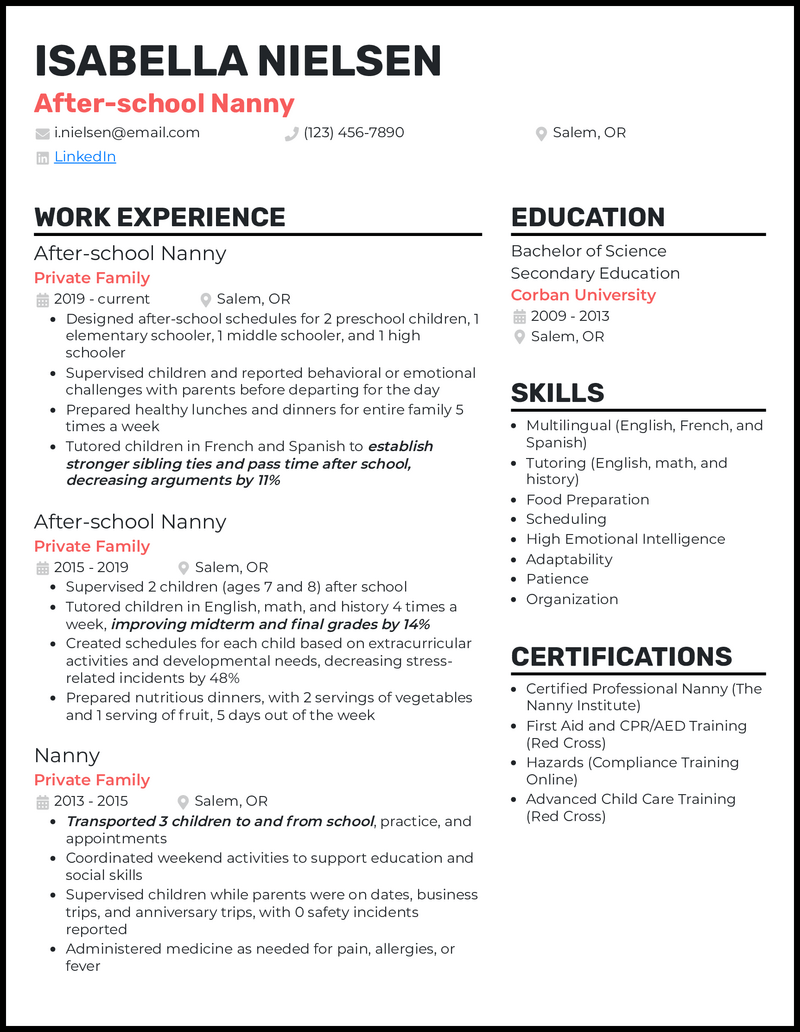
- Nannies are frequently a teacher, a cook, a guardian, and a friend, but how are you supposed to put all that on your after-school nanny resume? Start by using a resume outline, then build from there. Once you’ve written all your responsibilities down, narrow each position’s experience until you have three to four targeted bullet points.
Why this CV works
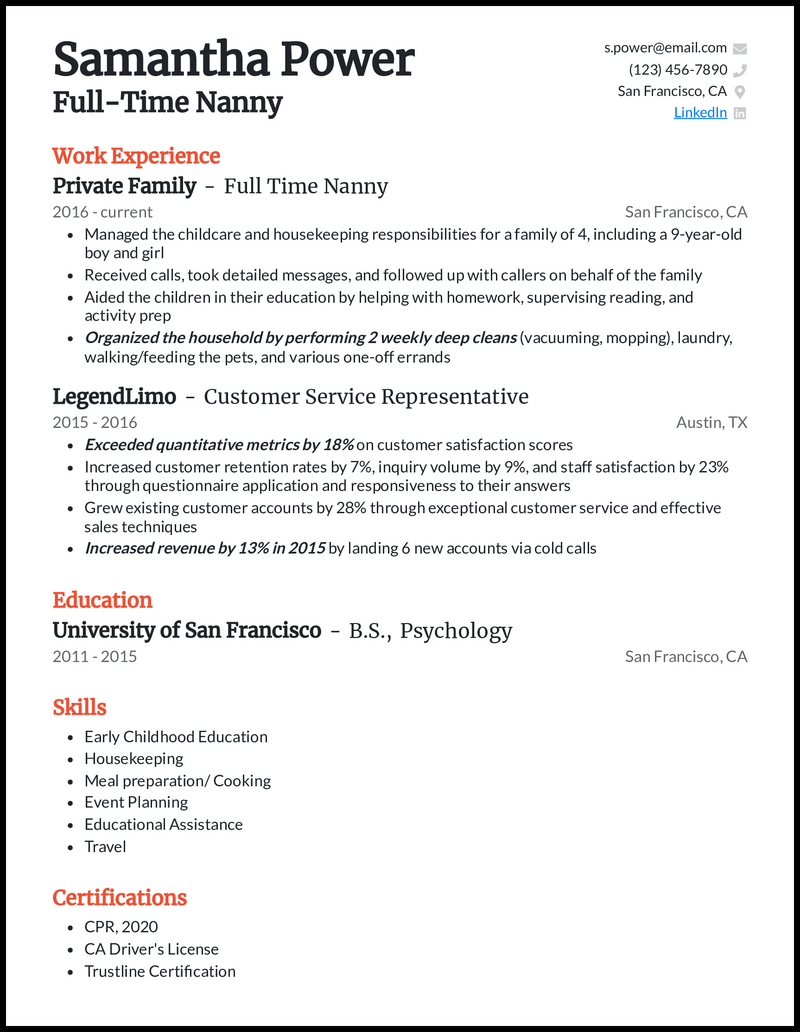
- Using a resume template can help you structure your ideas, but make sure you adjust it to fit your content. You can add sections, bullet points, and even social media links to fill out your full-time nanny resume, but keep your font size and margins relatively big so it’s easy to read.

Why this CV works
- A sole charge nanny CV that’s easy to read could be your ticket to convincing the recruiter of your nannying skills and securing that fantastic job offering good pay, paid holiday, a car, and even a generous amount of respect.
Related CV guides
How to Write a Nanny CV

Craft a nanny resume that proves you’re more than a babysitter; you’re a trusted professional families can rely on. Prove to families that you want the best for the young ones: helping them grow, nurturing, and protecting them.
So, when you write a CV for a nanny job, you must come across as caring and responsible, and highlight skills that emphasise your professionalism and make you relatable.
Here, you’ll discover:
- How to write a CV that feels personal and professional
- What families want to see on a nanny CV
- How to describe your childcare experience with real-life examples
- The correct way to list qualifications such as CPR, First Aid, or newborn care
- How to highlight special skills—such as cooking, tutoring, or being ready to travel
- Writing a brief yet friendly summary that fosters trust
- Clever formatting tips that make your CV easy to scan
- Adding personality without sounding unprofessional
For inspiration, you can review these CV examples before we begin working on your job-winning CV.

Share contact details
Your contact section may not be crucial in hiring you, but it’s the first thing to demonstrate your professionalism to recruiters. Ensure the information is clear and visible—no confusion, no searching.
Include your:
- First and surname
- Professional email address (avoid playful nicknames)
- Personal phone number
- Town and county
- Optional: a link to a childcare portfolio or first aid certification (if online)

How and when to write a summary or objective
Grab attention with a powerful and concise summary of your qualifications. Let recruiters know from the outset that you’re the genuine article by writing a summary that:
- Emphasises relevant experience
- Includes skills required for the job
- Displays one standout result from previous work
If you’re an experienced nanny, use a CV summary like the example below:
Example
Trusted house manager and nanny for 8 years with childcare expertise, strong leadership, and organisational skills. Assisted families in reducing monthly expenses by 28% through streamlining orders, minimising waste, proper budgeting and planning. Committed to consistency and empathy as the core foundations every child needs to thrive.
If you’re new to nannying, use a career objective such as the example below:
Example
Aspiring nanny keen to bring my practical childcare experience from organising child-focused activities in local community centres to the nurturing environment at Bright Horizons Family Solutions. With strong communication, emotional intelligence, and crisis response skills to support a safe, engaging, and development-focused space for every child.

How to demonstrate impactful past nanny work experience
If you just list past jobs, recruiters will be bored. Instead, impress them with the impact from relevant employment or projects to fit the modern components of a nanny CV.
Simply listing your past jobs is not enough to impress parents or agencies. Instead, focus on showing the impact you had in each role and highlight how you made a difference for the children and families you worked with.
In your experience section, pick two or three jobs that closely match the position you want. For each job, write three or four bullet points that start with an action word and include your skills, both technical and personal, plus any results you can measure. This approach helps your resume stand out to both software and recruiters.
Why and which metrics matter?
Metrics show what you can do and how you have used your skills on the job. Using them well helps recruiters see the value you offer.
Useful metrics for nanny jobs include things like timeframes, how often tasks are done, safety records, better communication, and client satisfaction scores. Use these details when they fit your experience.
Relevance is key
Every nanny job is different based on what each family needs. If a job ad highlights child safety, education, or housework, make sure your resume focuses on those areas.
Examples of nanny resume work experience bullet points
- Provided full-time care for two children (ages 6 and 8), organizing 10+ educational activities weekly that boosted their engagement and learning
- Spearheaded a 5-day-per-week Spanish program, resulting in 12 of the 18 participants achieving semi-fluency
- Optimized schedules and activities for 3 children, achieving on-time arrivals for sports and school events

How to include relevant education and certifications
While a degree isn’t necessary for a nanny, you must still include relevant training and certifications. Some parents value foundational knowledge, and demonstrating some education or relevant credentials would help secure you the job.
Relevant training and specialty recognitions speak volumes about your professionalism in child safety, nourishment, and development. Whatever level of education or training you have, this section validates your expertise and establishes trust.
List your most relevant and recent education
It could be your degree, a diploma, or a certification directly related to childcare. Include it with the title of your area of study, the school’s name, when you graduated, and location (city and state).
Example
Associate of Arts in Early Childhood Education
Los Angeles Community College
2022-2024
LA, CA
If you’ve also completed relevant courses in special needs support or developmental psychology, add that under “relevant coursework” to further prove your qualifications for the role.
How to highlight key certifications
Certifications take it one step further to confirm that you’re not merely qualified, but also committed to the best practices in childcare and learning. When listing such credentials, include the certification’s title, issuing body, and date of expiration, if applicable.
Examples of certifications for a nanny resume
- CPR and First Aid Certification (American Red Cross)
- Child Development Associate (CDA)
- Certified Newborn Care Specialist (NCS)
- Nutrition or Food Safety Training
- Background Check or TrustLine Registration (for U.S. nannies)
How to align your education and certification to the job description
If a family requests specific qualifications, such as bilingual skills, special needs experience, or educational development, give those credentials more prominence near the top of your resume or mention them in your professional summary. You’re meeting the requirements for the job and ensuring your resume is visible and friendly to screening bots.

How to tailor your resume to the specific role
Each job is different and requires a CV tailored specifically to the role. You should do the following to customise your CV:
Tailoring your nanny CV means:
- Carefully reviewing the job description
- Reflecting role-specific keywords
- Only including experience and skills that match what they are looking for
Example
If a family is looking for a nanny who also drives, make sure your valid driving licence is clearly visible. If they want someone to also tutor the children, share your experience with homework assistance or tutoring via online educational platforms.

How and which nannying skills matter?
As a nanny, your most significant role is taking care of children. You play a crucial role in their development, well-being, and easing the care burden on families. To be suited for these tasks, you should possess nurturing and caring abilities, along with a range of other skills such as the ones we list below:
Core childcare and household management skills
Keeping the household running smoothly, while putting the best interests of the kids first, will be a major part of your job. You need these competencies:
- Infant and toddler care
- Bathing, feeding, and diapering
- Meal plans and preps
- Activity scheduling and routine management
- Time management and reliability
Educational and developmental skills
Children’s development thrives through creative play and structured learning experiences. Parents expect that you will be part of that early development support by having these skills:
- Early childhood education principles
- Montessori or play-based learning
- Arts, crafts, and music activities
- Social and emotional skill building
Interpersonal and emotional intelligence skills
Your soft skills matter as much as your technical abilities. They’re proof that you can communicate and connect with children and their parents. The skills you need here include:
- Patience and empathy
- Adaptability
- Excellent communication
- Multi-tasking and teamwork
- Cultural awareness
- Deep-rooted family values
Specialized or advanced skills (for specialized jobs)
Some nanny jobs are specialized and require you to possess specific skills or abilities. Here you can include:
- Newborn care and sleep training
- Autism support
- Bilingual/multilingual communication
- First Aid and CPR certification
- Sensory integration strategies
How to match skills to the job description
Review the job posting for recurring keywords such as meal prep, tutoring, infant care, or schedule coordination. Those are part of the job’s requirements, and you should incorporate them in your skills, experience, and certifications sections to help further align your profile with the role’s expectations.

8 Nanny CV mistakes to avoid
- Poor format: The wrong format reflects on your skills as a nanny. A cluttered layout, difficult-to-read text, erratic fonts, and inconsistent font types and sizes suggest you’re disorganised and lack attention to detail. Avoid this by ensuring everything is well-spaced, clear, and professional.
- Bullet points without details: If you simply say, “prepared meals for children”, you’re not saying much. You need to add details to demonstrate impact. Mention hours, number of children, and measurable results.
- Grammar mistakes: Typos and other grammatical errors create a poor first impression. Proofread your CV several times and eliminate those mistakes.
- Irrelevant information: Not everything in your work history enhances your suitability as a nanny. Only focus on what the job requires.
- Keyword stuffing: CV keywords are like medicine; they are effective only when used in the correct dosage. Don’t overuse skills and other key phrases you picked from the job advert.
- Ignoring education and qualifications: While education and qualifications for nannies aren’t top of the list on recruiters’ checklists, you can’t ignore them as long as they’re relevant.
- Not explaining career gaps raises concerns: Tell potential employers what you did during that time.
- Writing a generic CV: A CV not tailored for the specific job may not get you on the shortlist. Avoid this by demonstrating relevant experience, skills, and other details recruiters require.

Key points
As you write your CV, remember to:
- Focus on how you care for children—not just where you’ve worked
- Demonstrate your abilities in a summary that reflects your personality and approach to childcare.
- Emphasise the specific age groups and types of families you’ve worked with
- Include certifications such as CPR, First Aid, or newborn care right at the beginning
- Mention any special skills—helping with homework, cooking, driving, or managing multiple children
- Use real examples to demonstrate how you manage responsibility and build trust
- Keep formatting tidy so busy parents or agencies can skim it quickly
Nanny CV FAQs

Nanny CV skills are competencies that highlight your creative and interpersonal abilities. They should focus on the well-being, growth, and development of children and on transforming homes into environments that nurture, protect, and guide them. It’s essential to align your CV skills with what the job requires.
Even for a part-time nanny role, you’re still expected to nurture, protect, and support the growth and development of children. To secure the job, include your childcare, social, and foundational skills that align you with the needs of children. Also, your education and relevant work experience will put you ahead of other candidates applying for the same position.
A nanny’s CV that stands out to parents and recruiters must demonstrate trustworthiness, efficiency, and warmth towards childcare. You want parents to fully entrust their children’s safety, growth, and development to you, so you must equally assure them that you’re up to the task. Your skills and success in a similar or the same role would get you closer to securing the position.
If your experience is less than 10 years, a one-page CV is sufficient to present your qualifications and persuade recruiters you’re suited for the role. You can use more than a page for 10 or more years of experience, but make sure you only include valuable information. Keep your CV focused on your top skills and achievements; your nanny cover letter should provide more details.
Secure your next job with our AI-powered, user-friendly tool.
Eliminate the guesswork in your job search. Upload your existing CV to check your score and make improvements. Create a CV with one of our eye-catching, recruiter-friendly templates.
• Work in real-time with immediate feedback and tips from our AI-powered experience.
• Utilise thousands of pre-written, job-specific bullet points.
• Edit your CV in-line like a Google Doc or let us guide you through each section one at a time.
• Enjoy peace of mind with our money-back guarantee and 5-star customer support.

Stephen is the co-founder and CEO of BeamJobs. Frustrated with the challenges he'd faced in his own job search, he left the corporate world to start BeamJobs with his brother. Drawing on firsthand experience with hiring and getting hired as technical talent, he started BeamJobs in 2020 to help qualified job seekers land interviews with less stress. Since then, more than 4 million people have built their resumes and cover letters on BeamJobs. Stephen's insights have been featured in notable outlets, such as Fast Company, Business Insider, Yahoo Finance, MIT, and Zapier. Learn more about Stephen.