



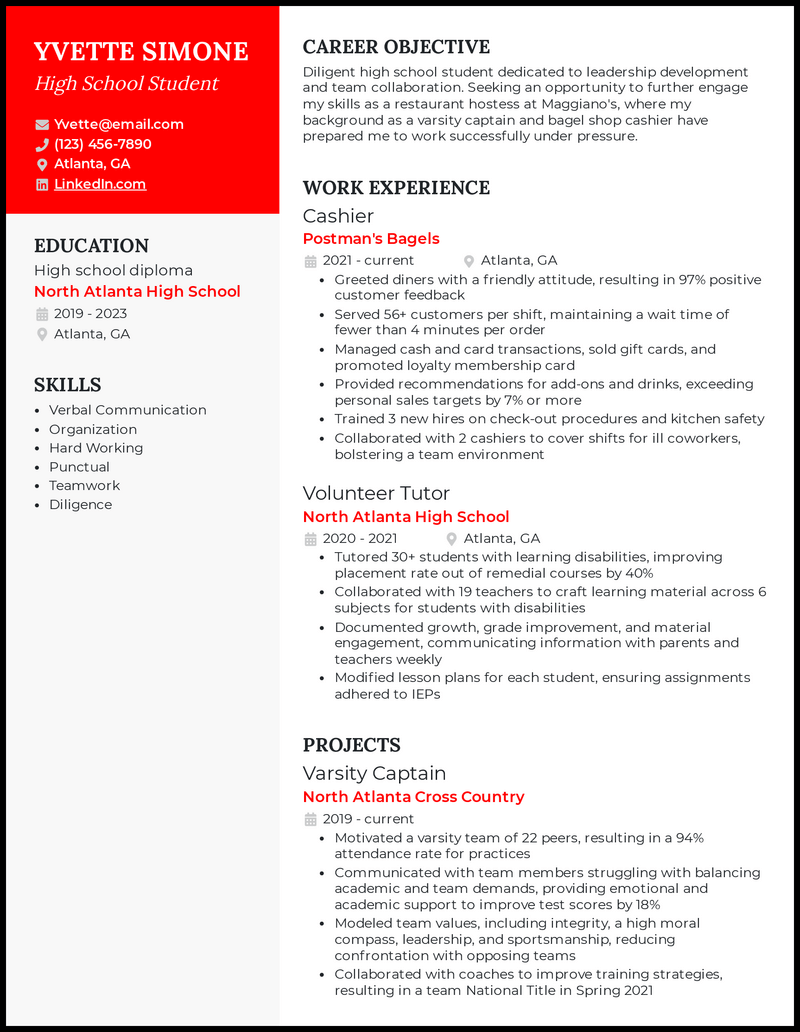


High School Student


Best for senior and mid-level candidates
Resume Builder
Like this template? Customize this resume and make it your own with the help of our Al-powered suggestions, accent colors, and modern fonts.
 Build my resume
 To write a secondary school student CV, start with what you have—not what you don’t. Include your education, grades (if they are 3.5 and above), coursework relevant to the industry, extracurricular activities, volunteering, and personal projects. Use clean CV templates that highlight key sections with clear headings and bullet points.
Describe each experience using action verbs and measurable results. You can demonstrate initiative, reliability, and skills even without direct work history. Include optional sections, such as languages, software tools, or certifications, to align your qualifications with the role as closely as possible. Real student cover letters and examples can help tailor your message.
If you use ChatGPT CVs to generate a cover letter or summary, always edit to sound specific and human.
This guide covers:
- ↪ 22 real secondary school student CV examples that got job offers in 2026
- ↪ What to include to show you’re the best fit, not just available
- ↪ How to format for clarity, not filler

Why this CV works
- Start by getting your CV’s formatting right. Ensure the text in all the sections isn’t squint-worthy (think font size 11-12) and setting the margins at one inch on all sides should be at the top of your list.

Why this CV works
- To make waves with our AI cover letter generator and let hiring managers know you’re the best fit for the role, you need a stellar secondary school graduate CV that shows what you bring. Including a tailored career objective statement could be the silver bullet that elevates your showpiece, making it irresistible.

Why this CV works
- Harness the power of a tailored career objective that summarises your experience, skills, and enthusiasm. This statement must align with the potential employer’s needs, demonstrating that you understand the job requirements and have gone the extra mile to address any doubts about your capabilities.

Why this CV works
- Schools won’t hand out funds freely—so clearly explain why you need a scholarship using the career objective. Present your quest for gaining knowledge to drive societal changes as a compelling argument that no school can overlook. Essentially, make them think, “We need this future reformer in our school.”

Why this CV works
- In the education section of your secondary school diploma CV, include your diploma, the school’s name, and your start and end date. Add some useful software skills to the mix to secure your place in any undergraduate programme.

Why this CV works
- A strong career objective in your recent secondary school graduate CV will be your ticket to success when applying for university. Start by clarifying which stream and degree you wish to pursue. Next, follow up with your goals and what you hope to achieve by completing the programme.

Why this CV works
- Having reliable skills is a key addition to any secondary school internship CV. Ideally, you want essential industry-proof skills that can be applied in any internship, such as Google Sheets, Adobe Lightroom, and Todoist.

Why this CV works
- Your hobbies can save the day: Leisure activities range from football, hiking, drawing and sketching, robotics, and photography to journalism. But how do they fit into the picture? Well, a penchant for drawing and sketching could reflect creativity and an eye for detail, while journalism stints could hint at strong communication and critical thinking.
Why this CV works
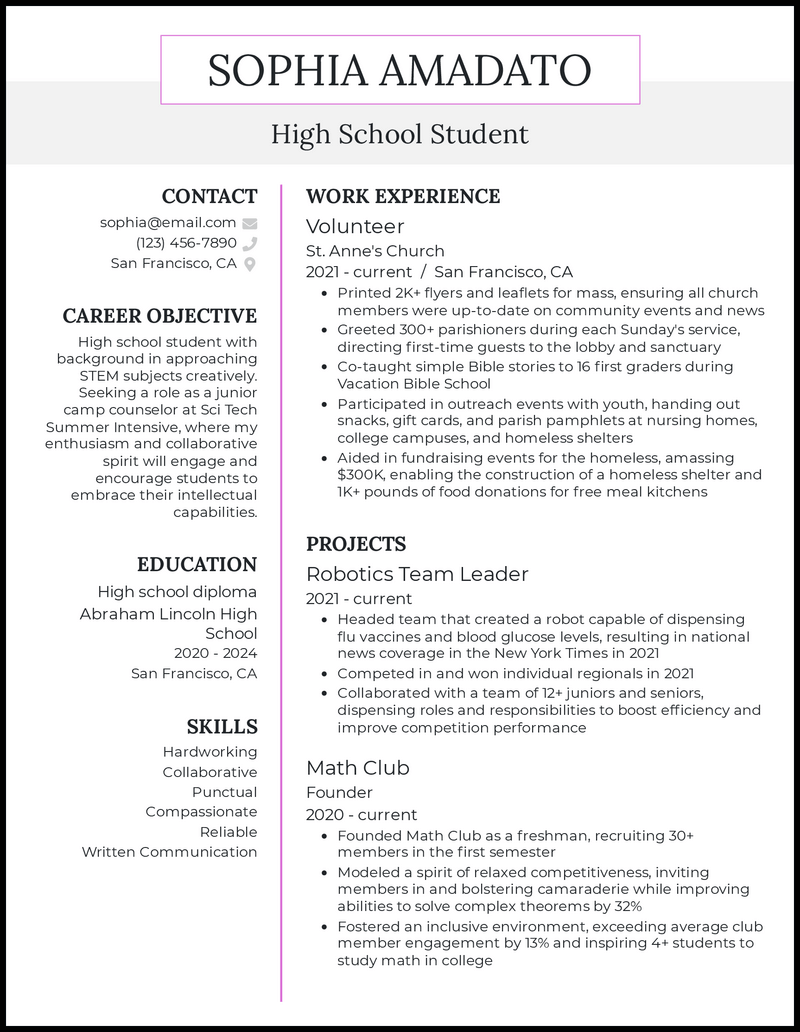
- Consider highlighting your proficiency in STEM subjects, complemented by one or two soft skills (perhaps teamwork and empathy). There should be no doubt about the potential of your mentions to add value to the role.
Why this CV works
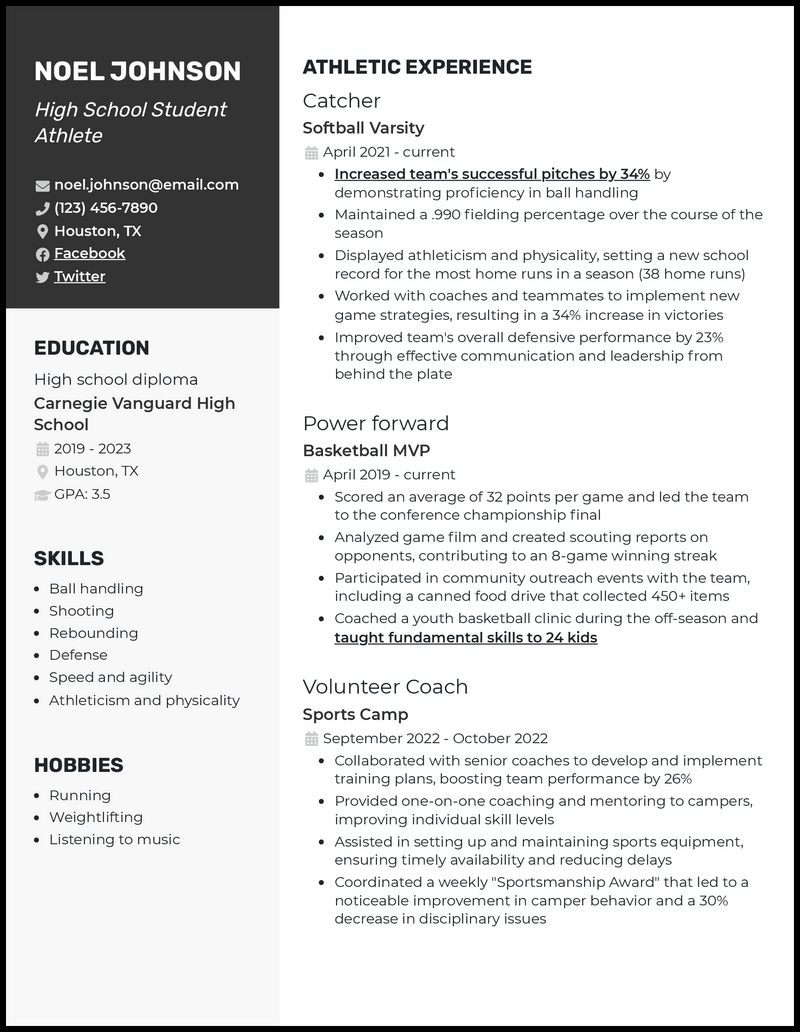
- Your most notable accomplishments will speak the loudest for your abilities as an athlete, so ensure you include them in your secondary school student athlete CV. Think of a time you proved you were the MVP on your team—Did you lead your team to a championship?
View more secondary school student athlete CVs>

Why this CV works
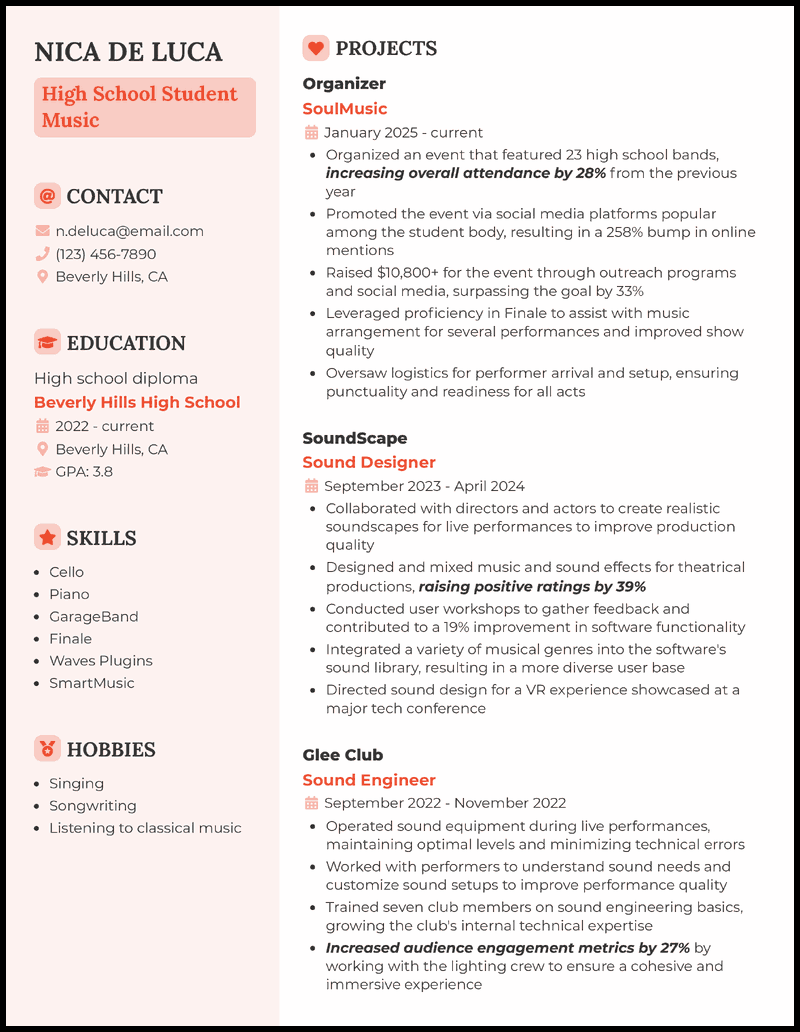
- Including hobbies in your sales pitch allows the potential employer to get a sense of your personality, connect with you, and understand why you would be a good fit for their culture. For example, if you’re passionate about music like Ione, it indicates that you’re not only a creative individual but also someone who can contribute positively to the atmosphere of the organisation.

Why this CV works
- Adding hobbies and interests to your CV doesn’t just provide insight into your personality; it’s a rather brilliant way to connect with the hiring manager, especially if they share your interests. Moreover, this is an extremely effective way to make a CV stand out and increase your chances of securing that interview where you can truly shine.
Why this CV works
- Your projects showcasing directing music, songwriting, and sound engineering leave no doubt in the recruiter’s mind that you live and breathe music. Of course, there’s no harm in mentioning hobbies that don’t align with your professional aspirations; it highlights your adventurous spirit and signals you’re ready to try new experiences.
View more secondary school student music CVs>
Why this CV works
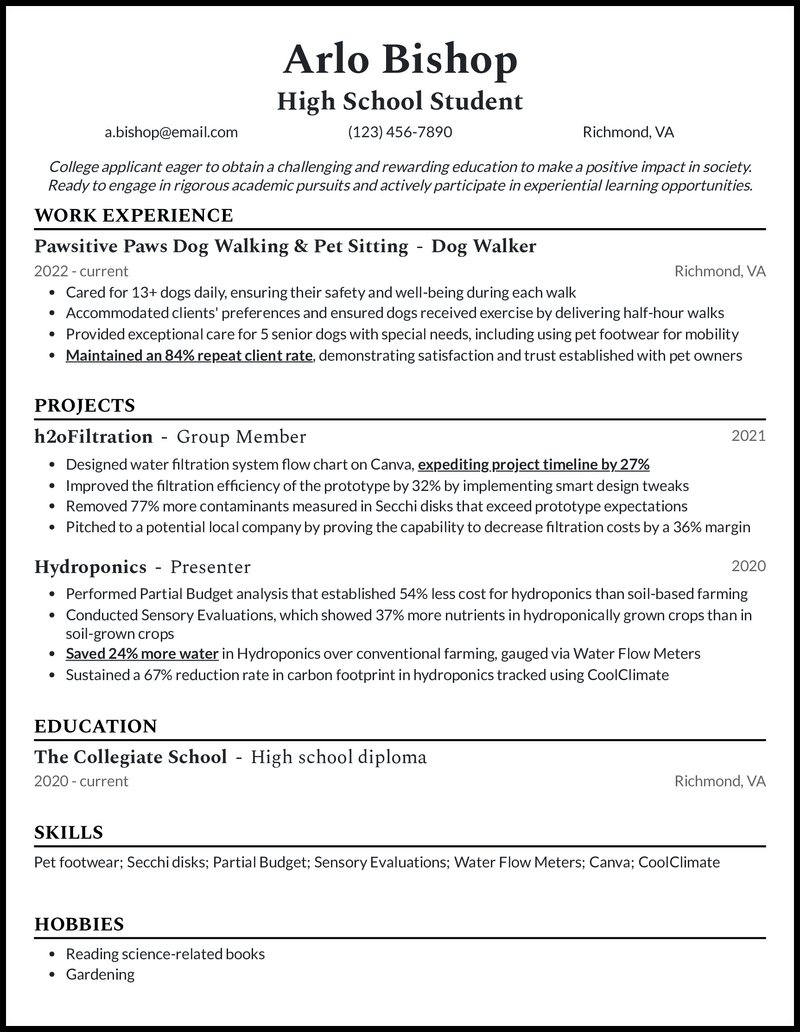
- Ensure your secondary school student’s university application CV highlights both practical and academic achievements that underscore your ambitious vision to make a positive contribution to society.

Why this CV works
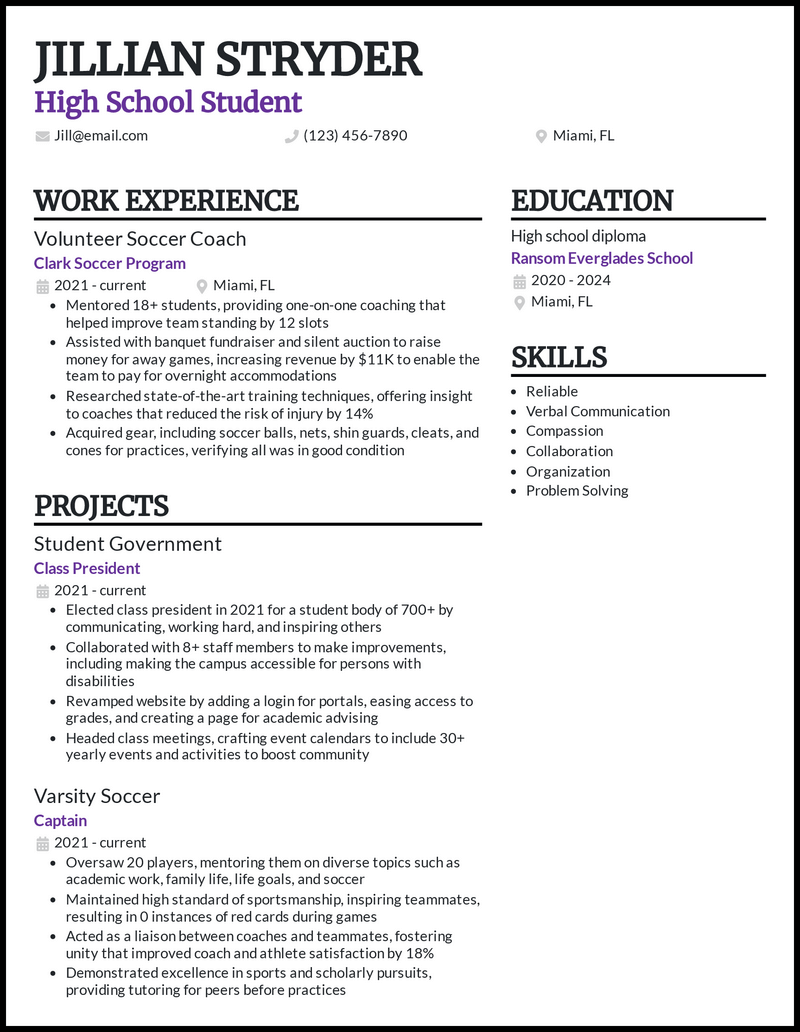
- Your secondary school student scholarship CV should clearly demonstrate your positive contributions to noble causes, such as providing assistance with daily living activities to elderly people, and highlight your impact on society.
Why this CV works
- Providing the hiring manager with an overview of your strengths (compassion, collaboration, and verbal communication) is fantastic—we couldn’t agree more! However, going the extra mile and demonstrating those abilities in your work history will truly win them over.
Why this CV works
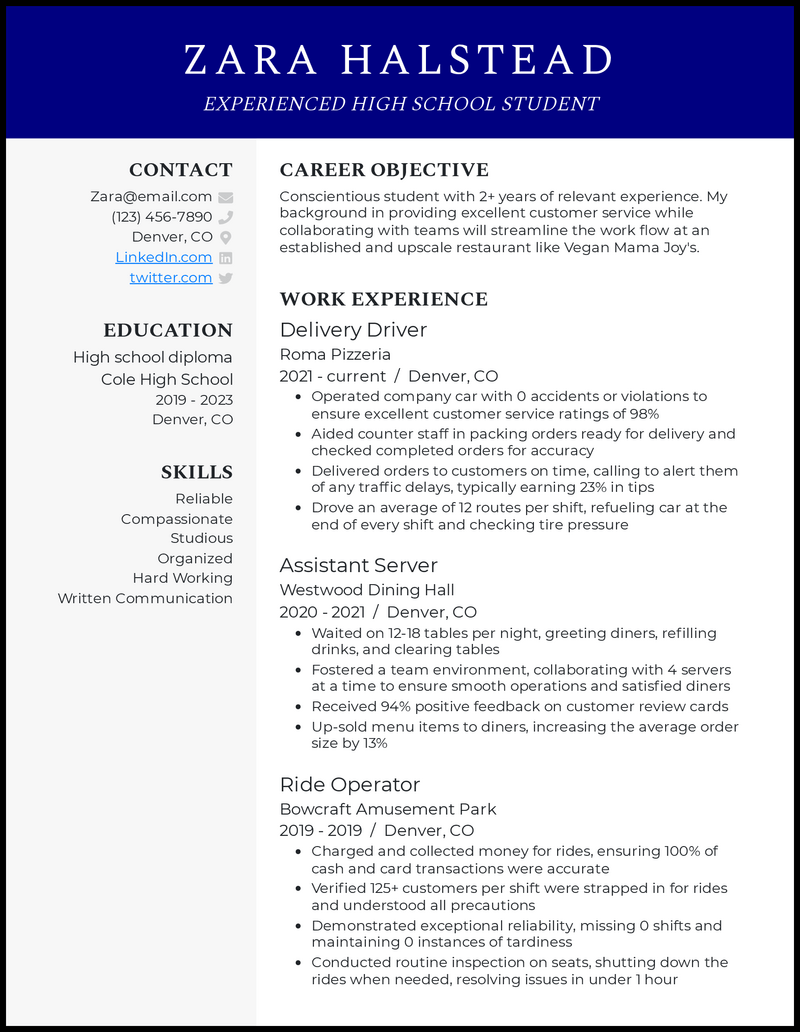
- When building a CV, choose a two-column layout; it allows you to fit all your relevant achievements, skills, and other qualifications onto a single, clutter-free page. Additionally, consider using a fun colour like blue to draw attention to the header.
Why this CV works
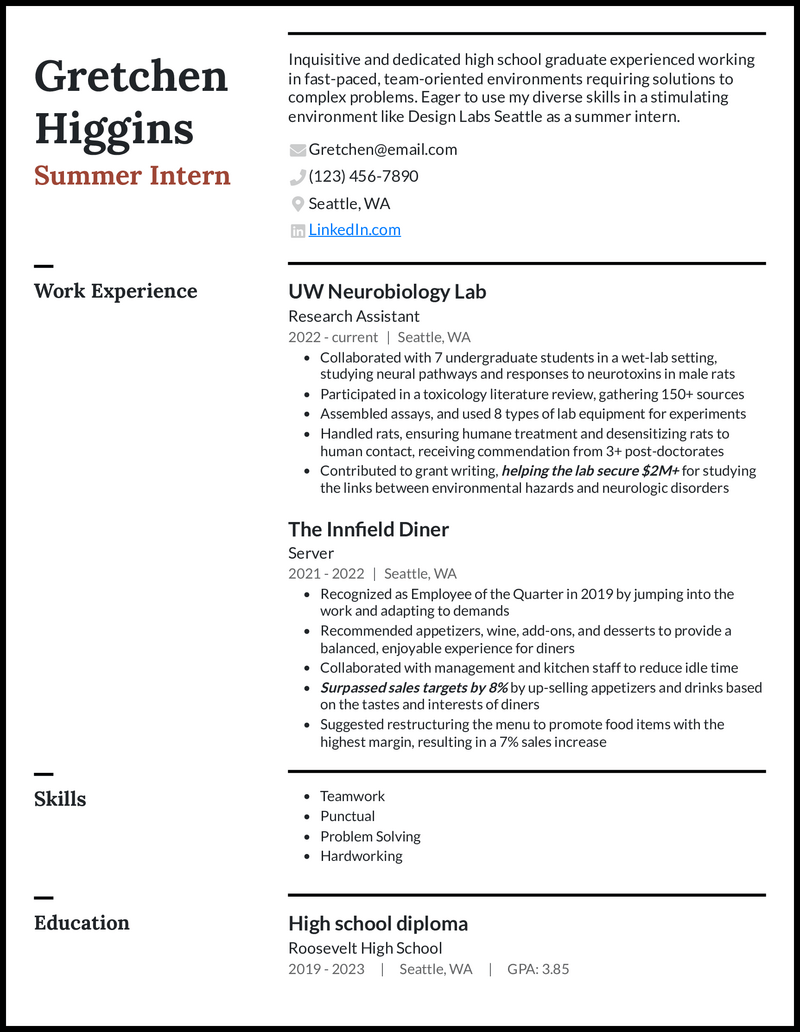
- Is your GPA 3.5 or higher? Be sure to highlight it in the education section of your piece—people appreciate candidates who excel academically. Plus, it indicates that you’re not someone who shirks responsibilities at work. And don’t forget to check your CV once more to ensure it’s flawless and ATS-friendly.
View more secondary school student CVs for university applications>
Why this CV works
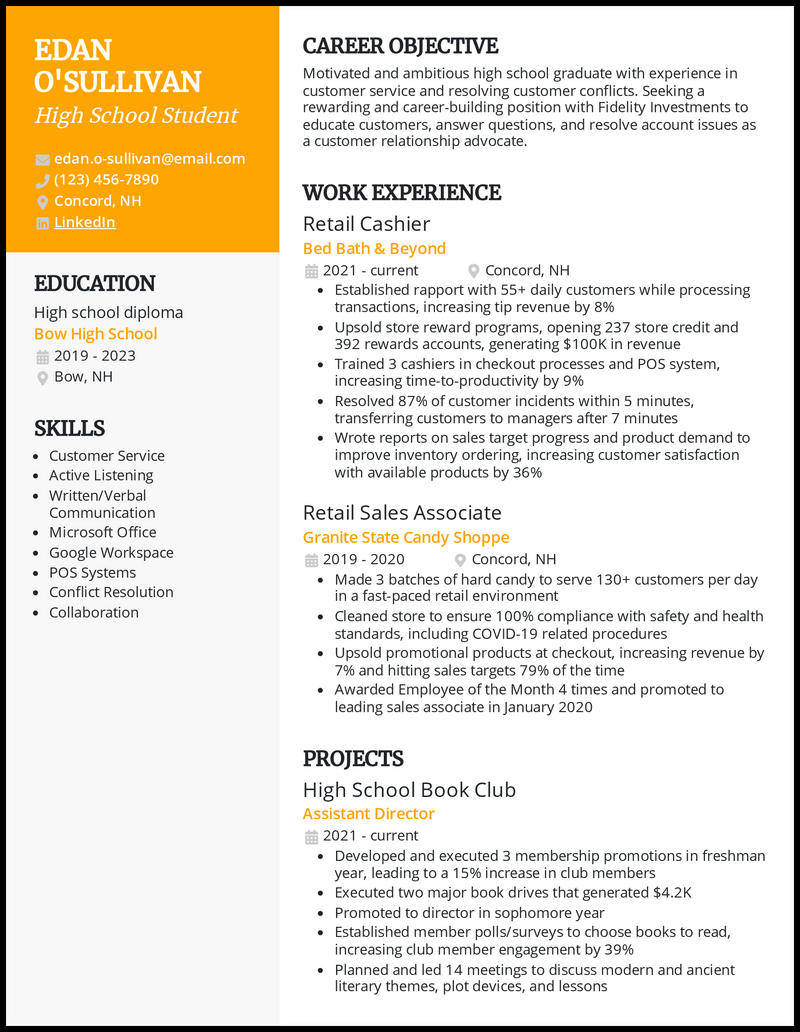
- Customise your CV so it portrays you as an ideal fit. Start by reviewing the customer service job description, and then adjust your pitch so it ticks all (or most) boxes of what the potential employer is looking for—that could range from soft skills like active listening, technical expertise (think Google Workspace and POS systems), to a few years of retail experience.

Why this CV works
- Demonstrating that you interviewed over 70 French historians and collaborated with four students to excel in a storyboarding project highlights remarkable language and teamwork skills. Focus on your time as a ballerina as well; being one isn’t for the faint-hearted; it requires commitment and dedication.

Why this CV works
- You can open the recruiter’s eyes to your value by showcasing relevant competencies (even the transferable ones). For example, as a drive-thru attendant at Jack in the Box, where you customised prices, served more than 60 cars per hour, and facilitated transactions worth £16K per day without any discrepancies.
Why this CV works
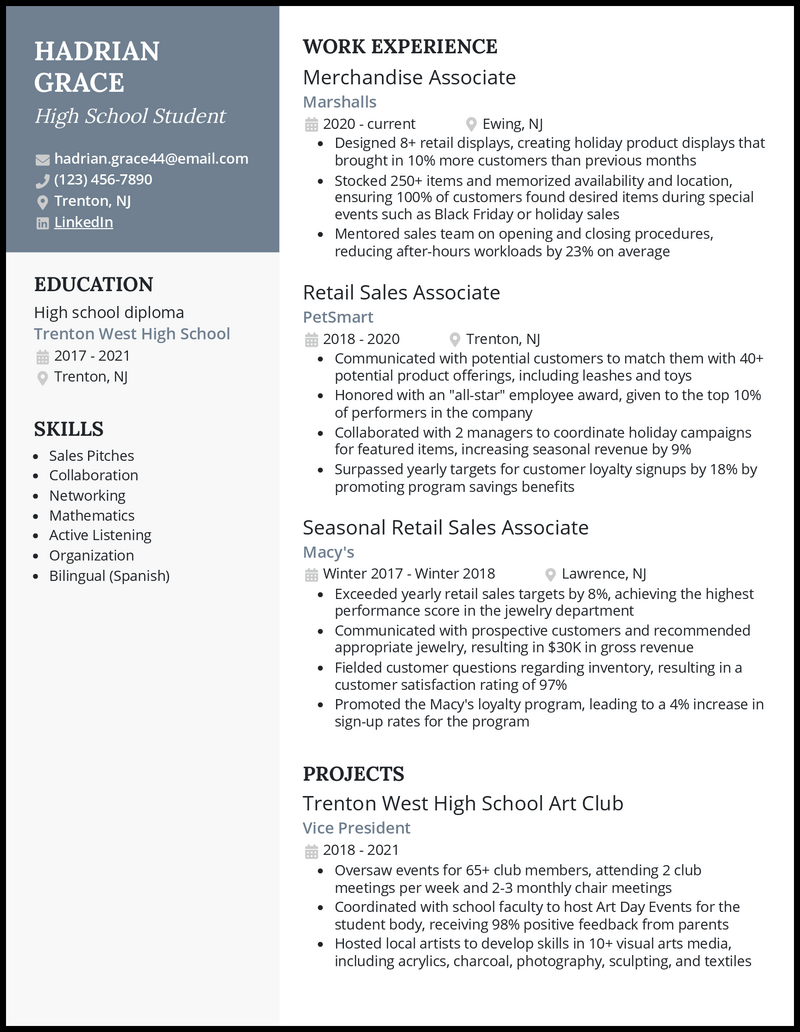
- Few other things demonstrate your value better than a CV with phrases like “Designed 8+ retail displays…”, “Stocked 250+ items…” and “…reducing after-hours workloads by 23% on average.” Even better, numbers make your pitch ATS-friendly, increasing the likelihood that it lands in front of the recruiter.
Related CV guides
How to Write a Secondary School Student CV

Even with limited or no formal work experience, a well-organised secondary school student CV can still highlight your suitability for the job, achievements, and potential. Focus on your contact information and a concise summary, then proceed to your education, skills, relevant experiences (even if unpaid), and extracurricular activities.
Present your information in a clear and concise format, with consistent headings and bullet points. Before sending your application, consider running your copy through a trusted CV checker to identify areas for improvement.
This section will guide you through each step and show you how to write a CV that stands out by covering:
- Sections every secondary school CV should include
- How to write compelling bullet points for experience
- What to include when you have no work history
- Designing your CV for clarity and readability
- Common mistakes to avoid on student CVs

What should a secondary school student’s CV include?
Dedicate your secondary school student CV to showcasing transferable skills, projects, and achievements that demonstrate your potential to contribute — even without prior job experience. Include the following core sections, each with clear headings, and limit the content to one page if you’re just starting out:
- Contact Information (name, email, phone, LinkedIn)
- Career objective (only if no work experience)
- Education (Grades if equivalent to 2:1 and above, coursework, awards)
- Soft and technical skills from projects and activities
- Extracurricular activities and volunteer work
- Certifications and programmes completed
- Achievements (quantified where possible)

What is the best CV template for secondary school students?
The template you use for your secondary school CV should be:
- Clean and professional without fancy graphics or too much colour: Opt for a clutter-free layout without graphics and other additions. You want the recruiters to focus on what you can do and not distract them with unnecessary decorations.
- ATS-friendly: you should be aware that your application will go through an applicant tracking system (ATS). If you’re not familiar with this, we’re informing you now. These systems don’t handle graphics and elaborate fonts well. Avoid them at all costs. And for an extra point, use bullet points and clearly define your headings for ease of readability. To ensure your document is ready to pass through these challenging screeners, run it through this AI checker.
- Editable in Word or PDF (unless otherwise stated): you’ll edit your CV several times before it’s ready. In that case, templates from Google Docs allow you to edit, save, and share your document from anywhere. It’s also helpful to save and send your application in PDF due to its portability and acceptance by hiring teams.
- Matching your purpose, whether university, first job, or scholarship: For instance, university admission and scholarship boards prefer a classic and simple CV format. On the other hand, media and marketing favour a creative and modern CV design.
Where to find good secondary school CV templates
You can start with our vetted and approved Google Docs CV templates and see if you find something that suits your taste.
However, for a guided and personalised experience when creating your secondary school student CV, this free online CV builder will take you through every step until you have a masterpiece that will beat ATS and receive a standing ovation from recruitment managers.

Should I include a career objective?
Only include a career objective if:
- You have no work experience: it’s a natural course of action for a secondary school student CV without experience to use a career objective. It helps you concentrate more on showcasing your skills and goals for the position you’re aiming for.
- You’re applying to university, scholarships, or work placements: you want a statement that expresses your willingness to learn on the job. This short statement shows your passion for a particular field and makes it easy for recruiters to see your potential even without work experience.
- You want to express your goals clearly: An objective can be that attention-grabbing opportunity to demonstrate your academic and career aspirations.

What makes a strong career objective?
Here’s what it takes to make yours impressive:
- Keeping it concise – one to two sentences can capture the attention of hiring managers. Anything longer will reduce your chances of being noticed.
- Tailor it to the role – you must be deliberate and specific about your application. Explain and demonstrate why you’re the best fit for the available opportunity.
- Optimise your strengths – your skills, achievements, and unique qualities are what you need to make a great first impression.

Good examples of secondary school students’ CV career objectives
To give you an idea of what a good career objective looks like, here are a few examples:
- For university scholarships – “Aspiring computer scientist passionate about problem-solving and software development, eager to utilise coding skills to create impactful technology. Seeking the Durham Tech scholarship to pursue a degree in computer science and contribute to advancements in the field.”
- For first job with no experience – “Compassionate and dedicated nursing graduate, eager to bring strong communication skills and a patient-centred approach to Northwestern Memorial Hospital. Committed to learning from experienced professionals while providing excellent patient care and support.”
- For university admissions – “Aspiring law student with a strong passion for justice, critical thinking, and advocacy, eager to make a meaningful impact in the legal field. Seeking admission to Harvard Law School for rigorous academic challenges and to contribute to a diverse community committed to excellence and ethical professionalism.”
- For internship – “Motivated secondary school student with strong analytical skills and a passion for finance, ready to apply classroom knowledge in a practical accounting internship at Gensler. Committed to learning industry best practices while contributing to a dynamic team with attention to detail and a growth mindset.”

How to list education on a secondary school CV
Your education section is your strongest asset because you lack direct or have little to no direct work experience.
Include:
- School Name (with city and county)
- Graduation date (or expected)
- average grade (if above 3.5)
- Relevant coursework for the industry you wish to enter
- Honours and awards
- Extracurricular involvement
Example of a good education section:
Example
Chicago Vocational Secondary School, Chicago, IL
Expected Graduation: December 2026
Grade: 3.7/4.0
Relevant Coursework: A-level English, Algebra, Maths, and Fine Arts Achievements: Second place in the National Drama Festival, vice president of the diversity and culture club

What are transferable skills, and how can I demonstrate them?
Transferable skills are the practical lessons and abilities you gained from school, clubs, work placements, or volunteering that apply to work or university.
Here’s how to do that correctly:
Skills from projects and coursework
Even without work experience, you’ve gained relevant skills through group projects, extracurricular activities, and coursework. These can include:
- Time management – completing and submitting assignments before deadlines
- Writing and research skills – developed through essay and report writing for lab experiments
- Communication and presentation – class presentations and society debates
- Problem-solving – maths quizzes and practical science projects
How to showcase extracurricular activities
Highlight your extracurricular activities to demonstrate potential, ability to lead, and solve real-world problems. Identify the most relevant ones, and use bullet points to emphasise impact, leadership, and commitment. Examples you can add to your CV include:
- Technical skills – acquired from the robotics club, coding, and web development group, managing social media page for wildlife club
- Creativity – drama festivals, art & music societies
- Teamwork and leadership – being the captain of the football team, the student union vice president
- Event planning – organising club meetings, fundraising events, and environmental conservation days
Skills from community and voluntary work
Don’t let your role in community service and volunteer work go to waste when you can use them to demonstrate valuable skills as follows:
- Strong work ethic and passion – supporting a noble cause without expecting any reward
- Planning and organisation – creating and planning activities for participants
- Customer service – participating in charity events and food banks and playing a role in mobilising donations
Emphasise soft skills
Just like technical skills, employers value soft skills that are transferable to a real workplace, such as:
- Attention to detail
- Excellent communication
- Initiative
- Adaptability
- Positive attitude
- Interpersonal skills

How do I measure my achievements?
Numbers ensure your CV stands out in both AI summaries and human reviews.
Instead of:
Assisted in organising school fundraiser
Write:
Organised a charity event raising £1,500 for animal shelters with over 70 attendees
Instead of:
Wrote articles for a school magazine
Write:
Published 22 articles each year for 2 consecutive years, increasing readership by 28% in 2024
Examples of measurable achievement bullet points
- Managed over 51 table bookings per day through SevenRooms, ensuring efficient seating arrangements
- Monitored and updated over 1,780 inventory items in real-time through Square POS, preventing product shortages
- Drafted 22 articles per term for the campus newsletter, increasing newsletter readership by 8%

What are strong action verbs for a secondary school CV?
Active verbs emphasise action, outcomes, and add a spark to the value you hold. Here are some grouped for quick access:
- Collaboration and teamwork: Supported, assisted, collaborated, and partnered
- Initiative and leadership: Led, supervised, coordinated, initiated, and managed
- Achievements: Optimised, surpassed, completed, accomplished, and awarded
- Problem-solving: Streamlined, improved, resolved, created, and designed
- Communication: Presented, explained, informed, educated, and advised
- Planning/managing: Scheduled, organised, planned, arranged, and executed

Common mistakes to avoid on secondary school CVs
- Ambiguous statements
- Spelling and grammar mistakes
- Irrelevant experience (e.g., Year 5 merit list)
- Dense paragraphs without bullet points
- Overly formatted templates

Key points
- Tailor for the specific role – read the job description or the university admission or scholarship requirements.
- Do your homework about the employer/school/programme – before writing your secondary school CV, research your prospective employer, the school, or the scholarship programme you’re applying to.
- Quantify your achievements – you may lack industry-specific experience, but that doesn’t stop you from demonstrating measurable impact from projects and other voluntary activities.
- Be concise—you’re not writing your life story, and recruiters don’t expect it anyway. A one-page CV is sufficient to demonstrate your value and have the admissions board and HR teams invite you for an interview.
- No room for errors – how do you, for instance, expect to crunch numbers for a giant retail company serving millions of customers each month when your CV is full of grammatical mistakes?
- Write for both ATS and humans – before your CV gets a chance to be reviewed by a human, it has to pass through online screeners.
- Finally, to ensure your CV is optimised for ATS, use ourCV scanner to check its effectiveness.
Secondary school student CV FAQs

Brevity is something you should use when writing your CV. A one-page document should cover your experience, skills, education, and anything else the job description asks for. You should only provide information that is impactful and relevant to the role you’re applying for.
Absolutely, yes! Resume templates give you a head start and keep your work organized professionally, which is appealing to ATS recruiters.
When choosing a template, go for one that is simple and easy to read. Anything decorative distracts from your skills and impact. Besides, ATS doesn’t like decorations, and your resume may not make it past these online gatekeepers.
Yes, but only if they’re relevant to the role you’re applying for. Good examples are writing blog posts if you’re applying for a content marketing job or swimming if you’re applying for a university athlete scholarship.
A high school resume summary is a brief opening statement— often 2 to 3 sentences—highlighting your key strengths, interests, and career or academic goals. It should be tailored to the opportunity you’re applying for, whether it’s a job, internship, scholarship, or college scholarship.
It should focus on your:
Top achievements
Transferable skills,
Standout experiences like leadership or extracurricular involvement
Example:
“Motivated high school junior with a 3.9 GPA, strong leadership in student government, and experience volunteering at local animal shelters. Interested in environmental science and seeking a summer internship at BioTech Services to gain hands-on lab experience.”
As a high school student, put your transferable skills in the forefront and announce that you’re ready, reliable, and resourceful. Cluster them into these broad categories:
Communication
Time Management
Leadership
Technology Proficiency – tools like Google Workspace, Canva, or Excel
Teamwork
Adaptability
A high school student resume should demonstrate your unique academic strengths, extracurricular involvement, volunteer work, and group u0026 personal projects.
Prioritize:
GPA (if 3.5 or above)
Honors, recognitions
Club or team participation
Volunteer activities
Certifications (CPR, Microsoft Office, etc.)
Personal or group projects (blogs, coding, art portfolios)
Yes, if you have any form of work experience that shows reliability, responsibility, and real-world application of soft skills, you should include it.
Follow this structure:
Job title
Employer or context
Dates of involvement
3–4 bullet points describing duties and results
Yes, you need a high school student resume for the following reasons:
Pitch your value when applying for jobs, internships, and scholarships
Describe your unique abilities during college admissions
Convince recruiters of your fitness for advertised roles
Track your accomplishments over time

Stephen is the co-founder and CEO of BeamJobs. Frustrated with the challenges he'd faced in his own job search, he left the corporate world to start BeamJobs with his brother. Drawing on firsthand experience with hiring and getting hired as technical talent, he started BeamJobs in 2020 to help qualified job seekers land interviews with less stress. Since then, more than 4 million people have built their resumes and cover letters on BeamJobs. Stephen's insights have been featured in notable outlets, such as Fast Company, Business Insider, Yahoo Finance, MIT, and Zapier. Learn more about Stephen.