



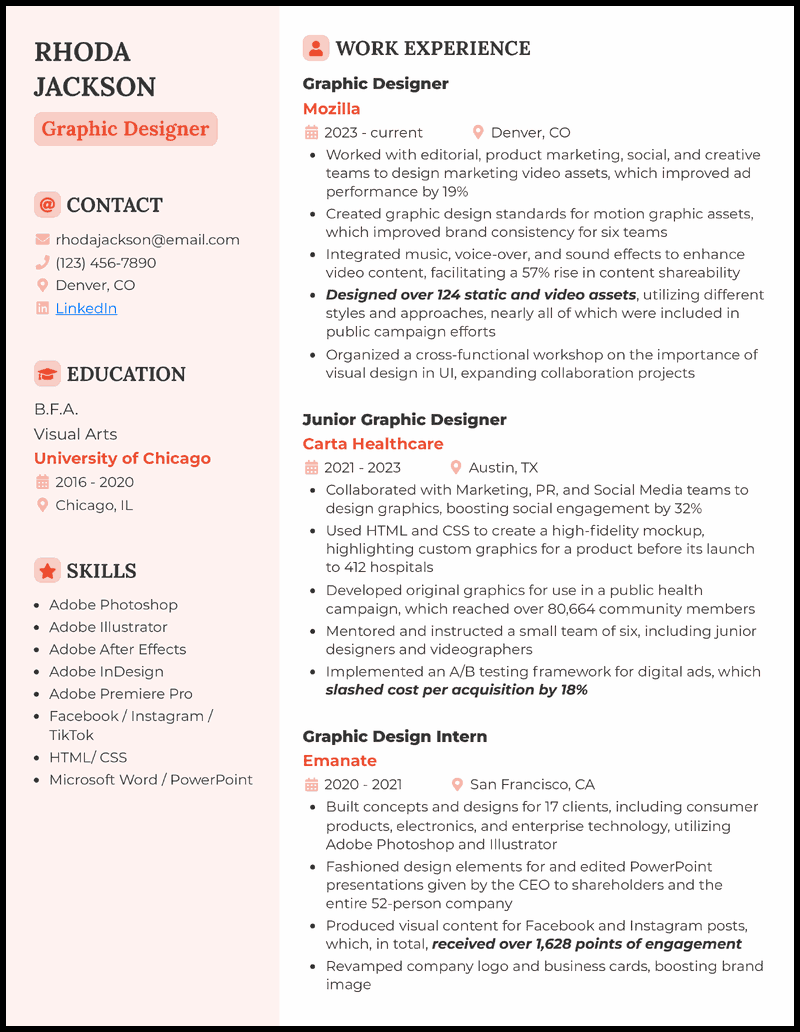


Graphic Designer


Best for senior and mid-level candidates
Resume Builder
Like this template? Customize this resume and make it your own with the help of our Al-powered suggestions, accent colors, and modern fonts.
 Build my resume
 To stand out in a crowded creative field, your graphic designer CV must strike a balance between clarity and personality, while also highlighting your design strengths and demonstrating how you solve real business challenges.
Your layout should feel well-designed, with a clear hierarchy and easily scannable headings that minimise clutter. In short, treat creating a CV like a design brief — every choice reflecting your taste, discipline, and intent. Match that tone when writing your covering letter, too.
This guide will show you:
- ↪ 25 graphic designer CV examples that actually secured interviews
- ↪ Key things every great graphic designer CV must include
- How to format your CV for readability, structure, and credibility

Why this CV works
- Portfolios are more or less a requirement for graphic design roles, so make sure to include a link to your own. If you choose to add a CV objective, customise it for each job to which you apply as well as craft a LinkedIn headline that reflects your creative identity.
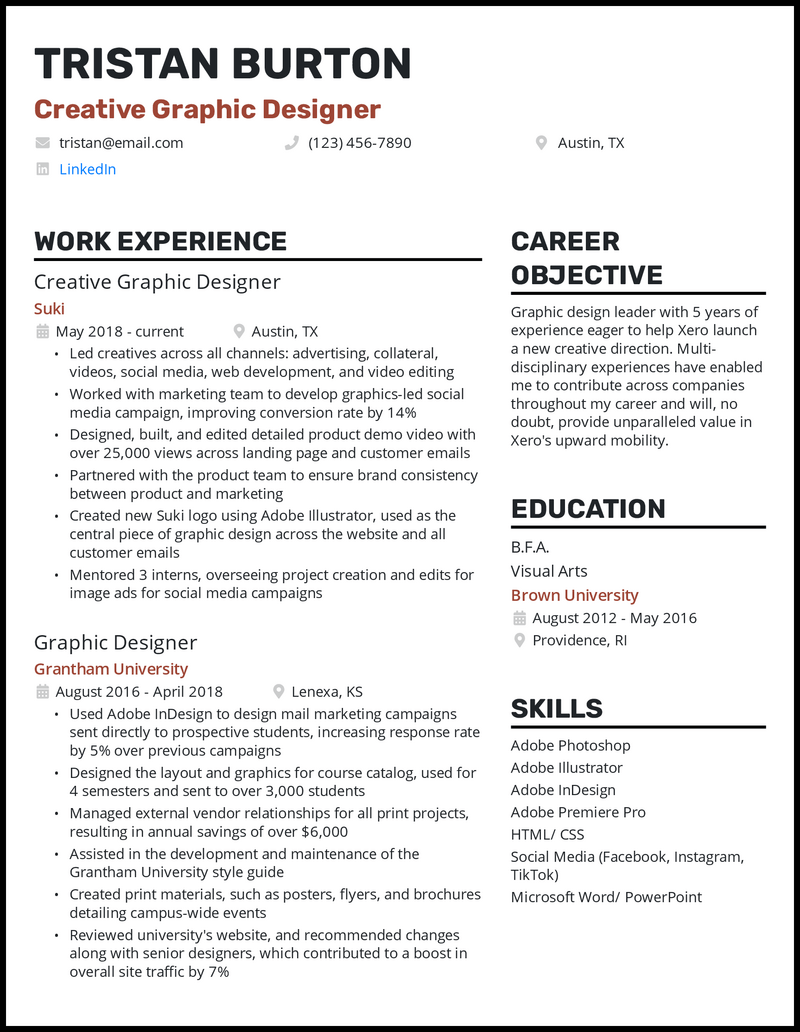
Why this CV works
- Demonstrating an increase in responsibility throughout your career is an excellent way to showcase your initiative. For example, mentoring other graphic designers illustrates positive growth as a leader.
View more creative graphic designer CVs>

Why this CV works
- Emphasising project-specific use of design tools and resourcefulness is most striking on a freelance graphic designer CV. Highlight how you’ve utilised Adobe Photoshop, Sketch, or CorelDRAW to deliver creative solutions for client projects, citing specific examples.
View more freelance graphic designer CVs>
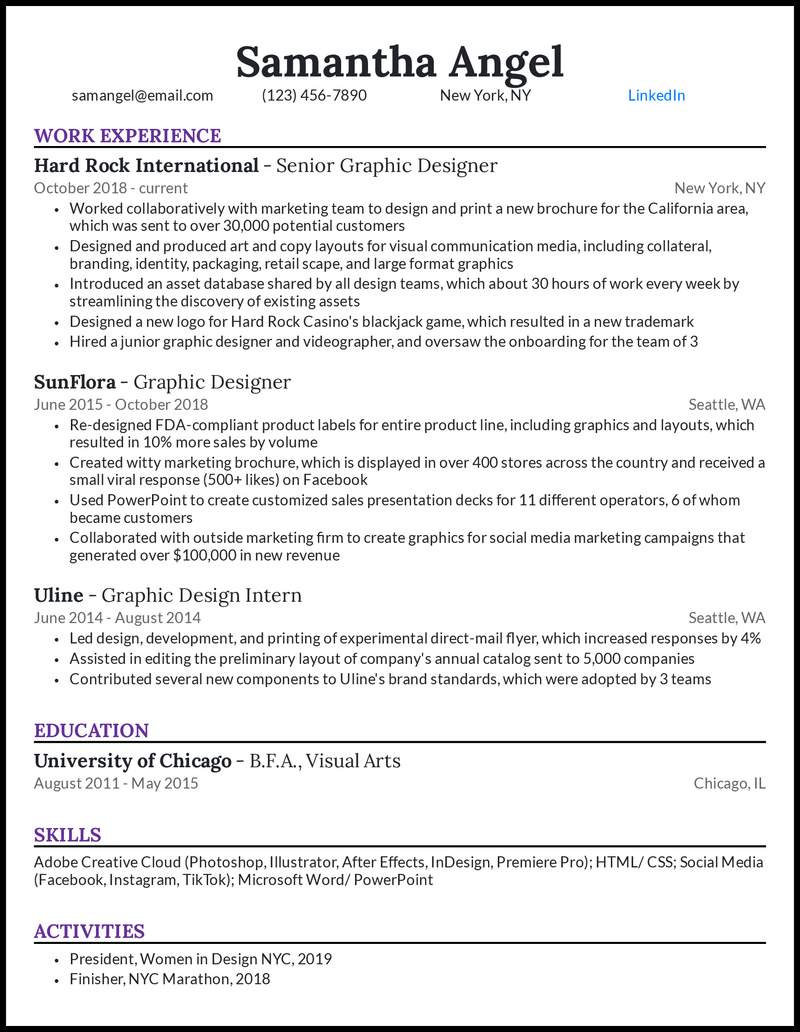
Why this CV works
- Hiring managers will be looking for any leadership roles on your senior graphic designer CV, so be explicit about your successes as a leader. How many hours did you help your team save? How many new customers did you gain? How many people viewed your designs?
View more senior graphic designer CVs>

Why this CV works
- Mention tools like Adobe Photoshop, Inkscape, Figma, and InVision that speak volumes about your artwork. Generating CV skills like these will convey that you’re well-versed with the latest design tools and can create modern designs with ease!

Why this CV works
- Showcase projects where you’ve used Affinity Designer, Adobe Fresco, or Canva to create compelling visuals, or your use of resources like Pixabay and Coolors for inspiration and project enhancement.

Why this CV works
- If you can back your creative designer CV with a fine arts degree in graphic design, you’ll be able to demonstrate your enthusiasm for the work and be on the hiring list for any employer.
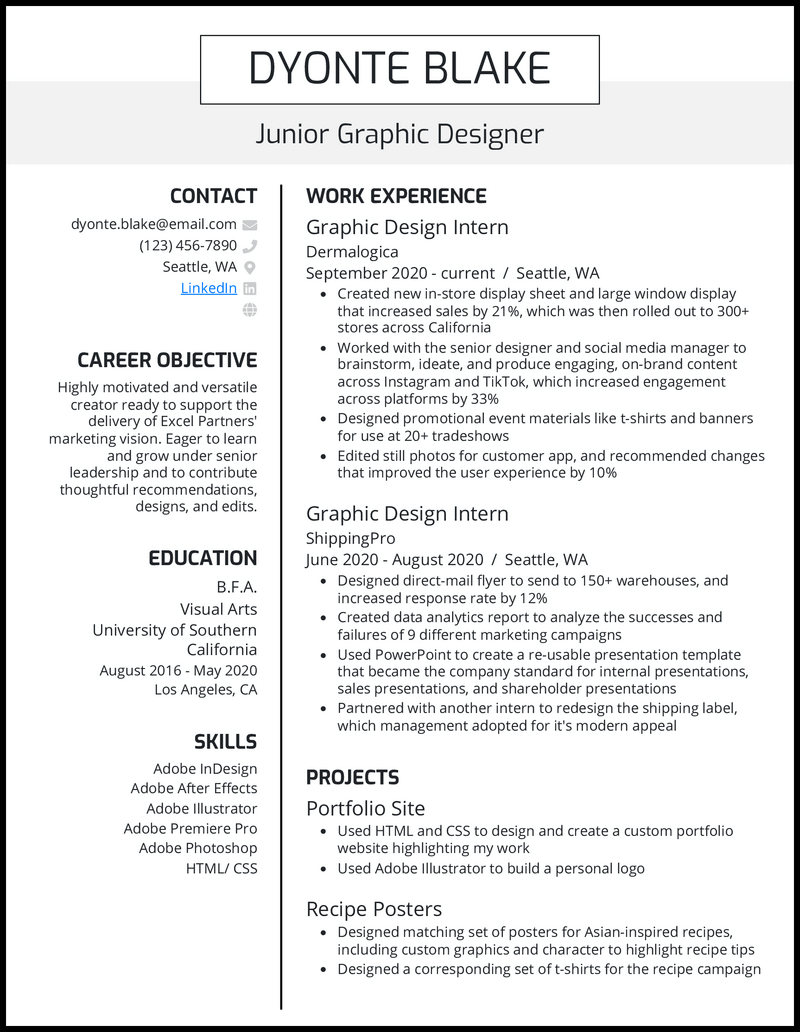
Why this CV works
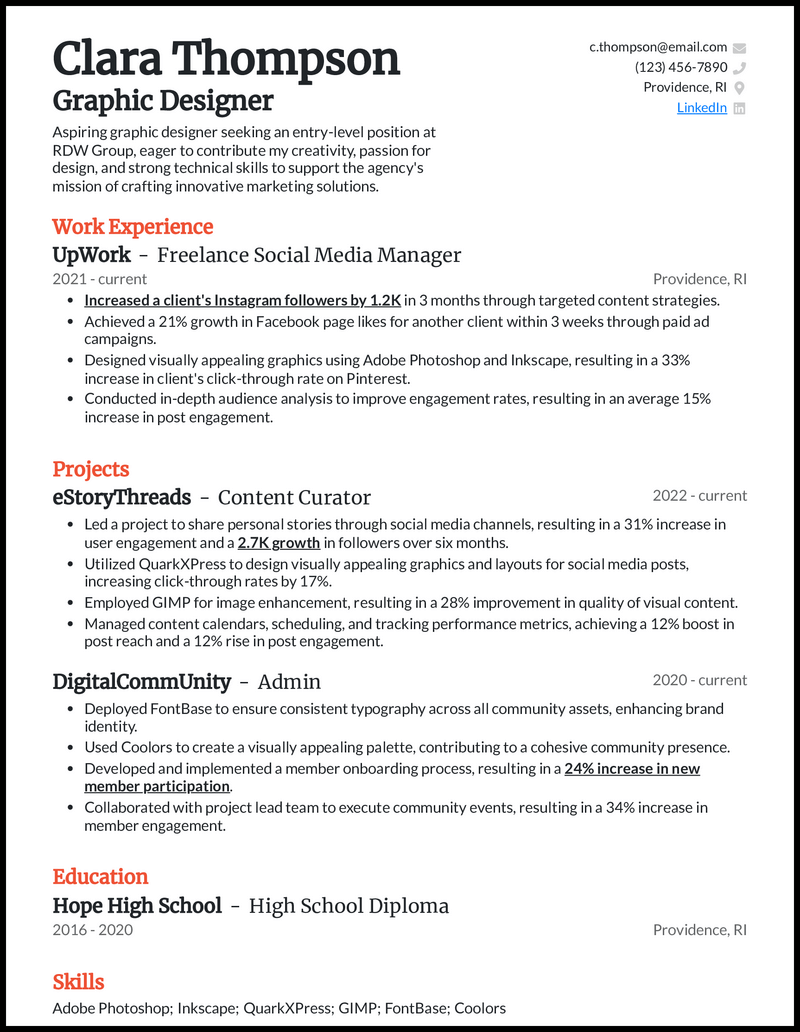
- If you’re lacking in relevant work experience, include any pertinent projects or work placements. Just ensure you include metrics when possible, as any recruiter will treat a work placement like a job and will therefore expect evidence of your impact.
View more junior graphic designer CVs>
Why this CV works
- You’re entering somewhat unfamiliar territory, which is why your beginner graphic designer CV should be well crafted to impress recruiters. One thing you can rely on is a career objective that’s both inspiring and clear about what you intend to do once you’re hired.

Why this CV works
- Explain what you did for the clients and how they responded. For instance, achieving 97% customer satisfaction across several projects is a genuine testament to your work ethic and client-focused approach.

Why this CV works
- Don’t just mention the tools but also how you used them to achieve tangible results. Showcase competencies in Blender, Figma, CorelDRAW, and so on to get things done and enhance user engagement.

Why this CV works
- In this CV for a graphic designer intern, Harper, for example, emphasises the Typography Precision seminar, where he refined his skills in using industry-relevant software (such as Adobe Photoshop, Sketch, and CorelDRAW Graphics Suite) and acquired valuable knowledge.
Why this CV works
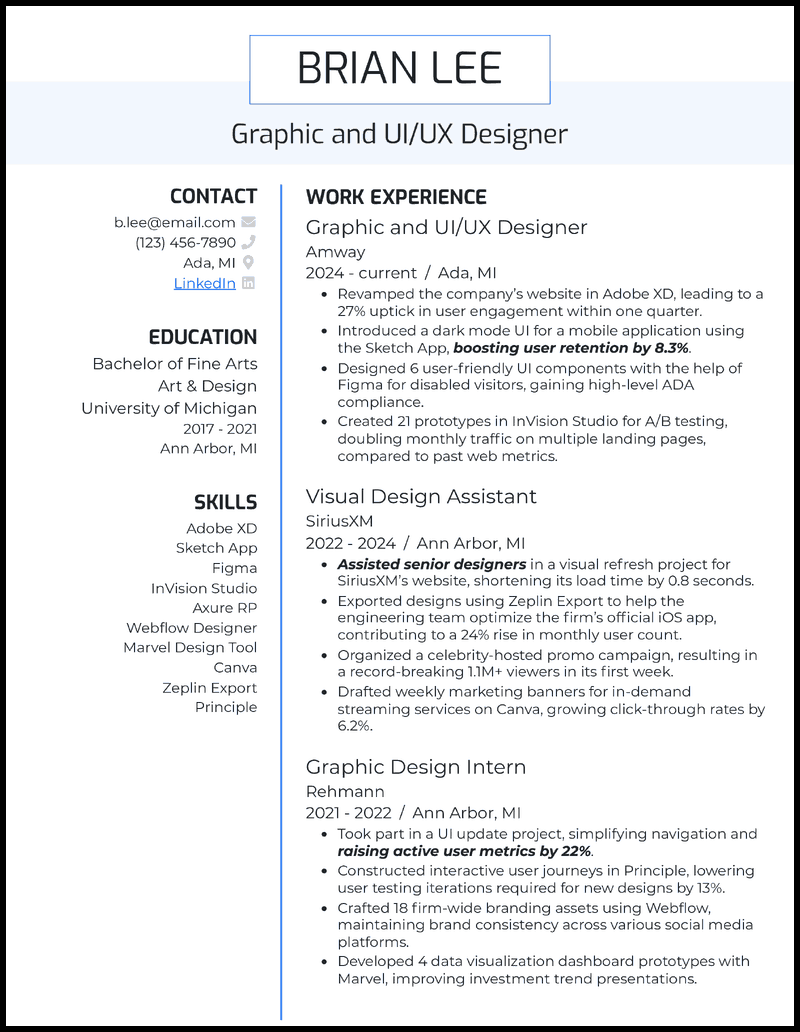
- Opt for a layout that’s sophisticated yet exudes a modern vibe. This is precisely what our Modern template is all about. It has everything you need (clean lines, stunning typography, and ample space) and nothing you don’t (sorry, Comic Sans).

Why this CV works
- Tailoring your Behance graphic designer CV to match the job advert is one of the most effective ways to demonstrate to the hiring manager that you are a good fit. Remember that time when you custom-built animated social media graphics? That could be essential for this role and showcasing it could be your ticket to getting hired.
Why this CV works
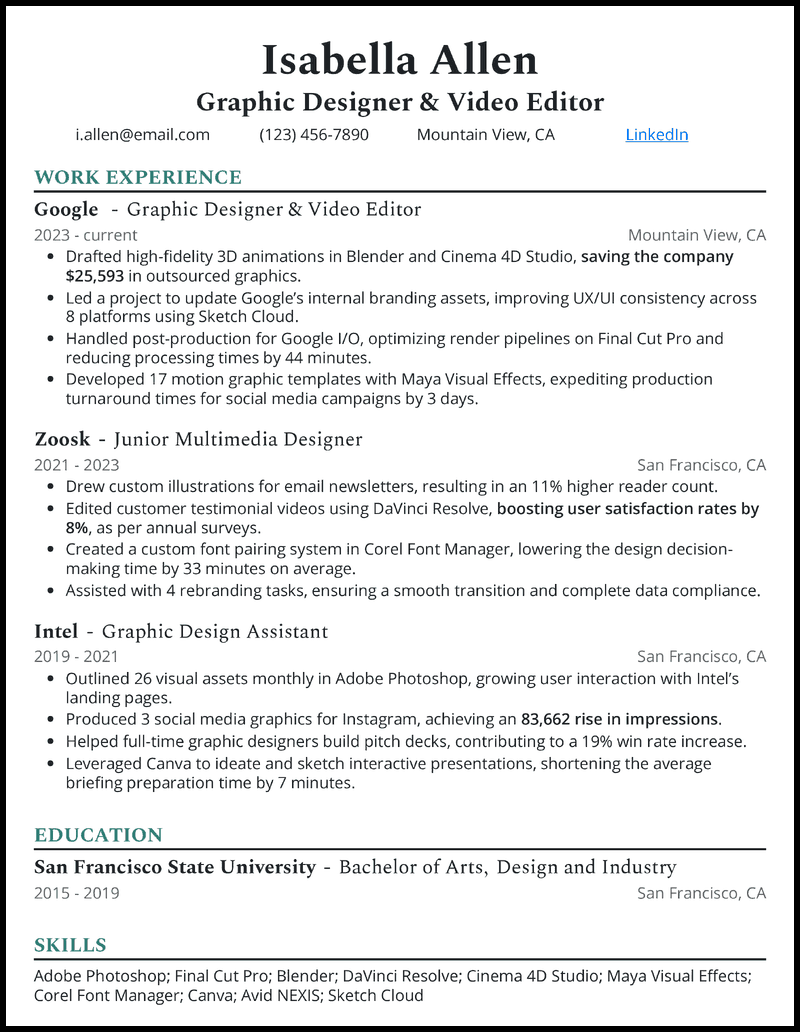
- Think Adobe Photoshop, Blender, and Final Cut Pro. Such software platforms are industry benchmarks for a professional editor. Simply mentioning them in your graphic designer and video editor CV will give hiring managers a strong impression that you truly understand the difference between good editing and mind-blowing results.

Why this CV works
- Tell a story of a resilient individual who is self-motivated and goes above and beyond to achieve results. Additionally, outline one or two projects which, if implemented in real-world situations, would help transform marketing trends and outcomes for businesses of all sizes.

Why this CV works
- Make the most of your graphic designer illustrator CV’s side columns to showcase the graphic design and illustration tools you’re proficient in (think GIMP, Vectr, Prezi and more). Then integrate evidence of using these tools in your employment history section.

Why this CV works
- Choose a modern template for your social media graphic designer CV. Organise everything clearly so that the hiring teams can easily follow your career path. Most importantly, ensure there’s no clutter, as that is a major deterrent.

Why this CV works
- Don’t stop at making a list of job-specific tools like Adobe Photoshop, Adobe XD, and Coolors in your freelance graphic/UI designer CV. Take them on a journey through your past projects, painting a picture of those moments your designs stole the show or the times your creativity drew gasps and nods of approval.
Why this CV works
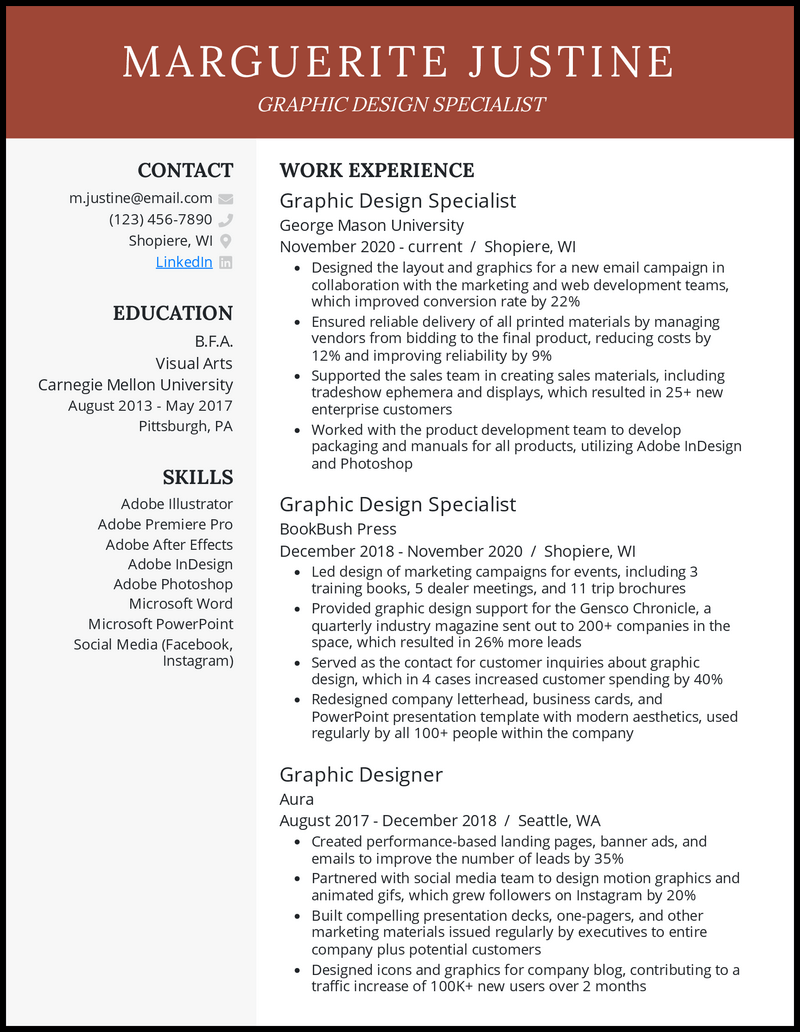
- Graphic designers are expected to be proficient with many different tools, especially the industry standard, Adobe Creative Suite. So make sure to let employers know if you’re skilled at Photoshop, Illustrator, and InDesign.
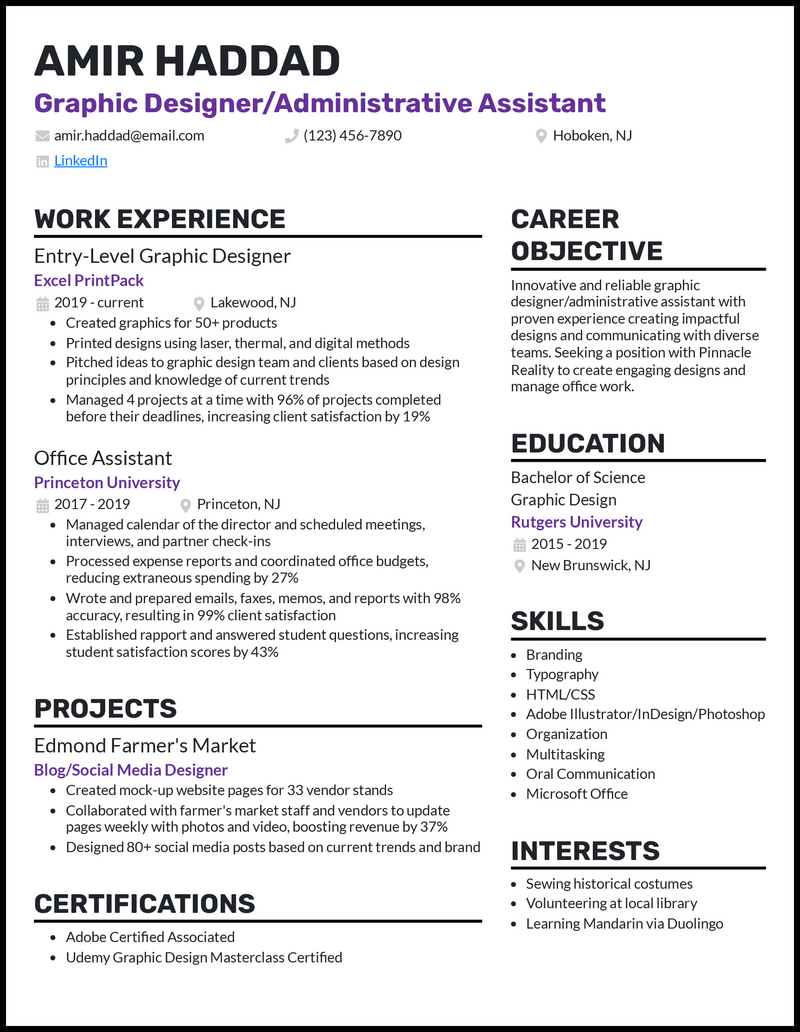
Why this CV works
- Even if you don’t have much work experience, you can still showcase your skills by adding any projects you’ve completed and even some of your CV-related hobbies and interests. However, limit your choices to activities/projects that required taking initiative, additional research, or learning a completely new skill.

Why this CV works
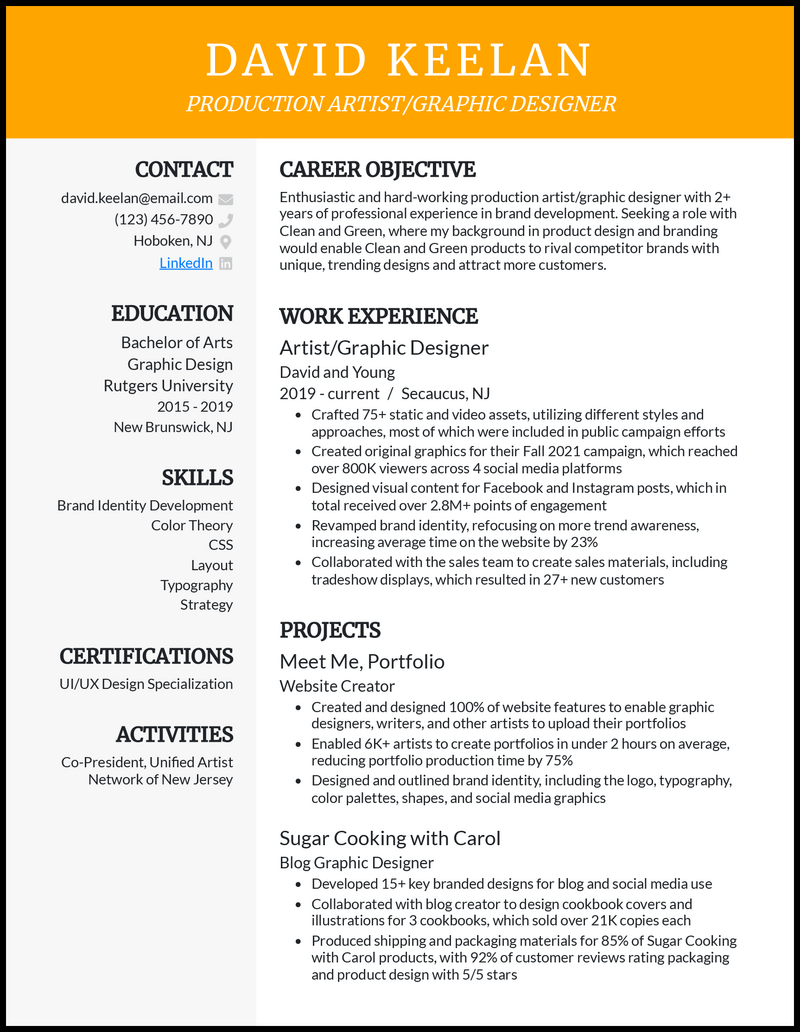
- Whip out those action-packed verbs that show you’re not just on the ball but also you’re the ball—words like conducted, executed, spearheaded, designed, structured, and systemised. Essentially, sprinkle those gems throughout your graphic designer/production specialist CV.
Why this CV works
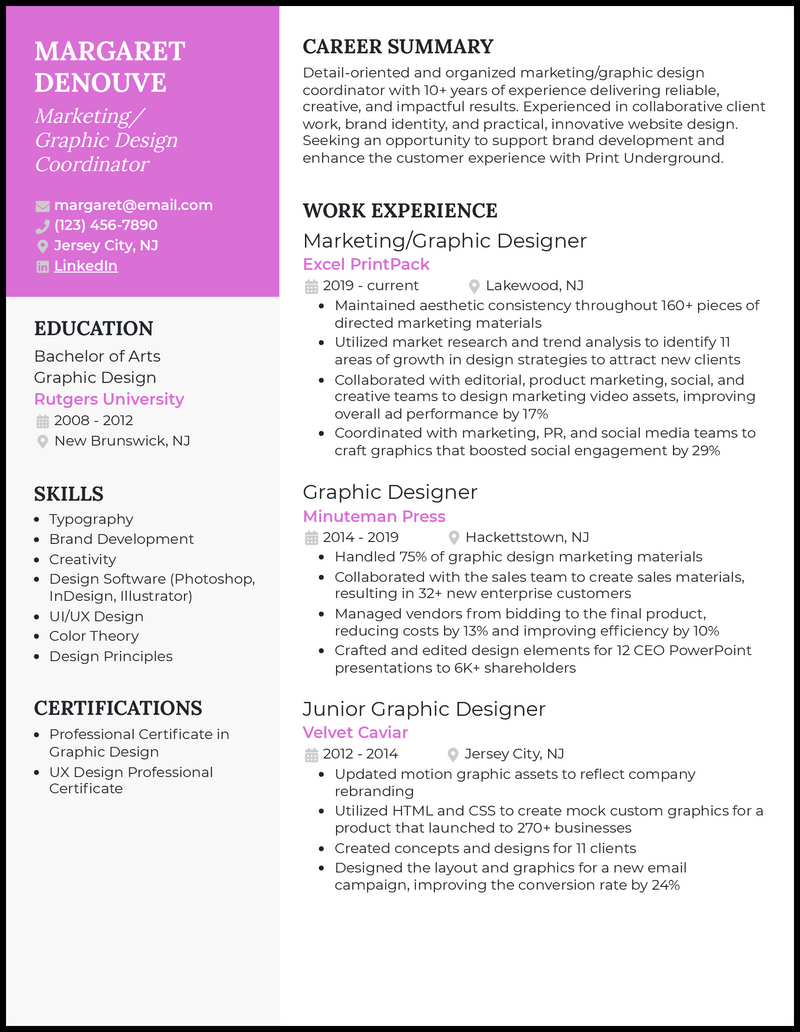
- Make your marketing/graphic designer coordinator CV stand out even more by including a focused career summary. Though including a CV summary is optional, we highly recommend one if you have more than 10 years of experience in the field.

Why this CV works
- Experience at a junior level, along with what you learned and your contributions, can effectively enhance the chances of your motion graphic designer CV progressing beyond the shortlisting stage.
Why this CV works
- Your production artist CV should be as captivating as your creations; demonstrate your eye for design by formatting your CV properly. Enhance your format by selecting two tastefully contrasting fonts, utilising white space throughout your CV, and using bold (but not garish) colours in your header and titles.
View more production artist CVs>
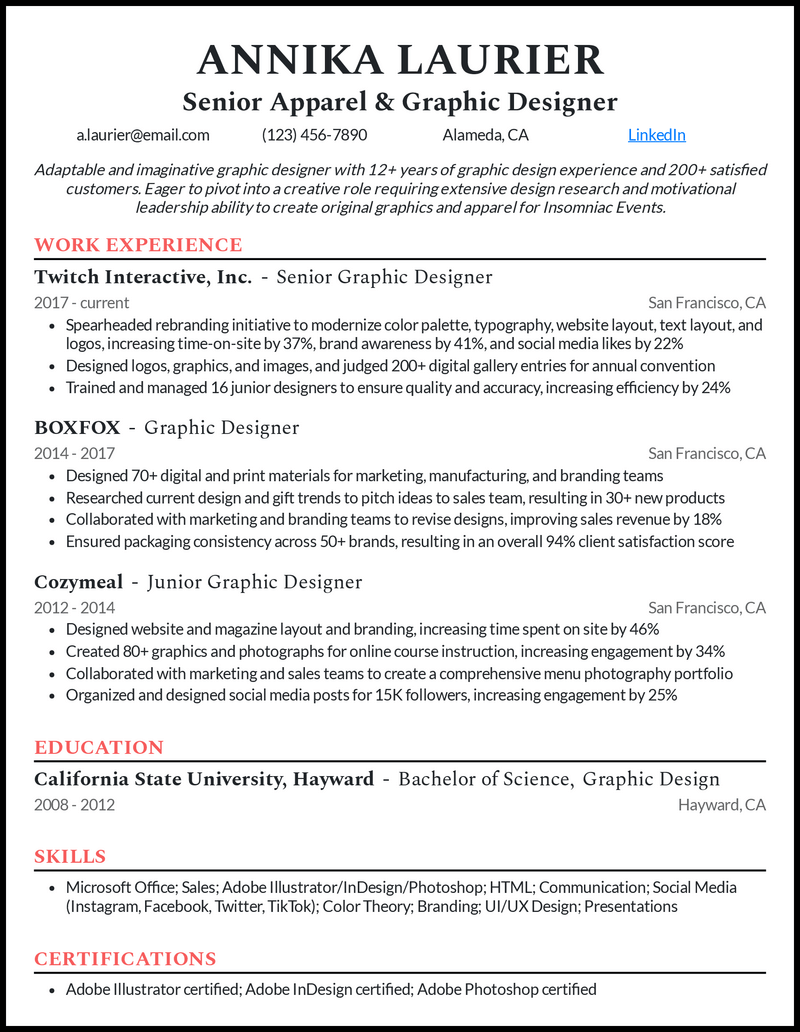
Why this CV works
- Include certifications at the bottom of your senior apparel and graphic designer CV. Adobe offers certification courses for many of their Creative Cloud products, and there are many courses offered through universities to give you an advantage over the competition.
Related CV guides
How to Write a Graphic Designer CV

Writing a standout graphic designer CV is about showcasing substance, structure, and strategy—highlighting the right details in the perfect format to impress human recruiters and bypass AI filters.
Whether you’re starting from scratch, updating your portfolio, or comparing formats with CV examples, you must present your background to capture attention in the competitive creative job market.
We’ll also show you how to run your final draft through a CV checker and how to craft related documents, such as a resignation letter or an email, that align with your personal brand and career goals.
What we’ll cover:
- What to include and what to leave out in a graphic designer CV
- How to write role descriptions that highlight creative impact
- Where and how to showcase portfolio links and projects
- The best CV formats that prioritise visual balance
- Keyword strategy for ATS optimisation
- Design-specific technical and soft skills that matter to hiring managers
- How to incorporate personal branding to stand out
- Common mistakes that weaken visual CVs

How to structure your CV header
For a complete and accurate CV header, include:
- Forename and surname
- Profession’s title
- Official email address
- Phone number
- Town and county
- Profile URL for LinkedIn or Behance
- Portfolio URL (visible and clickable)
Example
Rhoda Jackson
Graphic Designer
1234 567 890
Denver, CO
RhodaCreatives.co.uk

Should you use a summary or a personal statement?
Speaking of an objective/summary, perhaps you’re wondering whether you need one in your graphic designer CV. First, let’s explain the difference between the two.
A summary is a two-to-three-sentence statement that summarises your skills, work experience, and any specialisations. It’s best used when someone has been in graphic design for over 10 years.
Conversely, an objective is a two-to-three sentence statement that introduces your interests, qualifications, and how you’ll add value to the role you’re seeking. A CV objective is best used for those changing careers or entry-level job candidates.
The two are very similar, so it’s less important to understand the difference between them and more important that you pay attention to what you write for them. Vague statements and generalisations waste your and the recruiter’s time, so if you’re in doubt or are struggling to get it right, leave it out altogether.
If you’re a graphic designer looking for a junior position, an objective can specifically emphasise personal qualities and skills. To capture the recruiter’s attention, mention the company by name and share how you intend to contribute to your desired company:
A summary is ideal if you have more than 5 years of experience and is better positioned to highlight specific achievements.
Examples of strong graphic design CV summaries
- Senior graphic designer with ten years of experience in branding, print, and web. Led the redesign for a FTSE 100 brand, increasing engagement by 33%.
- Creative designer specialising in motion graphics and animation. Produced over 50 campaign videos for tech start-ups with CTR gains of up to 22%
Use an objective if you’re a recent graduate or changing careers—but only if you can tailor it specifically to the role and company.
Example
Junior graphic designer skilled in Adobe Creative Suite, Figma, and Canva, seeking to join Nike’s UK marketing team to create impactful digital and print designs while developing skills in UX/UI and branding.

What skills should you include on a graphic design CV?
Utilise up to 10–12 job-specific skills, categorised into technical and soft skills. Don’t just list them in the “Skills” section; incorporate them throughout your work experience bullet points. Avoid cramming your skills list with every tool you’ve ever used—stay relevant with only tools you can use to make a difference.
Here’s how you can highlight your skills in your graphic designer CV:
- List specific skill keywords in bullet points in the skills section of your CV.
- Use numbers and examples to quantify and demonstrate your skills in the employment history section
- Emphasise your most relevant skills in the CV objective or summary
Here are some of the top hard (technical) and soft (general) skills you could include in your graphic designer CV:
- Graphic Design Software and Tools:
- Adobe Illustrator
- Adobe Photoshop
- Adobe InDesign
- Canva
- Figma
- Gravit Designer
- Sketch
- Design Principles:
- Activating negative space
- Colour theory
- Typography
- Visual hierarchy
- Basic Coding:
- JavaScript
- Java
- Python
- HTML
- CSS
- Interpersonal skills:
- Communication
- Creativity
- Organisation

Which CV format is best for graphic designers?
Use the reverse-chronological format in most cases to emphasise your most recent experience and pass ATS systems.
If you’re a freelancer or transitioning to design from another industry, opt for a hybrid format (skills + chronological).
Follow these formatting guidelines:
- Professionalism over fancy designs
- Standard fonts (Arial and Calibri)
- Consistent design elements
- No columns, tables, or graphics
- Space for important headings
- Save as PDF or DOC
Consider these vital points when formatting your graphic designer CV:
1. Improving the appearance of your CV:
- Consistency in layout, punctuation, typeface, and type size
- Work experience is in bullet points for clarity
- Minimal colour (headers and titles only)
- Left-aligned text (your contact header is the exception)
- Headings to distinguish sections
2. Meeting organisation and technical requirements:
- Only a page long
- A recognised file format (such as PDF)
- An objective/summary when necessary

How to measure your impact as a graphic designer
Clients and customers value your designs, but it can be challenging to connect graphic design to business growth. Don’t overlook metrics, though; they’re worth the additional effort.
Design can become a key contributor to success, but only if you demonstrate how design is related to growth. There are various ways you can measure your impact on your graphic designer CV:
- Online success: if you’re dealing with digital design projects like a website or email marketing, it’s easy to track metrics such as engagement and conversions. A/B tests may also help you compare specific design details to determine which projects perform best.
- Improved sales: your design project(s) may lead to an increase in the number of customers or the quantity of goods purchased, indicating successful work on your part.
- Increased customer retention: if your graphic design work captures a customer’s interest, they’re more likely to stay and make a purchase. Alternatively, they can share your work and expand your company’s reach.
- Customer reviews and comments: keep track of positive client feedback to demonstrate to companies that your work is appreciated and effective.
How to demonstrate measurable impact on a design CV
Recruiters love numbers—provide them. Metrics demonstrate that you don’t just design—you achieve results.
Examples:
- Increased newsletter CTR by 22% using Mailchimp, reducing average design-to-send time by 21 minutes per campaign
- Created over 40 campaign assets in Adobe Illustrator, generating £500,000 in sales over two quarters
- Reduced website bounce rate by 17% with a UX redesign in Figma
Action verbs to start each bullet point
Begin each bullet point with a strong verb such as:
- Designed
- Conceptualised
- Executed
- Led
- Revitalised
- Illustrated
- Delivered
- Developed
- Led
- Collaborated

Role-specific CV tips: Junior, senior, motion & more
For every graphic design job you apply for, you need to tailor your CV accordingly. Customising your graphic designer CV not only demonstrates competence but also care and attention towards the employer and the specific position.
Trust us: there aren’t many job seekers taking the extra time to tailor their CVs accordingly, so make yours unique by tailoring your skills, work experience, and objective/summary sections for every job.
We also have customisation tips for different graphic designer job descriptions and graphic designer cover letters.
Graphic designer or graphic design specialist CV
- As a graphic designer or graphic design specialist, you likely have considerable experience under your belt already, so this might be the time to include a summary statement highlighting your best skills and achievements.
- Since you have more skills than a graduate candidate, it’s acceptable to include up to 10 keywords in your skills section.
- Once more, pay close attention to the skill keywords listed in the job description.
Creative graphic designer CV
- You’re most likely involved in the advertising and marketing world, so choose work experience that highlights your abilities.
- For example, if you design adverts for social media, reflect this in your skills and work experience.
- All graphic designers are creative individuals, but this job title implies a higher level of creativity and adaptability. This may also involve a role where you’re leading the creative team.
- Utilise your job description bullet points to highlight your leadership and teamwork skills. Include any work on various projects with colleagues or cross-functional teams.
Senior graphic designer CV
- If you’re seeking a senior position, the most important thing you can do is demonstrate your seniority. This means you must confirm your ability to:
- Lead a team
- Communicate with cross-functional teams and internal management
- Manage (and complete) projects
- Additionally, with this level of experience, you may choose to include a career summary. Don’t forget to tailor it to the new role you’re applying for!
Junior graphic designer CV
- Landing that first proper job can feel daunting when most employers want at least a year of experience, but all is not lost.
- Include any work experience placements, if you have them. If you don’t, consider getting a placement to gain useful skills and a new addition to your CV.
- Projects can also be invaluable. Have you designed a bespoke website for a friend? Did you create a logo for your aunt’s small business? These types of one-off projects may not pay well (or at all), but they can demonstrate that you have what it takes to do the job.
UI/UX designer
- Demonstrate expertise in Figma, wireframes, testing, and user flows
- List tools such as Maze, Webflow, and Adobe XD
- Highlight your impact on user satisfaction and meeting targets
Motion designer
- Lead with skills in After Effects, Blender, and Premiere Pro
- Provide a link to showreels
- Discuss campaign engagement metrics

7 CV mistakes graphic designers make
You may be the best fit for the role, but these mistakes can lead a recruiter to overlook you and instead choose a candidate who is a distant second:
- Using images
- Not including your portfolio link
- Listing irrelevant skills
- Writing a generic, vague overview
- Not tailoring for each job
- Ignoring metrics
- Burying design specialities or tools at the bottom
Key points for your graphic designer CV
By taking your graphic designer CV seriously, you’ll be well ahead of the average applicant and much closer to accepting a job offer.
Now it’s time to put your foot down and actually write your CV. Upload an old CV or start from scratch with our free CV maker. You can choose from our best CV templates for an attractive and ATS-friendly layout that’s sure to catch the attention of recruiters.
Your dream job is just around the corner, so get your CV in top-notch condition and secure the position you’ve been waiting for!
Graphic Designer CV FAQs

A graphic designer should include both technical tools and conceptual skills. It’s advisable to tailor the skills section to each job posting, the industry, and the employer’s expectations, which boosts ATS compatibility and recruiters’ retrievability.
Examples:
InDesign
Typography and layout design
Sketch, or XD
Cross-team collaboration
Deadline management
To show your impact and value, ensure each role features:
A brief context (agency, in-house, freelance)
Your core deliverables: Action and skills
Quantified results: Achievements and impact
A senior designer is the lead on creative direction and cross-functional collaboration. Responsibilities at this level include:
Mentoring junior designers
Planning and executing campaigns
Tracking KPIs
Cross-functional collaborations
Deadline management

Stephen is the co-founder and CEO of BeamJobs. Frustrated with the challenges he'd faced in his own job search, he left the corporate world to start BeamJobs with his brother. Drawing on firsthand experience with hiring and getting hired as technical talent, he started BeamJobs in 2020 to help qualified job seekers land interviews with less stress. Since then, more than 4 million people have built their resumes and cover letters on BeamJobs. Stephen's insights have been featured in notable outlets, such as Fast Company, Business Insider, Yahoo Finance, MIT, and Zapier. Learn more about Stephen.