



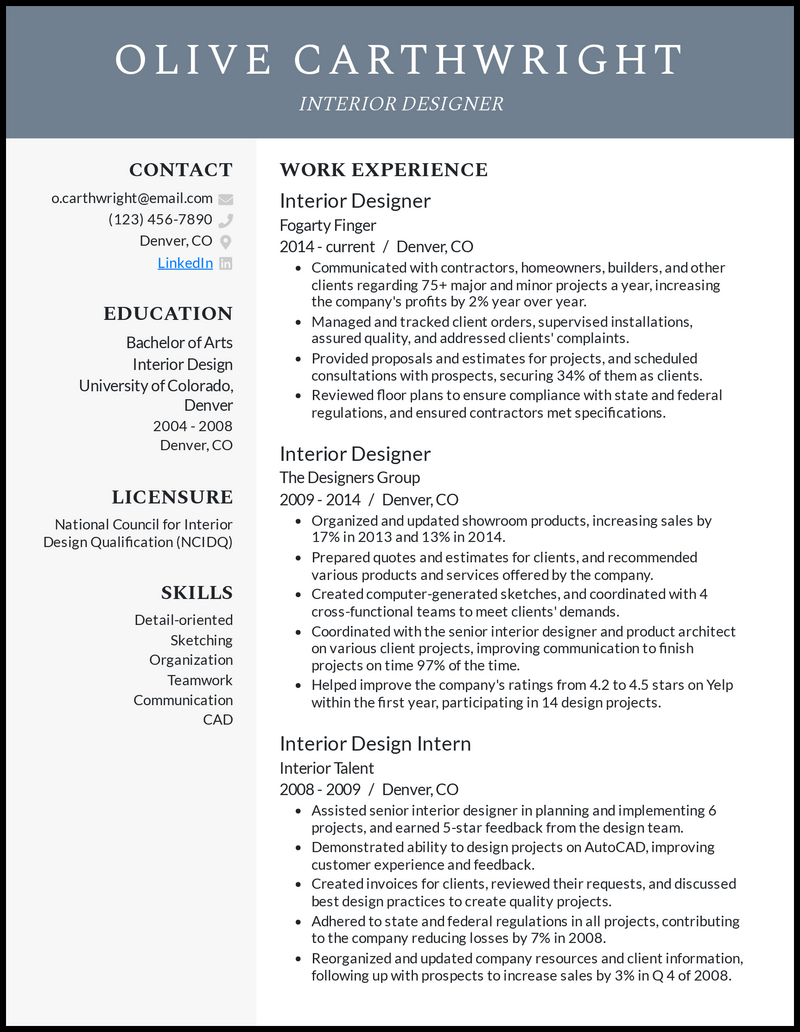
Create an interior design CV that highlights your attention to detail with a clear layout, top measurable achievements, and tools such as AutoCAD or SketchUp.
Demonstrate your value with a portfolio of your work and industry accolades. Remember to write a covering letter highlighting your unique perspective.
What you will find in this section:
- ↪ Tips for building a CV that reflects your design strengths
- ↪ What to include to highlight both technical and creative skills
- ↪ 7 interior design CV examples to guide and inspire you
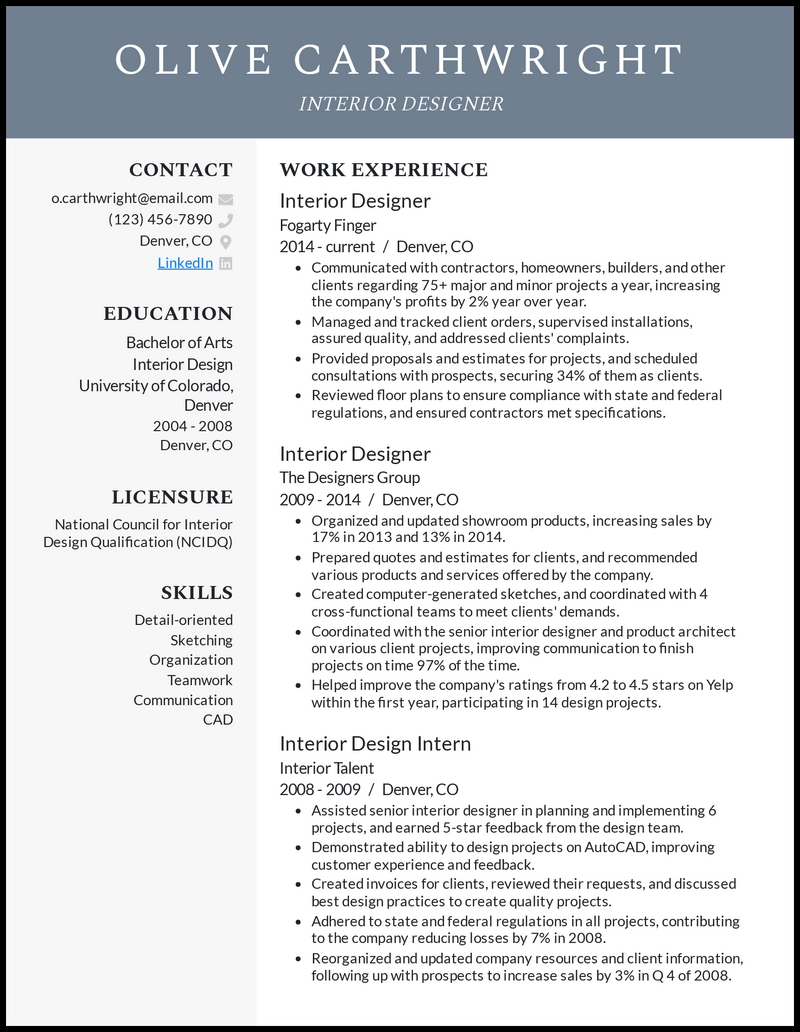
Why this CV works
- Your interior design CV needs to list academic qualifications and industry-specific certifications.
- Create a separate section for your certifications or licences, and don’t forget to mention which organisation issued your licence.
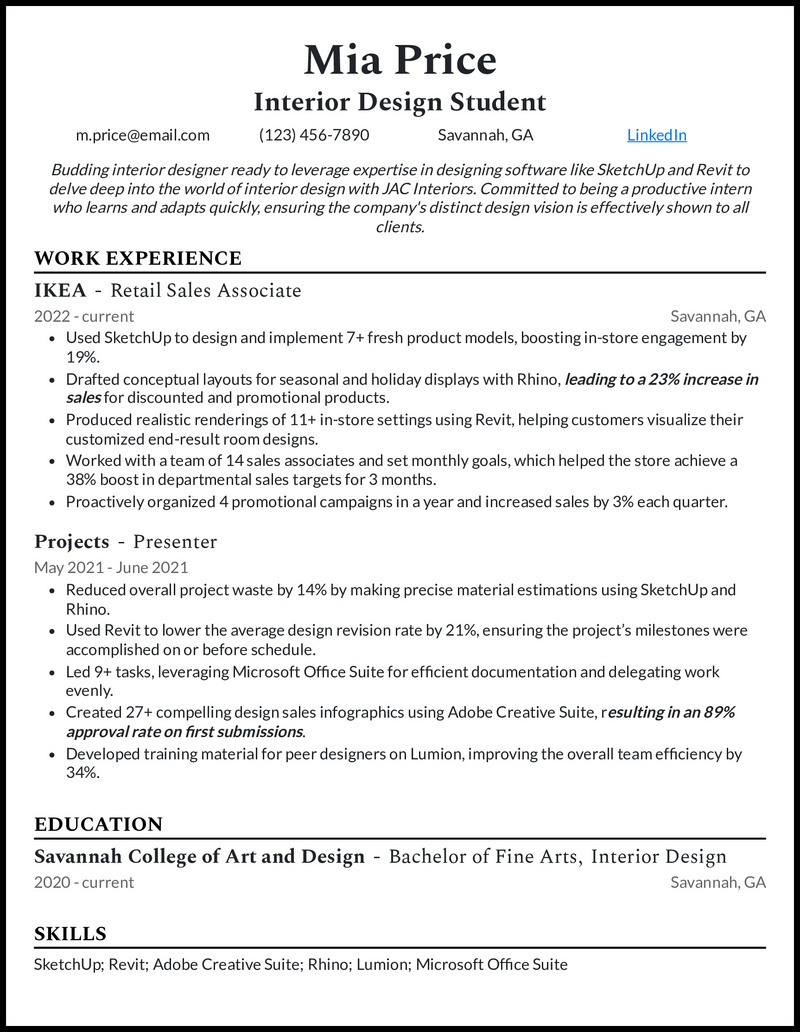
Why this CV works
- As a newcomer, you don’t need to have extensive metrics on your interior design student CV. In fact, at this stage, companies will mainly look for collaborative and creative skills.
- Remember to highlight how each design/layout contributed to solving a problem for the clients or company in your interior design cover letter.
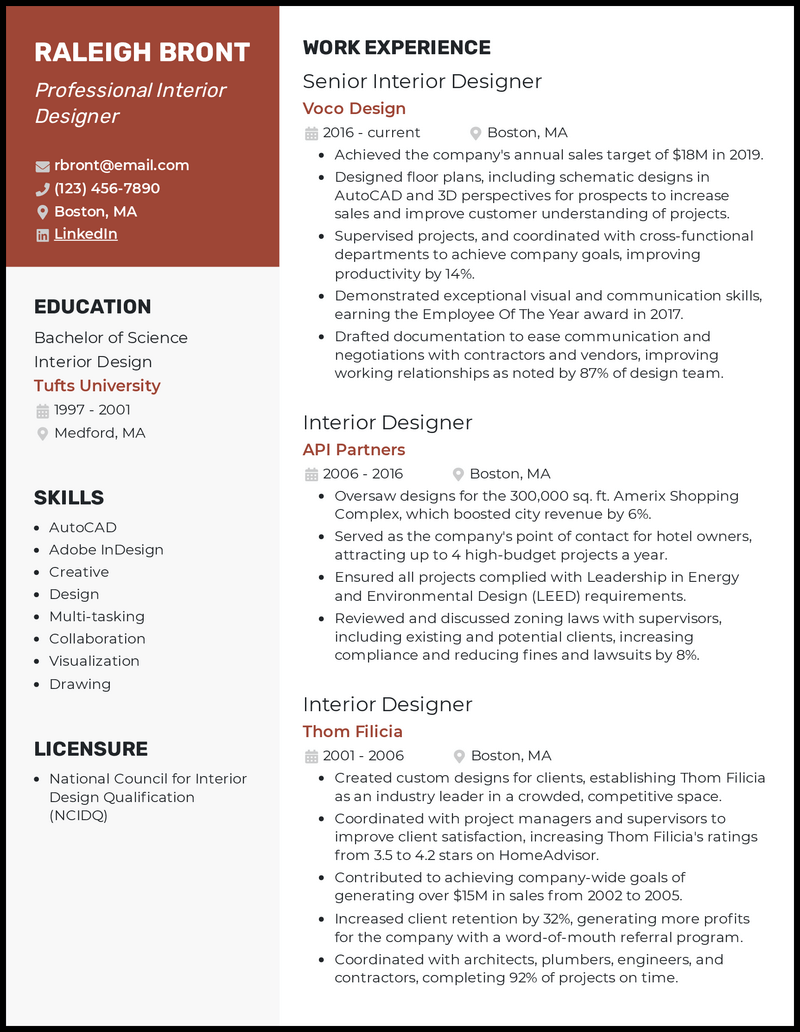
Why this CV works
- No CV is ever going to be picture-perfect, but you want yours to be as close as possible! Fix your CV so you avoid:
- Grammar errors/typos/misspellings/missing information (especially contact details) and punctuation errors
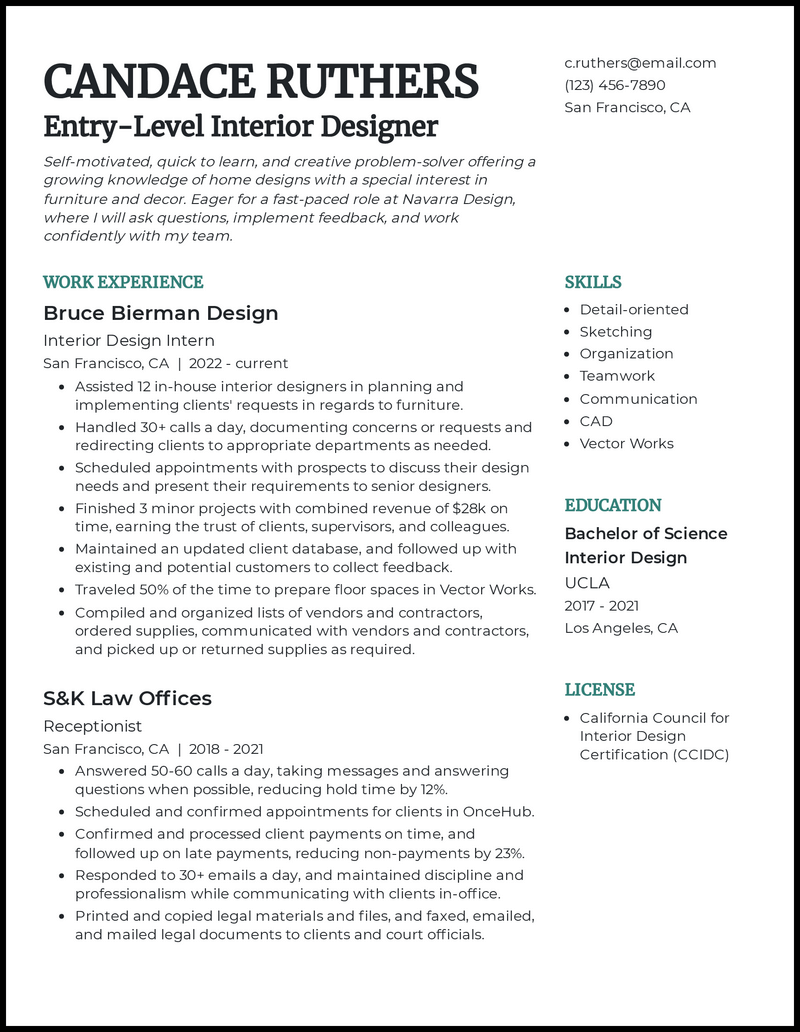
Why this CV works
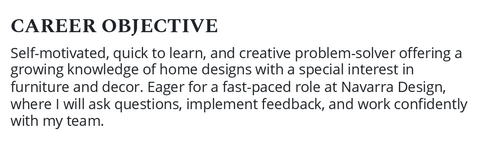
- If your entry-level interior design CV needs some more content, try adding a CV objective. This two-to-three-sentence statement sums up your skills and enthusiasm for the job without taking up too much space.
See more entry-level interior design CVs >
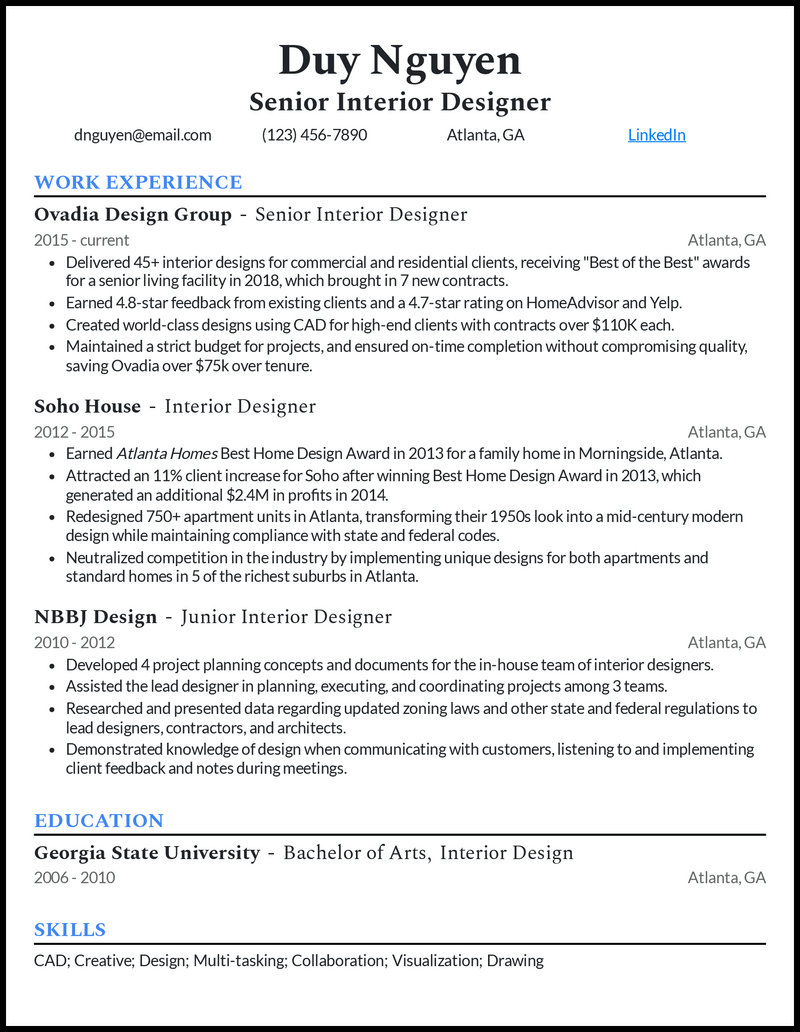
Why this CV works
- Your senior interior design CV should be anything but boring, so use a CV template to add some artistic flair.
- You can also experiment with formatting options to include as much as possible while still keeping your CV readable and on one page.
See more senior interior design CVs>
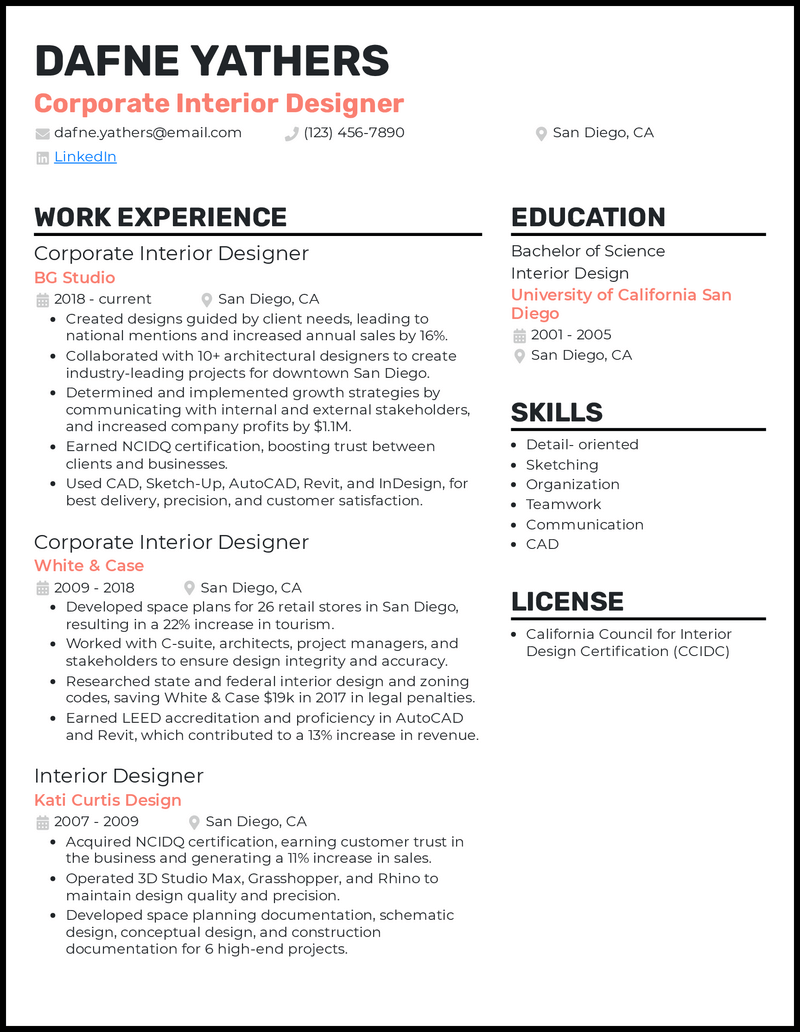
Why this CV works
- If you’re not sure which technical skills to include on your corporate interior designer CV, start with the job description.
- Just remember that you should tailor your skills section for each role.
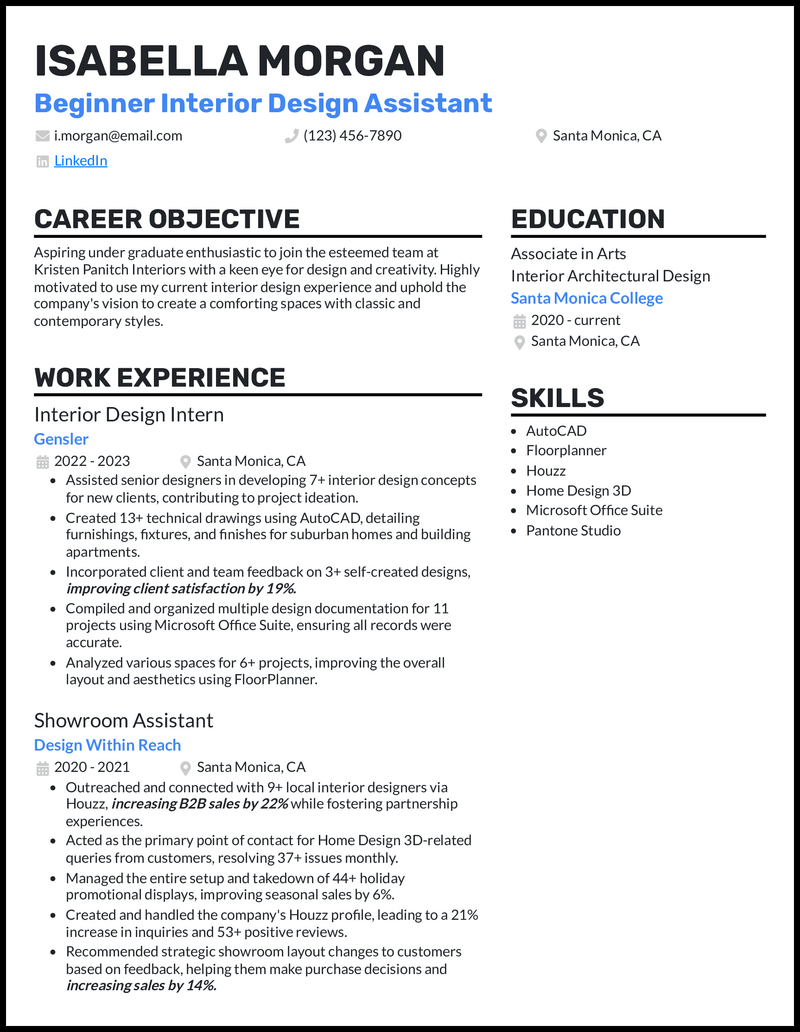
Why this CV works
- In a field with intense competition, your interior design no experience CV should include experience that showcases your creativity and knowledge of using design software.
Related CV guides
How to Write an Interior Design CV

When you write your interior design CV, don’t just list work and the tools you used. Instead, bring your stories to life by documenting the transformation of spaces, satisfied clients, accolades, and featured works.
Summary
Impress recruiters with a CV that reflects your creativity, showcases your technical skills, and positions you as the perfect interior design candidate.
Craft a CV that earns you a spot at the interview table by highlighting key skills, achievements, and style that recruiters will want more of.
This section examines:
- CV formatting to reflect your design style and professionalism
- What to include to highlight both creative and technical skills
- Ways to showcase your portfolio, qualifications, and client experience
- Tips for writing a concise, effective career summary that sets the tone
But before we begin, explore these CV examples for inspiration.
Ready? Let’s get stuck in.

Decide on CV format
The reverse chronological order will capture the essence of your successful career. It begins with your most recent experiences and traces back to where you started, clearly highlighting your professional development. This format is easy for applicant tracking systems (ATS) and human recruiters to scan, allowing them to quickly identify your strengths.
What the correct format involves:
- Enough white space.
- Clear headings
- Effective bullet points
- Consistent font styles and sizes
- Sufficient white space

Craft an outstanding heading
A messy header means you’re starting at a disadvantage. No matter how qualified you may be, recruiters won’t be trawling through your contact information to find an email or your phone number.
Ensure your CV header is professional, visible, accurate, up to date, and includes the following:
- First and surname
- The specific job title
- Professional email address
- Personal phone number
- Town/city & county (if the job is outside your county, mention that you’re willing to relocate)
- LinkedIn URL (complete with an updated LinkedIn summary and profile)
- Portfolio URL (it’s important to have one)

Summarise your qualifications
You’ll need a CV summary if you’re an experienced interior designer. For beginners and those changing careers, opt for a career objective.
With a professional profile, recruiters can immediately see your potential even before reading the rest of the details.
When summarising your qualifications, keep it to 2-3 compelling lines that discuss your experience, skills, top achievement, job title, and how you fit into the company’s needs.
Example of a summary
Transformed over 100 residential and commercial spaces across Los Angeles in more than 12 years, blending sustainable design with client-focused concepts. Expertise in project leadership, FF&E sourcing, AutoCAD, and Revit. Dedicated to telling stories by creating functional spaces.
Example of an objective:

Understand the responsibilities that lie ahead
What are the responsibilities of a graphic designer according to the job advert? If you can answer this question, you’ll easily tailor your CV to meet your future employer’s expectations.
Some of your routines will include:
- Meet and evaluate clients’ design requirements
- Create and present design models
- Select design elements, such as materials and colour schemes
- Manage project schedules and budgets
- Communicate with suppliers and contractors
- Comply with regulations and safety standards
- Present concepts and final products
Top tip: The next step is to make sure your application reflects those tasks and increases your chances of securing an interview.

Showcase your impressive interior design work experience
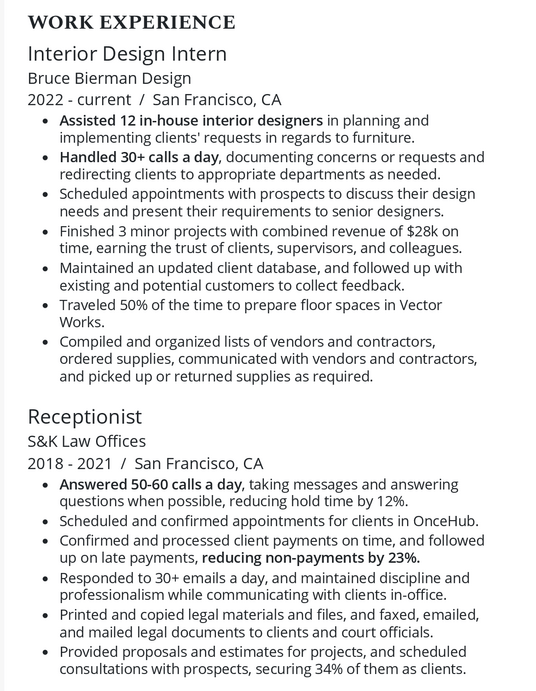
Your work experience should be like a showcase of what you’ve achieved and evidence of your accomplishments. Use the STAR approach: Present a Situation, highlight a Task, show Action, and demonstrate a measurable Result.
Remember, it’s all about demonstrating, not just stating, what you achieved. To emphasise the impact of your previous roles, use numbers and active verbs to create bullet points that highlight a career full of achievements.

Work experience for interior design with no experience CV
Lack of experience shouldn’t dampen your hopes of securing a job in interior design. You need to be strategic and utilise your passion, education, projects, work placements, apprenticeships, and voluntary work to inform hiring managers about your potential. Demonstrate what you did, the tools you used, and the results of each activity.

Showcase interior design skills
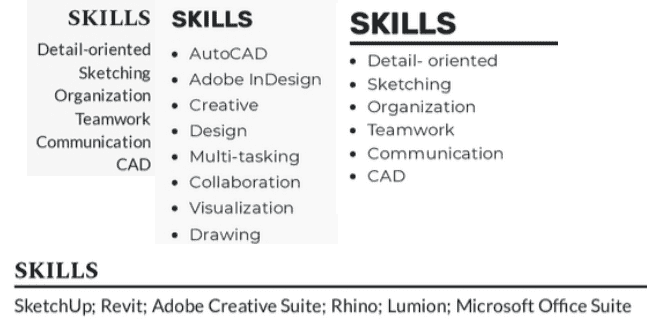
ATS will scan your technical skills before passing your CV to an HR manager. You should include some of these competencies listed in the job advert. This approach helps you align with the role and stand out to recruiters.

Showcase essential soft skills
First and foremost, you are a designer. However, your role requires you to be a project supervisor, a team player, a time manager, and a communicator. This is the perfect opportunity to showcase your soft skills, including:
- Time management
- Excellent communication with stakeholders
- Critical thinking
- Creativity
- Adaptability
- Problem-solving
- Time management

Add relevant education and licences
Education and relevant certification demonstrate your professionalism and knowledge of design principles. They also indicate that you possess the patience, adaptability, and attitude to learn and apply the best design practices in a real-world project.
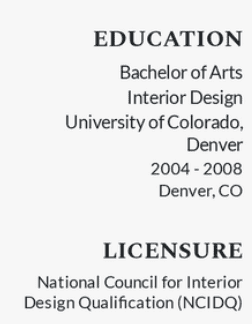
When listing your education, include the title of your field of study, the name of the institution, the location, and the year of graduation.
For certification, provide the name of the accreditation, the issuing body, and the expiry date (if applicable).

Additional sections: awards, voluntary work, membership in professional bodies
In this dynamic and competitive field, you must be creative to outshine your competition. Including additional sections that showcase your unique abilities can help you stand out.
You can include things such as:
- Design competition wins, such as RIBA and course projects
- Voluntary work in community centres
- Memberships to bodies such as BIID and SBID

Tailor your CV for the role
Every job is different, and you should customise your CV to reflect employers’ preferences. When you tailor your application, hiring managers consider you an excellent communicator, purposeful, and professional.
Here’s how you can do that effectively:
- Adjust the tone of the job advert
- Emphasise technical skills
- Share a portfolio
- Use keywords from the job advert
Key points
What did you learn here?
- Keep your CV clean, modern, and visually balanced—let the layout reflect your design sense.
- Emphasise real-world outcomes, not just tasks—demonstrate how your work made a difference
- Tailor each CV to the role by matching keywords and tools mentioned in the job advert
- Include a portfolio link that’s easy to find and opens without any hassle
- Use your summary to position yourself swiftly and set the tone for the rest
- Don’t forget the details: file format, legible fonts, and no typos—ever
Average Annual Salaries for Interior Designers in the UK
While you can work as a self-employed contractor and earn on a project-by-project basis, you can also secure a permanent position in a company. Below is what you can expect as your mean average salary according to the US Bureau of Labor Statistics update of 1/5/24.
| National/State | Average annual salary ($) |
|---|---|
| National | $71,430 |
| Maryland | $74,410 |
| New Jersey | $75,040 |
| Vermont | $75,440 |
| Illinois | $76,400 |
| New York | $77,170 |
| Wisconsin | $78,580 |
| Washington | $81,030 |
| Massachusetts | $82,040 |
| California | $85,650 |
| District of Columbia | $90,960 |
Interior Design CV FAQs

It’s a compilation of previous work projects, responsibilities, and achievements. It’s what you use to inform a prospective employer about your past successes and demonstrate that you can excel in their company’s available role. To maximise the effectiveness of your employment history, avoid listing tasks and instead highlight the impact with quantifiable results.
One page. You’re a designer who transforms spaces into stunning vistas through your work. Apply the same method when writing your CV, highlighting your skills and significant achievements. You won’t need more than a page to persuade potential employers of your capabilities. The only exception to exceeding a page is if you have extensive experience and an impressive list of top accomplishments. Even then, make sure you only include the most valuable details.
Projects, internships, voluntary work, strong educational background, relevant courses, competitions won, etc. Since you don’t have much experience, use these activities to give a sense of your potential and what you can bring to the role. Also, ensure recruiters notice your passion and knowledge of relevant tools and software.
Share a story of your achievements. Be cautious not to focus on your duties, as employers aren’t particularly interested in that. Emphasise your effective use of relevant skills to achieve impressive outcomes for previous employers and clients. With a consistent record of successes, any recruiter can see that you are deserving of the role.
Secure your next job with our AI-powered, user-friendly tool.
Eliminate the guesswork in your job search. Upload your existing CV to check your score and make improvements. Create a CV with one of our eye-catching, recruiter-friendly templates.
• Work in real-time with immediate feedback and tips from our AI-powered experience.
• Utilise thousands of pre-written, job-specific bullet points.
• Edit your CV in-line like a Google Doc or let us guide you through each section one step at a time.
• Enjoy peace of mind with our money-back guarantee and 5-star customer support.

Stephen is the co-founder and CEO of BeamJobs. Frustrated with the challenges he'd faced in his own job search, he left the corporate world to start BeamJobs with his brother. Drawing on firsthand experience with hiring and getting hired as technical talent, he started BeamJobs in 2020 to help qualified job seekers land interviews with less stress. Since then, more than 4 million people have built their resumes and cover letters on BeamJobs. Stephen's insights have been featured in notable outlets, such as Fast Company, Business Insider, Yahoo Finance, MIT, and Zapier. Learn more about Stephen.