



Deliver your photographer CV in a winning format that eliminates the chaos with style, impact, and your specialism.
To make a strong impression, avoid clutter and include only your technical skills, a portfolio, and specialism, plus writing a thoughtful cover letter to showcase your creative voice.
Here’s what we’ll cover in this guide:
- ↪ 11 inspiring photographer CV examples to spark your own ideas
- ↪ How to structure a professional photographer’s CV step-by-step
- ↪ What hiring managers in creative industries look for
- ↪ The best way to showcase your portfolio and equipment expertise
- ↪ How to showcase photography qualifications and awards
- ↪ Action verbs and skill phrases that resonate in visual industries
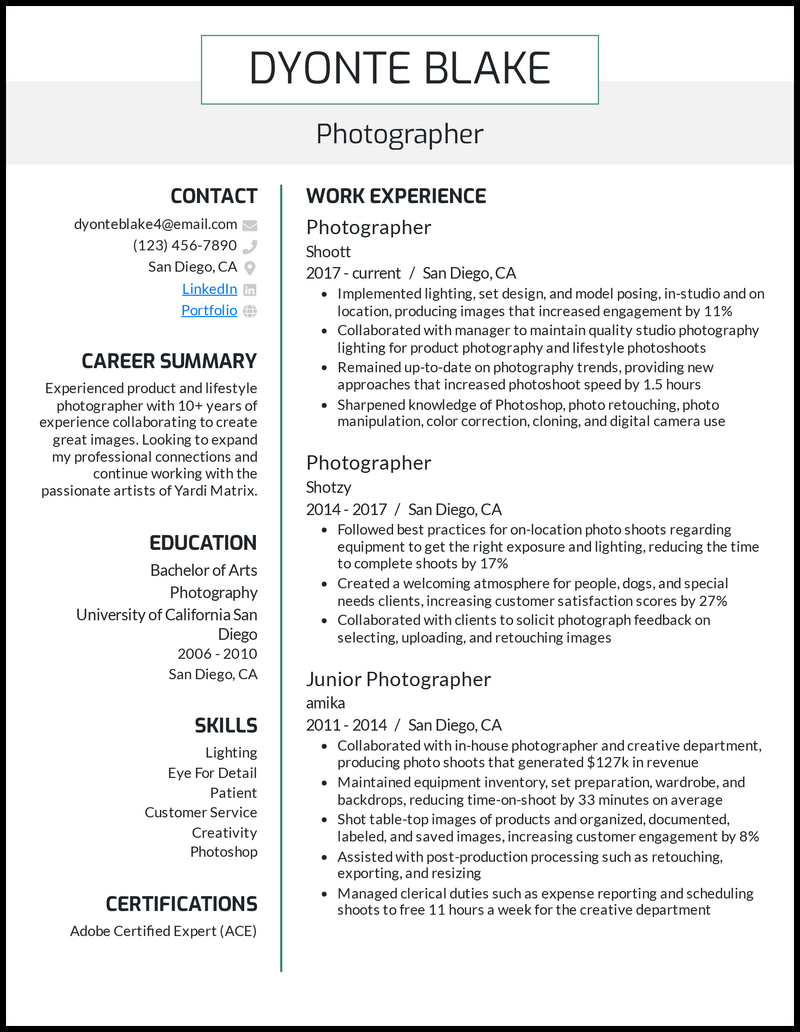
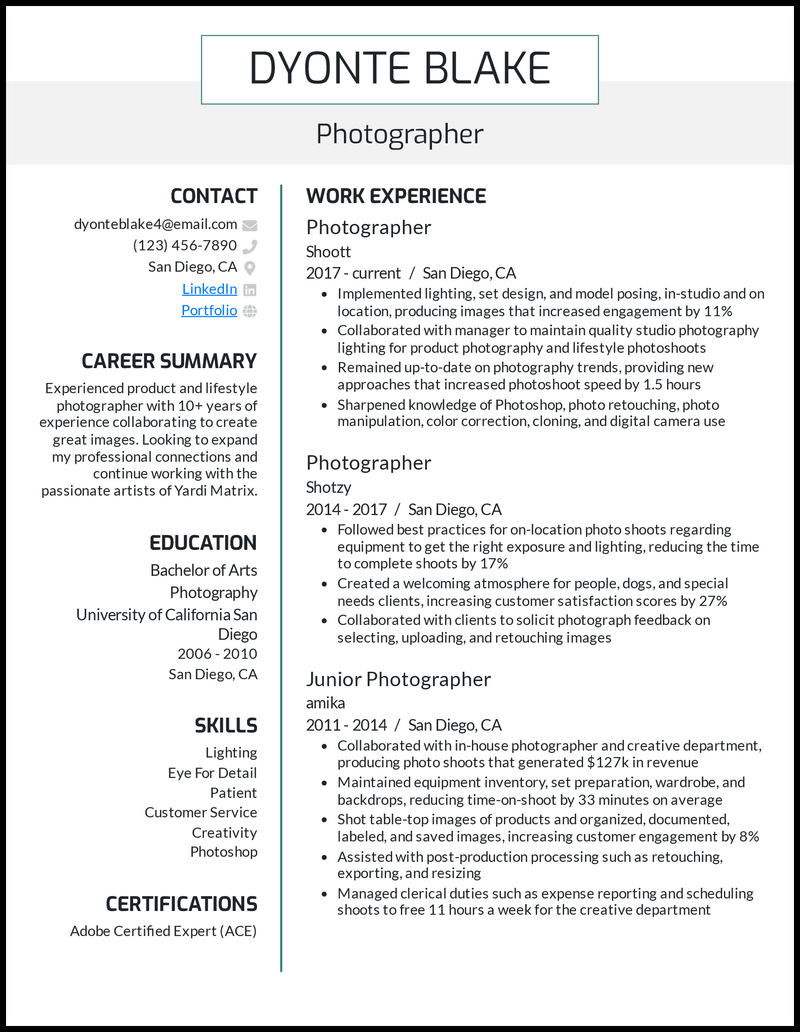
Show technical skills
- Have you used lighting techniques to create stunning images that boosted engagement? Are you a whizz at Photoshop, knowing every trick in the book? Can you operate and maintain all the essential equipment?
- You want to complement those technical competencies with soft skills (cue eye for detail, patience, customer service, and creativity), some of which deserve a mention in your CV career summary.

Add relevant links
- Making sure your LinkedIn profile and portfolio website are customised to highlight relevant work in your freelance photographer CV is essential if you’re serious about attracting the right attention: Kill two birds with one stone by creating your CV from LinkedIn.
See more freelance photographer CVs>

Tick the right boxes
- Ticking the right boxes in your wedding photographer CV could set things in motion for your application.
- Combine that with your expertise in useful software and equipment (cue Canon EOS R5, Fundy Designer, HoneyBook, Rawsie, and TinyPNG), and you’re the tech-savvy, memory-making professional they’re looking for.

Highlight your artistic talents
- For a creative photographer looking to gain a competitive advantage, now is the ideal time to focus on your artistic skills.
- Showcase in-demand skills such as photo manipulation and lighting expertise in action throughout your masterpiece, complemented by how you’ve blended your creative flair and technical know-how to excel in projects.
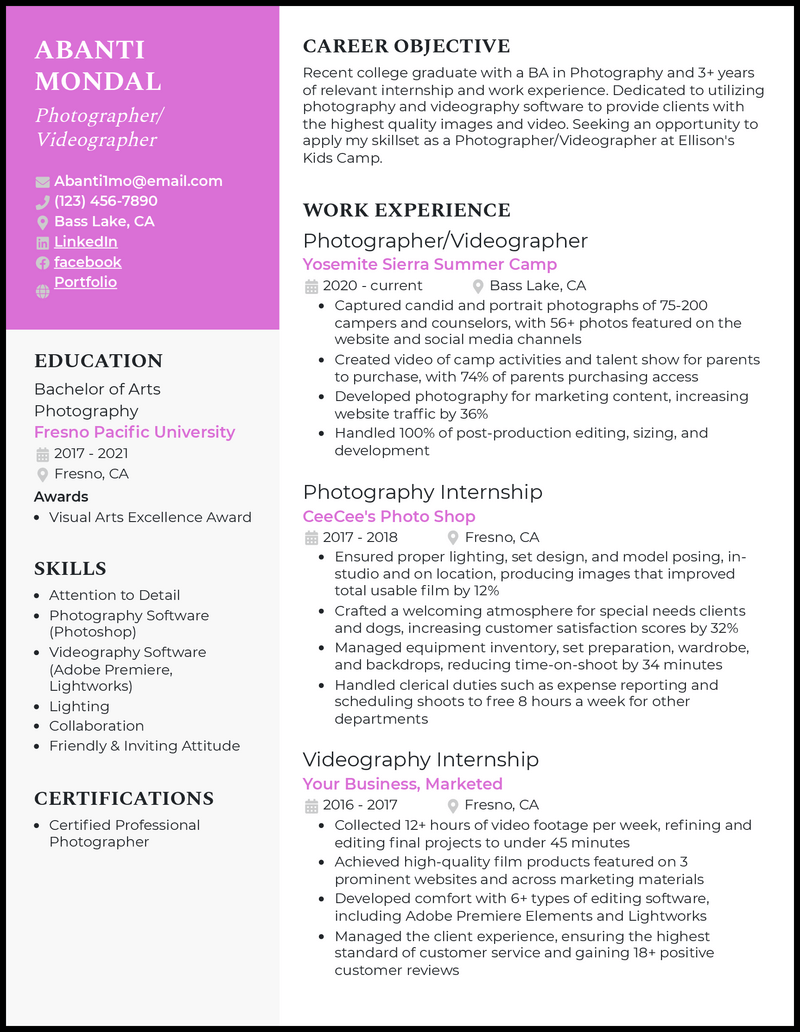
Opt for subtle colours
- Colour plays a massive role in making images and videos stand out, doesn’t it? Take it from us—sprucing up your photographer-videographer CV with a touch of it is one way to capture recruiters’ interest and showcase your creative flair.
See more photographer-videographer CVs>
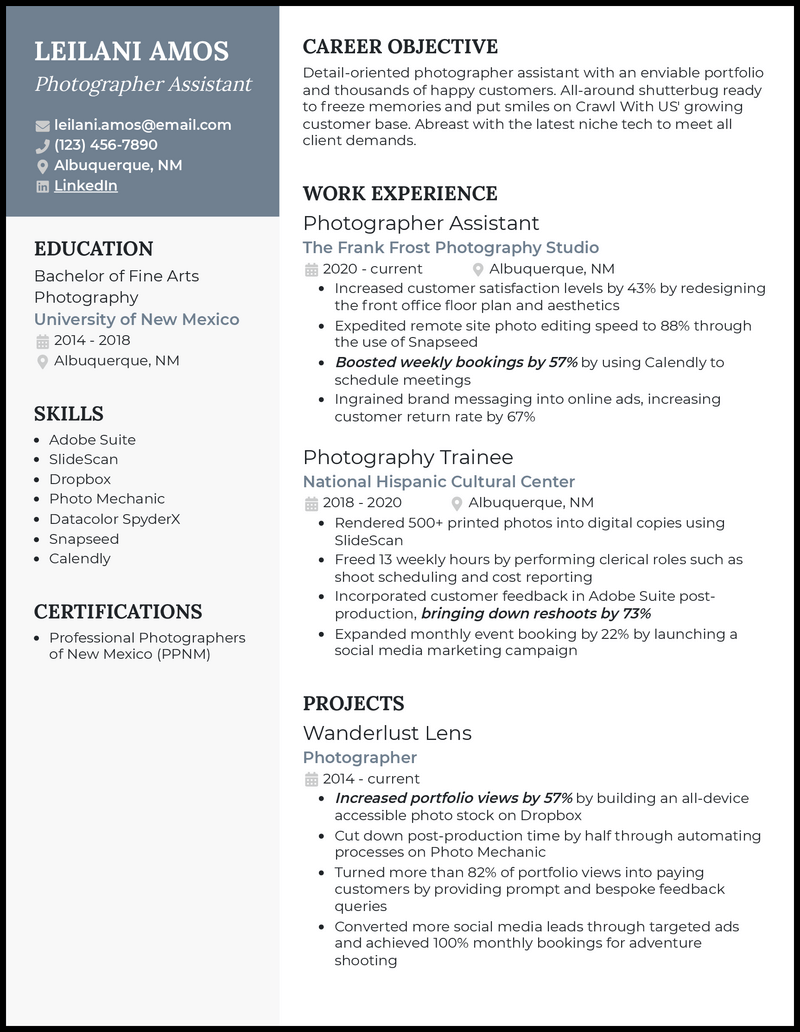
Using projects
- Job-specific projects on your photographer assistant CV highlight the skills and experiences that could make you an asset if hired. They demonstrate your readiness and potential, a clever move that helps alleviate concerns about whether you have sufficient experience in the field.

Keep your work history concise
- Make the most of the popular reverse chronological format and start your bullet points with strong action verbs. Then, quantify your achievements and include some industry-relevant terminology in your real estate photographer CV, and you’re already setting yourself up to secure that job interview.

Emphasise career progression
- Having navigated the waters for quite some time, you’re finally in control. Highlighting your outstanding career journey in your lead photographer CV could be the key to tipping the odds in your favour.
- However, focus on roles that are directly relevant to the job, ensuring your choice of words reflects the language of the job description.
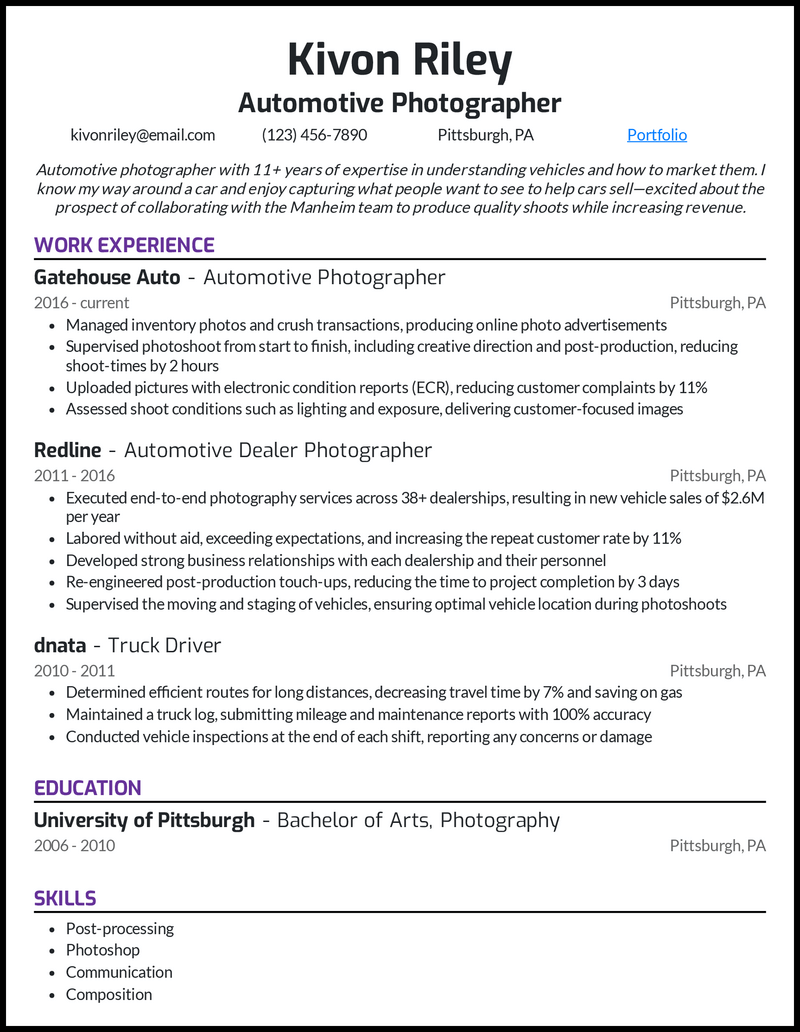
Choosing a CV template
- Planning successful professional car shoots requires exceptional organisational skills, and an automotive photographer CV that highlights your ability to keep everything in order can make a strong impression on recruiters.
- How about you stick with the classic single-column CV template? It’s clean, professional, and easy to read, which means hiring managers can go through your details without any hassle.

Capitalising your interests
- Adding one or two extra sections to your school photographer CV for additional impact could impress the recruiter and sway them in your favour, even over more-experienced candidates.
- For example, placing a section summarising CV-worthy hobbies and interests directly below your qualifications is another trick to strengthen your applications.
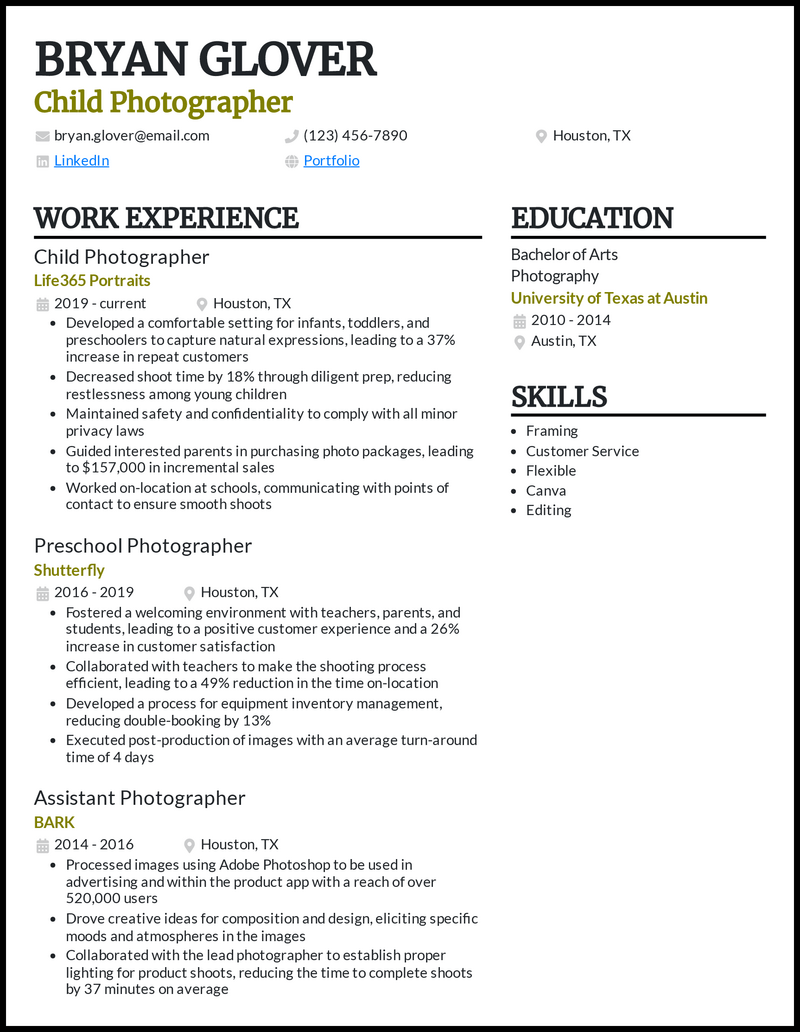
Fit into the role
- Encourage your child photographer CV to highlight instances where you adapted your approach to enhance children’s comfort, considering their emotional state, willingness to cooperate, and age. Moreover, these stories can provide compelling content for your photographer cover letter.
Related CV guides
How to Write a Photographer CV

Your portfolio is the centrepiece of your photographer CV. It does the heavy lifting in convincing potential employers to offer you the job.
Summary
Capture hiring managers’ attention instantly with a photographer CV that tells your story, showcases your best shots through measurable achievements, and frames your creative strengths in a format that highlights your value.
To stand out, highlight your work, achievements, skills, and creativity to share your stories, promote your image, and enhance your brand.
This section covers:
- What makes a photographer’s CV stand out (hint: it’s not just the photos)
- How to choose the right format that highlights your skills, not just your jobs
- Innovative ways to showcase your portfolio, equipment, and editing tools
- How to tailor your CV for any role
If you would prefer to get started straight away, explore these job-ready CV examples or dive into our CV builder and learn the ropes as you go.

Choose the right photographer CV format
Your choice of CV format reinforces trust in your style. Opt for a clean, well-spaced, and confident design. Like a photo that speaks a thousand words, let your layout easily pass through applicant tracking systems (ATS) and instantly impress recruiters. This is important because credible data shows over 98% of FTSE 100 companies use ATS to filter applications, and the same would be the standard procedure for other employers.
The reverse chronological order is the straightforward choice. No confusion, straight to the point, and highlights your strengths in the prime position for a potential employer to see.
However, if your portfolio is built on short-term jobs, the hybrid format best suits you. It highlights your photography skills while showcasing your strengths from each project.
Once the format question is settled and you begin writing, be consistent with font sizes and types, margins, white spaces, and colour. Simplicity will always win.

Share accurate contact details
Much like the reception area or an advertising banner, the contact section is the welcoming gesture that hiring managers receive when they review your CV. Use it to set the tone of your brand with the following details:
- Full names
- Professional email
- Phone number
- Town, County
- Portfolio link (essential!)
- LinkedIn (only if related to your work)
- Instagram (if it showcases your professional work)

Attract attention with a professional profile
Your work is more about what people see and less about what you say about yourself. That’s exactly what your profile needs to be: show, don’t tell.
Whether it’s a CV objective or a career summary statement, let a potential employer envision your final products, see your photos come to life, and tell an authentic story that can’t be captured in words.
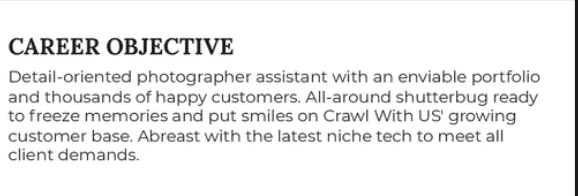
Example of a career objective for a photographer’s assistant
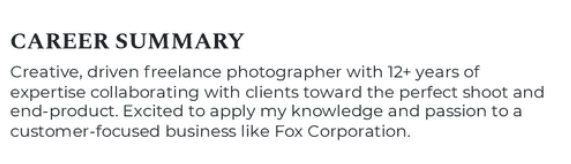
Example of a career summary for a freelance photographer CV

Let your achievements speak with metrics
Photography isn’t about you; it’s about the impact of what you do. To capture that and enhance it with your style and clients’ preferences, turn to numbers to clearly quantify your achievements.
How many events were you the lead photographer for? Do clients leave with a smile after you show them your work? Display satisfaction ratings. Did a brand attract more customers after it replaced old advertisement photos with new, brand-centric photos? Provide the number in pounds, traffic, percentages, or time.
To do this, generate bullet points that begin with unique, compelling action words, followed by skills, and end with measurable results. You’re getting the hang of it, aren’t you? That’s how you can make your experiences stand out and have recruiters eager to contact you before someone else does.

Showcase your photography-related skills
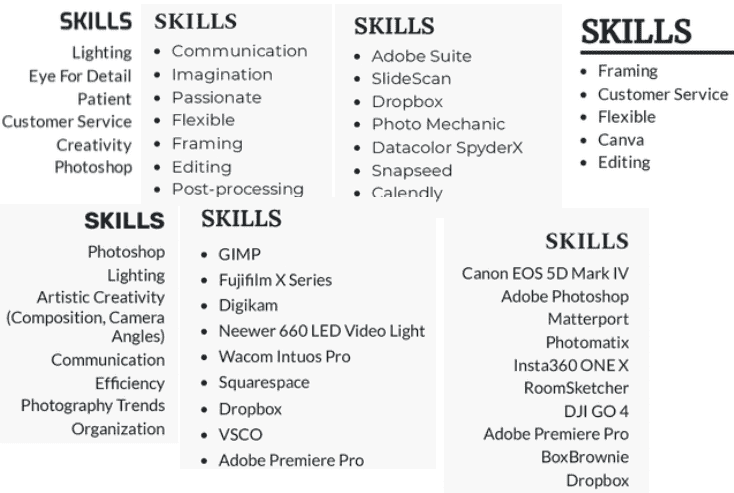
Who can’t press a shutter? But that’s not what an employer who knows what they’re looking for cares about. You’re a cut above the rest. Storytelling with every click of the shutter is your forte. Your timing is impeccable. Your attention to detail is second to none. You stay up-to-date with every photography trend, software, and tool. You can lead a team, refine concepts, collaborate with stakeholders, and deliver your work ahead of schedule.
All that requires a special section, “Skills”. That’s your set of competencies; you depend on it to achieve results. Let recruiters know what you’re capable of by highlighting some of those skills in your bullet points. No one is going to prevent you from getting the job.

Include education and qualifications
A Bachelor of Science in photography? Never heard of one. But that doesn’t mean your education is worthless. Relevant photography training can be the crowning glory of your CV. It tells hiring teams that you have academic discipline, adhere to guidelines, and hold yourself to the highest professional standards.
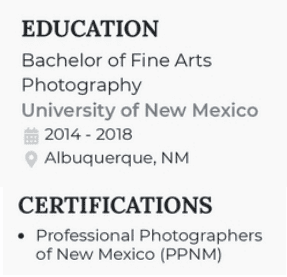
Certifications aren’t just decorations for your career; they tell a story of commitment, perseverance, and always striving for excellence.
Are you an Adobe Certified Professional, or do you hold a CAA Drone Licence? Don’t leave these out; keep them visible. You’re simply saying that your work has the stamp of approval from the industry leaders.

Make your mark with your photography achievements
Boasting about your well-deserved successes is acceptable in the creative field.
Have you ever won any photography awards? Had your work featured in Vogue? Won a university photo exhibition?
These are your medals of honour, and just as you hang the physical ones in your gallery room at home, let them shine on your CV.

H3 Customise your CV
Every photography job is unique and deserves a tailored CV that shows you’re the real deal.
For each role you apply for, let your CV:
- Match the job advert tone
- Share the most relevant and significant experiences
- Use keywords from the job advert
- Speak the language of the industry and the company offering the role

H3 Common photographer CV mistakes
Avoid these pitfalls:
- Leave out your portfolio
- Using a template with lots of graphics
- Describe responsibilities
- Assuming the audience
- Make grammar mistakes

H3 Key points
Things to keep in mind when putting your CV together:
- Opt for a clean, professional layout that doesn’t detract from your work
- Focus on the type of photography you’re best at — stick to your strengths
- Place your portfolio link right at the top so it’s easy to find.
- Mention your equipment and editing tools only if they are relevant for the job
- Describe your previous work in clear, confident language — keep it genuine
- Always include a covering letter — it’s your chance to show a bit of personality
- Keep it to one page unless you have a strong reason not to
Median Annual Salaries for Photographers in the UK
With a CV that lands you the job, the next thing on your to-do list is knowing how much to expect from freelance work, projects, or a permanent position. According to the US Bureau of Labor Statistics report released on 5/1/24, the median annual salary for a photographer is $42,520 and $20.44 per hour.
Photographer CV FAQs

A good photographer’s CV in 2026 should highlight your tech savviness, including staying up to date with new technologies and incorporating the latest trends in your work. It must present you as a modern photographer keeping pace with the needs of clients in the evolving landscape of the industry.
A professional photographer’s CV must include a header with all the essential contact information, a professional summary, core skills, relevant work experiences with top achievements, and use a clean, simple, functional format that presents your qualifications and strengths for the role.
Example:
Experienced wedding photographer with 7 years of blending editorial style with visual realism, and photographed 200+ weddings across the US, including four nationally featured ceremonies in Brides magazine. Adept in lighting control, compelling storytelling, and leading teams with ease. Committed to documenting fleeting moments and turning them into timeless heirlooms.
A property photographer’s CV should highlight your experience in the sector. Choose the most impressive achievements and present them to potential employers. If your work helped increase property viewings or close deals, make sure to include that as part of your selling points. Also, don’t forget skills that make it easy to get the job done, such as editing software.

Stephen is the co-founder and CEO of BeamJobs. Frustrated with the challenges he'd faced in his own job search, he left the corporate world to start BeamJobs with his brother. Drawing on firsthand experience with hiring and getting hired as technical talent, he started BeamJobs in 2020 to help qualified job seekers land interviews with less stress. Since then, more than 4 million people have built their resumes and cover letters on BeamJobs. Stephen's insights have been featured in notable outlets, such as Fast Company, Business Insider, Yahoo Finance, MIT, and Zapier. Learn more about Stephen.