




To write a standout front-end developer resume, start by tailoring your experience and skills to the specific job description, using clear formatting and action-driven language. Our resume-building tool can help.
Be sure to include relevant technical proficiencies, past project examples, and links to your work; for more help, see resume examples or learn how to write a cover letter that complements your resume.
In this guide, you’ll find:
- ↪ 19 front-end developer resume examples for different experience levels
- ↪ A breakdown of essential sections every front-end resume should include
- ↪ Tips for aligning your resume with job descriptions and keywords
- ↪ Advice on formatting, layout, and ATS (Applicant Tracking System) optimization

Why This Front End Developer Resume Works
- Generic and vague bullet points and skills are the death of a React developer resume. You’ve got the skills and the experience to prove it, so list skills on your resume like React Router and Redux.
See more React developer resumes >

Why this resume works
- As a last-year student, no one expects you to have intense experience making responsive web pages. This is where the career objective in your front end developer intern resume is going to save the day.
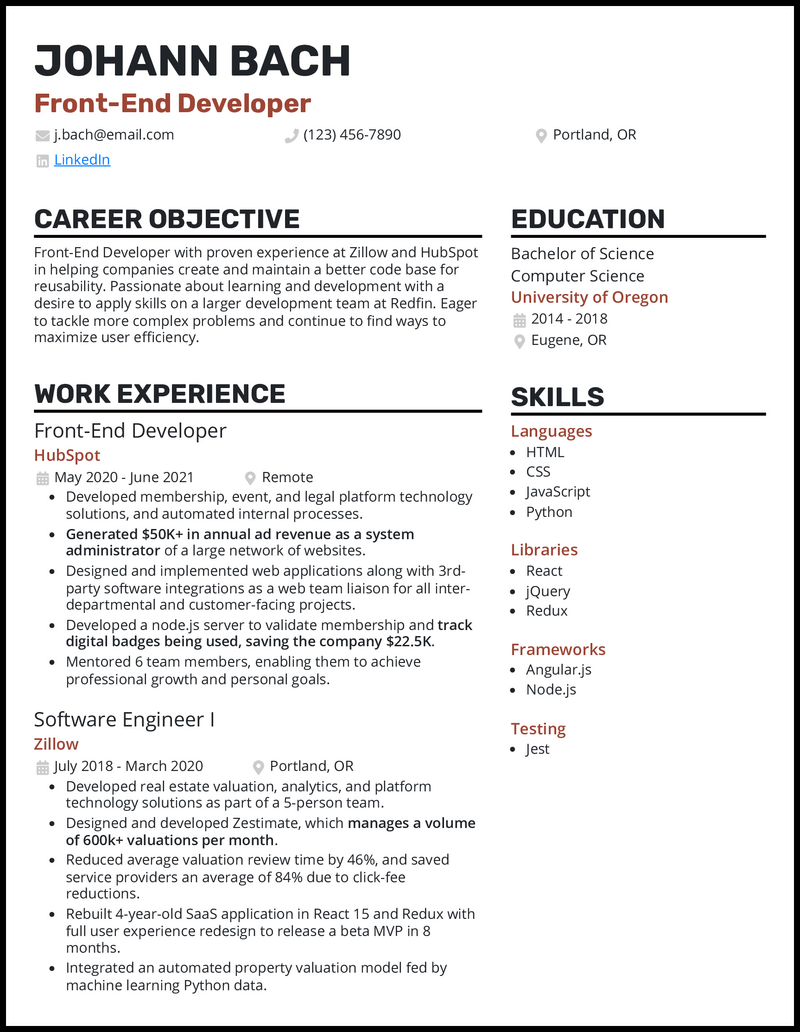
Why this resume works
- Including quantifiable metrics in your front-end developer resume will increase your chances of getting an interview. Try to quantify your impact in your past developer roles when possible, even if those impacts are rough estimates.

Why this resume works
- Keep things more easy to understand and realistic by portraying a steady career growth in your lead front end developer resume.
- With each job, add outstanding accomplishments to impress your to-be employer and prove that you’ve worked your way up the ladder.
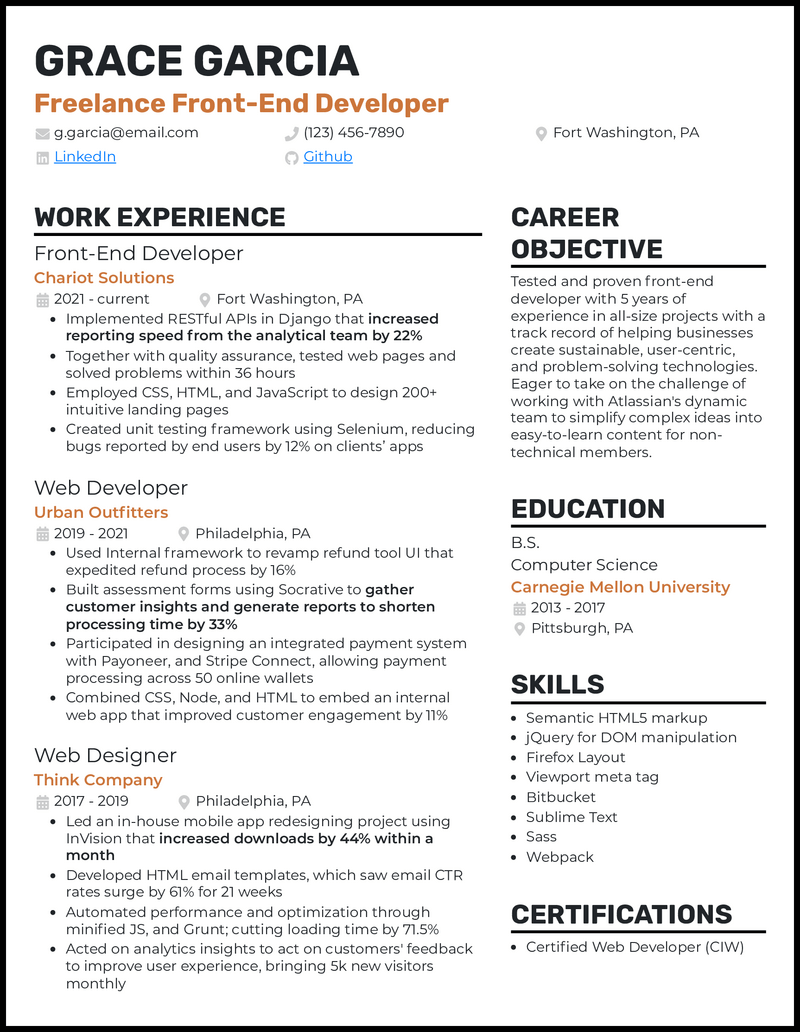
Why this resume works
- Including measurable metrics and tools used in your freelance front-end developer resume sets you ahead of other applicants. You stand out from the rest by quantifying your achievements in past roles even if you have to provide rough estimates.

Why this resume works
- So, you’re into improving the user experience for online visitors using TypeScript’s Angular framework? Kudos! Just remember to quantify its impact in your front end developer Angular resume.

Why this resume works
- Unlike the resume summary that’s reserved for veteran candidates with 10+ years of experience in a field, career objectives exist to support and enhance whatever work experience you list, even if limited.
- Use a career objective to instill confidence in the reader that you’ve got a history of driving value (even if your record is short).

Why this resume works
- Limit your skills section to 6-10 on which you’d be comfortable being interviewed. If you haven’t programmed in a specific language, it most likely shouldn’t be on your senior front-end developer resume.
See more senior front-end developer resumes>

Why this resume works
- Take a look at Selene’s AEM front end developer resume and see how they mention the best impacts such as, “driving a 57% uptick in user engagement” in their current role. This shows hiring managers that you’re an AEM expert and know how to use it to bring valuable changes.

Why this resume works
- Elevate your associate front end developer resume by including a variety of software that juniors may take years to master. Forget coding languages, you can even spread your skill section with other tools like CMS or package managers.

Why this resume works
- Even as a rookie, you can make your entry-level front-end developer resume shine! You just need to convince the hiring manager you know how to program and build great front-end experiences. What’s a great way to do that? With projects!
See more entry-level front-end developer resumes >

Why this resume works
- For your front end user interface developer resume, pick a template that can show employers your best abilities first. If you’re looking to focus more on work experience than skills, then a more formal template is just what you need.

Why this resume works
- Want to ensure your Java front-end developer resume pops from the first glance? Making strategic use of bold, underlining, or italics to highlight key achievements could be the golden ticket you need.

Why this resume works
- A research project you undertook at college could be your junior front-end web developer resume’s saving grace. Here, you want to emphasize your findings, lessons learned, and skills mastered throughout the process.
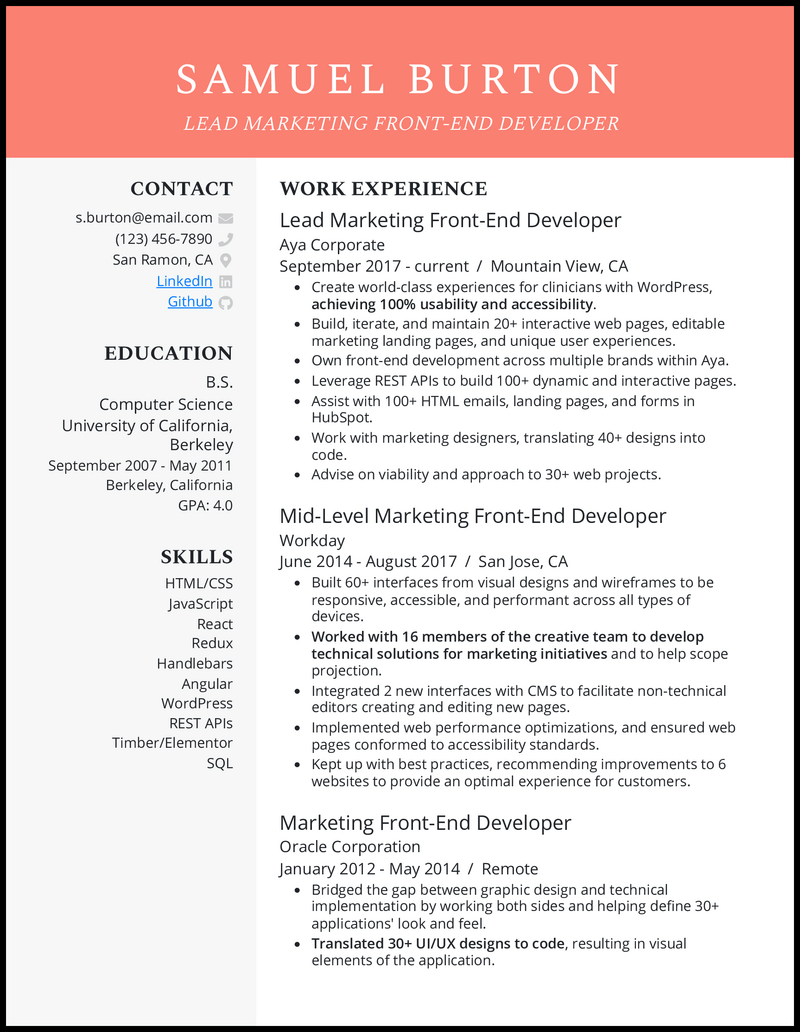
Why this resume works
- As a senior/lead marketing front-end developer, the need for a comprehensive career objective dwindles. Instead, the spotlight of your lead marketing front-end developer resume should be shining on work history, excellent KPIs, and leadership. Feel free to use our resume checker tool to avoid common pitfalls.

Why this resume works
- Include any licenses or certifications in a dedicated “Certifications” section on your mid-level front-end developer resume. Our easy-to-use resume templates let you add a section for certificates and licenses. Including your certifications in a specific section makes this determination super easy.

Why this resume works
- Check out how Jamie crafts her self taught front developer resume with various types of roles ranging from junior, and freelance, to a full-time front-end job, while senior developers can also show growth by mentoring junior developers.
- This shows prospective employers her growth and proven track record in the field simultaneously.
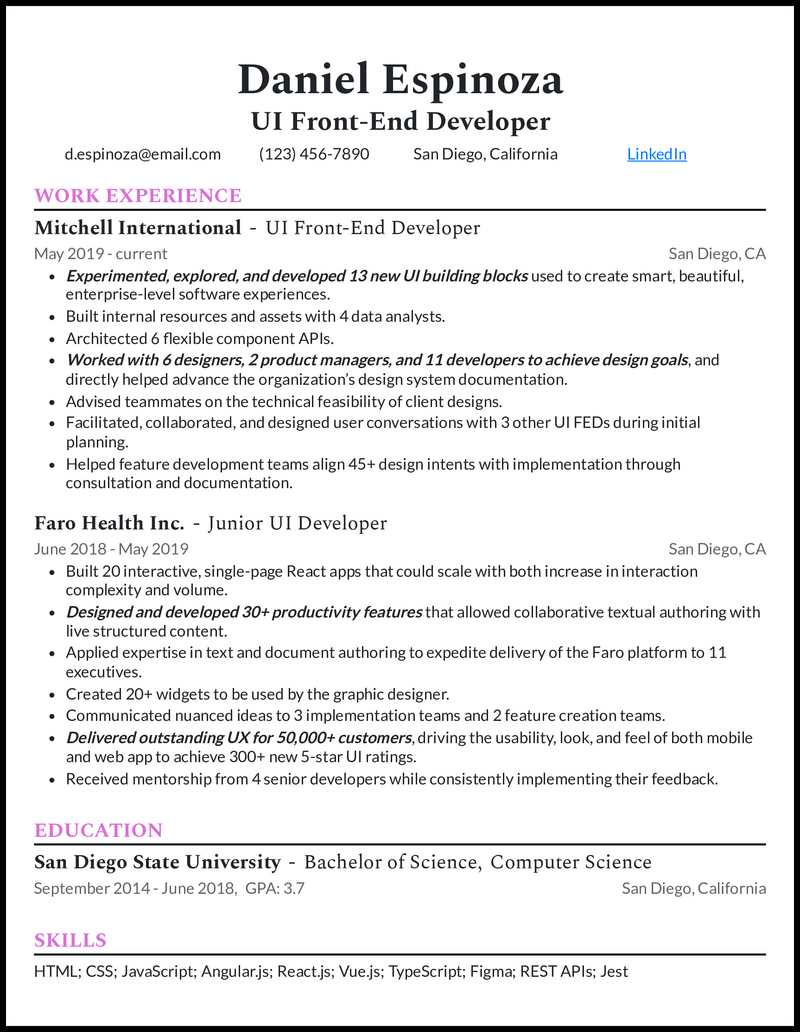
Why this resume works
- The resume header on your UI front-end developer resume should clearly present your contact details, and the title right under your name should match the role to which you’re applying.
- To be more specific, your title should read “UI Front-End Developer” if you’re applying for a UI front-end developer role, regardless of your previous experience.
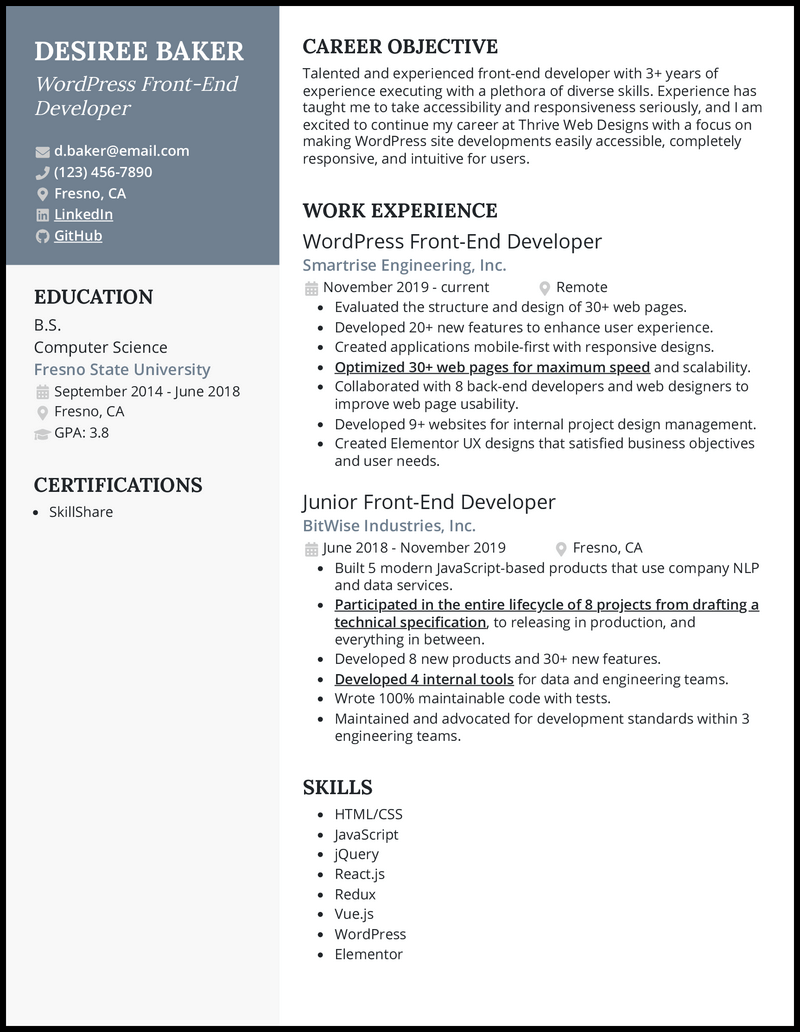
Why this resume works
- When seeking a specific position, customize your WordPress front-end developer resume by including current or previous job titles to fit the desired role best.
- Commonly interchangeable titles such as WordPress developer, WordPress front-end developer, and WordPress front-end engineer have virtually identical responsibilities.
How to Write a Front-End Developer Resume

As someone who handles the main design of a website/application, you know how important your job is. In fact, The demand for web developers is expected to grow 16% by 2032 and getting your resume right is the first step to landing a front-end job!
When you write a front-end developer resume, clearly present your technical expertise, experience, and impact in a way that tells hiring managers you’re actually what they’re looking for.
Summary
Command attention with precision by writing a job-winning front-end developer resume so hiring managers stop scrolling and start reading. Emphasize the right skills, structure, and measurable results..
You should include your strongest technical proficiencies, relevant projects, and proof of you solving real problems with clean, user-focused code.
Here’s what this section will cover:
- How to structure your resume so it’s scannable and recruiter-friendly
- What front-end specific keywords to use for better ATS visibility
- The best way to showcase portfolio links and GitHub contributions
- How to describe projects using outcomes, not just tasks
- Tips for balancing design sensibility with technical credibility

Front-end developer resume tips
If there is one thing you take away from this before you create a resume, then let it be this: quantify the bullet points on your resume whenever possible.
Our data show that is the most important factor in determining whether or not you’ll get an interview after controlling for experience and qualifications.
Here are some other high-level tips that we’ll dive into in more detail below:
- Customize your front-end developer resume for each job to which you apply.
- Only include languages and frameworks on which you’d be comfortable being interviewed.
- You most likely don’t need to have a resume objective.
- Again, quantify your impact!
- And finally, please, please avoid spelling and grammar errors.
Incorrect spelling or grammar is the silliest of reasons to be rejected for a job, and it is 100% preventable.
Be sure to proofread your resume a few times, then have someone else look at it for you.

Add title and key contact details in your resume header
Kick off your resume header with the most relevant things first: who you are and how to contact you. Include the exact job title, such as “Entry-Level Front-End Developer” or “React.js Front-End Engineer.” This section is the first thing recruiters use to filter applications before they reach their desks.
Include the following in your title and contact section:
- Job title
- Full Name
- Phone Number
- Professional Email Address
- LinkedIn URL (complete with a customized LinkedIn summary and headline)
- Portfolio Website or GitHub (a must-have for devs)

Front-end developer job description for resume
Customizing your resume for each front-end role you apply to will improve your chances of reaching the interview stage.
We promise it’s easier to do than you may think and should take no more than 15 minutes for each application, especially if you take advantage of one of our free resume templates that make it easy to customize.
Here’s a good, quick process for tailoring your front-end developer resume for each job:
- They use their Applicant Tracking System (ATS) to filter out candidates based on their skills and experience automatically.
- A non-technical HR person from the company reviews your resume.
- The hiring manager (usually technical) will review your candidacy to see if they think you’re a good fit.
To hammer home how easy this can be in practice, let’s look at a concrete example.
Work background
This front-end developer, Johann, has five years of experience building web apps for B2B companies. He is most comfortable with Angular, HTML/CSS, Javascript front end frameworks, and PostgreSQL.
On his first version of his resume, this is how we describe his latest work experience:
Feedzai
August 2017 – Present, New York NY
Front-End Developer
- Architected product tours with React for a new feature that improved customer adoption by 22%, leading to $1.1M in incremental revenue
- Partnered with back end developers to develop the front-end for a product recommendation engine that increased user time on page by 4 minutes
- Migrated a multi-page user experience into a single-page app which improved customer engagement by 8%
Front-end developer job description
This is the job description for the role Johann is applying to at Acme Corp:
Responsibilities
- Design and develop features to meet customer requirements and business goals
- Build high-quality and highly reliable software to meet the needs of the product owners
- Write clean, elegant, and reusable code that solves complex problems
- Participate in design & code review processes
Qualifications
- Excellent problem-solving skills
- Strong knowledge of HTML, CSS, JavaScript
- Experience in one (or more) of the following frameworks: AngularJS, React JS, Vue JS, D3
- Experience working with Relational databases like PostgreSQL
- Experience with at least one MVC server-side framework like Rails or Django
Update the work experience
Most of the experience Johann listed for his time at Feedzai is directly applicable to this role at Acme Corp. His focus on business goals aligns perfectly with this job description.
The only difference we would make to his work experience is to explicitly include the languages he used for each of his projects to match the skills Acme Corp is looking for in this role.
The changes are underlined below.
Feedzai
August 2017 – Present, New York NY
Front-End Developer
- Architected product tours with React, HTML/CSS, and PostgreSQL for a new feature that improved customer adoption by 22%, leading to $1.1M in incremental revenue
- Partnered with data scientists and and backend developers to develop the front-end for a product recommendation engine that increased user time on page by 4 minutes using Django
- Migrated a multi-page user experience into a single-page app which improved customer engagement by 8% using React
These changes are small, but they make Johann a much more appealing candidate to Acme Corp. Remember, tailoring your resume can improve interview chances by 15%.

How to write a front-end developer resume with no experience
No experience? No problem. Focus more on your potential, starting with a compelling objective outlining your passion for UI/UX, proficiency in modern frameworks, website development, and any hands-on projects or bootcamp experiences.
Here’s what you need to get it right:
- Emphasize projects (personal, open-source contributions, or coursework)
- Include internships, freelance work, or volunteer contributions
- Highlight transferable skills like collaborating in cross-functional teams, problem solving abilities, or Agile familiarity
Pro Tip: If you’re entry-level, a “Projects” section can replace a traditional “Experience” section. You don’t need to overthink it! A simple resume made on Google Docs will work here, too.

Highlight programming languages and tools
Hiring managers scan for your technology stack in seconds, so make it impossible to miss yours.
Unlike a full-stack developer who juggles both sides of the application, your focus here is purely frontend. You’ll want to highlight:
- The Essentials: HTML5, CSS3, and JavaScript/TypeScript.
- Modern Frameworks: Strong proficiency in at least one major ecosystem like React, Vue, or Angular.
- The Ecosystem: Tools like Git, npm, and Webpack, along with styling utilities like SAS.
Also, mentioning any experience with CSS preprocessors like Tailwind CSS is valuable.

Let your resume skills shine
Before a hiring manager or recruiter looks at your resume for a front-end dev role, an automated system called an Applicant Tracking System (ATS) scans your resume.
An ATS is filtering resumes based on keyword matching, so it’s critically important to include as many skills listed in the job description on your resume as possible. That said, soft skills like problem-solving and communication are also highly valued in front-end development roles, so show them through credible examples instead of a long label list.
Be careful to remember that a human will still look at your resume!
So adding skills like “coding skills” won’t cut it. It’s much better to be an expert in one to two languages than a beginner in many different languages.
Nothing is a bigger red flag to a technical hiring manager than a resume where a developer’s tech stack includes a laundry list of different skills and frameworks. It’s much better to be an expert in one to two languages than a beginner in many different languages.
As a rule of thumb, only include languages and frameworks on which you’d be comfortable being interviewed. Also, don’t be afraid to include Git. Recruiters know version control using Git is necessary for collaboration in software development.
Here are common resume skills employers look for in front-end developers to give you some inspiration.
Common resume skills for front-end developers
- JavaScript frameworks (ES6, React, Angular, Redux, Webpack)
- CSS preprocessors and frameworks (SASS or Tailwind CSS)
- HTML5
- CI/CD
- Agile Software Development
- Cloud (AWS, GCP, Azure)
- UX Design
- Service Side Development (C#, Node.js)
- TypeScript
- Python (Django)
- Git
- SQL (PostgreSQL, MySQL)
- Visual Studio
- Other front-end technical skills employers expect

Use the right action verbs for front-end developers
Strong action verbs instantly elevate your resume from basic to bold. Use verbs that reflect initiative and skill, like:
- Engineered
- Translated
- Optimized
- Debugged
- Collaborated
How to do it right:
- Begin each bullet point in your work history with an action verb; “Collaborated” works especially well when describing work with backend teams.
- Quantify results where possible

Resume objective
95 percent of front-end developers shouldn’t include a resume summary or objective on their resume.
Hiring managers are conditioned to ignore both because they’re usually generic and don’t add value to a resume. You should only include an objective if you’re going to take the time to customize it for each job to which you apply.
To ensure a hiring manager reads your objective, you should include numbers and the company’s name to which you’re applying.
The company’s name will draw the hiring manager’s attention as they skim your objective, which will encourage them to read the entire resume objective.
Your front-end developer resume objective should include your top one to two qualifications or biggest career accomplishments (quantified, of course), as well as why you’re interested in the company/role to which you’re applying.
Here are a few resume objective examples for inspiration: your next role.
Front-end developer resume objective examples
- “Recent graduate with an MS in Computer Science looking to leverage my experience building responsive and scalable web apps to solve interesting problems that delight end-users.”
- “Throughout my career in front end development, I’ve emphasized the importance of scalable and well-documented code. I enjoy working collaboratively but can also run projects on my own. Excited about the prospect of joining a product-driven company like Acme Corp.”
- “Experienced front-end developer who is comfortable working with JavaScript, HTML/CSS to deliver exceptional customer experiences. Looking for an opportunity to work at a company like Acme Corp with a positive social mission to democratize online payments.”

Measure your impact
We’ve said it before, and we’ll say it again: the single most important thing you can do on your resume is to quantify your impact.
To accomplish this, focus on your accomplishments instead of your responsibilities. Don’t be afraid to brag on your resume!
Quantifying your impact on your resume accomplishes a few major goals:
- It quickly and convincingly makes the case that you’ll have a large impact on the role to which you’re applying.
- It convinces the hiring manager you know the metrics that ultimately matter are tangible business outcomes.
- Numbers draw the hiring manager’s attention, convincing them to spend more time on your resume.
These impacts can be very rough estimates!
To give you an idea of how you can quantify your impact as a front-end developer, try to ask these questions about your past projects and work experiences:
- Did a change you made improve the conversion rate?
- Did you work on a feature that improved time on the page?
- Were you tasked with launching a product or feature for a new or expanded market? How much revenue did this drive?
- Has something you worked on reduced the manual work required to complete certain tasks? By how much?
- Did you make a fix that improved user interaction or web performance by increasing the speed of a web app? By how much?
- Was there a tangible increase in customer retention or satisfaction due to something you built?
WRONG – no quantifiable metrics
Acme Corp
August 2017 – Present, New York NY
Front-End Developer
- Architected product tours with React for a new feature that improved customer adoption
- Partnered with data science to develop the front-end for a product recommendation engine that increased user time on page
- Migrated a multi-page user experience into a single-page app which improved customer engagement
RIGHT – quantifiable impact
Acme Corp
August 2017 – Present, New York NY
Front-End Developer
- Architected product tours with React for a new feature that improved customer adoption by 22%, leading to $1.1M in incremental revenue
- Partnered with data science to develop the front-end for a product recommendation engine that increased user time on page by 4 minutes
- Migrated a multi-page user experience into a single-page app which improved customer engagement by 8%
Applying for front-end developer positions can be incredibly stressful and demoralizing. Take a second to congratulate yourself on taking a huge step and updating or building your resume!
Before you know it, you’ll be in a new front-end role you love. You got this!
Pro Tip: Not sure where to start with quantifying your experience? Check out different resume templates to get inspiration.

Including education and certifications
Even in tech, education is more than a checkbox because it shows your commitment and discipline. List it, whether it’s a degree or a coding boot camp.
How to add education:
Example
B.S. in Computer Science
University of Washington
Seattle, WA
2019-2023
Relevant courses: Web Development, HCI, Data Structures
On the other hand, certifications prove your credibility, especially if you’re self-taught or switching careers. Include them if relevant to the role.
Relevant certifications for front-end developers
- Meta Front-End Developer Certificate (Coursera)
- Google UX Design Certificate
- Responsive Web Design (freeCodeCamp)
- JavaScript Algorithms and Data Structures (freeCodeCamp)
- Front-End Web Developer Nanodegree (Udacity)
Example
Example:
Meta Front-End Developer Certificate — Coursera
Issued Jan 2024
Credential ID: 123-456-789

Optional sections for a front-end developer resume
Adding optional but relevant sections can boost your value.
What to include:
- Projects: Great for showcasing what you’ve built
- Awards: Show recognition of your skills (e.g., Hackathon wins)
- Volunteer Experience: Tech for community contributions
- Technical Blogs/Content: If you contribute to dev communities
Include optional sections when:
- The content aligns with the job
- You lack formal experience
- Applying to startups or mission-driven organizations

Key takeaways
Remember these tips:
- Lead with clarity and tailor your title to the job
- Don’t send a generic resume, tailored content performs better
- Showcase real-world tools, languages, and results
- Use specific action verbs to demonstrate value
- Don’t hide your projects, make them the hero if you lack experience
- Certifications and optional sections can push your resume above the rest
Related resume guides
Front-End Developer Resume FAQs

Demonstrate your ability to build, optimize, and maintain user-facing applications. To do this and convince the hiring manager, emphasize your practical knowledge in UI/UX collaboration, responsive design, cross-browser compatibility, and performance improvements.
As you do this, ensure that you align your experience and skills with what the potential employer is looking for.
The key components of a job-winning front-end developer are the job title, contact info, summary, technical skills, work experience/projects, education, certifications, and optionally, awards or portfolios.
Ensure everything you include adds value to your suitability for the job.
When it comes to length, a one-page resume is suitable for less experienced developers while two-page resumes are acceptable for those with more experience.
Craft bullet points that start with compelling action words, include skills listed in the job description, and use metrics to showcase results and impact. When recruiters review your resume, they want proof that you can do the job perfectly.
Highlight measurable achievements from building web applications, collaborating with designers, or integrating APIs to elevate your pitch and make you a standout applicant
Upload your resume to BeamJobs resume builder and get an instant score that measures formatting, use of action verbs, keyword matching the job description, and gives personalized insights to improve your document.

Stephen is the co-founder and CEO of BeamJobs. Frustrated with the challenges he'd faced in his own job search, he left the corporate world to start BeamJobs with his brother. Drawing on firsthand experience with hiring and getting hired as technical talent, he started BeamJobs in 2020 to help qualified job seekers land interviews with less stress. Since then, more than 4 million people have built their resumes and cover letters on BeamJobs. Stephen's insights have been featured in notable outlets, such as Fast Company, Business Insider, Yahoo Finance, MIT, and Zapier. Learn more about Stephen.