



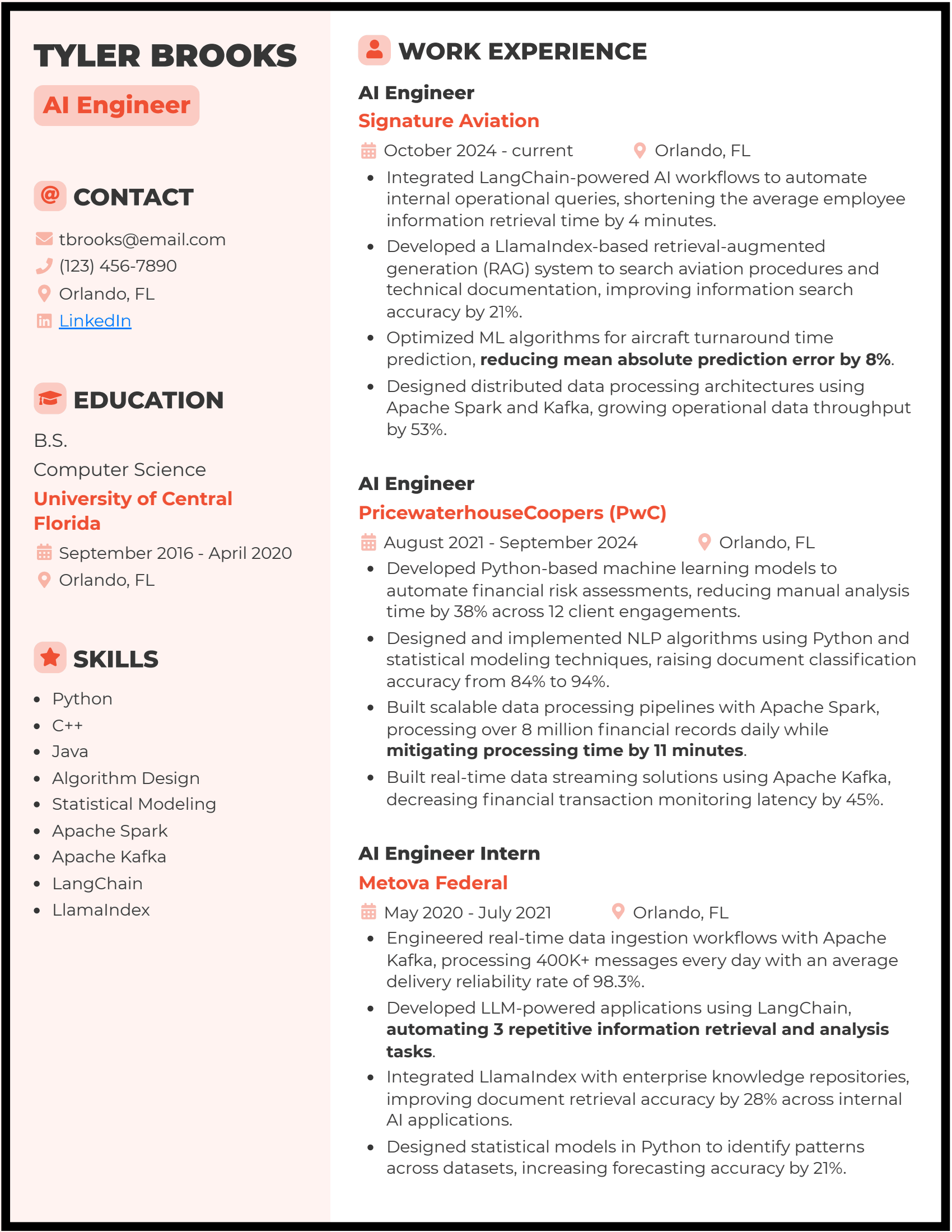
An effective AI engineer resume demonstrates strong software engineering fundamentals paired with practical experience productionizing generative AI models.
Hiring managers evaluate candidates based on their proficiency with core machine learning frameworks (PyTorch, TensorFlow), and vector search orchestration (Pinecone, ChromaDB, LangChain).
To capture top-tier engineering roles, your resume must highlight quantifiable production impact. This guide will walk you through the best practices for making an AI engineer resume and tools like a resume maker and a free AI cover letter builder to help you tell your story with strength and clarity.
What you’ll get:
- ↪ Five resume examples tailored for AI engineering professionals
- ↪ How to approach resume formatting to highlight strengths
- ↪ Practical ways to position yourself as a strong candidate and get hired faster
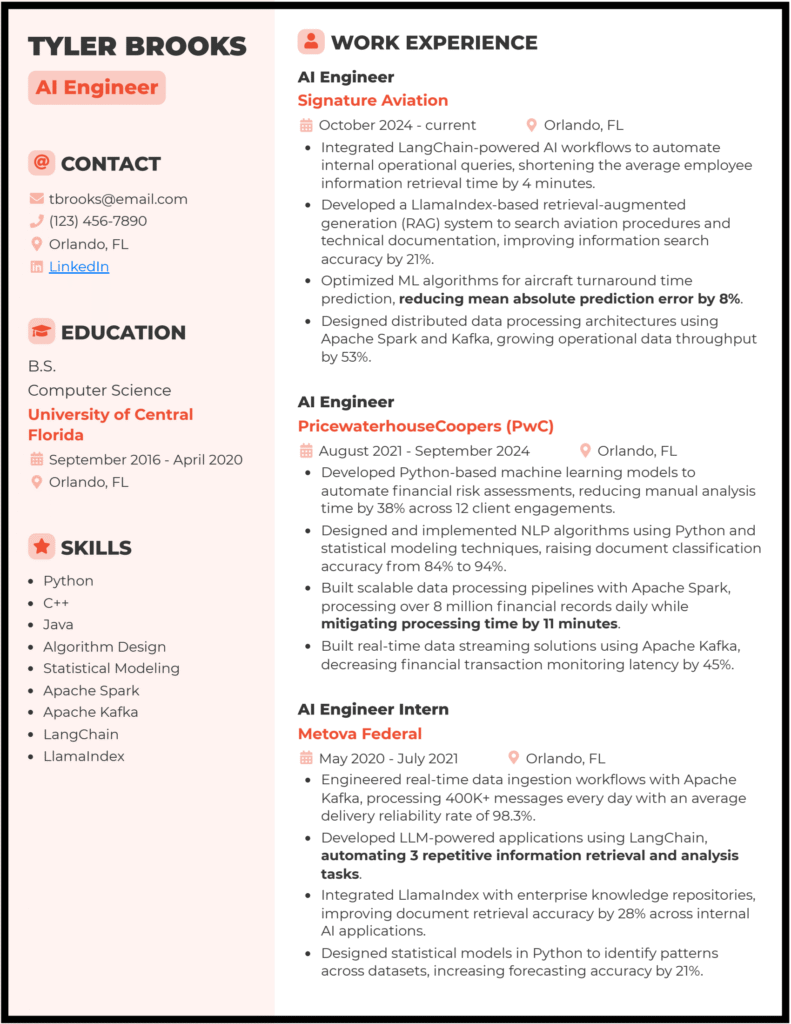
Why this resume works
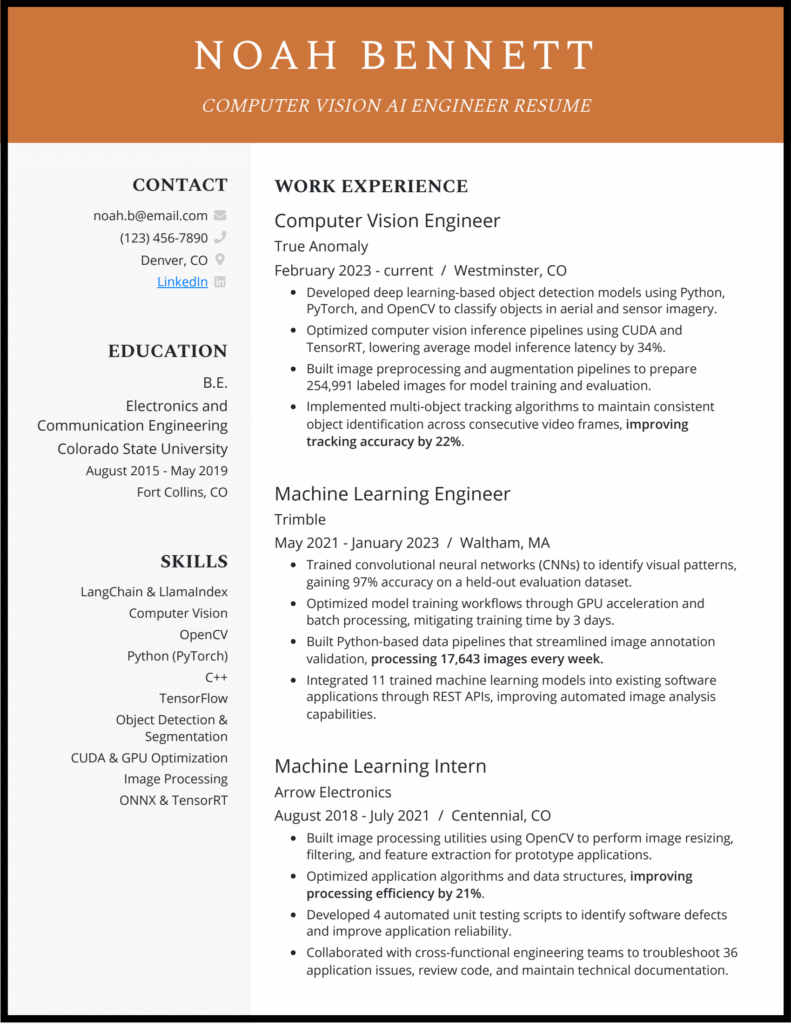
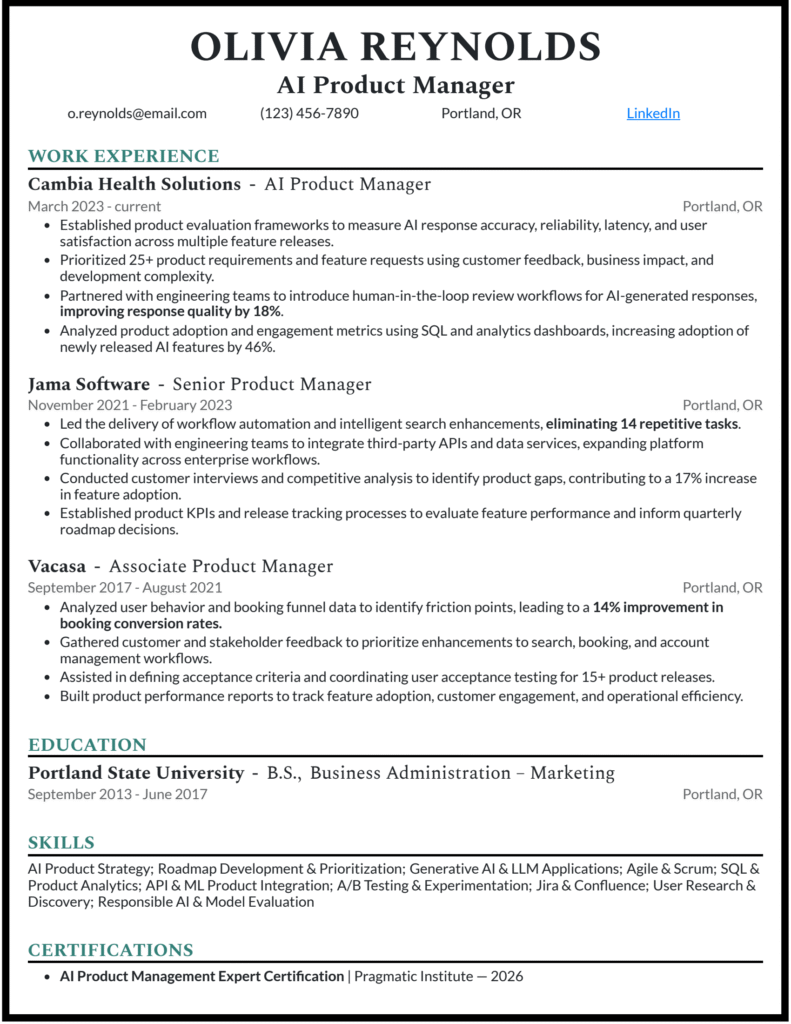
- Instead of burying skills in generic summary paragraphs, this structure immediately showcases your core AI competencies in categorizing foundational frameworks and MLOps tools into a clean, recruiter-friendly grid.
- Our clean design guarantees seamless parsing of your AI engineer resume across all major ATS platforms.
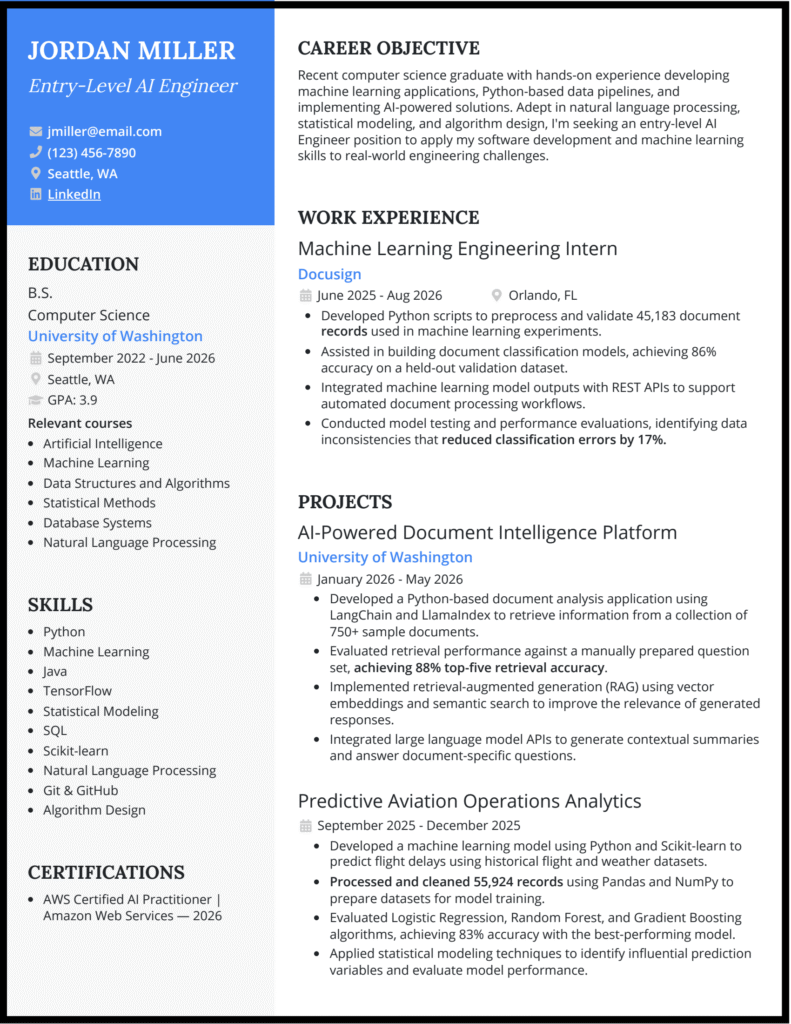
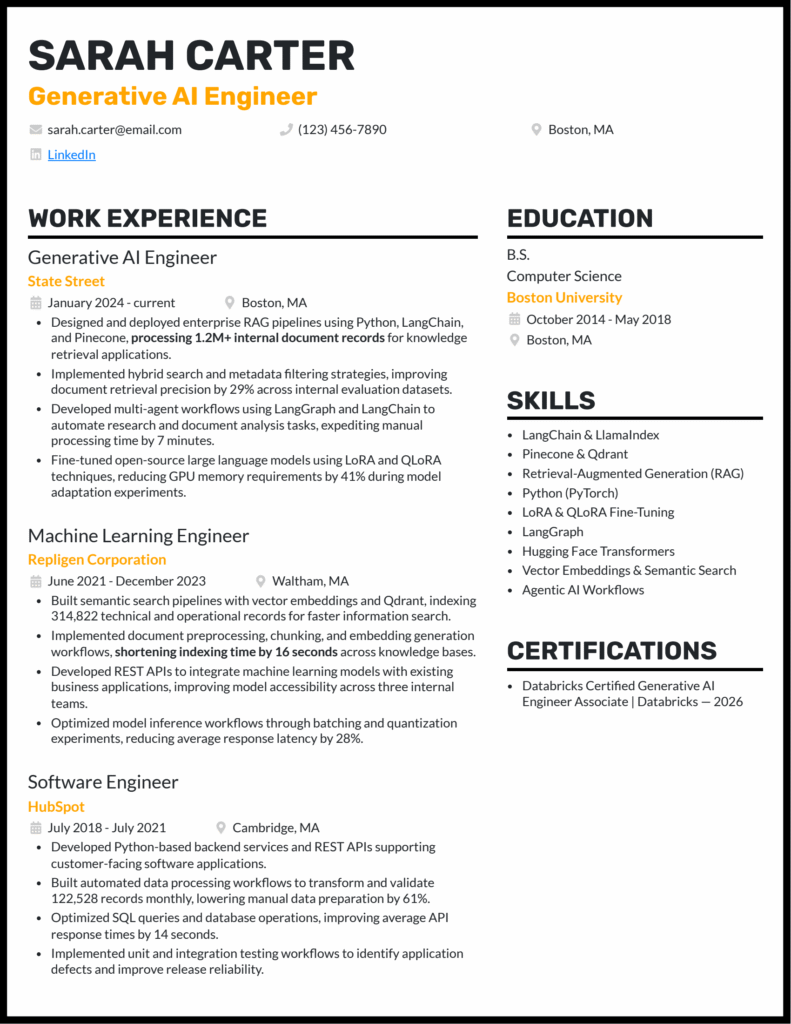
Related resume examples
How to Write an AI Engineer Resume

Writing a resume for an AI engineer position requires walking a fine line. On one hand, hiring managers want to see heavy-hitting software engineering fundamentals, clean code architecture, API design, and system scalability.
On the other hand, they want proof that you actually know how to fine-tune models, handle embeddings, and manage LLM latency without blowing up infrastructure costs. Striking that balance means ditching generic tech buzzwords and focusing entirely on high-impact proof of work.
Summary
An effective AI engineer resume highlights core machine learning frameworks, LLM tools, and vector databases while proving business impact. To win top roles, emphasize quantifiable metrics, such as latency reduction, API cost savings, retrieval accuracy, and production code deployments.
Here are some key strategies to focus on:
- Use a flexible format: Consider the hybrid resume format as a balanced option, or use the functional format to emphasize strengths, though it can be less effective with ATS screening.
- Highlight transferable skills: Think about how your previous roles and what you learned during your break reflect your core skills and support your career goals in the job you want now.
- Show impact in past roles: Instead of just listing responsibilities, point to results. Use numbers when you can. Include metrics that you see expected in the job posting. Eg: For a marketing role, if they expect you to improve ROI, make any mention of when you personally made it happen in the past!
- Include relevant activities from your break: Volunteer work, part-time roles, certifications, and online courses all count. These show initiative and growth.
- Stay honest: Don’t try to hide the break, explain it briefly if needed, and don’t over explain it. Then focus the rest of your resume on what you bring to the table today.

Contact header & profile details checklist
Your contact header needs to get straight to the point. Recruiters and engineering leads spend seconds scanning this section, so keep the clutter out.
- Full Name: Make it your largest text element at the top.
- City & State: Skip the full street address. Remote flexibility or local market alignment is all recruiters care about here.
- Professional Email: Clean, simple format. Avoid old handles or quirky naming conventions.
- Phone Number: Include your primary mobile number with the correct country code.
- LinkedIn Profile: Ensure your headline reflects your current focus (e.g., AI Engineer | LLMs & RAG Pipelines).
- GitHub / Portfolio Link: Non-negotiable for AI roles.
Pro-Tip: For an AI engineer, your GitHub link carries more weight than your university degree. Make sure your pinned repositories feature clean README files with architectural diagrams, clear setup instructions, and benchmark results rather than just raw, undocumented Jupyter notebooks.

Use a career summary or objective
Choosing between a summary and an objective depends entirely on where you are in your career trajectory.
When to Use a Resume Summary (10+ Years of Experience)
If you have professional experience shipping code or models to production, lead with a resume summary. This is a 2–3 sentence snapshot highlighting your core technical stack, years of experience, and a major quantifiable win.
- Good Example:
- Results-driven AI Engineer with 3+ years of experience designing scalable RAG pipelines and fine-tuning open-source LLMs using PyTorch and LoRA. Reduced inference latency by 42% across production microservices serving 1.2M daily active users.
- Vague Example (Avoid):
- Hardworking AI engineer passionate about artificial intelligence and machine learning. Experienced in Python, models, and building cool tech solutions for modern companies.
When to use a resume objective (freshers & career changers)
If you are breaking into the field from a traditional software engineering background or graduating fresh out of university, use a resume objective. Keep it focused on the specific value you bring and the technical domain you want to target.
- Good Example:
- Computer Science graduate with specialized project work in vector search optimization and local LLM deployment via Ollama. Seeking to leverage strong systems programming and Python skills as an AI Engineer at [Company Name].
- Computer Science graduate with specialized project work in vector search optimization and local LLM deployment via Ollama. Seeking to leverage strong systems programming and Python skills as an AI Engineer at [Company Name].
- Vague Example (Avoid):
- Looking for an entry-level position in AI where I can learn new things and grow with a dynamic company.

Focus on quantifiable experience & system scale
In traditional software development, success is often measured in traffic metrics or uptime. In AI engineering, recruiters look at a different set of numbers: cost, speed, accuracy, and scale.
Instead of stating that you “built a chatbot,” show how you optimized token usage, cut API costs, or improved retrieval accuracy.
Before/After Bullet Point Transformations:
- RAG Pipelines
- Before: Built a retrieval-augmented generation pipeline using vector databases.
- After: Architected a hybrid search RAG pipeline using Pinecone and BM25, improving context relevance (Recall@5) by 28% and reducing hallucination rates in customer support responses.
- LoRA Fine-Tuning
- Before: Fine-tuned open-source models for custom text generation tasks.
- After: Fine-tuned Llama-3-8B using QLoRA on domain-specific datasets, cutting GPU memory overhead by 35% while maintaining a 94% task alignment score.
- Latency Reduction
- Before: Optimized model inference speeds for production endpoints.
- After: Implemented vLLM tensor parallelism andPagedAttention, slashing time-to-first-token (TTFT) latency from 850ms to 210ms under high concurrency loads.

Structure your technical kkills for ATS & recruiters
Don’t hide your tech stack in paragraph form. Organize your skills into clean, scannable categories so Applicant Tracking Systems (ATS) and human engineering managers can instantly parse your toolkit.
- Generative AI & LLMs: LangChain, LlamaIndex, vLLM, Hugging Face Transformers, Ollama, OpenAI API, Anthropic Claude API
- Vector Databases: Pinecone, ChromaDB, Milvus, FAISS, Qdrant
- Core ML Frameworks: PyTorch, TensorFlow, Scikit-Learn, NumPy, Pandas
- MLOps & Infrastructure: Docker, Kubernetes, MLflow, Weights & Biases, FastAPI, AWS (SageMaker, Lambda)
- Languages & Cloud: Python, TypeScript, SQL, C++, Git, Linux

Format your technical education and credentials properly
Your education section validates your foundational understanding of computer science, mathematics, and statistics. Keep it straightforward. List your degree, major, university, and graduation year (or expected graduation date).
If you are a recent graduate or transitioning into AI, include a targeted “Relevant Coursework” line to show recruiters you have formal exposure to core concepts.
- Degree Majors to Highlight: Computer Science, Data Science, Mathematics, Statistics, Software Engineering, Electrical Engineering.
- Relevant Coursework to Include: Deep Learning, Natural Language Processing (NLP), Computer Vision, Linear Algebra, Probability & Stochastic Processes, Algorithms & Data Structures, Distributed Systems.
Example:
Bachelor of Science in Computer Science
University of Texas at Austin | May 2024
Relevant Coursework: Deep Learning, Natural Language Processing, Linear Algebra & Multivariable Calculus, Distributed Systems, Data Structures & Algorithms
Top AI certifications to list
Certifications won’t replace real-world projects or production experience, but they signal dedication to continuous learning and cloud platform competency. Focus on credentials offered by major cloud providers and recognized AI institutions.
- AWS Certified Machine Learning – Specialty: Validates your ability to build, train, tune, and deploy machine learning models on AWS infrastructure using services like SageMaker.
- Google Cloud Professional ML Engineer: Demonstrates expertise in designing, building, and productionizing ML models within the GCP ecosystem.
- DeepLearning.AI Generative AI Specializations: Proves hands-on mastery of fundamental deep learning, transformer architectures, and LLM fine-tuning concepts (e.g., Generative AI with Large Language Models).
- Microsoft Certified: Azure AI Engineer Associate (AI-102): Focuses on building, managing, and deploying AI solutions leveraging Azure AI services and cognitive APIs.
AI Engineer Resume for Freshers & No Experience
Breaking into AI without formal corporate titles on your resume requires a complete shift in layout strategy. When you don’t have industry experience, your portfolio has to do the heavy lifting.
Project-First Layout Strategy:
Reorder your resume sections to place your technical projects right beneath your contact header and skills.
- Contact Header
- Technical Skills
- Featured AI Projects (In place of professional experience)
- Education
- Certifications / Open Source Contributions
How to begin writing your no experience AI engineer resume
Prioritize GitHub & Open-Source Projects Above Work History: If your professional background is in retail, administration, or unrelated fields, push your software and AI projects to the top half of the first page. That is what hiring managers want to see.
Document Architecture & Performance Metrics: Even academic or side projects have metrics. Did your model achieve a specific F1-score? Did your local pipeline run under a certain memory constraint? Quantify your results.
Use this template for your project entries:
Local RAG Code Assistant
- Designed and deployed 3 privacy-first local code assistants leveraging Llama-3 running on Ollama and embedded via ChromaDB.
- Implemented custom chunking strategies for codebases, improving semantic retrieval accuracy and cutting irrelevant context tokens by 40%.
- Built a lightweight asynchronous FastAPI backend wrapped in a Streamlit UI, allowing 4 developers to query local repositories with sub-second response times.
What Reddit & Tech Communities Say About AI Engineer Resumes
Curating advice from engineering leads and hiring managers across tech communities like r/MachineLearning and r/cscareerquestions reveals a clear pattern: high-signal resumes win over high-buzzword resumes every time.
Community Insights
- Emphasize Engineering Standards Over Just Notebooks: The most common criticism from hiring managers on Reddit is candidate resumes filled with Jupyter notebook experiments that never made it past local machines. Show that you know how to productionize models: containerize applications with Docker/Kubernetes, handle token rate limits, lower API costs, and wrap inference logic in clean REST/gRPC APIs (e.g., FastAPI).
- Don’t Over-Hype High-Level Frameworks: Listing tools like LangChain or LlamaIndex is fine, but relying solely on them can signal shallow knowledge. Engineering managers want to know you understand the underlying abstractions, embedding spaces, vector similarity calculations, attention mechanisms, and prompt engineering principles, rather than just wrapping an API call in a third-party framework.
- Keep It to One Page (Unless Senior): Unless you have 7+ years of experience leading AI research or engineering teams, keep your resume strictly to one page. Recruiters and technical screeners prioritize concise, dense technical clarity. Strip out verbose descriptions of everyday duties and let your impact metrics and projects speak for themselves.
AI Engineer Resume FAQs

Focus on production impact over generic buzzwords. Structure your resume with a clean contact header, a categorized technical skills grid, and quantifiable bullet points.
Highlight system scale, cost optimization, latency reduction, and retrieval accuracy using metrics rather than just listing model names and frameworks.
Prioritize your GitHub link. Engineering leads inspect source code, repository structure, and commit history over visual sites.
Ensure pinned repositories feature detailed README.md files complete with architectural diagrams, setup instructions, and benchmark evaluation results like latency and accuracy metrics.
ML Engineer resumes emphasize model training, statistical modeling, feature engineering, and core frameworks like PyTorch or TensorFlow.
AI Engineer resumes focus on integrating, orchestrating, and productionizing foundation models using RAG architectures, vector databases, LLM APIs, latency optimization, and MLOps tooling.
Only if paired with production code. A standalone .ipynb file signals an experimental project. To impress screeners, modularize your code into standard Python files (.py), include a containerized setup (Dockerfile), and deploy a live demo or API endpoint using FastAPI or Streamlit.
Keep it to one page unless you have extensive experience. Engineering managers scan for high-signal impact metrics, tech stacks, and production wins within seconds. Reserve two-page layouts strictly for senior roles, staff engineers, or candidates with extensive publication and patent histories.

Stephen is the co-founder and CEO of BeamJobs. Frustrated with the challenges he'd faced in his own job search, he left the corporate world to start BeamJobs with his brother. Drawing on firsthand experience with hiring and getting hired as technical talent, he started BeamJobs in 2020 to help qualified job seekers land interviews with less stress. Since then, more than 4 million people have built their resumes and cover letters on BeamJobs. Stephen's insights have been featured in notable outlets, such as Fast Company, Business Insider, Yahoo Finance, MIT, and Zapier. Learn more about Stephen.