



Today’s engineering job market expects your mechanical engineering resume to highlight technical skills, problem-solving, and impact.
Regardless of whether you develop products, optimize systems, design thermal solutions, or analyze structures, both hiring managers and applicant tracking systems (ATS) prefer resumes that connect your engineering skills to tangible results.
This guide gives you 11 mechanical engineer resume examples to help you:
- ✅Show your experience with tools such as SolidWorks, MATLAB, and FEA software
- ✅Share achievements, such as cutting costs, improving design efficiency, or collaborating with cross-functional teams
- ✅Create a resume that matches job descriptions and passes ATS requirements to meet employer expectations
- ✅Improve your resume writing strategy with examples that define and present your value
- ✅Write a strong cover letter that supports your resume by explaining your skills, experience, and impact

What you should do in your resume
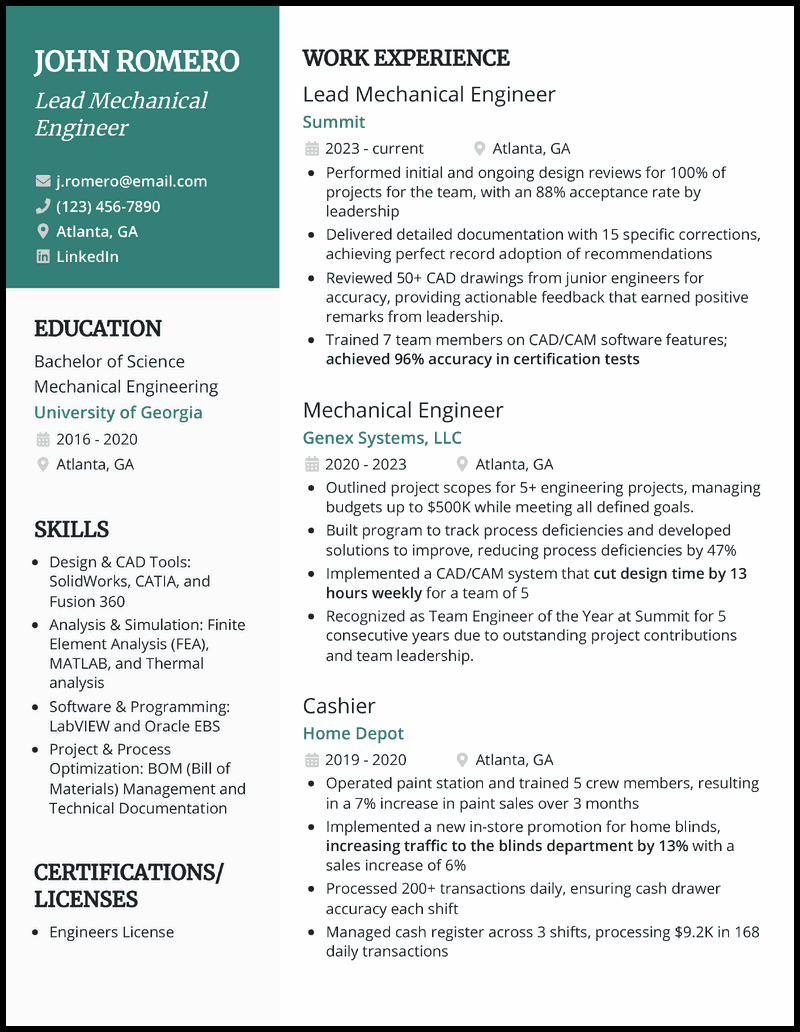
- State your academic background, such as a Bachelor of Science (BSc) in mechanical engineering, to establish the context.
- Highlight your skills in design (CATIA), analysis (MATLAB), and technical documentation by describing how you applied each in specific projects within your work experience descriptions.
- List licensure or certification in your mechanical engineer resume, such as an Engineer’s License, to demonstrate your current knowledge of the job and industry trends.
What you should do in your resume
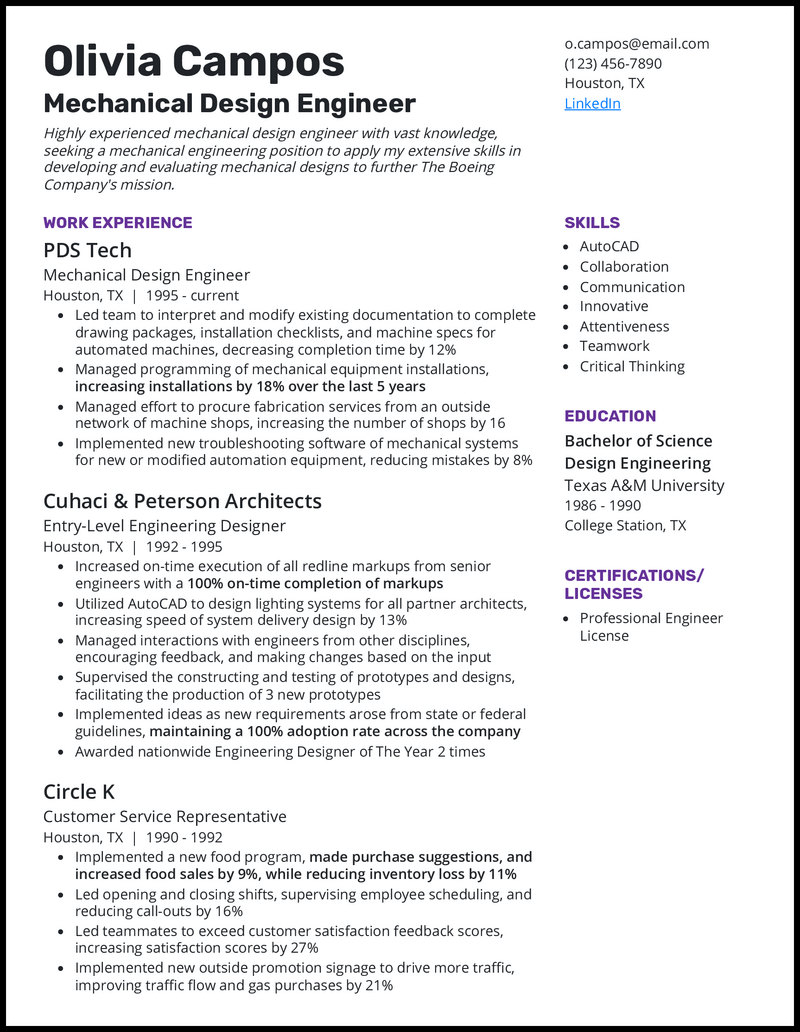
- Prioritize your education. For example, having a Bachelor of Science in Design Engineering demonstrates that you possess the foundational knowledge necessary to thrive in the industry.
- Next, build your work history on relevant experiences, such as an entry-level engineering designer role, to match recruiter and employer expectations.
- Additionally, if you have one, an industry certification, such as a Professional Engineer License, is an excellent way to give your mechanical design engineer resume a head start over candidates who do not have such credentials.

What you should do in your resume
- If you have 10+ years of experience, give an overview of your long, successful career in a resume summary.
- Remember to highlight your achievements, impact, and relevant hard skills, and incorporate some of the keywords from the job description and industry-specific terms into your senior mechanical engineer resume.
- Finally, include a license, such as a Professional Engineer, to say that you’re not an average candidate but someone who fits the role, company, and industry.

What you should do in your resume
- Lead your charge with a career objective that presents your passion, transferable skills, and the dream to be a mechanical engineer.
- Mention the degree program you’re pursuing (Bachelor of Science, mechanical engineering), any relevant courses, and awards that speak to your dedication.
- Finally, list any projects, your contribution, and outcomes to emphasize your untapped potential and what you can do in the real world of employment.
What you should do in your resume
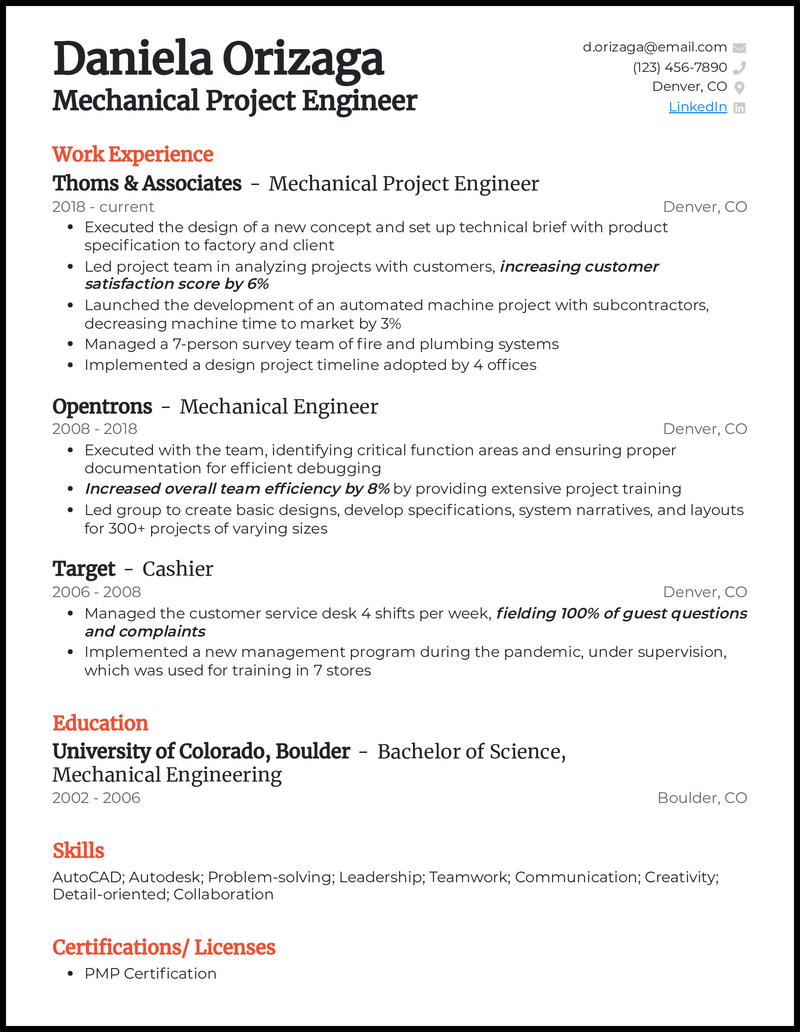
- Show your transition from assisting seniors to managing design schedules and leading projects.
- State your PMP and PE certifications as evidence that you manage technical details and regulations.
- Cite exact results where you cut costs, finished faster, or solved technical issues.
Why this resume works
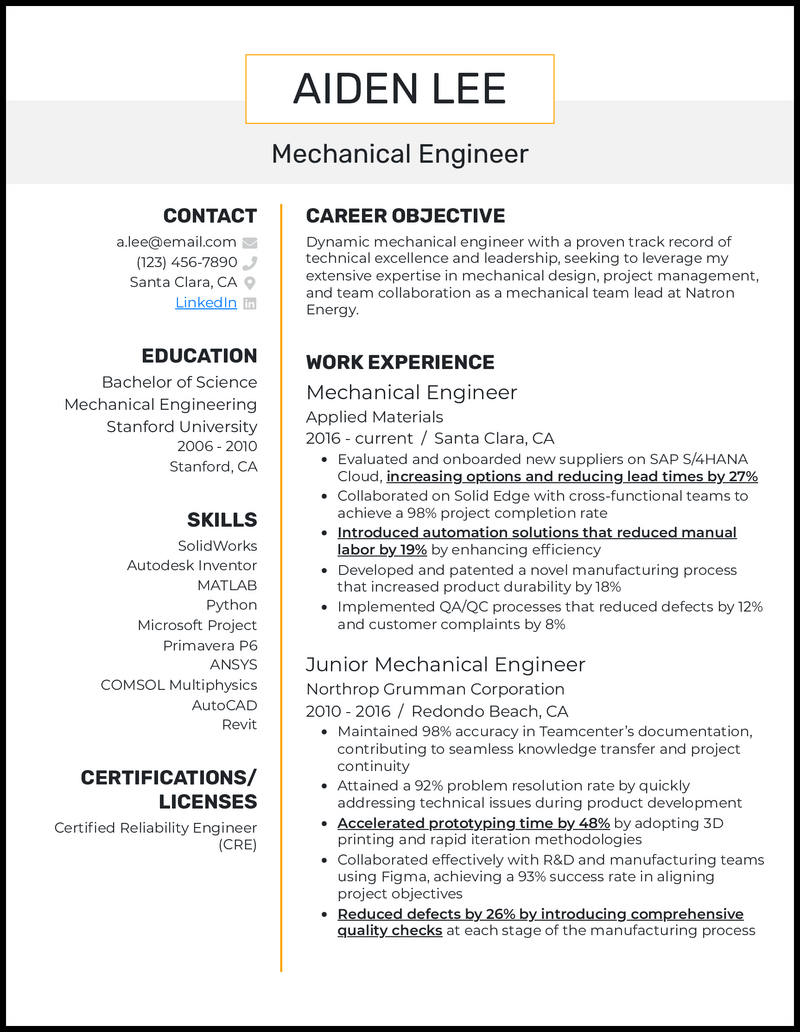
- While a great career objective will make a great first impression, you’ll need more to convince a potential employer to give you the job. You can take cues from this experienced mechanical engineer resume by focusing on the key achievements from your previous roles.
Why this resume works
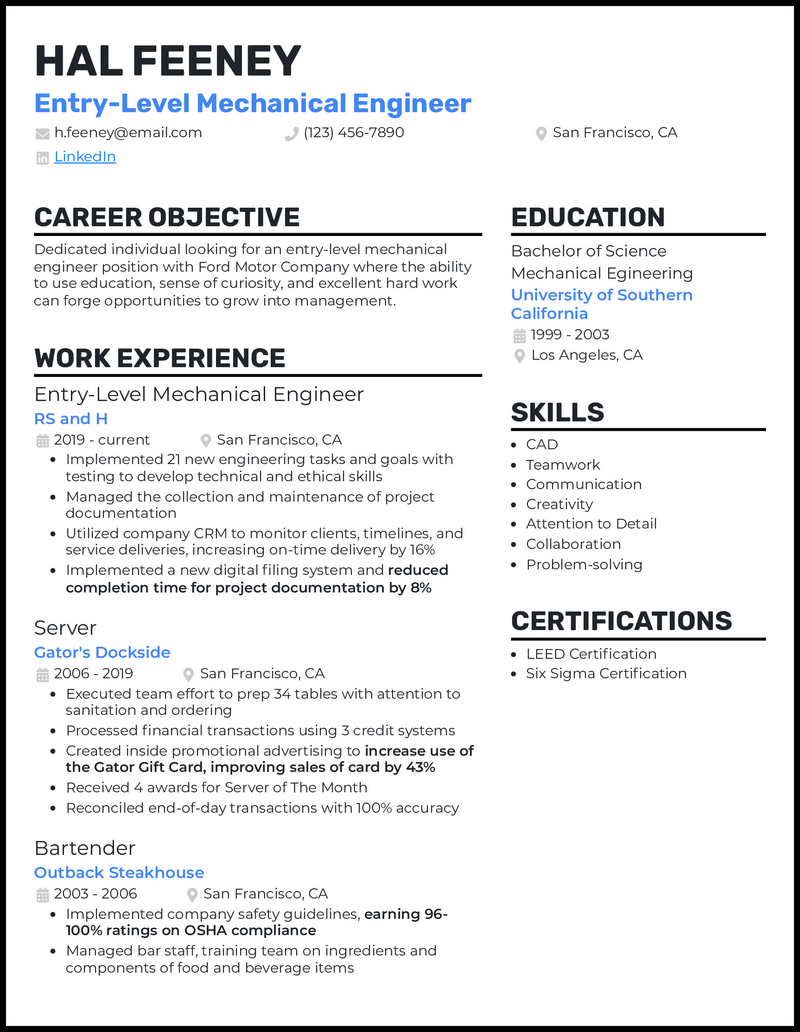
- Whether this is your first mechanical engineer position or not, your entry-level mechanical engineer resume should reflect your experience that focuses on transferable skills.
- And hey, for an entry-level position, don’t hesitate to include soft skills like time management or communication (as opposed to hard skills you might not yet possess, like AutoCAD or Autodesk) on your resume and mechanical engineer cover letter.
See more entry-level mechanical engineer resumes >

Why this resume works
- To gain the extra edge when breaking into mechanical engineering, create a resume from LinkedIn with customization in mind, thinking about the specific role for which you’re applying.
- You can do this in four places: your cover letter, your resume objective, the skills section, and your work experience.
See more mechanical engineer internship resumes >

Why this resume works
- A mention of your Professional Engineer (PE) license goes a long way in cranking up your credibility. Tucking that credential, along with other heavy hitters like Certified Manufacturing Engineer and Certified Quality Engineer certifications, right in your assistant mechanical engineer resume’s CERTIFICATIONS section is a solid move to show your devotion to career growth and rise above the crowd.

Why this resume works
- Choosing a great resume template for your mechanical service engineer resume can help you spotlight key points that make you ideal for the particular job at hand, such as your qualifying education or certification level.
- Licenses and official certifications such as CSEP and CMfgE are invaluable selling points, so don’t leave them out!
See more mechanical service engineer resumes >
Why this resume works
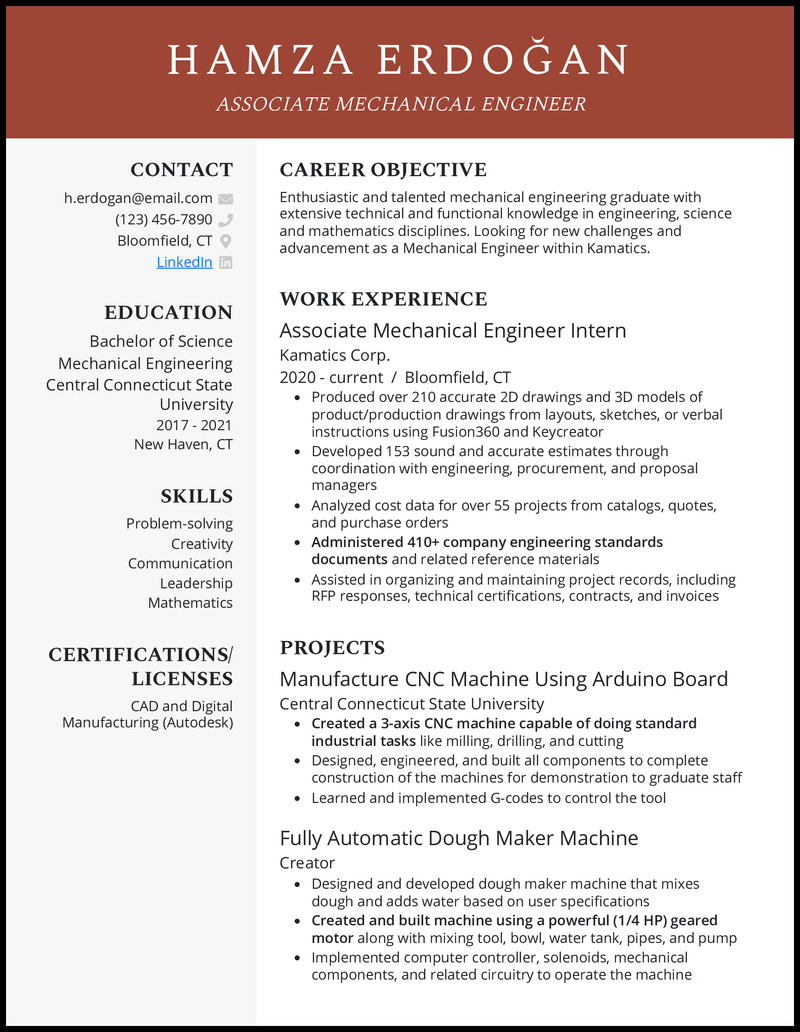
- Use quantifiable metrics instead of leaving things vague: Are there some eye-catching accomplishments or projects you’ve racked up and can include in your associate mechanical engineer resume?
- While polishing up your metrics, build a clear impressive resume skills section with the technical skills that fit the role. Strong resumes quantify achievements and include a dedicated technical skills section.
How to Write a Mechanical Engineer Resume

Summary
Elevate your mechanical engineer resume by emphasizing measurable achievements, technical expertise, and industry-relevant skills to capture recruiters’ attention and land interviews.
A standout mechanical engineer resume should showcase your technical prowess, innovative solutions to real-world problems, and relevant work experiences. From the start, you must build value and give recruiters a reason to consider you for the job.
If you’re wondering where to begin, check out these resume examples of people who won jobs in 2026 and get inspired to write a resume that gets you the job.

Start with the right resume format
Recruiters and applicant tracking systems (ATS) favor the proper resume format. Use clean formatting, clear section headers, and enough white space so they can quickly find the most relevant information.
Go with the reverse chronological format and give your most recent/relevant role the highlight it deserves. It’s the best design because it shows your career story, allows recruiters to scan your resume, and find the most important things without wasting time.
It’s also helpful to use a resume template that has all the important sections carved out. Then, you just have to fill in the essential information.
What to include:
- Contact information
- Professional summary or objective
- Work experience
- Projects (for beginners)
- Skills section (hard and soft skills)
- Education and certifications
Pro Tip: Keep everything on one page if you’re a new grad and only cross to two pages if you’re experienced.

Summarize your qualifications
Your career profile is what hiring managers see first. Make them want to keep reading to the end and stand a chance for an interview.
Use a career objective if you’re new to the field or switching industries.
If you have solid industry experience, use a resume summary to showcase your top accomplishments.
Career objective example (Entry-level)
Recent engineering graduate with hands-on experience designing 3D mechanical systems in SolidWorks for university projects and a summer internship at GreenTech Motors. Solid understanding of thermodynamics, materials science, and FEA simulations. Passionate about sustainable product design and eager to contribute to Tesla’s innovation-driven team.
Resume summary example (Senior-level)
Senior mechanical engineer with a decade of leadership experience in HVAC systems design and product lifecycle management. Led cost-saving redesigns that reduced material waste by 28% at GE Appliances. Proficient in AutoCAD, ANSYS, and DFMEA. Committed to continuous innovation, lean principles, and mentoring junior engineers to elevate team performance.

Add numbers to demonstrate impact in your experience
Your work experience, paired with measurable results, showcases your capabilities. But it’s not just your capabilities that matter; you must also highlight your business value using numbers in your job application.
Employers prefer bullets that demonstrate impact instead of only listing responsibilities. When you apply to a specific role, your mechanical engineering resume should highlight technical proficiency, measurable project outcomes, internships, and various projects.
Here are a few bullet point examples based on different experience levels.
Entry-level mechanical engineer:
- Modeled 12 mechanical devices using SolidWorks, improving design-to-prototype speed by 22% during a university-sponsored capstone project.
- Assisted in thermal testing of HVAC systems during internship, contributing to a 12% increase in energy efficiency benchmarks.
Senior mechanical engineer:
- Led a $2M R&D project team of 6 engineers to develop a new valve system, cutting production costs by 22% over two quarters.
- Optimized FEA processes using ANSYS, reducing design time from 10 days to 6 and increasing testing accuracy by 18%.
- Managed vendor quality assurance operations, resulting in a 98% compliance rate and decreasing part rejection rate by 33%.
Pro Tip: Remember that including industry-standard keywords can help resumes pass applicant tracking systems.

Showcase your mechanical engineering skills
Your skills should reflect more of what the employer/company seeks in the job posting. Here, you should emphasize both technical skills and soft skills, including problem solving skills and interpersonal skills.
Key skills for mechanical engineers:
- SolidWorks / AutoCAD / CATIA
- ANSYS / FEA / CFD
- MATLAB / Python for engineering simulations
- GD&T (Geometric Dimensioning & Tolerancing)
- Thermodynamics
- Heat transfer
- Lean Manufacturing
- Root Cause Analysis (RCA)
- Design for Manufacturability (DFM)
- Six Sigma methodologies
Top soft skills for mechanical engineers include adaptability, creativity, communication, teamwork, and desire to learn.
Pro Tip: Don’t just list your skills and hope for the best. Back them up with measurable work experience, and note that common technical skills include CAD software and FEA.

Include relevant education and certifications
While your technical know-how does the heavy lifting, your education and certifications add credibility to your abilities. Include your college, field of study, GPA (3.5 and above), and relevant coursework if you’re a beginner.
Having coursework shows you have deep knowledge in specific areas, such as thermodynamics, mechanical and thermal devices, fluid mechanics, etc.
Education Section
B.S. in Mechanical Engineering
University of Illinois
Urbana-Champaign, IL
2020-2024
GPA: 3.7
Relevant coursework: Heat Transfer, Fluid Mechanics, Mechanical Design, Control Systems
Keep in mind that mechanical resumes should list relevant education and certifications like FE or PE licenses.
Here are some core certifications for mechanical engineers:
- Certified SolidWorks Professional (CSWP)
- Lean Six Sigma Green Belt
- Fundamentals of Engineering (FE) – Passed, NCEES
- Certified Manufacturing Engineer (CMfgE) – SME
- Project Management Professional (PMP) – PMI
- Autodesk Certified Professional – AutoCAD
- Certified Reliability Engineer (CRE) – ASQ
Average Salaries for Mechanical Engineers Across the US
According to the latest data from U.S. Department of Labor, Employment and Training Administration (USDOL/ETA) and as listed on O*NET Resource Center, the following are the average national and 10-state annual salaries for engineer as of 2024, October 16 and beyond.
| National/State | Average Annual Salary ($) |
| National | $97,128 |
| Georgia | $84,080 |
| Ohio | $92,360 |
| Florida | $92,810 |
| North Carolina | $95,490 |
| Pennsylvania | $97,340 |
| New York | $97,410 |
| MIchigan | $98,760 |
| Illinois | $99,420 |
| Texas | $103,190 |
| California | $122,550 |
Related resume guides
Land your next job with our AI-powered, user-friendly tool.
Gut the guesswork in your job hunt. Upload your existing professional resume to check your score and make improvements. Build a resume with one of our eye-catching, recruiter-friendly resume templates and examples.
• Work in real-time with immediate feedback and tips from our AI-powered experience.
• Leverage thousands of pre-written, job-specific bullet points.
• Edit your resume in-line like a Google Doc or let us walk you through each section at a time.
• Enjoy peace of mind with our money-back guarantee and 5-star customer support.
Mechanical Engineer Resume FAQs

A mechanical engineer’s resume ready to win the job should be results-driven and professionally formatted. Use the reverse chronological format, giving prominence to your recent role and using headings and bullet points to showcase value.
Do your research on the employer beforehand. ATS software ranks resumes based on keywords and phrases. So, keep each section responsive to the needs of the potential employer and tailor your resume to every specific job you apply for.
The reverse chronological format brings out the best in your resume. It prioritizes your expertise, relevant roles, and gives a recruiter/company what they want: a clear career story. Also, ATS can quickly scan and pass your resume if it is aligned to the position you’re aiming.
Keep it one page if you’re a beginner or have limited direct work experience. You can go over a page if you have extensive, impressive work experience and top accomplishments to show.

Stephen is the co-founder and CEO of BeamJobs. Frustrated with the challenges he'd faced in his own job search, he left the corporate world to start BeamJobs with his brother. Drawing on firsthand experience with hiring and getting hired as technical talent, he started BeamJobs in 2020 to help qualified job seekers land interviews with less stress. Since then, more than 4 million people have built their resumes and cover letters on BeamJobs. Stephen's insights have been featured in notable outlets, such as Fast Company, Business Insider, Yahoo Finance, MIT, and Zapier. Learn more about Stephen.