



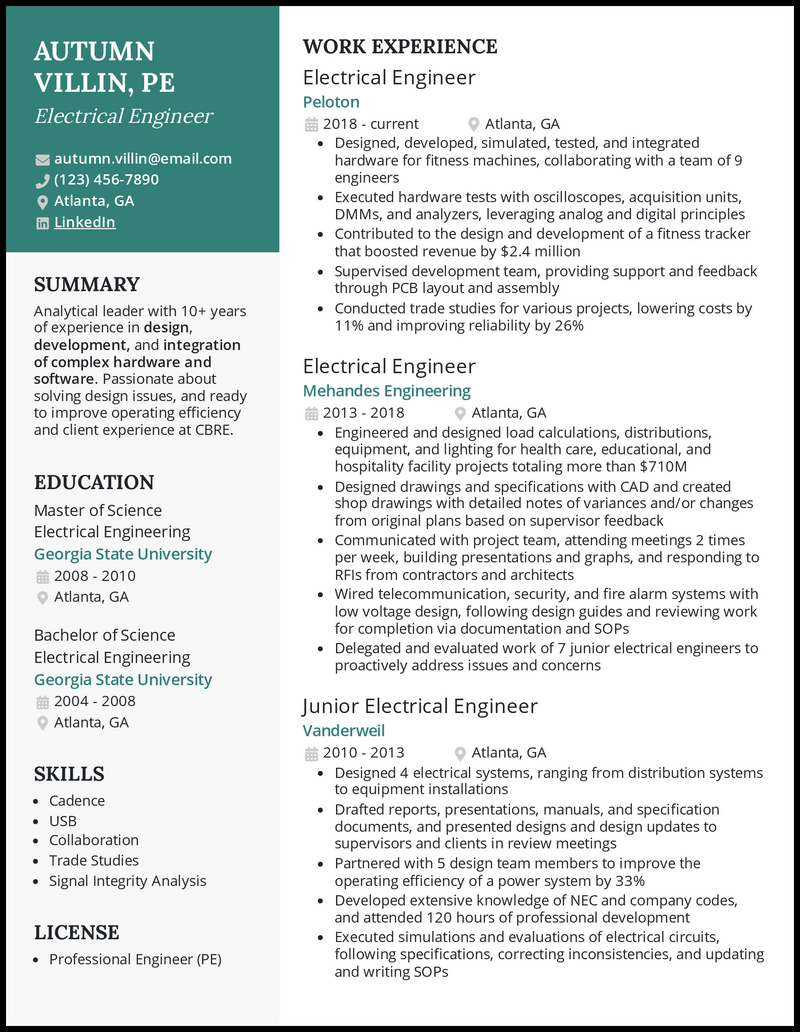
Crafting a standout electrical engineer resume takes more than listing your skills. It’s about building your resume into a clear, compelling story that hiring managers can’t ignore. From tailoring your achievements to writing a cover letter reinforcing your value, every step should showcase why you’re the right fit instead of just another applicant writing your resume.
This guide includes tailored samples for roles and experience levels ranging from intern/entry-level to senior, power, automation, maintenance, substation, field, consultant, and chief electrical engineer positions. If you’re applying for electrical engineering jobs and want an ATS-friendly resume, these examples are built for you.
Here, you’ll find:
- ↪ 16 electrical engineer resume samples
- ↪ How to streamline your job hunt
- ↪ Valuable tips that you’ll want to implement when you start writing your resume
Why this resume works
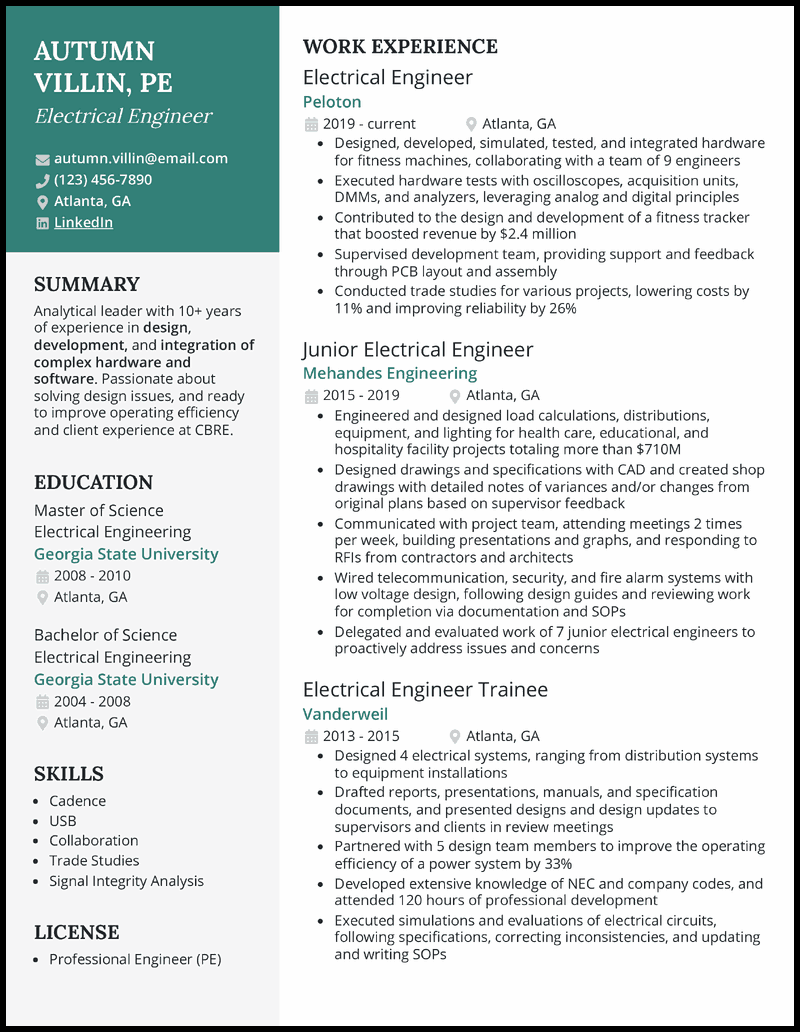
- One quick and easy item vitally important to add to your electrical engineer resume:
- Skills: The subsets of electrical engineering are endless. Make sure you list specific abilities that relate to the job in your resume skills section.
Why this resume works
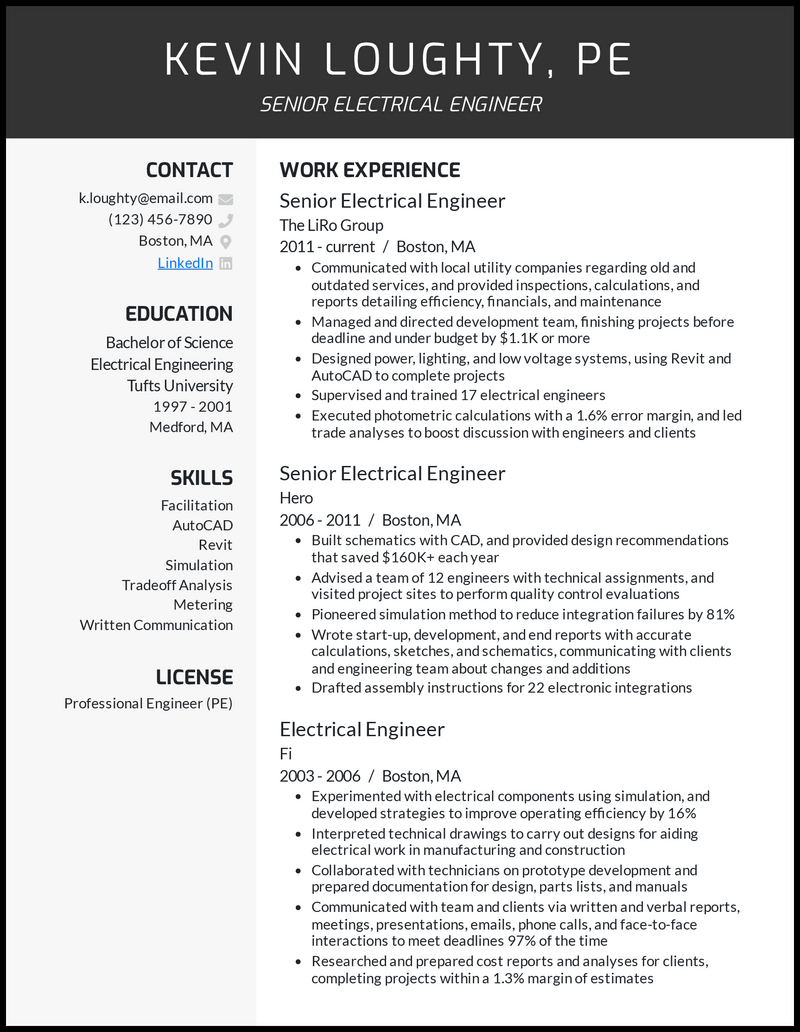
- A senior electrical engineer resume needs to indicate that you’ve had recent (and senior) engineering experience.
- Formatting your resume in reverse-chronological order will show that you’ve got what it takes to lead a technical team.
See more senior electrical engineer resumes>

Why this resume works
- Don’t underestimate the power of including university projects in an electrical engineer intern resume. Even if it’s only research work or power optimization, include ones that you can quantify.

Why this resume works
- Eager to grab that internship during the final year? Make sure your electrical engineering student resume reflects your passion for electrical innovation.
- Try aligning it to work that you’ve preferably practiced in the past as well, such as designing multi-layer PCBs, testing signal processing, learning circuit designs, or gaining hands-on experience with plc programming.

Why this resume works
- If you’re struggling to keep your electrical automation engineer resume on a single page, adjust the format or use a resume template.
- When using a template, you can rearrange the sections to suit your fancy, and you can adjust the margins and spacing.
See more electrical automation engineer resumes>

Why this resume works
- In whipping up your electrical maintenance engineer resume, make sure to draw attention to your tertiary education, especially bits that closely align with the open role’s requirements.
- Fred, for example, highlights his degree in electrical engineering technology from Oregon Institute of Technology.
Why this resume works
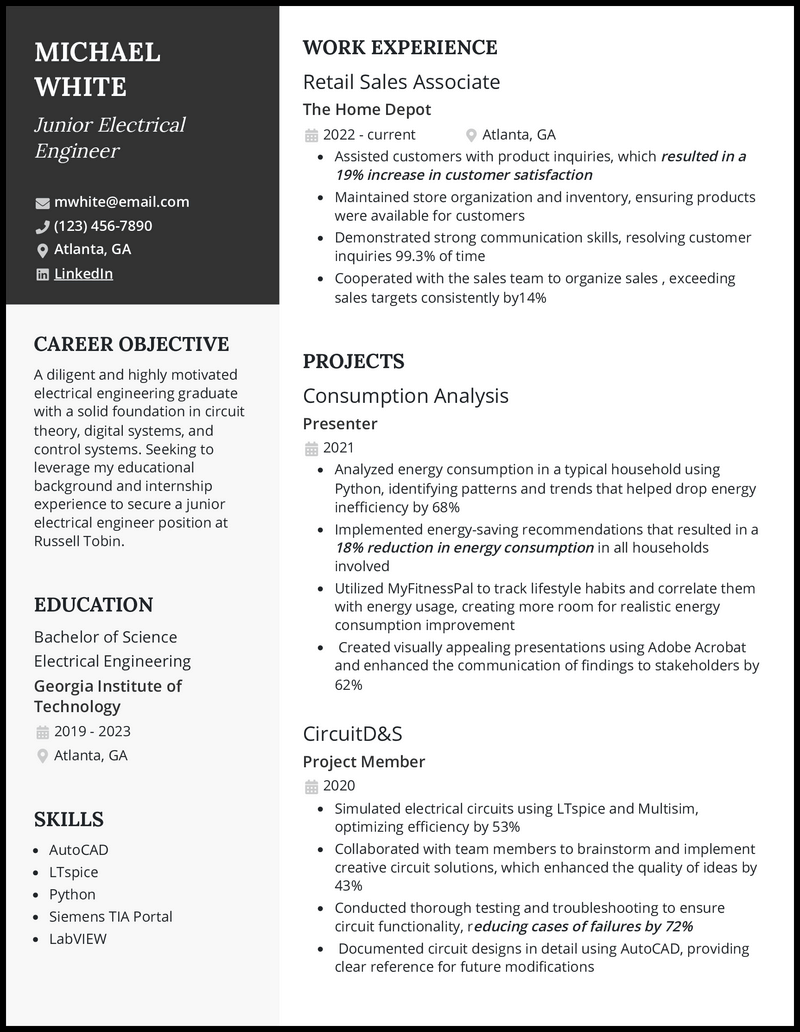
- Michael’s junior electrical engineer resume proves participation in relevant projects such as reducing energy inefficiency in houses and successfully designing electrical circuits.
Why this resume works
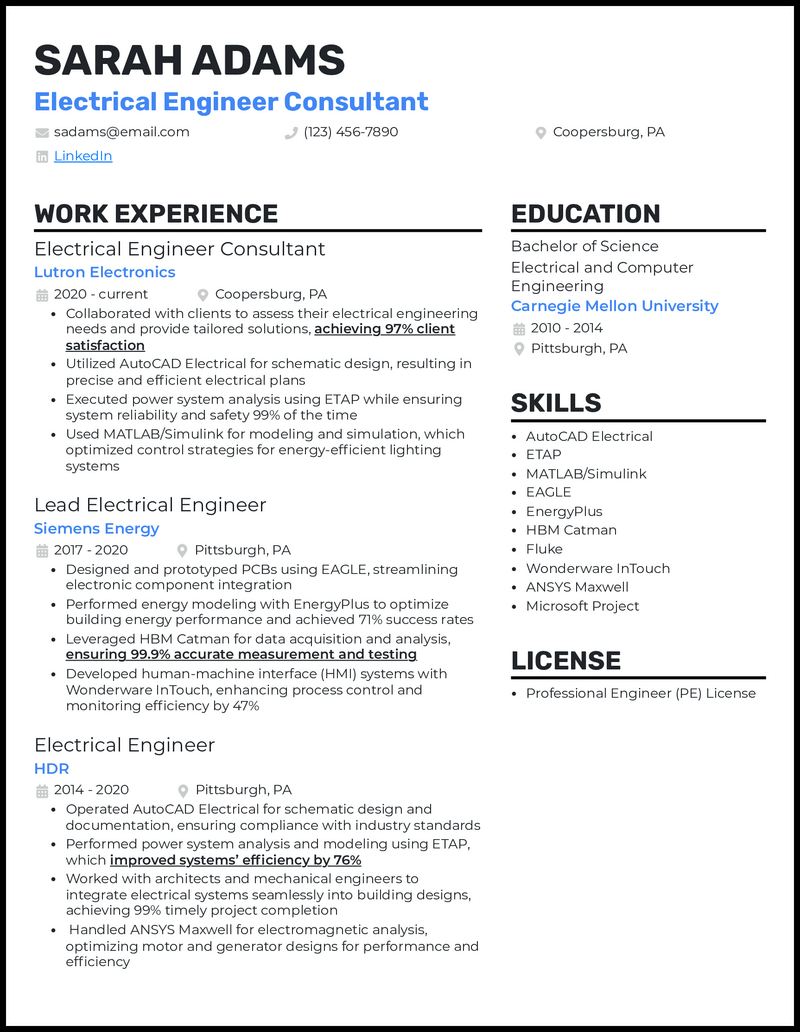
- You want to use this electrical engineer consultant resume as your guide because the applicant showcases how well their projects met industry compliance standards and clients’ needs.
- To ensure the projects come out great; be sure to incorporate this in both your electrical engineer cover letter and resume.

Why this resume works
- A great addition to any electrical substation engineer resume is a Certified Quality Engineer (CQE) certificate. Including it demonstrates your dedication to quality control and process improvement. Substation roles may also value experience with protection coordination.

Why this resume works
- Even for a subordinate role, having a credible document like a Professional Engineering License can do wonders for your assistant electrical engineer resume.
- It shows your commitment to staying updated with the latest industry trends through continuous learning and proves you’re prepared to contribute actively at a higher level.

Why this resume works
- Sometimes less is more, and an electrical substation engineer resume is no different. Remember, if you have shorter bullet points, don’t unnecessarily drag things out, especially when describing work on substations, where concise, high-impact details read best.
- Instead, use a template that helps you create a compact design while being aesthetically pleasing.

Why this resume works
- No one can start wiring like an expert on their first day, so make sure your electrical field engineer resume speaks volumes about your career growth.
- From being an electrical apprentice to becoming an electrical controls technician and completing repairs yourself, show how and what you’ve learned over the years.
Why this resume works
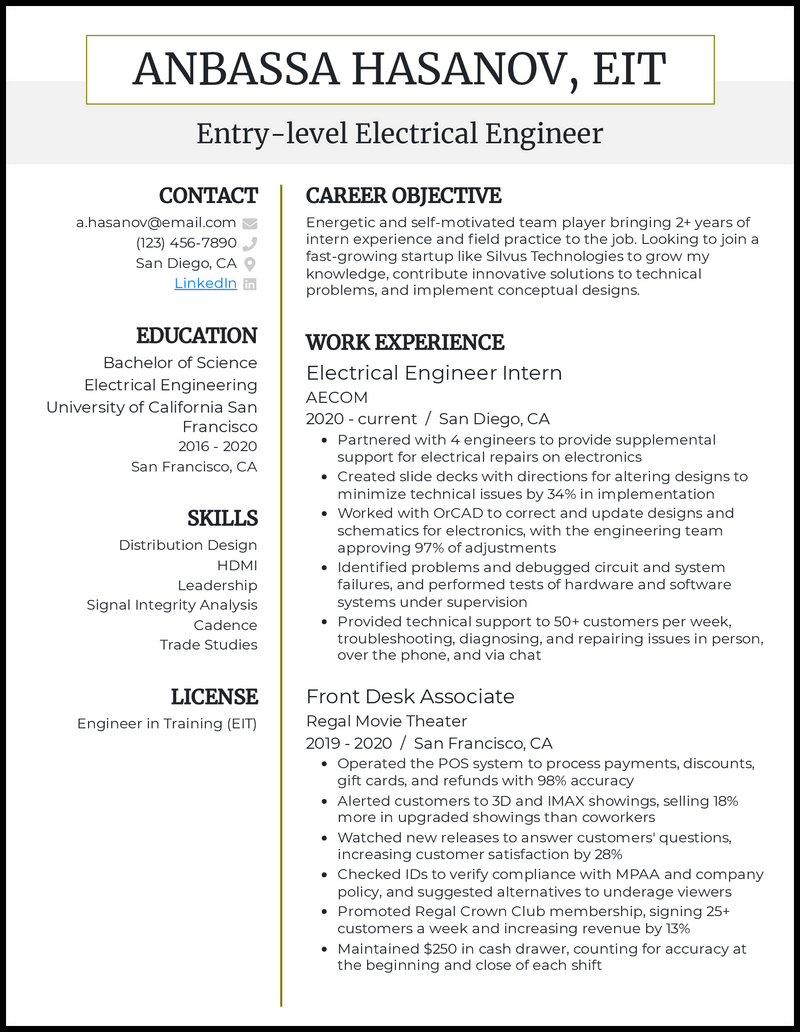
- There’s plenty of room for advancement in the field of electrical engineering, but first you’ve got to get your foot in the door. Your entry-level electrical engineer resume is your ticket into the profession.
- Take advantage of the resume objective, which can showcase your enthusiasm, qualifications, and goals for the job.
See more entry-level electrical engineer resumes>
Why this resume works
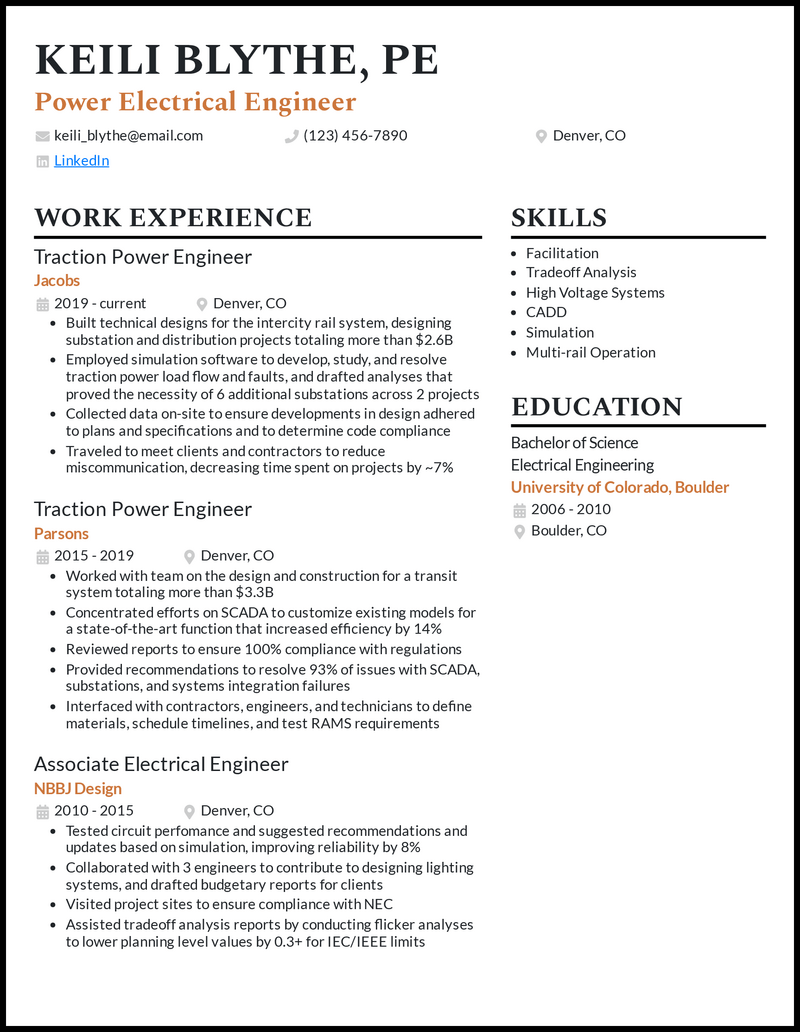
- As a power electrical engineer, you likely have many skills that aren’t directly relevant to other electrical engineering jobs. However, that doesn’t mean you shouldn’t include what you know on your power electrical engineer resume.
See more power electrical engineer resumes>

Why this resume works
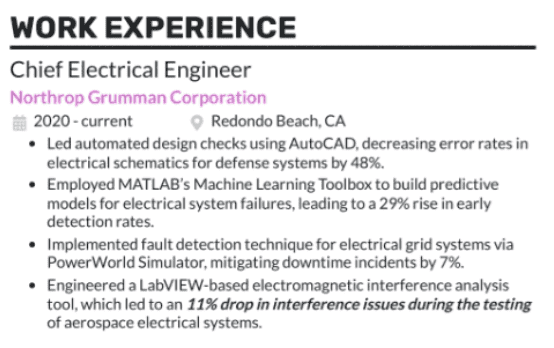
- Enrich your chief electrical engineering resume with leadership-based action words like Led, Managed, Implemented, Introduced, etc. Begin each work experience bullet point with these words, show employers the kind of electrifying impacts you made right off the bat, and provide context on how you used various engineering tools.

Why this resume works
- Even if you’re relatively new to the scene, you’ve still got what it takes to blow away the potential employer. The magic formula? Let your license steal the show in the sidebar of your mid-level electrical engineer resume.
How to Write an Electrical Engineer Resume

A strong electrical engineer resume must have a clean, reverse-chronological format that includes contact information, skills, experience, and education.
Focus your electrical engineer resume on your strengths and things that clearly put you as the lead candidate for the job, balancing technical expertise with clear project outcomes.
Summary
Ignite interest with a resume that fuses technical prowess, measurable achievements, and role-specific impact into one powerful document.
Working smarter, faster, safely fixing problems, introducing energy efficient solutions, and bringing relief to industrial and residential places is carved in your DNA as an electrical engineer. While that might be your strongest suit, writing a resume may be where you hit a short circuit for the first time ever.
Translating your accomplishments and technical mastery into an attention-grabbing, concise paragraph-length overview requires more than a complete tool kit; a summary should be concise, no more than a paragraph, and it’s a game of strategy and knowing the must-have elements, when, and how to use it to your advantage.
Whether you want to work in robotics, aviation, steel, or the power sector, we’ll help you write a resume that captures recruiters’ dreams with credibility, impactful achievements, and forward-thinking strategy.
It also helps to have your experienced electrical engineer resume stress specialized wins and credibility in the summary. Likewise, experienced engineers should spotlight the achievements most relevant to the role.
So, plug in and let us be the light to landing your dream job. Care for some inspiration? These hire-ready resume examples reflect what your electrical engineering story reads once we help you do it.
Here’s what we’ll cover:
- Highlighting your most relevant projects
- Picking the best format for your experience level
- Using numbers to show the impact of your work
- Matching keywords to the job description
- Steering clear of common resume mistakes that trip up engineers

Provide key personal information at the top
Essentials first. Include a header with your name and contact information, along with a clear job title. Make sure you also have the following mentioned, and save and send the final resume as a pdf:
- Name
- Official mail address
- Active phone number
- Location (city and state)
- LinkedIn and/or GitHub if relevant

Capture your strengths in a powerful profile summary
With hundreds of applications to review, recruiters can only dedicate limited time to your resume. Use those few seconds by crafting a 2-3 sentence snapshot showcasing your top achievement, skills, and qualifications, and mirror language from electrical engineer job descriptions when it genuinely matches your background.
This should have your:
- Skills
- Top Achievements
- Qualifications
If possible, mirror language from electrical engineer job descriptions when it genuinely matches your background.
You must customize that statement to fit the role requirements. If you don’t have much experience, lead with relevant skills from coursework, internships, volunteering stints, or projects.
If you don’t have much experience, either write a career objective or go with a summary statement if you have the experience and outstanding achievements to back it up, and make sure it highlights specific technical expertise rather than broad claims.
Example of a career objective for an entry-level electrical engineer resume:

Example of a career summary for an electrical engineer resume


Showcase your technical expertise to beat applicant tracking systems
By what you do, you’re familiar with electrical blueprints; they use precise details, clear structure, and are easy to read. That’s exactly how your core competencies should be.
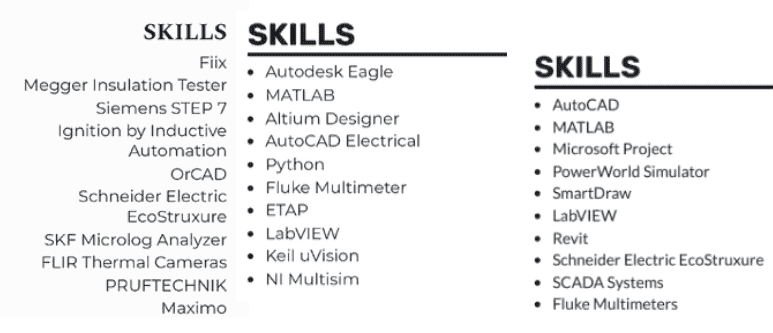
From tools and software to handy skills, open your toolbox for recruiters to know you didn’t come to play.
Lead with hard and soft skills in that order, putting the most job-relevant technical strengths first and matching your skillset as closely as possible to what the employer is looking for in the job posting.
For example, your technical skills can include:
- MATLAB
- AutoCAD
- Industrial equipment
- Control systems
- Complex systems
- Embedded systems development
A strong skills section can also highlight power systems, power systems design, electrical system design, SCADA, and familiarity with electrical components, electrical equipment, or single-line diagrams when they fit the role, while sustainability-focused candidates can add renewable energy or sustainable energy solutions.

Unlock your soft skills
Yes, you’re a technical person, and the quality of your work precedes anything else. However, you won’t work in isolation. You’ll lead teams, and employers also value your ability to:
- Work with cross functional teams
- Collaborate with plumbers, structural engineers, and quality assurance members
- Explain concepts to clients with limited technical knowledge
In that case, you will also want to demonstrate your teamwork, communication, and leadership skills. These can include:
- Problem solving skills
- Critical thinking
- Attention to detail
- Ability to work under high-pressure environments
- Teamwork and cross-functional collaboration

Use action verbs to reinforce your competencies
Cliches and buzzwords do nothing other than bore recruiters. Hiring teams are looking for something unique, and if all you have to show is the usual run-of-the-mill words, you can’t expect your resume to amount to anything much.
Instead, use powerful, active verbs that command attention and underscore what you can do. In every bullet point, position one of the action verbs and let it support your skills and impact. That’s one effective way to get attention.
Here are some good power words for your electrical design engineer resume:
- Optimized
- Led
- Analyzed
- Troubleshot
- Deployed
- Engineered
- Solved
- Upgraded
Verbs like delivered and implementing can also work when they accurately reflect project ownership or system rollouts.

Focus on measurable results and impact
A resume isn’t the place where long stories about your electrical engineering career hold any power. It’s a waste of precious time and space. Turn your attention to project experience and accomplishments, not just job duties.
Electrical engineering projects and other engineering projects are strongest when they show measurable business or operational results.
Focus on measurable results rather than just responsibilities.
Can you quantify what you did in percentages, money, time, and efficiency? String out the hard figures and metrics that highlight your contributions and value. Use past tense for bullet points describing previous roles.
Also, don’t just list duties from a past electrical engineering role. Mention how many emergencies you responded to, systems you optimized, new connections you made, cost savings you drove for existing power grids, timely interventions made, and losses prevented.
Pro Tip: When relevant, include voltage levels for testing, commissioning, or system work. Quantified impact matters even more on large-scale transmission and infrastructure projects.
Short examples work best: Write how you improved energy efficiency by 18%. Another point could show reducing energy consumption in renewable energy systems by 12%.
You can also quantify:
- System efficiency
- Lower energy consumption
- Reduced energy consumption
- Gains in energy efficiency
- Drops in energy consumption
- Stronger customer satisfaction (when the work affected reliability or service)
How to display work experiences:

Include relevant academic background
Like any other technical field, electrical engineering isn’t about your academic conquests but proven craft. Nevertheless, some jobs will require you to be a graduate or hold a mandatory licensure to practice, and an electrical engineering graduate with limited experience should make relevant education especially prominent.
In that case, it’s time to include your degree, diploma, or other formal training.
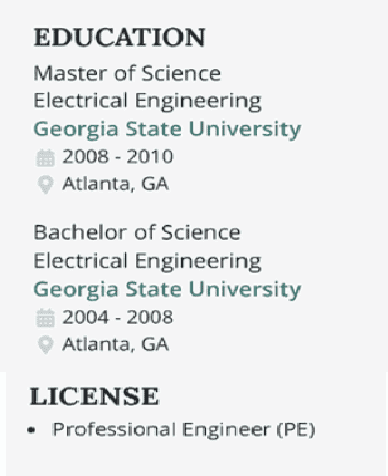
Start with your highest level of education and include your field of study, school’s name, and location; naming your electrical engineering university can strengthen credibility when it’s well recognized or especially relevant.
If you’re a recent graduate, relevant coursework and a GPA of 3.5 and above are acceptable. Electronics engineers and electrical and electronics engineers should also include relevant coursework or academic projects that match their target roles.

Prove credibility with industry-specific certifications
Electrical engineering comes with professional and regulatory standards. To practice, you must meet the mandatory professionalism, safety, and compliance threshold. In other words, including relevant certifications can enhance your resume’s credibility and strengthen its appeal to employers.
It proves that you’ve undergone all the tests and are fit to install safe, sound, compliant, and reliable electrical systems. For regulated or high-responsibility work, relevant credentials may include a professional engineer license or a certified energy manager certification when they match the role.
Example certification for electrical engineer resume:

Tailor your resume to the job description
When applicant tracking systems and recruiters review your resume, they want to feel that you understand the role, the company, and the industry. A generic application can’t come close to that.
Study the job advert, responsibilities, specifications, and visit the company’s official site and try to learn as much about them as possible. Build a careful analysis of the posting before you tailor anything. Applicant tracking systems often scan for keywords and phrasing pulled directly from the posting. Hence, tailoring your resume increases chances of passing ATS.
Tailoring also means adjusting your electrical engineer resume to match the exact electrical engineering position, highlighting troubleshooting skills for analog and digital circuits, or showing a proven track record when those details genuinely fit the role.
If you’re targeting an electrical design engineer opening or work tied to renewable energy projects, foreground those strengths when they’re relevant, and do the same for large scale commercial projects when applicable. When you write your resume, let it reflect the values, principles, tone, expectations, and customs of the place you want to work, including aligning project language to coordination responsibilities when the posting emphasizes them.

Key takeaways
Here’s a quick recap of our discussion:
- Highlight your engineering impact
- Use easy-to-follow language
- Use numbers and data to back up your achievements
- Keep every detail relevant, focused, and free of fluff
- Align your key skills and technical knowledge with the specific role’s wording without copying its verbatim
Average Annual Salaries for Electrical Engineers in the US
As you prepare to send job applications, knowing your work’s worth and not underselling yourself is useful. For electrical engineers in the US, the median annual salary and hourly rates are $106,950 and $51.42, respectively, according to the US Bureau of Labor Statistics data (April, 2/24).
| National/State | Average Annual Salary ($) |
|---|---|
| National | $120,980 |
| Arizona | $124,080 |
| Maryland | $126,270 |
| Iowa | $126,950 |
| Washington | $130,870 |
| Massachusetts | $132,220 |
| Idaho | $132,910 |
| District of Columbia | $138,380 |
| New Hampshire | $138,430 |
| New Mexico | $144,120 |
| California | $148,390 |
Electrical Engineer Resume FAQs

Bullet points for an electrical engineer resume must begin with a unique, compelling action verb, showcase skills, measurable achievements, and underscore impact.
This winning formula ensures that you don’t fall into the trap of narrating your duties, but showing with hard proof what you’ve done and can do if hired.
Example:
Developed CAD drawings and shop plans, incorporating supervisor feedback to enhance project accuracy by 18%.
Yes. A tailored resume is key to easing through the ATS and landing on a recruiter’s desk. You must align your application to the job requirements, including skills, experiences, responsibilities, industry trends, and the employer’s expectations. Plus, you can also share tailored project highlights on LinkedIn when they support your application narrative.
Absolutely! A license is a seal of acknowledgement that you’ve been tested, proven, and passed to practice. It’s a guarantee that you deliver quality work that is compliant with safety codes and professional regulations.
A one-page resume is ideal for early-career electrical engineers. Your measurable achievements and skills don’t need a novel to stand out. You can convince recruiters of your qualifications and abilities in a concise, well-formatted one-page resume.
You can cross to the second page if you are a seasoned professional with an impressive work track record. Even then, you must be careful only to include valuable information.

Stephen is the co-founder and CEO of BeamJobs. Frustrated with the challenges he'd faced in his own job search, he left the corporate world to start BeamJobs with his brother. Drawing on firsthand experience with hiring and getting hired as technical talent, he started BeamJobs in 2020 to help qualified job seekers land interviews with less stress. Since then, more than 4 million people have built their resumes and cover letters on BeamJobs. Stephen's insights have been featured in notable outlets, such as Fast Company, Business Insider, Yahoo Finance, MIT, and Zapier. Learn more about Stephen.